
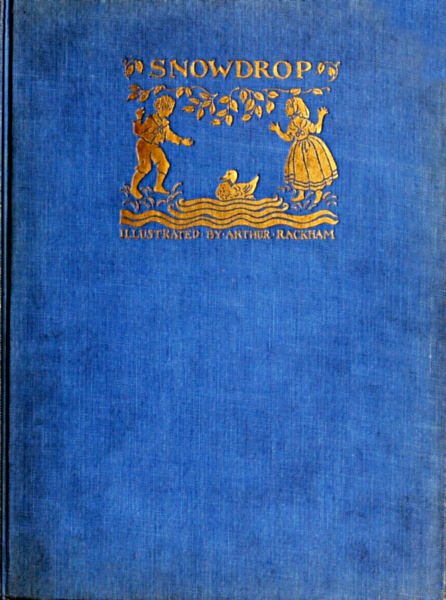
The Project Gutenberg eBook of Snowdrop & Other Tales
Title: Snowdrop & Other Tales
Author: Jacob Grimm
Wilhelm Grimm
Illustrator: Arthur Rackham
Release date: September 10, 2011 [eBook #37381]
Language: English
Credits: Produced by David Edwards, Sam W. and the Online Distributed
Proofreading Team at http://www.pgdp.net (This file was
produced from images generously made available by The
Internet Archive)
SNOWDROP
& OTHER TALES
BY THE
BROTHERS GRIMM
ILLUSTRATED BY
ARTHUR RACKHAM
NEW YORK
E P DUTTON & COMPANY
PUBLISHERS
| Originally published in ‘Grimm’s Fairy Tales. Illustrated by Arthur Rackham’ | 1909 |
| Re-issued separately | 1920 |
| GRIMM’S FAIRY TALES |
| Illustrated by ARTHUR RACKHAM |
| HANSEL AND GRETHEL |
| SNOWDROP |
| LITTLE BROTHER AND LITTLE SISTER |
Contents
| PAGE | |
| SNOWDROP | 1 |
| THE PINK | 11 |
| BRIAR ROSE | 17 |
| THE JEW AMONG THE THORNS | 22 |
| ASHENPUTTEL | 28 |
| THE WHITE SNAKE | 37 |
| THE WOLF AND THE SEVEN KIDS | 42 |
| THE QUEEN BEE | 46 |
| THE ELVES AND THE SHOEMAKER | 49 |
| THE WOLF AND THE MAN | 51 |
| THE TURNIP | 53 |
| CLEVER HANS | 57 |
| THE THREE LANGUAGES | 63 |
| THE FOX AND THE CAT | 67 |
| THE FOUR CLEVER BROTHERS | 69 |
| THE LADY AND THE LION | 75 |
| THE FOX AND THE HORSE | 81 |
| THE BLUE LIGHT | 84 |
| THE GOOSEGIRL | 90 |
| THE GOLDEN GOOSE | 97 |
| THE WATER OF LIFE | 104 |
| CLEVER GRETHEL | 111 |
| THE KING OF THE GOLDEN MOUNTAIN | 114 |
| DOCTOR KNOW-ALL | 121 |
| THE SEVEN RAVENS | 124 |
| THE MARRIAGE OF MRS. REYNARD | 128 |
| THE SALAD | 132 |
| THE YOUTH WHO COULD NOT SHUDDER | 140 |
| KING THRUSHBEARD | 152 |
| IRON HANS | 157 |
List of Illustrations in Colour
| The Dwarfs, when they came in the evening, found Snowdrop lying on the ground | Frontispiece |
| FACING PAGE | |
| The King could not contain himself for joy | 18 |
| The young Prince said, ‘I am not afraid; I am determined to go and look upon the lovely Briar Rose’ | 20 |
| Ashenputtel goes to the ball | 30 |
| The Fishes, in their joy, stretched up their heads above the water, and promised to reward him | 38 |
| The Seven Kids and their mother capered and danced round the spring in their joy | 44 |
| The Ducks, which he had once saved, dived and brought up the key from the depths | 48 |
| So the four Brothers took their sticks in their hands, bade their Father good-bye, and passed out of the town gate | 68 |
| The King’s only daughter had been carried off by a Dragon | 72 |
| She went away accompanied by the Lions | 76 |
| Alas! dear Falada, there thou hangest | 92 |
| Blow, blow, little breeze, And Conrad’s hat seize | 96 |
| Good Dwarf, can you not tell me where my brothers are? | 106 |
| Then he ran after him, still holding the carving-knife, and cried, ‘Only one, only one!’ | 112 |
| The Son made a circle, and his Father and he took their places within it, and the little black Mannikin appeared | 116 |
| Once upon a time a poor Peasant, named Crabb, was taking a load of wood drawn by two oxen to the town for sale | 120 |
| The good little Sister cut off her own tiny finger, fitted it into the lock, and succeeded in opening it | 124 |
| But they said one after another: ‘Halloa! who has been eating off my plate? Who has been drinking out of my cup?’ | 126 |
| Then the Youth took the axe and split the anvil with one blow, catching in the Old Man’s beard at the same time | 150 |
| The Beggar took her by the hand and led her away | 154 |
List of Black and White Illustrations
| PAGE | |
| Headpiece | 1 |
| ‘Mirror, Mirror on the wall, Who is fairest of us all?’ | 2 |
| In the evening the seven Dwarfs came back | 4 |
| The scullions brought live coals, which he had to eat until the flames poured out of his mouth | 13 |
| ‘The Thirteenth Fairy’ | 18 |
| But round the castle a hedge of briar roses began to grow up | 20 |
| The Jew was forced to spring up and begin to dance | 24 |
| Dancing as hard as he could | 26 |
| The Three Sleeping Princesses | 48 |
| So the rich Brother had to put his Brother’s Turnip into a cart, and have it taken home | 54 |
| When he got home he had the rope in his hand, but there was nothing at the end of it | 61 |
| On the way he passed a swamp, in which a number of Frogs were croaking | 64 |
| The Cat crept stealthily up to the topmost branch | 67 |
| They found the Princess still on the rock, but the Dragon was asleep with his head on her lap | 73 |
| The poor Horse was very sad, and went into the forest to get a little shelter from the wind and weather | 82 |
| Then the Horse sprang up, and dragged the Lion away behind him | 83 |
| Before long the Witch came by riding at a furious pace on a tom cat | 86 |
| There stands an old tree; cut it down, and you will find something at the roots | 98 |
| So now there were seven people running behind Simpleton and his Goose | 99 |
| And so they followed up hill and down dale after Simpleton and his Goose | 100 |
| The King could no longer withhold his daughter | 105 |
| When she entered she met a Dwarf | 126 |
| The Ravens coming home | 127 |
| Does the gentleman wear red breeches, and has he a pointed muzzle? | 131 |
| But the Old Woman was a witch | 133 |
| He tied them all together and drove them along till he came to a mill | 138 |
| Crowds of black cats and dogs swarmed out of every corner | 146 |
| She immediately clutched at his cap to pull it off; but he held it on with both hands | 161 |
| He called three times, ‘Iron Hans,’ as loud as he could | 162 |
Snowdrop
IT was the middle of winter, and the snowflakes were falling from the sky like feathers. Now, a Queen sat sewing at a window framed in black ebony, and as she sewed she looked out upon the snow. Suddenly she pricked her finger and three drops of blood fell on to the snow. And the red looked so lovely on the white that she thought to herself: ‘If only I had a child as white as snow and as red as blood, and as black as the wood of the window frame!’ Soon after, she had a daughter, whose hair was black as ebony, while her cheeks were red as blood, and her skin as white as snow; so she was called Snowdrop. But when the child was born the Queen died. A year after the King took another wife. She was a handsome woman, but proud and overbearing, and could not endure that any one should surpass her in beauty. She had a magic looking-glass, and when she stood before it and looked at herself she used to say:
Who is fairest of us all?’
then the Glass answered,
Then she was content, for she knew that the Looking-glass spoke the truth.
But Snowdrop grew up and became more and more beautiful, so that when she was seven years old she was as beautiful as the day, and far surpassed the Queen. Once, when she asked her Glass,
it answered—
But Snowdrop is fairer a thousandfold.’
Then the Queen was horror-struck, and turned green and yellow with jealousy. From the hour that she saw Snowdrop her heart sank, and she hated the little girl.
‘Mirror, Mirror on the wall,
Who is fairest of us all?’
The pride and envy of her heart grew like a weed, so that she had no rest day nor night. At last she called a Huntsman, and said: ‘Take the child out into the wood; I will not set eyes on her again; you must kill her and bring me her lungs and liver as tokens.’
The Huntsman obeyed, and took Snowdrop out into the forest, but when he drew his hunting-knife and was preparing to plunge it into her innocent heart, she began to cry:
‘Alas! dear Huntsman, spare my life, and I will run away into the wild forest and never come back again.’
And because of her beauty the Huntsman had pity on her and said, ‘Well, run away, poor child.’ Wild beasts will soon devour you, he thought, but still he felt as though a weight were lifted from his heart because he had not been obliged to kill her. And as just at that moment a young fawn came leaping by, he pierced it and took the lungs and liver as tokens to the Queen. The Cook was ordered to serve them up in pickle, and the wicked Queen ate them thinking that they were Snowdrop’s.
Now the poor child was alone in the great wood, with no living soul near, and she was so frightened that she knew not what to do. Then she began to run, and ran over the sharp stones and through the brambles, while the animals passed her by without harming her. She ran as far as her feet could carry her till it was nearly evening, when she saw a little house and went in to rest. Inside, everything was small, but as neat and clean as could be. A small table covered with a white cloth stood ready with seven small plates, and by every plate was a spoon, knife, fork, and cup. Seven little beds were ranged against the walls, covered with snow-white coverlets. As Snowdrop was very hungry and thirsty she ate a little bread and vegetable from each plate, and drank a little wine from each cup, for she did not want to eat up the whole of one portion. Then, being very tired, she lay down in one of the beds. She tried them all but none suited her; one was too short, another too long, all except the seventh, which was just right. She remained in it, said her prayers, and fell asleep.
When it was quite dark the masters of the house came in. They were seven Dwarfs, who used to dig in the mountains for ore. They kindled their lights, and as soon as they could see they noticed that some one had been there, for everything was not in the order in which they had left it.
The first said, ‘Who has been sitting in my chair?’
The second said, ‘Who has been eating off my plate?’
The third said, ‘Who has been nibbling my bread?’
The fourth said, ‘Who has been eating my vegetables?’
The fifth said, ‘Who has been using my fork?’
The sixth said, ‘Who has been cutting with my knife?’
The seventh said, ‘Who has been drinking out of my cup?’
In the evening the seven Dwarfs came back.
Then the first looked and saw a slight impression on his bed, and said, ‘Who has been treading on my bed?’ The others came running up and said, ‘And mine, and mine.’ But the seventh, when he looked into his bed, saw Snowdrop, who lay there asleep. He called the others, who came up and cried out with astonishment, as they held their lights and gazed at Snowdrop. ‘Heavens! what a beautiful child,’ they said, and they were so delighted that they did not wake her up but left her asleep in bed. And the seventh Dwarf slept with his comrades, an hour with each all through the night.
When morning came Snowdrop woke up, and when she saw the seven Dwarfs she was frightened.
But they were very kind and asked her name.
‘I am called Snowdrop,’ she answered.
‘How did you get into our house?’ they asked.
Then she told them how her stepmother had wished to get rid of her, how the Huntsman had spared her life, and how she had run all day till she had found the house.
Then the Dwarfs said, ‘Will you look after our household, cook, make the beds, wash, sew and knit, and keep everything neat and clean? If so you shall stay with us and want for nothing.’
‘Yes,’ said Snowdrop, ‘with all my heart’; and she stayed with them and kept the house in order.
In the morning they went to the mountain and searched for copper and gold, and in the evening they came back and then their meal had to be ready. All day the maiden was alone, and the good Dwarfs warned her and said, ‘Beware of your stepmother, who will soon learn that you are here. Don’t let any one in.’
But the Queen, having, as she imagined, eaten Snowdrop’s liver and lungs, and feeling certain that she was the fairest of all, stepped in front of her Glass, and asked—
Who is fairest of us all?’
the Glass answered as usual—
But Snowdrop over the fells,
Who with the seven Dwarfs dwells,
Is fairer still a thousandfold.’
She was dismayed, for she knew that the Glass told no lies, and she saw that the Hunter had deceived her and that Snowdrop still lived. Accordingly she began to wonder afresh how she might compass her death; for as long as she was not the fairest in the land her jealous heart left her no rest. At last she thought of a plan. She dyed her face and dressed up like an old Pedlar, so that she was quite unrecognisable. In this guise she crossed over the seven mountains to the home of the seven Dwarfs and called out, ‘Wares for sale.’
Snowdrop peeped out of the window and said, ‘Good-day, mother, what have you got to sell?’
‘Good wares, fine wares,’ she answered, ‘laces of every colour’; and she held out one which was made of gay plaited silk.
‘I may let the honest woman in,’ thought Snowdrop, and she unbolted the door and bought the pretty lace.
‘Child,’ said the Old Woman, ‘what a sight you are, I will lace you properly for once.’
Snowdrop made no objection, and placed herself before the Old Woman to let her lace her with the new lace. But the Old Woman laced so quickly and tightly that she took away Snowdrop’s breath and she fell down as though dead.
‘Now I am the fairest,’ she said to herself, and hurried away.
Not long after the seven Dwarfs came home, and were horror-struck when they saw their dear little Snowdrop lying on the floor without stirring, like one dead. When they saw she was laced too tight they cut the lace, whereupon she began to breathe and soon came back to life again. When the Dwarfs heard what had happened, they said that the old Pedlar was no other than the wicked Queen. ‘Take care not to let any one in when we are not here,’ they said.
Now the wicked Queen, as soon as she got home, went to the Glass and asked—
Who is fairest of us all?’
But Snowdrop over the fells,
Who with the seven Dwarfs dwells,
Is fairer still a thousandfold.’
When she heard it all her blood flew to her heart, so enraged was she, for she knew that Snowdrop had come back to life again. Then she thought to herself, ‘I must plan something which will put an end to her.’ By means of witchcraft, in which she was skilled, she made a poisoned comb. Next she disguised herself and took the form of a different Old Woman. She crossed the mountains and came to the home of the seven Dwarfs, and knocked at the door calling out, ‘Good wares to sell.’
Snowdrop looked out of the window and said, ‘Go away, I must not let any one in.’
‘At least you may look,’ answered the Old Woman, and she took the poisoned comb and held it up.
The child was so pleased with it that she let herself be beguiled, and opened the door.
When she had made a bargain the Old Woman said, ‘Now I will comb your hair properly for once.’
Poor Snowdrop, suspecting no evil, let the Old Woman have her way, but scarcely was the poisoned comb fixed in her hair than the poison took effect, and the maiden fell down unconscious.
‘You paragon of beauty,’ said the wicked woman, ‘now it is all over with you,’ and she went away.
Happily it was near the time when the seven Dwarfs came home. When they saw Snowdrop lying on the ground as though dead, they immediately suspected her stepmother, and searched till they found the poisoned comb. No sooner had they removed it than Snowdrop came to herself again and related what had happened. They warned her again to be on her guard, and to open the door to no one.
When she got home the Queen stood before her Glass and said—
Who is fairest of us all?’
and it answered as usual—
But Snowdrop over the fells,
Who with the seven Dwarfs dwells,
Is fairer still a thousandfold.’
When she heard the Glass speak these words she trembled and quivered with rage. ‘Snowdrop shall die,’ she said, ‘even if it cost me my own life.’ Thereupon she went into a secret room, which no one ever entered but herself, and made a poisonous apple. Outwardly it was beautiful to look upon, with rosy cheeks, and every one who saw it longed for it, but whoever ate of it was certain to die. When the apple was ready she dyed her face and dressed herself like an old Peasant Woman and so crossed the seven hills to the Dwarfs’ home. There she knocked.
Snowdrop put her head out of the window and said, ‘I must not let any one in, the seven Dwarfs have forbidden me.’
‘It is all the same to me,’ said the Peasant Woman. ‘I shall soon get rid of my apples. There, I will give you one.’
‘No; I must not take anything.’
‘Are you afraid of poison?’ said the woman. ‘See, I will cut the apple in half: you eat the red side and I will keep the other.’
Now the apple was so cunningly painted that the red half alone was poisoned. Snowdrop longed for the apple, and when she saw the Peasant Woman eating she could hold out no longer, stretched out her hand and took the poisoned half. Scarcely had she put a bit into her mouth than she fell dead to the ground.
The Queen looked with a fiendish glance, and laughed aloud and said, ‘White as snow, red as blood, and black as ebony, this time the Dwarfs cannot wake you up again.’ And when she got home and asked the Looking-glass—
Who is fairest of us all?’
it answered at last—
Then her jealous heart was at rest, as much at rest as a jealous heart can be. The Dwarfs, when they came at evening, found Snowdrop lying on the ground and not a breath escaped her lips, and she was quite dead. They lifted her up and looked to see whether any poison was to be found, unlaced her dress, combed her hair, washed her with wine and water, but it was no use; their dear child was dead. They laid her on a bier, and all seven sat down and bewailed her and lamented over her for three whole days. Then they prepared to bury her, but she looked so fresh and living, and still had such beautiful rosy cheeks, that they said, ‘We cannot bury her in the dark earth.’ And so they had a transparent glass coffin made, so that she could be seen from every side, laid her inside and wrote on it in letters of gold her name and how she was a King’s daughter. Then they set the coffin out on the mountain, and one of them always stayed by and watched it. And the birds came too and mourned for Snowdrop, first an owl, then a raven, and lastly a dove.
Now Snowdrop lay a long, long time in her coffin, looking as though she were asleep. It happened that a Prince was wandering in the wood, and came to the home of the seven Dwarfs to pass the night. He saw the coffin on the mountain and lovely Snowdrop inside, and read what was written in golden letters. Then he said to the Dwarfs, ‘Let me have the coffin; I will give you whatever you like for it.’
But they said, ‘We will not give it up for all the gold of the world.’
Then he said, ‘Then give it to me as a gift, for I cannot live without Snowdrop to gaze upon; and I will honour and reverence it as my dearest treasure.’
When he had said these words the good Dwarfs pitied him and gave him the coffin.
The Prince bade his servants carry it on their shoulders. Now it happened that they stumbled over some brushwood, and the shock dislodged the piece of apple from Snowdrop’s throat. In a short time she opened her eyes, lifted the lid of the coffin, sat up and came back to life again completely.
‘O Heaven! where am I?’ she asked.
The Prince, full of joy, said, ‘You are with me,’ and he related what had happened, and then said, ‘I love you better than all the world; come with me to my father’s castle and be my wife.’
Snowdrop agreed and went with him, and their wedding was celebrated with great magnificence. Snowdrop’s wicked stepmother was invited to the feast; and when she had put on her fine clothes she stepped to her Glass and asked—
Who is fairest of us all?’
The Glass answered—
The young Queen fairer a thousandfold.’
Then the wicked woman uttered a curse, and was so terribly frightened that she didn’t know what to do. Yet she had no rest: she felt obliged to go and see the young Queen. And when she came in she recognised Snowdrop, and stood stock still with fear and terror. But iron slippers were heated over the fire, and were soon brought in with tongs and put before her. And she had to step into the red-hot shoes and dance till she fell down dead.
The Pink
THERE was once a Queen, who had not been blessed with children. As she walked in her garden, she prayed every morning that a son or daughter might be given to her. Then one day an Angel came, and said to her: ‘Be content: you shall have a son, and he shall be endowed with the power of wishing, so that whatsoever he wishes for shall be granted to him.’ She hurried to the King, and told him the joyful news; and when the time came a son was born to them, and they were filled with delight.
Every morning the Queen used to take her little son into the gardens, where the wild animals were kept, to bathe him in a clear, sparkling fountain. It happened one day, when the child was a little older, that as she sat with him on her lap she fell asleep.
The old Cook, who knew that the child had the power of wishing, came by and stole it; he also killed a Chicken, and dropped some of its blood on the Queen’s garments. Then he took the child away to a secret place, where he placed it out to be nursed. Then he ran back to the King, and accused the Queen of having allowed her child to be carried off by a wild animal.
When the King saw the blood on the Queen’s garments he believed the story, and was overwhelmed with anger. He caused a high tower to be built, into which neither the sun nor the moon could penetrate. Then he ordered his wife to be shut up in it, and the door walled up. She was to stay there for seven years, without eating or drinking, so as gradually to pine away. But two Angels from heaven, in the shape of white doves, came to her, bringing food twice a day till the seven years were ended.
Meanwhile the Cook thought, ‘If the child really has the power of wishing, and I stay here, I might easily fall into disgrace.’ So he left the palace, and went to the boy, who was then old enough to talk, and said to him, ‘Wish for a beautiful castle, with a garden, and everything belonging to it.’ Hardly had the words passed the boy’s lips than all that he had asked for was there.
After a time the Cook said, ‘It is not good for you to be so much alone; wish for a beautiful Maiden to be your companion.’
The Prince uttered the wish, and immediately a Maiden stood before them, more beautiful than any painter could paint. So they grew very fond of each other, and played together, while the old Cook went out hunting like any grand gentleman. But the idea came to him one day that the Prince might wish to go to his father some time, and he would thereby be placed in a very awkward position. So he took the Maiden aside, and said to her, ‘To-night, when the boy is asleep, go and drive this knife into his heart. Then bring me his heart and his tongue. If you fail to do it, you will lose your own life.’
Then he went away; but when the next day came the Maiden had not yet obeyed his command, and she said, ‘Why should I shed his innocent blood, when he has never done harm to any creature in his life?’
The Cook again said, ‘If you do not obey me, you will lose your own life.’
When he had gone away, she ordered a young hind to be brought and killed; then she cut out its heart and its tongue, and put them on a dish. When she saw the old man coming she said to the boy, ‘Get into bed, and cover yourself right over.’
The old scoundrel came in and said, ‘Where are the tongue and the heart of the boy?’
The scullions brought live coals, which he had to eat till the flames poured out of his mouth.
The Maiden gave him the dish; but the Prince threw off the coverings, and said, ‘You old sinner, why did you want to kill me? Now hear your sentence. You shall be turned into a black Poodle, with a gold chain round your neck, and you shall be made to eat live coals, so that flames of fire may come out of your mouth.’
As he said the words, the old man was changed into a black Poodle, with a gold chain round his neck; and the scullions brought live coals, which he had to eat till the flames poured out of his mouth.
The Prince stayed on at the castle for a time, thinking of his mother, and wondering if she were still alive. At last he said to the Maiden, ‘I am going into my own country. If you like you can go with me; I will take you.’
She answered: ‘Alas! it is so far off, and what should I do in a strange country where I know no one?’
As she did not wish to go, and yet they could not bear to be parted, he changed her into a beautiful Pink, which he took with him.
Then he set out on his journey, and the Poodle was made to run alongside till the Prince reached his own country.
Arrived there, he went straight to the tower where his mother was imprisoned, and as the tower was so high he wished for a ladder to reach the top. Then he climbed up, looked in, and cried, ‘Dearest mother, lady Queen, are you still alive?’
She, thinking it was the Angels who brought her food come back, said, ‘I have just eaten; I do not want anything more.’
Then he said, ‘I am your own dear son whom the wild animals were supposed to have devoured; but I am still alive, and I shall soon come and rescue you.’
Then he got down and went to his father. He had himself announced as a strange Huntsman, anxious to take service with the King, who said, ‘Yes; if he was skilled in game preserving, and could procure plenty of venison, he would engage him. But there had never before been any game in the whole district.’
The Huntsman promised to procure as much game as the King could possibly require for the royal table.
Then he called the whole Hunt together, and ordered them all to come into the forest with him. He caused a great circle to be enclosed, with only one outlet; then he took his place in the middle, and began to wish as hard as he could. Immediately over two hundred head of game came running into the enclosure; these the Huntsmen had to shoot, and then they were piled on to sixty country wagons, and driven home to the King. So for once he was able to load his board with game, after having had none for many years.
The King was much pleased, and commanded his whole court to a banquet on the following day. When they were all assembled, he said to the Huntsman, ‘You shall sit by me as you are so clever.’
He answered, ‘My lord and King, may it please your Majesty, I am only a poor Huntsman!’
The King, however, insisted, and said, ‘I command you to sit by me.’
As he sat there, his thoughts wandered to his dear mother, and he wished one of the courtiers would speak of her. Hardly had he wished it than the Lord High Marshal said—
‘Your Majesty, we are all rejoicing here, how fares it with Her Majesty the Queen? Is she still alive in the tower, or has she perished?’
But the King answered, ‘She allowed my beloved son to be devoured by wild animals, and I do not wish to hear anything about her.’
Then the Huntsman stood up and said—
‘Gracious father, she is still alive, and I am her son. He was not devoured by wild animals; he was taken away by the scoundrel of a Cook. He stole me while my mother was asleep, and sprinkled her garments with the blood of a chicken.’ Then he brought up the black Poodle with the golden chain, and said, ‘This is the villain.’
He ordered some live coals to be brought, which he made the dog eat in the sight of all the people till the flames poured out of his mouth. Then he asked the King if he would like to see the Cook in his true shape, and wished him back, and there he stood in his white apron, with his knife at his side.
The King was furious when he saw him, and ordered him to be thrown into the deepest dungeon. Then the Huntsman said further—
‘My father would you like to see the Maiden who so tenderly saved my life when she was ordered to kill me, although by so doing she might have lost her own life?’
The King answered, ‘Yes, I will gladly see her.’
Then his son said, ‘Gracious father, I will show her to you first in the guise of a beautiful flower.’
He put his hand into his pocket, and brought out the Pink. It was a finer one than the King had ever seen before. Then his son said, ‘Now, I will show her to you in her true form.’
The moment his wish was uttered, she stood before them in all her beauty, which was greater than any artist could paint.
The King sent ladies and gentlemen-in-waiting to the tower to bring the Queen back to his royal table. But when they reached the tower they found that she would no longer eat or drink, and she said, ‘The merciful God, who has preserved my life so long, will soon release me now.’
Three days after she died. At her burial the two white Doves which had brought her food during her captivity, followed and hovered over her grave.
The old King caused the wicked Cook to be torn into four quarters; but his own heart was filled with grief and remorse, and he died soon after.
His son married the beautiful Maiden he had brought home with him as a Flower, and, for all I know, they may be living still.
Briar Rose
A LONG time ago there lived a King and Queen, who said every day, ‘If only we had a child’; but for a long time they had none.
It fell out once, as the Queen was bathing, that a frog crept out of the water on to the land, and said to her: ‘Your wish shall be fulfilled; before a year has passed you shall bring a daughter into the world.’
The frog’s words came true. The Queen had a little girl who was so beautiful that the King could not contain himself for joy, and prepared a great feast. He invited not only his relations, friends, and acquaintances, but the fairies, in order that they might be favourably and kindly disposed towards the child. There were thirteen of them in the kingdom, but as the King had only twelve golden plates for them to eat from, one of the fairies had to stay at home.
The feast was held with all splendour, and when it came to an end the fairies all presented the child with a magic gift. One gave her virtue, another beauty, a third riches, and so on, with everything in the world that she could wish for.
When eleven of the fairies had said their say, the thirteenth suddenly appeared. She wanted to revenge herself for not having been invited. Without greeting any one, or even glancing at the company, she called out in a loud voice: ‘The Princess shall prick herself with a distaff in her fifteenth year and shall fall down dead’; and without another word she turned and left the hall.
Every one was terror-struck, but the twelfth fairy, whose wish was still unspoken, stepped forward. She could not cancel the curse, but could only soften it, so she said: ‘It shall not be death, but a deep sleep lasting a hundred years, into which your daughter shall fall.’