
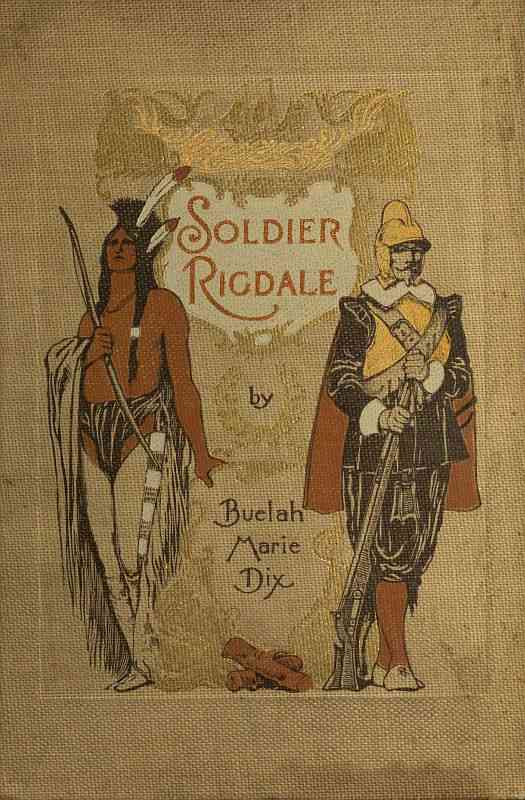
The Project Gutenberg eBook of Soldier Rigdale: How He Sailed in the Mayflower and How He Served Miles Standish
Title: Soldier Rigdale: How He Sailed in the Mayflower and How He Served Miles Standish
Author: Beulah Marie Dix
Illustrator: Reginald B. Birch
Release date: November 12, 2013 [eBook #44165]
Most recently updated: October 23, 2024
Language: English
Credits: Produced by sp1nd, Emmy, and the Online Distributed
Proofreading Team at http://www.pgdp.net (This file was
produced from images generously made available by The
Internet Archive)
Soldier Rigdale
·AND HOW HE SERVED MILES STANDISH·
BY
AUTHOR OF "HUGH GWYETH: A ROUNDHEAD CAVALIER"
WITH ILLUSTRATIONS BY REGINALD B. BIRCH
New York
THE MACMILLAN COMPANY
LONDON: MACMILLAN & CO., Ltd.
1899
All rights reserved
By THE MACMILLAN COMPANY.
Norwood Press
J. S. Cushing & Co.—Berwick & Smith
Norwood, Mass., U.S.A.
Contents
CHAPTER I |
Page |
| Playing with Powder | 1 |
CHAPTER II |
|
| The Name of Miles | 17 |
CHAPTER III |
|
| Thievish Harbor | 30 |
CHAPTER IV |
|
| Hewers of Wood and Drawers of Water | 45 |
CHAPTER V |
|
| News from the Shore | 61 |
CHAPTER VI |
|
| The Going Landward | 74 |
CHAPTER VII |
|
| The Man of the Family | 81 |
CHAPTER VIII |
|
| In the Time of the Sickness | 95 |
CHAPTER IX |
|
| Master Hopkins's Guest | 108 |
CHAPTER X |
|
| The Lords of the Soil | 125 |
CHAPTER XI |
|
| When the Good Ship Sailed | 141 |
CHAPTER XII |
|
| The Sowing of the Fields | 156 |
CHAPTER XIII |
|
| The Two Edwards | 171 |
CHAPTER XIV |
|
| A Mighty Resolution | 187 |
CHAPTER XV |
|
| In the Southward Country | 202 |
CHAPTER XVI |
|
| The House of Bondage | 217 |
CHAPTER XVII |
|
| How they kept the Sabbath | 228 |
CHAPTER XVIII |
|
| At Nauset Village | 243 |
CHAPTER XIX |
|
| Fallen among Friends | 257 |
CHAPTER XX |
|
| A Son of Perdition | 270 |
CHAPTER XXI |
|
| Between Man and Man | 283 |
CHAPTER XXII |
|
| The Bearer of Tidings | 296 |
CHAPTER XXIII |
|
| The Captain's Soldier | 311 |
List of Illustrations
| "As if he knew the place, and held he had the right to come there" (p. 111) | Frontispiece |
| Opposite Page | |
| "With his arm up to shut out the glare of the lanterns" | 14 |
| "Dolly plaited a fold of her apron between her fingers" | 66 |
| "'Do you like to do it, Captain Standish?'" | 102 |
| "Saw the two young men close in combat" | 184 |
| "'Oh, Miles, 'tis the savages come for us!'" | 214 |
| "Miles made out the figures of the men in the shallop" | 254 |
| "The breath came gripingly in his throat" | 308 |
CHAPTER I
PLAYING WITH POWDER
How those yards seesawed up and down with the rolling of the ship, and the mastheads, they dipped too, quite as if they might pitch down upon a body! Miles Rigdale, standing with legs craftily planted and head thrown well back, stared and stared at their measured movement till, dizzy with the feeling that the great spars were tottering loose, he was glad to straighten his aching neck once more.
"Did you see a goose, all roasted, flying for your mouth?" Francis Billington called from the waist of the ship, where he perched jauntily upon the bulwark.
Sauntering from his place near the companion way, Miles halted beside the speaker; not that he had a great liking for Francis Billington, but he was a sociable lad, who must talk to some one, and, as the bleak air had driven the women and children into the great cabin, while the men were absent,—the leaders conferring in the roundhouse and the lesser men seeking firewood on shore,—he could for the moment find no comrade save young Billington.
The latter was an unprepossessing lad, stunted and small for his fourteen years, with elfish eyes which he now turned sharply on Miles. "I take it, Jack Cooke is ill, and Giles Hopkins has packed you about your business, that you've come to spend the time with me," he suggested disagreeably.
"I take it, maybe you've spoke the truth," Miles answered unruffled, as he propped his chin on his fists and braced his elbows against the bulwark.
Gazing thus northward, he could see all about him green hills, wooded to the water's edge, now higher, now lower, as the ship mounted upon the waves, and the strip of sand beach, off which rode the bobbing longboat. "I wish my father had taken me with him when they went to fetch the wood," Miles broke out at that sight; "it's weeks and weeks since I set foot on land."
"Pooh! I've been ashore thrice already," bragged Francis, setting one arm akimbo, though he took good care to grip the shrouds tightly with the other hand, for the bulwark was not the safest of perches.
Miles tried to swallow down his envy, but he could not help saying, with a touch of triumph: "Anyhow, you saw no savages, and my father saw 'em when he went exploring with Captain Standish,—six Indians and a dog, he saw."
"So did my father," Francis sought to crush him; but Miles, declaring sudden truce, was asking, with civil interest: "You did not see any lions when you went ashore, did you, Francis?"
"N—no, but Ned Dotey thought he heard one roar the other night."
"Father would not take our mastiff Trug on land lest they kill him. Trug would give 'em a fight for it, though. But he couldn't fight the serpents; nobody could. Did you know, Francie, there's a serpent here in America,—they call it the rattlesnake,—and if it but breathe on you, you die presently."
"How do you know?" asked Francis, awed, but incredulous.
"My father read it in a book about plantations in Virginia. Maybe the serpents lie close in cold weather, though, so you did not see them." Miles was silent a long instant, while he gazed fixedly at the mysterious shore yonder, where all these rarities were to be met with. "The trees do not look like our English trees," he said, half to himself, "but I'd fain go in among them. Perhaps you found conies there, Francis? There were a plenty of them on the common at home; Trug and I used to chase them, and 'twas brave sport."
"Mayhap if you had Trug with you, you could start some here," suggested Francis. "Tell you, Miles, you beg your father let you go ashore to-morrow, and I'll go too, and we'll seek for conies together. Will you?"
"'Tis no use," Miles answered, scowling straight ahead.
"Why not?"
"Father says I cannot go," the boy blurted out. "I answered him saucily this morning, and he said for that I should not stir foot off the ship for a week. I think—I think he might let me go ashore. Along the first I was coughing, so my mother said I must not venture in the boat; and then my sister Dolly was ailing, and I must stay to bear her company; and then it stormed; and now he will not let me go. And I am so weary of this ship!"
"I'd not bear such usage from any man," Francis boasted grandly. "If 'twere my daddy treated me so harshly, I'd tell him to his face 'a' was a sour old curmudgeon, and—"
"You need not talk so of my father," Miles interrupted sullenly, though he held his eyes fixed upon the shore line, not on the speaker. It was hard, while he looked toward the land of wonders, still unknown to him, to think quite kindly of the father who had arbitrarily shut him out from the enjoyment of it. "If you miscall him so again, Francis, I'll fight you," he added, conscience-stricken, in the hope of making amends for the disloyalty of his thoughts.
Francis bent his sharp eyes on his companion, but did not take up the challenge; indeed, a less discreet lad than he might have considered an instant before coming to fisticuffs with Miles Rigdale. The boy, for his scant eleven years, was of a proper height, with straight back and sturdy limbs, a stocky, yet not clumsy, little figure, that promised a vigorous stature when he came to man's age. His deeply tanned face, that was lightly sprinkled with brown freckles, was square and resolute; his blue eyes were very level and honest; and his tousled brown hair tumbled about his forehead in a way to make more women than his mother think him a bonny boy. For the rest, he was clad humbly enough in doublet and breeches of dark gray frieze, with long gray stockings and stout shoes; he wore neither cloak nor hat, and his clenched fists, that now rested firmly on the bulwark, were bare and chapped red by the wind.
It was the sight of the aggressive fists that made Francis use a different tone: "You're a pretty comrade, Miles, to fly out at me so."
"You may leave my father in peace, then."
"Perhaps you'd wish me to leave you in peace too. I know Goodman Rigdale has forbid his little son speak to me."
"I'm still speaking to you, am I not?" answered Miles, and bent to adjust one of his shoes, so Francis could not see his face; those last words had hit dangerously near.
"But you'll show me a clean pair of heels very speedily," sneered his companion, "for yonder the boat with your good father is putting off from shore, and when he comes—"
"That's how the wind blows, is it?" struck in a new voice close at hand. Looking over his shoulder, Miles saw, lounging on a coil of rope by the foremast, a certain Edward Lister, one of the servants of Master Stephen Hopkins. He was a slim, dark fellow of some twenty years, whom Miles admired for a tall swaggerer, because he always wore his red cap rakishly on one side, and, since the rules about lighting tobacco aboard ship were strict, was ever chewing at a long pine splinter instead of a pipe. "So if your father catch you with Master Billington here, he'll swinge you soundly, eh, Miles Rigdale?" he asked, with his mouth quite grave, but a glancing mockery in his black eyes. "Better show us how briskly you can run into the cabin."
Miles ostentatiously leaned his shoulders against the bulwark and crossed one leg over the other, as if he thought to finish the afternoon in that position. Shifting round thus, his gaze travelled beyond his companions to the high quarter-deck, where he spied several men trudging forth from the roundhouse. "Has the conference broken off?" he asked, forgetting in his curiosity that he was angry with both Francis and Ned Lister.
"How else?" the latter answered dryly, and, rising to his feet, sauntered over to the two boys. "D'ye think they would confer without the great Master Hopkins? And he quit the roundhouse long since. Wearied out, doubtless, with such vigorous labor. It has taken them an hour to determine no more than to send forth a gang to-morrow and try a third time for a place where we may settle."
"Another exploration? Is my father to go on it, do you know?" Miles questioned.
"They won't let any but the great folk have a hand therein; daddy said 'twould be so," commented Francis.
"True enough," scoffed Lister; "the Governor, and Captain Standish, Master Bradford, Master Winslow, Master Hopkins, and—the worshipful Master Edward Dotey."
"Aha!" jeered Francis. "They're taking old Hopkins's other man Dotey along, and Ned Lister is jealous of him."
"Hold your tongue!" cried Lister, catching the lad by the scruff of the neck, "else I'll heave you over the bulwark."
Francis twisted up his face and opened his mouth in a prodigious, dry-eyed howl, which would have set Miles laughing, had he not been intent just then upon the approaching boat. He could see her visibly growing larger, as she bounded nearer and nearer over the swell of the water, and each moment he recalled more distinctly in what terms his father had forbidden him have to do with "that Satanish brood of the Billingtons." Miles shuffled one foot uneasily; perhaps he really ought to go into the cabin now and see how his sick friend, Jack Cooke, was faring.
He turned away and had idled a few paces along the deck, when Francis, who had been suffered wrest out of Lister's hold, called after him: "Ah, Miles daren't let his father find him with me. I knew so."
"It's not so, neither," Miles flung back, and made a great show of stopping by the mainmast, where he stood gazing down the open hatchway which led to those cabins that were in the depth of the hold. "Aren't you coming with me, Francis?" he asked presently.
The other, quite undeceived, came snickering up to him: "Have no fear; I'll take myself off ere your father come. Sure, you're a stout-hearted one, Miles."
"You're a pretty fellow to talk of courage," Miles was goaded into replying, "after the way you howled out but now. You might have known Ned Lister'd do you no hurt."
"No doubt you'd not have been afraid," his tormentor scoffed. "You're not afraid of anybody save your father."
"So are you, if you told the truth of it," Miles took him up. "You'd not have Goodman Billington hear you vaporing so for all the silver crowns in England, and if Goodwife Billington came by and heard you, she'd cuff your ears smartly."
Francis's sallow face reddened. "Much she would!" he said angrily. "I'll show you I be no milksop to stand in fear of my father and mother. Maybe now you think I'd not dare to—" he paused, his eyes half-closed, while he tried to concoct some peculiarly wicked sounding project—"to take some of my father's gunpowder and make squibs?" he concluded, with a triumphant look at his companion.
"No, I don't think you dare," Miles answered stolidly.
"Come, then, I'll show you," the other cried, and headed for the companion way that descended beneath the quarter-deck.
Four steps down, and, passing through a narrow door, they entered into the stifle and stir of the "great" or main cabin. On every hand murmured the ceaseless confusion that always filled the straitened space: underfoot, sometimes with fretful wrangling, children were at play; women were passing to and from their cabins, or dressing their meat for the evening meal at the long table; upon the benches several sick men, whose heavy voices were audible through the shriller tones of those about them, sat together in talk. Over all, the brightness from the narrow skylights fell wanly, so the corners of the low apartment were dusky with thick shadows, and the dim outline of the great timbers overhead, and the slits of doors into the double tier of little cabins adjoining, could only just be made out.
Miles was glad of the half light, for he knew well that if his mother should chance to be there and see him with Francis, she would make a pretext of some task to call him to her. He caught sight of her now, as she stood by the table in speech with Constance Hopkins, and, almost treading on Francis's heels in his hurry, he slipped into the Billingtons' cabin.
It was the veriest closet of a room in which he found himself, black, save for a glint of sickly light that crept through an opening in the door, by which Miles contrived presently to discern the unmade bunk along the wall, the mattress, still spread out upon the floor, and the iron kettle and other vague household stuff that littered untidily the narrow space. Comparing it with his father's ordered cabin, he recalled his mother's indignant comment to Mistress Hopkins, that Ellen Billington was a poor, thriftless body, who would better be tidying her quarters than gossiping with her neighbors.
"Now you'll see what I dare, Master Miles," Francis broke in, as, with much panting, he dragged from beneath the bunk a small keg. "This is gunpowder, if you be not afraid of the sight of it."
"It does not take much courage to touch gunpowder," said Miles, bending forward from the bunk, where he had seated himself, and plunging his fist into the keg. "Let's see your squibs, Francis."
Young Billington stretched himself on his stomach and, grubbing once more beneath the bunk, drew out a fistful of rustling papers. "These are leaves I tore from a jest book of daddy's," he bragged. "No doubt you won't believe I durst."
Miles made no reply; after all, he scarcely cared to prolong his differences with a boy who had such a delightful plaything as a keg of powder. "Let me make a squib too, Francie," he begged, squatting down on the mattress beside his host.
For a space there was silence, while, with some hard breathing, the two, guided more by touch than by any sight they had in the dark cabin, labored industriously. Blacker and blacker it grew all round them, till they struck their hands together as they groped in the keg, when a ray of faint yellow light, that must fall from a lantern in the great cabin, stole through the door.
Now they could see how they were faring at their work, and Francis, who had laid his handfuls of powder on the papers and folded them quite dexterously, laughed in provoking fashion at Miles, who, new to this game, had spilt the powder and failed to make his papers stay folded. "It's all very well," the boy retorted irritably, as one of his painfully made squibs, bursting open, scattered powder between his knees, "but after you've made these mighty squibs what else do you do?"
"Why, I'll light a bit of match," said Francis, scrambling to his feet, "and then we'll touch 'em off."
Miles jumped up delightedly, and, reasoning that a really satisfactory squib should be set off in darkness, took from the bunk a blanket which he fastened by two nails across the opening in the door.
Meantime Francis had struck his father's flint and steel together, till at length he succeeded in catching a spark upon the piece of "match" or twisted tow steeped in saltpetre. Miles could see the little red point shimmering in the dark and, picking up the squibs, he moved warily toward it. "Gi' me a squib," came Francis's voice, close at his feet. More accustomed to the dimness now, Miles could make out the boy's crouching figure and saw him lean far forward with one arm outstretched to touch off the powder.
Then he felt Francis crowd up against his knees, and instinctively he drew back so his own body was pressed against the wall. Out of the dark on the floor, right at his feet, started a little flicker of flame which, with a sudden whishing sound, leaped up, a broad, bluish puff of fire, almost in his eyes; then, before the exclamation had left his lips, died sizzling away.
"That was brave, wasn't it?" spoke Francis, in a rather quavering voice. "You can touch off one now."
Miles eagerly seized the match and, setting it to a squib, flung the twisted paper a pace from him. The same whiz, burst, sizzle, but this time he lost the keen pleasure in a sudden hideous thought that, even as the squib left his hand, came over him. "Francis," he cried, before the flame died down, "is this safe, think you? Say the powder in the keg took fire?"
"Pshaw! You're afraid; I knew you'd be," replied Francis, his own courage quite restored.
Thereupon Miles lit a third squib to show his fearlessness, and then together they set off the remaining two. "That's the last, and I've no more paper," sighed Francis, and Miles echoed the sigh.
They were sitting now on the edge of the bunk; the cabin seemed very black to their eyes, still dazzled with the last flash, and the air was hot and heavy with the pungent odor of burnt powder. Miles sniffed it contentedly. "This is what 'twould be like in a great battle," he began. "Sometime I mean to be a soldier and have a musket. Did you ever shoot with a musket, Francis?"
"No, but I've shot off a fowling piece," answered the other. He clambered upon the bunk, groping audibly in the dark, and presently dropped down again beside his companion with something long and slender and heavy in his arms. "Look you, Miles, here's daddy's fowling piece now," he said exultantly. "What say if I shoot her off?"
"'Twould make a mighty big noise in so small a room," Miles answered longingly.
"Give me the match, then."
Later Miles remembered clearly how Francis had sprung to his feet at the word, but after that all was a confusion of dire noises,—a rending crash, then a sound of women screaming, of children crying, and of men running with clattering footsteps across the great cabin. Through it all he felt the weight of Francis Billington, who had pitched back against him, and he saw a little spurt of yellow fire that licked along the boards. Though he did not remember snatching a blanket from the bunk, one was in his hand, and he was down upon the floor, smothering the flames that would press out beyond the edges. A powder keg was somewhere near, he recollected, and he beat out one little jet of flame with his hand, that smarted fiercely.
It all must have taken a long, long time, but still the women screamed, and the heavy footsteps had only just reached the door. The latch rattled beneath a rough hand, the light streamed into the cabin, and Miles dropped back against the bunk, with his arm up to shut out the glare of the lanterns, and the sight, too, of the angry faces in the doorway. "Francis, Francis," he found himself saying, in a poor whisper that he realized was not meant for Francis Billington's ears, "we must 'a' killed some one."
CHAPTER II
THE NAME OF MILES
But the grasp on his neck—it was big John Alden, the cooper from Southampton, who had dragged him out into the great cabin—was real, and so, he now found, were the faces of the men who confronted him. The Elder, William Brewster, with his gray hair, and grave Governor Carver, he noted among them, with a hopeless feeling that all the majesty of the company was come thither to judge him. Close by, he heard Francis Billington crying, with tearful sobs, not dry howls alone, but Miles dropped his shamed eyes to the floor of the cabin and did not look at his companion. He heard Goodman Billington's rough voice, thick with abuse and threats against his son, and then he heard the Elder cut him short: "Peace now, friend. Maybe the lad is hurt."
Just then, from within the Billingtons' cabin, whence a light smoke still drifted, spoke a quick, deep voice: "Come you in and lend a hand, Alden. There is work for two needs despatch. The floor here is over shoe thick with powder."
"Ay, Captain Standish," the young man answered promptly, and loosed his hold on Miles's collar.
There was a little movement in the group of men, and Master Stephen Hopkins, stepping closer to the cabin door, peered in and spoke solemnly: "A full keg of powder broke open! 'Tis by the mercy of Heaven alone the ship was not blown into atoms."
"I did not have it in mind to blow up the ship," Miles faltered, raising his eyes. "I did but touch off a squib—because it would burn bravely." There the words choked in his throat, for, a little back from the other men, he caught sight of his father, and Goodman Rigdale's arms were folded, his heavy brows drawn close together, and his lips, beneath his beard, set in a way Miles knew of old. "I did not mean it," he repeated huskily, and, gazing at the floor again, began crushing a fold of his doublet in his hand.
About him there was questioning and answering, he knew, and he heard Francis whimper: "'Twas Miles. He touched off squibs, he did."
"Squibs do not make such a noise as that we heard," Governor Carver interrupted sternly.
"'Twas daddy's fowling piece. Miles Rigdale and I shot her off, and he—"
"Let Miles Rigdale rest," the Elder admonished. "Do you tell us of Francis Billington."
Bit by bit a fairly accurate story was drawn from the two boys, though by such slow and woful stages that before it was ended Captain Miles Standish and John Alden, with their hands all grimed with powder, came out from the cabin. Miles stole a fearful side-glance at the Low Country soldier, who, being trained in the brutal discipline of the camps, was likely to prove a harsher judge than the Elder or the Governor, but, to his relief, he saw the Captain halt beside Goodman Billington, to whom he growled out some pithy advice as to the expediency of keeping his powder covered up and out of reach of mischievous hands.
Miles took heart a little then, as much as he could take heart while he knew Goodman Rigdale was frowning in the background, and even ventured to look up when he heard Elder Brewster say, in a tone which a trace of amusement and much relief made almost kindly: "Well, well, 'twas no Guy Fawkes conspiracy, it seems, only the folly of two scatter-brained lads. Your Excellency scarce will set them in the bilboes?"
"Nay, I leave it to their fathers to teach them not to meddle with such tools in future," Governor Carver answered gravely; and thereupon, with a surly mutter or so from other fathers in the company as to what the two culprits deserved to get, the men scattered to weightier affairs.
As the group thinned, Miles was left face to face with his father, who, making a curt sign for him to come after, led the way to the door of the cabin. Miles felt queer and empty at the pit of his stomach, and his fingers trembled as he began unhooking his doublet, but he followed along bravely. His eyes were still downcast, and, as he stepped, he counted the planks in the flooring and tried to think of nothing but their number.
Out in the darkness of the forward deck his father gave him such punishment as he looked for,—a beating with a rope's end, so hard that Miles had to set his teeth tight and clench his hands to keep from crying. Once, in the midst, Goodman Rigdale stayed his arm, and in the instant's cessation Miles, standing in his shirt-sleeves, felt the wind from across the harbor strike cold on his hot flesh, that was quivering with the blows. "That is for that you near destroyed the ship," his father spoke, gravely and without anger. "Now I must flog you for that you disobeyed me, and had to do with one of those Billington imps."
The second whipping ended, Miles huddled on his doublet, stiffly and awkwardly, glad of the darkness that hid his face. Goodman Rigdale was speaking again: "And ere you lie down to-night, my son, remember to give thanks unto God that by His mercy He has preserved you from being cast into His presence with the deaths of all that are within this ship upon your soul."
Miles did not quite follow the words, but, with a sense that he was the chiefest of sinners, and with a keen realization that his back and sides were smarting, he gulped out an unsteady "Yes, sir," and blindly fled away.
Aft of the foremast, as he stumbled uncertainly, he ran against a woman, and at once he knew it was his mother. In an unformed way he was aware that she had been waiting to comfort him, and at each blow had suffered more than he. Her voice was quavering now, though she tried hard to keep her everyday tone: "Come, come down to the cabin now. Father has shot a bird, and I've made a broth to our supper. Come, deary, it is turning chill here."
Shaking off the hand she laid on his arm, Miles broke away and ran to the mainmast, where the hatchway yawned. Slipping and swinging on the steep ladder, he descended headlong; he was not going to his father's cabin, nor did he know whither he was going, only that he wanted to be by himself. On the orlop deck he halted an instant before passing down into the hold; below, there would be many people, while here, for the moment, he was alone. He stood blinking at the dim lantern that hung by the ladder, till slowly it grew blurry to his eyes, and, raising his bent arm, he hid his face.
It seemed only a moment before he heard someone come tramping up from the hold, and felt a hand on his shoulder. He was turned round; he had to look up; and he saw, standing over him, Master Hopkins, very grim and stern, as was his wont. "I am glad to see these tears of repentance, Miles Rigdale," he spoke severely.
Miles wriggled out of his hold. "I am not repentant," he cried. "I wish I had blown you up. Now you can go bid my father flog me again." With that he dodged the hand Hopkins put out to detain him, and, jumping over some coils of rope, scrambled away out of reach.
Clambering over the chests and kegs that were placed upon the orlop, he paused only when he reached the next cleared space, by the forward hatchway that led to the gunroom. There it was all dark, a comfortable, thick blackness, and, to make it safer and lonelier, he crept under a table that was stored among other household stuff.
For a moment he sat panting, and listened to the lap, lap of the waves upon the side of the ship and to his own heavy breathing, but he heard no sound of any one's pursuing him. Doubtless Master Hopkins had gone away to tell every one that he was crying and repentant, Miles tormented himself; no matter, he was never coming out to be jeered at and preached to; he would stay under the table forever, and he would not shed another tear to please them.
So he sat, rigid and still, and each moment grew more keenly aware that he was sore from his beating, that his head ached, and his burnt hand throbbed, and his heart was big with a great burden of shame. Of a sudden, in the stillness and dark, he heard a sob. Then he found it was himself, lying with his head buried in his arms against the crosspiece that braced the legs of the table, and crying helplessly.
He had lost track of the minutes, but he had lain there a long time, he knew, for his arms were numb with the pressure of the crosspiece against them, and his throat ached with much sobbing, when he caught the sound of a footstep on the planking of the orlop. At the same moment, light beat against his smarting eyelids, and, opening his eyes, he raised his head to look.
The edges of the table under which he crouched were silhouetted blackly against the yellow lantern-glow, which crept midway into his shelter. Following with his eyes along the light, he could see beyond the table the joinings of the planks of the floor, a bit of the ladder that led to the main deck, and by the ladder, in shadow as the lantern was raised, the lower part of a man's body.
Miles stared breathlessly at the commonplace leather shoes and kersey breeches,—all the rest the table hid from his view,—while he strove to hold back a sob that was halfway up his throat. It would out, but he tried to turn it into a sneeze, which ended in a mournful, indefinable gurgle.
Instantly the light of the lantern, swinging round, swept almost into his face, and a deep voice commanded: "Come out hither."
Miles sat up, tense and braced. "Is it you, Captain Standish?" he asked, in a small voice. Not that, to his knowledge, Miles Standish had ever hurt any one, but he was a brusque, peremptory man, reputed of a fiery temper; it was for this, probably, that Master Hopkins had sent him hither, as one fitted to deal out further punishment to such a criminal as Miles Rigdale.
"Come out, and you'll speedily find if 'tis I," Standish's voice rejoined grimly.
Miles rubbed his sleeve across his eyes, the rough frieze hurting them rarely, then dubiously crept from his shelter. The straight course was to crawl toward the light, but to go that way would land him squarely at the Captain's feet,—a last touch of ignominy that he could not endure. So he scrambled painfully over the crosspieces and round the table-legs, till he came out upon the open floor the width of the table-top from the enemy.
"It's naught but you, is it?" the Captain greeted him, and turned the lantern so the light fell full upon him.
The boy struggled hastily to his feet. "Ay, sir," he nodded, without speaking or looking up.
The other drew a step nearer. "You're one of the knaves who tried to blow up the Mayflower, are you not?" he questioned sternly. "Did you steal down here to fire the magazine and finish the work?"
"I—I did not go for to blow up the ship, sir," Miles pleaded, raising his eyes. With amazed relief, he saw that, for all his gruff tone, the Captain looked more amused than angry.
Standish must have taken closer note of him, too, for he asked abruptly: "You're John Rigdale's lad, are you not?"
"I am Miles Rigdale."
The lantern was lowered suddenly. "My namesake, are you? Do you not think, sirrah, you bear too good a name to drag it into a powder-burning matter such as this?"
"I do not hold it a good name," Miles burst out. "I would they had called me plain Jack."
"Wherefore, pray you?"
"Miles is no name at all," the boy hesitated, between shyness and the desire to vent a long-standing resentment. "It makes me think of the stone in our village that said: 'Thirteen miles to London.'"
"Tut, tut, lad! Have you no Latin?"
Miles slipped one hand under the edge of the table against which he leaned, and picked at a splinter he found there, while he stammered: "N—no, sir. There was no school in our village, and, had there been, my father could not spare me from the farm. I must help him, for I'm mighty strong for my years," he added gravely. "And I never want to go sit in a school, either. I am glad there will be no schools here in the plantation, not till I'm a man and can do as I will. I hold that is the best part of all in planting a colony, except the lions and the savages."
"And what do you think to do with the lions and savages, Miles Rigdale?"
"Fight 'em, sir."
Captain Standish chuckled softly in his beard. "You'll fight 'em, eh? 'Tis a great pity, in truth, no one has told you what name you bear. You should know that Miles in the Latin tongue signifies 'a soldier.'"
Miles forgot that his cheeks were tear-stained and his eyes swollen, and looked up happily into the speaker's face. "I am right glad of that," he announced. "'Tis a good enough name, after all." He was sorely tempted to ask the Captain if he had been named that after he proved himself a soldier in the wars, or if they named him first and he grew to it afterward, but he concluded that would be over-bold.
Though, after all, he began to doubt if Captain Standish were such a terrible body. He looked pleasant enough now, as he stood in the lantern light,—a stocky, square-shouldered man of some six and thirty years, with yellow-brown hair and beard, and eyes so deep set under his brows Miles could not tell their color. The linen bands at his neck and wrists were small and plain, and along the sides of his doublet of dark maroon kersey the rubbing of armor had worn down the cloth. He was not so fine a gentleman, doubtless, as young Master Edward Winslow, but he looked the man of war, through and through, and, moreover, he neither scolded nor preached at a small sinner; Miles began to be glad in his heart that he bore the same name as the Captain.
"So, after all, you're content to be named 'Soldier' Rigdale?" Standish suddenly read the expression of his face.
"'Tis a soldier that I mean to be," Miles confessed. "I like the smell of powder."
"So it seems," the Captain answered, in the dryest possible tone, and then, as Miles's cheeks began to burn, went on hastily: "Which was it, you or the Billington lad, put out the fire? We found the blanket on the floor of the cabin."
"Mayhap 'twas I. I do not recall it clearly."
The Captain reached out his hand, and, taking Miles by a fold of the doublet-sleeve, lifted his arm. "No doubt 'twas you," he said; "you've blistered your hand here."
"I know. It aches," Miles whispered, with a sudden husky dropping of his voice.
"You'd better go to your mother straightway and ask her to put oil on it; that will soon draw out the fire."
"I can't," Miles gulped. "I can never go out among the people again. When they all think I tried to blow them up,—and when every one will know I have been newly whipped. I shall stay here forever." His voice died down as he spoke the last: it did not sound manly, but uncommon silly.
"You'd get mighty hungry if you did," the soldier answered him coolly. "You're going to your mother now, my man. Run along with you. I've to go on down into the gunroom, but I'll light you up the ladder."
Miles gave a tremulous gasp of resignation, and scuffed slowly to the foot of the ladder, where he paused and smeared the back of his hand across his cheeks; then turned to his companion. "Captain Standish," he hesitated; then, as it was the only possible way of learning what he wished to know before he showed himself among the company, he blurted out desperately, "Will you tell me, is my face clean?"
Captain Standish looked down at him with a funny expression in his eyes. "I think 'twill serve in a half light, if you slip directly into your father's cabin."
"Thank you, sir," Miles answered; then added hastily, "You see, there was something flew into my eye, and one that did not know might think—I had been crying."