
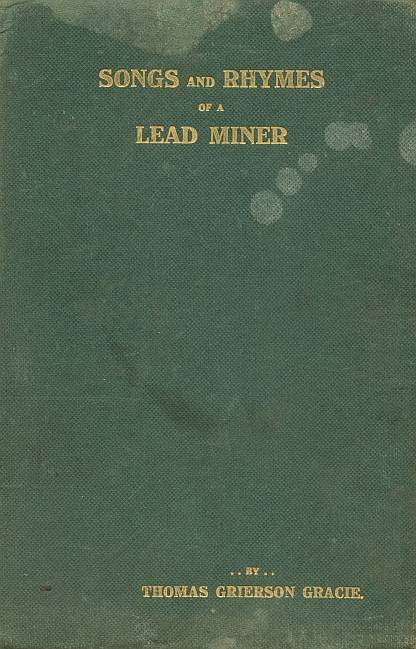
The Project Gutenberg eBook of Songs and rhymes of a lead miner
Title: Songs and rhymes of a lead miner
Author: Thomas Grierson Gracie
Release date: August 26, 2025 [eBook #76732]
Language: English
Original publication: Dumfries: Courier and Herald Press, 1921
Credits: Al Haines
SONGS AND RHYMES
OF A
LEAD MINER.
By
THOMAS GRIERSON GRACIE,
Wanlockhead.
DUMFRIES:
COURIER AND HERALD PRESS. HIGH STREET.
1921.
INDEX.
DESCRIPTIVE PIECES—
Ridge of Glengonar
A Fishin' Splore
Troloss
The Otter Hunt
The Bearers
Mennock Burn
Heights of Glendyne
A Waddin' in the Glen
Three Fishers
Ma Wag-at-The-Wa'
Curmudgeon
Bonnie Banks o' Cree
Chancellor's seat, Leadhills
MEMORIAM PIECES—
Last of the Old Band
To Mr and Mrs James Slimmon
Doctor Wilson
Funeral of Private Alex. Howland
Lines on a Friend
Wullie Tamson
Kitchener
David Cumming
Baby M'Kenzie
Wanlock Lads
Auld Volunteers
Young Volunteers
Pony Driver's Lament
Bride's Lament
Davy's Grave
SONGS—
The Auld Sangs
My Auld Violin
Auld Thackit Hoose
Auld Grey Glen
Level No. 6
Emergency Pump, Level No. 4
Turnin' o' the Wheel
To Arms
Happy Lover
Never Seen More
Wanlock's Buirdly Robin
Lass o' Durisdeer
Bonnie Jean
Betty o' The Strankly
Lass o' Glendoweran
Sae Wull We Yet
Doric o' Scotland
Cheer Up
Where is the Hindenburg Line?
Forward
Wanlock
Auld Cronie Tam
H.L.I.
Brave Lads o' Sanquhar
Mennock Burn
MISCELLANEOUS PIECES—
Scunner't
Absent Friend
The Miner
Love
Curlin'
A Word o' Advice
Jock
The Exile
The Old Churchyard
Letter in Rhyme
The Answer
Note o' Thanks
Leadhills
Euchan's Banks
On Higher Plane
Song Birds
The Photo
"Something Wrang"
The Flu'
Wee Jim
The Nurses
The True Man
An Evening Prayer
Rabbie
Welcome Home
Day Dream
To Wanlock Soldiers
PERSONAL NOTE AND PREFACE.
One of a family of ten, I was born at Wanlockhead, Dumfriesshire, in the year 1861. My boyhood was spent in the midst of comparative poverty, under whose grim shadow so many toilers live and die. Of my parents I say nothing here, except that my love and reverence for their memory remain undimmed to this day. The amount of love and self-sacrifice involved in bringing up a large family on the earnings of the lead miner at that period—from fifteen to seventeen shillings per week—I leave to the imagination of my readers. In spite of poor environment, my boyhood was, on the whole, happy and care-free. My greatest delight was to roam the glens and hills of my nativity. My pet aversion was the school, and to be confined within its four walls when the sun was shining and the birds singing outside was to me the refinement of cruelty. My parents and teachers must have been at their wits' end with me, for, in spite of heavy punishment, I played truant whenever opportunity offered. I was employed as a lead washer at the age of thirteen, for the magnificent wage of fivepence per day. This was increased at the rate of one penny or twopence yearly, at the discretion of the manager. After working five years at lead washing it came my turn to go underground as a labourer and miner's assistant, where in course of time I became a fully qualified lead miner.
I will not weary my readers with an account of my ups and downs in life or of my many startling experiences in the lead and coal mines. I was a coal miner in different parts of Scotland for six years. I did not take kindly to the work, and when I left it I fervently hoped it was for good. Of the coal miners I have a high opinion. Beneath the rough exterior of the most of them they are true to the core; brave hearted men, who have proved their sterling worth on many a shell-torn, blood-stained field, and in many an appalling mine disaster; ready to fight, suffer, or die on the field of battle for their ideals: ready in the mine disaster to go to almost certain death to rescue their comrades. Can human nature rise higher than this?
My hobby has been the study of music and the playing of different instruments. I have gained an elementary knowledge of composition, harmony, and counterpoint, and in the playing of different instruments made myself fairly expert. My favourite is the violin, and my earnings with it at concerts, balls, kirns, and merry-makings generally enabled my wife to keep the pot boiling and the bairns fed and clad when the lead miner's wage was utterly inadequate for that purpose.
At the outbreak of the Great War I commenced to rhyme. I am sorry if the jingo spirit is too evident in some of my pieces. Such were composed in the dark days, when our brave soldiers had their backs at the wall, and required every moral and material support that could be given them. For the political and religious bias of my pieces I make no apology. I make no claim to the honour of being a Poet; that I have no claim will be evident to cultured minds to whom these songs and rhymes will no doubt appear poor in conception, crude in expression, grammatically wrong in parts, and altogether commonplace. But as I am writing to people on my own level of intelligence—that is, the intelligence of a self-taught man—cultured people do not come into the picture. Some of my friends are quite pleased with my verses, but I will not require a larger size in headwear over the opinion of others. I am pleased, however, to note that they all agree about the general tone and sentiment being of a high order. With that I am content. If there is anything in my pieces that will raise a smile, a laugh, or a tear—anything that will make the human more humane, any thought or sentiment that will tend to raise the moral or mental standard of my readers—they have not been written in vain.
One third of the pieces in this book have already been published, and my thanks are due to local and other Editors for space given me, and specially to the Editor of the "Dumfries and Galloway Courier and Herald," for an artistic touch here and there in some of them. I give the tunes when well known to which a number of my songs may be sung. As for the others, the music being new, it will depend on circumstances whether they ever see the light of publicity. The song "Wanlock," by M'Arthur, schoolmaster in Wanlockhead (1850), and "The Lowther Winds Wail," by the Rev. J. Moir Porteous, minister of the Free Church, Wanlockhead (1877), I insert so that they will continue to be familiar to the people of the district in which their authors lived and worked.
I am indebted to Robert Wanlock Reid for permission to publish his "Letter in Rhyme," and to J. M. Harkness for his appreciation expressed in "Auld Cronie Tam;" also to Miss Annie J. Mitchell for kindly typing the bulk of my pieces; and to all those who have given me any encouragement in the making of this book.
AUTHOR.
DESCRIPTIVE PIECES.
WINTER SCENE.
The pale lovely moon o'er the Lowthers was rising
As lonely I strayed at the fall of the night
Away to the far-stretching Ridge of Glengonar,
The high hills to view in their mantle of white.
Old Boreas had swept them for days in his anger,
As though he would crush them beneath his proud sway;
But grandly they stood, with their brows high uplifted,
Firm based in majestic, eternal array.
Then thoughts did arise as I gazed on the scene
That lay bathed in the silvery light of the moon
Of Flanders' torn fields that were once fair and fertile,
Made barren and shrouded in sorrow and gloom;
Of men who went forth in the pride of their manhood,
Aroused, by the call that appeals to the brave,
Inspired by the noblest and purest of motives,
Who fell on the field or were sunk 'neath the wave.
I stood all alone on the Ridge of Glengonar,
Alone 'neath the stars that shone bright in the blue;
And prayed to the Ruler of men and of nations
To strengthen the arms of our gallant and true;
To silence for ever the roar of the cannon
And sink in oblivion this era of pain,
That in peace we might live in the land of our fathers
'Neath harmony, love, and prosperity's reign.
Wullie, Sandy, Rab, an' Tam
Yae nicht when sittin' owre a dram
Agreed when neist the day wad daw
Tae tak' their rods an' trudge awa'
An' try their skill wi' flee an' worm
On bonnie Carron's wimplin' burn.
The mornin' broke sae fresh an' fair,
New life was in the caller air;
Owre Grey Mere's Tail the sun did peep,
Tae wake oor fishers frae their sleep.
Ilk yin gat up wi' bizzin' croon;
Short time had passed since they lay doon.
They dressed fu' quick, nae time tae loss,
An' sune were skelpin' through the moss;
Owre dyke an' fence, through sheuch an' glen,
Up, up, they spieled tae Enterkin:
An' when at last they did get there
A view they had ayont compare.
They had nae time the scene tae view,
Sae hurried owre the mountain's broo,
An' doon the brae they ran pell-mell
Tae hae a drink at Katie's Well,
"Whaur Black M'Michael's bearded lip
Yince fain did dip."
Then doon they ran wi' muckle speed,
Tae Nature's charms they paid nae heed,
An' didna slack their pace a jot
Until they reached the Lucky Pot[1];
Sae awfu' keen an' anxious they
Tae see if luck was theirs that day.
Then walin' steps wi' canny care
They gaed alang the hill-side bare,
Whaur Kelt,[2], the hound, fell aff his steed
When Harkness[3] shot him through the heid;
The roarin' pool whaur he fell in
Has since been known as Kelty's Linn.
There fore-nent them Stey-Guile stood,
Defyin' time an' storms an' flood;
They gazed upon its steepest side,
Doon whaur 'twas said bold Graham[4] did ride,
His pony shod wi' deevils' cloots;
'Twas maybe true. "They had some doots."
Owre Dalveen Hill an' doon the brae
Richt cheerily they held their way;
An' when they High Dalveen had passed
They reached the Carron Burn at last;
Then fast their taikle they gat oot,
Their minds fair set on killin' troot.
Then Wullie, keen his skill tae test,
Got started weel afore the rest;
He banged oot yin, syne made it twa;
When oot cam' three, lie croose did craw.
"Come here, ma callans, gin ye wish,
I'll show ye hoo tae catch the fish."
"But pleesures are like poppies spread,
Ye seize the floo'er, its bloom is shed;"
He thocht he was a fisher rare,
But, strange tae say, he gat nae mair;
An' then he cried "I'll bet a quid
It's been the tail en' o' the tid."
But Rab an' Tam, mair skilfu' they,
On pools an' streams their flees did play;
They played wi' sic a cunnin' wrist
The finny tribe couldnae resist,
But lap an' danced at bob an' trail;
Some e'en were hookit by the tail.
Doon by Stonebutt an' by the Brig,
They landed fishes wee an' big;
An' when they reached the Carron Mill,
O' fishin' they had got their fill:
An' here a signboard took their e'e,
A maist uncommon sign tae see:
"Ginger-beer an' lemonade,
Here as guid as can be made,
An' if ye want some more repast,
Dinner, supper, or breakfast;"
These lines, my friens, depend upon it,
Composed were by Grier the Poet.
The landlord there, a sober chiel,
Wad hae nae traffic wi' the deil:
O' aqua vitae he had nane;
Sair did oor weary fishers grane;
An' ere they rested on their hurdies,
Hied owre the hill tae Tam o' Murdy's.
Tam o' Murdy's, Durisdeer,
Was famed for Mountain Dew an' beer,
An' ony ither kin' o' drink,
But jist for them wha had the clink:
For Tammy, tho' a kin'ly man,
Could aye look efter num'er wan.
An' there they sat an' smoked an' sang,
An' gill stoups toomed o' liquor strang,
Which quickly put them a' at ease,
In tellin' stories, maistly lees,
O' salmon they had landed oot,
An' hoo they lost their biggest troot.
Their pooches toom, nae mair tae spen',
Their nonsense sune cam' tae an en',
An' forced were they tae tak' the gait,
Tho' they were in a muddled state.
The moon on them was shinin' clear,
When leavin' guid auld Durisdeer.
They wandered on, whiles up, whiles doon,
An' heard fu' mony an eerie soon;
The fitpath wasna' braid aneuch,
They tumelt in the burn an' sheuch;
They staggered in amang the dreels,
O' turnip, kail, an' tattie fiel's.
An' tho' they had nae wish tae tarry,
Their legs refused the drink tae carry:
An'' doon on Carron's hichts they sank,
An' for a time their min's were blank;
Hoo they gat hame, what them befel,
Deil yin o' them could ever tell.
MORAL.
When man is on enjoyment bent,
O' aftermath he should tak' tent,
An' no abuse John Barleycorn,
Or life o' pleesure will be shorn.
[1] A natural pot formation in the bare rock in the middle of the burn, about twenty yards down from the foot-path from which, if a fisher, in the morning, out of three stones put one in the lucky pot, his luck was in for that day.
[2] Captain of Dragoons searching for Covenanters amongst the hills.
[3] One of the hunted Covenanters.
[4] Graham of Claverhouse, of whom many marvellous stories have been told.
Song or Recitation. Tune: "Tinker's Waddin'."
In August, when the heather blooms,
An' grouse are fairly on the wing,
The scented breeze frae hill an' moor,
Tae hunters health an' pleesure bring.
Then hunters meet at Auld Troloss,
As they hae dune for mony a year:
Tam Johnston ready taks the names
O' beaters there frae far an' near.
The Laird aye greets them wi' a smile,
An' shakes auld servants by the han';
Nae purse-prood autocrat is he,
But jist a kindly gentleman.
Aye weel esteemed are men like him,
An' loyal service they comman';
It isna siller, pomp, or power,
But honest worth that maks the man.
The guns gae first; each finds his butt;
Then beaters bauldly briest the brae;
Lang miles atween them an' their hames—
Their herts are licht, sae what care they?
They drive the Hoose, they drive the drain,
An' next in order comes the mine;
Success does a' their efforts croon,
When Tammas Johnston marks the line.
An' thus the merry hunt goes on,
Drive after drive they run them in;
An' when they get back tae the Hoose,
They ken their heavy darg is dune.
They there get coffee in their turn,
Some hae milk an' some hae tea,
Wi' routh o' breed weel spread wi' jam,
An' a bicker o' the barley bree.
A few choice spirits meet at nicht
Tae spen' a happy social 'oor,
When ilka yin is blyth an' bricht,
An' meenits pass like fleein' stour.
The gentry a' maun share the fun,
Nae cless distinction dae they show;
Tae Gracie's fiddle weel in tune
They trip the "licht fantastic toe."
Carmichael is a canty chiel,
Tae sing a sang he is'na sweir—
The "Tinkers' Waddin'," "Spellin' o't,"
An' "Bonnie Lass o' Durisdeer."
Then Laidlaw sings aboot the hills,
Up whaur the Wanlock waters rowe,
An' "True till death," "The Eastern Star,"
An' "Jessie on the Quarry Knowe."
Miss Vickers an' Miss Jonson, tae,
The auld-time sangs sae sweetly sing,
Accompanied by the auld banjo,
The fiddle an' the mandolin.
The auld wife in the ingle neuk
Raises her voice in cheerfu' key,
An' nicely sings "Woods o' Duirmore,"
An' "The Bonnie Lad that comes tae me."
Coachman Fraser, stalwart wight,
Does neist a humorous piece recite,
Hoo Tibbie lood an' lang did growl
When her puir bit lassie brak the bowl.
Then Lauder, tho' he canna sing.
Does fairly dance the Heelan' Fling,
An' Hornpipes, tae; wi' heavy wear,
His feet like hammers strike the flair.
Gracie gies them o' his best
Till voice an' airms are needin' rest;
Hoo he does sing, hoo he does play,
It wadna dae for me tae say.
The 'oor is gane; some maun gang hame;
They canna' stay the han' o' time.
They pairt tae meet some ither nicht,
For the happy days o' Auld Langsyne.
Chorus after every 2nd verse.
Durum dook an' doo an' dae,
Durum dook an' derry O.
Durum dook an' doo an' dae,
Hurrah for the hunt sae merry O.
(An otter was run down and killed by three lads belonging to Wanlockhead and Leadhills in the head of Pedan in the month of August, 1915. Some people say I have made a mountain out of a molehill in the following piece. I advise such to keep clear of the jaws of an otter if ever they run up against one.)
Tae the hunt! Tae the hunt! Come haste ye away!
An otter's been seen on the Lowthers this day,
An' brave lads are wanted the beast tae destroy,
So it's Donal an' Archie an' Jock for the ploy.
They breisted the Lowthers like houn's frae the leash,
In their herts an' their minds there were nae thochts o' peace;
It was war, an' they cunnin'ly followed the trail
That led them away for the hichts o' Powtrail.
"Tally Ho! Tally Ho!" was the hunters' wild cry,
And speedily after the otter they hie;
Thro' heather an' breckins, thro' threshes an' bent
Regairdless o' danger oor brave trio went.
The chase it was stern and the chase it was lang
Wi' the race tae the swift and the fecht tae the strang;
They pressed him sae hard an' sae swiftly they ran
He was forced for tae hole in the heid o' Pedan.
He holed in the broo o' a pool in the burn,
Where water frae forking comes doon wi' a run:
They had run him to earth, o' that they'd nae doot,
The puzzle was noo hoo tae get the bruit oot.
Syne yin o' them stood at the heid o' the pool,
Anither yin takin' his stance at the fit,
While the third tried his best tae breck the broo doon,
Makin' use o' the tae an' the heel o' his buit.
At last he cam' oot, makin' fast up a drain
(For conveying the little springs intae the main),
But Archie was ready, an' took a sure aim,
An' knocked him doon deid wi' a big cobble stane.
Then here's tae the lads wha then did display
Sic courage an' speed at the huntin' that day;
An' lang may the tale roon the fireside be tauld
To the mournful sound of the curfew's note,
On to the churchyard they go;
Bearing the form of a dear lost friend
"With measured step and slow."
A moment they pause the cords to adjust,
Then lower him into the ground,
While paying their last respects to the dead
The mourners stand around.
Reverently they cover him up
(Of mortal this is the end);
Then sadly leave him in the dust
"Where the tall trees sway and bend."
In the winds that weep o'er the lowly graves
Where the ashes of forebears lie,
And the requiem sounds from the crystal stream
That is swiftly flowing by.
When mist nae langer hides the brae,
An' rain cluds flee afore the sun,
Wi' rod in han' I slowly gang
Awa' tae fish in Mennock Burn.
Dear Mennock Burn! What memories cling
Roon ilka bend that's in thy course;
For happy 'oors I spent in youth
I thank thee for them wert the source.
I've fished ye when the days were short,
I've fished ye when the days were lang
(An' whiles wee Davy was my mate,
An' whiles it was his brither Tam).
Frae Mossburn doon by Whitchincleuch,
An' by the path that maks Glenym
Tae whaur yer waters when in spate
Gang roarin' owre the Horseman Linn;
An' then a wee bit farer on
(I min' we got a hearty lauch
When silly Rab fell in the burn)
Whaur waters flow frae dark Glenclauch.
Those happy days are langsyne gane
An' I am weirin' on in life;
My pleasure's a' in lookin' back:
There's naething noo but care and strife.
When Nature fails an' I maun bend
An' fade jist like a witherin' tree,
Beside ye, gin I hae my wish,
I fain will lay me doon an' dee.
On a fair summer morn when the sun did adorn
The top of Glengaber, Glencrieve, and Glenglass,
I wandered away to the hill and the brae,
At the footstool of Nature a few hours to pass.
As I climbed the steep hill by the pure little rill
That trills its sweet song 'mid the heather and thyme
My memory swept back on its well-beaten track
To the days of my boyhood and friends of langsyne.
From the head of Glendyne I kept a straight line
As far as the rock where the fox makes his den,
Where the hill of the bloody bell stands like a sentinel
Guarding the pass to the bonnie Monk's Glen.
Nowhere I have been is such wild beauty seen
As that from the spot where I then took my stand;
It must stir the cold heart, inspiration impart,
These marvellous works of the Almighty hand.
Where is the pen 'mongst the learned of men
That could to the mind's eye its beauties array?
Where is the hand the brush could command
Its splendours so solemn and wild to pourtray?
Freedom from strife and the cares of this life
I find in this solitude has its abode;
The soul it is free as the soul ought to be
To commune with Nature and worship its God.
50 YEARS AGO.
Song. Tune: "A Hundred Pipers."
Stranger—What's a' the steer in the village the nicht,
An' what has gaen wrang wi' the folk?
Villager—There's naething gane wrang, an' a' thing is richt;
It's Meg gettin' mairit tae Jock.
Ye see, when a waddin' taks place in the glen
It is a momentous occasion,
For a guid week afore't the hale o' the crack
Is wha's bid tae the jollification.
CHORUS.
Then haste ye awa' tae the waddin' the nicht!
Dinna miss it whate'er may befa'!
Ye'll never forget it as lang as ye leeve,
The lassies are buskit sae braw.
When ye're bid ye maun hasten awa' tae the bride
If ye can wi' a denty bit praisent,
For the lassie we a' dae oor best ye maun ken
Tae mak' her doon-sittin' fu' daicent.
An' the women folk a' maun see the bride's braws,
Ken what siller she got tae a fraction;
An' the mair that she gets the mair they are pleased,
It gies them the mair satisfaction.
CHORUS.
The bride's freens meet in her faither's ain hoose,
An' sit, if tae sit there is room,
An' wait till they hear the fiddler's lilt
That speedily brings the bridegroom.
The minister then the marriage begins—
As a rule he is tauld tae be brief—
An' quickly he ties them a knot wi' his tongue
They never can loose wi' their teeth.
CHORUS.
An' then it's the grand procession that's formed;
The best-man leads aff wi' the bride,
While the bridegroom comes on at the tail o' the line
Haudin' close tae the minister's side.
The fiddler leads at a lively pace,
An' clear frae his strings does he draw
The bonnie sweet notes o' that auld-farrant tune,
"Oh, it's woo'ed an' mairit an' a'."
CHORUS.
The procession maun halt at the bridegroom's new hoose
While the bride gangs in tae admire;
Then a ferl o' breed is thrown owre her heid,
An' wi' the poker she steers up the fire.
The procession moves on, an' the auld wifies cry,
"Eh, sirs, but she's bonnie an' braw!"
The fiddler's tune at this juncture is drooned
By the company's hearty "Hurrah."
CHORUS.
A' the wey tae the Ha', whaur the supper is spread,
They mairch tho' a mile an' mair;
Auld Bacchus afore them aye beckons them on,
For he's routh o' a' guid things there.
When the supper is owre the minister speaks
On the joys an' the sorrows o' life,
Advises the bride tae be guid tae her man
An' bridegroom tae be guid tae his wife.
CHORUS.
Then "Weel may we be, ill may we ne'er see,"
Is sung by the guests in accord;
At the end o' the roon, wi' a thunderin' soun',
They frichten the rats frae the board;
They disperse for a wee tae meet later on
Tae hae a nicht's pleesure an' fun,
For there's naething like daffin' an' dancing ye ken,
Tae drive dowie care tae the wun'.
CHORUS.
The fiddler tunes up an' rosins his bow,
An' sooples his airm for the jinkin';
At the very first note that soons thro' the ha'
The lads wi' the lassies come linkin';
The bride an' bridegroom lead aff the first dance,
Weel pleased wi' ilk ither, I'm thinkin',
While the auld yins that arena sae fleet o' the fit
Gang canny awa' tae the drinkin'.
CHORUS.
The fun an' the daffin gang on withoot check
Till the nicht's turned intae the mornin';
They've even been kent for tae haud at the dance
Till the sun the hill-taps was adornin'.
But if dreich is the dance, the drinkin' is waur;
Never heard is the craw o' the cock;
For as lang as there's drink an' the jollity guid
It's nae easy maiter tae stop.
CHORUS.
"But the drink gangs dune afore the drooth,"
An' the herts o' the tipplers a' sadden,
An' ilka yin noo maun fin' his wey hame,
For that is the end o' the waddin'.
Noo dinna ye think that they're gien tae the drink,
An' tae honour they're no weel behaudin';
They're leal an' they're true, their marrows are few,
Tho' they tak' a wee drap at a waddin'.
CHORUS.
At dawn of day we sped away
On the path that skirts the mine hill-side,
Whaur Elvan Burn, wi' mony a turn,
Gangs singing tae the River Clyde.
"When lazy loons did lie an' snore
An' dream the gowden dawn away
We lap the burn at Greenshields' door,
An' breisted bauld the Wungate brae."[1]
Then owre the fence an' through the pass,
That's cleft atween the Lowther hills,
Whaur mountain air, sae pure an' rare,
Blaws free frae Pedan's crystal rills.
Doon Pedan's vale straucht for Powtrail
We gaed, an' in oor min's nae doot
There was but what wi' flee or worm
We'd land some bonnie speckled troot.
The sun shone bricht, oor herts were licht,
We knew that we were better far
Away frae city's din an' strife,
Whaur Powtrail mingles wi' the Daur.
Three fishers keen as e'er were seen,
Tae throw a line on loch or stream,
Noo plied their rods wi' muckle skill,
An' sune their creels began tae fill.
We fished the Annershy an' Squaw
Frae noon weel on tae evenin' fa',
Likewise Glenocher an' Glengeath,
An' then we tramped across the heath,
Tae whaur the Toll Bar stood alane,
Like oasis in a desert plain,
Whaur weary fishers meet thegither,
Tae rest or join the sang an' blether.
Like nectar was the landlord's cheer,
Glenlivet, stout, an' reaming beer;
But ere the drink could tak' oor brain
We wisely took the road for hame.
Eicht lang Scots miles, an' uphill road,
Besides o' fish a heavy load,
We stauchert on wi' mony a grane,
Vowing we'd ne'er gang back again.
But e'er a week its coorse had run,
We thocht on naething but the fun
We had on Clyde's clear sparklin' river,
An' aff' we gaed as keen as ever.
[1] From Reid.
Owre a hunner year auld, ye are still hale an' strang;
Ye've seldom been kenned the time tae gie wrang;
Tho' puirtith may come, an' misfortune befa',
I never will pairt wi' ma Wag-at-the-Wa'.
Ye belanged tae ma granny when she was a bride;
She coft ye an' fixed ye up on the wa' side;
New-fashioned timers I've heard her misca'
There ne'er was a clock like her Wag-at-the-Wa'.
When I cam' tae this warl' o' trouble an' sin,
Whaur we work oor life oot tae keep oor life in,
When I opened ma een, the first thing I saw
Was the braw soncy face o' my Wag-at-the-Wa'.
It is easy tae see ye are no jerry made;
Ye've been fashioned by workmen weel up tae their trade;
The modern timepiece has nae chance ava'
When compared wi' ma auld-farrant Wag-at-the-Wa'.
Many changes ye've seen since ye startit tae tick,
Yer han's tae gang roun' an' yer wheels tae gang click;
Ye sit on yer perch serene thro' them a'
Steady markin' the time, ma Wag-at-the Wa'.
The mail coach has gane, an' the train's taen its place;
We've Zepplins an' airyplanes fleein' in space;
Wi' wire an' wi' wireless, an' X-rays an' a',
Mony wonders ye've seen, ma Wag-at-the Wa'.
Electreecity harnessed likewise ye hae seen,
Propellin' the ship an' the bauld submarine,
Defyin' the elements, rain, wun', an' snaw;
It's the age o' invention, ma Wag-at-the-Wa'.
In city an' country it's drivin' the trams,
It will sune, I've nae doot, be applied tae the prams,
The lorries and 'busses an' motor cars braw;
What's next on the programme, ma Wag-at-the-Wa'?
Ye hae seen us in peace time, ye see us in war;
The roar of the cannon is heard frae afar;
The guid sword o' Freedom we strongly maun draw
As oor sires did langsyne, ma Wag-at-the-Wa'.
The wecht o' oor blows the Kaiser maun feel
Till he's seik at the hert an' ready tae kneel
Tae oor brave sturdy Allies an' Britannia;
Then peace will be lastin', ma Wag-at-the-Wa'.
Dear Wag-at-the-Wa', I hear by ye'r chime,
It's time I was stoppin' this rummelin' rhyme;
I'll blaw oot the can'le, on Morpheus I'll ca',
An' I'll bid ye "guid-nicht," ma Wag-at-the-Wa'.
The word "curmudgeon" denotes to the Author's mind everything that is bad in human nature.
O' a' the ills we hae tae bear,
The greatest is Curmudgeon,
An' gin I had ma wull o' him
I'd trounce him wi' a bludgeon.
He thinks that man was made tae mourn,
Tae trouble he wad bind him;
Tae ilk fireside he trouble brings
An' leaves the same behind him.
He is the "daith's-heid at the feast;"
He's always in employment;
His greatest pleesure is tae keep
Mankind frae a' enjoyment.
When we are on a holiday
We want the sun tae smile again,
An' gie's a joyfu' cloudless day;
It's then Curmudgeon prays for rain.
To him, there's great men in this warl',
There's equals and inferiors;
He scorns the honest working-man,
And fawns on his superiors.
He licks the rich man's dirty buits,
An' never min's the flavour;
By every means he tries tae gain
The lordling's smile an' favour.
A bonnie lass gaes dancin' by,
Wha's licht o' hert an' cheerie;
He tells the next man that he meets
She's anybody's dearie.
An' if he meets a sober lass
Wha has nae smile tae greet him,
He says "still waters aft rin deep,
An' the deevil lies beneath them."
The lads are a' gaun tae the deuce
Wi' impudence an' pride, man!
Their lauch an' sang an' merry ploy
Curmudgeon canna bide, man.
He is an elder in the kirk,
Believes in fire an' blood, man;
An' for oor sins wad burn us up
Or droon us in a flood, man.
Curmudgeon is a thrifty carle,
The siller he can hain, man;
Tae catch the bawbees on the hop
Curmudgeon's ever fain, man.
It maiters na' hoo it may come,
Tae him it's always gain, man;
Owre ilk yin's fauts he greets an' granes,
An' never min's his ain, man.
Tae damp the fire o' age an' youth
He's like a sowkit blanket;
We hae na mony o' his kin',
"Sae let the Lord be thankit."
Burns e'en had peety for the Deil,
Deep doon in his vile dungeon;
But Clootie is a gentleman
Compared wi' auld Curmudgeon.
Down by the river Cree I stray
This lovely day in June;
The birds are sweetly singing.
The wild rose is in bloom,
The sparkling waters flowing
From the high-land rocks set free
In kingly style and glory by
The bonnie banks o' Cree.
O, if I were an artist true
I'd paint this scene so fair—
Fields and flowers and shaggy woods,
And streams and mountains bare.
And if I were a minstrel bard
I'd sing in praise of thee,
The wild birds to outrival on
The bonnie banks o' Cree.
Sweet river, I must leave you,
And I leave you with regret:
This glorious day upon thy banks
I never will forget.
I may again, if Heaven wills,
Enjoy thy charms and see
The love-inspiring beauty of
The bonnie banks o' Cree.
Amidst the Lowther Hills, on a slope rising from the Shortcleugh Burn, the friends of the late Henry Chancellor of Newton and Shieldhill have erected in his memory and to mark the spot where, he was found dead on the 1st of April, 1915, a stone seat, which is a centre of interest to visitors in this district. On paying my first visit on a fine Autumn day to Chancellor's Seat, as it is called, I was deeply impressed by the circumstances of his death and the wild beauty, solemnity and solitude of the scene of his passing, In front, the main Lowther Slope rising steeply to its lofty summit, its still smooth sides dressed in soft springy grey green turf; from the right, the Shortcleugh Burn springing from the rocks of the Five Cairns, winding its way down the Glen; to the left, the purple heather clad hills stretching as far as the eye could see, and in close proximity the Reservoir, its surface water moved by the wind, and sparkling in the rays of the sun—the whole made a scene that could not fail to soothe the jaded spirit, weary with the vexations and troubles of life. Such, with its Spring instead of its Autumn dressing, was the scene of the passing of Henry Chancellor.
Amidst the everlasting hills
He loved so well,
He met his end; what pain he bore
No tongue could tell;
No earthly friend was standing by,
No loved one over him to sigh,
No tender human heart was nigh
With grief to swell.
And, yet, his greatest Friend was there,
In yon' lone glen,
Who holds Creation in His care
And lives of men;
To comfort and uphold him, till
The Angels winged adown the hill
To bear his spirit from all ill
And mortal ken.
IN MEMORIAM.
Lines suggested by the death of John Dixon.
Gone is the last o' a guid auld Ban'
That played in the glen langsyne;
"Buirdly an' bauld like the hills o' their hame,"
Stalwart in body an' min';
For anything clever an' manly
At gala or market or fair
They could haud the croon o' the causey,
Frichtit for naebody there.
Gracies, M'Millans, an' Tyler,
Nicol an' Dixon, M'Kane,
Hastie an' Harkness an' Shankland,
Their like we may ne'er see again.
Weel could they han'le their trumpets,
Their notes a' sae sweetly in tune;
Nae Ban' could tae them haud a can'le
Tho' ye'd socht for a hunner mile roon.
An' yet they said naething aboot it,
Sae modest an' manly were they:
They never were guid at the braggin',
Tho' difficult pairts they could play.
They played at the sports an' the picnic,
They played at the concert an' dance.
Weel pleased if by honest endeavour
They could oor bit pleasures enhance.
Happy were they a' thegither
When met for a crack or a dram;
Their mirth never mair unseemly
Than the lilt o' a guid auld sang.
Noo, alas! they're gane frae amang us,
Nae mair will their music inspire;
Maybe the Maister has ta'en them
Tae play in the heavenly choir.
WANLOCKHEAD.
On the death of their son, Private Robert Slimmon, Duke of Cornwall's Light Infantry, while serving his country in Egypt.
Dear friends, the news has come to hand,
I scarce can think it true;
With heart that's sore I pen my thoughts
And send them on to you.
We cannot read the hand of Fate
Or what's in store foretell;
We know not why his life was claimed,
A life that promised well.
Fair as the noon of summer day,
Or like a flower in spring,
Or like the glint of morning sun
That makes the wild birds sing;
Such was his life. We had a glimpse
That filled our hearts with joy;
Alas! the rose but hid the thorn
As gold hides the alloy.
When loose becomes the silver cord,
And broken by death's strain,
The body crumbles, but the soul
Returns to God again—
To where the wondrous might of love
Is voiced in deathless song.
Have faith: its power will fit our boy
To join the angel throng.
And so, methinks, we should not mourn
Or question dispensation;
To know he did his duty well
Must be our consolation.
And while the months and years roll on
His memory let us cherish,
And ne'er forget our bright young friend
Till mind and mem'ry perish.
"OOR DOCTOR."
Come a' wha leeve in Wanlockheid
An' murn wi' me, oor Doctor's deid:
Nae mair he'll cheer us on oor way,
Nae mair he'll spiel the Gow'scaures brae
Tae his loved hame amang the flooers.
Whaur he did spen' his leisure oors—
Oors that were few an' far between,
For sair he toiled frae morn till e'en
Tae free his patients frae their pain
An' mak' the broken hale again;
Wi' muckle skill he tent us a'
Wi' equal care, baith great an' sma'.
A kin'ly hert beat in his breast,
His love was great for man an' beast;
Aye ready Fortune's smile tae share,
The freen an' champion o' the puir.
On Nature's charms he looked wi' joy,
An' earnest seekers did employ
Wha gethered frae the mine an' glen
Mony a flooer an' mineral gem.
He had his fau'ts, we hae nae doot;
What mortal ever leeved withoot?
They were sae sma' we couldna' scan
Them through the virtues o' the man.
An' noo his earthly coorse is run;
Nae mair he'll see the settin' sun,
An' watch frae aff the mountain's hicht
Day's glory deein' intae nicht.
The loss is oors; we murn fu' sair:
Maybe his like we'll see nae mair;
Till death's dark shadow dims the e'e
Oor Doctor will remembered be.
FUNERAL OF PRIVATE ALEX. HOWLAND,
2nd K.O.S.B.,
Who died of wounds in St. Luke's Hospital, Halifax, and was buried in Wanlockhead Churchyard on August 30, 1918.
The curfew's mournful tone was heard
Resounding through the glen,
And from the pathway on the hill
The heavy tramp of men,
Whose mien contrasted strangely with
The glow of Autumn's sun,
Bearing the form of a soldier lad
To his rest so nobly won.
'Twas sad to see the cortege pass
His dear old father's home,
From which, at the call of duty stern,
He sailed across the foam.
'Twas sad to see his mother's grief
And hear his sisters weep,
E'er the silver line began to shine
Through shadows dark and deep.
They laid him down in the Old Churchyard,
'Neath the swaying, bending trees,
Where green grass grows and wild flowers bloom
'Mid the heather-scented breeze,
Far, far removed from the din of war,
No more to feel its thrills;
To rest in peace in the kindly shade
Of the everlasting hills.
Who, before he died, expressed the desire to be laid in Wanlock.
Oh! lay me doon in Wanlock;
Untroubled I will sleep
Whaur heather grows and the burnie rowes
Awa' tae join the deep.
The friends lie there I kent langsyne,
The kindest an' the best;
Until the Resurrection Morn
Amang them let me rest.
Dear lo'ed yins that I leave 'ahin,
Oh, dinna, dinna murn;
According to great Nature's plan
Tae dust we maun return.
Oh! Wanlock, dear auld Wanlock,
Beside ye I maun be,
For God has planted in ma hert
A daithless love for thee.
Near whaur Duneaton smoothly flows
A namely poet leeved langsyne,
A kin'ly, genial, honest soul
Wha wove his fancies intae rhyme.
A humble shepherd lad was he,
An' ne'er aspired tae high estate:
His name was never on the roll
Amang the world's rich an' great.
In simmer heat an' winter's snaw
He tent his flocks upon the hill,
Whaur he could inspiration draw
Frae tum'lin' burn an' sparklin' rill,
Frae heather bloom an' wavin' fern,
Frae lintie's sang an' bonnie flooer,
Frae winter storms an' driftin' snaw,
Frae thunder-cloud an' sleety shooer.
In simple words he sweetly voiced
The joys an' sorrows o' the poor;
'Mang shepherd lads the country roon
He bore the gree in social oor.
A man o' independent mind,
He feared nae maister, man, or lord;
Aye strecht was he at mairt or fair
Or seated at the social board.
Auld Scotland, why will we forget
Tae render honour whaur it's due?
Why will we fawn on gowd an' lan'
Wi' naething higher in oor view?
Let's fill a bumper tae the brim
An' toast his mem'ry near an' far,
An' ne'er forget tae honour men
The Nation mourns for K. of K.;
Who from this life has passed away;
His body lies beneath the wave,
The soldier's found a sailor's grave.
The hero he of many a fight,
Was stern, unbending, for the right;
In purpose strong, he feared no foe;
Ah, Fate! then why this cruel blow?
The Nation mourns; where can she find
A man so true, so just, so kind,
With brain and hand to guide the helm,
And guard the honour of the realm?
Would he had lived to see the fall
Of Europe's tyrants one and all,
From war's fell grip the world's release,
And nations crowned with lasting peace!
Sleep on, great heart! If we endure
Like thee, our victory is sure;
Thy shade will lead us, Nation's friend,
Thy spirit conquer in the end.
IN LOVING MEMORY OF DAVID CUMMING.
Beloved husband of Margaret Gracie, who died at 126 Glasgow Road, Burnbank, on Monday, 7th October, 1918, aged 51 years.
The Angel of Death came silent and swift,
And wafted your spirit away;
And all that was mortal, with reverent touch,
We sadly consigned to the clay.
We thought of you then as the husband and friend,
The brother who did not wax old,
Whose rugged exterior never could hide
The big, kindly heart of pure gold.
We thought of the last time we met on the hill
And angled the swift-running stream;
How we gloried and revelled in Nature's delights,
And the golden hours passed like a dream.
As we stood at the close of a perfect day
Inhaling the mountain's pure breath,
We reck'd not how soon between us would roll
The dark, sullen river of death.
The summer will come with its long sunny days,
The daisies will spangle the lea;
The brooks and the rivers will sing to the sun
As they flow on their way to the sea;
The whaup and the lapwing will sound their wild note,
The thyme and the heather will bloom;
And all these allurements will call you again,
But no answer can come from the tomb.
You have crossed o'er the bourne to the mystery land;
No more will we meet on this plane;
The joys of the bright sunny days we have spent
We cannot live over again;
Yet meekly, submissively, humbly we bend
To the will of our Father in Heaven.
To Him, with His infinite love for mankind,
Let honour and glory be given.