
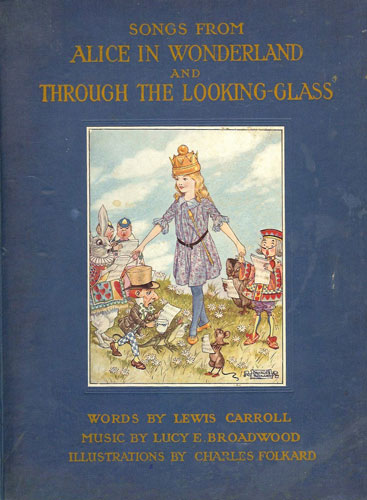
The Project Gutenberg eBook of Songs From Alice in Wonderland and Through the Looking-Glass
Title: Songs From Alice in Wonderland and Through the Looking-Glass
Composer: Lucy Etheldred Broadwood
Author: Lewis Carroll
Illustrator: Charles Folkard
Release date: June 2, 2011 [eBook #36308]
Most recently updated: January 7, 2021
Language: English
Credits: Produced by David Edwards, Linda Cantoni, and the Online
Distributed Proofreading Team at https://www.pgdp.net (This
file was produced from images generously made available
by The Internet Archive.) Music transcribed by Linda
Cantoni.
Transcriber's Note: Click on the [Listen] link to hear the music (midi). Click on the [XML] link to view or download the music notation in MusicXML format. Click on the [PDF] link to view, download, or print sheet music in PDF format.
SONGS FROM
ALICE IN WONDERLAND
AND
THROUGH THE LOOKING-GLASS
[Enlarge]
WORDS BY LEWIS CARROLL
MUSIC BY LUCY E. BROADWOOD
ILLUSTRATIONS BY CHARLES FOLKARD
[Enlarge]
SONGS FROM
ALICE IN WONDERLAND
AND
THROUGH THE LOOKING-GLASS
WORDS BY LEWIS CARROLL
MUSIC BY LUCY E. BROADWOOD
ILLUSTRATIONS BY CHARLES FOLKARD
A. & C. BLACK, LTD., 4, 5 & 6, SOHO SQUARE, LONDON, W. 1.
This Book is published by kind permission of
Messrs. Macmillan & Co., Ltd.
Published, October, 1921.
Contents.
| SONGS FROM ALICE IN WONDERLAND. | |
| PAGE | |
| How doth the little Crocodile | 11 |
| You are Old, Father William | 13 |
| Twinkle, twinkle, little Bat! | 15 |
| Pig and Pepper | 17 |
| The Lobster Quadrille | 19 |
| 'Tis the Voice of the Lobster | 21 |
| Beautiful Soup | 23 |
| The Queen of Hearts | 24 |
| Who Stole the Tarts? | 25 |
| SONGS FROM THROUGH THE LOOKING-GLASS. | |
| Jabberwocky | 29 |
| Tweedledum and Tweedledee | 31 |
| The Walrus and the Carpenter | 33 |
| Humpty, Dumpty | 35 |
| The Message to the Fish | 37 |
| The Lion and the Unicorn | 39 |
| The Aged, Aged Man | 41 |
| Queen Alice | 45 |
| The Fish Riddle | 47 |
| Hush-a-by, Lady | 48 |
It has been found necessary to slightly alter the original arrangement of the songs; "Pig and Pepper" and "Twinkle, twinkle, little Bat!" have been transposed, and "Hush-a-by, Lady" has been placed last instead of before "Queen Alice."
ILLUSTRATIONS IN COLOUR
BY
CHARLES FOLKARD.
| A Mad Tea-party | Frontispiece |
| PAGE | |
| Yet you balance an Eel on the end of your Nose | 12 |
| Speak roughly to your little Boy | 16 |
| The Lobster Quadrille | 18 |
| Beautiful Soup | 22 |
| He took his Vorpal Sword in Hand | 28 |
| The Walrus and the Carpenter | 32 |
| I went and shouted in his Ear | 36 |
| I look for Butterflies that sleep among the Wheat | 40 |
| Then fill up the Glasses with Treacle and Ink | 44 |
| The Fish Riddle | 46 |
| Alice and her Friends | On the Cover |
Songs from
Alice in Wonderland
How doth the little Crocodile
|
How doth the little crocodile Improve his shining tail, And pour the waters of the Nile On ev'ry golden scale! How cheerfully he seems to grin, How neatly spreads his claws, And welcomes little fishes in With gently smiling jaws! |
[Enlarge]
You are old, Father William
|
"You are old, Father William," the young man said, "And your hair has become very white; And yet you incessantly stand on your head— Do you think, at your age, it is right?" "In my youth," Father William replied to his son, "I feared it might injure the brain; But, now that I'm perfectly sure I have none, Why I do it again and again." |
|
"You are old," said the youth, "as I mentioned before, And have grown most uncommonly fat; Yet you turned a back-somersault in at the door— Pray, what is the reason of that?" "In my youth," said the sage, as he shook his grey locks, "I kept all my limbs very supple By the use of this ointment—one shilling the box— Allow me to sell you a couple." "You are old," said the youth, "and your jaws are too weak For anything tougher than suet; Yet you finished the goose, with the bones and the beak— Pray, how did you manage to do it?" "In my youth," said his father, "I took to the law, And argued each case with my wife; And the muscular strength which it gave to my jaw, Has lasted the rest of my life." "You are old," said the youth; "one would hardly suppose That your eye was as steady as ever; Yet you balance an eel on the end of your nose— What made you so awfully clever?" "I have answered three questions, and that is enough," Said his father; "don't give yourself airs! Do you think I can listen all day to such stuff? Be off, or I'll kick you down stairs!" |
Twinkle, twinkle, little Bat
|
Twinkle, twinkle, little bat! How I wonder what you're at! Up above the world you fly, Like a tea-tray in the sky! |
[Enlarge]
Pig and Pepper
|
"Speak roughly to your little boy, And beat him when he sneezes; He only does it to annoy, Because he knows it teases." Wow! Wow! Wow! "I speak severely to my boy, I beat him when he sneezes; For he can thoroughly enjoy The pepper when he pleases." Wow! Wow! Wow! |
[Enlarge]
The Lobster Quadrille
|
"Will you walk a little faster?" said a whiting to a snail, "There's a porpoise close behind us, and he's treading on my tail. See how eagerly the lobsters and the turtles all advance! They are waiting on the shingle—will you come and join the dance? Will you, won't you, will you, won't you, will you join the dance? Will you, won't you, will you, won't you, won't you join the dance?" |
|
"You can really have no notion how delightful it will be When they take us up and throw us, with the lobsters, out to sea!" But the snail replied, "Too far, too far!" and gave a look askance— Said he thanked the whiting kindly, but he would not join the dance. Would not, could not, would not, could not, would not join the dance. Would not, could not, would not, could not, could not join the dance. "What matters it how far we go?" his scaly friend replied; "There is another shore, you know, upon the other side. The further off from England the nearer is to France— Then turn not pale, belovèd snail, but come and join the dance. Will you, won't you, will you, won't you, will you join the dance? Will you, won't you, will you, won't you, won't you join the dance?" |
’Tis the Voice of the Lobster
|
'Tis the voice of the lobster; I heard him declare, "You have baked me too brown, I must sugar my hair." As a duck with its eyelids, so he with his nose Trims his belt and his buttons, and turns out his toes. |
[Enlarge]
Beautiful Soup
|
Beautiful soup, so rich and green, Waiting in a hot tureen! Who for such dainties would not stoop? Soup of the ev'ning, beautiful soup! Soup of the ev'ning, beautiful soup! Beautiful soo-oop! Beautiful soo-oop! Soo-oop of the e-e-ev'ning, Beautiful, beautiful soo-oo-oop! "Beautiful soup! Who cares for fish, Game, or any other dish? Who would not give all else for two p- ennyworth only of beautiful soup! Pennyworth only of beautiful soup! Beautiful soo-oop! Beautiful soo-oop! Soo-oop of the e-e-ev'ning, Beautiful, beautiful soo-oo-oop!" |
Transcriber's Note: The hyphen at the end of the third line of the second verse is deliberate in the original, so that "two p-" pronounced as one syllable rhymes with "soup."
The Queen of Hearts
|
The Queen of Hearts, she made some tarts, All on a summer day: The Knave of Hearts, he stole those tarts, And took them quite away! |
Who stole the Tarts
|
They told me you had been to her, And mentioned me to him: She gave me a good character, But said I could not swim. He sent them word I had not gone (We know it to be true): If she should push the matter on, What would become of you? I gave her one, they gave him two, You gave us three or more; They all returned from him to you, Though they were mine before. If I or she should chance to be Involved in this affair, He trusts to you to set them free, Exactly as we were. My notion was that you had been (Before she had this fit) An obstacle that came between Him, and ourselves, and it. Don't let him know she liked them best, For this must ever be A secret, kept from all the rest, Between yourself and me. |
Songs from
Through the Looking-Glass
[Enlarge]
Jabberwocky
|
'Twas brillig, and the slithy toves Did gyre and gimble in the wabe; All mimsy were the borogoves, And the mome raths outgrabe. "Beware the Jabberwock, my son! The jaws that bite, the claws that catch! Beware the Jubjub bird, and shun The frumious Bandersnatch!" |
|
He took his vorpal sword in hand: Long time the manxome foe he sought— So rested he by the Tumtum tree, And stood awhile in thought. And as in uffish thought he stood, The Jabberwock, with eyes of flame, Came whiffling through the tulgey wood, And burbled as it came. One, two! One, two! And through and through The vorpal blade went snicker-snack! He left it dead, and with its head He went galumphing back. "And hast thou slain the Jabberwock?— Come to my arms, my beamish boy! O frabjous day! Callooh! Callay!" He chortled in his joy. 'Twas brillig, and the slithy toves Did gyre and gimble in the wabe; All mimsy were the borogoves, And the mome raths outgrabe. |
Tweedledum and Tweedledee
|
Tweedledum and Tweedledee Agreed to have a battle; For Tweedledum said Tweedledee Had spoiled his nice new rattle. Just then flew down a monstrous crow, As black as a tar barrel; Which frightened both the heroes so, They quite forgot their quarrel. |
[Enlarge]
The Walrus and the Carpenter
|
The sun was shining on the sea, Shining with all his might: He did his very best to make The billows smooth and bright— And this was odd, because it was The middle of the night. The moon was shining sulkily, Because she thought the sun Had got no bus'ness to be there After the day was done— "It's very rude of him," she said, "To come and spoil the fun!" The sea was wet as wet could be, The sands were dry as dry. You could not see a cloud, because No cloud was in the sky: No birds were flying overhead— There were no birds to fly. The Walrus and the Carpenter Were walking close at hand; They wept like anything to see Such quantities of sand: "If this were only cleared away," They said, "it would be grand!" "If seven maids with seven mops Swept it for half a year, Do you suppose," the Walrus said, "That they could get it clear?" "I doubt it," said the Carpenter, And shed a bitter tear. "O, Oysters, come and walk with us!" The Walrus did beseech, "A pleasant walk, a pleasant talk, Along the briny beach: We cannot do with more than four, To give a hand to each." The eldest Oyster looked at him, But never a word he said: The eldest Oyster winked his eye, And shook his heavy head— Meaning to say he did not choose To leave the oyster-bed. But four young Oysters hurried up, All eager for the treat: Their coats were brushed, their faces washed, Their shoes were clean and neat— And this was odd, because, you know, They hadn't any feet! Four other Oysters followed them, And yet another four; And thick and fast they came at last, And more, and more, and more— All hopping through the frothy waves, And scrambling to the shore. |
|
The Walrus and the Carpenter Walked on a mile or so, And then they rested on a rock Conveniently low; And all the little Oysters stood And waited in a row. "The time has come," the Walrus said, "To talk of many things: Of shoes—and ships—and sealing-wax— Of cabbages—and kings— And why the sea is boiling hot— And whether pigs have wings." "But wait a bit," the Oysters cried, "Before we have our chat; For some of us are out of breath, And all of us are fat!" "No hurry," said the Carpenter: They thanked him much for that. "A loaf of bread," the Walrus said, "Is chiefly what we need: Pepper and vinegar, besides, Are very good indeed— Now, if you're ready, Oysters dear, We can begin to feed." "But not on us!" the Oysters cried, Turning a little blue. "After such kindness, that would be A dismal thing to do!" "The night is fine," the Walrus said. "Do you admire the view?" "It was so kind of you to come! And you are very nice!" The Carpenter said nothing, but "Cut us another slice: I wish you were not quite so deaf— I've had to ask you twice!" "It seems a shame," the Walrus said, "To play them such a trick, After we've brought them out so far, And made them trot so quick!" The Carpenter said nothing, but "The butter's spread too thick!" "I weep for you," the Walrus said: "I deeply sympathize." With sobs and tears he sorted out Those of the largest size, Holding his pocket-handkerchief Before his streaming eyes. "Oh, Oysters," said the Carpenter, "You've had a pleasant run! Shall we be trotting home again?" But answer came there none— And this was scarcely odd, because They'd eaten every one. |
Humpty Dumpty
|
Humpty Dumpty sat on a wall: Humpty Dumpty had a great fall. All the King's horses and all the King's men Couldn't put Humpty Dumpty in his place again. |
[Enlarge]
The Message to the Fish
|
In winter, when the fields are white, I sing this song for your delight— In spring, when woods are getting green, I'll try and tell you what I mean. In summer, when the days are long, Perhaps you'll understand the song: In autumn, when the leaves are brown, Take pen and ink, and write it down. |
|
I sent a message to the fish: I told them "This is what I wish." The little fishes of the sea They sent an answer back to me. The little fishes' answer was "We cannot do it, sir, because—" I sent to them again to say "It will be better to obey." The fishes answered, with a grin, "Why, what a temper you are in!" I told them once, I told them twice: They would not listen to advice. I took a kettle large and new, Fit for the deed I had to do. My heart went hop, my heart went thump; I filled the kettle at the pump. Then some one came to me, and said, "The little fishes are in bed." I said to him, I said it plain, "Then you must wake them up again." I said it very loud and clear; I went and shouted in his ear. But he was very stiff and proud; He said, "You needn't shout so loud!" And he was very proud and stiff; He said, "I'd go and wake them, if—" I took a corkscrew from the shelf: I went to wake them up myself. And when I found the door was locked, I pulled and pushed, and kicked and knocked. And when I found the door was shut, I tried to turn the handle, but— |
The Lion and the Unicorn
|
The Lion and the Unicorn were fighting for the Crown: The Lion beat the Unicorn all round the town. Some gave them white bread, some gave them brown; Some gave them plum cake, and drummed them out of town. |
[Enlarge]
The Aged, Aged Man
Tune "I give thee all, I can no more," adapted by T. Moore
from H. Bishop, arranged by L. Broadwood.