
About This Book
A systematic survey of acoustics that explains how sound arises from alternating condensations and rarefactions and propagates through air, gases, liquids, and solids, supported by classical and laboratory experiments. It treats reflection, refraction, diffraction, echoes, and the influences of temperature and density on wave velocity, drawing on Newtonian and Laplacian analyses and connections to specific heats and thermal effects. The text distinguishes noise from musical tone, addresses pitch and hearing limits, and analyzes vibrating systems—strings, rods, plates, tuning-forks, and sirens—covering nodes, harmonics, timbre, optical methods for visualizing vibrations, and practical implications for instruments and materials.
About the Author
More Books by This Author
6 picks
 Address delivered before the British Association assembled at Belfast
by John Tyndall
Address delivered before the British Association assembled at Belfast
by John Tyndall
 Essays on the use and limit of the imagination in science
by John Tyndall
Essays on the use and limit of the imagination in science
by John Tyndall
 Faraday as a Discoverer
by John Tyndall
Faraday as a Discoverer
by John Tyndall
 Fragments of Science: A Series of Detached Essays, Addresses, and Reviews. V. 1-2
by John Tyndall
Fragments of Science: A Series of Detached Essays, Addresses, and Reviews. V. 1-2
by John Tyndall
 Hours of Exercise in the Alps
by John Tyndall
Hours of Exercise in the Alps
by John Tyndall
 Six Lectures on Light / Delivered In The United States In 1872-1873
by John Tyndall
Six Lectures on Light / Delivered In The United States In 1872-1873
by John Tyndall
You May Also Like
6 picks
 A Brief Account of Radio-activity
by F. P. Venable
A Brief Account of Radio-activity
by F. P. Venable
 A Brief History of Element Discovery, Synthesis, and Analysis
by Glen W. Watson
A Brief History of Element Discovery, Synthesis, and Analysis
by Glen W. Watson
 A Budget of Paradoxes, Volume I
by Augustus De Morgan
A Budget of Paradoxes, Volume I
by Augustus De Morgan
 A Color Notation / A measured color system, based on the three qualities Hue, Value and Chroma
by A. H. Munsell
A Color Notation / A measured color system, based on the three qualities Hue, Value and Chroma
by A. H. Munsell
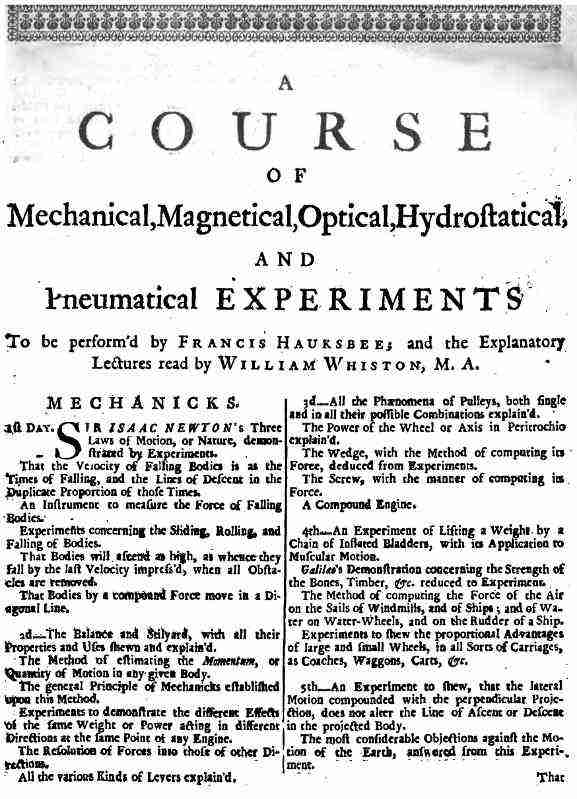 A Course of Mechanical, Magnetical, Optical, Hydrostatical and Pneumatical Experiments / perform'd by Francis Hauksbee, and the Explanatory Lectures read by William Whiston, M.A.
by William Whiston
A Course of Mechanical, Magnetical, Optical, Hydrostatical and Pneumatical Experiments / perform'd by Francis Hauksbee, and the Explanatory Lectures read by William Whiston, M.A.
by William Whiston
 A Discourse Presented to the Most Serene Don Cosimo II., Great Duke of Tuscany, Concerning the Natation of Bodies Vpon, and Submersion In, the Water.
by Galileo Galilei
A Discourse Presented to the Most Serene Don Cosimo II., Great Duke of Tuscany, Concerning the Natation of Bodies Vpon, and Submersion In, the Water.
by Galileo Galilei