
The Project Gutenberg eBook of South America: Observations and Impressions
Title: South America: Observations and Impressions
Author: Viscount James Bryce Bryce
Release date: June 14, 2014 [eBook #45961]
Most recently updated: October 24, 2024
Language: English
Credits: Produced by David Edwards, Charlie Howard, and the Online
Distributed Proofreading Team at http://www.pgdp.net (This
file was produced from images generously made available
by The Internet Archive)
Transcriber's note:
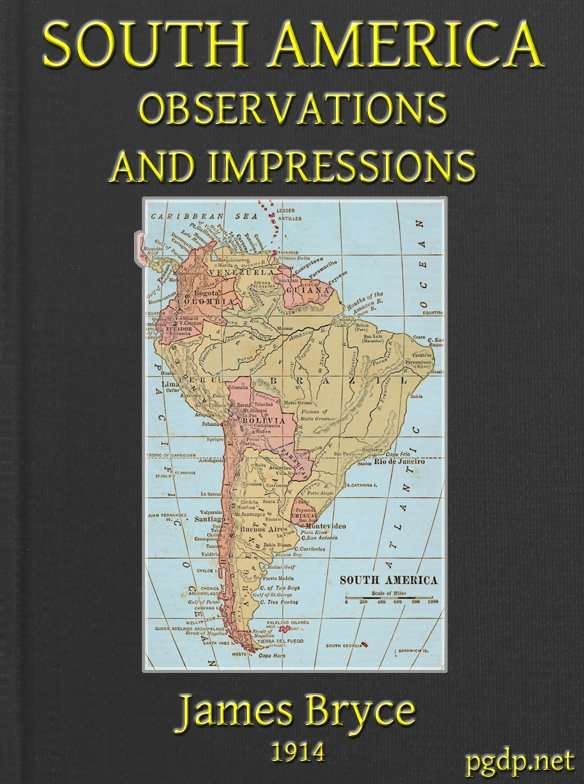
Cover created by Transcriber, using an illustration from the original book, and placed in the Public Domain.
Other Transcriber notes will be found near the end of this eBook.
SOUTH AMERICA
THE MACMILLAN COMPANY
NEW YORK · BOSTON · CHICAGO
DALLAS · SAN FRANCISCO
MACMILLAN & CO., Limited
LONDON · BOMBAY · CALCUTTA
MELBOURNE
THE MACMILLAN CO. OF CANADA, Ltd.
TORONTO
SOUTH AMERICA
OBSERVATIONS AND IMPRESSIONS
BY
JAMES BRYCE
AUTHOR OF "THE HOLY ROMAN EMPIRE"
"THE AMERICAN COMMONWEALTH," ETC.
WITH MAPS
NEW EDITION CORRECTED AND REVISED
New York
THE MACMILLAN COMPANY
1914
All rights reserved
Copyright, 1912, 1914,
By THE MACMILLAN COMPANY.
Set up and electrotyped. Published September, 1912.
Reprinted October, November, December, 1912; January, 1913.
New revised edition, February, 1914.
Norwood Press
J. S. Cushing Co.—Berwick & Smith Co.
Norwood, Mass., U.S.A.
TO MY FRIENDS OF THE
ENGLISH ALPINE CLUB
PREFACE
This book records observations made and impressions formed during a journey through western and southern South America from Panama to Argentina and Brazil via the Straits of Magellan. The nature of its contents is briefly outlined in the Introduction which follows, so all that I have to do here is to acknowledge gratefully the many kindnesses I received in every part of South America which I visited, and in particular from the following persons: Colonel Goethals, Chief Engineer of the Panama Canal, and other officers of the United States engineers stationed there, and Colonel Gorgas, head of the medical staff; the officials of the Peruvian Corporation in Lima and of the Peruvian Southern Railways in Mollendo, Arequipa, and La Paz; the officials of the Antofagasta and Bolivia Railroad Company; those of the Transandine Railway Company in Chile and those of the Buenos Aires and Pacific and Argentine Great Western Railways Companies in Mendoza and Buenos Aires, and also those of the Leopoldina Railway in Brazil. Nor must I fail to express my obligations to the heads in New York of the firm of Messrs. W. R. Grace Co., who advised me regarding my journey, and to my friend Professor Bingham of Yale University, who, familiar with South America from his own travels and studies, has given me valuable help in many ways.
I have also to return my respectful thanks to the Governments of Chile and Brazil, who were good enough to extend to me facilities for travel on their railways, and to the Governments of Peru, Bolivia, Argentina, and Uruguay for other courtesies. To many statesmen and scholars in these six republics, too numerous to mention by name, as also to not a few of my own fellow-countrymen from Britain and Canada who are there settled, I am indebted for hospitality, for private acts of kindness, and for valuable information.
JAMES BRYCE.
June 27, 1912.
NOTE TO REVISED EDITION
This edition has been carefully revised and many corrections have been made in it.
February 26th, 1913.
TABLE OF CONTENTS
| PAGE | |
| Preface | vii |
| Introduction | xvii |
| CHAPTER I | |
| THE ISTHMUS OF PANAMA | |
| The Part of the Isthmus and the Strait in History | 1 |
| The Isthmus of Suez and the Isthmus of Panama: The Route from Colon to Culebra and Panama | 2 |
| View from the Hill of Ancon | 9 |
| The Natives of the Isthmus: The San Blas Indians | 13 |
| The English Raiders: Drake and Morgan | 15 |
| The Canal: Gatun Locks and Lake | 19 |
| The Great Cutting at Culebra | 24 |
| Administration and Sanitation of the Canal Zone | 26 |
| Failure of the French Undertaking due Primarily to Disease | 28 |
| Commercial Prospects of the Canal | 33 |
| General Impressions made by the Isthmus and the Canal | 35 |
| CHAPTER II | |
| THE COAST OF PERU | |
| Cold Climate of the West Coast | 37 |
| The Antarctic Current | 38 |
| Aridity and Barrenness of the Peruvian Coast | 39 |
| Payta: The Guano Islands | 40 |
| Lima: General Aspect and Buildings | 46 |
| Life and Society in Lima | 51 |
| Mollendo and the Peruvian Southern Railway | 54 |
| First View of the Andes | 56 |
| The Desert of Western Peru | 57 |
| The City of Arequipa | 60 |
| The Volcano of El Misti | 61 |
| Oriental Aspect of Arequipa | 64 |
| Character of the People of Arequipa | 66 |
| A Story from Colonial Days | 69 |
| CHAPTER III | |
| CUZCO AND THE LAND OF THE INCAS | |
| Physical Character of Peru | 75 |
| Crossing of the Andes from Arequipa to the Central Plateau of Lake Titicaca | 80 |
| Scenery of the Valley from the Plateau to Cuzco | 81 |
| One of the Sources of the Amazon | 86 |
| Market Day at Sicuani: The Quichua Indians | 88 |
| Cuzco: Its Situation and Aspect | 95 |
| The Spanish Buildings at Cuzco | 96 |
| The Ancient Buildings: Inca Walls | 102 |
| The Prehistoric Fortress of Sacsahuaman | 107 |
| Impression made by the Remains of Ancient Peruvian Work | 114 |
| Historical Associations of Cuzco | 114 |
| [Note on the Fortress Walls of Sacsahuaman] | 118 |
| CHAPTER IV | |
| LAKE TITICACA AND THE CENTRAL ANDES | |
| The Central Plateau and the Lake | 119 |
| Inhabitants of the Plateau: The Aymará Indians | 121 |
| Scenery of Lake Titicaca | 124 |
| The Shrine of Copacavana | 128 |
| Voyage to the Sacred Islands | 130 |
| Koati: The Island of the Moon | 131 |
| The Island of the Sun | 132 |
| The Bath and Garden of the Inca | 133 |
| The Sacred Rock of the Wild Cat | 135 |
| View of the Snowy Range of Sorata or Illampu | 141 |
| The Lake of Vinamarca | 143 |
| Tiahuanaco and its Ruins | 144 |
| Impression made by the Ruins | 147 |
| Character of the Ancient Peruvian Civilization | 152 |
| The Primitive Religion of Peru | 156 |
| Government and the Policy of the Incas | 160 |
| CHAPTER V | |
| LA PAZ AND THE BOLIVIAN DESERT | |
| Origin of the Bolivian Republic | 166 |
| General Physical Character of Bolivia | 167 |
| Approach to La Paz: The Barranca | 168 |
| Climate of La Paz: The Mountain Sickness or Soroche | 171 |
| The City and its Environs | 174 |
| Character and Habits of the Bolivian Indians | 179 |
| The Plateau from La Paz to Oruro | 186 |
| Uyuni: The Great Bolivian Desert | 191 |
| Passage through the Andes | 198 |
| The Borax Lake and the Volcanoes | 199 |
| View of the Western Cordillera | 203 |
| The Desert of Atacama | 204 |
| CHAPTER VI | |
| CHILE | |
| The Three Regions of Chile | 206 |
| Northern Chile: The Nitrate Fields | 207 |
| Megillones and Antofagasta | 210 |
| Valparaiso | 212 |
| Santiago | 216 |
| Pedro de Valdivia and the Rock of Santa Lucia | 218 |
| Chilean Society and Politics | 220 |
| Southern Chile: Its Climate and Scenery | 223 |
| The Coast Cities: Concepcion and Talcahuano | 225 |
| Lota Valdivia and Corral | 227 |
| The Araucanian Indians: Their History, Customs, and Religion | 232 |
| Osorno and its German Colony | 239 |
| Rio Bueno | 242 |
| Attractiveness of Southern Chile | 241 |
| Lake Rinihue and the Chilean Forests | 244 |
| CHAPTER VII | |
| ACROSS THE ANDES | |
| The Andean Range | 248 |
| The Uspallata Pass from Chile into Argentina | 250 |
| Construction of the Transandine Railway | 251 |
| Scenery on the Chilean Side | 253 |
| The Tunnel under the Summit of the Cordillera | 256 |
| Scenery on the Argentine Side | 256 |
| Aconcagua and Tupungato | 257 |
| The City of Mendoza | 260 |
| Argentines and Chileans | 264 |
| Return across the Mountains and Ascent to the Cumbre | 267 |
| The Christ of the Andes | 269 |
| Observations on the Scenery of the Andes in General | 271 |
| Comparison with the Himalayas | 276 |
| [Note on the Passage of the Andes, in 1817, by the Army of General San Martin] | 280 |
| CHAPTER VIII | |
| THE STRAITS OF MAGELLAN | |
| Discovery of the Straits, and Circumnavigation of the Globe, by Magellan | 284 |
| Voyage of Sir Francis Drake | 286 |
| The Coast of Southern Chile: The Sea-birds | 286 |
| Approach to, and Entrance of, the Straits | 290 |
| The Scenery of the Western Half of the Straits | 291 |
| Punta Arenas and Tierra del Fuego | 300 |
| The Eastern Half of the Straits | 304 |
| General Observations on the Character of the Straits | 305 |
| Their Historical Importance | 307 |
| The Falkland Isles, their Character and Products | 308 |
| Their History | 311 |
| Their Scenery | 313 |
| CHAPTER IX | |
| ARGENTINA | |
| The Approach to Buenos Aires | 315 |
| Aspect of the City | 316 |
| Society in Buenos Aires | 318 |
| Physical Character of Argentina | 324 |
| Inhabitants of Argentina: The Gaucho | 327 |
| Agriculture and Ranching | 329 |
| The Process of Settlement: Labour | 330 |
| The Scenery of the Pampas | 334 |
| Economic Prospects of Argentina | 336 |
| The European Immigrants | 338 |
| Character and Tendencies of Society in Argentina | 341 |
| Argentina the Most Modern of South American Countries | 346 |
| CHAPTER X | |
| URUGUAY | |
| How Uruguay became an Independent Republic | 349 |
| Resources of the Country | 350 |
| The City of Montevideo | 351 |
| Population of Uruguay: Immigrants and Natives | 355 |
| A Revolution in Uruguay | 356 |
| The Whites and the Reds | 357 |
| Causes of the Revolutionary Habit | 358 |
| Prosperity of Uruguay | 362 |
| CHAPTER XI | |
| BRAZIL | |
| How Brazil fell to the Portuguese | 366 |
| Physical Features of the Different Parts of the Country | 368 |
| Voyage from Montevideo to Santos | 370 |
| Santos and the Railway to São Paulo | 372 |
| The City of São Paulo and its People | 374 |
| Approach to Rio de Janeiro | 377 |
| Aspect of Rio: The Bay and the Mountains | 378 |
| Scenery of the Environs of Rio | 382 |
| Petropolis the "Hill Station" of Rio | 384 |
| Excursion through the Mountains | 386 |
| A Brazilian Forest | 390 |
| Naval Mutiny at Rio | 395 |
| Economic Resources of Brazil | 402 |
| The People: German and Italian Immigrants | 405 |
| The Negroes and Indians | 407 |
| Recent History of Brazil | 410 |
| Character and Tendencies of the Brazilians | 416 |
| The Future of Brazil | 420 |
| CHAPTER XII | |
| THE RISE OF NEW NATIONS | |
| The Colonial Empire of Spain divided into Sixteen Republics or Nations | 423 |
| What is a Nation? | 424 |
| Process by which New Nations Arise | 426 |
| The Administrative Divisions of the Colonies the Basis of the Division into Republics | 427 |
| Influences which differentiate Nations | 429 |
| Geographical Position | 429 |
| Physical Environment: Climate | 430 |
| The Aborigines: Their Number and Character | 432 |
| The Struggle for Independence and the Civil Wars | 434 |
| Recent Economic Development: Immigration | 437 |
| Which of the Republics have become Nations? | 438 |
| Chile and Argentina: Mexico, Peru, Brazil | 441 |
| The Caribbean and Central American Republics | 441 |
| Does there exist a Common Sentiment of Spanish-American Nationality? | 444 |
| Will the Present Political Divisions be Maintained? | 447 |
| Prospects of International Peace in South America | 448 |
| CHAPTER XIII | |
| THE RELATIONS OF RACES IN SOUTH AMERICA | |
| Importance of the Aboriginal Element in Spanish-American Countries | 454 |
| How the Native Tribes came to Survive | 455 |
| Probable Present Numbers of the Indian Population | 458 |
| The Indians in Peru and Bolivia | 460 |
| Present State of these Indians, Social and Religious | 460 |
| Ulloa's Report on their Condition in the Eighteenth Century | 463 |
| Universal Illiteracy of the Indians: Their Civil and Political Status | 465 |
| Relations of Indians and Whites: No "Colour Line" in Latin America | 470 |
| How the Presence of the Aborigines has affected the Whites | 475 |
| The Negroes in Brazil | 479 |
| Three General Conclusions regarding the Native Indians of South America | 480 |
| It is not certain that they have injured the White Race by Intermixture | 481 |
| Demoralization of the Peruvian Indians by the Spanish Conquest, and Subsequent Oppression | 481 |
| Racial Repugnance not a Universal Phenomenon in the Relations of Peoples of Different Colour | 482 |
| CHAPTER XIV | |
| THE TWO AMERICAS AND THE RELATION OF SOUTH AMERICA TO EUROPE | |
| Origin of the Name "America" | 484 |
| How it came to be applied to Two Continents | 486 |
| Some Physical Similarities of the Two Continents | 488 |
| Some Similarities in their History | 489 |
| "Teutonic" America and "Latin" America | 490 |
| Divergent History of the Two Americas | 492 |
| The Indians: The Mines: The Settlers | 493 |
| Different Methods of Government | 494 |
| The Two Wars of Independence | 496 |
| The English Colonies held together while the Spanish split Up | 499 |
| What "Teutonic" and Latin America have in Common | 500 |
| The Contrasts between them are More Important | 504 |
| Present Attitude of Spanish Americans to North Americans | 507 |
| Real Affinities of Spanish America are with Some European Peoples | 512 |
| Sympathy and Intercourse with Spain not very Close | 513 |
| Relations are Most Intimate with France | 518 |
| Are the South American Peoples a New Group, with a New "Racial Type"? | 520 |
| CHAPTER XV | |
| THE CONDITIONS OF POLITICAL LIFE IN SPANISH-AMERICAN REPUBLICS | |
| European Views of Spanish America during and after the War of Independence | 524 |
| Physical or Geographical Conditions affecting the Political Life | 527 |
| Racial Conditions: The Aborigines | 528 |
| Economic and Social Conditions | 532 |
| Historical Conditions in the Colonial Period | 534 |
| Historical Conditions during and since the War of Independence | 536 |
| The Peoples of the Republics began with no Experience in the Methods of Free Government | 537 |
| Some Revolutionary Leaders did not approve Democracy | 538 |
| Would Monarchy or Oligarchy have been Better? | 540 |
| Differences between the existing Republics: Three Classes of States | 541 |
| Some have truly Republican Governments | 543 |
| Influences making for Political Progress | 546 |
| European Judgments on Spanish-American Republic unduly Severe | 550 |
| CHAPTER XVI | |
| SOME REFLECTIONS AND FORECASTS | |
| Rapid filling up of the Cultivable Areas of the World | 552 |
| Regions available for Settlement in South America | 555 |
| The Temperate Regions | 556 |
| The Selvas of the Amazonian Plain | 558 |
| Possible Future Population of South America | 563 |
| Elements, Aboriginal and White, in the Population | 564 |
| Phenomena of Race Intermixture in South America | 566 |
| No Predominant Type in the South American Peoples | 568 |
| Spanish Americans misjudged because their Conditions at Time of Independence were not Understood | 570 |
| Evidences of Social and Political Advancement | 573 |
| South America has suffered from Want of Intellectual Contact with Other Countries | 574 |
| The Spanish Race stronger on the Practical than on the Intellectually Creative Side | 577 |
| Backwardness of Knowledge and Intelligence in the Rural Parts of Spanish America | 580 |
| Decline in the Influence of the Church and Religion | 582 |
| Continued Vigour of the Spanish-American Race | 584 |
| Note I. Some Books upon Latin America | 587 |
| Note II. A Few Remarks on travelling in South America | 588 |
| Index | 591 |
| Maps.
South America. The Isthmus of Panama. Parts of Peru and Bolivia. The Straits of Magellan. Parts of Argentina, Uruguay, and Brazil. | |
INTRODUCTION
Whoever read as a boy the books of old travellers in the Andes, such as Humboldt's Aspects of Nature, or pored over such accounts of the primitive American peoples as are given in Prescott's Conquest of Peru must have longed to visit some day the countries that fired his imagination. These had been my experiences, and to them there was subsequently added a curiosity to learn the causes which produced so many revolutions and civil wars in Spanish America, and, still later, a sense that these countries, some of them issuing from a long period of turbulence, were becoming potent economic factors in the modern world. So when after many years the opportunity of having four clear months for a journey to South America presented itself, I spent those months in seeing as much as I could within the time, and was able to make some observations and form certain impressions regarding the seven republics I visited. These observations and impressions are contained in the following pages. They are, of course, merely first impressions, but the impressions which travel makes on a fresh mind have their value if they are tested by subsequent study and by being submitted to persons who know the country thoroughly. I have tried so to test these impressions of mine, and hope they may be of service to those who desire to learn something about South America, but have not time to peruse the many books of travel that have been written about each of its countries.
The chief points of interest which these countries have for Europeans and North Americans may be summed up as follows:—
1. The aspects of nature.
2. The inhabitants, the white part of whom are of Spanish origin, except the Brazilians, who come from Portugal.
3. The economic resources of the several countries.
4. The prospects for the development of industry and commerce.
5. The relics of prehistoric civilization.
6. The native Indian population.
7. The conditions of political life in the several republics.
It may be convenient that I should explain how far and in what order each of these topics is dealt with.
The first eleven chapters of the book contain a description of what I saw of scenery and of social and economic phenomena in the seven republics of Panama, Peru, Bolivia, Chile, Argentina, Uruguay, and Brazil, and in these chapters the first three of the above-mentioned subjects are dealt with when and as each country is described. It is Nature that chiefly engages the traveller's mind in Peru and Bolivia, as it is economic development which interests him in Argentina and Uruguay. In Chile and Brazil he must be always thinking of both. The fourth topic has been treated so fully by many writers who have brought special knowledge to it and have written professedly for the information of business men, that I have not thought it necessary to fill this book with statistical tables or, indeed, to do more than indicate the possibilities for commercial development or agricultural immigration which the natural resources of each country seem to promise.
It is only in Peru and Bolivia that any prehistoric monuments exist. Some of the most important and interesting of these I saw, and in describing them I have endeavoured to convey an idea of the character of the ancient Peruvian civilization (if that name can properly be applied to it) and of the people who produced it. This is done in Chapters III, IV, and V.
Only in Peru, Bolivia, and Chile did I have opportunities of seeing the native Indians. In the two former states they constitute a part of the total population far larger than in any other state (except Paraguay): they are nominally Christians, and they lead a settled agricultural life. In Chile there is only one considerable Indian tribe remaining, the famous Araucanians. Of these warriors, of the Quichuas in Peru and of the Aymarás in Bolivia, some account will be found in Chapters III to VI.
In the above-mentioned eleven descriptive chapters I have endeavoured to individualize, so to speak, the chief countries of South America, so as to bring out the chief characteristics, natural and human, of each of them.
But marked as are the differences between the various republics, they have all something in common, something that belongs to South America as opposed to Europe or North America or Australia. There are also certain general questions affecting the whole Continent which present themselves to the traveller's mind and need to be discussed upon broad and general lines. To these questions the last five chapters of the book have been devoted. One chapter endeavours to indicate the causes which have divided the vast Spanish-American dominion (including Mexico and Central America) as it stood in A.D. 1810 into the sixteen independent republics of to-day, some of which have become, others of which are becoming, true nations with marked national characteristics. Another chapter deals with the relations to the white population of the aborigines in the Spanish countries and of the negroes in Brazil, the only state in which negroes are numerous. It is a subject of study all the more interesting because these relations are altogether different from those borne by the European element to the coloured races in the British colonies, in India, and in the United States of North America, and also because the intermixture of races which is now going on in South America suggests physiological and ethnological problems of high interest.
A third chapter (Chapter XIV) briefly compares the conditions of settlement and of government which determined the course of economic and political development in North and in South America respectively and enquires how far the latter Continent is to be considered any more closely related to the former than it is to Europe. Is there, in fact, such a thing as that which the word Pan-Americanism is intended to describe, or does the expression denote an aspiration rather than a fact?
Of the political history of these republics very little is said in this book, and of their current politics nothing at all. That is a topic on which it would not be fitting for me to enter. But in travelling through the seven countries, in observing their physical features and the character of their people, and the state of knowledge and education among them, as well as in reading accounts of the kind of administration which the Spanish Crown gave them during nearly three centuries, I was struck by the influence which all these facts must have had upon the free governments which the Revolutionary leaders tried to set up when they broke away from the mother country. The history of Spanish America since 1810 cannot be understood or fairly judged, without taking these things into account. They have been the fundamental and determinative conditions of political life in these countries; and to them Chapter XV has been devoted.
In the last Chapter (XVI) I have touched upon several subjects relating to the South American lands and peoples in general for which no appropriate earlier place could be found, and have indulged in a few conjectures as to the future both of the several states and of the Continent as a whole. These are not meant as predictions, but rather as suggestions of possibilities which may serve to set others thinking.
Lest some of the views presented, especially those regarding the native races and political conditions should be deemed unduly optimistic, let me try to meet any such criticism by a few words on optimism in general.
Pessimism is easier than optimism, as it is easier to destroy than to construct. There was an old dictum in the Middle Ages, "Omnia tendunt naturaliter in non esse,"1 and Mephistopheles in Goethe's Faust tells us that