
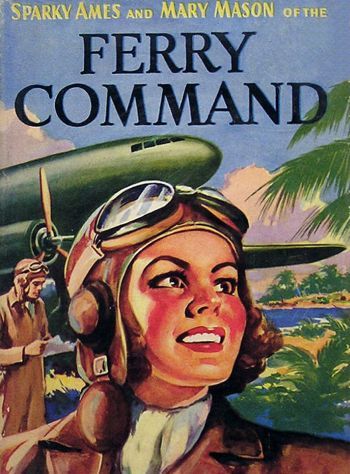
“Captain Ramsey, This Is My Daughter, Mary.”
“Mary,” he said, “you must be starved, dead for sleep, and—”
“And visibly shaken,” she added. “Yes, all of that and more. You’d never believe it, but we did away with two desert rats on this trip.”
“That’s right,” Sparky, who had just come up, agreed. “One yellow rat and one that was a doubtful white.”
“Tell us,” Ramsey demanded.
“Not now,” Mary pleaded. “Perhaps not ever.”
“I just wanted to say,” Sparky broke in, “that we’ll be here until three tomorrow morning. Our next hop is a long one and that burned engine needs a going over.”
“Oh! Hours of rest!” Mary nearly collapsed in her father’s arms. “You’ll never know what that means.”
“I’ll leave you now,” Burt Ramsey saluted. “Shall I see you at Waltz Time tonight?”
“Waltz Time on the radio?” Mary stared.
“No, indeed. Waltz Time on a very good floor and with an orchestra that lifts its hat to none.”
“Oh!” she breathed, “That will be too much.”
“Just the change you need,” her father encouraged. “You can do a man’s work, but no woman can be a man all the time.”
“All right, then, it’s a date.” She put out a hand. “Father and I will be there.”
Once again the Captain saluted, then, turning about, he marched away.
After taking her overnight bag from the plane, Mary climbed into a big car beside her father and went rolling away.
“This is like old times,” she sighed.
“I wish you were staying a week.” He drew a long breath. “That, of course, is out. That big flight of four-motored bombers went through here yesterday.”
“Our flight.”
“Yes, I suppose so. Thirty-eight planes. And they were burning up the air. Looks as if something big were in the making over the air of China.”
“Or Tokio.”
“That’s what everyone is hoping, but no one really knows.”
“Did you see our flight leader?” she asked.
“Yes, indeed. They took on gas here. He was very much concerned about your plane, and—” his voice dropped, “about your cargo. Made me promise you fighter protection across the Arabian Desert.”
“Fighter protection. Hmm—we could have used some today.”
“You’ll have the very best tomorrow. Captain Ramsey is going as fighter flight commander. He’ll have three men with him.”
“Oh! That will be wonderful,” she enthused. “Even if we don’t run into trouble.”
“Well, here we are. This is where I live.” He brought the car to a stop before a beautiful little chateau.
“Some class!” she exclaimed. “How about my staying on as your cook?”
“The cooking is taken care of. I’ll give you a job as hostess after your journey’s end.”
“Nope. Not interested. I’m in for the duration.”
“Good girl.” He took her bag. “We’ll find you a cool, dark room to sleep in and call you in time for dinner. How’s that?”
“Nothing could be sweeter.”
She was awake and dressed for dinner before he called her and, in spite of the ordeals of the day, felt quite refreshed and ready for anything.
“Here’s a party dress I managed to pick up for you,” her father said, holding out a creation of thin, dark blue trimmed with some strange Syrian lace. “Bought it from a Syrian peddler. It’s the real McCoy.”
“Oh! Dad! It’s lovely! But for just one night! It must have cost a fortune!”
“Not so great a fortune,” was his smiling reply. “Besides, in times like these, when we live so fast, one night of perfect happiness can be treasured for days on end.”
“One night of happiness,” she repeated softly. “That sounds wonderful!”
“I’m hoping it may be wonderful. The dance is to be held at the Officers’ Club, quite a splendid place. It’s really a British affair, but we’re all in on it, just as we are in the big fight. Once a week officers motor from long distances and bring the ladies. The Colonel’s lady,” he laughed. “I tried to get your partner Sparky in on the dance,” he added. “He turned me down, said he needed the time for getting the plane in shape, but he did promise to have dinner with us.”
“Dad, he’s wonderful, Sparky is,” Mary enthused. “The only trouble with him is,” a wistful note stole into her voice, “he’s just a machine, like those engines he watches so carefully.”
“You’re lucky to have a partner like that. There’s only one in a hundred like him. You could fly all the way around the world with him.”
“Looks as if we might do just that.”
“Your destination is China?”
“Yes.”
“What route do you take on your return to America?”
“I—I’m afraid we never gave it a thought. Our journey’s end comes first.”
“Yes, of course. You’ll return by way of Australia or Alaska perhaps.”
“Either will be thrilling.”
“And dangerous. Well, now,” his voice changed, “get on your party dress and we’ll be on our way.”
A maid appeared from nowhere. She had, in truth, been borrowed from a beauty parlor. When she looked at herself in the glass after the maid had done her work, Mary gasped, then experienced a sinking feeling about her knees.
“Sparky,” she thought. “He’ll put on his everyday coat and come strolling over to the club for dinner. It’s a shame. I wish I could wear my uniform with a few spots on it!”
But then, perhaps she did not know Sparky. Or was it young Captain Ramsey who had engineered the transformation? Be that as it may, as she entered the club, she looked Sparky up and down for a full ten seconds before she knew him.
“Sparky! You old rogue!” she exclaimed. “Why! You’re actually handsome! I’d like to—” She advanced toward him with shining eyes.
Blushing, Sparky backed away. “It says in the Bible,” he drawled, “that you should let your moderation appear before all men. You’re not looking so bad yourself,” he added in a low tone, “but, pardner, this is no sort of armor for a fightin’ fool. When do we eat?”
Colonel Mason led them to a table in the corner where the lights were subdued, and there they took their places, Mary, Sparky, Ramsey, and the Colonel.
The food, Mary discovered, was wonderful. “Lend-Lease?” she whispered to her father.
“Something like that,” he smiled. “However it gets here, it’s deserved. All the men you see here, British, French, or American, are on active duty. Most of them are fliers. Some have just returned from Tunisia where they have been on duty for long weeks. Half their squadron was shot down. Some are guarding the airways, as Captain Ramsey will be doing tomorrow. Almost every day some fine fellow fails to return—”
“But they seem so happy and cheerful.” Her eyes swept the large room filled with laughing, chattering men and their ladies.
“Certainly. What do you ask?” was the quick reply. “You just must believe in your luck and keep your sense of humor. You, who have come a long way, should know that.”
“Yes—” she agreed. “Yes, of course, I know it.”
Just then young Captain Ramsey claimed her attention. For the next half hour he held it. While the Colonel and Sparky were busy comparing notes on the performance of various types of airplanes, she and Ramsey talked and laughed as they compared notes on the lives they had lived before the war descended upon them.
“It will never be the same,” she sighed at last.
“Of course it won’t,” he agreed. “But do you really wish it?”
“I—I don’t know,” she hesitated.
“Of course you don’t. None of us does. We’ve been whirled completely out of that world. When we get back, if we do—” his voice fell, “then’s the only time we’ll really know what we want. That’s why I say, ‘forget the post-war problems. Let’s get on with the war.’ We—”
“Look!” She gripped his arm. “There’s an Arab. The head-waiter is bringing him this way. Oh, I’m scared.”
“Arabs are harmless enough.” He gave her a questioning look.
“Not all who pass as Arabs are harmless,” she insisted. There was no time for explaining. The Arab, with the head-waiter at his elbow, had arrived at their table.
CHAPTER IX
A ROLL OF PAPYRUS
“I tried to tell him, sir, that it was not right that he should come in,” the polite waiter apologized to the Colonel, Mary’s father. “I said it is not convenient, it is not allowed, but he would come.”
“It’s all right, Pierre,” the Colonel spoke quietly. “What is it you wish?” He turned to the Arab.
“Oh! Sir, if you knew.” The Arab spoke English without a flaw. “You are interested in Egypt, all her past,—”
“Yes, yes, I know, but—”
“It is this.” The man drew something from beneath his robe. Both Sparky and Ramsey half rose in their places, then settled back for, the Arab’s fingers, long and thin, held what appeared to be a roll of paper.
Taking the roll, the Colonel removed the outer layer of green paper, of a peculiar tint, then examined the dull, gray roll beneath.
“Is it papyrus?” he asked.
“Yes, Colonel,” came in a whisper. “From an ancient tomb. It is, I believe, three thousand years old.”
The Colonel made no reply. Instead he took from his pocket a small, powerful magnifying glass.
Mary, who was watching the Arab, saw a sudden look of fear pass over his face. It was little more than a flitting shadow, yet she was to recall it in the days to come.
“Yes,” said the Colonel after a minute examination of the roll, “it is papyrus. Beyond a doubt it is quite old. And I suppose you want to sell it?”
“Oh, no! No! No!” The man’s face was twisted into a look of terror. “It is not for me to sell. I must send it to Dr. Spinka. He is a great Egyptologist. His home is in America.”
“But I am not returning to America. Perhaps I shall never return.”
“Ah, yes, but the young lady—” The Arab leaned forward, hiding the roll under his long robe. “She is but a visitor. Is it not so? She will return very soon. Is this not true?”
“Perhaps.” The Colonel spoke slowly. “What do you say, Mary? Will you accept the responsibility?”
“No!” was the quick response. “How could I? Even my own life is not safe. Only today—”
“Ah! Yes, it is true,” the Arab broke in, “today, yes, but the miserable wretch who threatened your life is dead.”
“What? How did you find this out?” Sparky demanded.
“Not so loud, my friend,” the Arab spoke in a hoarse whisper, at the same time completely covering the roll. “There are those who would kill me for having this roll.”
“They would kill me as quickly,” Mary declared.
“Ah, but they shall not know. It shall be at your Chateau one minute before you go. You fly to Persia. I do not ask, I know. I shall not speak. I am always to be trusted. In Persia they do not care for papyrus. There you are safe. Wherever you go, you are safe.”
Mary looked to her father for the answer to this strange problem. What he said puzzled her more than a little.
“There is no reason why you should not take this with you. At my house and the airport you will have ample protection.
“You, of course, must take the risk of its being destroyed by the fortunes of war.” He spoke to the Arab.
“It shall be in the hands of God and a lady,” was the reply. “If God wills its destruction, I shall bare my head. As for the lady, I trust her.”
“It is then so arranged.” The Colonel re-wrapped the roll. “The roll must be in my hands at midnight.”
“But, sir, the plane does not—”
The Colonel held up a hand. “None but God is permitted to know the hour of departure. Midnight—how do you say?”
“It is the will of God.” The Arab was gone.
The two hours that followed will linger long in Mary’s memory. “I never dreamed of anything like this when I volunteered for this trip,” she said to Captain Ramsey, as they swung away for the dance.
“You expected only blood, sweat, and tears,” he replied soberly.
“Something like that.”
“That’s mostly what war is like. But there must be change and contrast, laughter, music and the lighter touch or we break and then we’re no good.”
Music, laughter, and the lighter touch, that was what they had during the next swiftly passing hours. The dances were all waltzes. The strange, fantastic orchestra—Mary could not name half the instruments—played very well. There was a wild ecstasy running through it all. The shrill pipe of reed instruments, the tom-tom-tom of strange drums at times set her blood tingling. Then, too, there were moments of quiet, swinging rhythm that set her dreaming.
The people too were interesting, intriguing. Dark-eyed, Egyptian women; slender, young French officers; smiling, little French ladies with faces like dolls; imperial dames from the British Isles—all these swung past her and on out of sight.
The Quiet, Swinging Rhythm Set Her Dreaming
She danced with Ramsey, with her father, and with nice British and American boys to whom she was introduced.
“This,” she said to Ramsey, “is the sort of life I used to love.”
“But not now?” he asked.
“For tonight—yes—tonight it is divine.”
“But not for tomorrow?”
“Not tomorrow. Even now I find my hands reaching for the controls, my fingers itching for the feel of the switches, and my ears listening for the roar of the motors.”
“It gets in your blood. I know. What’s it going to be after it’s all over?”
“We’ll know when it is all over, if we’re still around to know. Let’s have tonight for tonight.”
“And tomorrow for tomorrow.”
The music ceased. That dance was over. It was announced that the orchestra would play two selections that were not dances.
“We sit these out. Come on!” He led her by the hand. “There’s a spot before the fountain where we can sit and watch the pyramid.”
“Does it need watching?” she asked with a laugh.
“It seems not.” His tone was sober as he helped her to a seat beneath the stars. “I like to watch it all the same. Sometime I expect it to speak to me.”
“Speak to you?”
“Yes, why not? Surely it’s stood there in silence long enough. Look,” he leaned close to her, “did you ever think what that great pile of stone over there stands for?”
“No—I—”
“Of course not. You haven’t watched it night after night as I have. It stands for power. That’s what. The power one man wielded over thousands and thousands of others. Think of the weary years toiled cutting those stones with primitive tools and getting them up, up, up toward the sky.”
“What for?”
“Because some man wanted to be remembered after he was dead. They did remember, but only to curse him. We have our monuments today, skyscrapers, museums, places for fishes to live in, homes for mummies and stuffed elephants. They have been built by men who wanted to be remembered. But the people who pay for them are the little people who have made machines, sold goods, and all that for a little pay, and who were left to finish their lives as best they could when they were too old to work any more. That is what the pyramid will say to me some moonlit night.”
“And what shall you do about it?”
“Probably nothing, just as other generations have done. But see here!” he sprang to his feet. “This was to be a night!”
“Of music, laughter and the lighter touch.” She supplied the words. “Well, there’s the music. Isn’t it lovely?”
When it was over and they were sauntering back toward the dance floor he said:
“I’m to be up there with you over the Arabian Desert tomorrow. Rommel’s desert rats have a hidden base somewhere out there. We lose a plane now and then, never get a trace of it. It seems your father doesn’t want you to get lost.”
“I think you’re right.”
“There will be three other escorting planes in the squad. They will all be double seaters. I’ll be in a single-seater, a regular blue devil of a fighting plane.”
“So I’ll be able to recognize you. How grand!” she enthused. “You shall be my knight in shining armor.”
“Sure, it’s like going back to ancient days, when fair ladies and rich treasure in coaches were guarded on their way by armored knights on horseback.”
“Swift steeds you ride now,” she laughed.
“Real enough for all that. The lady is real, too, and the treasure, never forget that.”
“I shall not forget.”
“Have you any notion what the treasure is?”
“Not the slightest. All we know, Sparky and I, is that it is of the greatest importance to China and that it must go through.”
“Here we are,” he said, helping her up the steps. “One more dance.”
“One more and that’s all,” she agreed. “I must have my beauty nap, for tomorrow I am a working woman again.”
A short time later they said good-night to the Colonel who assured them he was leaving at once. Then he drove her home in his car.
“It’s been the most delightful evening of my life,” she declared.
“It’s the contrast,” was his reply. “Today you were in great danger.” She had told him of her adventure with the spy. “Tonight you have been safe with the right kind of people and quite happy.”
“And tomorrow?”
“Who knows? I shall be with you in the Arabian skies. That much is decided. The rest is chance.”
He went with her to the door of the chateau. Then, gripping her hand he whispered: “Just something to remember.”
She did not refuse. A moment later, a little flushed and quite happy, she was in her own room preparing for a few winks of sleep.
She was just putting on the night robe that had been left for her when her father entered the chateau.
“Have a good time?” he asked.
“Best ever.”
“That’s splendid! I wish you were to be here a week.”
“I don’t,” was the quick reply. “I love duty, and, I’m ashamed to say it, danger. But, Dad, I don’t see this papyrus business. Why should I take that roll to America?”
“Why shouldn’t you?”
“It might be dangerous.”
“There’s scarcely a chance. In the first place, I know that Arab. He seems an honorable old man. In the second, I shall place your overnight bag in your plane the moment before you start—”
“And the roll will be in that bag?”
“Exactly. Once you are in the air, the roll cannot possibly get you into trouble. When you arrive at your destination there is not a chance in a thousand that anyone there will know about that papyrus—or any papyrus, for that matter.
“So you see—” he went on, “you will be aiding this aged Arab and, at the same time, adding a little to our American collection of Egyptian lore. Some rare discoveries have been made by those who delve into the mysteries of the messages recorded thousands of years ago.”
“Perhaps this tells of some war fought and won on these very grounds,” she suggested.
“Here is a card,” he said, handing her a square of cardboard. “On it I have written the address of my old professor of Egyptology. I suggest that you show the roll to him before you deliver it to this Doctor Spinka—”
“Why?”
“Well,” he hesitated, “in these times we must be very careful. There is an off chance that an enemy spy is working through this Arab to turn a sharp trick on us.”
“And if that is true, your professor will discover it?”
“He and his colleagues.”
“Okay—good-night, Dad. You’ll call me?”
“You’ll be at the airport on time, with a good cup of coffee and toasted English muffins under your belt.”
The off chance is sometimes the real chance, also the wisest of men sometimes make mistakes. It is also true that the game is neither won nor lost until the last card is played. The roll of papyrus went aboard Mary’s plane as planned and was promptly forgotten.
CHAPTER X
TWO CAN HIDE IN A CLOUD
When, at three A.M., Mary walked up to her plane, she found Ramsey waiting for her.
“I just wanted to tell you,” he said, “that you need not be frightened if your fighter escort seems at times to disappear.”
“Disappear from the sky? How could you?”
“Even over the desert at times there are fleecy, white clouds, like a filmy party dress.”
“And you hide behind them—not the dresses, but the clouds.”
“Quite right.”
“And then you come dashing out at the Messerschmitts?”
“Right again. That may seem like using your plane as a decoy. Perhaps it is, in a way. But we’re guarding the airways and we must get those flying rats. Two of our finest boys, the grandest in the world, vanished over that desert, just last week.”
“We’ll be seeing you.” She climbed up to take her place in the plane.
She found Sparky looking rather bleary-eyed. “Big job getting that burned engine into shape,” was his curt explanation.
“I’m all rested up,” she said. “Just as soon as we’re well in the sky, I’ll take the ship. You’re due for two hour’s rest.”
“Guess that’s safe enough.” He handed her the “Form One” card. “Those brigands of the air don’t operate close to this airport.”
She studied the card. He turned on fuel and ignition, then tested his fuel tanks.
“Okay,” he murmured. At that he primed the motors, set the energizer whirling, nodded to the mechanic, flipped on the fuel booster, nodded once more to the mechanic, then they were away.
Five minutes later Sparky slipped from his place and Mary had the big ship all to herself.
It was a marvelous day. They were flying at eight thousand feet. The indistinct desert trails seemed mere lines. Camel trains were moving insects.
As they advanced, the occasional villages began to disappear. At times she imagined that she saw elephants and droves of zebras close to the same water hole.
Their fighter escort caught up with them when they were an hour from port.
“Port.” That was the name Mary found herself giving to the place she had left. Why not? One left a port for a sea lane. Sea lanes were carefully guarded these days. Their fighter escorts were like destroyers. They guarded her air lane. And her plane’s load might, for all she knew, be more precious than a big ocean freighter’s cargo.
“Well,” she thought, “we’re fully halfway between America and China and they haven’t got us yet. We—”
Her thoughts broke off short. Had she spotted a plane flying low on the horizon?
As if to confirm her suspicion, her escort flew in close. She recognized the long, slim, sleek fighter flown by Ramsey. He dropped his right wing in salute.
The last plane in Ramsey’s fighter formation gave her a real shock. The pilot dropped the plane’s nose, then pulled it up short as if he were riding a bucking bronco.
“That,” she told herself, “is one of Dad’s tricks. But he can’t be in that two-seater. He’s taught the trick to one of his men, I suppose. I wonder?”
For a full hour after that she zoomed straight on.
“We’ll be in Persia in a few hours, dining in one of those rare Persian gardens.” For her Persia was Persia, the Persia of the golden moon. People could call it Iran if they chose. She was all for the beauty and romance that had been Persia.
There were fleecy, white clouds in the sky just as Ramsey had said. The members of their flying escort seemed to be playing a game of hide-and-go-seek among those clouds. Then, just as a thicker cloud shut her off from the light of the sun, they all vanished.
The Fighter Planes Guarded Her Air Lane
At that moment, as everything took on a darker hue, she seemed, to be in a lonely little world all her own. She wanted to call Sparky but could not get the consent of her mind to do so. “Poor Sparky,” she thought, “he works so hard. And when he’s through the old ship moves on like a placid river.”
Another quarter hour passed and then suddenly she called in a startled voice:
“Sparky! Sparky!”
“What is it?” He was at her side in an instant.
She did not answer, only pointed forward and down, then set her plane climbing toward a cloud, at the same time driving the engines into a tremendous roar. Four powerful enemy fighters were all but upon them and, as if bent upon suicide and destruction, racing straight on. If these pilots had rejoiced because of their rare find, their exultation was short lived, for, darting from a cloud, a flying fury sprang straight at their leader.
“Ramsey!” Mary exclaimed. “It’s Ramsey! He’ll be killed!”
“Give me the controls,” Sparky’s voice was quiet. After slowing the motors, he continued to climb.
“It’s our only chance,” he grumbled. “Not much of a chance at that. Those Huns are too close. If it wasn’t for those fighters of ours we’d be lost.”
“Lost before you could say it,” Mary agreed. “But Ramsey! Ramsey!” she screamed.
The leader of the Messerschmitts had let loose a burst of fire at Ramsey’s plane but, tilting his ship’s nose, he had gone shooting beneath the enemy to execute a turn that was like a pinwheel and then to send three short, sharp bursts at the flying Hun.
It seemed to Mary as she looked that the Messerschmitt had been sawed squarely in two. It doubled up, began to smoke, then went spinning down.
“I’ll take the controls,” she said. “You man the machine gun. They may come straight at us.”
Hardly had Sparky gripped the machine gun when one of the remaining flying bandits came zooming in.
“He’s got a cannon,” Mary thought. “He’ll get our right engine and then—”
But he didn’t. Seeming to have hopped off from the back of her plane, a two-seated fighter leaped straight at the on-coming enemy.
As if fearing a collision in mid-air, the enemy pilot banked sharply to the left. This left his broadside exposed. At the same instant, both the gunner of the two-seater and Sparky let go a smoking fury of fire. For a moment the enemy appeared to stand still in mid-air. Then its nose turned swiftly downward as it went into a spin.
“Two of them!” Mary exulted. “We’ll have them all in a minute more.”
But when it comes to enemy fighting planes it would seem that four minus two equals five for, as she looked again, she saw five planes zooming straight at them.
The sun came out from behind the cloud. At that all the planes shone in that bright light. Mary’s big plane with its precious load still climbed, but to her excited mind it seemed so slow. “Like a lumbering stage coach,” flashed through her mind.
The fighters, too, climbed. It was one of those times when a minute seems an hour, when the work of a lifetime is rewarded for good or evil in a trice.
Before the girl’s astonished eyes, a rare spectacle of the air formed itself, then put on its deadly show. Six planes, three of the enemy and three of her fighter escort, formed in a circle, head-to-tail. Each striving for the advantage, went circling round and round.
It was Ramsey who broke this up. Darting out from a cloud he sent a burst of fire into the tail-end enemy plane, then with a wide swing met the foremost enemy head-on.
Mary caught her breath. It seemed to her that they must crash. A moment more and they were hidden by smoke. One had been hit. Which one? She could not tell.
Free for the moment, the remaining enemy of the three headed straight for the big cargo ship. Then it was that the two-seater pilot, who had given her the bronco-nose salute earlier in the day, got in some deadly work, for, with surprising speed, he got on this last plane’s tail and brought him down in flames.
“Good work!” she screamed. “But, Ramsey? What of Ramsey?” She was soon enough to know.
After allowing her eyes to sweep the sky making sure that the two other enemy planes were not an immediate menace, she turned once more for a look at the spot where Ramsey and his opponent had been. They were not there, but high in the sky and still climbing, Ramsey was in hot pursuit of his antagonist.
“Both planes are smoking,” she said to Sparky who had come to stand at her side.
“But neither badly,” was the quiet reply.
“There! Oh! There!” she exclaimed. “The Spitfire has gone into a nose dive!”
“Don’t expect too much. He’s not badly hurt.”
Scarcely had Sparky spoken when the enemy plane, coming out of his dive, spun around in a narrow circle to get on Ramsey’s tail and let forth a burst of fire.
“Oh! He’s got him! Poor Ramsey’s gone!”
“Give me the controls.” Sparky took over while, with lips parted, eyes staring, Mary watched for the end.
The end was not yet. Ramsey’s slender fighter staggered, spun half about, tilted over, did two complete flip-flops, then by some miracle, or by the sheer will-power of her master, righted herself.
By some good chance, Ramsey found himself facing his on-coming opponent. He must have pressed the firing button and given her the works for the enemy plane appeared to fall to pieces in mid-air—not, however, until its pilot had sent one more burst of fire into Ramsey’s smoking plane.
“He’s on fire! He’s going down!” Mary shouted. At that moment she was seeing war in all its stark naked horror.
“There! Your friend Ramsey’s out of the plane,” Sparky said quietly as ever.
“Good!” The girl settled back. “His parachute is open. He’s coming down. But, Sparky! we’ll be right beneath him!”
Sparky banked sharply to the right. Mary leaped for the door. Bracing herself against the current of air, she threw the door open, to stand there waiting, looking up, hoping.
Yes, there he was drifting down. He was closer, closer, much closer. He saw her. She could see him smile. She waved. He waved back. She shouted:
“I’ll be seeing you!”
He could not hear, but understood. With his hand he threw her a kiss. Then he was gone. When Mary brushed her hands across her eyes, they were wet with tears.
After that, seated beside Sparky, she sat in silence while miles of desert and mountains, narrow, green valleys, and more mountains passed beneath them until, with surprising suddenness, a small city with many trees, domes and strange rooftops appeared beneath them.
“That’s it,” Sparky said quietly. “We come down here.”
A little beyond the city that nestled among the hills, they dropped into a narrow valley and down upon a landing field.
As Mary stepped from the plane, she once again found herself staring at a familiar, broad back and, as the man turned, exclaimed:
“Dad! It’s you!”
CHAPTER XI
THE TUMBLING DONKEY
“Ramsey,” Mary caught her breath. “Did he—he—”
“Did he land safely?” Her father’s eyes shone. “Of course he did. I followed him down in my two-seater.”
“You!” she exclaimed. “Were you in that fight?”
“Surely. Didn’t you recognize my bronco-buster salute?”
“Yes, but—”
“You didn’t think it was I? I don’t wonder at that. I would have told you I was to be in it, but I was afraid it would make you nervous.”
“Nervous?” she shuddered. “After today, I shall never be nervous again.”
“It was a grand fight,” he enthused. “You and Sparky had a real part in it.”
“And we’re still here safe and sound. So’s our cargo.”
“Yes,” he frowned, “but that was a narrow escape. Here’s hoping you meet with nothing like that on the remaining laps of your important mission.”
“Without Ramsey and you, it would have been fatal.”
“Ramsay is a brave and skillful fighter. I’ve known no better. I stayed around long enough to see that he was picked up by one of the other planes. Then my gunner and I flew on toward Persia. We made one stop for fuel but beat you here as it is. Our plane is really fast.
“Well,” he sighed, “it’s been quite a day. We cleaned up that nest of hornets. Two of them got away, but we’ve spotted their landing field and can finish them off later.
“I’ve got a little business here. You’ll not be leaving before morning?” he said, turning to Sparky.
“Daylight is best for our next long flight,” said Sparky.
“And it pays to be at your best on such a journey,” Colonel Mason agreed. “Persia is worth a good, long look.”
“I’ll be looking after the plane,” said Sparky, hurrying away.
“Oh, my overnight bag!” Mary called, hurrying after him.
“I will meet you at the desk in the small landing field depot,” said the Colonel.
“Set your bag in this corner,” her father told her when he joined her in the depot later. “Persian coffee is not bad, and their lemon ice is really good.”
“Hot coffee and lemon ice,” she laughed as she dropped into a low, rattan chair. “What a combination!”
“Try it. You’ll find it hits the spot,” he laughed.
“I have a friend in the city,” he told her. “A wealthy Persian merchant. He takes great pride in his garden. It is really very wonderful. I want you to see it. But first we’ll take a car up town and reserve rooms for the night.”
“Look!” Mary exclaimed, springing up. “That man is carrying off my bag! Quick! Stop him! That roll of papyrus!”
“Why, no,” her father stopped her. “There’s your bag, right where you left it.”
“Sure—there it is,” she stared in surprise. “But think of a man having an overnight bag just like mine, and in such a strange place.”
“American-made goods go everywhere. My merchant friend sells many articles from America. Most of the cotton used in his prints comes from America.”
For all that Mary breathed a sigh of relief as she picked up her bag.
“It’s that roll of papyrus,” she sighed. “I wouldn’t mind about the other things. I suppose they could all be replaced from the shops right up here in the city.
“Every item,” he agreed.
At that they did not know the half of it.
A few moments later they hailed a cab and rode up to the strange little city half hidden among the barren hills.
“You’ll not see anything like it for a long time,” he assured her.
Having secured a suite of three rooms in a small hotel, they departed, after depositing their bags, for a look at the city.
“We’ll hire a couple of donkeys,” her father said, “and ride up to the bazaar. That’s the most colorful spot of all, and that too is where we will find my friend of the glorious garden.”
Mary felt very much as if she were riding astride a child’s scooter as their shaggy donkeys crept down the hot, dusty street.
“It all takes you back into the past,” she said.
“Yes, a thousand years.”
“But it’s charming for all that, a glorious place to rest.”
After riding down narrow, winding streets they came to the gates of the bazaar which, with its vaulted roof, offered cooling shade from the heat of the day.
“We ride in,” her father explained.
“How odd!” she said, patted her donkey, and in they went. At once they found themselves in a jam of donkeys, camels, and perspiring men. “Avarda! Avarda!” sounded on every side.
“What do they mean—Avarda?” Mary asked.
“That means, ‘Make room!’,” her father explained.
“All right,” she laughed. “Avarda! Avarda!”
They came at last to the shops where men sat cross-legged in the midst of their wares. Here were piles of cups, saucers, pitchers and plates, there were all manner of brooms, here piles of cheap, cotton prints and over in this corner long, flowing gowns.
“My friend has a large shop back a little from the others,” the Colonel explained, “This seems a quiet spot. Hold my donkey. I’ll be back.” He hurried up a flight of narrow stairs. To Mary the passing throng, Arabs, Syrians, black slaves, Jews with packs on their backs, and portly strangers of seeming importance, were a fascinating study in character and life.
It was a man of portly importance who at last caught her attention. She had seen him before, but where? One swift glimpse at the picture walls of her memory and she knew. He was the man who had been carrying a bag exactly like her own.
Just then their eyes met. For ten seconds his startled eyes were upon her. Then, shouting, “Avarda! Avarda!” he forced his stout donkey through the throng, all but running several people down, at last disappearing from sight.
“How strange,” she murmured.