
Travelers complained bitterly of the service on the Picolata stage line, here shown bogged down enroute to St. Augustine. From a sketch made in 1867.
Tourist Industry Resumed
When the Civil War came to an end in 1865, St. Augustine was three centuries old. As the effects of the war and the reconstruction period wore away, the entertainment of winter residents and visitors was resumed. The city was still exceptionally quaint and foreign in appearance.
A visitor of 1869 found the Florida House, one of the city’s three small hotels, crowded with guests and wrote: “The number of strangers here greatly exceeded our expectations, and thronged in every street and public place. The fashionable belle of Newport and Saratoga, the pale, thoughtful clergyman of New England, were at all points encountered.”
The city badly needed better hotels and travel facilities. Visitors then had to come up the St. Johns River by steamer to Picolata, and from there a horse-drawn stage jolted them for eighteen miles over a miserable road to the San Sebastian River, where a flatboat ferried the carriage across the river to the city’s outskirts.
By 1871 travelers could go up the St. Johns River by steamer to Tocoi Landing, and there take a mule-drawn car over a crude railroad that ran fifteen miles east through the wilderness to St. Augustine. It was called the St. Johns Railway and a few years later installed two wood-burning locomotives.
The San Marco, St. Augustine’s first great resort hotel, was opened in 1886, and burned to the ground in 1897.
Its Isolation Broken
The bonds of isolation and inaccessibility, which had retarded St. Augustine’s growth yet preserved its Old World character, were gradually being removed. Some signs of this awakening were apparent. “Hammers are ringing on the walls of a new hotel,” a visitor noted, “in which northern tourists are to be lodged, a splendid coquina wall, which might have stood for another century, having been torn down to make room for this ephemeral box.”
The same observer lamented that because of these changes the city was losing some of it former charm: “The romance of the place is gradually departing now. The merry processions of the Carnival, with mask, violin and guitar, are no longer kept up with the old taste; the rotund Padri, the delicate form of the Spanish lady, clad in mantilla and basquina are gone.”
In 1883 the Jacksonville, St. Augustine and Halifax River Railway was completed, linking the city with South Jacksonville. A mammoth four-story wooden hotel, the San Marco, arose on a site just west of the Castillo. The tide of tourists swelled. Souvenir shops, museums, and showplaces sprang up.
The Flagler Influence
Among St. Augustine’s many visitors during the winter of 1883-84 was Henry M. Flagler, one of the co-founders of the Standard Oil Company. Immensely wealthy, he came to rest but was impressed with St. Augustine’s charm and possibilities. Many well-to-do families were then wintering on the southern shores of France and Italy, a section known as the Riviera. Flagler believed they could be induced to come to Florida if proper facilities were provided for them. He decided to invest in the construction of luxurious hotels at St. Augustine that would make the Florida coast an “American Riviera.”
His first hotel, the Ponce de Leon was begun in 1885. Two others, the Alcazar and Casa Monica (later renamed Cordova), were soon underway nearby. These and other Flagler-financed structures were massively built of solid concrete in a style of architecture adapted from palaces in Spain.
The magnificent Ponce de Leon opened on January 10, 1888, the Alcazar and Cordova soon afterward. Wealth and fashion flocked to St. Augustine, which became termed the “Southern Newport.” Sailboats dotted the bay and fine carriages dashed about the streets.
When Flagler began the construction of his hotels, he also purchased the small railroads in the vicinity, improving their service and facilities as a means of making the area easier to reach. This marked the beginning of the Florida East Coast Railway, which he later extended down the coast, creating Palm Beach in 1894, and launching Miami upon its career of magic growth in 1896.
The building of the Hotel Ponce de Leon ushered in a new era.
A reconstructed portion of St. George Street near City Gateway.
The Changing Scene
Progress, like St. Augustine’s former invaders, had little respect for the past. The old and storied inevitably gave way to the new and so-called modern. Old houses and remaining sections of the defense lines were torn down to make room for new buildings of the prevailing period, and the changes were hailed as a great improvement.
Even before this took place many of the old landmarks had disappeared. When building material was needed, St. Augustine’s residents of former periods used the stone from some old dilapidated structure. It was much easier than cutting and transporting new blocks of coquina from the Anastasia Island quarries.
A visitor of 1870 reported: “Although the ruins of its former greatness are to be seen on every side, yet by one and another means the most venerable are passing out of sight. The Palace of the British Attorney General (located opposite the Cathedral), which it is said was of grand proportions, has been torn down so that the material could be used for other buildings.”
Fires also took their toll. The settlement was completely burned by Drake in 1586, and again burned by the Carolinians under Moore in 1702. In 1887 flames swept the Cathedral and portions of the block north of the Plaza. Again in 1914 a disastrous fire wiped out many of the buildings in the older section of the city between the City Gates and the Plaza.
The St. Augustine Historical Society’s Oldest House is a carefully preserved example of a Spanish colonial home.
As in all towns of Spanish colonial origin, a stately Cathedral looks down upon an ancient Plaza.
St. Augustine Today
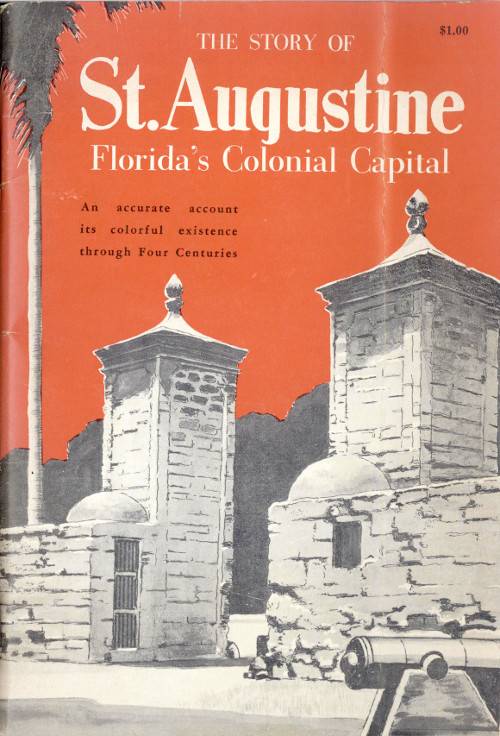
In spite of the many changes made in its physical appearance down through the centuries, many evidences of St. Augustine’s historic past have managed to survive. Massive Castillo de San Marcos still frowns upon the bay as it did two centuries and a half ago. The City Gateway, remains as a mute reminder of the capital’s former defenses. The narrow streets of the original town have defied complete alteration, and still reflect their Old World origin and character.
The ancient Plaza, with its refreshing shade, is possibly more beautiful now than when worn by the tread of parading garrisons. Here also stood the residence of a long line of Spanish and English governors. Facing the Plaza on the north the Cathedral looks down in simple dignity, its clock and sundial marking the infinite procession of hours, days and years.
The city’s long period under Spain is reflected in some of its architecture, in many of its street names, and in the general plan of the older section, which was laid out as specified by the Spanish King. The name St. George Street, honoring England’s patron Saint, is a legacy from the English period, as is also Charlotte Street, named for the queen of George III.
The bayfront commands a view of waters where ships of many kinds and from many ports once rode at anchor. The original inlet through which they sailed has disappeared, and a man-made channel now cuts through the barrier islands. Davis Shores, a popular residential district across the bay, was once a marsh from which the English shelled the fort and town in 1740.
At the south end of the original settlement the State Arsenal occupies the site of the Franciscan Monastery, from which the heroic Friars went forth to Christianize the Florida Indians. Across from it the Oldest House, owned by the St. Augustine Historical Society, preserves some of the Spanish atmosphere of former periods. Its connecting museum and library contain many relics and records of the past.
The Old Spanish Treasury on St. George Street was once the residence of the Royal Treasurer, from which Treasury Street also derives its name. North of the City Gateway the Fountain of Youth perpetuates the memory of Ponce de Leon’s discovery of Florida and man’s longing for youth restored. Occupying high ground nearby the Mission of Nombre de Dios marks the probable landing place of Menéndez and the hallowed spot where the first Parish Mass was celebrated.
Few who visit St. Augustine can fail to feel the romantic spell of its antiquity. The memory of its eventful past still haunts its sandy shore.
New Library building of the St. Augustine Historical Society.
The voluminous historical records of St. Augustine and early Florida are preserved in the library of the St. Augustine Historical Society. Assembled over a period of more than fifty years, and spanning 400 years of history, these records include copies of literally thousands of documents from the archives of Spain, Mexico, England, and repositories in the United States. The collection also comprises hundreds of old maps, various forms of pictorial material, and some 7,500 books, many of them rare and out of print. To save space much of the material is in the form of microfilm.
Founded in 1883, the Society is dedicated to the preservation and accurate interpretation of St. Augustine’s rich historical heritage. It has been long active in protecting the historic landmarks of the city, and pioneered in restoring some of its older structures.
PUBLICATIONS
ST. AUGUSTINE’S HISTORICAL HERITAGE, Harris Pictures. An illustrated guide to the city’s principal points of historic and scenic interest, with fine photographs of streets and buildings. 40 pages, size 8½ x 11 inches. $1.00
SAINT AUGUSTINE, AN EARLY HISTORY OF THE FAMOUS CITY TOLD IN PICTURES. 24 pages, size 8½ by 11 inches. 50¢
COLOR BOOK OF HISTORIC FORTS, Fort Caroline—Fort Matanzas—Castillo De San Marcos. 36 pages, 8½ x 11 inches. 50¢
Mail orders filled at prices quoted plus 25¢ to cover mailing. Florida residents add 4% state sales tax. Address:
C. F. Hamblen Inc.
P. O. Box 1568
St. Augustine, Florida 32084
Transcriber’s Notes
- Silently corrected a few typos.
- Retained publication information from the printed edition: this eBook is public-domain in the country of publication.
- Transcribed the text within some illustrations.
- In the text versions only, text in italics is delimited by _underscores_.