
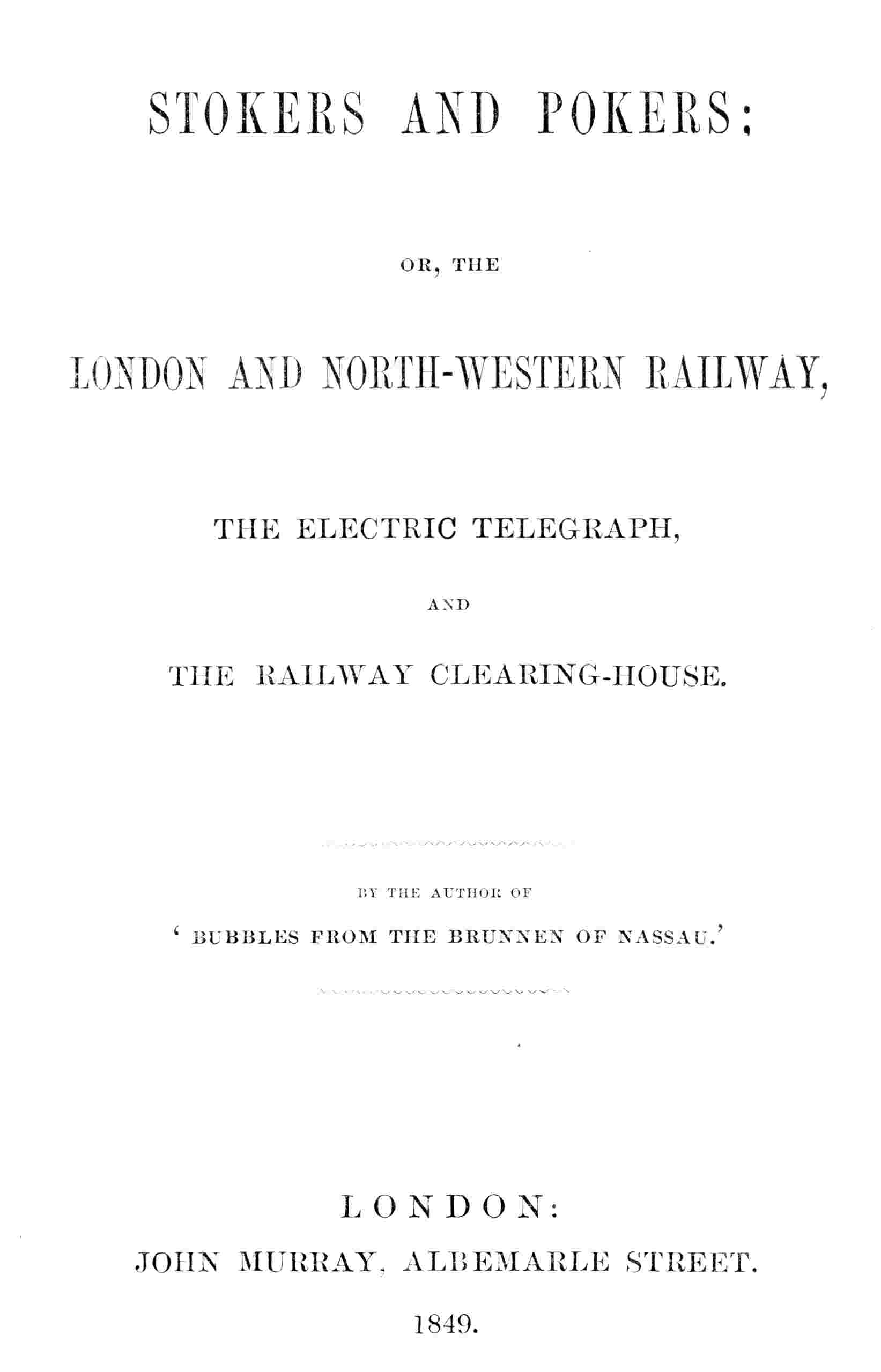
LONDON AND NORTH-WESTERN RAILWAY.
CHAPTER I.
On the Construction of a Railway.
At the grand inauguration dinner eaten in Paris on the 28th of December, 1848, for the express purpose of celebrating the installation of the new President of the French Republic, it has been recorded by the reporters present, that among the numerous guests assembled, there was no one whose presence engrossed such universal attention as that of an erect emaciated member of “La Vieille Garde.”
The old soldier, it is stated, as he sat at table, scarcely noticed the constellations of bright, black, and hazel-coloured eyes that from all directions were concentrated upon him, but, addressing himself first to his own black bottle, and then with the utmost good humour to those of his neighbours, he drank and ate—drank—swigged—reflected,—and then, as if to refresh himself, drank again, again, and again, until, according to pre-arrangement, he stood up on the tribune to re-propose the health of “Louis Napoleon,” to which—coupling the meteor now shining in its zenith with the “sun of Austerlitz,” which, though sunk for ever below the horizon, still beamed as resplendently as ever within his heart—he added, with great naïveté, “Mais sans oublier l’autre!”
The French people, or rather the representatives of the French nation who were assembled, had received the consecutive orations of several of the most illustrious of their fellow-citizens with considerable marks of approbation; but when the veteran in question, who was about seventy years of age, with hair white as snow, rose to address to them a short speech that would scarcely have filled his empty wine-glass, the sight of the uniform so dear to Frenchmen—the tall bear-skin cap, the crimson feather, blue coat, red facings, red worsted epaulettes, white breast, white breeches, long black gaiters reaching over the knee, and, above all, buttons with an eagle supporting the imperial crown—created a storm of applause which it would be utterly impossible to describe. For nearly a quarter of an hour shouts and clappings of hands prevented the old warrior from opening his lips, and the applause if possible increased when the veteran, with the palm of his hand turned outwards, stiffly saluted the company in correct martial style: and yet, strange to record, at the very moment of all this military enthusiasm, so characteristic of a nation of whom it was lately very eloquently stated “that it had been its ambition to be the world’s guide and its destiny to be the world’s warning,” the French Government was not only without funds to protect public or private property, but, in fact, had nothing but the plunder of both to conciliate and feed the multitude of misguided and misguiding people who, by the ruin of commerce and by the stagnation of trade, were literally all over France starving from cold and hunger. Of their enthusiasm, therefore, as of that of the veteran standing up before them, it may truly be said or sung—
Having related, or rather merely repeated, this curious little anecdote, we will now endeavour to explain in what manner it applies to the subject of our chapter, namely, “the construction of a railway.”
It has been justly observed that “England is bound over to keep the peace by a national debt, or penalty, of 800 millions.” During the glorious expenditure of all this money, the attention of the country was solely engrossed with the art, employment, occupation, and victories of war. Our great statesmen were war-ministers—our great men were naval and military warriors of all ranks, whose noble bearing and gallant feats were joyfully announced, and, by universal acclamation, as gratefully rewarded; and if every man who took a government contract, or who in any way came into contact with government, easily made a large fortune by war, he, generally speaking, as rapidly spent it; and thus an artificial circulation of wealth was kept up, which, like the schoolboy’s mode of warming himself, commonly called “beating the booby,” produced a temporary glow, estimated at the moment to be of as much value as if it had naturally proceeded from the heart.
The English people during the period in question drank hard. The rule had scarcely an exception. As regularly as four o’clock P.M. struck, our noblemen, magistrates, judges, hunting squires, and country gentlemen, began to look a little flushed—the colour gradually increasing, until in due time they all became, like their sun in a fog, red in the face. Before bedtime the semi-rulers of the nation were half inebriated—some of our leading statesmen being, alas! notoriously, very nearly in the same state.
No sooner, however, were the British people, by the results of 1815, suddenly weaned from war, than their extraordinary natural powers, moral as well as physical, invigorated by comparative temperance, were directed to investigations, occupations, and studies which rapidly produced their own rewards. Indeed, without entering into details, the wealth which has been created and amassed since the period in question, added to that with which we have not only irrigated, but almost without metaphor top-dressed the greater portion of the old as well as of the new world, and, lastly, the extraordinary improvements that have taken place in light, heat, locomotion—electrical as well as by steam-power—machinery, in short in everything that administers to human comfort, form altogether the golden harvest of our labours; and thus, although to our eminent civil engineers considerable credit is due, they are, in fact, but secondary causes; the engineer-in-chief—the primary inventor—the real constructor of our railways most indisputably being
The Construction of the Line.
1. In considering the project of a railway, after fixing upon the two termini, it becomes necessary to select the towns through which it ought to pass.
2. When these have been determined, the chief engineer to whom the investigation of the proposed line has been confided, with the Ordnance map in his hand, walks and re-walks over the whole length (Mr. Robert Stephenson, in his investigation of the proposed line between London and Birmingham, walked upwards of twenty times over the country between each), until he feels that he carries in his mind the whole picture; and while he is thus imagining and making out various lines for consideration, his assistants are testing the eligibility of each by rapidly taking for him what are called “flying levels,” as also “cross levels,” along the principal ridges that at various angles intersect the proposed line, and yet, notwithstanding the accuracy of these mathematical precautions, it is almost invariably found that the eye of the chief engineer has intuitively selected the best line.
It is, however, as painful to reflect on, as it is humiliating to record, the prejudices, ignorance, passions, and artifice by which our principal engineers were opposed, or rather by which they were consecutively thwarted in the calm scientific investigations for the benefit of the public which we have just described.
Instead of a general desire on the part of the community to hail with gratitude, and to receive with open arms, an invention which was practically not only to enable them with double elbow-room, and at about half fares, to travel at four or five times the speed which by their utmost efforts they had previously been enabled to attain, but to afford similar facilities to millions of tons of manufactures and merchandize, much of which had either been impeded by delay, or altogether clogged by the heavy charges on their transit, our engineers, in tracing the lines for our great arterial railways, were but too often looked upon as magicians, evil genii, or unclean spirits, whose unearthly object was to fright the land from its propriety.
In many instances where it was proposed, by tapping the dull stagnant population of a country town, to give vigour and animation to its system, the inhabitants actually fancied that their interests and their happiness would, like their habits, expire under the operation.
For example, it is well known that one of the results of Mr. R. Stephenson’s deliberate investigations was, that the present London and North-Western Railway ought to pass through the healthy and handsome town of Northampton,—an arrangement which of course would instantaneously have given to it commercial importance of inestimable value. The inhabitants, however, urged and excited by men of influence and education, opposed the blessing with such barbarous force, that they succeeded, to their everlasting punishment, in distorting the line—viâ the Kilsby Tunnel, which, if the projected plan had been adopted, would not have been required—to a point five miles off! and if such ignorance could, in the nineteenth century, exist in a large and populous town, it cannot be a matter of surprise that our engineers should have had to encounter similar, or, if possible, still greater prejudices in rural districts.
It was there generally considered to be utterly incredible that a railway could ever possibly supersede our mail and stage coaches; at market meetings, and at market dinners, the invention was looked upon as, and declared to be, “a smoky substitute for canals;” and while men of property inveighed against its unsightly appearance, their tenants were equally opposed to the measure.
For instance, among the reasons for preventing the present London and North-Western Railway coming to Northampton, it was seriously urged by many very wealthy and respectable graziers in the neighbourhood, that the smoke of the passing engines would seriously discolour the wool of their sheep; that the continual progress through their verdant meadows of a sort of rumbling, hissing, fiery serpent, would, by continually alarming, fretting, and distracting the attention of their cattle, prevent them, “poor things!” from fattening; in short, such was the opposition to the new system, that one of the engineers employed by the London and North-Western Railway to trace out a branch line (which, at a considerable expense to the Company, was to confer inestimable advantages upon its locality) was attacked by the proprietors of the soil, and a conflict or battle royal ensued, which ended in very serious legal results.
3. As soon as the chief engineer has, instead of the best line of railway that could have been determined on, decided on that which, for the reasons stated, it is advisable he should recommend—alas! what a pity it is that, in the construction of our great arterial railways, such a discreditable difference should have been allowed to exist!!—he employs his assistant engineers and surveyors to make for him accurate surveys, and to take correct sections, copies of which are to be deposited, according to Act of Parliament, with the various clerks of the peace of the several counties through which the line is to pass, with the Commissioners of Railways, &c. &c. &c.; besides which there is to be prepared for each parish its proportion, as also for every landholder a section, showing the greatest depth of cutting or embankment in any of his fields.
In addition to the collection and construction of all these data and drawings, notices are to be served upon every landowner, wherever he may be, in the United Kingdom; for which duty in 1845 almost everybody that could be picked up was engaged, the number of horses employed and killed in the operation having been utterly incalculable.
4. By the time these expenses have been incurred, the attention of the chief engineer is engrossed by a new struggle of vital importance, practically called “the fight for the Act,” in both houses of Parliament.
As the question before the reader is abstractedly one of science, we gladly refrain from staining it by the slightest political remark; we will therefore, on this branch of the subject, only state that, from returns which have officially been published, it appears that, in the years 1845, 1846, and 1847, more than ten millions were expended in parliamentary inquiries and parliamentary contests.
This money would, at the rate of 20,000l. per mile, have constructed a national railway 500 miles in length—say from London to Aberdeen!
Casting aside the bitter mortification which these expenses must create to the man of science, whose mind is enthusiastically engrossed with the vast importance of railway communication, the permanent tax which they inflict upon the public can very briefly be demonstrated.
Supposing 5 per cent. be deemed an adequate return to railway proprietors for the capital they have expended, the comparative charges to be levied by them on every passenger or ton of goods would be as follows:—
| Charge per mile on a railway which ought to have cost 15,000l. per mile | 1d. | per mile. |
| Ditto on a railway which has unnecessarily been made to cost 20,000l. per mile | 1⅓d. | „ |
| Ditto on a railway which has unnecessarily been made to cost 25,000l. per mile | 1⅔d. | „ |
| Ditto on a railway which has unnecessarily been made to cost 30,000l. per mile | 2d. | „ |
5. As soon as the Act of Parliament has been obtained, the chief engineer directs the immediate construction of a most accurate plan and section of the whole line, from which he ascertains and lays down its gradients. He then determines the sizes of the bridges required, as also the nature and amount of masonry for each; he calculates the quantities of embankments and cuttings, balancing the one against the other as nearly as circumstances will allow, and having, by first boring, and afterwards by the sinking of “trial shafts,” ascertained as accurately as possible the nature of the various strata to be excavated or tunnelled, he proceeds to estimate in detail the cost of the several works, which he then divides into lengths for construction, taking care that in each the amount of earth to be excavated and filled up shall as nearly as possible balance each other; in short, inasmuch as all contractors prudently, and indeed very properly, invariably lower their tenders in proportion as the work they are required to execute has been clearly laid open to their view, and, on the other hand, to secure themselves from unknown difficulties, as invariably raise their tenders for work which has not been sufficiently bored or examined, he is fully sensible that a considerable saving in the cost of the proposed railway will be effected by a clear preliminary development of its works.
6. This mass of information having been prepared, the chief engineer now advertises his work in its various lengths for execution by contract, and, on receiving tenders for the same, he selects, not always the lowest, but that which, for various reasons, is the most approved, taking security generally to the amount of 10 per cent. of the contract.
Previous, however, to the reception of the tenders the chief engineer appoints his staff of assistants. To each 40 or 50 miles there is usually appointed an experienced engineer, having under him “sub-assistants” who superintend from 10 to 15 miles each—these sub-assistants being again assisted by “inspectors” of masonry, of mining, of earth-work, and of permanent way, to each of whom a particular district is assigned.
7. The chief engineer now finds himself engaged in a new struggle with man in addition to nature. In many instances the contractors let out a portion of the work they have engaged to perform to sub-contractors, who again “set” the earth-work to a body of “navvies,” who again among themselves sub-divide it among the three branches of which their State is composed, namely, “excavators,” “trenchers,” and “runners,” each party of whom appoint their own “ganger.”
The duty of effectually overlooking all these details, of preventing collusion as well as collision, of enforcing the due execution of the contract, and yet, where necessary, occasionally to alleviate the strict letter of its law, constitute perhaps the most harassing of the various difficulties which the chief engineer has to overcome: for it must be evident that if, by means of bribery, or from inattention, or from sheer roguery, any important portion of the work be “scamped,” or insufficiently performed, results may ere long occur of the most serious description.
Tunnels.
8. The brief history of the construction of the Kilsby Tunnel of the London and North-Western Railway very strikingly demonstrates the latent difficulties which occasionally evade the investigations, baffle the calculations, and which, by chastening as well as by humbling, eventually elevate the mind of every man of science who has practically to contend with the hidden secrets of the crust of the earth which we inhabit.
The proposed tunnel was to be driven about 160 feet below the surface. It was to be, as indeed it is, 2399 yards 2 feet 6 inches in length, with two shafts of the extraordinary size of 60 feet in diameter, not only to give air and ventilation, but to admit light enough to enable the engine-driver in passing through it with a train to see the rails from end to end.
In order correctly to ascertain, and honestly to make known to the contractors, the nature of the ground through which this great work was to pass, the engineer in chief sank the usual number of what are termed “trial shafts,” and, it clearly appearing therefrom that the principal portion of the stratum was the shale of the lower oolite, the usual advertisements for tenders were issued, and the shafts, &c., having been minutely examined by the competing contractors, the work was let to one of them for the sum of 99,000l.
In order to drive the tunnel, it was deemed necessary to construct 18 working shafts, by which, like the heavings of a mole, the contents of the subterranean gallery were to be brought to the surface.
This interesting work was in busy progress, when all of a sudden it was ascertained, that at about 200 yards from the south end of the tunnel, there existed, overlaid by a bed of clay 40 feet thick, a hidden quicksand, which extended 400 yards into the proposed tunnel, and which the trial shafts on each side of it had almost miraculously just passed without touching.
The traveller in India could scarcely be more alarmed at the sudden sight of a crouching tiger before him, than the contractor was at the unexpected appearance of this invincible enemy. Overwhelmed at the discovery, he instantly took to his bed, and though he was liberally, or, to speak more correctly, justly relieved by the Company from his engagement, the reprieve came too late, for he actually died!
The question then arose whether, in the face of this tremendous difficulty, the execution of the Kilsby Tunnel should be continued or abandoned. The general opinion of the several eminent engineers who were consulted was against proceeding, and certainly the amount of the difficulties which were subsequently incurred, justified the verdict. But in science, as well as in war, the word “IMpossible” can occasionally, by cool and extraordinary exertions, be divested of its first syllable; and accordingly, Mr. Robert Stephenson offering, after mature reflection, to undertake the responsibility of proceeding, he was duly authorised to do so.
His first operation was of course to endeavour by the power of steam-engines—the comrades of his life—to lower the water with which he had to contend; and although, to a certain degree, this attempt succeeded, yet by the draining of remote springs, and by the sinking of the water in wells at considerable distances, it was soon ascertained that the quicksand in question covered several square miles.
The tunnel, 30 feet high by 30 feet broad, arched at the top as well as the bottom, was formed of bricks laid in cement, and the bricklayers were progressing in “lengths” averaging 12 feet, when those who were nearest the quicksand, on driving into the roof, were suddenly almost overwhelmed by a deluge of water which burst in upon them. As it was evident that no time was to be lost, a gang of workmen, protected by the extreme power of the engines, were with their materials placed on a raft; and while, with the utmost celerity, they were completing the walls of that short length, the water, in spite of every effort to keep it down, rose with such rapidity, that at the conclusion of the work the men were so near being jammed against the roof, that the assistant-engineer, Mr. Charles Lean, in charge of the party, jumped overboard, and then, swimming with a rope in his mouth, he towed the raft to the foot of the nearest working shaft, through which he and his men were safely lifted up into daylight, or, as it is termed by miners, “to grass.”
The water now rose in the shaft, and as it is called “drowned out” the works. For a considerable time all the pumping apparatus appeared to be insufficient. Indeed the effort threatened to be so hopeless that the Directors of the Company almost determined to abandon it, but the engineer-in-chief, relying on the power of his engines, prayed for one fortnight more; before that period expired Science triumphed over her subterranean foe, and—thanks to the inventors of the steam-engine—the water gradually lowered.
By the main strength of 1250 men, 200 horses, and 13 steam-engines, not only was the work gradually completed, but during night and day, for eight months, the astonishing and almost incredible quantity of 1800 gallons per minute from the quicksand alone was raised by Mr. Robert Stephenson and conducted away!!
Indeed such is the eagerness with which workmen in such cases proceed, that, on a comrade being one day killed at their side by falling down the shaft, they merely, like sailors in action, chucked his body out of the way and then instantly proceeded with their work. In the construction of the tunnel there were lost twenty-six men, two or three of whom were “navvies,” killed in trying, “for fun,”—as they termed it—to jump one after another across the summits of the shafts.
The time occupied from the laying of the first brick to the completion of the work was thirty months. The number of bricks used was 36,000,000, sufficient to make a good footpath from London to Aberdeen (missing the Forth) a yard broad!
On the completion of this great work the large populous village which had been constructed on its summit was of course suddenly deserted; it has since completely disappeared, and, instead of the busy scenes it once witnessed, there is now nothing heard on the dreary summit of the Kilsby Tunnel but the desolate moan of the rumbling train, or the occasional subterranean whistle of its engine; these noises being followed by the appearance of a slight smoke slowly meandering upwards from the two great shafts of the tunnel.
During the operations we have just described, an artificer who had been working in the tunnel was ascending one of the shafts when, the back of his coat happening to get into an angular crevice of the partition, called by miners a “brattice,” which separated the shaft from the pumps, it became so completely jammed therein that the man was obliged to let go the rope, and accordingly, while dangling over his head it rose to the surface, he remained, to the utter astonishment and dismay of his comrades, suspended about 100 feet from the bottom, until some of them descended and rescued him by cutting away the imprisoned piece of his coat, which, on being afterwards extricated, was long preserved in the engineer’s office as a trophy demonstrating the strength of good honest English broadcloth.
At the same shaft an accident of exactly a contrary nature subsequently occurred. In order to execute some trifling repair to the brattice, there was, during a desperate cold night, suspended, about half-way down the shaft, a temporary scaffolding on which several artificers were working by candle-light, when all of a sudden a well-known powerful “navvy,” named Jack Pierson, fell from the surface with such momentum, that, breaking through the frail scaffolding as if it had been tinder, he was in a few seconds heard to go souse into the water at a considerable depth beneath!
As soon as the men on the scaffold had recovered from their surprise they naturally all at once were animated with a desire to save their comrade. One lustily roared out for rope; another vociferously proposed something else; while several navvies, bawling from the surface, were each as eagerly and as loudly prescribing his own remedy. In the midst of this confusion the stentorian voice of Jack Pierson himself was heard, from the very bottom of the pit, calmly to exclaim,
“Darm your eyes, make less noise and pool me arout!!”
His rough command was instantly attended to, and he was moreover carried to his bed, where, poor fellow! he lay many weeks unable to move.
Besides the 1250 labourers employed in the construction of the tunnel, a proportionate number of suttlers and victuallers of all descriptions concentrated upon the village of Kilsby. In several houses there lodged in each room sixteen navvies, and as there were four beds in each apartment, two navvies were constantly in each; the two squads of eight men as alternately changing places with each other in their beds as in their work.
Such was the demand for lodging that it was, as we have stated, found necessary to construct a large village over the tunnel for the accommodation of the workmen, and, as they generally allowed themselves three meat meals a-day, it has been asserted that more beef was eaten at Kilsby during the construction of the tunnel than had previously been consumed there since the Deluge.
As these navigators are now before us, we trust that our readers will not only be curious but desirous to know a little more of the habits of a set of men who have lately added so materially to the prosperity of the country as well as to our luxuries, by the numerous railways which, by the honest sweat of their brows, they have one after another executed.
We need hardly say that, as regards their physical strength, they are the finest Herculean specimens of the British race; and, as is generally the case, in proportion as they are powerful so are they devoid of all bluster or bravado.
Those who have commanded large numbers of them state that they are not only obedient to all above them, even to their own “gangers,” but that, although they have—we think very justly—occasionally required a permanent increase of pay, they have never meanly taken advantage of a press of business to strike for wages. Indeed the conduct of a “navvy,” like his countenance, is honest and open. If from illness or misfortune he is unable to work, he and his family are maintained by his comrades; in truth the same provision is made among them for what are called by navvies their “tally-wives,” a description of relationship exceedingly difficult correctly to describe.
As they earn high wages, it is a fashion among them to keep dogs; and as rather a noble trait, we may mention that there have been several instances where 10l. has been in vain offered to “a navvy” to induce him to sell his dumb favourite.
Generally speaking they are not addicted to poaching; but when not at work they usually amuse themselves by playing at skittles, at quoits, by drinking, and occasionally by fighting; and although the latter species of recreation is no doubt reprehensible, yet surely it is better for a man to walk homewards at night with a pair of black eyes and a bloody nose, than with an I O U cheque in his pocket for ten thousand pounds, gained by what the fashionable world terms “at play” from a companion whose wife he has made destitute, and whose children he has probably ruined!
At a navvy’s funeral 500 of his comrades in their clean short white smock-frocks, with thin black handkerchiefs tied loosely round their throats, are seen occasionally in procession walking in pairs hand in hand after the coffin of their mate. In short, there exists among them a friendly “esprit de corps,” which not only binds them together, but renders it rather dangerous for any stranger to cheat, or even to endeavour to overreach them.
During the construction of the present London and North-Western Railway, a landlady at Hillmorton, near Rugby, of very sharp practice, which she had imbibed in dealings for many years with canal boatmen, was constantly remarking aloud that no navvy should ever “do” her; and although the railway was in her immediate neighbourhood, and although the navvies were her principal customers, she took pleasure on every opportunity in repeating the invidious remark.
It had, however, one fine morning scarcely left her large, full-blown, rosy lips, when a fine-looking young fellow, walking up to her, carrying in both hands a huge stone bottle, commonly called “a grey-neck,” briefly asked her for “half a gallon of gin;” which was no sooner measured and poured in than the money was rudely demanded before it could be taken away.
On the navvy declining to pay the exorbitant price asked, the landlady, with a face like a peony, angrily told him he must either pay for the gin or instantly return it.
He silently chose the latter, and accordingly, while the eyes of his antagonist were wrathfully fixed upon his, he returned into her measure the half-gallon, and then quietly walked off; but having previously put into his grey-neck half a gallon of water, each party eventually found themselves in possession of half a gallon of gin and water; and, however either may have enjoyed the mixture, it is historically recorded at Hillmorton that the landlady was never again heard unnecessarily to boast “that no navvy could ‘do’ her.”
A navvy at Kilsby, being asked why he did not go to church? dully answered in geological language—“Why, Soonday hasn’t cropped out here yet!” By which he meant that the clergyman appointed to the new village had not yet arrived.
The contrast which exists between the character of the French and English navigator may be briefly exemplified by the following trifling anecdote:—
In excavating a portion of the first tunnel east of Rouen towards Paris, a French miner dressed in his blouse, and an English “navvy” in his white smock jacket, were suddenly buried alive together by the falling in of the earth behind them. Notwithstanding the violent commotion which the intelligence of the accident excited above ground, Mr. Meek, the English engineer who was constructing the work, after having quietly measured the distance from the shaft to the sunken ground, satisfied himself that if the men, at the moment of the accident, were at the head of “the drift” at which they were working, they would be safe.
Accordingly, getting together as many French and English labourers as he could collect, he instantly commenced sinking a shaft, which was accomplished to the depth of 50 feet in the extraordinary short space of eleven hours, and the men were thus brought up to the surface alive.
The Frenchman, on reaching the top, suddenly rushing forwards, hugged and embraced on both cheeks his friends and acquaintances, many of whom had assembled, and then, almost instantly overpowered by conflicting feelings,—by the recollection of the endless time he had been imprisoned—and by the joy of his release,—he sat down on a log of timber, and, putting both his hands before his face, he began to cry aloud most bitterly.
The English “navvy” sat himself down on the very same piece of timber—took his pit-cap off his head—slowly wiped with it the perspiration from his hair and face—and then, looking for some seconds into the hole or shaft close beside him through which he had been lifted, as if he were calculating the number of cubic yards that had been excavated, he quite coolly, in broad Lancashire dialect, said to the crowd of French and English who were staring at him as children and nursery-maids in our London Zoological Gardens stand gazing half terrified at the white bear,
“Yaw’ve bean a darmnation short toime abaaowt it!”
In the construction of the London and North-Western Railway, the contractor at Blisworth also failed and also died.
Besides the perpendicular cutting which he had undertaken to execute, there was, on the surface of the rock through which it now passes, a stratum of about twenty feet of clay of so slippery a nature, that for a considerable time, in spite of all efforts or precautions, it continued to flow over into the cutting like porridge. The only remedy which could be applied was, at vast labour and expense, to remove this stratum for a considerable distance, terminating it by a slope at a very flat angle, all of which extra labour, trouble, and expense, we may observe, is not only unseen but unknown to the traveller, who, as he flies through the tunnel, if he looks at the summit at all, naturally fancies that it forms the upper extremity of the work.
In the construction of the tunnel at Walford an accident occurred of rather a serious nature. A mass of loose gravel concealed in the chalk, slipping viâ the shaft into the tunnel, suddenly killed eleven men, besides letting down from the surface a horse and gin.
Cuttings.
9. In passing through the consecutive cuttings of a great railway, the traveller usually considers that those through rock must have been desperate undertakings, infinitely more expensive than those through clay. The cost of both, however, is nearly equal; for, not only does the perpendicular rock-cutting require infinitely less excavation than the wide yawning earth one of the same depth, but when once executed the former is not liable to the expensive slips which subsequently occasionally afflict the latter.
In determining whether the line should proceed by tunnelling or by cutting, the engineer’s rule usually is to prefer the latter for any depth less than sixty feet; after which it is generally cheaper to tunnel. If, however, earth be wanted for a neighbouring embankment, it becomes of course a matter of calculation whether it may not be cheaper to make a cutting instead of what abstractedly ought otherwise to have been a tunnel.
In the construction of the Tring cutting alone of the present London and North-Western Railway, there were excavated 1,297,763 cubic yards of chalk, of which about fifteen cubic feet weighed a ton.
Embankments.
10. Besides contending with water above ground as well as below, the constructor of a railway is occasionally assailed by an element of a very different nature. For instance, when the Wolverhampton embankment of the present London and North-Western Railway, at vast trouble and expense, was nearly finished, it was observed first to smoke, then get exceedingly hot, until a slow mouldering flame visible at night appeared. The bank began to consume away, and the heat continued until it actually burned the railway sleepers; at last, however, it exhausted itself. The combustion was caused by the quantity of sulphuret of iron or pyrites contained in the earth of the embankment, which, having been baked by the fire, will probably never slip.
11. It would be tedious, and indeed impossible, to detail the various works which a railway engineer has to superintend in the construction of the line, in the laying down of the rails or “permanent way,” and in the subsequent, or rather simultaneous, erection of the various station-houses, storehouses, workshops, &c. &c., the interior of which we shall soon have occasion to enter.
An idea, however, of the magnitude of his operations may be faintly imparted by the following brief abstract of a series of calculations made by Mr. Lecount, one of the engineers employed in the construction of the southern division of the present London and North-Western Railway, and the writer of the article ‘Railways’ in the ‘Encyclopædia Britannica.’ The great Pyramid of Egypt was, according to Diodorus Siculus, constructed by three hundred thousand—according to Herodotus by one hundred thousand—men; it required for its execution twenty years, and the labour expended on it has been estimated as equivalent to lifting 15,733,000,000 of cubic feet of stone one foot high. Now, if in the same manner the labour expended in constructing the Southern Division only of the present London and North-Western Railway be reduced to one common denomination, the result is 25,000,000,000 cubic feet of similar material lifted to the same height; being 9,267,000,000 of cubic feet more than was lifted for the pyramid; and yet the English work was performed by about 20,000 men only, in less than five years.
Again, it has been calculated by Mr. Lecount that the quantity of earth moved in the single division (112½ miles in length) of the railway in question would be sufficient to make a foot-path a foot high and a yard broad round the whole circumference of the earth! the cost of this division of the railway in penny-pieces being sufficient to form a copper kerb or edge to it. Supposing therefore the same proportionate quantity of earth to be moved in the 7150 miles of railway sanctioned by Parliament at the commencement of 1848 (Vide Parliamentary Returns), our engineers within about fifteen years would, in the construction of our railways alone, have removed earth sufficient to girdle the globe with a road one foot high and one hundred and ninety-one feet broad!
Abandoning, however, speculations of this nature, we will conclude our slight sketch of the principal works required for a railway by a few data, exemplifying the magnitude of the Britannia Bridge over the Menai Straits, the construction of which has been intrusted by its well-known inventor to the very able and experienced management of Mr. Frank Forster.
The dimensions of this straight wrought-iron aërial gallery, through which passengers and goods are to travel by rail, are—
| Total length of bridge, divided into 4 openings— | ⎫ | Feet. In. 1834 9 | |
| 2 of 230 feet | } each | ⎬ | |
| 2 of 460 feet | ⎭ | ||
| Height of rails above high-water mark | 104 0 | ||
| Quantity of masonry in the towers and abutments | { | 1,365,000 cubic feet. | |
| Weight of one of the iron tubes for the largest span, to be lifted 100 feet | } | 1,800 tons. | |
| Value of each of the largest of the iron tubes, not including expense of raising it | } | £54,000 | |
| The cost of the scaffolding now in use about the bridge has exceeded | } | £50,000 | |
It would, we conceive, be impertinent to dilute the above facts by a single comment.
The Chief Engineer.
As the selection of an engineer-in-chief, competent to determine the best line for a projected railway to take, the mode in which it should be constructed, and, lastly, to execute his own project—deviating from it with consummate judgment according to the difficulties, physical, moral, and political, which, sometimes separately and sometimes collectively, suddenly rise up to oppose him—is a point not only of vital importance to the success of the undertaking, but in the undertaking is the first important point to be decided, it would, we were aware, have apparently been the most regular to have commenced the present chapter with this subject. We conceived, however, that instead of there detailing the qualifications necessary for the duties required, it would save us very many words, and our readers as much time, if we were to defer the consideration of that subject until a brief outline of those duties should, without comment, practically explain the qualifications required.
If the United Kingdom had only projected the construction of one or two great arterial railways, we might naturally have expected that the few competent engineers necessary would readily have been obtained; but when we consider the number of railways that were simultaneously created, the surveys, plans, sections, and other preparations that were necessary, the magnitude of the works of various descriptions that were to be constructed in each, it must evidently to many be a subject of astonishment that there should have been found on the surface of our country not only the amount of engineering talent necessary for the execution of such vast works, but an amount which may truly be said to have exceeded the demand.
The curious historical fact, however, is, that the amount of engineering talent thus suddenly required existed not on the surface of our country, but, on the contrary, many hundred fathoms beneath it. The brilliant talents that were required were “black diamonds,” without metaphor embedded in the bowels of the earth. Science called her spirits from the vasty deep, and in obedience to her commands there arose out of the shafts of our coaleries, and from beneath the bottom of the Thames—
Old George Stephenson, who had served his articles of apprenticeship in a coal-mine, for many years working at the engines both above ground and below;
Isambard Brunel, whose principal experience had been acquired in the construction of the Thames Tunnel;
Joseph Locke, a colliery-viewer, who had served his apprenticeship below ground;
Robert Stephenson, brought up as a coal-miner, served his apprenticeship at Killingworth colliery;
Frank Forster had worked for seven years as an apprentice in a coal-mine;
Nicholas Wood, ditto;
Charles Lean, ditto;
And a crowd of similar genii, all slaves of the same lamp, or “Old Davy,” as they term it.
To such men the difficulties attendant upon the construction of a railway were trifling as compared with those against which all their lives they had been contending.
For instance, he who along dark, intricate, subterranean passages, or “heavings,” as they are termed, often only three feet and a half high, and occasionally only two feet high, creeping and crawling through foul air, could with great speed, not only with unerring certainty find his way, but in such a secluded study could plan a variety of new cuttings, each forming part and parcel of a reticulated system of excavation which an unpractised mind would find it utterly impossible to comprehend, would, it may easily be conceived, experience but little difficulty, when walking erect in sunshine and in balmy air, to carry in his mind from, say Harrow to Watford, Watford to Tring, Tring to Wolverton, and Wolverton to Birmingham, those great leading features of the surrounding country which would enable him to exercise for the laying out of a railway the judgment and decision required.
Again, what, it may justly be asked, are embankments, deep cuttings, and occasionally here and there a straight tunnel thirty feet broad, twenty-seven feet high, usually forming by drainage its own adit, in comparison with the overwhelming and intricate difficulties attendant upon—
1st. The excavation of coal from strata of various characters, at various depths, each passage or “air-heaving” requiring perhaps a different system of support.
2nd. Encountering at various depths quicksands.
3rd. The great as well as minute arrangements necessary for wheeling carriages and raising the coals.
4th. The organization and management of a subterranean army of men and horses.
5th, and lastly. Lifting by steam-power from various depths, by night and by day, streams, floods, and occasionally almost rivers of water?
It has been beneath the surface of our country that these and many other difficulties of vast magnitude—unknown to and unthought of by the multitude—have for many generations been successfully encountered by science, capital, and by almost superhuman physical exertion; and it was accordingly, as we have stated, from beneath the surface of Great Britain that an organised corps of civil engineers, who, like those we have named, had regularly served as apprentices, arose, in the emergency of a moment, to assist their eminent brother engineers above ground, in constructing for the country the innumerable railways so suddenly required.