
TRUE HAPPINESS.
The visitor was a merchant of great wealth, one who had known Lily for many years during his occasional visits to the city. He had learned of their pecuniary trials, and had so great a curiosity to see how she would bear the change from luxury to comparative poverty that he readily accepted Mr. Everett's invitation to make a visit at the cottage. On their way, he hinted at the subject, saying, cautiously,—
"I presume Lily misses her parents and all the elegances of her former position."
But the husband only smiled. "Yes," he said, "it is a great change for her certainly. Lily—But she will tell you about it."
"I never knew a child more petted and indulged than she was," rejoined Mr. Abbott. "Every wish of her heart was gratified."
Again that peculiar smile, and at this moment Lawrence announced that they had reached home.
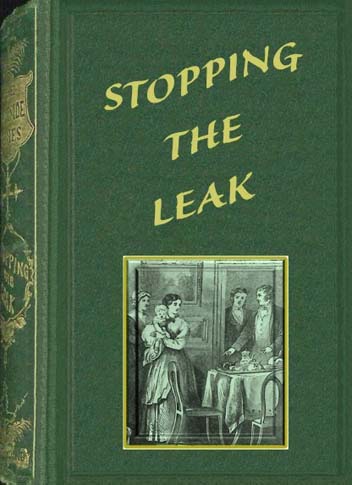
Lady-bird had not given up her old habit of opening the door for her husband, and came running down the stairs at the first sound of his step on the walk, bringing her babe in her arms. A crimson merino dress, for it was now chilly weather, gave a beautiful rosy tinge to her cheek, a little knot of ribbon doing day for a breastpin, while her eyes beamed with happiness.
"Oh, Lawrence!" she began, joyfully, when, seeing Mr. Abbott, she checked herself, and extended to him a cordial welcome.
"Come right in here," she said, leading the way to the library, where a bright coal fire was blazing in the grate. "Come, and I will show you my boy."
"Mr. Everett, you have played me false!" exclaimed the gentleman, warmly. "You have been telling me of your losses, but Lily looks as gay as if she had become heir to the wealth of the Rothschilds."
"Do you mean losing our money?" asked Lady-bird, opening wide her eyes in astonishment. "Because that was the greatest blessing that could have happened to us. I have learned a great deal I shouldn't have known otherwise."
"Truly, then, you can say, 'Sweet are the uses of adversity,'" rejoined the gentleman, laughing. "But I am neglecting to cultivate the acquaintance of this little fellow, a fine specimen certainly. I congratulate you both on the possession of such a prize."
Dinner was usually served as soon as Mr. Everett came home, and Lily, leaving her boy with his father, ran out to cast a glance over the table, and see that all was right. Everything was in order, and she needed only to add an extra plate.
"How glad I am," she said to Aunt Mercy, "that the roast came out so nicely browned, and then my dumplings are such a success!"
"The proof of the pudding is in the eating, child," was the smiling rejoinder.
"This is a great occasion for us," remarked the husband, when grace had been said. "This is Lily's first effort at cooking an entire dinner."
"Mrs. Everett cooking! I can scarcely credit it. What would your fashionable acquaintances say?" asked the gentleman, in pretended astonishment. "Well, I think wonders never will end. I should have thought of almost any one in my knowledge undertaking such business before you."
"I think, sir," remarked Aunt Mercy, "you never could have known our Lady-bird, or you would have been sure that she would do this very thing."
"Well done, Aunt Mercy! You see," exclaimed Mr. Everett, "Lily has stout defenders here."
"So you will have to be careful how you slander me," added the young wife, blushing.
"I can tell you how it is in a word," explained the gentleman. "When I was married, I was in a thriving business and began housekeeping on too large a scale. It took us but a few months, with Aunt Mercy's help, to find out there was a dreadful leak in our expenses, and we have all taken hold in earnest to stop it."
"And what does mamma say to all this?"
Lily's eyes sparkled with merriment, as she replied,—
"She don't know what to say. She can't believe me when I write her that I can make custards and fricassee chickens and scallop oysters. She don't understand how I can be so happy in this little cottage. She has never seen our dear little household angel. She writes doleful letters of sympathy in reply to my merry ones, and only wishes I could be with her in Paris, where she is visiting and fêting so gayly. I think if she could see me in the morning, making coffee and muffins for breakfast with my apron on, she would weep over me."
Lily ended with a sweet, musical laugh, so hearty that all her hearers joined in it.
"Aunt Mercy could tell you a long story of my inefficiency when she first knew me," the young wife went on. "I had not the least idea of my duties as the mistress of a household, but thought they consisted in watching at the window for my husband and running to open the door for him."
"Ah, Lady-bird! Who is slandering my wife, now?" asked Lawrence, with a tender glance in her face. "You know you find time to do that now with all your care."
"I shall be warmly received among your old friends, Mrs. Everett," said Mr. Abbott, "when they know I have been to visit you."
"Oh, no! We have had many visitors, but you are welcome to tell all who are interested to know that we would not go back to our palace in Montgomery Place, and be as rich as we once were, for anything. Would we, Lawrence?"
"I am perfectly content with my present lot," he said, so warmly, that Mr. Abbott nodded approval.
With the coffee Master Harry was brought in, and sat in his father's lap, while the delicious beverage was discussed and enjoyed. And then Mr. Everett reluctantly left for the city, saying, "I must not be behind the rest in stopping the leak. I work hard in these days."
CHAPTER XII.
A SECOND LEAK STOPPED.
EARLY in the winter John Allen came to the city, and after some discussion, it was concluded to give him a home at the cottage, and thus shield him from some of the many temptations which would surround him. He was an ardent admirer of his Cousin Lily from the first moment he saw her; and speedily ingratiated himself into her favor by the attention he paid little Harry. John had brown hair, which curled close to his head, and nothing pleased the baby better than to get his tiny fingers tangled in the locks, and then hear John exclaim, with a start, "Oh! Oh, dear!"
At the store, John strove to please, laying up every cent of his wages to help stop the leak at his own home. Mr. Everett soon agreed with Aunt Mercy that there was something in the boy, and resolved to give him a chance to succeed.
From Lizzie, John heard regularly, sometimes receiving letters she had written home, and at others epistles directed to himself. She had succeeded so well during the fall term, and the scholars plead so earnestly that she would remain, that the committee concluded to leave the winter school in her hands. There was double the number of scholars, some of them older than herself. But, as Mr. Greenough remarked to the other members of the committee, with all her mirth there was a dignity about their new teacher which would carry her triumphantly through many difficulties.
The vacation was passed with John in his new home, where the merry girl speedily became a great favorite. Indeed, the first tears that Lady-bird had shed at the cottage were when parting from her young visitor. She had so many queer experiences to relate of her scholars, so much to say of the kindness of the committee, and withal was so helpful, in the kitchen and nursery, that both Lily and her husband begged her to give up her school and pass the winter with them.
One incident which occurred during her visit I must not forget to relate. The candles were lighted-one evening, and Lizzie was having a game of frolics with Harry on the floor, while Mr. and Mrs. Everett were laughing spectators, when there was a ring at the door, and presently Maggie ushered in a tall, thin stranger. Lizzie sprang so quickly to her feet that she upset the baby,—blushes burning on her cheeks, when she introduced the gentleman as "Dr. Greenough."
"What a sly girl," whispered Lily, when the couple were so much absorbed as not to notice her, "pretending to be such a confidential friend, and yet keeping back that she had a lover!"
"Hush, Lady-bird!" was the cautious rejoinder. "He will hear you; and I can see by his manner that though he is a lover, he has not yet declared himself."
"I shall just go and call Aunt Mercy, and see what she says to all this."
The old lady had merely seen the family of Mr. Greenough at church, having been absent most of the time since their arrival; and now she fixed her keen eyes on the young man, as if she would read him through. He bore the scrutiny very well, while Lizzie, whose eyes were running over with merriment, sat smiling to herself at Aunt Mercy's questions. He was son of the Mr. Greenough who had been so kind to Lizzie in the school. He had graduated from college, had just finished the study of medicine, and was intending to accept the offer of the old physician in N—, to go into partnership with him. This was the substance of the information Mrs. Lovell's questions elicited from him.
She grew a trifle more gracious, and went on with her catechizing, resolved to test well the character of a man who was so evidently making love to her favorite niece. In the course of the conversation, it came out that for several years he had been a church-member; and some remark he made concerning the aged pastor satisfied her that he was a possessor, as well as a professor, of religion. She leaned back in her chair with an air of so much relief that both Lady-bird and Lizzie, who had been closely watching them, found difficulty in restraining their mirth.
Dr. Greenough well understood and appreciated the object of her inquiries. When they were through, he gave Lizzie so arch a glance that she was obliged suddenly to leave the room in order to maintain the dignity of a school-teacher. When she came back, the conversation turned on her school,—the marked improvement in Thomas Brown, the devotion of her friend Willie, and the prospect for the ensuing term. At a late hour the gentleman, with evident reluctance, took his leave, after having obtained permission to accompany her back to N—.
It is now time that we inquire how Mr. Allen succeeds in stopping the leak made by his intemperate habits. Bell, Carrie, and Ned made themselves so useful that, besides attending school, they earned a considerable part of the money necessary for the actual outlays of the family. The little ones saved their pennies for shoes and hats, while Mrs. Allen did her full part in putting everything, in doors and out, to the best use of which it was capable. Besides what she earned in the dairy, her own cow was so profitable that she was able to make more butter than the family used, which she readily disposed of at the store in exchange for groceries. Every moment of her time was turned to good account,—making, repairing clothes for herself and children from garments given her at the great house, or knitting for winter wear at intervals, while she superintended the movements of her older girls in the kitchen.
In this way Mr. Allen was enabled to lay by almost the whole of his wages toward the secret object of his desires. What this was, no one but his wife knew. But now it was necessary to put the funds he had gathered in some place where they would be earning interest, and he resolved to take Aunt Mercy into his confidence. He did so in the following letter:—
"TO MRS. MERCY LOVELL:
"DEAR AUNT,—We have been hoping for a visit from you. But as John
writes there is no probability of your leaving the city for the
present, I wish to write you confidentially on a subject of great
importance to me.
"As soon as I came to my right mind after leaving N—, I began to ask
myself whether there was any hope that I might recover the estate left
me by my father. For a long time I did not speak of it even to Mary,
but I used to lie hour after hour in the night pondering the subject,
and making plans to get it out of the hands of the man who I am
convinced took advantage of my habits to cheat me.
"From the first Mary has encouraged me to hope, and she has done more.
Without one word of repining and complaint that I had brought this
trouble on her, she cheerfully promised to aid me in saving every cent
we could spare from our family expenses toward the attainment of that
end.
"Since that, the estate has been purchased, as you know, by Mr.
Greenough, who has laid out large sums in improving the land,
ornamenting the house, and also in adding about twenty acres to the
original homestead.
"Against all this I have now four hundred dollars by me, which I wish
to invest safely where it will accumulate. A small sum you will say to
repurchase an estate worth seven thousand dollars, but I hope now to be
able to add rapidly to my stock, while real estate is rather falling
than rising in value.
"I have questioned Lizzie closely in regard to the present owners,
though she has not the most distant idea of my intention. She says
there are two sons, neither of them intending to be farmers, that Mr.
Greenough himself is not a practical farmer, but he has retired from
the life of a merchant in consequence of feeble health, and that Mrs.
Greenough much prefers the city.
"Upon these facts I build my hopes that by and by he may be induced to
sell the place, even if he retains a mortgage on it. I feel sure that,
with the experience I have gained here, if I could live there, I could
make the crops so valuable that I could soon pay off any incumbrance
on it. Will you do me the favor to consult Mr. Everett in relation to
funding my small sum? Until I am back in my old position, I never shall
feel that our terrible leak is stopped.
"Your affectionate nephew,
"JOSEPH ALLEN."
"There isn't much prospect of his ever realizing his hopes," murmured Aunt Mercy, deliberately folding the letter and taking off her glasses to reflect upon the subject it contained. "Joseph doesn't seem to suspect that Mr. Greenough's son and his Lizzie are so friendly. 'Twould be strange indeed if the young people should have the farm. Well, I'll talk with Lawrence about investments. I wouldn't discourage Joseph for the world; and if he is likely to succeed, there's a thousand or two I might loan him to begin with. I should be sure of the interest, and I sha'n't live to want it a great while. No, 'twont do to discourage him."
The next day she wrote an answer stating two ways of investing his four hundred dollars where it would yield a good income, and at the close hinted that in the county bank there were a couple of thousand dollars which he was welcome to use whenever he wished.
"I wonder what good news Allen has heard," exclaimed Mr. Burrel one evening to his wife. "He's had a broad grin on his face every time I've met him."
"He always looks smiling," was the quiet, response.
"Yes, but not as he has to-day. I've heard him whistle often, but there's something new I'm sure. Well, he's a faithful fellow, and I was fortunate to secure him."
"Mary told me something of their former history the other day," said Mrs. Burrel, which accounts for their being so different from most in their position. "They were quite wealthy when they were married. Mary says she never knew what it was to have a want unsupplied till she had been married five years."
"Allen took to drinking, and lost everything; he told me that himself, when I first hired him. He is a stanch temperance man now. I can see the effect of his example on the other men. There's Carter has improved wonderfully of late."
"All Mary's work," was the smiling response. "She began with the wife. Carter fought her for a long time, and forbade his children speaking to Mr. Allen's, he was so bitter."
"I really feel a curiosity to know what good fortune has happened to him," murmured the gentleman, thoughtfully.
"Probably favorable news from Lizzie or John; both, I know, are prospering. I'll ask Mary, when I see her, what she hears from them."
CHAPTER XIII.
FAILURE FROM LEAKS.
IT was midsummer of the next year when Aunt Mercy returned for a visit to her old home, and Lily with the baby accompanied her. The little fellow was teething, and the old lady advised a change of air.
Lizzie was just through her summer term, and was hesitating whether to engage for the winter, when they arrived. She was eager to take advice, and was easily persuaded to delay her return home for a few weeks. Dr. Greenough long before this had ventured to tell the young teacher that he was earning a home for her; and now he urged her to give up teaching, as his business was sufficiently profitable to justify him in taking a wife. He called at once upon Aunt Mercy, hoping to win her over to his views, as, since that first catechizing, as he termed it, she had been a firm friend.
But, after hearing all his arguments, she agreed with Lizzie that it would be better to wait another year. His business, it was true, was extending, but he was dependent entirely on his parents for means to commence housekeeping. While if they postponed their marriage a year, his expenses were slight, living as he did at his father's, and she could be earning something toward her outfit. At the end of that time, she would be only eighteen, quite young enough, Aunt Mercy thought, to assume the cares of housekeeping.
Lily plead for the young physician, and made Harry fold his hands and say, "Pease, tousin."
But, though Lizzie loved her all the more for this interest in her friend, she was convinced that Aunt Mercy was right.
The doctor submitted rather ungraciously to this decision, but was obliged to be content with her laughing promise to be very dutiful at the end of the prescribed period.
One evening he called, and the conversation turned on Aunt Mercy's favorite subjects, prudence and economy. He remarked,—
"If young people would only begin right, there would be no need of their spending half their lives in stopping the leak."
Dr. Greenough laughed.
"I never heard that term before," he said, "but it is so applicable to a case I knew in college, I must tell you the story.
"In my Sophomore year I became acquainted with a young man, a classmate, by the name of Storm. His parents lived in the city, only three miles from college; and I used often to accompany him home. Mr. Storm lived in great splendor in one of the most fashionable streets, keeping his carriages of different sorts for the convenience of the family. But his especial delight was his library, which was one of the most extensive private libraries within my knowledge. He had a perfect passion for books; and everything rare, antique, or elegant could be found on his shelves. He employed agents in England to search for books new and books old to add to his immense collection."
"I should call that his leak," remarked Lily, laughing.
"Indeed, it proved so; but I am too fast for my story.
"Horace, my friend, was a great reader, and could gather up the knowledge contained in a volume quicker than any person I ever knew. He never passed a book-store or an antiquarian stall without stopping to purchase, if he found anything to admire. I have known him spend twenty dollars day after day in this manner. And when once I remonstrated, he laughingly assured me that his father had given him 'carte-blanche' in the purchase of literature.
"I used to go home with Horace once a week regularly. There was a young lady," he added, with an arch glance at Lizzie, "very pretty and very desirous of fascinating; and then we used often to run to the city for an hour in the evening, especially if my friend had found any rare volume to add to his father's collection.
"Besides books, paintings of every description were included in Mr. Storm's mania. There was a large hall in his house, and the walls were completely lined with elegant paintings and engravings.
"Suddenly I noticed that Horace ceased to call for me to go home with him. He bought no more books, and grew daily more gloomy. To all my questions he answered, petulantly, 'There is nothing the matter.'
"But one day I was astonished more than I can tell you by finding a note from him on my table, when I returned from recitation. It simply said,—
"'DEAR ALBERT,—The game is up. There is no need for me to conceal
longer what by to-morrow will be in all the papers. My father has
failed in business for a large amount, double what he is worth.
Everything has gone with a crash,—library, paintings, statuary, and
all. My parents leave for Europe in the next steamer, unable to meet
the loss among old friends. I am penniless, and have lost faith in
everybody. Perhaps even you, the best friend I ever had, will forsake
me; if so, life is worthless.
"'HORACE STORM.'"
"Poor fellow!" faltered Lizzie. "But I'm sure I've heard the name somewhere."
"Do you remember the gentleman who called with me one day at your school to inquire for Willie? He wore at that time gray spectacles."
"Oh, yes, indeed!"
"That was Horace. He was passing a few days with me, and I had told him about a certain teacher whose services I was trying to engage for life. He had a natural curiosity to see her, and so I—"
"Oh, the depravity of man!" exclaimed Lily, pitying poor Lizzie's embarrassment. "And so you planned a wicked excuse to criticise my little cousin?"
"You had better finish your story, doctor," coolly remarked Aunt Mercy.
"I have little more to say. The family embarked for Europe."
"Pretty young lady and all?" archly inquired Lily.
"Yes, the young lady, and as much property as they could manage to get together unknown to the creditors, leaving my classmate, who had too much honor to accompany them, to look out for himself. He had been troubled for a year with affection of the eyes, or he would have accepted the offer of the professors, and finished his college course. But the distress he was in, together with his sleepless nights, aggravated the difficulty, and he had to give up study altogether. He tried to get employment, and for a year peddled books and engravings from house to house."
"Where is he now?" eagerly asked Lizzie.
"He is teacher in a deaf and dumb asylum, for which he has a singular aptness. The influence he has over the scholars is wonderful. He is a noble fellow, as you will all say, when I tell you to what use he put his first earnings in the institution. When the family broke up, his mother owed a poor seamstress over fifty dollars, which she could ill afford to lose. Somehow Horace found it out, and sent her the money, though at the time he was greatly in need of clothes."
"There are a great many good people in the world!" exclaimed Lily, with deep feeling. "I should like to know that man, and to have Harry know him when he is older."
"If he could do it, he would like to stop the leak which his parents' extravagance has made, especially his father's passion for books, statuary, and paintings, which were, most of them, sacrificed for a song."
"Where are his parents now?"
"Still in France. They would scarcely venture back. Horace rarely mentions them. But he did say that they had not escaped from trouble by fleeing the country. They were living, the last I knew, in a little village, where Mr. Storm had found some business: barely sufficient to support them. His mother embroidered collars to eke out a living."
"And the pretty young lady?"
"Her fate is too sad to repeat," was the concise reply, in a tone which prevented farther remark.
"Fortunately, Aunt Mercy, you were at hand to prevent so dreadful a result to our leak," faltered Lily, looking up from her babe with a smile and a tear. "I shall teach Harry to live so prudently that there will be no leak."
"But, Mrs. Lovell, don't you approve of giving in charity?"
"You don't know her as well as we do, or you wouldn't ask that," urged Lizzie, in an enthusiastic tone.
"Certainly I do," was the old lady's reply, "but we must give what is our own, and not what we owe for debts. I don't believe in doing, as one of my father's acquaintances did, and give so profusely that his own family came to want, and his wife, with her two daughters, was obliged to resort to slop-work to save themselves from starvation. They worked day and night, trying to stop the leak the husband and father had made by his injudicious generosity, until, at the end of two years, the daughters fell ill of disease, brought on by close confinement, and died, and the broken-hearted mother soon followed them."
"But this kind of leak is very uncommon; for more err in giving too little, rather than too much. There ought to be system and judgment in benevolence as well as in anything else."
Lady-bird blushed. This had been a fruitful source of discussion between them. A generous impulse led the wife to give everything she possessed to the first needy object which presented itself. In this way she was frequently imposed upon, and afterwards regretted her charity.
"All can't expect to be as shrewd judges of character as you are," she urged, half laughing. "You know you discovered Tom was a rogue the first time you saw him."
"Yes; and it didn't take me long to find out Ann either. But we must allow experience to be our teachers. When a man or woman comes to my door with a voluble story of destitution, which they roll off their tongues like a parrot, I suspect they are telling me a false tale. You remember how quickly that poor woman dropped her mask of piety the other day, and began to curse me, when I pointed out to her some inconsistencies in her story."
"But, Aunt Mercy," urged Lizzie, "I have heard you say you had rather give to ten impostors than have one really destitute go from your door unrelieved."
"And so I had, but there is generally not much difficulty in discerning who are really needy, or to distinguish between those who are suffering for want of employment and who are too lazy to work."
"Giving to the poor is one of the luxuries I find it very hard to be deprived of," faltered Lily, gravely. "I often ask myself what if my boy should ever be in want of food? Wouldn't I wish some one to take compassion on him, even if he were indolent?"
"I think my father's way a good one," remarked Dr. Greenough. "He lays by so much every month for charitable purposes, though he often exceeds it in emergencies, promising himself to make it up the next month. He is cautious, though, in the selection of his objects."
"Which makes his money go twice as far," added Aunt Mercy, smiling.
CHAPTER XIV.
HOME VERSUS OYSTER SALOON.
"HOW much is there in the teapot now, wife?"
This question was put by Robert Carter, as he saw Betsey, mounted on a chair, dropping some pieces of silver coin into an old earthen teapot which stood on the upper shelf of the cupboard.
"The last time I counted it there was fifty dollars lacking a few pennies, and since that you've given me three from the week's wages, beside the trifle I and the children has earned."
"At this rate, we shall get leave to purchase the house when we're as old as Methuselah."
"Oh, Robert, you're always for a joke!" replied Betsey, being in earnest not to allow her husband's interest to flag. "Wait till I tell ye what the plan is. Mr. Allen explained it all over to me.
"Mr. Morrison offers to sell the house and the little patch belonging to it for five hundred dollars. When we get one hundred scraped together, he will give us a writing, and take a paper—I forget what he called it—for the remainder."
"A mortgage, I suppose."
"Yes, that's it; and then we sha'n't be paying out money for rent. All we pay will go toward the house."
"What nonsense you do talk, Betsey! We shall have to pay interest for his money."
"But Mr. Allen says it wont be half as much as the rent, and then it will be such a comfort to think we are going to have a home of our own. I shall plant a rose-bush under the window; Bell Allen has promised me one. And we can have potatoes and cabbages without buying them. I shouldn't wonder if, some day, we had a barn and a cow in it, like the Allens."
Even Mr. Carter was betrayed into a laugh by the pleasant anticipation, but quickly drew down his mouth, saying, in his usual petulant tone,—
"I shall believe it when I see it. You're always running on, like the girl in the spelling-book, with a basket of eggs on her head."
"Well, I've got fifty dollars and over to show toward the bargain, and that's better for ye than to have the money in the till at the oyster saloon for what's gone down your throat, besides the good it's done the children. Why, Bob works as steady now as Jamie Allen. It may be the making of him. Come now, Robert, own up that you're pleased, like you did the night you gave me the ring out by the big wood-pile."
Robert didn't do that, but he took his pencil and a little piece of smooth board, and calculated how long it would take, at their present rate of advancement, to lay by the remainder of the hundred dollars. Then to this he added the amount he spent for tobacco in six months, and was surprised to see what a sum-total it made.
"But I can't do it," he said to himself, grumbling; "so there's no use to talk. I can't, and I wont!"
Nevertheless, Betsey was astonished to see her husband knock the ashes from his pipe, and replace it on the shelf without even a whiff to solace himself with, and still more, when the next morning passed without the most formal recognition of his old friend. This was a concession in favor of her purchase of which she had never dreamed; and, though his abstinence made him exceedingly fretful, she bore his ill-natured remarks without a murmur.
"It's the way he has of putting the worst of himself outside," she said to herself, "like the lamb the Bible tells about, that put on the wolf's covering, when he's meaning to do his best. But there's my ironed clothes to go to the great house, and I must be about it."
In the course of the day, Robert told Mr. Allen he thought he'd try to do without tobacco. "But I warn ye all ye'd better keep your distance for a day or two. I'm getting dangerous with this horrid gnawing at my stomach."
It was a trying week to all the Carter family. Nothing went right with the father; Bob had his ears boxed for answering back, and Sarah was sent off without her dinner for laughing when he groaned. Even Betsey began to wish he would take one whiff, just to put a little good-nature into him, but, encouraged by her kind friends, she did everything she could to lessen the craving, slavish appetite for the weed. She made strong barley coffee, and exerted herself with the corn-cakes, for which Mrs. Allen was always willing to spare a little buttermilk. Not a word of praise did she receive, but, on the contrary, Robert found fault with everything she did. And finally, when she asked him whether he missed his pipe as much as at first, he told her to shut her mouth, and mind her own business.
At the end of a fortnight, however, she had her reward. One day Robert came home, trying to wear the sullen face which had become almost habitual to him, but it was easy to see something had occurred to please him. He had a clumsy package under his arm, which he had thrown his coat over, trying to conceal it.
"Pa!" screamed Bob, jumping from the top of the gate. "I've got a job, and ma says I shall have the whole of what I earn to buy me a new jacket."
"What kind of a job is there that you'd stick to, I should like to know?"
"Oh, Robert, it's hard to say that to the boy, when he helped me so bravely with the apples and potatoes," urged Betsey, acting, as she often did, as a lightning-rod between her husband and the children. "Come in, now; the pudding is fried to a crisp just as ye like it, and plenty of pork and potatoes hot to yer hand."
The man looked confused, as if he had got himself into a dilemma, and didn't know how to get out. He walked into the kitchen. But instead of going to the sink to wash as usual, he sat down at the table with the package still under his arm. But presently he threw off his coat, and, starting up, said, with a heightened color,—
"There, Betsey, don't you ever say I never gave you a present! I've done with tobacco forever, and there's something I've bought for you with the money I should have spent for it. You shall have something to put in yer parlor as well as Allen's wife. Now don't go to fooling," as he saw her suddenly throw her apron over her head to hide her tears, "but hand on the victuals while I clean up."
"Oh, Robert, I knew the good was in yer heart, if ye'd only let it shine out! 'Twas only the want of that vile stuff that made ye bitter against yer own family. I'll be a better wife to ye than ever. I thank ye, too, for the elegant present."
The children eagerly gathered about to admire the gift. It was a statue of plaster, white as snow, representing a lovely child kneeling, with uplifted hands and eyes. It looked so pure that even Bob was awed, and unconsciously lowered his voice, as he said,—
"Oh, my! Sally, isn't that a pooty picter? I wonder who he sees up there."
Lifting the statue with the greatest care, Mrs. Carter stowed it away in a large chest, and covered it with a towel, until the time when she should have a parlor like her neighbors.
It was astonishing what an effect that simple act of kindness had on the whole family. Robert often found fault with his food, or the manner in which it was cooked, but to-night he ate it with an evident relish, meantime relating every particular of the purchase.
"I may as well make a clean breast of it," he said, laughing. "I've been cross as fury since I left off smoking, and I don't say but there'll be times when I shall be so agin, but 'tisn't every wife that would have got along with it as well as you have. I said that to myself over and over again in the midst of my tantrums. To-night I was coming home from work, when I met a man with a long shelf of them 'ere things on his head, and all at onct it come right into my mind, 'There's a present for Betsey to put inter the new parlor.'"
The next morning, when the children had gone to school (Mrs. Allen had persuaded Betsey to send them regularly now), she could not refrain from carrying the statue to her kind neighbors.
"It's a perfect beauty!" exclaimed Mrs. Allen, wiping the suds from her hands, and lifting it tenderly.
"Bobby says he's looking at somebody," repeated the mother.
"He is praying to God, Betsey. Children who pray to him see him with an eye of faith."
"I never thought of that," faltered the woman, her face growing very serious.
"Don't you see he looks like a little angel?" continued Mary, noticing with pleasure the effect of her words. "See how pure and peaceful every feature is! That is the way Christians feel when they have given all their cares up to Him. They seem to see his smile, and it encourages them to pray always."
Betsey covered the towel over her treasure, and merely saying "Good-morning," turned toward home. But again and again she said to herself, "He's praying to God," and twice she lifted a corner of the towel to gaze at the peaceful features. The woman could not then describe her feelings, but she afterwards said,—
"I never seemed to know before what prayer was, and my heart yearned toward God."
In the evening, she called the children, one by one, into the bedroom, and showed them the praying child, repeating what Mrs. Allen had said. But they did not seem impressed by it as she was. To her it seemed to say, "You ought to pray to God."
In the dead of night, when all were sleeping, she crept softly out of bed, and kneeling in the middle of the floor, raised her hands and eyes in the darkness toward that gracious Friend who needs no light to see the contrite heart searching after him. Not a sound escaped her lips, but her soul went forth to God, "if haply she might find him," in yearning desires to be made pure and peaceful like that little child. She longed to strike a light for one glimpse of those sweet, calm features, but feared to arouse her husband; so she again sought her pillow, and was soon fast asleep.
One month glided rapidly into another, every week enabling Betsey to lay aside a pretty little sum toward the purchase of their cottage, until a hundred dollars were safely deposited in the earthen teapot. Mr. Carter now thought it time for him, as the head of the family, to negotiate the business with the owner. But first he asked Mr. Allen's advice, who recommended him to request Mr. Burrel, who was justice of the peace, to draw the deed.
"But how came you by so much money, Carter?" asked the gentleman, after listening with great interest to the story.
"Well, sir," answered Robert, trying to conceal his confusion by a laugh, "about half of it is what I've saved from the till of Massey at the oyster saloon, and what I used to spend for tobacco. T'other half Betsey and the young ones have scraped together by odd jobs. You see Betsey has took a notion to have a home of her own, and so we've all put to, to help it on."
"Capital!" exclaimed the gentleman, warmly. "It shows a great deal of character to get rid of a habit of long standing. I dare say it was a good deal of a trial to you."
"Every word you say is true, sir. It was a tough job, as Betsey could testify. But Allen told me he'd got through it, and I thought it mean in me to be behind another."
"I'll take the money, and do the business for you with pleasure. And here is ten dollars toward the second hundred. Betsey may tell the wife of any of my men that I will do the same by them, when they have proved themselves to be in earnest, as you have. You say there is a strip of ground for a garden-patch?"
"Yes, sir; and Bob is old enough to mind it."
"Well, remember, when you are ploughing in the spring, to turn over the loam with the oxen. You can raise a fine crop of vegetables with a little care."
"Many thanks to you, sir, and Betsey 'll say the same."
CHAPTER XV.
AFFIDAVIT.
LETTERS from Lizzie, who had returned to N— for another year, informed her father that Mr. Greenough had cleared the meadow running for half a mile along by the river, and had planted it over with cranberry vines, from which he expected a great return of profit. To be sure, he had been obliged to make a large outlay, and there would be the expense of picking, but one season of only moderate yield would pay for all. Lizzie knew nothing whatever of her father's project. If she had, she would have told him that the present owner would not sell the farm for twice the sum he gave. She little realized, when she wrote the above, with what a pang her father would read her letter. Yet, strange to say, it did not discourage him.
"After all," he said to Mary, "it's only putting money in my pocket; for something tells me I shall have the old place yet."
In his answer to his daughter, he wrote her to keep him informed of everything connected with the dear old homestead.
The next week Lizzie wrote, among other events,—
"I must tell you that Matilda Fish, the daughter of the rumseller I
used to dislike so much, comes to my school. Though her father is
reputed to be rich, she dresses very ordinarily, and seems painfully
aware of her position. Through his means, many a man has drank up
everything he was worth, and there is a feeling of burning indignation
toward him among the best part of the community. I pity Matilda,
because I can see that she feels herself neglected on account of her
father's crimes, and have taken pains to render her situation more
pleasant.
"At recess, instead of joining in their plays, she always comes to
my desk to talk with me about her lessons. Many a pear, peach, and
bunch of grapes she has brought me, until I made her confess she had
saved her own portion of luxuries for that purpose. To-day she acted
strangely, and I can't think what to make of it. It happened that,
except a little urchin who had violated the rules and was paying the
penalty by staying in, we were alone in the schoolroom. I noticed that
she was very pale, and said, kindly,—
"'You are ill, Matilda?'
"'No, not ill, Miss Allen,' she answered, quickly, the bright color
spreading over her face and neck,—'not ill, but—'
"'But what? Can't you tell me your troubles?'
"'It isn't about myself. If it were, I would never say a word,—no,
never!'
"She spoke with passionate energy, such as I had never seen in her
before.
"'I can't tell what's right to do,' she went on, beginning to cry.
"'I will help you, Matilda, if I can, but you must tell me frankly all
about it.'
"'You can't, you can't! I dare not tell! I must go home!' And, hiding
her face in her hands, she left me.
"Poor child! I'm afraid she has trials with her father. I will comfort
her all I can. This afternoon she was not in her seat.
"Later. I have just heard that Mr. Fish kept the whole neighborhood
awake last night in a fit of delirium tremens. This explains Matilda's
conduct. How my heart aches for her!"
Two, three weeks, a month passed. Mr. Allen was busier than usual in the nursery, setting out new stock, and getting everything ready for winter. Two letters had been received from Lizzie in which she did not mention Mr. Fish. But one morning, Jamie brought a letter from the office, which read as follows:—
"FATHER,—come here as quick as you can. Mr. Fish is dying, and
continually calls for you. He has something on his conscience, and says
he can't die easy till he's confessed it. Matilda has told me some
things, but I can't believe they're true. Don't wait a minute after you
receive this, if you would be in time.
"LIZZIE."
Mrs. Allen grew pale as she read, but, rallying, sent Jamie to the field to summon his father. The train went at half-past eight. It now only wanted fifteen minutes of that time. With nervous haste, the woman ran to the closet, and took down her husband's Sunday suit. Then, throwing a clean shirt, etc., etc., into a bag, she ran to the door to meet him.
"Take this letter, and read it as you go along," she cried, her chin quivering with excitement. "You haven't a minute if you want to reach the morning train. Fish is dying. I can't imagine what the wicked man wants of you."
"I can." The words came thick and husky. "I have felt it all along. God help me if I'm too late! Good-by."
He ran along, and, springing over a wall, was out of sight in a moment, leaving Mary and the children gazing in the direction he had taken, and wondering what it all could mean.
"Father said he knew!" exclaimed Ned. "I wonder he didn't tell us." While Bell sank into a chair, and began to cry.
"I am afraid father will be put in prison," sobbed little Fred. "I wish he hadn't gone."
Leaving them still excited and wondering, Mrs. Allen sought her own room, where she knelt down, and, as she had often done before, commended her husband to the care of her almighty Friend. Then, calmed by this exercise, she returned quietly to her household duties.
The children, seeing her tranquillity, began to make preparations for school, Jamie first going to find Mr. Burrel, and announce to the gentleman that his father had been suddenly called away.
When Mr. Allen reached his native town, without a moment's delay, he hurried down the familiar street to the house of the dying man. On his way, he was obliged to pass his old home, but he scarcely noticed it; his thoughts were too intensely anxious concerning the coming interview.
A crowd of men were standing on the piazza outside the bar-room, but that was nothing unusual. He quickened his steps, and soon was standing on the threshold which had so nearly proved the ruin of his soul and his body. Staggering with excitement, he addressed one of the men, a stranger to himself.
"Is Mr. Fish living?"
"No; he died half an hour ago. The bell's just done tolling his age,—sixty-two."
Without another word, Mr. Allen turned and walked away.
"Too late, too late!" he repeated. "O God, help me to bear it!"
He turned his steps mechanically toward the house where his daughter boarded, but suddenly checked himself, as he remembered that at this hour she would be in school. On arriving there, however, he found only two or three children playing about the door.
"Where is Lizzie—Miss Allen—your teacher?" he asked, hurriedly.
"She's gone home with a scholar who is sick. Mr. Greenough came and carried them, and dismissed the school."
He turned away sick at heart; he felt faint and giddy, too, from over-excitement. He stood still a moment, wondering what he should do next, and whether he had not better take the return train home, when the thought of Lizzie's disappointment detained him. Suddenly remembering that he had not asked where the sick child lived, he turned back, but the children were out of sight. There was nothing now to do but to return to the depot and take the back train.
Walking slowly on, he met a gentleman standing in earnest conversation with some one who was in a covered buggy. The horse was going the other way, so that he could not have seen who it was, even if he had desired. But his only object being at the moment to escape observation, he was hurrying past them, when his steps were arrested by the words,—
"I told Lizzie he couldn't be expected by this early train."
The voice was familiar, and, turning back, the recognition was mutual. Dr. Greenough cordially extended his hand, and then introduced his father.
"I am looking for Lizzie," said Mr. Allen, trying to speak calmly.
"She is at Mr. Fish's. I have just left her there."
"Mr. Fish is dead I hear."
"Yes. Did you learn nothing more?"
"Only that I was too late to answer his summons."
"Mr. Allen," said Mr. Greenough, taking his hand, "I have just come from the death-bed of Mr. Fish, where I listened to a confession which nearly concerns you and me."
"Thank God, then, he did make it!" murmured Mr. Allen, devoutly.
"Yes, I took a deposition from his lips only two hours before he breathed his last."
"Was he perfectly conscious?"
"It would be for my interest, I suppose, to say that he was in a fit of 'mania a potu,' but I must honestly confess that he appeared sane, and in earnest in endeavoring to repair the wrong he had done you. You must come home with me and get dinner. My son Horace will make it convenient, I dare say, to bring Lizzie there too."
The two walked slowly on, by tacit consent avoiding the subject which engrossed them both, while the doctor rode off rapidly in the opposite direction.
When they were seated in the parlor, which was so changed by French windows and gilded paper that Mr. Allen scarcely recognized it, the other gentleman said, gravely,—
"Perhaps you do not know that I am a justice of the peace. I know a little of law, but am not yet prepared to say what offer it will be right for me to make you."
"Offer!" repeated Mr. Allen. "I don't understand you, sir."
"Excuse me, but I wholly forgot that you are entirely ignorant, as yet, of what Fish confessed. Here is his affidavit, which I will read you."
He took from his breast-pocket a folded paper, and began,—
"I, Abner Fish, being on my death-bed, and realizing that in a short
time I must appear before God, and wishing, as far as in me lies, to
die at peace with all men, do now on oath declare that, in the year
18—, I forged Joseph Allen's signature to a deed, caused by me to be
drawn up, conveying to me his farm and the houses and barns on the
same in payment of pretended indebtedness to me, which indebtedness
did not cover one seventh part of the amount; that I afterward showed
the signature to said Joseph Allen, who refused utterly to credit the
account, or to believe that he had put his name thereto; that, by means
of threats of personal violence, I persuaded him that he had done this
while under the influence of liquor, and I then took him with me before
Squire Harwood, justice of the peace, to bear testimony to his forged
signature; that he did bear testimony under compulsion, and therefore
that the property in said farm, houses, and barns on it belongs to
said Joseph Allen, the title to them not being valid when conveyed by
me to H. H. Greenough; that Mr. Allen's true bill for liquor was six
hundred and forty-five dollars instead of seven thousand as I told him;
that the same will be found in true charges on my books, and that my
last wish and desire is that, by my dying confession, I may restore
the rights and property of a man whom I have wickedly defrauded, and
therefore I hereby direct my executors to pay to said H. H. Greenough
the balance of the money he paid me above my real and true title to the
said farmhouses and barns thereon, and so may God have mercy on my soul.
"Subscribed and sworn to on this twentieth day of October, in the year
of our Lord 18—
"Before me,
"JOSHUA HARWOOD, 'Justice
of the Peace.'"
Mr. Allen, who had started from his chair, and stood breathless while the reading was going on, now fell back unable to utter a syllable.
"Does this statement accord with your recollection?" inquired Mr. Greenough, after a long pause, in which both were occupied with their own thoughts.
"Perfectly. I cannot deny that I visited Fish's bar far too often for the welfare either of my soul or body. But when he brought me a deed conveying all my property to him in payment for a long account on his books, I was bewildered, and had no words sufficient to express my anger. This property had been in our family under the same name for several generations; and he says true that I would not for an instant credit the idea that I had signed it away. But I was in his power, and I could not escape. Week after week, and sometimes day after day, he tormented me and my family with threats of imprisonment, of violence, if I did not go with him and bear testimony to the fact of my signature. At last, we did go, Mary and I, like martyrs to the stake, where I sullenly and defiantly bore witness to my supposed signature. Fish had agreed if I would do this, to allow me as much whiskey as I could drink for a month, the time I was allowed to stay in the house, and also a part of the stock, which, under one false pretence and another, he had got into his hands.
"The month passed. I was a beggar with a wife and nine children dependent on me for support, but I had abandoned the cup, and become a sober man. I had formerly been respected by all; now I was disgraced, and I left the place, resolving never to enter it again. By and by hope began to dawn on me; I sought the pardon of God, and then began to inquire whether it were possible for me to earn enough to buy back my inheritance. I knew you had bought it, and were making expensive improvements, but still I did not despair. My wife encouraged me, I suppose, because she saw my heart was so greatly set on it; and both she and my children have taken hold in earnest to stop the leak occasioned by my intemperance. At this moment I have five hundred and fifty dollars laid by toward the purchase, beside the offer from Mrs. Mercy Lovell of two thousand dollars whenever I was ready to make you a proposition."
This simple story, told with tearful eyes and earnest gestures, was not without its effect on the gentleman. He had not once imagined that it would make any difference to him except the drawing out of a new deed, and paying the money over to Joseph Allen instead of Abner Fish, with perhaps a small bonus to satisfy all parties. But here was the original owner, proved to be the present owner, with money in hand to pay the bill to the estate of his former creditor, and wishing to take possession. These thoughts flashed like lightning on his mind, while, his visitor was talking, and caused him to say,—
"But, Mr. Allen, this property is worth more than twice as much as when I purchased it. I have sunk a good many thousand dollars in improvements. The cranberry meadow, formerly yielding twenty tons of hay, is now worth more than the whole farm was in your time; I mean in the way of profit. Why, I hope to realize several thousand dollars this fall, if the frost keeps off two or three weeks longer."
Mr. Allen started, as if about to speak, but checked himself, and at this moment he heard Lizzie's voice in the hall, asking,—
"Where is he, Horace?"
He turned and caught her in his arms.
After answering half a dozen questions, which she asked all in a breath, he turned to Mr. Greenough, and said,—
"As this subject is new to both of us, I propose that we defer any attempt to settle until to-morrow. I am excited, and wish to have time to think. I shall stay with my daughter to-night, and will be ready to meet you as early as you please in the morning."
"I wholly agree with you," was the cordial reply. "It is rather sudden, I acknowledge, for a man who arose this morning, thinking he had a pleasant home arranged exactly to his liking, to find before dinner that it has all slipped from under his feet."
"Or to find, as I have," was the humble reply, "that, by the mercy of God, the consequences of my former sinful habits have not been equal to my fears."
At dinner the conversation was general, and, during the half-hour they stayed after it, the peculiar situation of the parties was not once referred to.
CHAPTER XVI.
THE RESTORED HOME.
EARLY the following morning, Mr. Allen walked up the winding avenue which his successor had laid out in front of the house, and gazed with delight at the clusters of shade trees which adorned the smoothly-shaven lawn. This had formerly been an enclosed field for mowing. But by a new arrangement, the whole had been thrown open as far as the public street, leaving an elegant lawn in front, through which two side avenues wound their way to the front entrance. The man had an eye to the beautiful, and could thoroughly appreciate the good taste which marked every arrangement.
Mr. Greenough met him at the door and asked, with a smile, how he liked the grounds.
"I could scarcely have believed they were capable of so much improvement. That rock, where my children used to play with their dolls, under the shade of the friendly butternut is vastly prettier with its rustic seats. Indeed, it looks quite ornamental, and makes me blush that I ever thought of drilling and blasting it out."
"I must go over the farm with you after a while, but come in now. Here is my son Willie waiting to be introduced to the father of his teacher. He was absent yesterday."
"I am glad, Willie," said the stranger, "to have an opportunity to thank you for your defence of my daughter. She wrote me about it."
The lad laughed merrily, exhibiting a row of beautifully white teeth. "I liked her," he said, archly, "because she wasn't afraid of the big boys."
"And you'll be happy to own her as a sister," added his father.
"Wont I, though? But it will seem queer to call her Lizzie, as she says I must then."
Turning to the table, Mr. Greenough said,—
"I have prepared a schedule of expenses incurred by me since I bought the farm, copied from my books, setting aside the land I have added to the original deed. It amounts in all to four thousand two hundred and fifty dollars, including expense for cranberry-plants. From one year's experience in this last, I am sure that in a short time I could realize a fortune more than sufficient to pay me back every cent I have spent here. It seems reasonable that I should have some return for all I have done here; and yet I can't expect you to pay for improvements you did not authorize."
"Mr. Greenough," exclaimed Mr. Allen, warmly, "I profess to be governed by Christian principles. I prayed last night that I might be enabled to do right in this whole business,—to obey the Golden Rule, and do to you as I should wish you to do by me, were our circumstances reversed. I am aware, as you say, that I might claim the farm at once, but I have come to the conclusion to make you two propositions, with either of which I shall be satisfied.
"First, that you continue on the place, rent free, for five years, on the sole condition of keeping the farm up to its present condition of productiveness, and at the end of that time leave all to me.
"Or, that you remain here until next June, which will give you time to build a new house on your own land and adjoining mine, and have the profits of the meadow lot for eight years."
Mr. Greenough considered for a moment, and then answered, promptly, "There is scarcely a doubt that I shall accept the latter proposition, which I consider a very generous one. I like the locality, and am so confident of success that I am willing to give my whole attention to raising cranberries for the market. As I am making provision for flooding the meadow in case of sudden frost, I can hardly fail to make it very profitable."
"I shall be most happy to have you for a neighbor," was the pleased reply.
"Till June, then, I continue here, as if nothing had occurred?"
"Of course, it would be better for me to take the farm earlier, but I reckoned on giving you time enough."
"Just so. I agree, then, to plough and plant as if I expected to get in a harvest."
"Yes, sir. I may, perhaps, suggest some slight changes in the crops, or I may not. If you can vacate in April or May, so much the better for me."
"That is scarcely possible. I must be busy after this. I little expected to build a house this year. Now we will take a walk around the farm. I will draw the paper, after you leave, and send them to you for signing."
The last year's experience had enabled Mr. Allen to judge of good farming as he had never done before. He was delighted with everything, and did not hesitate to express his approval in the warmest terms. As he went through one field after another, his heart swelled with gratitude to his heavenly Father, who had ordered his path in so much mercy. He left for home in the noon train, after having made arrangements with one of the executors of Mr. Fish's will, to send him a check for money due the estate.
When he reached G—, and came in sight of the pretty cottage, where the last year or two had been so happily passed, his emotions almost overpowered him.
"I can ask Mary to forgive me then for all the trials I have brought on her," he said to himself, "when I can take her to that beautiful home."
The children had just returned from school, and at the sound of his voice came flocking around him, eager to hear the news.
Trying to speak calmly, he called the whole family to his side and gave them a brief detail of the facts as I have related them, Mary's face growing whiter and whiter with the excitement of the story, until her head sunk on her husband's shoulder, and she faintly whispered,—
"How good God is! I felt sure it was not for evil that you were called so suddenly away."
"Lizzie wanted to come home with me, to help you bear the joy," the father said, "but she couldn't leave her school, and Matilda can scarcely bear her out of sight."
"Oh, husband! Did you find out what Matilda was crying for?"
"Yes; and we owe the poor girl a great debt, but I must tell you.
"Matilda, who is an only child, slept in the next room to her father. He has no wife, you know, and he often used to call out to her to come in and drive out the devils that were dancing about the chamber. This was the effect of his drinking, and is one of the terrible evils resulting from it. She told Lizzie one morning that she used often to hear my name, like this:—
"'Joseph Allen, go away! I wont have you here tormenting me before the time!'
"At last, one night he raved so, she did not sleep a minute. The wretched man thought I was there upbraiding him, and kept shrieking out,—
"'You shall have it back! I know I ruined you! Go away; you'll have it when I die!'
"Lizzie consulted the doctor who was his physician, and he bade her tell Matilda to ask him if he would confess what he had done to injure me.
"'No,' he screamed, 'I never, never will.'
"But she continually urged him, saying,—
"'He will forgive you; and then you will not have these dreadful visions.'
"Dr. Greenough told her one day that her father could live but a short time, when she again urged him to confess, from which moment he never ceased calling,—
"'Joseph Allen! Come quick, or it will be too late!'
"Lizzie was at his side through his last night, and sent for Mr. Greenough and Squire Harwood to come and receive his deposition, as the doctor feared his patient would not be alive when I reached G—."
"I shall always love Matilda," said Bell, earnestly. "I wouldn't speak to her when I lived in our dear old home."
"Who will take care of the poor girl?" inquired Mrs. Allen.
"Lizzie is with her now, and will do all she can."
"Tell about the house, father," cried Bell, pressing closer to him. "What is it like?"
"There is not a place in town to compare with it."
"What, pa, not the great house where Mr. Burrel lives?" asked Jamie.
"No; it is handsomer and more modern than that."
"Oh, goody, goody!" screamed the child, dancing and clapping his hands with delight.
"Can't I learn to play on the piano, father, when we get there?" asked Carrie, coaxingly.
"Yes, child; you and all the rest shall have every advantage of education. That was one of my first thoughts. What do you think John and Aunt Mercy will say?"
"Or Mr. Burrel and all the folks here? Mayn't I go and tell them, father?"
"No, my child, not at present. I shall tell Mr. Burrel myself soon that he may look out for another gardener. For the present we shall go on exactly as we have before."
"Isn't it splendid, Carrie?" exclaimed Bell, when, at her request, her father had described the parlors, front hall, and dining-room, the only apartments he had entered. "I can hardly wait till spring."
"I'm not sure that I wouldn't have preferred our home as it was," faltered Mary, her eyes glistening. "I'm afraid it will all seem strange."
"Yes, it did to me at first, but when I went into the fields, by the big elm-trees, and the willow hedge near the creek, there was a rush of old memories. I'll tell you what, wife, I seem to be living in a dream,—a pleasant one, indeed. We must be careful that prosperity does not turn our hearts from God."
"I'm sure, father," faltered Bell, laughing, "I never felt half so much like loving him."
"It is well, my daughter, when the goodness of God leads us to penitence. I remember with deep sorrow that I needed adversity and trial before my heart acknowledged him as my ruler. Now, children, to your work. I shall never regret anything but the sins which caused our poverty since it has led you all to form habits of industry."
"We sha'n't have to work when we get to that handsome house; shall we, father?" eagerly asked Jamie.
"To be sure we shall; I give you leave to be idle, though, when you see your mother sit down and fold her hands. If you were all to stop working, you'd soon be in mischief. Don't you remember your mother's favorite hymn?—
"'For Satan finds some mischief still
For idle hands to do.'
"And pretty soon there'll be another leak in our fortunes. Now we will have supper, and then I will go and see Mr. Burrel about the work."
"Shall you tell him to-night, father?"
"No, Carrie, I think not, unless he asks me what detained me from home. We must all remember that, although we have a fine house and extensive barns, we have little furniture and only one cow to put in them. My father used to keep two yoke of oxen. I see Mr. Greenough uses both oxen and mules."
"But you have lots of money, father, that you have earned here," cried Ned.
"My boy," said the father, sorrowfully, "I am mortified to be obliged to tell you that the money we have all earned with so much labor and pains-taking must go to pay a bill I ought not to have run up, otherwise the house would not be ours."
"No matter, pa; we'll all help you earn more. Boll and Carrie can get in apples when school is done, and Ned and I will dig potatoes and pull turnips as fast as we can. Before June we can have time to earn ever so many dollars."
At breakfast the next morning, Mr. Allen said,—
"I have a plan to propose. It is this: that each of you girls should try to earn, between this and June, a set of furniture, such as you would wish in your own chambers. John shall furnish a room, too, which he shall occupy when he visits us, while the boys may club together and buy a horse."
"Goody, goody! I'll do it!" shouted Jamie. "We'll buy a black one, and call him Bucephalus, like Alexander's horse we read about at school."
"And what will ma do with her money? She earns more than any of us, with her butter and cheese."
"She may furnish one of the parlors if she pleases, Bell. I have a secret use for the north parlor and the chamber over it, which you will all know in due time."
Later in the day Mr. Allen sought his employer, who was absent the previous evening, and informed him of the change in his prospects.
Mr. Burrel listened with profound attention, and when he had done, said,—
"I congratulate you most heartily; and yet there is a feeling,—a selfish one, I fear,—that I shall be obliged to give up a gardener who suits me in every particular."
"It was about that I wish to speak to you, sir. I feel an interest here, where I and my family have been so kindly treated. I know a man whom I can recommend as honest and faithful, who has a taste for nursery business. A few months' experience, with the teaching I can give him, would, I think, insure you a good hand."
"What is his name?"
"Robert Carter."
"Carter! Why, he is a surly, snappish fellow, whom I always dread to speak to, whose children have been a torment,—a man I kept more out of charity to him than from any other motive."
"That was formerly his character, sir. But I think you will agree with me that there has been a great change in all of them. His wife has grown neat and ambitious, and the children are as anxious to work as they were formerly to rob hen-roosts."
"All your influence, Allen. When you and your wife are gone, he'll relapse into his old way."
"Don't you think he showed a good deal of character when he left off using tobacco and beer?"
"Yes, I acknowledge that I thought then he was more of a man than I'd imagined."