
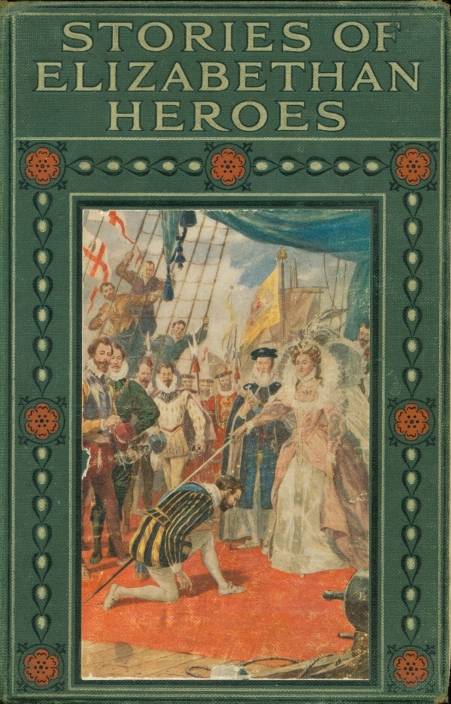
The Project Gutenberg eBook of Stories of Elizabethan heroes
Title: Stories of Elizabethan heroes
Stirring records of the intrepid bravery and boundless resource of the men of Queen Elizabeth's reign
Author: Edward Gilliat
Illustrator: J. F. Campbell
Release date: May 1, 2024 [eBook #73507]
Language: English
Original publication: London: Seeley, Service & Co. Limited, 1914
Credits: Al Haines
STORIES OF
ELIZABETHAN HEROES
STIRRING RECORDS OF THE INTREPID BRAVERY
AND BOUNDLESS RESOURCE OF THE MEN
OF QUEEN ELIZABETH'S REIGN
BY
EDWARD GILLIAT, M.A. (Oxon.)
SOMETIME MASTER AT HARROW SCHOOL
AUTHOR OF "FOREST OUTLAWS," "HEROES OF MODERN INDIA,"
"ROMANCE OF MODERN SIEGES," &c. &c.
WITH FULL-PAGE ILLUSTRATIONS
LONDON
SEELEY, SERVICE & CO. LIMITED
38 GREAT RUSSELL STREET
1914
UNIFORM WITH THIS VOLUME
THE RUSSELL LIBRARY
FOR
BOYS & GIRLS
A SERIES OF COPYRIGHT VOLUMES OF TRUE
STORIES OF ADVENTURE
Fully Illustrated. Extra crown 8vo, 2s. 6d. each
STORIES OF RED INDIAN ADVENTURE.
By H. W. G. HYRST, Author of "Adventures in the
Arctic Regions," &c.
STORIES OF ELIZABETHAN HEROES.
By Rev. EDWARD GILLIAT, M.A., sometime Master at
Harrow School, Author of "In Lincoln Green,"
"Heroes of the Indian Mutiny," &c., &c.
SEELEY, SERVICE & CO. LIMITED
CONTENTS
CHAPTER I
CHAPTER II
Sir John Hawkins, Seaman and Administrator
CHAPTER III
George Clifford, Earl of Cumberland, the Champion of the Tilt-yard
CHAPTER IV
Sir Martin Frobisher, the Explorer of the Northern Seas
CHAPTER V
Sir Humphrey Gilbert, the Founder of Newfoundland
CHAPTER VI
Lord Howard of Effingham, the Trusted of the Queen
CHAPTER VII
Sir Richard Grenville, the Hero of Flores
CHAPTER VIII
John Davis, the Hero of the Arctic and Pacific
CHAPTER IX
Francis Drake, the Scourge of Spain
CHAPTER X
Sir Francis Drake, the Queen's Greatest Seaman
CHAPTER XI
Sir Richard Hawkins, Seaman and Geographer
LIST OF ILLUSTRATIONS
"Sir Francis" ... Coloured Frontispiece [missing from source book]
Attempt on Sir John Hawkins' Life
The Blowing-up of the "San Felipe"
Sir Richard Grenville and the "Revenge"
PUBLISHERS' NOTE
The contents of this volume have been taken from Mr. Gilliat's larger book entitled "Heroes of the Elizabethan Age," published at five shillings.
STORIES OF ELIZABETHAN HEROES
CHAPTER I
THE ELIZABETHAN WORLD
Before we touch upon the lives of some of the heroes of the Maiden Queen, it were well to consider briefly what life was like in those days, and how it differed from our own.
When on a November day in 1558 Sir Nicholas Throckmorton spurred his steaming horse to Hatfield, in haste to inform the Princess Elizabeth that Queen Mary was dead, he was bidden to ride back to the Palace of St. James's and request one of the ladies of the bedchamber to give him, if the Queen were really dead, the black enamelled ring which her Majesty wore night and day. So cautious had the constant fear of death made Anne Boleyn's daughter.
Meanwhile a deputation from the Council had arrived at Hatfield to offer to the new Queen their dutiful homage.
Elizabeth sank upon her knees and exclaimed: "A Domino factum est istud, et est mirabile in oculis nostris" ("This is the Lord's doing, and it is marvellous in our eyes")—a text which the Queen caused to be engraved on her gold coins, in memory of that day of release from anxiety. For the poor young Princess had lived for years in a state of alarm; she had been imprisoned in the Tower, the victim of plots for and against her; she had been kept under severe control at Woodstock under Sir Henry Bedingfeld, where she once saw a milkmaid singing merrily as she milked the cows in the Park, and exclaimed, "That milkmaid's lot is better than mine, and her life far merrier."
And now on a sudden her terrors were turned into a great joy; and what the Princess felt all England was soon experiencing, as soon as men realised that the tyranny of Rome and of Spain was shattered and gone.
Elizabeth was now at the close of her twenty-fifth year, of striking beauty and commanding presence, tall and comely, with a wealth of hair, yellow tinged with red; she inherited from her mother an air of coquetry, and her affable manners soon endeared her to her people. The English were tired of Smithfield fires and foreign priests and princes; a new era seemed to be dawning upon them at last—an era of freedom for soul and body; and imagination ran riot with hope to forecast a new and happier world. The homage of an admiring nation was stirred by her young beauty; and wild ambition, not content with the quiet fields of England, turned adventurously to the New World beyond the Atlantic, where men dreamed of real cities paved with gold. It is true that the Pope had given all the great West to his faithful daughter, Spain; but Englishmen thought they had as much right to colonise America as any son of Spain, and they soon obtained their Queen's leave to land and explore. But the first merchants who ventured west found that Spanish policy forbade "Christians to trade with heretics." Nay, if they were taken prisoners by the Spaniards they suffered the punishment of the rack and the stake; and if they escaped, they came home with tales of cruelty that set all England ablaze to take revenge. "Abroad, the sky is dark and wild," writes Kingsley, "and yet full of fantastic splendour. Spain stands strong and awful, a rising world-tyranny, with its dark-souled Cortezes and Pizarros, Alvas, Don Johns and Parmas, men whose path is like the lava stream: who go forth slaying and to slay in the names of their Gods.... Close to our own shores the Netherlands are struggling vainly for their liberties: abroad, the Western Islands, and the whole trade of Africa and India, will in a few years be hers ... and already Englishmen who go out to trade in Guinea, in the Azores and New Spain, are answered by shot and steel."
We know a good deal of the life in Elizabethan England from an account written by Harrison, Household Chaplain to Lord Cobham. He was an admirer of still older days, as we see from his complaint about improved houses: "See the change, for when our houses were builded of willow, then had we oaken men; but now that our houses are come to be made of oak, our men are not only become willow, but a great manie, through Persian delicacie crept in among us, altogether of straw, which is a sore alteration.... Now have we manie chimnies; and yet our tenderlings complain of rheumes, catarhs and poses. Then had we none but reredosses, and our heads did never ache. For as the smoke in those daies was supposed to be a sufficient hardning for the timber of the house, so it was reputed a far better medicine to keep the goodman and his family from the quake or pose."
Harrison notes how rich men were beginning to use stoves for sweating baths, how glass was beginning to be used instead of lattice, which was made out of wicker or rifts of oak chequer-wise, how panels of horn for windows had been going out for beryl or fine crystal, as at Sudeley Castle. Then for furniture, it was not rare to see abundance of arras in noblemen's houses, with such store of silver vessels as might fill sundry cupboards. There were three things that old men remembered to have been marvellously changed; one was the multitude of chimneys lately erected, whereas only the great religious houses and manor places of the lords had formerly possessed them, but each one made his fire against a reredosse in the hall, where he dined and dressed his meat in the smoke and smother; the second thing was the improved bedding. Formerly folks slept on straw pallets covered only with a sheet, and a good round log under their heads for a bolster. "As for servants, if they had anie sheet above them, it was well, for seldom had they any under them to keep them from the pricking straws that ran oft through the canvas and rased their hardened hides."
The third thing was the exchange from wooden cups and platters into pewter or tin. Now the farmers had featherbeds and carpets of tapestry instead of straw, sometimes even silver salt-cellars and a dozen spoons of pewter.
Harrison bewails the decay of archery, and says that all the young fellows above eighteen wear a dagger. Noblemen wear a sword too, while desperate cutters carry two rapiers, "wherewith in every drunken fray they are known to work much mischief"; and as the trampers carry long staves, the honest traveller is obliged to carry horse-pistols; for the tapsters and ostlers are in league with the highway robbers who rob chiefly at Christmas time, "till they be trussed up in a Tyburn tippet."
There was a proverb, "Young serving-men, old beggars," because servants were spoilt for any other service or craft; so that the country swarmed with idle serving-men, who often became highwaymen.
A German traveller writes of England thus: "The women there are charming, and by nature so mighty pretty as I have scarcely ever beheld, for they do not falsify, paint or bedaub themselves as they do in Italy or other places, but they are some deal awkward in their style of dress; for they dress in splendid stuffs, and many a one wears three cloth gowns, one over the other. Then, when a stranger goeth to a citizen's house on business, or is invited as a guest, he is received by the master of the house and the ladies and by them welcomed: he has even a right to take them by the arm and to kiss them, which is the custom of the country; and if any one doth not do this, it is regarded and imputed as ignorance and ill-breeding on his part."
Erasmus, writing in 1500, after a visit to Sir Thomas More, exclaims merrily: "There is a custom which it would be impossible to praise too much. Wherever you go, every one welcomes you with a kiss, and the same on bidding you farewell. You call again, when there is more kissing.... You meet an acquaintance anywhere, you are kissed till you are tired. In short, turn where you will, there are kisses, kisses everywhere."
It was the same before and after a dance: you bowed, or curtseyed, and kissed your partner in all formal ceremony. So Shakespeare—
"Come unto these yellow sands,
And then take hands:
Curtseyed when you have, and kissed,
The wild waves whist" (hushed).
Another foreigner describes the English as serious, like the Germans, liking to be followed by hosts of servants who wear their masters' arms in silver, fastened to their left arms: they excel in music and dancing, and their favourite sport is hawking: they are more polite than the French in eating, devour less bread but more meat, which they roast in perfection. They put a great deal of sugar in their drink, a habit which may account for their teeth turning black in age. Harrison tells us that the nobles had "for cooks musicall-headed Frenchmen, who concocted sundrie delicacies: every dish being first taken to the greatest personage at the table."
We are told that Sir Walter Raleigh was once staying with a noble lady, whom he heard in the morning scolding her servant and crying, "Have the pigs been fed? have the pigs been fed?"
At eleven o'clock Master Walter came down to dinner, and could not resist a sly remark to his hostess, "Have the pigs been fed?" The lady drew herself up haughtily and rejoined, "You should know best, Sir Walter, whether you have had your breakfast or no." So the laugh was turned on the wit for once: for indeed it had become unusual for people to require any breakfast before eleven o'clock in Queen Elizabeth's time. Formerly they had four meals a day, consisting of breakfast, dinner, nuntion or beverage, and supper. "Now these odd repasts," says Harrison, "thanked be God! are very well left, and each one (except here and there some young hungrie stomach that cannot fast till dinner-time) contenteth himself with dinner and supper only." It was the custom at table amongst yeomen and merchants for the guest to call for such drink as he desired, when a servant would bring him a cup from the cupboard; but when he had tasted of it, he delivered it again to the servant, who made it clean and restored it to the cupboard. "By this device much idle tippling is cut off, for if the full pots should continually stand neare the trencher, divers would be alwaies dealing with them." Yet in the houses of the nobles it was not so, but silver goblets or glasses of Venice graced the tables.
They were content with four or six dishes, finishing with jellies and march-paine "wrought with no small curiosity"; potatoes, too, began to be brought from Spain and the Indies. The best beer was usually kept for two years and brewed in March; of light wines there were fifty-six kinds, mostly foreign, from Italy, Greece, and Spain, clarets from France, and Malmsey wine.
"I might here talk somewhat of the great silence that is used at the tables of the honourable and wiser sort, likewise of the moderate eating and drinking that is daily seen, and finally of the regard that each one hath to keep himself from the note of surfeiting and drunkennesse."
They were a proud, self-respecting people in those spacious times, and even the poorer sort, when they could get a time to be merry, thought it no small disgrace if they happened to be "cup-shotten."
In regard to their dress the English at that time seem to have been somewhat extravagant, copying first the Spanish guise, then the French, anon the Italian or German—nay, even Turkish and Moorish fashions gained favour; "so that except it were a dog in a doublet, you shall not see any so disguised as are my countrymen of England."
Our good friend Harrison waxes quite sarcastic as he describes, "What chafing, what fretting, what reproachful language doth the poor workman bear away! ... Then must we put it on, then must the long seams of our hose be set by a plumb-line: then we puff, then we blow, and finally sweat till we drop, that our clothes may stand well upon us."
It became the fashion for ladies to dye their hair yellow out of compliment to the Queen, who however in her later years used wigs, and was reputed to have a choice of eighty attires of false hair.
In 1579 the Queen gave her command to the Privy Council to prevent excesses of apparel, and it was ordered that "No one shall use or wear such excessive long cloaks; being in common sight monstrous." Neither were they to wear such high ruffs of cambric about their necks as were growing common, both with men and women. Quilted doublets, curiously slashed, and lined with figured lace, Venetian hose and stockings of the finest black yarn, with shoes of white leather, betokened the courtier, the clank of whose gilded spurs announced his coming.
In regard to weapons, the long-bow had gone out of use, but they shot with the caliver, a clumsy musket with a short butt, and handled the pike with dexterity. Corslets and shirts of mail still remained; every village could furnish forth three or four soldiers, as one archer, one gunner, one pikeman, and a bill-man. As to artillery, the falconet weighed five hundred pounds, with a diameter of two inches at the mouth; the culverin weighed four thousand pounds, having a diameter of five inches and a half; the cannon weighed seven thousand, and the basilisk nine thousand pounds.
In 1582 Queen Elizabeth had twenty-five great ships of war, the largest being of 1000 tons burden, besides three galleys: there were 135 ships that exceeded 500 tons, which could fight at a pinch, for many private owners possessed ships of their own.
A man-of-war in those days was well worth two thousand pounds, and "it is incredible to say how greatly her Grace was delighted with her fleet." After all, it is the men that count most, and the men of that day were as full of good courage as the best of us.
On the Continent they had a saying that "England is a paradise for women, a prison for servants, and a purgatory for horses"; for the females had more liberty in England than on the Continent, and were almost like masters; while the servants could not escape from England without a passport, and the poor horses were worked all too hard.
For instance, when the Queen broke up her Court to go on progress, there commonly followed her more than three hundred carts laden with bag and baggage. For you must know that in Tudor England, besides coaches, they used no waggons for their goods, but had only two-wheeled carts, which were so large that they could carry quite as much as waggons, and as many as five or six horses were needed to draw them.
In those days they knew full well what deep ruts could do in the way of lowering speed, and the jaded horses must sometimes have thought that they were pulling a plough, and not a coach.
Fynes Moryson, a traveller, gives a pleasant account of his journeyings: "The world affords not such Innes as England hath, either for good and cheap entertainment after the guests' own pleasure, or for humble attendance upon passengers. For as soon as a traveller comes to an Inne, the servants run to him, and one takes his horse and walks him till he be cold, then rubs him and gives him meat. Another servant gives the traveller his private chamber and kindles his fire: the third pulls off his boots and makes them cleane. Then the Host or Hostess visits him; and if he will eat with the Host, or at a common table with others, his meal will cost him six pence, or in some places but four pence: but if he will eat in his chamber, the which course is more honourable, he commands what meat he will, according to his appetite, and when he sits at table the Host or Hostess will visit him, taking it for courtesie to be bid sit downe: while he eats he shall have musicke offered him: if he be solitary the musicians will give him the good day with musicke in the morning. It is the custom to set up part of supper for his breakfast. Ere he goeth he shall have a reckoning in writing, which the Host will abate, if it seem unreasonable. At parting, if he give some few pence to the chamberlain and ostler they wish him a happy journey."
We may add that folk did not use night-gowns, as we see from George Cavendishes "Life of Wolsey": "My master went to his naked bed." But a night-gown in those days meant a dressing-gown. Hentzner gives us a description of the life at Court, from which we will take a few passages. He was at Greenwich Palace, being admitted to the presence-chamber, which was hung with rich tapestry and strewn with hay, or rushes. After noticing the small hands and tapering fingers of the Queen, her stately air and pleasing speech, he says: "As she went along in all this state and magnificence, she spoke very graciously, first to one foreign Minister, then to another: for, besides being well skilled in Greek, Latin, and French, she is mistress of Spanish, Scotch, and Dutch. Whoever speaks to her, it is kneeling: now and then she will pull off her glove and give her hand to kiss, sparkling, with rings and jewels. The Ladies of the Court that followed her, very handsome and well-shaped, were dressed in white, while she was guarded on either side by her gentlemen Pensioners, fifty in number, with gilt battle-axes."
What a marvellous lady was this Queen, so taught by suffering to dissemble and deceive, so trained by her tutors, Ascham and others, that she could make a speech in Latin to the Doctors of Cambridge and Oxford, or converse with a Dutchman, nay, even with a Scot in his own tongue.
We rather suspect that Hentzner may have been mistaken about the Scot; for surely she could not speak with a Highlander in Gaelic, and to understand a Lowland Scot could not have taxed her royal powers much.
England was a strange mixture of richness and poverty, of learning and superstition, of refined luxury and brutal amusements at that age. Hentzner describes how in a theatre built of wood he one day sat to listen to excellent music and noble poetry of tragedy or comedy, the next time he witnessed the cruel baiting of bulls and bears by English bull-dogs. "To this entertainment there often follows that of whipping a blinded bear, which is performed by five or six men standing around in a circle with whips, which they exercise upon him without any mercy, as he cannot escape from them because of his chain: he defends himself with all his force and skill, throwing down all who come within his reach, and tearing the whips out of their hands and breaking them. At these spectacles" (he writes in 1598) "the English are constantly smoking tobacco, and in this manner: they have pipes on purpose made of clay, into the farther end of which they put the herb, so dry that it may be rubbed into powder; putting fire to it they draw the smoke into their mouths, which they puff out again through their nostrils, like to funnels."
The writer has one of these Elizabethan pipes: it is made with an exceedingly small bowl, showing how precious was the weed which Raleigh had recently introduced. The pipes have been found by workmen employed on the banks of the Thames in Southwark.
We must remember, in criticising the conduct of Elizabethan heroes, that they lived in a cruel age; that torture was still employed by the law, even to delicate ladies; that much of their sport was brutal, and much of their merriment gross and indelicate. There is, and there has been, a decided progress in the manners of Europeans; so that it is with a moral effort that we try to see things with their eyes and judge them with discrimination. For instance, many of their great seamen may in one aspect be regarded as pirates; for the great Queen sometimes did not sanction their raids over western waters until they had brought her some priceless spoil. The pirate was then knighted and commended for his valiant deeds of patriotism. Even along the coasts of England local jealousy set the galleys of the Cinque Ports in the south at making reprisals upon the traders of Yarmouth. When these depredations were made upon foreigners there were few who denounced them; for it became a kind of sport, an adventure well worth the attention of any squire's son, to snatch some rich prize from the wide ocean and distribute largesse on safely coming to port.
These men were the Robin Hoods of the sea, and when from selfish plunderings they rose to be champions of religious freedom as well, their career seemed in most men's minds to be worthy of all admiration. But in order to understand fully the motives which induced the more noble spirits to go forth and do battle with Spain on private grounds, and at their own expense, we ought to have sat at the Mermaid, or other taverns, and heard the mariners' tales as they told them fresh from the salt sea. We should have listened to stories of cruel wrongs inflicted on the brave Indians of South America, which would have stirred any dormant spirit of chivalry within us, and made us long to champion the weak.
We should have heard the story of the Indian chief who was taken prisoner by the Spaniards, and suffered the penalty of losing his hands because he had fought so strenuously for his mother-land. This Indian returned to his people, and devoted the rest of his life to encouraging and heartening his countrymen to the great work of fighting for life and liberty, showing his maimed arms, and calling to mind how many others had had half a foot hacked off by the Spaniards that they might not sit on horseback. Then, when a battle was being fought, we should have been told how this chief loaded his two stumps with bundles of arrows and supplied the fighters with fresh store, as they lacked them. Surely men so brave as this man challenged admiration and deserved succour.
The young Queen of England had suffered herself, and these stories must have stirred her heart to say with the Dido of Virgil—
"Haud ignara mali, miseris succurrere disco."
Raleigh and Drake, Hawkins and Frobisher, Shakespeare and Spenser may have sat by a coal-fire and heard or told such stories; for Raleigh writes: "Who will not be persuaded that now at length the great Judge of the world hath heard the sighs, groans, and lamentations, hath seen the tears and blood of so many millions of innocent men, women, and children, afflicted, robbed, reviled, branded with hot irons, roasted, dismembered, mangled, stabbed, whipped, racked, scalded with hot oil, put to the strapado, ripped alive, beheaded in sport, drowned, dashed against the rocks, famished, devoured by mastiffs, burned, and by infinite cruelties consumed,—and purposeth to scourge and plague that cursed nation, and to take the yoke of servitude from that distressed people, as free by nature as any Christian."
It was not the massacres under Cortez and Pizarro, earlier in this century, which roused the deepest indignation; it was the tales of inhuman cruelty perpetrated by Spanish colonists in time of peace, and of the noble conduct of the conquered Indians under the degrading conditions of their slavery, which most moved pity and wrath and feelings of revenge.
Men told the story of the Cacique who was forced to labour in the mines with his former subjects, how he called the miners together—ninety-five in all—and with a dignity befitting a prince made them the following speech:—
"My worthy companions and friends, why desire we to live any longer under so cruel a servitude? Let us now go unto the perpetual seat of our ancestors, for we shall there have rest from these intolerable cares and grievances which we endure under the subjection of the unthankful. Go ye before, I will presently follow." So speaking, the Indian chief held out handfuls of those leaves which take away life, prepared for the purpose; so they disdainfully sought in death relief from the cruel bondage of their Spanish masters.
Again, an officer named Orlando had taken to wife the daughter of a Cuban Cacique; but, because he was jealous, he caused her to be fastened to two wooden spits, set her before the fire to roast, and ordered the kitchen servants to keep her turning. The poor girl, either through panic, fear, or the torment of heat, swooned away and died. Now the Cacique her father, on hearing this, took thirty of his men, went to the officer's house and slew the woman whom he had married after torturing his former wife, slew her women and all her servants; then he shut the doors of the house and burnt himself and all his companions. Tales such as these might well sting a generous and kindly people into doing harsh actions. Froude says in his "Forgotten Worthies": "On the whole, the conduct and character of the English sailors present us all through that age with such a picture of gallantry and high heroic energy as has never been over-matched." So, when we feel inclined to pass judgment upon our "heroes" for their misdeeds, we must remember the spirit of the time, and the wrongs of the weaker, and the promptings of generosity and religion.
CHAPTER II
SIR JOHN HAWKINS, SEAMAN AND ADMINISTRATOR
This famous sea-captain was the grandson of John Hawkins of Tavistock, who was a merchant in the service of Henry VIII. John was born at Plymouth in the year 1520, and drank in the love of the salt seas from his earliest years. His father, William Hawkins, was known to be one of the most experienced sea-captains in the west of England: he had fitted out a "tall and goodly ship," the Paul of Plymouth, and made in her three voyages to Brazil and to Guinea. He treated the savage people so well that they became very friendly, and in 1531 he brought one of their chiefs to England, leaving a Plymouth man behind as hostage. This chief was presented to King Henry and became the lion of society. On his way home to Brazil he died of sea-sickness; but Hakluyt tells us that the savages, being fully persuaded of the honest dealing of William Hawkins with their king, believed his report and restored the hostage, without harm to any of his company.
William Hawkins married Joan Trelawny and had two sons, John and William, both of whom made their way as seamen and merchants.
John made some voyages to the Canary Islands when quite a youth, and with his quick eye for gain soon learnt that negroes might be cheaply gotten in Guinea and profitably sold in Hispaniola. John Hawkins was not the first to make and sell slaves, but he was the first Englishman to take part in this cruel and inhuman barter. The Spaniards and Portuguese had used slaves, both Moors and negroes, and Hawkins no doubt had seen plenty of cases of slave-holding along the west coast of Africa, where savage warfare was carried on between native tribes, and such of the conquered as were not eaten were retained as slaves. He may have thought therefore that he was only carrying them to a less barbarous captivity; and we should remember that slavery was defended even by some religious people until quite recent times: but we must deplore the fact that this daring sea-dog, who certainly was not without religious feelings, found in this traffic a source of gain.
No doubt John, on his return to England, discussed the matter openly with men of influence, for in October 1562, being now more than forty years old, he led an expedition of a hundred men in three ships, the Solomon of 120 tons, the Swallow of 100 tons, and the Jones of 40 tons burden, and sailed direct for the coast of Sierra Leone, in West Africa, just north of Guinea. Hakluyt draws a veil over the exact methods by which John Hawkins got possessed of 300 fine negroes, besides other merchandise; but he probably took sides in some local quarrel and carried off his share of the prisoners. These poor wretches were carried across the Atlantic in the stuffy holds of small ships, and landed at San Domingo, one of the largest of the Spanish islands in the West Indies.
John made due apologies for entering the Spanish port: they could see he was really in want of food and water. The Spaniards too were polite, and as they peeped into his hold they saw the very thing they wanted—negroes. A bargain was quickly made, and John Hawkins took off in return for his captives quite a goodly store of pearls, hides, sugar, and other innocent materials.
Hawkins himself arrived safely in England with his three ships, but his partner, Thomas Hampton, who took what was left over in two Spanish ships to Cadiz, did not fare so well. For when it became known at Cadiz that English merchants had been trading with Spain's colonies, Philip II. confiscated the cargo, and Hampton narrowly escaped the prisons of the Inquisition. Queen Elizabeth was warned by her ambassador at Madrid that further voyages of this nature might lead to war.
For it seems that Philip had been an admirer of the Maiden Queen, and had been rebuffed as a suitor; whereby his love had changed to hate, and he lost no opportunity of showing his resentment.
But Queen Bess had her father's spirit in her, and answered the Spanish threat by permitting one of her largest ships, the Jesus of Lübeck, to be chartered for a new voyage. The Earls of Leicester and Pembroke joined in raising money for the expedition—this time it was a Court affair; there sailed a hundred and seventy men in five vessels, and they were to meet another Queen's ship, the Minion, before they got out of the Channel.
Again Hawkins raided the West African coast, "going every day on shore to take the inhabitants, with burning and spoiling of their towns."
It is strange how men engaged in such ruthless work could yet believe that they were specially preserved by Providence. For on New Year's Day 1565 they were well-nigh surprised by natives as they were seeking water. But a pious seaman wrote thus in his journal: "God, who worketh all things for the best, would not have it so, and by Him we escaped without danger—His name be praised for it!" Then they set sail for the West Indies with a goodly cargo of miserable slaves; but for eighteen days they were becalmed—"as idle as a painted ship, upon a painted ocean." "And this happened to us very ill, being but reasonably watered for so great a company of negroes and ourselves. This pinched us all: and, that which was worst, put us in such fear that many never thought to have reached the Indies without great dearth of negroes and of themselves; but the Almighty God, which never suffereth His elect to perish, sent us the ordinary breeze."
Let us hope that they felt some pity for the poor negroes too, who must have suffered agonies of thirst on that hideous journey.
But King Philip had ordered his Christian subjects to have no dealings with heretics; and for some time they could sell no negroes in Dominica.
But some heathen Indians presented cakes of maize, hens, and potatoes, which the English crews bought for beads, pewter whistles, knives, and other trifles. "These potatoes be the most delicate roots that may be eaten, and do far exceed our parsnips and carrots."
We need to remind ourselves occasionally of some of the luxuries which our ancestors never knew till these old seadogs brought them home—tobacco and potatoes! and later on, tea and coffee! It is difficult to imagine what the want of such things would mean to us now.
But not all the Indians were so kind as these they first met; for on the American mainland they fell in with a tribe whom the devilries of Spain had turned to "ferocious bloodsuckers," and whom they only narrowly avoided. Hawkins, according to his instructions from the Queen's Council, kept away from the larger dependencies and islands, and tried to sell his cargo in out-of-the-way places which Philip's orders might not have reached. At Barbarotta he was refused permission to trade. But Hawkins sent in a message: "I have with me one of Queen Elizabeth's own ships. I need refreshment and without it I cannot depart; if you do not allow me to have my way, I shall have to displease you."
Thereat he ran out a few of his guns to mark the form which his displeasure might assume: the Spaniards improved in politeness. At Curacoa they feasted on roast lamb to their heart's content: near Darien they again had to use threats of violence in order to get licence to trade; but the price offered by the Spaniards for the negroes so disgusted the equitable mind of John Hawkins that he wrote the Governor a letter saying that they dealt too rigorously with him, to go about to cut his throat in the price of his commodities ... but seeing they had sent him this to his supper, he would in the morning bring them as good a breakfast.
When that breakfast was served—and served hot—it proved to be garnished with a handsome volley of ordnance, with ships' boats landing at full speed a hundred armed Englishmen: the Spaniards fled.
"After that we made our traffic full quietly, and sold all our negroes." Hawkins then sailed for Hispaniola, but being misled by his pilot he found himself at Jamaica and then at Cuba, and so along the coast of Florida, meeting many Indians whenever they landed who were of so fierce a character that of five hundred Spaniards who had recently set foot in the country only a very few returned; and a certain friar who essayed to preach to them "was by them taken and his skin cruelly pulled over his ears and his flesh eaten." "These Indians as they fight will clasp a tree in their arms and yet shoot their arrows: this is their way of taking cover."
In coasting along Florida they found a Huguenot colony that had been founded there at the advice of Admiral Coligny. They had been reduced by fighting the Indians from two hundred to forty, and were glad to accept a passage home in the Tiger. On the 28th of July the English ships started for home, but, owing to contrary winds, their provisions fell so short they "were in despair of ever coming home, had not God of His goodness better provided for us than our deserving." On the 20th September they landed at Padstow in Cornwall, having lost twenty persons in all the voyage, and with great profit in gold, silver, pearls, "and other jewels great store." The Queen was delighted with the bold way in which Hawkins had traded in defiance of the Spanish king, and by patent she conferred on him a crest and coat of arms.
The Spanish ambassador at once wrote off to his master, saying he had met Hawkins in the Queen's palace, who gave him a full account of his trading with full permission of the governors of towns (he did not say by what means he had obtained such licence); "The vast profit made by the voyage has excited other merchants to undertake similar expeditions. Hawkins himself is going out again next May, and the thing needs immediate attention." The result of this letter was that Hawkins was strictly forbidden by Sir William Cecil from "repairing armed, for the purpose of traffic, to places privileged by the King of Spain." So the ships went, but Hawkins stayed at home; his ships returned next summer laden with gold and silver. The crews did not publish any account of how they had obtained their cargoes, and as the Queen had recently been assisting the Netherlands in their struggle for liberty against Spain, she made no indiscreet inquiries, and proceeded to lend the Jesus of Lübeck and the Minion for another expedition. One of the volunteers was young Francis Drake, now twenty-two years of age, whom Hawkins made captain of one of his six vessels.
As they left Plymouth they fell in with a Spanish galley en route for Cadiz with a cargo of prisoners from the Netherlands. Hawkins fired upon the Spanish flag, and in the confusion many of the captives escaped to the Jesus, whence they were sent back to Holland.
The Spanish ambassador wrote strongly to the Queen, and the Queen wrote strongly to Hawkins; but Hawkins had sailed away and was encountering storms off Cape Finisterre, so that he had a mind to return for repairs. But the weather moderating he went on to the Canaries and Cape Verde. Here he landed 150 men in search of negroes, but eight of his men died of lockjaw from being shot by poisoned arrows. "I myself," writes Hawkins, "had one of the greatest wounds, yet, thanks be to God, escaped."
In Sierra Leone they joined a negro king in his war against his enemies, attacked a strongly paled fort, and put the natives to flight. "We took 250 persons, men, women, and children, and our friend the king took 600 prisoners," which by agreement were to go to the English, but the wily negro decamped with them in the night, and Hawkins had to be content with his own few. They were at sea from February 3rd until March 27th, when they sighted Dominica, but found it difficult to trade, until after a show of force the Spaniards gave in and eagerly bought the slaves. At Vera Cruz the inhabitants mistook our ships for the Spanish fleet. There is a rocky island at the mouth of the harbour which Hawkins seized. The next morning the Spanish fleet arrived in reality, but Hawkins would not admit them until they had promised him security for his ships. Now there was no good anchorage outside, and if the north wind blew "there had been present shipwreck of all the fleet, in value of our money some £1,800,000." So he let them in under conditions, for even Hawkins thought that he ought not to risk incurring his Queen's indignation. On Thursday Hawkins had entered the port, on Friday he saw the Spanish fleet, and on Monday at night the Spaniards entered the port with salutes, after swearing by King and Crown that Hawkins might barter and go in peace.
For two days both sides laboured, placing the English ships apart from the Spanish, with mutual amity and kindness. But Hawkins began to notice suspicious changes in guns and men, and sent to the Viceroy to ask what it meant. The answer was a trumpet-blast and a sudden attack. Meanwhile a Spaniard sitting at table with Hawkins had a dagger in his sleeve, but was disarmed before he could use it. The Spaniards landed on the island and slew all our men without mercy. The Jesus of Lübeck had five shots through her mainmast, the Angel and Swallow were sunk, and the Jesus was so battered that she served only to lie beside the Minion, and take all the battery from the land guns.
ATTEMPT ON SIR JOHN HAWKINS' LIFE
As the Spanish and English fleets were anchored at Vera Cruz apparent amity and goodwill existed between the two, but as Hawkins was sitting at dinner one day a Spaniard sitting at table with him was discovered with a dagger up his sleeve, but fortunately was disarmed before he could use it.
Hawkins cheered his soldiers and gunners, called his page to serve him a cup of beer, whereat he stood up and drank to their good luck. He had no sooner set down the silver cup than a demi-culverin shot struck it away. "Fear nothing," shouted Hawkins, "for God, who hath preserved me from this shot, will also deliver us from these traitors and villains."
Francis Drake was bidden to come in with the Judith, a barque of 50 tons, and take in men from the sinking ships: at night the English in the Minion and Judith sailed out and anchored under the island. The English taken by the Spaniards received no mercy. "They took our men and hung them up by the arms upon high posts until the blood burst out of their fingers' ends."
The Judith under Drake sailed for England and reached Plymouth in January 1569; the Minion, with 200 men, suffered hunger and had to eat rats and mice and dogs. One hundred men elected to be landed and left behind to the mercies of Indians and Spaniards. "When we were landed," said a survivor, "Master Hawkins came unto us, where friendly embracing every one of us, he was greatly grieved that he was forced to leave us behind him. He counselled us to serve God and to love one another; and thus courteously he gave us a sorrowful farewell and promised, if God sent him safe home, he would do what he could that so many of us as lived should by some means be brought into England—and so he did." Thus writes Job Hartop. So we see that John Hawkins, the slave-dealer, sincerely tried after his fashion to serve God as well as his Queen. His men loved him and spoke well of him when he failed; a good test of a man's worth when men will speak well of you though all your plans be broken and your credit gone. But alas! for the poor hundred men left ashore on the Mexican coast! They wandered for fourteen days through marshes and brambles, some poisoned by bad water, others shot by Indians or plagued by mosquitoes, until they came to the Spanish town of Panluco, where the Governor thrust them into a little hog-stye and fed them on pigs' food. After three days of this they were manacled two and two and driven over ninety leagues of road to the city of Mexico. One of their officers used them very spitefully and would strike his javelin into neck or shoulders, if from faintness any lagged behind, crying, "March on, English dogs, Lutherans, enemies to God." After four months in gaol they were sent out as servants to the Spanish colonists. For six years they fared passing well, but in 1575 the Inquisition was introduced into Mexico, and then their "sorrows began afresh." On the eve of Good Friday all were dressed for an auto-da-fé and paraded through the streets. Some were then burnt, others sent to the galleys, the more favoured ones got three hundred lashes apiece. One who had escaped had spent twenty-three years in various galleys, prisons, and farms.
Meanwhile Hawkins was taking his other hundred men back to England, meeting violent storms, but "God again had mercy on them." Then food became scarce and many died of starvation: the rest were so weak they could hardly manage the sails. At last they sighted the coast of Spain and put in at Vigo for supplies; here more died from eating excess of fresh meat after their famine. At length, with the help of twelve English sailors they reached Mount's Bay in Cornwall, in January 1569.
Here was a miserable ending of an ambitious expedition: no profits, no gold, no silver for the rich merchants and courtiers who had subscribed for the fitting out of the ships; no jewels for the lady who graced the throne. Sadly John Hawkins wrote to Sir William Cecil: "All our business hath had infelicity, misfortune, and an unhappy end: if I should write of all our calamities, I am sure a volume as great as the Bible will scarcely suffice."
Thus our hero, ruined but not broken, bided his time for revenge. As the years wore on England and Spain grew more embittered. Private warfare had existed for some time, and Philip had wished to declare open war in 1568; but the Duke of Alva cautioned him against making more enemies, while they still found it hard to subdue the Low Countries. So, for a while, the King contented himself with underhand efforts to stir up rebellion in Ireland and England.
In the year 1578 John Hawkins was summoned by the Queen from Devon and appointed Comptroller of the Navy. His business was to see to the building of new ships, the repairing of old ones, and the victualling and manning of all about to take the sea. Hawkins is said to have invented "false netting" for ships to fight in, chain-pumps and other devices. Acting with Drake he founded the "Chest" at Chatham, a fund made up by voluntary subscriptions from seamen on behalf of their poorer brethren. In fact he entered upon his work with the same zeal which he had shown in the West Indies. Lucky was it for him that he had a mistress like Elizabeth; for under the craven James he would certainly have been handed over to the Inquisition, or put to death by Spanish order, like Raleigh. In 1572 Hawkins and George Winter were commissioned to do their utmost to clear the British seas of pirates and freebooters, for of late the coasts of Norfolk and the East had been much troubled by sea-robbers. But through all his multifarious duties the old sea-rover was ever most bent on paying off old scores against King Philip. So many of his friends, beside himself, had lost their all or endured sharp punishment in Spanish dungeons, that he grimly chuckled when he heard of Drake having "singed King Philip's beard"; and when the news came that the invasion of England was only put off, and Pope Sixtus V. had spurred his Spanish Majesty to quick action by the oft-quoted taunt, "The Queen of England's distaff is worth more than Philip's sword," then John Hawkins rubbed his hands gleefully, and lost no time in getting all the Queen's ships taut and in order, well victualled and well manned. But Hawkins did not mince matters when he saw anything amiss; any hesitation or signs of parsimony met with his blunt disapproval. He writes in February 1588 to urge that peace could only be won by resolute fighting: "We might have peace, but not with God. Rather than serve Baal, let us die a thousand deaths. Let us have open war with these Jesuits, and every man will contribute, fight, devise or do, for the liberty of our country."
Hawkins also wrote to ask for the use of six large and six small ships for four months, with 1800 mariners and soldiers, which he would employ in another raid upon the Spanish coast, so as to hinder Philip's grand Armada. "I promise I will distress anything that goeth through the seas: and in addition to the injury done to Spain, I shall acquire booty enough to pay four times over the cost of the expedition."
But Burghley, like his mistress, kept a tight hand over slender resources, and he rejected Hawkins' offer. Macaulay says that even Burghley's jests were only neatly expressed reasons for keeping money carefully. Lord Howard bitterly complained to Walsingham that "her Majesty was keeping her ships to protect Chatham Church withal, when they should be serving their turn abroad"; and again, when Drake was being prevented from getting his Plymouth squadron in order for sea-service, he writes: "I pray God her Majesty do not repent her slack dealing.... I fear ere long her Majesty will be sorry she hath believed some so much as she hath done." Lord Burghley's task was to defeat the Armada with an almost empty exchequer. We find calculations of his as to whether it will not be cheaper to feed the sailors of the fleet on fish three days a week and bacon once, instead of the usual ration of four pennyworth of beef each day. And naturally these attempts to cut down expenses were misconstrued into parsimony. But with all her rigid economy, Elizabeth could show a brave front when the crisis came; as in the camp at Tilbury, when she addressed the little army that was expecting every hour to be called to meet the fierce onset of the invaders: "I have placed my chiefest strength and safeguard in the loyal hearts and goodwill of my subjects; and therefore am I come amongst you, as ye see, at this time, resolved in the midst and heat of the battle, to live or die amongst you all; to lay down for my God, for my kingdom, and for my people, my honour and my blood even in the dust. I know I have the body but of a weak and feeble woman; but I have the heart of a king, and of a King of England too, and think it foul scorn that Parma, or Spain, or any Prince of Europe, should dare to invade the borders of my realm; to which, rather than any dishonour shall grow by me, I myself will take up arms, I myself will be your General, Judge, and Rewarder of every one of your virtues in the field."
The Great Armada had left the Tagus on the 20th of May 1588. It consisted of one hundred and thirty-two ships under the command of the Duke of Medina Sidonia. Besides 8766 sailors, there were on board 2088 galley slaves, 21,855 officers and soldiers ready for action as soon as they should land; 300 monks and friars were pacing the decks, sent to take spiritual charge in partibus infidelium.
Against this force Queen Elizabeth had only thirty-four of her own ships, but all the seaports from Bristol to Hull sent small armed vessels, while noblemen and merchants contributed to swell the total, which came to nearly two hundred in all.
John Hawkins was there as Rear-Admiral under Howard, making with Drake and Frobisher his headquarters at Plymouth. "For the love of God," he writes to Walsingham, on the 19th of June, "let her Majesty care not now for charges," and in the same vein he wrote also to the Queen.
As he kept watch the Spanish fleet came slowly on, intending to surprise Plymouth; but Hawkins and his vessels were already awaiting the foe outside, so they anchored for the night off Looe. The next day was Sunday, the 21st of July, and Medina Sidonia seems to have made up his mind to go on to the Isle of Wight. All that day the little English ships were barking round the unwieldy galleys of Spain. "We had some small fight with them that Sunday afternoon," said Hawkins. By three o'clock the Spanish fleet was in a pretty confusion, hasting to get away from their tormentors. On Monday and Tuesday the fight continued, the details of which may be reserved for a later chapter; but every day more reinforcements came to Howard, as courtiers and merchants hurried down from London to serve in pinnace or frigate. By Wednesday morning the English ships had spent nearly all their ammunition, and were begging for powder and shot at every village they passed. On Friday Lord Howard knighted Frobisher and Hawkins for their valiant conduct; he then allowed the Armada to sail along the Sussex coast and cross the Straits of Dover towards Calais. There through Saturday and Sunday vast crowds of Flemings and Frenchmen gathered to gaze at the two great fleets, which were waiting, the Spaniards for the Prince of Parma to join them from Dunkirk, the English to carry out a little device which Sir William Winter had suggested.
Six of the oldest vessels were filled with combustibles and guns loaded to the mouth with old iron, and at midnight were conducted in the pitchy darkness of a rising storm within bow-shot of the Armada.
A train was fired, and the fierce south-west wind bore the fire-ships into the crescent of the Spaniards. The blaze, the explosions, the cannon-shot, struck a panic into the Armada. "The fire of Antwerp!" they cried. "Cut cable, up anchor!" In a few minutes they were all colliding together in their hurry to get away from the flames, and all that night they sped away past Dunkirk and Parma even to the mouth of the Scheldt.
"God hath given us so good a day in forcing the enemy so far to leeward," wrote Drake, "as I hope in God, the Prince of Parma and the Duke of Sidonia will not shake hands these few days.... I assure your honour, this day's service hath much appalled the enemy."
Then on the Monday Hawkins in the Victory, Drake in the Revenge, and Frobisher in the Triumph, led the English to the attack upon a fleet disorganised and cowed, fearing alike the sands, the storm, and the foe. Every ship in the Spanish fleet had received damage, some had been taken and others sunk, while a score or so went on shore and were lost.
The Spanish fleet lay safely moored in Calais Harbour, huge impregnable castles of timber, but Howard's fire-ships caused them to scurry away before the wind like frightened fowls.
"We pluck their feathers by little and little," wrote Lord Howard, and if Burghley had only given them powder enough, the victory would have been complete. The English had no more ammunition left, but still, as the Spaniards forged ahead to the north, they grimly followed: "We set on a brag countenance and gave them chase."
It was not until Friday the 2nd of August that Howard abandoned the pursuit. He made for the Firth of Forth, took in victuals, powder, and shot, and sailed southwards to be ready for Parma, should he cross from Dunkirk. As they sailed, a storm burst upon them, scattering them so that they did not assemble again in Margate Roads until the 9th of August. A note from Lord Burghley suggests that as the danger is over, the ships shall be at once discharged; but there was no money to pay the men who had saved England in her hour of danger. Towards the end of August, Sir John wrote urgently to Burghley for money to pay the seamen—£19,000 were already due to them before the fight off Gravelines—and Lord Howard added a postscript: "Hawkins cannot make a better return. God knows how the lieutenants and corporals will be paid." Howard and Hawkins could not pay them off. The men were kept hanging on, ill-fed, ill-clad, housed like hogs and dying as by a pestilence. "'Tis a most pitiful sight to see how the men here at Margate, having no place where they can be received, die in the streets. The best lodging I can get is barns and such outhouses, and the relief is small that I can provide for them here. It would grieve any man's heart to see men that have served so valiantly die so miserably." So Howard writes to Burghley.
Burghley, at his wits' end, writes to Hawkins a melancholy letter: "Why do you ask for money when you know the exchequer is so empty?"
Howard tells the Queen how the men sicken one day and die the next; and as woman she pitied them, but could not find means to help her sailors. "Alas! these things must be—after a famous victory!" Her minister may have suggested some such reflection.
Meanwhile the great Armada, left to the judgment of God, was leaving its wrecks on the coasts of Norway, Scotland, and Ireland. It was not until October that fifty-three ships out of one hundred and thirty-two came back wearily to a Spanish port.
Sir Francis Drake tells us that many Spanish seamen landed in Scotland and Ireland, of whom a few remained to live amongst the peasantry, but the most part were coupled in halters and sent from village to village till they were shipped to England. "But her Majesty, disdaining to put them to death, and scorning either to retain or entertain them, they were all sent back again to their own country to bear witness to the worthy achievement of their Invincible Navy."
Sir John Hawkins in 1589 proposed to Lord Burghley a scheme for capturing Cadiz and sinking all the Spanish galleys he could find there. "It is not honourable for her Majesty to seem to be in any fear of the King of Spain." But Burghley did not approve of any more expenditure of money, and the scheme was dropped.
But every year English merchantmen were held up by Spanish galleys and had to fight for their existence: so in 1590 we hear of Sir John proposing another attack on Spain; and when this too was rejected, he wrote to Burghley, saying that he was now out of hope that he should be allowed to perform "any royal thing." So out of heart was he now that he begged he might be relieved of his duties as Treasurer of the Navy. "No man living hath so careful, so miserable, so unfortunate, and so dangerous a life." This request too was declined. But in May 1590 Sir John was sent, with Sir Martin Frobisher as Vice-Admiral, in command of fourteen ships to try and intercept a fleet of Portuguese carracks coming from India. They ransacked nearly every port on the Spanish coast for five months, so that all valuables were hastily removed inland, and all the Spanish galleys were hidden behind rocky promontories. But Philip had ordered the trading fleets to be kept back, and therefore no prizes were captured, and the adventurers returned empty-handed.
Queen Elizabeth was mightily incensed, though it was through no fault of the admirals that the expedition had been a financial failure.
Hawkins wrote the Queen a lengthy epistle explaining why they had failed, and he finished with a Biblical allusion: "Paul might plant, and Apollos might water, but it was God only who gave the increase." The Queen, stamping her foot, exclaimed hotly, "This fool went out a soldier, and is come home a divine!"
So the poor seaman returned to his hated desk as Treasurer, though he wrote to Burghley that he was fain to serve her Majesty in any other calling. "This endless and unsavoury occupation in calling for money is always unpleasant." He was now over seventy years of age, and his son Richard had for some years been distinguishing himself on the sea. But when that son had to surrender to the Spaniards and was sent to a Spanish prison, the old sea-dog thirsted to go abroad again and rescue his son, or at least take a great revenge.
His old friend Sir Francis Drake was to go with him, for the Queen had assented; but rumours of a fresh Armada kept them in England, for "all men," says Camden, "buckled themselves to war," and mothers only bewailed that their sons had been killed in France instead of being alive and well to defend hearth and home in England. But all the Spaniards did was to cross from Brittany with four galleys and land at Penzance. This town they sacked and burnt, but as the inhabitants had fled inland, no lives were lost. This was the last hostile landing made by the Spaniards on England's shore.
Next year, in August 1595, Drake and Hawkins left Plymouth with twenty-seven ships and 2500 men, Drake sailing in the Defiance as Admiral, Hawkins in the Garland as Vice-Admiral; Sir Thomas Baskerville was the Commander by land. The plan was to sail to Nombre de Dios and march across the isthmus to Panama, there to seize what treasure they could. But just before they sailed letters came from the Queen informing them that they were too late to intercept the West Indian fleet; it had already arrived in Spain; but one treasure-ship had lost a mast and put back to Puerto Rico; they were to seek for this and take it. So they sailed on the 28th of August, and in four weeks reached the Grand Canary. Drake and Baskerville wished to land, victual the fleet, and take the island; Hawkins, still smarting under Elizabeth's lash, was for strictly obeying the Queen's instructions. However, Baskerville promised he would take the place in four days, and Hawkins consented to wait. But finding that a strong mole had been built, and that the landing-place was defended by guns, and as a nasty sea was rising, they just landed to get water on the western side of the island and made for Dominica.
After making some traffic in tobacco they went on to Guadaloupe, where they cleaned their ships and let the men land. The next day, seeing some Spanish ships passing towards Puerto Rico, Drake concluded that the treasure-ship was still there, and that this force had been sent to convoy it. Captain Wignol in the Francis, having straggled behind out of Hawkins' fleet, fell in with these Spanish ships under Don Pedro Tello, and was captured. Tello put his men to torture, and drew from them the object and proposed course of the English ships. When Hawkins heard of this from a small vessel that had escaped the Spaniards, he suddenly fell sick: age, the troubles of the voyage, this last disappointment—all were too much for him; he struggled bravely against his malady, but every day he grew weaker. They started in three days from Guadaloupe and reached the Virgin Islands, where they took plenty of fish. Drake and Hawkins had some dispute here, some difference of opinion, and this was the last straw to weigh down the balance of death. For on the morning of the 12th of November the fleet passed through the Strait; and at night, when it was off the eastern end of Puerto Rico, Hawkins breathed his last.
Drake sailed in imprudently under the forts; one shot wounded his mizzen-mast, another entered the steerage, where he was at supper, and struck the stool from under him, killing two of his officers, but not hurting him. The treasure had been removed from the galleon, and the empty galleon had been sunk in the mouth of the channel. After a fierce fight Drake had to give up the attempt to get the treasure and sail away.
He only survived his old friend by eleven weeks. Thus England lost two of her grandest seamen in this expedition. Hawkins was seventy-five years old—too old to be exposed to the burning sun and all the anxieties of warfare. Then came bitter disappointment, and the feeling that he had done nothing to rescue his son, and little to avenge his wrongs. For six weeks Sir John Hawkins strove to make head against this "sea of troubles," but his work had been done, his body was worn out, and he could endure no more. In his adventurous life he had done many questionable things; but we ought not to judge him by the moral standard of another age; in his day, the rights of the slave had not yet been thought of. Hawkins had tried to do his duty to God and man, as he conceived that duty, and to his unflagging labours and zeal as Treasurer of the Navy, the success of England against the Armada was largely due.