
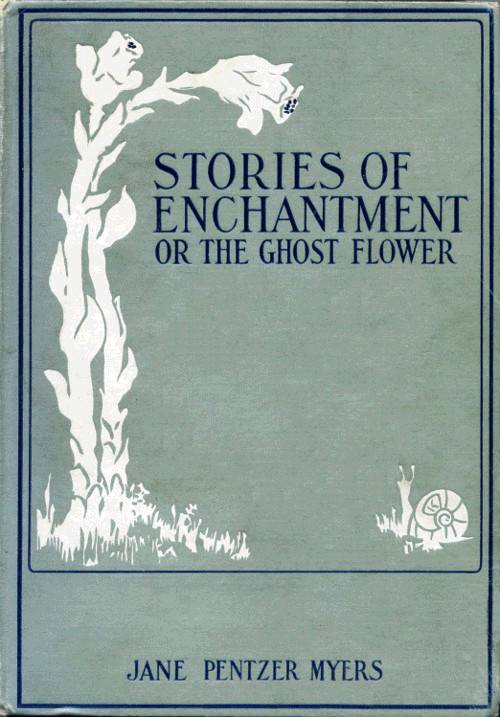
The Project Gutenberg eBook of Stories of Enchantment
Title: Stories of Enchantment
Author: Jane Pentzer Myers
Illustrator: Harriet Roosevelt Richards
Release date: January 15, 2016 [eBook #50931]
Most recently updated: October 22, 2024
Language: English
Credits: Produced by Stephen Hutcheson, Dave Morgan, Rod Crawford
and the Online Distributed Proofreading Team at
http://www.pgdp.net
THE LAND OF FANCY
STORIES
OF
ENCHANTMENT
BY
JANE PENTZER MYERS
ILLUSTRATED BY
HARRIET ROOSEVELT RICHARDS
CHICAGO
A. C. McCLURG & CO.
1901
Copyright
By A. C. McClurg & Co.
A.D. 1901
TO KATE WINIFRED.
Just between the “Land o’ Dreams” and broad daylight is a beautiful world: where good wishes come true: where the poor and the lonely are rich in castles and friends: and where sorrowful folk are happy.
There you may hear the birds singing and children laughing, all day long. The trees are full of blossoms and fruit. The sky is always blue, the grass green and soft.
Under the trees dwell the fairies, and against the blue sky is sometimes seen the sheen of angels’ wings.
On the borders of this land the real and the unreal are so strangely blended that children are puzzled to know where the boundary lies.
Just across its borders blooms the little white ghost-flower.
It is for you, little girl.
J. P. M.
CONTENTS.
- Page
- I. The Ghost Flower, or the White Blackbird 11
- II. The Little Yellow Moccasins 31
- III. The Little Ghost who Laughed 45
- IV. Titania’s Maid of Honor 71
- V. Bran, the Wolf Dog 89
- VI. The Corn Fairy 111
- VII. At the Wayside Cross 125
- VIII. In Quest of the Dark 133
- IX. The King will hunt To-day 149
- X. He was a Prince 161
- XI. Where the River hides its Pearls 187
- XII. The Mist Lady 205
ILLUSTRATIONS.
- Page
- The pipe changed into a strange flower 21
- Little Bravo 35
- “Oh, you pretty dear” 55
- Mateel sank down on her knees and gazed around 75
- In a great carven chair sat a lady 95
- The little girl playfully clasped her knees 115
- Glimpses of the Wonderful City shall be given to her 129
- Soon he was in her arms 137
- “I think I am going to like you” 141
- “He gave me this keepsake for my mamma” 144
- In their palace by the water wait the king and queen 167
- She started up in alarm 195
- “Open your eyes wide and look at me” 207
I.
THE GHOST FLOWER, OR THE WHITE BLACKBIRD.
There is a region of our own land, far to the westward, where great mountains lift their serene heads into the eternal calm of the upper air. Sunrise and sunset paint them with unearthly beauties; and night, with its myriads of flashing stars or its splendid moon, shines down on their white foreheads, and bids them dream on through the coming ages, as they have done in the past.
Among their barren valleys one sometimes lights upon a small oasis. A little mountain stream, fed by the melting snows of the peaks, leaps and sings and flashes to its grave in the desert sand. Its banks are fringed with cottonwood trees, and the short grass and underbrush flourish in their shade.
Usually, some energetic American or Chinaman is ranching it there, and claiming all the valley; but far away from the towns and the mines one may sometimes come upon a band of Indians, living their own lives separate and alone in their secluded valley.
A generation ago, a fierce war raged between the whites and the Indians; and during its progress a train of emigrants, passing near an Indian village, was attacked by the warriors of the tribe. All the whites were killed, except one little child, who crept away into the sagebrush, and, worn out with fear and fatigue, dropped asleep. There the wife of the chief medicine man of the tribe found her; and when the little one opened her eyes, and, putting up a piteous lip, began to sob, the woman gathered her into her arms with tender “No, no’s” and soft guttural cooings, that soothed and quieted the child. For the Great Spirit had lately called her own baby “far over the terrible mountains” to the spirit land. And this little one crept into the bereaved heart of the Indian mother.
She took the child to her husband, and received permission to keep her. And so the little girl, with her lint-white hair and blue eyes, grew up among the other children of the valley. Soon after the massacre of the wagon train, the tribe withdrew from the vengeance of the white soldiers to a fertile, wooded valley, hidden in the heart of the mountains. Here little “Snow-flower,” as she was named, lived happy with her foster parents. Her Indian mother was very proud of her childish beauty, and took excellent care of her. She bathed her often, in the clear water of the little river that ran through the valley; for, contrary to the popular belief, the Indians of the mountain are cleanly in their habits, and bathe their persons and wash their garments frequently, if water is plentiful. She braided her fair hair, and made for her pretty little dresses of pink or red calico, bought at the trader’s store at the agency, many weary miles away.
In the winter, she wore over her dress a warm fur coat reaching to the ankles, with a hood at the back to draw over her head. This was made of the skins of jack rabbits. Warm leggings and moccasins helped to keep her warm, and she was usually very comfortable.
Sometimes the supply of pine nuts would give out, the fish refuse to bite, or the jack rabbits become scarce and shy. Then the only alternative was to go to the hated agency.
At such times little Snow-flower was hidden in some secure place and warned to remain quiet; for her Indian mother was haunted by the fear of separation from the child. She knew that inquiries had been set afloat at the agency for a little one, said to have been saved from the massacre, and her heart told her that the child’s kindred would claim her, sooner or later. So, for many years little Snow-flower never saw a white person.
When she asked her Indian father or mother why she was so different from the other children, they told her The Great Spirit had made her so, and she was content.
“Perhaps it’s because I am the great Medicine Chief’s daughter,” she said to her father; and he gravely nodded.
She was very fond of both of her foster parents; but her love for the medicine man was mingled with awe. When she saw him dressed for some religious dance or yearly festival, in his strange medicine dress, with his face painted in grotesque and horrible pattern, she fled to her mother and hid her face in her lap. She loved her mother devotedly, and her love was returned. The woman was like all Indian mothers, very gentle and kind to her little daughter. The little girl was never punished, and was always spoken to in the soft, low voice peculiar to Indian women. “Little daughter,” “Little Starlight,” “Little Singing-bird,” were the fond names bestowed on her.
The years passed quietly by, until Snow-flower was ten years old, when, one summer day, the medicine man came into the tepee looking very ill. He threw himself down on the pallet on the floor and soon was unconscious. He lingered so nine days, anxiously watched and cared for by his wife and Snow-flower. On the tenth day he opened his eyes and beckoned his wife to him.
“I must go far over the terrible mountains, into the heart of the sunset, into the spirit land. You will come soon; watch for the token I will send you.”
Then, closing his eyes, he was quickly gone. And the tepee was very desolate and lonely to the wife and little Snow-flower.
All through the long days and the bright starlit nights the wife watched for the token he would send her, until her knees grew weak, and her head drooped, and she could not walk. Then little Snow-flower fed her, and waited on her, and also watched for the token that was to be sent. One day she crept into the hut and knelt by the Indian woman.
“Mother,” she whispered, “I have seen a strange sight: a flock of blackbirds lit close to our home. I thought to snare some for your food; but as I approached them, I saw that one of them was shaped like the rest,—but, mother, he was pure white; and he lit on the ridgepole of our home.”
Then the pale wife raised herself on her elbow, her eyes shining with joy.
“It is the spirit-bird, dear little one; it is the token. Go now, quickly, up the dark ravine; follow to its source the spring that runs past our door. I have never allowed you to go there, for a dark spirit lives in that dread place; but now, do not fear; the spirit-bird will protect you. Go into the deep wood that grows around the fountain head. You will come to a fallen log. Watch closely; and come and tell me what you see.”
So little Snow-flower, shaken with fear and grief,—for she knew that her mother must soon leave her,—followed the little rill, up the dark ravine, to its source. The white blackbird flitted ahead, and wherever he rested, the sunlight broke through the thick leaves overhead, so that she walked in light all the way. Presently she came in sight of the fallen log, and her heart stood still with fear; for, sitting on the log, wrapped in his blanket, and smoking a long-stemmed, strange-looking pipe, was the medicine man, her foster father. As she came toward him, he arose and fixed on her his bright eyes; and then he spoke in a soft voice that seemed to come from a long distance.
“Little pale-face daughter, take this pipe to my wife. It is a token that you have seen me. Tell her I am lonely without her; that she must be ready when the sun is setting to go with me, through the sunset gates, into the spirit world. As for you, my daughter, your path lies there,” pointing toward the east; “follow it to your own nation and your own kindred;” and, laying his pipe on the log, he was gone in an instant.
Little Snow-flower, almost overcome with fear, ran quickly to the log. She picked up the pipe, which changed in her hands into a strange flower; the leaves, the stem, and the blossoms were all white. It was the Ghost flower, or Indian pipe.
Hurrying back down the ravine, she ran with flying feet into the tepee. The Indian woman snatched the flower from the child’s hand and kissed it, then listened anxiously to her story.
“Yes, little one, I must go. I had hoped that you might go with me; but the Great Spirit does not will it so. And before I go, you must leave me; I must see you started on your journey.” And then she told her of her rescue, and of her parentage.
The pipe changed into a strange flower.
“This was tied fast round your neck. I hid it, and told no one.” She showed the little girl the case of a gold locket, with a scrap of closely written paper within. “Take this to the agency. The paper talks; but do not fear, it is not bewitched. The agent will speak for it, and I believe it will tell you where to find your kindred. Now hasten, dear child; the sun will soon reach the cleft in the mountain, and then I must go. I will see you again; my husband’s power is great; he will let me come to you whenever you find a flower like this—the Ghost flower.”
Then, with tears and sobs, they separated. And when the sun was setting, a great flock of blackbirds flew straight into its splendor; and among them were two white ones: the souls of the medicine chief and his wife. And poor little Snow-flower had begun her long journey to the agency. She left the valley secretly, crept away without bidding any one in the tribe farewell, for her Indian mother feared that they might detain her. The medicine chief’s home stood apart from the rest of the village, and was approached by the villagers with fear. When it was known that he was dead, the tribe buried him and mourned for him. But the mother and the daughter were unmolested in their grief.
A few days after Snow-flower had left, a kind-hearted woman ventured near. Great was her surprise to find the tepee empty; and it was believed by all that the medicine man had come for his wife and daughter, and had conveyed them to the spirit world.
Little Snow-flower followed the path as far as she had gone in the old days with her foster mother; but when she came to the cave where she had been concealed, she was at a loss to know which way to go. She wandered on, frightened and weary. The food she had brought with her was almost gone. One night she lay down beside a strange-looking trail. There were short logs laid across it, and on these were long slim logs or poles made of iron. It was in a valley between two great mountains. She wondered at it greatly. It was either a trail made by some wizard or medicine man, or it was made by that strange tribe to which she belonged, and of which she had heard for the first time that day, the “pale-faces.”
But at least there was companionship in it, after the horrible loneliness of the mountains. So she snuggled down near the trail, and went to sleep. She was awakened by a terrible rumble and roar that shook the earth around her. Something all fire and flashing eyes went shrieking and hissing past her. She screamed with fear, and tried to run, but her feet refused to carry her. The monster went a little way, and then stopped. Some men sprang from its back and came toward her, carrying a light. She saw that they were fair, like herself, and then she fainted.
The men came hurrying on. It was a special train, carrying the superintendent of the road, and a friend. “Did you say the massacre was just here?” said the gentleman.
“Right about here—perhaps a few feet farther north.”
The gentleman sighed. “And has nothing been heard of the child?”
“The Indians positively declare that she is living somewhere in the mountains, and that she is well cared for, but refuse to tell anything more.”
“Well, I must have the child, if she is to be found on— Why, what is this?” he exclaimed, as his foot struck against the soft little body of Snow-flower. She shivered and moaned.
“What in this world! a little white girl, dressed like a little Indian!” cried the superintendent.
“Let me see the child. She looks as my sister Mary did at that age. What if this is her child, the little one I am searching for? Here, let me carry her into the car; she is mine; I am sure of it,” said the gentleman.
And so little Snow-flower awoke from her swoon to a new and wonderful life. It almost seemed in later years, as she looked back to that time, that she had entered another world; for she found love, riches, education, all awaiting her.
Once or twice since, in lonely walks, she has found the Ghost flower; and always then appears the vague, misty outline of her Indian mother.
A few days ago, her little son (for she is a woman and a mother now) came into the house crying, “Mother, I saw a white blackbird. It was with a great flock of black ones; it was just like them, only it was white.”
She hurried out of the house hoping to find the spirit-bird; but it had visited her, found her happy, and hastened back to the spirit land.
II.
THE LITTLE YELLOW MOCCASINS.
A clear river goes winding down, past green and shaded banks, through the beautiful state of Iowa. It is named the Cedar, although the Oak, or the Maple, or a dozen other names would be more appropriate, for the Cedar is seldom found among the abundant trees that grow beside it.
Years ago, the Indians dwelt on its banks. They led an idyllic life: the men fished in the blue waters, or hunted and trapped in the woods; the women planted the small clearings with corn. These corn-fields may still be seen, covered with little hillocks resembling in size and shape those seen in a prairie-dog village; the corn was planted in these mounds, instead of in rows, as with us.
Here the women worked and gossiped,—the babies in their cradles, strapped to their mothers’ backs, or propped up against the trunks of trees, and staring with round black eyes at the new and strange scenes around them.
Among the women was one pretty young mother, who watched, as she worked, her little son in his cradle. She talked or sang to him as she passed him by. She named him “Little Bravo,” “Little Hunter.” She told him that she was growing very old now; that he must step out of his cradle and take care of her. Then she would laugh, showing her white teeth, and the baby would wag his head from side to side, and laugh in sympathy, revealing two cunning little teeth also. All the fond talk that a white mother lavishes on her baby was told over by this Indian mother; for mothers are alike in their love, whatever their color may be.
The years passed merrily along, for happy hearts make the hardest life a merry one. The Little Bravo was a large boy now. Ten summers and winters had passed since he came to his proud father and mother. He had learned to row a canoe on the river, to fish, to set traps, and with bow and arrow to bring down the wild duck and the prairie chicken. Soon he would be a man, a—young brave indeed,—and go with his father to hunt the bison, or on the warpath.
How many daydreams his mother enjoyed over his future! She saw him in fancy a great chief, leading the tribe in war and in peace; she saw him returning from war with many scalps of the enemy; saw him in the home with wife and children, while his father and herself, grown old and gray, sat in the warmest corner of the tepee and told his children stories of their father’s brave deeds.
As she dreamed her daydreams, she busily worked on the fine clothing with which she adorned him and his father; for it was her delight that they outshone the rest of the men of the tribe in the splendor of their raiment,—hunting shirts and leggings of the finest tanned skins, adorned with fringes and gorgeous with crude embroidery, and moccasins of the yellow buckskin, trimmed with beads and porcupine quills.
The boy was a noble little fellow; brave, warm-hearted, and merry. But the Great Spirit saw that the doating love of father and mother was ruining the gift He had placed in their hands.
Little Bravo.
One summer night the heat hung heavy over the land. It seemed an effort to breathe. Black clouds hung sullen in the sky, and in the west the lightning was flashing and the thunder was rumbling. “There will be much wind and rain to-night. Where is our son?” said the father.
“Down on the river’s bank asleep,” answered his mother. “I sat long beside him, and brushed away the stinging insects that annoyed him. He has taken off his moccasins, the heat is so great, and his little feet are bare. He is very beautiful as he sleeps. I will lift him without waking him, and bear him into the storm cave.”
She hastened quickly down to the river, for the storm was rapidly approaching. Just as her hands reached down to clasp her boy, there came a vivid flash of lightning, and two strong hands (the hands of the spirit who lives in the water) reached up, and grasping the boy firmly, drew him down under the water.
Where, but a moment before, the rosy, dreaming boy was lying, was only the print of his body in the grass, and the two little yellow moccasins, shining like gold.
The mother gave a scream; the father came bounding to the spot; together they sprang into the water, and dived again and again, striving to find their son. The storm broke over the river in great fury, tearing off great limbs of trees, and dashing their tepee to the ground; but neither knew that it stormed. Finally, half dead, and heart-broken, they sought the bank. The mother sat down and gathered the little moccasins to her heart. “My son, my son! O spirit of the river, give him back to us!” she moaned.
The father arose and straightened himself, and, looking into the dark sky, he said: “It is the will of the Great Spirit. He gave him to us. He has taken him away again.” Turning, he walked away into the forest.
But the mother sat there beside the river many days, moaning, “My son, my son.” No food passed her lips, no sleep came to her eyes; and always she kissed and clasped to her heart the little moccasins.
One night, when the stars were flashing in splendor, she raised her eyes to the sky, and beheld that pathway made of star-dust, that leads to the spirit land. And while she gazed, longing to follow it, she felt the pressure of a small hand on her shoulder. She turned, to meet the loving, smiling gaze of her son.
“O Great Spirit, I thank thee! The dead is alive again! O my son, I grieved for thee! Why didst thou stay away so long?”
And the boy said, “Come, dear mother; we are to follow yonder path to-night,” pointing upward. “I have come for thee, because thy weeping grieves the happy ones.”
Then gladly the mother placed her hand in that small clasp; but first she said: “Stay, dear child; here are thy moccasins. Thou wilt need them; the way may be rough.”
The boy, laughing, held up to her gaze one of his feet, on which flashed and glowed a moccasin of shining yellow, like the color of a star, and he said, “Lay down the moccasins, dear, and thou shalt see how a mother’s love shall be remembered.”
She placed them on the ground, and at once a plant sprang up beneath them. It grew rapidly, and on its highest branches the moccasins were fastened. They shrank in size, and changed into flowers, keeping, however, their original shape and color. And the boy said, “These flowers shall bloom on forever beside this shining river; long after the red man is gone, they shall bloom.”
Then, wondering and happy, the mother followed her son along the star-strewn path to the spirit land; and not many moons later, the father, from the midst of battle, went to them.
Long ago, the Indians left the banks of the beautiful river, but the yellow flowers bloom on beside its clear waters; and the white children call them the “Orchid,” or “Lady’s Slipper,” or give them their real name, the “Indian Moccasins.”
III.
THE LITTLE GHOST WHO LAUGHED.
Dolores sat beside Aunt Polly, in the door of the cabin. The setting sun shone on her yellow curls, changing her into a veritable “Goldilocks,” peeped into her blue eyes, until she was obliged to shut them. It shone on Aunt Polly’s black face, causing it to glisten like black satin, and on her clean calico dress and white apron; for this was Sunday evening, and she was resting from her labors.
Across the fields, its light was reflected from the roof and chimneys of “The House,” as Aunt Polly called it; for there she had lived as a slave before the war, and to her it was the only house of importance in the neighborhood. Dolores watched the sun climb from the roof and chimneys to the gilded points of the lightning-rods, turning them to flashing spear points. Then it was gone; and she breathed a sigh.
Aunt Polly heard it. “What’s the mattah, honey girl?”
“I’m lonesome, Aunt Polly; won’t you tell me ’bout the little ghost girl up at the house?”
“Now, sugah, I have to be away from home all day to-morrow, and you’ll be here alone; that story will make you feel skeery.”
“I won’t be afraid. Besides, I’ll go to school, maybe.”
“Bless yo heart now, will you? Well, I’ll tell you then, ’cause yo goin’ to be so good. Well, honey, when I was a young girl, I lived up at The House; that was befo’ the wah. I was one of the house servants, sort of waitin’ maid, and table maid, too. Well, one stormy night, I was in the dinin’-room, settin’ the dinnah table. The rain and sleet was bangin’ aginst the windows, and it was growin’ mighty dark. I thought I’d go out and shut the shuttahs; I thought I’d run out the front doah, and close the pahlor shuttahs too. The lamp wasn’t lit in the hall yet, and as I went through, it seemed to me I saw somethin’ white curled up on the lower stair. I opened the front doah so that I could see bettah what it was, and then I turned and went to it, and there, cuddled all up in a heap, was a strange little girl. She had a little peaked white face and great blue eyes, and her hair was about the coloh of you-all’s. She had on a little white dress, and had somethin’ in her hands—looked like a man’s cap, and it was all torn and bloody; and there was blood on her dress.
“‘My land, honey, whar you come from?’ I says, and she huddled down closer than ever, and began to cry just like her heart was most broke. I stooped down to pick her up in my ahms”—Aunt Polly’s voice sank to a whisper—“and—she—wasn’t—there. I rubbed my eyes and looked agin, then I run to the doah and looked out; but they wasn’t nobody about. Then I got so skeered I banged the doah shut and run whoopin’ and screamin’ to the kitchen. Aunt Susan, the cook, grab me by the ahm. ‘Shut yo haid, girl, and tell me wha’s de mattah,’ she said. So I done told her all about it, and she just dropped all in a heap and she say: ‘O my Lawd, O my deah Lawd, the judgment am a comin’ agin! Tell me, gal, was dat baby laughin’ or cryin’?’ and I say, ‘Cryin’;’ and she say, ‘Ooh, my poo’ mistess;’ and I said, ‘Oh, Aunt Susan, what is it?’ She say: ‘Gal, you done see a ghost. Dat’s no baptized baby; dat’s a poo’ child dat was muhdard yeahs and yeahs ago by some wicked limb of dis fambly, fo’ to get its money. Whenever dat child comes here a weepin’ and a moanin’, dat’s de sign of a death; if it comes a laughin’, den it brings good luck to we-alls.’
“Well, I was that skeered to think I’d done seen a ghost, that I shuck all over, and couldn’t wait on the table. Well, honey, I kep’ a waitin’ for a death or somefin as bad; and ’bout a week later, my mastah’s oldest boy was out huntin’, and the gun went off too soon, and blowed the top of his haid plum off. They brought his torn and bloody cap home. I’d—seen—it—before.
“Aftah that, I was always watchin’ for that ghost-child, but I nevah seen her no more. But she came after that, fo’ my old mastah died; and there was othah troubles. Finally, aftah the wah, my old mistress moved to the city with young Mistah Tom, and left the house in the care of the overseeah of the plantation. Once a yeah Mistah Tom comes down and stays a week or so, lookin’ aftah things. He used to bring a lot of company with him, but since ole Miss died, he’s sobered down; don’t seem to cah fo’ company no more.
“And now, sugah, you come go to baid, so you can get up early, and go to school.”
“Aunt Polly, tell me first, do please tell me, where did you get me?”
Aunt Polly looked at her doubtfully.
“I dunno as you need to know. But yo ma was a lady, and yo pa a gentleman. You come of a good stock. Sometime I’ll tell you, but not now; so you go to sleep.”
The next morning Aunt Polly was up and away early. She left a dainty breakfast spread out for Dolores, and a little tin pail packed with a lunch for her school dinner. Dolores wakened later and lay debating the question of school. It is needless to say that Aunt Polly, with her lax government and her fondness for the child, was spoiling her completely. Dolores was a law unto herself, and came and went as she pleased. She was looked down upon by the girls at school, because she lived with Aunt Polly. She did not tell this to her, for she knew she would resent it bitterly. So she avoided them as much as possible, and many hours when Aunt Polly supposed that she was at school, she was wandering in the woods and fields.
She thought of her half promise given the night before in exchange for the ghost story, and resolved that she would go.
“My mother was a lady, and my father a gentleman; then why need I care for those white trash? Aunt Polly is better than they are. I reckon I’d better go. And I’ll go past the house, and peek in at the hall where Aunt Polly saw the ghost.”
So she hurriedly put away her breakfast dishes, tidied up her room, locked the door, hid the key, and started on her way to school. She crossed the field and came to the old house by a path through a grove of old trees. This side of the house was never used; the shutters were closed; and the trees grew so close to the house that their great branches scraped against the walls, causing a creaking, groaning noise when the wind blew, that had frightened the timid colored people away from the neighborhood.
Dolores put down her pail and books. She sat down a moment to rest in the shade, for the sun was hot. That resting-spell was the undoing of her good resolutions; for, glancing above her, she discovered a squirrel watching her, who began to chatter, as soon as he knew that she had seen him.
“Oh, you pretty dear, come down and I’ll feed you,” she said; and then she thought, “I wonder if he has a nest up there; I’m going to find out.” And soon she was among the lower branches of the tree, steadily working her way to the top.
The squirrel turned with a jerk and a squeak, and disappeared through an open window that the branches had concealed from below. Dolores, following, found that one shutter was gone, and that the wind, during some storm, had forced in the sash, while a limb had grown in through the window. She pushed her way in past the limb, in spite of the squirrel’s remonstrance, and found herself in a large attic, which extended over the entire unused wing of the house. The squirrel scampered up the side of the window-casing, and sat scolding her from above.
The attic was filled with a rich treasure-trove for Dolores. There were old spinning-wheels, broken chairs, an empty cradle, a great old four-posted bed, and a number of trunks and boxes to rummage in. That was as far as she could see in the gloom, but no doubt beyond her range of vision were more delights. What a lovely place in which to play! The cradle for her dolls, an old clock to take to pieces, and dozens of old garments to dress up in. Several wonderfully queer old bonnets hung against the wall. She put on one (after shaking off the layer of dust with which it was coated), and glanced in a broken mirror to see the effect. Her merry laugh echoed through the attic as she beheld her face framed by the bonnet. And then she heard a sharp exclamation from the room beneath her, the scurrying of feet, and the slamming of a door.
“Oh you pretty dear.”
Crouching down behind the cradle, she waited developments; but no one came; so in a little while she grew bold again.
“I think I won’t go to school after all. I reckon it’s too late, anyway; I’ll stay here to-day. But first, I must go back and get my dinner-pail and books. I can study up here just as well as at school.”
And soon Dolores, watched by the protesting squirrel, had slid down the tree, secured her books and dinner-pail in her apron, and was back again. And then began her delightful, if naughty, day. She wound up the clock, polished up the broken mirror, pulled the lighter articles of furniture here and there, tried the spinning-wheel, and finally settled down to the delightful task of exploring the boxes and chests.
In the meantime, down below, in the kitchen of the old house, an excited group of colored people were talking. Aunt Polly was the centre of the group, and was relating, for the benefit of a new comer, her experience.
“I tell you, I done heerd that ghost-child agin. No, I didn’t see it, but I heerd it. I went ovah to the noth wing to put away that ar seed, as Mistah Jones told me to do, and while I was in that dark, lonesome bedroom above the pahlor, I heerd a child laugh, just as cleah and sweet as a bird; it sounded just right beside me. Oh, I was so skeered, I run and banged the doah after me. You don’t ketch this child goin’ in that pawt of the house no moah.”
“Aunt Polly,” asked one breathless listener, “wasn’t that the room whar the murdah was committed?”
“Yas, em; yes indeedy; the poor child was strangled in its sleep.”
Just then the voice of Mr. Jones was heard. “Here, hurry up in there; got too much to do to stand here gabbling. You know Mister Tom comes to-night; he wants this place to be shining.” Each one hurried off to her work. Aunt Polly, with a toss of her head and a sniff, proceeded leisurely to hang out the white curtains and bed-linen she was doing up against the arrival of her beloved Mistah Tom.
Dolores ate her dinner when she became hungry, gave some of it to the squirrel, and played on until the shadows in the attic indicated that evening was coming. Then she scrambled down and ran for home. She had time to brush the dust from her clothes, wash her face and hands, and lie down on the bed and fall asleep before Aunt Polly returned. By the time supper was ready and Dolores awakened, Aunt Polly had forgotten to ask about the school, in her eagerness to tell the important news that Mistah Tom was coming, and that she had heard the little ghost-girl’s laugh. And in a little while Dolores again had forgotten everything in the dreamless sleep which comes to tired children whether they are good or bad.
She awoke in the morning to find Aunt Polly already gone. Not long after, the little truant followed and, climbing her sylvan stairway, was soon in the delightful attic. She had explored all but one chest, that was pushed under the eaves. The other chests had yielded up a rich treasure, but she was curious to know what they all contained before she enjoyed the contents. So the little box was pushed close to the window, for it was growing dark in the attic. Dolores could hear the rumble of thunder, and the rain was beginning to patter on the shingles; she was not the least afraid of a storm, and proceeded leisurely with her task. The little chest was locked, but the key hung obligingly tied to one of the handles by a string. She unlocked it, and raised the lid. Who can say what loving, breaking heart looked last into that little box? For, carefully folded away, with dead roses in each dainty garment, was a little girl’s wardrobe, complete,—the finest linen undergarments, trimmed with delicate laces, little white silk clocked stockings, little heelless slippers of blue and red kid, all faded and spotted with age and mould; the loveliest little lace-trimmed dresses with short waists, puffed sleeves, and long skirts. Dolores hesitated a moment before examining them. On top of them was placed a note in a woman’s hand. She laid it aside and did not read it, until she had finished the examination. She opened it at last, and read, “This is the wardrobe of my dear little dead daughter Dolores.”
She closed the lid down gently, sprang up, and went to the window. “I must go home; I don’t like this old attic. I’ve been a wicked girl to come here. But how did that little dead girl come to have my name?”
She started to climb through the window, and saw that it was raining very hard; a steady downpour that promised to last all day. She returned to the chest, laid the note carefully aside, and again lifted out and unfolded each garment. How beautiful they were! Time had given them the delicate, mellow tint of old ivory. Dolores dearly enjoyed pretty clothes, and had possessed but few in her short life. She was charmed by their dainty quaintness.