
The Project Gutenberg eBook of Stray leaves from strange literature; and, Fantastics and other fancies
Title: Stray leaves from strange literature; and, Fantastics and other fancies
Author: Lafcadio Hearn
Author of introduction, etc.: Charles Woodward Hutson
Release date: September 30, 2017 [eBook #55650]
Most recently updated: October 23, 2024
Language: English
Credits: Produced by Laura Natal Rodriguez & Marc D'Hooghe at Free
Literature (online soon in an extended version,also linking
to free sources for education worldwide ... MOOC's,
educational materials,...) (Images generously made available
by the Internet Archive.)
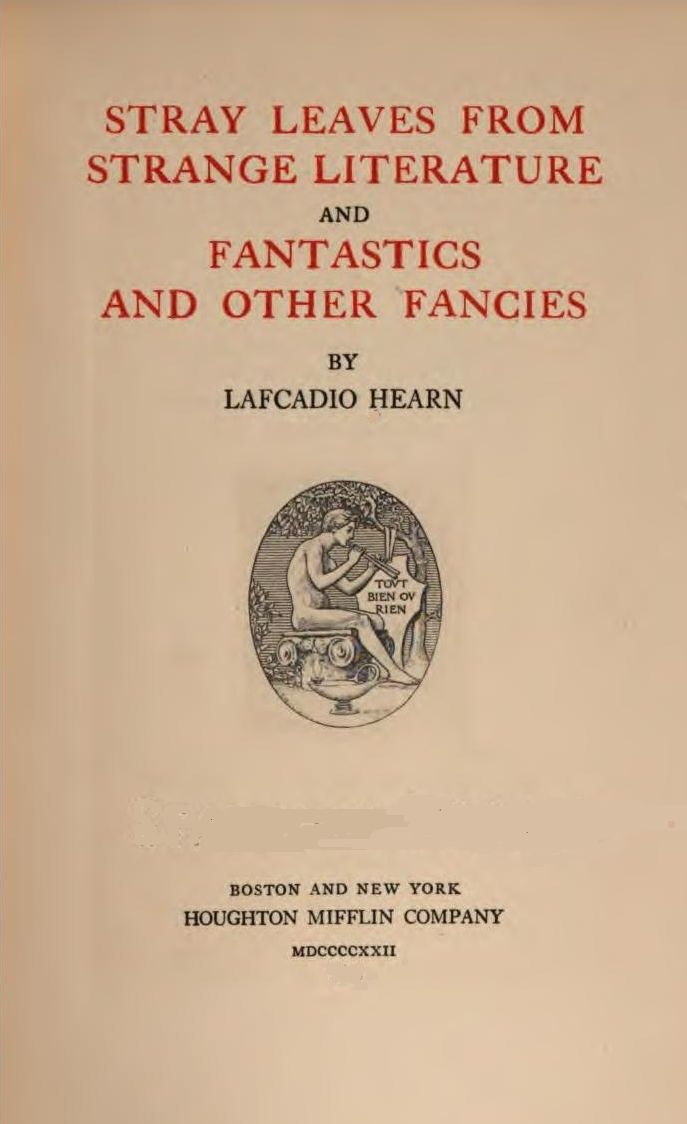
STRAY LEAVES FROM
STRANGE LITERATURE
AND
FANTASTICS
AND OTHER FANCIES
BY
LAFCADIO HEARN
BOSTON AND NEW YORK
HOUGHTON MIFFLIN COMPANY
MDCCCCXXII
A Dock Scene in New Orleans.
NOTE
The thanks of the Publishers are due to Dr. A. K. Coomaraswamy, of the Boston Museum of Fine Arts, for corrections in the spelling of proper names in the Tales from India and Buddhist Literature included in this volume.
CONTENTS
Explanatory xvii
STRAY LEAVES
THE BOOK OF THOTH. From an Egyptian Papyrus 3
THE FOUNTAIN MAIDEN. A Legend of the South Pacific 16
THE BIRD WIFE. An Esquimau Tradition 23
TALES FROM INDIAN AND BUDDHIST LITERATURE
THE MAKING OF TILOTTAMA 31
THE BRAHMAN AND HIS BRAHMANI 42
BAKAWALI 48
NATALIKA 57
THE CORPSE-DEMON 64
THE LION 77
THE LEGEND OF THE MONSTER MISFORTUNE 80
A PARABLE BUDDHISTIC 86
PUNDARI 91
YAMARAJA 96
THE LOTUS OF FAITH 106
RUNES FROM THE KALEWALA
THE MAGICAL WORDS 113
THE FIRST MUSICIAN 125
THE HEALING OF WAINAMOINEN 131
STORIES OF MOSLEM LANDS
BOUTIMAR, THE DOVE 141
THE SON OF A ROBBER 146
A LEGEND OF LOVE 152
THE KING'S JUSTICE 156
TRADITIONS RETOLD FROM THE TALMUD
A LEGEND OF RABBA 161
THE MOCKERS 168
ESTHER'S CHOICE 173
THE DISPUTE IN THE HALACHA 179
RABBI YOCHANAN BEN ZACHAI 184
A TRADITION OF TITUS 188
BIBLIOGRAPHY 193
FANTASTICS AND OTHER FANCIES
INTRODUCTION, BY CHARLES WOODWARD HUTSON 197
IN THE "ITEM"
ALL IN WHITE 217
September 14, 1879
THE LITTLE RED KITTEN 220
September 24, 1879
THE NIGHT OF ALL SAINTS 224
November 1, 1879
THE DEVIL'S CARBUNCLE 227
November 2, 1879
LES COULISSES 230
December 6, 1879
THE STRANGER 237
April 17, 1880
Y PORQUE? 239
April 17, 1880
A DREAM OF KITES 241
June 18, 1880
HEREDITARY MEMORIES 244
July 22, 1880
THE GHOSTLY KISS 249
July 24, 1880
THE BLACK CUPID 253
July 29, 1880
WHEN I WAS A FLOWER 257
August 13, 1880
METEMPSYCHOSIS 259
September 7, 1880
THE UNDYING ONE 263
September 18, 1880
THE VISION OF THE DEAD CREOLE 269
September 25, 1880
THE NAME ON THE STONE 274
October 9, 1880
APHRODITE AND THE KING'S PRISONER 277
October 12, 1880
THE FOUNTAIN OF GOLD 283
October 15, 1880
A DEAD LOVE 291
October 21, 1880
AT THE CEMETERY 294
November 1, 1880
"AÏDA" 297
January 17, 1881
EL VÓMITO 304
March 21, 1881
THE IDYL OF A FRENCH SNUFF-BOX 309
April 5, 1881
SPRING PHANTOMS 312
April 21, 1881
A KISS FANTASTICAL 316
June 8, 1881
THE BIRD AND THE GIRL 322
June 14, 1881
THE TALE OF A FAN 327
July 1, 1881
A LEGEND 330
July 21, 1881
THE GYPSY'S STORY 334
August 18, 1881
THE ONE PILL-BOX 341
October 12, 1881
IN THE "TIMES-DEMOCRAT"
A RIVER REVERIE 347
May 2, 1882
"HIS HEART IS OLD" 352
May 7, 1882
MDCCCLIII 358
May 21, 1882
HIOUEN-THSANG 362
June 25, 1882
L'AMOUR APRÈS LA MORT 371
April 6, 1884
THE POST-OFFICE 374
October 19, 1884
ILLUSTRATIONS
A DOCK SCENE IN NEW ORLEANS (page 348) Frontispiece From a painting, by Robert W. Grafton, in the St. Charles Hotel, New Orleans. By the courtesy of Alfred S. Amer.
INDRA IN HIS COURT From a Fifteenth Century Jain manuscript. 50
THE OLD CREOLE OPERA HOUSE, NEW ORLEANS 230
JUTTING BALCONIES IN THE CREOLE CITY 322
Except as otherwise stated, the illustrations are from photographs by CHARLES S. OLCOTT
STRAY LEAVES FROM STRANGE LITERATURE
STORIES
RECONSTRUCTED FROM THE ANVARI-SOHEÏLI, BAITÁL PACHÍSÍ, MAHABHARATA, PANTCHA-TANTRA, GULISTAN, TALMUD, KALEWALA, ETC.
TO MY FRIEND
PAGE M. BAKER
EDITOR OF THE
NEW ORLEANS TIMES-DEMOCRAT
EXPLANATORY
While engaged upon this little mosaic work of legend and fable, I felt much like one of those merchants told of in Sindbad's Second Voyage, who were obliged to content themselves with gathering the small jewels adhering to certain meat which eagles brought up from the Valley of Diamonds. I have had to depend altogether upon the labor of translators for my acquisitions; and these seemed too small to deserve separate literary setting. By cutting my little gems according to one pattern, I have doubtless reduced the beauty of some; yet it seemed to me their colors were so weird, their luminosity so elfish, that their intrinsic value could not be wholly destroyed even by so clumsy an artificer as I.
In short, these fables, legends, parables, etc., are simply reconstructions of what impressed me as most fantastically beautiful in the most exotic literature which I was able to obtain. With few exceptions, the plans of the original narratives have been preserved. Sometimes I have added a little, sometimes curtailed; but the augmentations were generally made with material drawn from the same source as the legend, while the abbreviations were effected either with a view to avoid repetition, or through the necessity of suppressing incidents unsuited to the general reading. I must call special attention to certain romantic liberties or poetic licenses which I have taken.
In the Polynesian story ("The Fountain Maiden") I have considerably enlarged upon the legend, which I found in Gill's Myths and Songs of the South Pacific—a curious but inartistic book, in which much admirable material has been very dryly handled. In another portion of Mr. Gill's book I found the text and translation of the weird "Thieves' Song"; and conceived the idea of utilizing it in the story, with some fanciful changes. The Arabic "Legend of Love" is still more apocryphal, as it consists of fragmentary Arabian stories, borrowed from De Stendhal's L'Amour, and welded into one narrative.
In the Rabbinical legends I have often united several incidents related about one personage in various of the Talmudic treatises; but this system is sufficiently specified by references to the Gemara in the text. By consulting the indices attached to Hershon's Miscellany, and Schwab's translations of the Jerusalem Talmud, it was easy to collect a number of singular traditions attaching to one distinguished Rabbi, and to unite these into a narrative. Finally, I must confess that the story of "Natalika" was not drawn directly from Ferista, or Fihristah, but from Jacolliot, a clever writer, but untrustworthy Orientalist, whose books have little serious value. Whether true or false, however, the legend of the statue seemed to me too pretty to overlook.
In one case only have I made a veritable translation from the French. Léouzon Le Duc's literal version of the "Kalewala" seemed to me the most charming specimen of poetical prose I had met with among translations. I selected three incidents, and translated them almost word for word.
Nearly all of the Italic texts, although fancifully arranged, have been drawn from the literatures of those peoples whose legends they introduce. Many phrases were obtained from that inexhaustible treasury of Indian wisdom, the Pantchatantra; others from various Buddhist works. The introductory text of the piece, entitled "The King's Justice," was borrowed from the Persian Mantic Uttaïr, of Farid Uddin Attar; and the text at the commencement of the Buddhist Parable (which was refashioned after a narrative in Stanislas Julien's Avadanas) was taken from the Dhammapada. The briefer stories, I think, have generally suffered less at my hands than the lengthier ones. That wonderful Egyptian romance about the Book of Thoth is far more striking in Maspéro's French translations from the original papyrus; but the Egyptian phrases are often characterized by a nakedness rather more startling than that of the dancing girls in the mural paintings....
Upon another page will be found a little bibliography of nearly all the sources whence I have drawn my material. Some volumes are mentioned only because they gave me one or two phrases. Thus, I borrowed expressions or ideas from "Amarou," from Fauche's translation of the Ritou Sanhara, and especially from the wealth of notes to Chézy's superb translation of Sacountala.
This little collection has no claim upon the consideration of scholars. It is simply an attempt to share with the public some of those novel delights I experienced while trying to familiarize myself with some very strange and beautiful literatures.
During its preparation two notable works have appeared with a partly similar purpose: Helen Zimmern's Epic of Kings, and Edwin Arnold's Rosary of Islam. In the former we have a charming popular version of Firdusi, and upon the latter are exquisitely strung some of the fairest pearls of the "Mesnewi." I hope my far less artistic contribution to the popularization of unfamiliar literature may stimulate others to produce something worthier than I can hope to do. My gems were few and small: the monstrous and splendid await the coming of Sindbad, or some mighty lapidary by whom they may be wrought into jewel bouquets exquisite as those bunches of topaz blossoms and ruby buds laid upon the tomb of Nourmahal.
NEW ORLEANS, 1884
STRAY LEAVES
THE BOOK OF THOTH
An Egyptian tale of weirdness, as told in a demotic papyrus found in the necropolis of Deir-el-Medineh among the ruins of hundred-gated Thebes.... Written in the thirty-fifth year of the reign of some forgotten Ptolomæus, and in the month of Tybi completed by a scribe famous among magicians.... Dedicated, doubtless, to Thoth, Lord of all Scribes, Grand Master of all Sorcerers; whose grace had been reverently invoked upon whomsoever might speak well concerning the same papyrus....
... Thoth, the divine, lord of scribes, most excellent of workers, prince of wizards, once, it is said, wrote with his own hand a book surpassing all other books, and containing two magical formulas only. Whosoever could recite the first of these formulas would become forthwith second only to the gods—for by its simple utterance the mountains and the valleys, the ocean and the clouds, the heights of heaven and the deeps of hell, would be made subject unto his will; while the birds of air, the reptiles of darkness, and the fishes of the waters, would be thereby compelled to appear, and to make manifest the thoughts secreted within their hearts. But whosoever could recite the second formula might never know death—for even though buried within the entrails of the earth, he would still behold heaven through the darkness and hear the voices of earth athwart the silence; even in the necropolis he would still see the rising and setting of the sun, and the Cycle of the Gods, and the waxing and waning of the moon, and the eternal lights of the firmament.
And the god Thoth deposited his book within a casket of gold, and the casket of gold within a casket of silver, and the casket of silver within a casket of ivory and ebony, and the casket of ivory and ebony within a casket of palm-wood, and the casket of palm-wood within a casket of bronze, and the casket of bronze within a casket of iron. And he buried the same in the bed of the great river of Egypt where it flows through the Nome of Coptos; and immortal river monsters coiled about the casket to guard it from all magicians.
Now, of all magicians, Noferkephtah, the son of King Minibphtah (to whom be life, health, and strength forevermore!), first by cunning discovered the place where the wondrous book was hidden, and found courage to possess himself thereof. For after he had well paid the wisest of the ancient priests to direct his way, Noferkephtah obtained from his father Pharaoh a royal cangia, well supplied and stoutly manned, wherein he journeyed to Coptos in search of the hidden treasure. Coming to Coptos after many days, he created him a magical boat and a magical crew by reciting mystic words; and he and the shadowy crew with him toiled to find the casket; and by the building of dams they were enabled to find it. Then Noferkephtah prevailed also against the immortal serpent by dint of sorcery; and he obtained the book, and read the mystic formulas, and made himself second only to the gods.
But the divinities, being wroth with him, caused his sister and wife Ahouri to fall into the Nile, and his son also. Noferkephtah indeed compelled the river to restore them; but although the power of the book maintained their life after a strange fashion, they lived not as before, so that he had to bury them in the necropolis at Coptos. Seeing these things and fearing to return to the king alone, he tied the book above his heart, and also allowed himself to drown. The power of the book, indeed, maintained his life after a strange fashion; but he lived not as before, so that they took him back to Thebes as one who had passed over to Amenthi, and there laid him with his fathers, and the book also.
Yet, by the power of the book, he lived within the darkness of the tomb, and beheld the sun rising, and the Cycle of the Gods, and the phases of the moon, and the stars of the night. By the power of the book, also, he summoned to him the shadow of his sister Ahouri, buried at Coptos—whom he had made his wife according to the custom of the Egyptians; and there was light within their dwelling-place. Thus Noferkephtah knew ghostly happiness in the company of the Ka, or shadow, of his wife Ahouri, and the Ka of his son Mikhonsou.
Now, four generations had passed since the time of King Minibphtah; and the Pharaoh of Egypt was Ousirmari. Ousirmari had two sons who were learned among the Egyptians—Satni was the name of the elder; Anhathorerôou that of the younger. There was not in all Egypt so wise a scribe as Satni. He knew how to read the sacred writings, and the inscriptions upon the amulets, and the sentences within the tombs, and the words graven upon the stelæ, and the books of that sacerdotal library called the "Double House of Life." Also he knew the composition of all formulas of sorcery and of all sentences which spirits obey, so that there was no enchanter like him in all Egypt. And Satni heard of Noferkephtah and the book of Thoth from a certain aged priest, and resolved that he would obtain it. But the aged priest warned him, saying, "Beware thou dost not wrest the book from Noferkephtah, else thou wilt be enchanted by him, and compelled to bear it back to him within the tomb, and do great penance."
Nevertheless Satni sought and obtained permission of the king to descend into the necropolis of Thebes, and to take away, if he might, the book from thence. So he went thither with his brother.
Three days and three nights the brothers sought for the tomb of Noferkephtah in the immeasurable city of the dead; and after they had threaded many miles of black corridors, and descended into many hundred burial pits, and were weary with the deciphering of innumerable inscriptions by quivering light of lamps, they found his resting-place at last. Now, when they entered the tomb their eyes were dazzled; for Noferkephtah was lying there with his wife Ahouri beside him; and the book of Thoth, placed between them, shed such a light around, that it seemed like the brightness of the sun. And when Satni entered, the Shadow of Ahouri rose against the light; and she asked him, "Who art thou?"
Then Satni answered: "I am Satni, son of King Ousirmari; and I come for the book of Thoth which is between thee and Noferkephtah; and if thou wilt not give it me, I shall wrest it away by force."
But the Shadow of the woman replied to him: "Nay, be not unreasoning in thy words! Do not ask for this book. For we, in obtaining it, were deprived of the pleasure of living upon earth for the term naturally allotted us; neither is this enchanted life within the tomb like unto the life of Egypt. Nowise can the book serve thee; therefore listen rather to the recital of all those sorrows which befell us by reason of this book...."
But after hearing the story of Ahouri, the heart of Satni remained as bronze; and he only repeated: "If thou wilt not give me the book which is between thee and Noferkephtah, I shall wrest it away by-force."
Then Noferkephtah rose up within the tomb, and laughed, saying: "O Satni, if thou art indeed a true scribe, win this book from me by thy skill! If thou art not afraid, play against me a game for the possession of this book—a game of fifty-two!" Now there was a chess-board within the tomb.
Then Satni played a game of chess with Noferkephtah, while the Kas, the Shadows, the Doubles of Ahouri, and the large-eyed boy looked on. But the eyes with which they gazed upon him, and the eyes of Noferkephtah also, strangely disturbed him, so that Satni's brain whirled, and the web of his thought became entangled, and he lost! Noferkephtah laughed, and uttered a magical word, and placed the chess-board upon Satni's head; and Satni sank to his knees into the floor of the tomb.
Again they played, and the result was the same. Then Noferkephtah uttered another magical word, and again placed the chess-board upon Satni's head; and Satni sank to his hips into the floor of the tomb.
Once more they played, and the result was the same. Then Noferkephtah uttered a third magical word, and laid the chess-board on Satni's head, and Satni sank up to his ears into the floor of the tomb!
Then Satni shrieked to his brother to bring him certain talismans quickly; and the brother fetched the talismans, and placed them upon Satni's head, and by magical amulets saved him from the power of Noferkephtah. But having done this, Anhathorerôou fell dead within the tomb.
And Satni put forth his hand and took the book from Noferkephtah, and went out of the tomb into the corridors; while the book lighted the way for him, so that a great brightness traveled before him, and deep blackness went after him. Into the darkness Ahouri followed him, lamenting, and crying out: "Woe! woe upon us! The light that gave life is taken from us; the hideous Nothingness will come upon us! Now, indeed, will annihilation enter into the tomb!" But Noferkephtah called Ahouri to him, and bade her cease to weep, saying to her: "Grieve not after the book; for I shall make him bring it back to me, with a fork and stick in his hand and a lighted brazier upon his head."
But when the king Ousirmari heard of all that had taken place, he became very much alarmed for his son, and said to him: "Behold! thy folly has already caused the death of thy brother Anhathorerôou; take heed, therefore, lest it bring about thine own destruction likewise. Noferkephtah dead is even a mightier magician than thou. Take back the book forthwith, lest he destroy thee."
And Satni replied: "Lo! never have I owned a sensual wish, nor done evil to living creature; how, then, can the dead prevail against me? It is only the foolish scribe—the scribe who hath not learned the mastery of passions—that may be overcome by enchantment."
And he kept the book.
Now it came to pass that a few days after, while Satni stood upon the parvise of the temple of Pthah, he beheld a woman so beautiful that from the moment his eyes fell upon her he ceased to act like one living, and all the world grew like a dream about him. And while the young woman was praying in the temple, Satni heard that her name was Thoutboui, daughter of a prophet. Whereupon he sent a messenger to her, saying: "Thus declares my master: I, the Prince Satni, son of King Ousirmari, do so love thee that I feel as one about to die.... If thou wilt love me as I desire, thou shalt have kingliest gifts; otherwise, know that I have the power to bury thee alive among the dead, so that none may ever see thee again."
And Thoutboui on hearing these words appeared not at all astonished, nor angered, nor terrified; but her great black eyes laughed, and she answered, saying: "Tell thy master, Prince Satni, son of King Ousirmari, to visit me within my house at Bubastes, whither I am even now going,"... Thereupon she went away with her retinue of maidens.
So Satni hastened forthwith to Bubastes by the river, and to the house of Thoutboui, the prophet's daughter. In all the place there was no house like unto her house; it was lofty and long, and surrounded by a garden all encircled with a white wall. And Satni followed Thoutboui's serving-maid into the house, and by a coiling stairway to an upper chamber wherein were broad beds of ebony and ivory, and rich furniture curiously carved, and tripods with burning perfumes, and tables of cedar with cups of gold. And the walls were coated with lapis-lazuli inlaid with emerald, making a strange and pleasant light.... Thoutboui appeared upon the threshold, robed in textures of white, transparent as the dresses of those dancing women limned upon the walls of the Pharaohs' palace; and as she stood against the light, Satni, beholding the litheness of her limbs, the flexibility of her body, felt his heart cease to beat within him, so that he could not speak. But she served him with wine, and took from his hands the gifts which he had brought—and she suffered him to kiss her.
Then said Thoutboui: "Not lightly is my love to be bought with gifts. Yet will I test thee, since thou dost so desire. If thou wilt be loved by me, therefore, make over to me by deed all thou hast—thy gold and thy silver, thy lands and houses, thy goods and all that belongs to thee. So that the house wherein I dwell may become thy house!"
And Satni, looking into the long black jewels of her eyes, forgot the worth of all that he possessed; and a scribe was summoned, and the scribe drew up the deed giving to Thoutboui all the goods of Satni.
Then said Thoutboui: "Still will I test thee, since thou dost so desire. If thou wilt have my love, make over to me thy children, also, as my slaves, lest they should seek dispute with my children concerning that which was thine. So that the house in which I dwell may become thy house!"
And Satni, gazing upon the witchery of her bosom, curved like ivory carving, rounded like the eggs of the ostrich, forgot his loving children; and the deed was written.... Even at that moment a messenger came, saying: "O Satni, thy children are below, and await thee." And he said: "Bid them ascend hither."
Then said Thoutboui: "Still will I test thee, since thou dost so desire. If thou wilt have my love, let thy children be put to death, lest at some future time they seek to claim that which thou hast given. So that the house in which I dwell may be thy house!"
And Satni, enchanted with the enchantment of her pliant stature, of her palmy grace, of her ivorine beauty, forgot even his fatherhood, and answered: "Be it so; were I ruler of heaven, even heaven would I give thee for a kiss."
Then Thoutboui had the children of Satni slain before his eyes; yet he sought not to save them! She bade her servant cast their bodies from the windows to the cats and to the dogs below; yet Satni lifted not his hand to prevent it! And while he drank wine with Thoutboui, he could hear the growling of the animals that were eating the flesh of his children. But he only moaned to her: "Give me thy love! I am as one in hell for thy sake!" And she arose, and, entering another chamber, turned and held out her wonderful arms to him, and drew him to her with the sorcery of her unutterable eyes....
But as Satni sought to clasp her and to kiss her, lo! her ruddy mouth opened and extended and broadened and deepened—yawning wider, darker, quickly, vastly—a blackness as of necropoles, a vastness as of Amenthi! And Satni beheld only a gulf before him, deepening and shadowing like night; and from out the gulf a burst of tempest roared up, and bore him with it, and whirled him abroad as a leaf. And his senses left him....
... When he came again to himself, he was lying naked at the entrance of the subterranean sepulchres; and a great horror and despair came upon him, so that he purposed ending his life. But the servants of the king found him, and bore him safely to his father. And Ousirmari heard the ghostly tale.
Then said Ousirmari: "O Satni, Noferkephtah dead is a mightier magician than even thou living. Know, my son, first of all that thy children are alive and well in my own care; know, also, that the woman by whose beauty thou wert bewitched, and for whom thou hast in thought committed all heinous crimes, was a phantom wrought by Noferkephtah's magic. Thus, by exciting thee to passion, did he bring thy magical power to nought. And now, my dear son, haste with the book to Noferkephtah, lest thou perish utterly, with all thy kindred."
So Satni took the book of Thoth, and, carrying a fork and stick in his hands and a lighted brazier upon his head, carried it to the Theban necropolis and into the tomb of Noferkephtah. And Ahouri clapped her hands, and smiled to see the light again return. And Noferkephtah laughed, saying: "Did I not tell thee beforehand?" "Aye!" said Ahouri, "thou wert enchanted, O Satni!" But Satni, prostrating himself before Noferkephtah, asked how he might make atonement.
"O Satni," answered Noferkephtah, "my wife and my son are indeed buried at Coptos; these whom thou seest here are their Doubles only—their Shadows, their Kas—maintained with me by enchantment. Seek out their resting-place at Coptos, therefore, and bury their bodies with me, that we may all be thus reunited, and that thou mayst do penance."...
So Satni went to Coptos, and there found an ancient priest, who told him the place of Ahouri's sepulture, saying: "The father of the father of my father told it to my father's father, who told it to my father."... Then Satni found the bodies, and restored to Noferkephtah his wife and his son; and thus did penance. After which the tomb of Noferkephtah was sealed up forever by Pharaoh's order; and no man knoweth more the place of Noferkephtah's sepulture.
THE FOUNTAIN MAIDEN
A legend of that pacific land where garments are worn by none save the dead; where the beauty of youth is as the beauty of statues of amber; where through eternal summer even the mountains refuse to don a girdle of cloud....
MIGHTY OMATAIANUKU!
Dark Avaava the Tall!
Tall Outuutu!
Shadow the way for us!
Tower as the cocoa-palms before us!
Bend ye as dreams above the slumberers!
Make deeper the sleep of the sleepers!
Sleep, ye crickets of the threshold! Sleep, ye never
reposing ants! Sleep, ye shining beetles of the night!
Winds, cease ye from whispering! Restless grass,
pause in thy rustling! Leaves of the palms, be still!
Reeds of the water-ways, sway not! Blue river, cease thy
lipping of the banks!
Slumber, ye beams of the house, ye posts, great and
small, ye rafters and ridge-poles, thatchings of grass,
woven work of reeds, windows bamboo-latticed, doors
that squeak like ghosts, low-glimmering fires of sandal-wood—slumber
ye all!
O Omataianuku!
Tall Outuutu!
Dark Avaava!
Make shadowy the way for us!
Tower as the cocoa-palms before us!
Bend ye as dreams above the slumberers!
Make deeper the sleep of the sleepers—
Deeper the sleep of the winds—
Deeper the sleep of the waters—
Dimmer the dimness of night!
Veil ye the moon with your breathings!
Make fainter the fires of the stars!
In the name of the weird ones:
Omataianuku!
Outuuturoraa!
Ovaavaroroa!
Sleep!
Sleep!
So, with the rising of each new moon, was heard the magical song of the thieves—the first night, low as the humming of the wind among the cocoa-palms; louder and louder each succeeding night, and clearer and sweeter, until the great white face of the full moon flooded the woods with light, and made silver pools about the columns of the palms. For the magic of the full moon was mightier than the witchcraft of the song; and the people of Rarotonga slept not. But of other nights the invisible thieves did carry away many cocoanuts and taros, and plantains and bananas, despite the snares set for them by the people of Rarotonga. And it was observed with terror that cocoanuts were removed from the crests of trees so lofty that no human hand might have reached them.
But the chief Aki, being one night by the fountain Vaipiki, which gushes out from the place of waters that flow below the world, beheld rising up from the water, just as the thin moon looked into it, a youth and a girl whiter than the moon herself, naked as fishes, beautiful as dreams. And they began to sing a song, at whose sound Aki, hidden among the pandanus leaves, stopped his ears—the wizard-song, E tira Omataianuku, E tira Outuuturoroa! And the winds were stilled, and the waves sank to sleep, and the palm-leaves ceased to nod, and the song of the crickets was hushed.
Then Aki, devising to capture them, set a great fish-net deep within the fountain, and waited for their return. The vast silence of the night deepened; the smoke of the mountain of fire, blood-tinted from below, hung motionless in the sky, like a giant's plume of feathers. At last the winds of the sea began their ghost whisperings among the palm-groves; a cricket chirped, and a million insect-chants responded; the new moon plunged one of her pale horns into the ocean; the east whitened and changed hue like the belly of a shark. The spell was broken, the day was dawning.
And Aki beheld the White Ones returning, bearing with them fruits and nuts and fragrant herbs. Rising suddenly from his hiding-place among the leaves, he rushed upon them; and they leaped into the fountain, like fishes, leaving their fruits scattered upon the brink. But, lo! they were caught in the net!
Then Aki strove to pull the net on shore; and, being a strong man, he easily moved it. But, in turning, the male leaped through the opening of the net, and flashed like a salmon through the deeps down to the unknown abyss of waters below, so that Aki caught the girl only. Vainly she struggled in the net; and her moon-white body took opalescent gleams, like the body of a beautiful fish in the hands of the captor. Vainly she wept and pleaded; and Aki blocked up the bottom of the fountain with huge blocks of coral, lest, slipping away from him, she might disappear again. But, looking upon the strangeness of her beauty, he kissed her and comforted her; and she ceased at last to weep. Her eyes were large and dark, like a tropical heaven flashed with stars.
So it came to pass that Aki loved her; more than his own life he loved her. And the people wondered at her beauty; for light came from her as she moved, and when she swam in the river her passage was like the path of the moon on waters—a quivering column of brightness. Only, it was noticed that this luminous beauty waxed and waned contrariwise to the waxing and waning of the moon: her whiteness was whitest at the time of the new moon; it almost ceased to glow when the face of the moon was full. And whensoever the new moon rose, she wept silently, so that Aki could not comfort her, even after having taught her the words of love in the tongue of his own people—the tongue, many-voweled, that wooes the listener like the mockery of a night-bird's song.
Thus many years passed away, and Aki became old; but she seemed ever the same, for the strange race to which she belonged never grow old. Then it was noticed that her eyes became deeper and sweeter—weirdly sweet; and Aki knew that he would become a father in his age. Yet she wept and pleaded with him, saying:
"Lo! I am not of thy race, and at last I must leave thee. If thou lovest me, sever this white body of mine, and save our child; for if it suckle me, I must dwell ten years longer in this world to which I do not belong. Thou canst not hurt me thus; for though I seem to die, yet my body will live on—thou mayst not wound me more than water is wounded by axe or spear! For I am of the water and the light, of moonshine and of wind! And I may not suckle thy child."...
But Aki, fearing that he might lose both her and the child, pleaded with her successfully. And the child was beautiful as a white star, and she nursed it for ten happy years.
But, the ten years having passed, she kissed Aki, and said to him, "Alas! I must now leave thee, lest I die utterly; take thou away, therefore, the coral rocks from the fountain." And kissing him once more, she vowed to come back again, so that he complied at last with her request. She would have had him go with her; but he could not, being only mortal man. Then she passed away in the fountain deeps, like a gleam of light.
The child grew up very tall and beautiful, but not like his mother—white only like strangers from beyond the sea. In his eyes there was, nevertheless, a strange light, brightest at the time of the new moon, waning with its waxing.... One night there came a great storm: the cocoa-palms bent like reeds, and a strange voice came with the wind, crying, calling! At dawn the white youth was gone, nor did human eyes ever behold him again.
But Aki lived beyond a hundred years, waiting for the return by the Vaipiki fountain, until his hair was whiter than the summer clouds. At last the people carried him away, and laid him in his house on a bed of pandanus leaves; and all the women watched over him, lest he should die.
... It was the night of a new month, and the rising of the new moon. Suddenly a low sweet voice was heard, singing the old song that some remembered after the passing of half a hundred years. Sweeter and sweeter it grew; higher rose the moon! The crickets ceased to sing; the cocoa-palms refused obeisance to the wind. And a heaviness fell upon the watchers, who, with open eyes, could move no limb, utter no voice. Then all were aware of a White Woman, whiter than moonlight, lithe-fashioned as a lake-fish, gliding between the ranks of the watchers; and, taking Aki's gray head upon her bright breast, she sang to him, and kissed him, and stroked his aged face....
The sun arose; the watchers awakened. They bent over Aki, and it seemed that Aki slept lightly. But when they called him, he answered not; when they touched him, he stirred not. He slept forever!...
THE BIRD WIFE
There the Moon becometh old and again young many times, as one that dieth often and is reanimated as often by enchantment; while the Sun moveth in a circle of pallid mists, and setteth not. But when he setteth at last, it is still light; for the dead make red fires in the sky above the icebergs until after many, many dim months he riseth again.
All things there are white, save the black sea and the wan fogs; and yet it is hard to discover where the water ends and the land begins, for that part of the world the gods forgot to finish. The ice-peaks grow and diminish, and shift their range north-ward and southward, and change their aspects grotesquely. There are Faces in the ice that lengthen and broaden; and Forms as of vanished creatures. When it is full moon the innumerable multitude of dogs, that live upon dead fish, howl all together at the roaring sea; and the great bears hearing huddle themselves together on the highest heights of the glaciers, and thence hurl down sharp white crags upon the dogs. Above all, rising into the Red Lights, there is a mountain which has been a fountain of living fire ever since the being of the world; and all the surface of the land about is heaped with monstrous bones. But this is summer in that place; in winter there is no sound but the groaning of the ice, the shrieking of the winds, the gnashing of the teeth of the floes.
Now there are men in those parts, whose houses are huts of snow, lighted by lamps fed with the oil of sea-creatures; and the wild dogs obey them. But they live in fear of the Havstramb, that monster which has the form of an armless man and the green color of ancient ice; they fear the Margige, shaped like a woman, which cries under the ice on which their huts repose; and the goblin Bear whose fangs are icicles; and the Kajarissat, which are the spirits of the icebergs, drawing the kayaks under the black water; and the ghostly ivory-hunter who drives his vapory and voiceless team over ice thinner than the scales of fish; and the white Spectre that lies in wait for those who lose their way by night, having power to destroy all whom he can excite to laughter by weird devices; and the white-eyed deer which must not be pursued. There also is the home of the warlocks, the wizards, the Iliseetsut—creators of the Tupilek.
Now the Tupilek is of all awful things the most awful, of all unutterable things the most unutterable.
For that land is full of bones—the bones of sea monsters and of earth monsters, the skulls and ribs of creatures that perished in eons ere man was born; and there are mountains, there are islands, of these bones. Sometimes great merchants from far southern countries send thither ivory-hunters with sledges and innumerable dogs to risk their lives for those white teeth, those terrific tusks, which protrude from the ice and from the sand, that is not deep enough to cover them. And the Iliseetsut seek out the hugest of these bones, and wrap them in a great whale skin, together with the hearts and the brains of many sea creatures and earth animals; and they utter strange words over them. Then the vast mass quivers and groans and shapes itself into a form more hideous, more enormous, than any form created by the gods; it moves upon many feet; it sees with many eyes; it devours with innumerable teeth; it obeys the will of its creator; it is a Tupilek!
And all things change form in that place—even as the ice shifts its shapes fantastically, as the boundaries of the sand eternally vary, as bone becomes earth and earth seems to become bone. So animals also take human likeness, birds assume human bodies; for there is sorcery in all things there. Thus it came to pass, one day, that a certain ivory-hunter beheld a flock of sea-birds change themselves into women; and creeping cautiously over the white snow—himself being clad in white skins—he came suddenly upon them, and caught hold of the nearest one with a strong hand, while the rest, turning again to birds, flew southward with long weird screams.
Slender was the girl, like a young moon, and as white; and her eyes black and soft, like those of the wild gulls. So the hunter—finding that she struggled not, but only wept—felt pity for her, and, taking her into his warm hut of snow, clothed her in soft skins and fed her with the heart of a great fish. Then, his pity turning to love, she became his wife.
Two years they lived thus together, and he fed her with both fish and flesh, being skillful in the use of the net and the bow; but always while absent he blocked up the door of the hut, lest she might change into a bird again, and so take wing. After she had borne him two children, nevertheless, his fear passed from him, like the memory of a dream; and she followed him to the chase, managing the bow with wonderful skill. But she prevailed upon him that he should not smite the wild gulls.
So they lived and so loved until the children became strong and swift.
Then it came to pass one day, while they were hunting all together, that many birds had been killed; and she called to the children, "Little ones, bring me quickly some feathers!" And they came to her with their hands full; and she laid the feathers upon their arms and upon her own shoulders, and shrieked to them, "Fly! ye are of the race of birds, ye are the Wind's children!"
Forthwith their garments fell from them; and, being changed into wild gulls, mother and children rose in the bright icy air, circling and circling, higher and higher, against the sky. Thrice above the weeping father they turned in spiral flight, thrice screamed above the peaks of glimmering ice, and, sweeping suddenly toward the far south, whirred away forever.
TALES FROM INDIAN AND BUDDHIST BUDDHIST LITERATURE
THE MAKING OF TILOTTAMA
Which is told of in the holy "Mahabharata," written by the blessed Rishi Krishna-Dvaipayana, who composed it in twenty-four thousand slokas[1], and who composed six millions of slokas likewise. Of the latter are three millions in the keeping of the gods; and one million five hundred thousand in the keeping of the Gandharvas, who are the musicians of Indra's Heaven; and one million four hundred thousand in the keeping of the Pitris, who are the ghosts of the blessed dead; and one hundred thousand in the keeping of men.... And the guiltiest of men who shall hear the recital of the "Mahabharata" shall be delivered from all his sins; neither sickness nor misfortune shall come nigh him.
Now I shall tell you how it happened that the great gods once became multiple-faced and myriad-eyed by reason of a woman's beauty, as the same is recounted in the Book of Great Weight—in the Mahabharata.
In ancient years there were two Daityas, twin brothers sprung from the race of the Asouras, the race of evil genii; and their names were Sounda and Oupasounda. Princes they were born; cruel and terrible they grew up, yet were ever one in purpose, in thought, in the pursuit of pleasure, or in the perpetration of crime.
And in the course of time it came to pass that the brothers resolved to obtain domination over the Three Worlds, and to practice all those austerities and sacrifices by which the holiest ascetics elevate themselves to divinity. So they departed to the solitude of the mountain Vindhya, and there devoted themselves to contemplations and to prayer, until their mighty limbs became slender as jungle-canes, and their joints like knots of bone. And they ceased all the actions of life, and fore bore all contact with things earthly—knowing that contact with earthly things begetteth sensation, and sensation desire, and desire corruption, and corruption existence. Thus by dint of meditation and austerity the world became for them as non-existent. By one effort of will they might have shaken the universe; the world trembled under the weight of their thoughts as though laboring in earthquake. Air was their only nourishment; they offered up their own flesh in sacrifice; and the Vindhya, heated by the force of their austerities, smoked to heaven like a mountain of fire.
Therefore the divinities, being terrified, sought to divert them from their austerities, and to trouble their senses by apparitions of women and of demons and of gods. But the Asouras ceased not a moment to practice their mortifications, standing upon their great toes only, and keeping their eyes fixed upon the sun.
Now, after many years, it came to pass that Brahma, Ancient of Days, Father of the Creator of Worlds, appeared before them as a Shape of light, and bade them ask for whatsoever they desired. And they made answer, with hands joined before their foreheads: "If the Father of the Father of Worlds be gratified by our penances, we desire to acquire knowledge of all arts of magic and arts of war, to possess the gifts of beauty and of strength, and the promise of immortality."
But the Shape of Brahma answered unto them: "Immortality will not be given unto you, O Princes of Daityas, inasmuch as ye practiced austerities only that ye might obtain dominion over the Three Worlds. Yet will I grant ye the knowledge and power and the bodily gifts ye desire. Also it shall be vouchsafed you that none shall be able to destroy you; neither among creatures of earth nor spirits nor gods shall any have power to do you hurt, save ye hurt one another."
Thus the two Daityas obtained the favor of Brahma, and became unconquerable by gods or men. And they returned to their habitation, and departed utterly from the path of righteousness, eating and drinking and sinning exceedingly, more than any of their evil race had done before them; so that their existence might be likened to one never-ending feast of unholy pleasures. But no pleasures could satiate these Asouras, though all mortals dwelling with them suffered by reason of monstrous excesses.
By the two Daityas, indeed, repose and sleep were never desired nor even needed—night and day were as one for them; but those mortals about them speedily died of pleasure, and the Daityas were angry with them because they died.
Now, at last, the two Asouras resolved to forego pleasure awhile, that they might make the conquest of the Three Worlds by force of that magical knowledge imparted to them by will of Brahma. And they warred against Indra's Heaven; for it had been given them to move through air more swiftly than demons. The Souras, indeed, and the gods knowing of their coming and the nature of the powers that had been given them, passed away to the Brahmaloka, where dwell the spirits of the holiest dead. But the Daityas, taking possession with their army of evil genii, slew many of the Yakshas, who are the guardians of treasures, and the Rakshasas, which are demons, and multitudes of all the beings which fly through the airs. After these things they slew all the Nagas, the human-visaged serpents living in the entrails of the world; and they overcame all the creatures of the sea.
Then they made resolve to extend their evil power over the whole earth, and to destroy all worshipers of the gods. For the prayers and the sacrifices offered up by the Rajarshis and the Brahmans continually augmented the power of the gods; and these Daityas therefore hated exceedingly all holy men. Because of the power given the wicked princes, none could oppose their will, nor did the mighty imprecations of the hermits and the Brahmans avail. All worshipers of the gods were destroyed; the eternal altar-fires were scattered and extinguished; the holy offerings were cast into the waters; the sacred vessels were broken; the awful temples were cast down; and the face of the earth made vast with desolation, as though ravaged by the god of death. And the Asouras, changing themselves by magical art into the form of tigers, of lions, of furious elephants, sought out all those ascetics who lived in the secret hollows of the mountains or the unknown recesses of the forest or the deep silence of the jungles, and destroyed them. So that the world became a waste strewn with human bones; and there were no cities, no populations, no smoke of sacrifice, no murmur of prayer, no human utterance—vast horror only, and hideous death.
Then all the holy people of air—the Siddhas and the Devarshis and the Paramarshis—aghast at the desolation of the world, and filled with divinest compassion for the universe, flocked to the dwelling-place of Brahma, and made plaint to him of these things which had been done, and besought him that he would destroy the power of Sounda and Oupasounda. Now Brahma was seated among the gods, surrounded by the circles of the Siddhas and the Bramarshis; Mahadeva was there, and Indra, and Agni, Prince of Fire, and Vayou, Lord of Winds, and Aditya, the Sun-god, who drives the seven-headed steeds, and Chandra, the lotus-loving god of the Moon. And all the elders of heaven stood about them—the holy Marichipas and Ajas and Avimoudhas and Tejogharbas; the Vanaprasthas of the forest, and the Siddhas of the airs, and the Vaikhanas who live upon roots, and the sixty thousand luminous Balakhilyas—not bigger than the thumb of a man—who sprang from the hairs of Brahma.
Then from the violet deeps of the eternities Brahma summoned unto him Viswakarman, the Fashioner of the Universe, the Creator of Worlds—Viswakarman, Kindler of all the lights of Heaven. And Viswakarman arose from the eternities as a star-cloud, and stood in light before the All-Father.
And Brahma spake unto him, saying: "O my golden son, O Viswakarman, create me a woman fairer than the fairest, sweeter than the sweetest—whose beauty might even draw the hearts of all divinities, as the moon draweth all the waters in her train.... I wait!"
So Viswakarman, veiling himself in mists, wrought in obedience to the Father of Gods, invisibly, awfully, with all manner of precious gems, with all colors of heaven, with all perfume of flowers, with all rays of light, with all tones of music, with all things beautiful and precious to the sight, to the touch, to the hearing, to the taste, to the sense of odors. And as vapors are wrought into leafiest lacework of frosts, as sunbeams are transmuted into gems of a hundred colors, so, all mysteriously, were ten thousand priceless things blended into one new substance of life; and the substance found shape, and was resolved into the body of a woman. All blossom-beauty tempted in her bosom; all perfume lingered in her breath; all jewel-fires made splendor for her eyes; her locks were wrought of sunlight and of gold; the flowers of heaven rebudded in her lips; the pearl and the fairy opal blended in her smile; the tones of her voice were made with the love-songs of a thousand birds. And a name was given unto her, Tilottama, which signifies in that ancient Indian tongue, spoken of gods and men, "Fair-wrought of daintiest atoms."... Then Viswakarman passed away as the glory of evening fades out, and sank into the Immensities, and mingled with the Eternities where no time or space is.
And Tilottama, clothed only with light as with a garment, joining her hands before her luminous brows in adoration, bowed down to the Father of Gods, and spake with the sweetest voice ever heard even within the heaven of heavens, saying: "O thou universal Father, let me know thy will, and the divine purpose for which I have been created."
And the deep tones of gold made answer, gently: "Descend, good Tilottama, into the world of men, and display the witchcraft of thy beauty in the sight of Sounda and Oupasounda, so that the Daityas may be filled with hatred, each against the other, because of thee."
"It shall be according to thy desire, O Master of Creatures," answered Tilottama; and, having prostrated her beautiful body thrice before Brahma, she glided about the circle of the gods, saluting all as she passed.
Now the great god Siva, the blessed Maheswara, was seated in the south, with face turned toward the east; the other gods were looking toward the north; and the seven orders of the rishis—the Devarshis, Bramarshis, Maharshis, Paramarshis, Rajarshis, Kandarshis, and Sroutarshis—sat upon every side. And while Tilottama passed around the circle, the gods strove not to gaze upon her, lest their hearts should be drawn irresistibly toward that magical beauty, created not for joy, indeed, but verily for destruction. So for a moment Indra and the blessed Sthanou made their hearts strong against her. But as she drew near to Maheswara, who kept his face to the east, there came to Maheswara another face, a face upon the south side, with eyes more beautiful than lotus-flowers. And when she turned behind him, there came to him yet another face upon the west side; and even as she turned to the north, there came to him a face upon the north side, so that he could not choose but gaze upon her. And even great Indra's body, as she turned around him, blossomed with eyes, before, behind, on every side, even to the number of a thousand eyes, large and deep and ruddy-lidded. Thus it was that Mahadeva became the Four-Faced God, and Balasoudana the God with a Thousand Eyes. And new faces grew upon all the divinities and all habitants of heaven as Tilottama passed around them; all became double-faced, triple-faced, or myriad-faced, in despite of their purpose not to look upon her, so mighty was the magic of her loveliness! Only Brahma, Father of all the Gods, remained impassive as eternity; for unto him beauty and hideousness, light and darkness, night and day, death and life, the finite and the infinite, are ever one and the same....
Now Sounda and Oupasounda were diverting themselves with their wicked women among the mountains, when they first perceived Tilottama gathering flowers; and at the sight of her their hearts ceased to pulsate. And they forgot not only all that they had done, and their riches and their power and their pleasures, but also the divine provision that they could die only by each other's hands. Each drew near unto Tilottama; each sought to kiss her mouth; each repulsed his brother; each claimed her for himself. And the first hatred of each other made flame in their eyes. "Mine she shall be!" cried Oupasounda. "Wrest her from me if thou canst!" roared Sounda in mad defiance. And passing from words to reproaches, and from reproaches to mighty blows, they fell upon each other with their weapons, and strove together until both were slain.
Then a great fear came upon all the evil company, and the women fled shrieking away; and the Asouras, beholding the hand of Brahma in these things, trembled, and took flight, returning unto their abode of fire and darkness, even unto the Patala, which is the habitation of the damned.
But Tilottama, returning to the Brahmaloka, received the commendation of the gods, and kindly praise from Brahma, Father of Worlds and Men, who bade her ask for whatsoever grace she most desired. But she asked him only that she might dwell forever in that world of splendors and of light, which the blessed inhabit. And the Universal Father made answer, saying: "Granted is thy prayer, O most seductive among created beings! thou shalt dwell in the neighborhood of the sun, yet not among the gods, lest mischief be wrought. And the dazzle of thy beauty shall hinder the eyes of mortals from beholding thee, that their hearts be not consumed because of thee. Dwell therefore within the heaven of the sun forevermore."