
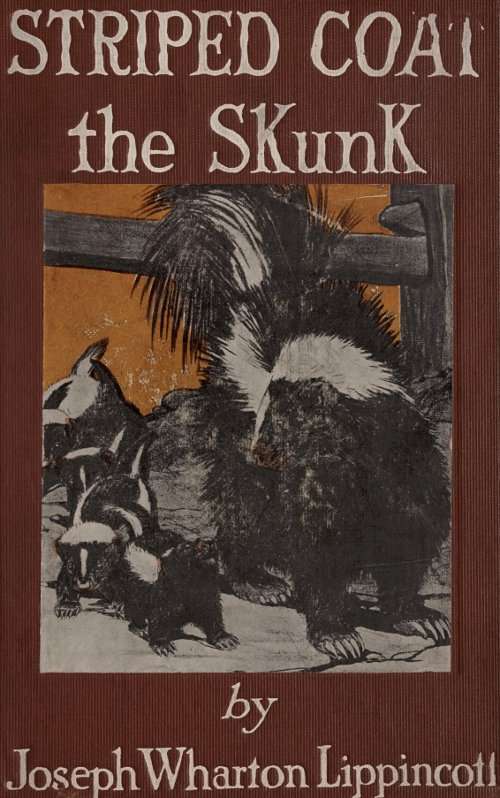
The Project Gutenberg eBook of Striped Coat, the Skunk
Title: Striped Coat, the Skunk
Author: Joseph Wharton Lippincott
Release date: August 1, 2018 [eBook #57619]
Language: English
Credits: Produced by Stephen Hutcheson and the Online Distributed
Proofreading Team at http://www.pgdp.net (This file was
produced from images generously made available by The
Internet Archive)
Standing once more in front of the stone pile he shook himself until his fur stood out all over him, that fur for which any dealer would give a big price
STRIPED COAT
THE SKUNK
by
Joseph Wharton Lippincott
Author of “Bun, a Wild Rabbit”
“Red Ben, the Fox of Oak Ridge”
and “Gray Squirrel”
Illustrated by the author
THE PENN PUBLISHING
COMPANY PHILADELPHIA
MCMXXII
COPYRIGHT
1922 BY
THE PENN
PUBLISHING
COMPANY
Striped Coat, the Skunk
MADE IN U. S. A.
INTRODUCTION
Lest I be misunderstood in calling this wonderful little animal man’s best friend among the furry creatures of the wood, let me at the outset draw attention to the fact that, far from putting a bounty on its destruction as some people might think desirable, many states have laws protecting it, as much for its usefulness to the farmers as for the value of its very beautiful fur.
The large black and white striped skunks we or our pet dogs often encounter, sometimes to our disaster, belong only in North America. Our friend Striped Coat was one of these. In the southern and western states lives also a little cousin of his—the spotted skunk—whose fur though attractive is not so valuable; but neither he nor the broad-striped skunk of Central and South America enter the pages of this story, for Striped Coat lived his life farther north than the range of either.
All of the skunk family still seem to be considered unpleasant and almost unmentionable creatures merely because of their ability to throw in self-defence a liquid, in the form of a spray, possessing anything but the fragrance of roses. Admitting that the odor is indescribably awful and that to get it on one’s clothing is anything but a reason for joy, it may still be claimed that the skunk himself is by no means a “smelly” animal and that his recourse to this means of defending his life is quite permissible as proved by our own methods of warfare.
In the ocean the otherwise defenceless little squid, when attacked, throws out a dark liquid which spreads in the water and either blinds its pursuer momentarily or so confuses his vision that the active squid has time to escape. It is the same thing in the case of the skunk. Let a fierce dog rush at him, and when a show of his little teeth and a brave stand have failed to save the poor fellow, deny him if you can the right to use as a last resort this stinging, pungent musk which, properly aimed at the eyes of his big enemy will have just enough effect to allow him a safe and bloodless retreat.
I do not doubt that there are many skunks who have never had occasion to pollute the air in this way. Several have lived for years in drains around my country home, and because my dogs are tied at night, have only twice made their presence known by throwing musk—once when one of their number was run over by an automobile and once when some kind of a fight occurred among the animals feeding together at night around the garbage barrel.
That they have done me great service in killing rats, field mice, beetles and grubs, is only too evident. On all sides are small holes in the earth and otherwise unobtrusive signs of their diligence in my behalf. They are my friends and I am theirs. To me no other pretty creature of the woods is more interesting.
In the past the skunk has been badly treated by authors. It was so easy to take a humorous but barbed fling at the poor wood pussy! But that day is past, for facts will out and our debt of gratitude is too great longer to be ignored. If my own words in tracing a part of the life history of Striped Coat, prove at all illuminating, I shall be happy. I have come across several skunks of his peculiar marking; one of them, partly tamed, is shown in the illustrations; but the story itself is largely fictional though following throughout the habits and true characteristics of these wild little friends of man. Belonging as they do to the elusive weasel tribe and being largely nocturnal in their habits, to chronicle all the actual happenings in the natural, wild life of one of them would seem an impossible task.
Including this little creature in my wild animal series is somewhat contrary to the advice of my publishers who naturally believe in “best sellers” rather than in “best smellers,” but I have a fond hope that Striped Coat will win his way with readers to a place beside Bun, Red Ben, Gray Squirrel and those to follow. I might add that a young skunk readily becomes a very tame, unusually interesting and beautiful pet, a safe one however only if accidents are provided against by “disarming,” that is, by the removal of the two scent sacs.
J. W. L.
Bethayres, Pa.
TABLE OF CONTENTS
- CHAPTER PAGE
- I. The Wood Pussy’s Journey 13
- II. Strong Medicine 24
- III. Under the Brush Pile 34
- IV. Every Animal Must Eat 45
- V. The Burning Woods 56
- VI. Good Hunting 65
- VII. Strange Happenings 75
- VIII. The Mystery Solved 85
- IX. Fifty Dollars on His Head 97
- X. Captured at Last 107
- XI. The Winter Sleep 117
- XII. The Spring Awakening 125
- XIII. Raising a Family 133
- XIV. Master of the Woods 144
LIST OF ILLUSTRATIONS
- Standing once more in front of the stone pile he shook himself until his fur stood out all over him, that fur for which any dealer would give a big price Frontispiece
- FACING PAGE
- Striped Coat’s foot-prints; front and hind foot (Pen and Ink) 26
- The wood pussy examined it very carefully 28
- The mouse ... had left in the nest her whole family of five young ones 51
- Several times she looked out and wandered about uneasily 64
- Where he had been a moment before, now stood the big bird, its eyes glaring, wings ready for another dash and strike 72
- He approached with caution 89
- In much the same way as a young hawk before it acquires its full plumage 104
- Under the persimmon and wild apple trees he picked up ripe fruit, often shaken down by Possum 119
- The friendliness of this beautiful and entirely free creature of the woods delighted many a visitor 122
- Side by side they neared the entrance 132
- The three tugging, biting, squealing and pulling each other this way and that until they burst from under the barn and had it out on the flat ground 141
- Skunk Tracks (Pen and Ink) 148
- “That big black skunk of yours was the one that did the trick” 149
Striped Coat, the Skunk
CHAPTER I
THE WOOD PUSSY’S JOURNEY
The full moon was shining over the narrow waters of Goose Creek. Here and there, its light slipped between the seemingly endless branches of the cedars, pines and oaks, and lay in silvery patches on the sand along the banks and on the carpet of dead leaves which extended from either side of the stream on and on, into the big silent woods. Wherever the light could not pierce the foliage, there were black shadows in streaks and squares and checker board patterns—black on white, white on black—just two colors all through the quiet woods.
But presently one of these patterns seemed to move. The keen round eyes of Screech Owl who was perching on a dead limb overhead, soon made out the form of an animal, about the size of a small cat, moving quietly along the woods path; but even Screech Owl had to look very hard, for this little animal was all black and white itself and therefore like a part of the woods carpet.
Along the path it ambled until another animal about the same size but gray in color appeared from the opposite direction. Then the little black and white one slowed down to a walk until the other, a ’possum, had passed, but it might have been noted that it was the ’possum which moved out of the path. When, a little further on, a larger animal, Gray Fox, came trotting through the shadows and not seeing the black and white one, nearly bumped into it, the haste with which Gray Fox leaped aside to make the way clear was almost comical. Since both Possum and Gray Fox felt such respect for the little black and white animal it was very evident that there was something most important or formidable about it.
This same feeling was even shared by two big does who with their young fawns close at heel were walking to the creek to drink. With snorts of surprise and of warning to their tender charges, they stood in the path for an instant, at bay, the young ones peeping with wide spread ears from behind their flanks. But the black and white animal, acknowledging the right of every woods mother to protect her young, stopped just long enough to allow the deer to see who it was and gracefully to step out of the way. Then on it ambled.
Two old coons shuffled out of the path without any hesitation, so did the mate of Gray Fox—all feared to come to close quarters with a full grown wood pussy; but a mother mink who was hungry and in a bad temper anyway, halted directly in the center of the wood pussy’s trail and curled back her lips in an evil snarl which showed every tooth in her head.
The skunk, taken by surprise, slowed down to a walk, her long fur bristling just a little and her bright, beady little eyes and sharp nose trying their best to search out some reason for this menace. She had often passed the slim-bodied mink at a distance, and knew her well as one of the woods creatures that belonged in that part of the wood. Surely the mink recognized her.
With bushy tail raised well over her back and every muscle ready to meet an attack the skunk sidled cautiously forward. She was not afraid, but she was good natured and hated a fuss. Nearer she came, then suddenly stamped a front foot so fiercely and with such a show of anger that the mink instinctively drew back. Past her then grandly sailed the skunk in the very center of the path, all fluffed up like a ship under full sail. If she saw the furious gleam in the mink’s eyes she did not show it, but went on about her business as unconcernedly as before.
It was to be sure, the custom among the little wild things not to interfere with anyone in the woods unless he was a playmate or unless he looked good to eat. The little gnawing tribe of grass and nut eaters, the mice, the squirrels, the rabbits and their kind nearly always looked like a good meal to meat eaters such as the fox, skunk, mink, owl, ’possum, ’coon and cat. Therefore the little nut and grass eaters always had to be careful to keep entirely out of the way of the killers; otherwise they were seen no more. But a mink would not care to eat an old skunk unless starvation stared him in the face, nor would he go outside of the mink family in search of a playmate.
These, however, were strange, exciting days for the woods folk. It was spring time and nearly all of them were hunting mates or, like the mother mink, taking care of families of hungry little ones. Only the wood pussy seemed all alone and unhurried as she travelled steadily through the moonlight.
Before very long, the path she followed ended in a fenced clearing. This was new to her, so she proceeded cautiously, with many stops to test the night air through her keen nose. Strange things had happened since she had been there before. Trees had been cut down and dragged into heaps; a house and a barn had been built; and worst of all for the wood pussy, the hollow stump for which she had headed so confidently all this time, was uprooted and gone from its old place. Now she too grew worried and ran this way and that hunting for this cozy, safe den which, during the Spring before, had been her home.
Well she remembered where it had stood, among beds of sweet fern and blackberry bushes, now all plowed under or, if their ends did stick up from the furrows, reeking with the smell of man and of his constant companion the dog.
As the poor wood pussy looked about, a new fear swept through her. It was growing light in the East; soon the shadows would be gone and she would be caught without a den far from the woodchuck burrow from which, early in the night, she had made this journey with such assurance.
She turned back, slowly retracing her steps to the edge of the wood where stood the rows of brush piles. Here she began to hunt for a temporary hiding place. The brush piles had not been there long enough to have settled into tight, safe retreats; but one of them had a base of logs under which the wood pussy found a narrow hole. Into this she pushed her way only to be startled by the sudden scampering of some animal which had already made this a home.
It was Bun, the woods rabbit. He was big, but his teeth and mouth were shaped for gnawing soft grass and bark, not fighting, so he made way very quickly for the skunk and waited outside until she should leave. But this she did not do, so after a while he grew impatient and peeped inside only to find her curled up in his bed of leaves fast asleep.
Bun angrily thumped his hind feet against the earth and complained a bit to himself, but finally had to go away and find another bed. He knew of several, for he was used to this kind of treatment on the part of the powerful meat eaters and was always ready for a quick change, inconvenient though it sometimes seemed.
Through the day, while the sun shone warmly on the wood pile and the little birds hopped about it, there was no sign of the weary wood pussy. Once she looked out to see whether it was safe yet to make the trip back to the woodchuck’s burrow, but finding the sun high overhead returned to Bun’s nest. Several times she moved uneasily and pulled more leaves about her for bedding. But she did not leave the woodpile that day nor the night following, and when in the morning the birds awoke with the dawn and chirruped among the twigs, there were five wood pussies instead of one, in Bun’s old nest, four of them hairless, blind babies only a few hours old, over whom the old wood pussy was already keeping faithful, tireless guard.
CHAPTER II
STRONG MEDICINE
And so it happened that Farmer Ben Slown had a family of skunks as neighbors. Some people might have been happy about it, but not he. It was well for the family that they were hidden under the wood pile so securely that he did not even suspect they were there; for Farmer Slown had never learned to live on friendly terms with the little woodsfolk.
He shot the crows and blackbirds because he thought they spent most of their time eating his crops. He set traps for the rabbits and the woodchucks because they nibbled his vegetables. The squirrels, in his opinion, lived only to carry away his corn, and the foxes, skunks, hawks and other meat eaters were supposed to be always on the lookout for his chickens. Altogether he made himself have a hard time with his wild neighbors.
He had moved into the woods and started his present farm because he wished to be far away from every human being, in a place where he could do pretty much what he pleased with everything he saw. But even Farmer Slown could not regulate the actions of the wild furry folk, nor know how many pairs of bright little eyes watched the lights of his house at night from field and thicket and high tree top.
No roads led into the big woods, but the farmer had a flat bottomed boat in which he could pole up and down Goose Creek. Then, too, there was the woods path along the stream, worn smooth by deer and by countless little padded feet. So Ben Slown was able to reach the village when he wanted to, which was not often.
Striped Coat’s foot-prints; front and hind foot.
When finally his new neighbor, the wood pussy, slipped from underneath the brush pile, she was not very happy. Out in the field, however, she could hear the hum of night flying beetles and the chirping of other insects, so in that direction she wandered. Beside clods of earth and under rubbish she poked her nose, cleverly digging out bugs wherever they had hidden themselves and finding, now and then, small grubs and worms of different kinds. No matter how small or how big, if she could get a hold of them that was the end of their happy days of feeding on the Farmer’s crops.
But it was too early in the year for many insects to have collected in a freshly cleared field, so when she had searched most of the ground, the wood pussy’s hunger was nearly as great as ever. There remained indeed the yard around the house and barn, and into this apparently deserted place the little mother’s hunger now led her.
She crept around the dog house and listened for a moment to the farmer’s old black and white hound wheezing in his sleep and grunting every time a flea bit him particularly hard. There were dry bones lying about the entrance but these she was too shy to take.
Next came the barn, a more interesting building, from which issued the strong scent of horses, poultry and the Farmer’s milk goat. The wood pussy examined it very carefully, sniffing through the cracks, straining to reach the open windows and finally getting underneath the floor by way of a loose board at the rear. She saw at once that this was a good hiding place, except for its nearness to things she did not understand and so could not help fearing.
The wood pussy examined it very carefully
But food was the important thing now, so next she crept around the house and hungrily picked up scraps thrown from the kitchen door, potato peelings for the most part, with one foot of a hen and two fish skeletons as tid bits. An old ’possum was there too, munching away in sour silence and cracking bones with his strong jaws.
These two were not, however, long to enjoy their humble meal. Suddenly Possum looked up and shuffled towards the wood. The skunk, knowing he had discovered something wrong, also straightened up. She then saw sneaking around the house the black and white hound who had either smelled or heard the two feasters and was coming around to investigate.
Her short legs would not make much speed, but she did her best to reach the hole under the barn. This however served only to bring on the hound full tilt to head her off. Being a noisy fellow he fairly bellowed with joy when he caught up and had her almost in his jaws.
But just in time she turned on him and threw up so quickly her dangerous looking, fluffy tail that he checked himself and began to dance around her in a circle, looking for a better chance to rush in without in any way getting hurt himself. The noise was quite enough to bring Farmer Slown’s tousled head out of the window.
“What’s going on around here!” he thundered. In the dark he could not see what kind of creature the dog had found, but wanted it killed anyway. “Sic ’em, you!” he encouraged, “sic ’em!” But the hound was a big coward at heart and only danced about all the more.
The Farmer grew angry at once.
“Just you wait!” he muttered, and vanished from the window only to appear at the door, clad in his blue night shirt and armed with a gun.
“Now, go for him!” he called and ran out to help the dog.
That was enough encouragement for the hound. Just as his master came up, he excitedly threw himself on the wood pussy, but not before that quick little animal had twisted herself around and given him a terrible musk bath square in the eyes and mouth. She could not run fast, her claws were not made for scratching, nor her teeth for fighting, but she had instead this weapon of defense which was enough to stop any hound.
With a yowl of pain the surprised dog threw himself on the ground and tried to rub the smarting stuff from his half blinded eyes. He wildly rolled and rubbed and finally in desperate fear and pain rushed to Farmer Slown and bounded against him again and again regardless of the man’s frantic efforts to keep him away.
The dog, the man, the yard and indeed the whole farm were wrapped in a cloud of horrible odor. But the little wood pussy, unhurt and untouched by the musk, was nowhere to be seen. She had vanished in the confusion and soon was nursing the hungry young ones safe under the brush pile.
That night, the little watchers about the clearing could have seen an angry looking figure in a blue night shirt striding down the path to the waters of Goose Creek. A big bar of soap and a towel went along too, also a strong smell, suggestive of fumes from a burning gum shoe factory. Also there was some fiery language about fool dogs, wood pussies in general and a certain one especially. Oh, it was a great night on Goose Creek!
CHAPTER III
UNDER THE BRUSH PILE
The next day found the farm still rich with the bitter odor of musk. The Farmer’s brisk scrubbing in the waters of Goose Creek removed the worst of the scent from his own limbs, but plenty remained to keep him reminded of the night’s experience. So he and his hound went about with sore noses hating themselves and brooding over the mean treatment they thought they had received. Each vowed vengeance in his own way, but neither felt especially anxious to again meet the little wood pussy face to face. There was enough perfume around the farm already. It was all very well to get an occasional whiff of an odor so interestingly awful, but to have it follow them about everywhere and almost live with them, was quite another affair.
On the second day, however, a strong breeze carried away much of the objectionable smell and Farmer Slown breathed easier. He even plucked up enough courage to hunt around his field and in the neighboring thickets for the wood pussy’s den, which he was shrewd enough to guess was nearby.
The brush piles quickly caught his eye. He poked around the first one, then moved to the next and finally reached the very one under which slept the baby skunks and their mother. This one looked more promising than the others, so the Farmer got down on his hands and knees and cautiously—oh, exceedingly carefully—peered under the logs.
Inside, the mother, hearing the heavy footsteps and the cracking of the brush, stood up in readiness to defend the little ones with her musk and with her own life if necessary. She made no sound, the young ones absorbing her fear, also keeping very still, waiting, as if knowing that terrible danger was near.
And Farmer Slown looked and listened and sniffed but could discover nothing. He was not entirely satisfied, however, and so took the risk of moving closer. He was well within the wood pussy’s fatal aim, but still did not know it. Then he poked his red face so close to the ground that a low briar pricked his nose. With an exclamation he drew back only to find that another had caught his ear and become partly wound around his neck.
At once his quick temper broke loose. Tearing himself free he kicked about him to destroy the offending bushes, and failing in this, strode away. Thus the meddlesome Farmer was saved from a much worse dose of musk than he received the first time. But more trouble was brewing; the man had made up his mind that the brush heaps were bad things to have near his fields, he had decided to burn them. That day, however, he did not have time, and on the next it rained, so the wood pussies lived on; and every day the little ones grew bigger and stronger.
But while Farmer Slown did not find the little family, the nest was not hidden from the prying eyes and keen noses of the woodsfolk. Gray Fox, trotting by on the first night, had at once caught the faint scent of the baby skunks and turned to investigate. He had, however, found the mother on guard and so that time had passed on.
Another who found the place was the mother mink with whom the wood pussy had already had trouble. As usual Mink was hungry; she had four little ones of her own in a burrow under a cedar whose roots dipped into Goose Creek. Therefore she sneaked under the woodpile and might have carried off one or all of the baby skunks if their mother had not returned suddenly and sprung upon her.
Mink, knowing herself in the wrong, backed off snarling, then flashed out of the woodpile and away. Both she and Gray Fox, however, remembered that here was something young, helpless and good to eat. Sometime when they came in that direction the mother might not be near and then—but somehow the wise faithful mother seemed to know their designs and to try always to be on guard.
However this was a very unprotected place for the little skunks and none felt it more than the mother. After Farmer Slown’s visit she became too uneasy to stay there any longer and thought only of making a move all the way back to the woodchuck’s deep burrow which had been her safe home all winter. Indeed, no sooner had night come again than she seized the nearest young one in her teeth and started out with it.
This young one was not like the others. To begin with he was stouter. Then, too, instead of having a black and white back like his brothers and sisters he was pure black all over except where two narrow white stripes came from the top of his head down either side of his neck. This little fellow was also peculiar in his habits. Nearly all night, while the others nervously crawled about, he lay happily on his back or flat on his stomach resting. But no sooner would the mother return to feed them than he would hear or smell her and spring up so quickly that he would be eating with furious energy before the others knew quite what was happening. And so he got much food and rest and grew very fast. All over his body the fur was beginning to show. It was short, thick and soft.
Now the mother, in her anxious state had started on an impossible task. The woodchuck’s burrow was much too far away to be reached in a night by a mother skunk with four youngsters that had to be carried one at a time. She had gone scarcely fifty yards with this one when her jaws and neck became very tired from lugging the fat, furry little fellow. He was slippery as well as heavy. Laying him down in the path, she rested, and at that moment caught a glimpse of Mink galloping through the woods towards the brush pile.
The wood pussy looked after this ruthless enemy and started to follow, forgetting the baby at her feet until by luck she tripped over him. Instantly picking him up by the neck she hurried back towards the nest. She was not as swift as Mink, but fear for the other young ones spurred her on until it seemed as if the youngster in her mouth would nearly be torn to pieces by the bushes they sped through, or choked by her tight hold.
Suddenly the brush pile was directly in front of them, and the mother slowed up as if afraid to face the sight she might find. In the next instant, however, she had rushed underneath, every hair on end, every nerve keyed for battle. But Mink was not there, she had returned in time!
A noise at the entrance caught her ear. She whirled around only to find that the young one she had dropped there in coming in, had gotten back some of his breath and was crawling shakily to the nest. Quickly picking him up she placed him among the others and then sprawled herself over them, panting, almost exhausted but ready for Mink.
And Mink came, smelled about outside, found to her surprise that the mother was again on guard and hastily bounded away to other hunting grounds. But for an hour or more the wood pussy stayed there resting and assuring herself through the feel of all those moving little bodies underneath her, that all were really safe. She had wisely given up the idea of moving them to the woodchuck burrow. When, later on hunger drove her forth, she chose another direction, and did not go further than the edge of the field where big, buzzing bugs were laying eggs in the grass, and where lizards often hid for the night.
CHAPTER IV
EVERY ANIMAL MUST EAT
Farmer Slown was plowing the corner of the field nearest Goose Creek. It was not far from the wood-pussies’ den, so the clank of the plow chains and the loud commands of “gid up,” “whoa there,” kept the skunk family from their usual morning sleep. Then, too, the black and white hound amused himself by sniffing about until he discovered the hiding place of Bun, the woods rabbit, whom he chased for a long time with much crashing of brush and excited baying. Bun led the stupid hound to all the most prickly briar patches and then hid in a hollow log. The hound was too big to follow him there and so, after growling and gnawing at the entrance until his mouth was sore, gave up the chase and slunk away to rest and lick his scratches.
Then lunch time arrived and the Farmer unhooked the two horses from the plow and tied them to the fence, where they could munch corn he spread for them on some sacking. He then walked across the field to the farm yard to milk the goat and prepare his own meal.
No sooner had he gone from sight than Jim Crow came flying from the woods for a look around. His sharp eyes at once saw the corn, but he said nothing and turned back to the woods to wait until the horses had moved away. At the same time however Red Squirrel, running about in the pines along the edge of the field, had also made a discovery of the corn. He looked all around to make sure he was the only one who had seen this food treasure, then sneaked to a nearby limb impatiently to watch for a chance to get a part of it.
But Gray Squirrel too had noticed the grain, and so also had a keen nosed deer mouse and a meadow mouse who lived in a round nest of grass hidden in a tangle of weeds beside the very posts to which the horses were tethered. So also had some black birds and a pair of starlings, and a blue jay and almost countless other creatures always on the watch for food.
Therefore when the afternoon plowing was over and the horses had been led back to the barn, birds began to arrive as if by magic to gather the scattered kernels. First appeared a mother quail with ten young ones not much larger than bumble bees following her as chicks follow a mother hen. She picked up a few of the smaller grains, then scurried away as big Jim Crow swooped down. He was followed by the starlings. Suddenly Red Squirrel sounded his rattle from the wood. Up flew Jim and the starlings in alarm only to see the little red fellow dash along the top of the fence, seize a big kernel and then rush back with it to a safe retreat. And so the feeding continued, with interruptions, until night came and only the mice and flying squirrels were left to hunt the very few kernels which remained. Although the horses had been careless with their feed, there had been no waste—the woods people had seen to that.
And soon from the brush pile, slipped the mother wood pussy. She had heard sounds of the feasting and now caught the scent left by some of the little creatures. She walked forward sniffing. Suddenly, up a fence post close by, ran Flying Squirrel. Out of reach of the hungry wood pussy, he squeaked shrilly and scolded. But the mother skunk was paying no attention, she had caught the fresh scent of the meadow mouse which lived in the grass nest beside the post.
The mouse had been eating a grain of corn when Flying Squirrel’s sudden alarm signal had sent her scurrying down her tunnel under the dead grass and leaves. Now, seeing no enemy, she was cautiously coming back to find the grain. Soon she was again gnawing away at it with a rasping noise which, slight as it was, caught the ear of the wood pussy and led her right to the spot.
The next thing the busy mouse saw was a pointed black and white head and two black paws directly above her. Without wasting breath for even a squeak of fear, she dashed headlong into her tunnel. The wood pussy could not open the tunnel quickly enough with her paws to catch up and so the mouse escaped that time.
The mouse had left in the nest her whole family of five young ones
But the skunk was a better mouser than any cat. With her strong claws she dug along the tunnels and runways, chasing the mouse from place to place until at last she came to the nest of grass. Her nose told her that the mouse was inside. Now was her chance! Poking her sharp head into the round entrance to keep the mouse from bolting out and past her, she dug into the mass of woven grasses with her front paws. Soon out came a mass of soft lining material made of shredded bark and tender dry grass blades, but no fat mouse. The little creature had wisely made a back door with a special safety tunnel leading into the underground burrow of a mole. Down this she had dodged. Even the wood pussy could not follow her there.
However the mouse, thinking only of saving herself had left in the nest her whole family of five young ones. Their eyes were still tight shut and their bodies hairless. If left undisturbed, however, they would soon have grown up and been running about like the mother making tunnels in the grass far and wide, to the disgust of Farmer Slown. So the wood pussy did the Farmer a good turn, though to her it was only a matter of easing her empty, aching stomach with a meal and providing food for her young ones.
Next day the mother mouse began to build another snug nest in a different place, in which in less than three weeks she was raising another family.
Under the wood pile, the young wood pussies were more lively than ever. It was four weeks since they were born, and their eyes were open; also their tender legs were growing strong enough to support their little furry bodies.
The fat black one with the white stripes on his head and neck—the one who had had such a rough journey with the mother the night she tried to move the family to the woodchuck’s burrow, was still the largest. He lay now on his back as usual, apparently fast asleep. It did not seem to matter to him how many times the others climbed over him or stepped on his face. But with the first step of the mother in the entrance, he was on his feet and waddling towards her with hungry little mouth open. She liked the little fellow and rarely disappointed him. And it was he who a year later became known as “Striped Coat” from one end of Goose Creek to the other—yes, and even further, for fame travels fast in the woods.
At five weeks of age he was like a little black ball of fur with a handle to it, which was his tail. His teeth were strong by that time and he often helped the others strip the feathers off some tough old blackbird or crow which the Farmer had shot in the field and left there, and which the mother had dragged under the brushpile for a feast. No matter how dead the bird, he would always pounce upon it as if it might escape, then pull and worry at its feathers and finally seize it by the head and try to drag it to a corner, away from the others.
This always caused a big rumpus. The others would seize the bird and try to pull it in the other direction. All four tugging together on one end could drag Striped Coat all about the place, and they always did this. But while it was going on, Striped Coat was as busy as a bee chewing on the bird’s neck and swallowing just as much as he could get into his mouth at a time, until he was as solidly stuffed as a plum pudding. No wonder he slept soundly all day sprawled on his stomach, or with all four feet up in the air. Life under the brush pile was a happy one.