
The Project Gutenberg eBook of Studies and Exercises in Formal Logic
Title: Studies and Exercises in Formal Logic
Author: John Neville Keynes
Release date: May 24, 2019 [eBook #59590]
Most recently updated: September 6, 2023
Language: English
Credits: Ed Brandon from material at the Internet Archive
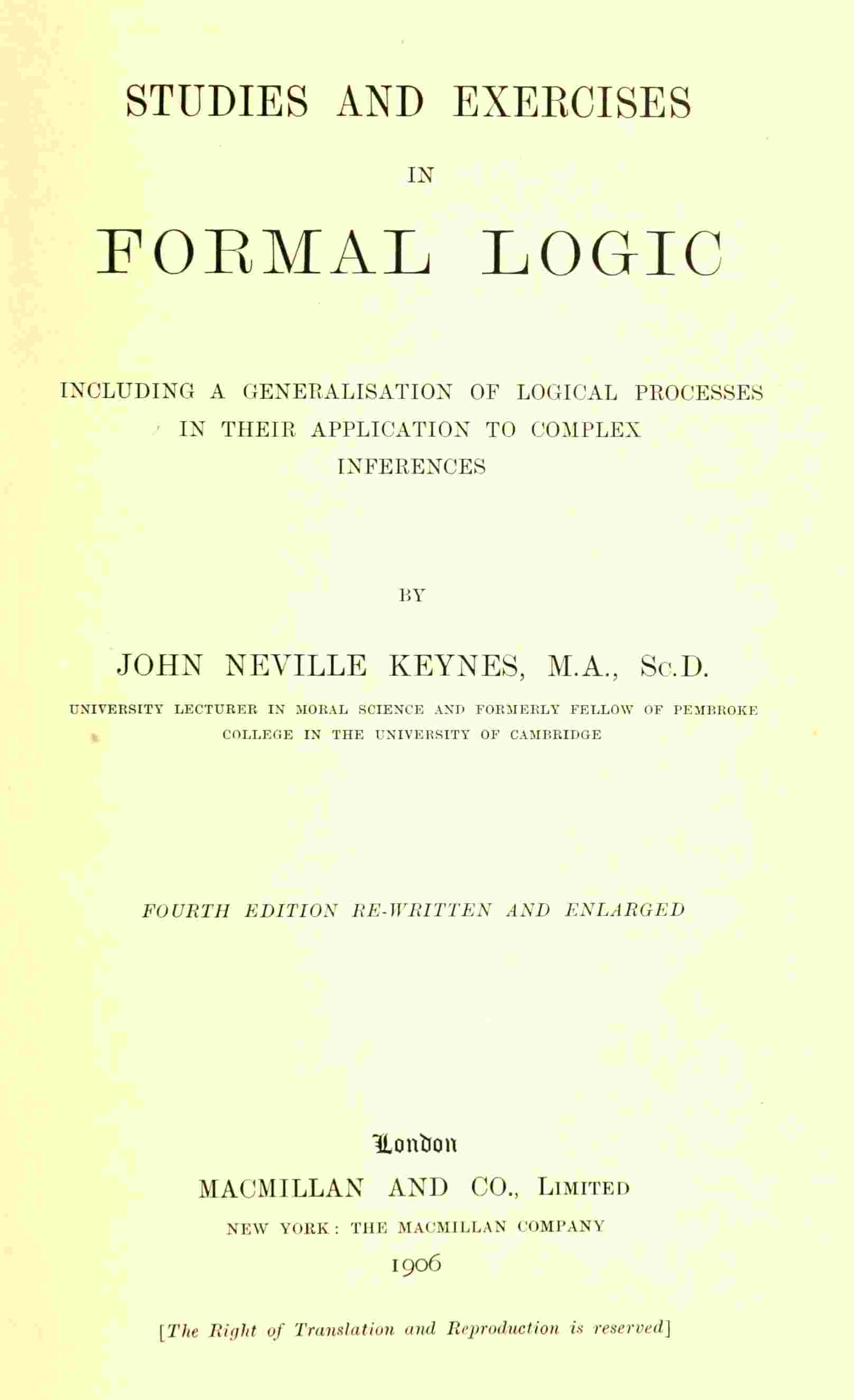
STUDIES AND EXERCISES
IN
FORMAL LOGIC
INCLUDING A GENERALISATION OF LOGICAL PROCESSES IN THEIR APPLICATION TO COMPLEX INFERENCES
BY
JOHN NEVILLE KEYNES, M.A., Sc.D.
UNIVERSITY LECTURER IN MORAL SCIENCE AND FORMERLY FELLOW OF PEMBROKE
COLLEGE IN THE UNIVERSITY OF CAMBRIDGE
FOURTH EDITION RE-WRITTEN AND ENLARGED
𝕷𝖔𝖓𝖉𝖔𝖓
MACMILLAN AND CO., LIMITED
NEW YORK: THE MACMILLAN COMPANY
1906
[The Right of Translation and Reproduction is reserved]
First Edition (Crown 8vo.) printed 1884.
Second Edition (Crown 8vo.) 1887.
Third Edition (Demy 8vo.) 1894.
Fourth Edition (Demy 8vo.) 1906.
PREFACE TO THE FOURTH EDITION.
IN this edition many of the sections have been re-written and a good deal of new matter has been introduced. The following are some of the more important modifications.
In Part I a new definition of “connotative name” is proposed, in the hope that some misunderstanding may thereby be avoided; and the treatment of negative names has been revised.
In Part II the problem of the import of judgments and propositions in its various aspects is dealt with in much more detail than before, and greater importance is attached to distinctions of modality. Partly in consequence of this, the treatment of conditional and hypothetical propositions has been modified. I have partially re-written the chapter on the existential import of propositions in order to meet some recent criticisms and to explain my position more clearly. Many other minor changes in Part II have been made.
Amongst the changes in Part III are a more systematic treatment of the process of the indirect reduction of syllogisms, and the introduction of a chapter on the characteristics of inference.
An appendix on the fundamental laws of thought has been added; and the treatment of complex propositions which previously constituted Part IV of the book has now been placed in an appendix.
The reader of this edition will perceive my indebtedness to Sigwart’s Logic. I have received valuable help from Professor J. S. Mackenzie and from my son, Mr J. M. Keynes; and I cannot express too strongly the debt I once more owe to Mr W. E. Johnson, who by his criticisms has enabled me to improve my exposition in many parts of the book, and also to avoid some errors.
J. N. KEYNES.
6, HARVEY ROAD,
CAMBRIDGE,
4 September 1906.
PREFACE TO THE FIRST EDITION.1
1 With some omissions.
IN addition to a somewhat detailed exposition of certain portions of what may be called the book-work of formal logic, the following pages contain a number of problems worked out in detail and unsolved problems, by means of which the student may test his command over logical processes.
In the expository portions of Parts I, II, and III, dealing respectively with terms, propositions, and syllogisms, the traditional lines are in the main followed, though with certain modifications; e.g., in the systematisation of immediate inferences, and in several points of detail in connexion with the syllogism. For purposes of illustration Euler’s diagrams are employed to a greater extent than is usual in English manuals.
In Part IV, which contains a generalisation of logical processes in their application to complex inferences, a somewhat new departure is taken. So far as I am aware this part constitutes the first systematic attempt that has been made to deal with formal reasonings of the most complicated character without the aid of mathematical or other symbols of operation, and without abandoning the ordinary non-equational or predicative form of proposition. This attempt has on the whole met with greater success than I had anticipated; and I believe that the methods formulated will be found to be both as easy and as effective as the symbolical methods of Boole and his followers. The book concludes with a general and sure method of solution of what Professor Jevons called the inverse problem, and which he himself seemed to regard as soluble only by a series of guesses.
The writers on logic to whom I have been chiefly indebted are De Morgan, Jevons, and Venn. To Mr Venn I am peculiarly indebted, not merely by reason of his published writings, vii especially his Symbolic Logic, but also for most valuable suggestions and criticisms while this book was in progress. I am glad to have this opportunity of expressing to him my thanks for the ungrudging help he has afforded me. I am also under great obligation to Miss Martin of Newnham College, and to Mr Caldecott of St John’s College, for criticisms which I have found extremely helpful.
CAMBRIDGE,
19 January 1884.
PREFACE TO THE SECOND EDITION.
THIS edition has been carefully revised, and numerous sections have been almost entirely re-written.
In addition to the introduction of some brief prefatory sections, the following are among the more important modifications. In Part I an attempt has been made to differentiate the meanings of the three terms connotation, intension, comprehension, with the hope that such differentiation of meaning may help to remove an ambiguity which is the source of much of the current controversy on the subject of connotation. In Part II a distinction between conditional and hypothetical propositions is adopted for which I am indebted to Mr W. E. Johnson; and the treatment of the existential import of propositions has been both expanded and systematised. In Part IV particular propositions, which in the first edition were practically neglected, are treated in detail; and, while the number of mere exercises has been diminished, many points of theory have received considerable development. Throughout the book the unanswered exercises are now separated from the expository matter and placed together at the end of the several chapters in which they occur. An index has been added.
I have to thank several friends and correspondents, amongst whom I must especially mention Mr Henry Laurie of the University of Melbourne and Mr W. E. Johnson of King’s College, Cambridge, for suggestions and criticisms from which I have derived the greatest assistance. Mr Johnson has kindly read the proof sheets throughout; and I am particularly indebted to him for the generous manner in which he has placed at my disposal not only his time but also the results of his own work on various points of formal logic.
CAMBRIDGE,
22 June 1887.
PREFACE TO THE THIRD EDITION.
THIS edition has been in great part re-written and the book is again considerably enlarged.
In Part I the mutual relations between the extension and the intension of names are examined from a new point of view, and the distinction between real and verbal propositions is treated more fully than in the two earlier editions. In Part II more attention is paid to tables of equivalent propositions, certain developments of Euler’s and Lambert’s diagrams are introduced, the interpretation of propositions in extension and intension is discussed in more detail, and a brief explanation is given of the nature of logical equations. The chapters on the existential import of propositions and on conditional, hypothetical, and disjunctive (or, as I now prefer to call them, alternative) propositions have also been expanded, and the position which I take on the various questions raised in these chapters is I hope more clearly explained. In Parts III and IV there is less absolutely new matter, but the minor modifications are numerous. An appendix is added containing a brief account of the doctrine of division.
In the preface to earlier editions I was glad to have the opportunity of acknowledging my indebtedness to Professor Caldecott, to Mr W. E. Johnson, to Professor Henry Laurie, to Dr Venn, and to Mrs Ward. In the present edition my indebtedness to Mr Johnson is again very great. Many new developments are due to his suggestion, and in every important discussion in the book I have been most materially helped by his criticism and advice.
CAMBRIDGE,
25 July 1894.
TABLE OF CONTENTS.
| INTRODUCTION. | ||
| SECTION | PAGE | |
| 1. | The General Character of Logic | 1 |
| 2. | Formal Logic | 1 |
| 3. | Logic and Language | 3 |
| 4. | Logic and Psychology | 5 |
| 5. | The Utility of Logic | 6 |
| PART I. | ||
| TERMS. | ||
| CHAPTER I. | ||
| THE LOGIC OF TERMS. | ||
| 6. | The Three Parts of Logical Doctrine | 8 |
| 7. | Names and Concepts | 10 |
| 8. | The Logic of Terms | 11 |
| 9. | General and Singular Names | 11 |
| 10. | Proper Names | 13 |
| 11. | Collective Names | 14 |
| 12. | Concrete and Abstract Names | 16 |
| 13. | Can Abstract Names be subdivided into General and Singular? | 19 |
| 14, 15. | Exercises | 21 |
| CHAPTER II. | ||
| EXTENSION AND INTENSION. | ||
| 16. | The Extension and the Intension of Names | 22 |
| 17. | Connotation, Subjective Intension, and Comprehension. | 23 |
| 18. | Sigwart’s distinction between Empirical, Metaphysical, and Logical Concepts | 27 |
| xii | ||
| 19. | Connotation and Etymology | 28 |
| 20. | Fixity of Connotation | 28 |
| 21. | Extension and Denotation | 29 |
| 22. | Dependence of Extension and Intension upon one another | 31 |
| 23. | Inverse Variation of Extension and Intension | 35 |
| 24. | Connotative Names | 40 |
| 25. | Are proper names connotative? | 41 |
| 26 to 30. | Exercises | 47 |
| CHAPTER III. | ||
| REAL, VERBAL, AND FORMAL PROPOSITIONS. | ||
| 31. | Real, Verbal, and Formal Propositions | 49 |
| 32. | Nature of the Analysis involved in Analytic Propositions | 53 |
| 33 to 37. | Exercises | 56 |
| CHAPTER IV. | ||
| NEGATIVE NAMES AND RELATIVE NAMES. | ||
| 38. | Positive and Negative Names | 57 |
| 39. | Indefinite Character of Negative Names | 59 |
| 40. | Contradictory Terms | 61 |
| 41. | Contrary Terms | 62 |
| 42. | Relative Names | 63 |
| 43 to 45. | Exercises | 65 |
| PART II. | ||
| PROPOSITIONS. | ||
| CHAPTER I. | ||
| IMPORT OF JUDGMENTS AND PROPOSITIONS. | ||
| 46. | Judgments and Propositions | 66 |
| 47. | The Abstract Character of Logic | 68 |
| 48. | Nature of the Enquiry into the Import of Propositions | 70 |
| 49. | The Objective Reference in Judgments | 74 |
| 50. | The Universality of Judgments | 76 |
| 51. | The Necessity of Judgments | 77 |
| 52. | Exercise | 78 |
| xiii | ||
| CHAPTER II. | ||
| KINDS OF JUDGMENTS AND PROPOSITIONS. | ||
| 53. | The Classification of Judgments | 79 |
| 54. | Kant’s Classification of Judgments | 81 |
| 55. | Simple Judgments and Compound Judgments | 82 |
| 56. | The Modality of Judgments | 84 |
| 57. | Modality in relation to Simple Judgments | 85 |
| 58. | Subjective Distinctions of Modality | 86 |
| 59. | Objective Distinctions of Modality | 87 |
| 60. | Modality in relation to Compound Judgments | 90 |
| 61. | The Quantity and the Quality of Propositions | 91 |
| 62. | The traditional Scheme of Propositions | 92 |
| 63. | The Distribution of Terms in a Proposition | 95 |
| 64. | The Distinction between Subject and Predicate in the traditional Scheme of Propositions | 96 |
| 65. | Universal Propositions | 97 |
| 66. | Particular Propositions | 100 |
| 67. | Singular Propositions | 102 |
| 68. | Plurative Propositions and Numerically Definite Propositions | 103 |
| 69. | Indefinite Propositions | 105 |
| 70. | Multiple Quantification | 105 |
| 71. | Infinite or Limitative Propositions | 106 |
| 72 to 78. | Exercises | 107 |
| CHAPTER III. | ||
| THE OPPOSITION OF PROPOSITIONS. | ||
| 79. | The Square of Opposition | 109 |
| 80. | Contradictory Opposition | 111 |
| 81. | Contrary Opposition | 114 |
| 82. | The Opposition of Singular Propositions | 115 |
| 83. | The Opposition of Modal Propositions | 116 |
| 84. | Extension of the Doctrine of Opposition | 117 |
| 85. | The Nature of Significant Denial | 119 |
| 86 to 95. | Exercises. | 124 |
| xiv | ||
| CHAPTER IV. | ||
| IMMEDIATE INFERENCES. | ||
| 96. | The Conversion of Categorical Propositions | 126 |
| 97. | Simple Conversion and Conversion per accidens. | 128 |
| 98. | Inconvertibility of Particular Negative Propositions | 130 |
| 99. | Legitimacy of Conversion | 130 |
| 100. | Table of Propositions connecting any two terms | 132 |
| 101. | The Obversion of Categorical Propositions | 133 |
| 102. | The Contraposition of Categorical Propositions | 134 |
| 103. | The Inversion of Categorical Propositions | 137 |
| 104. | The Validity of Inversion | 139 |
| 105. | Summary of Results | 140 |
| 106. | Table of Propositions connecting any two terms and their contradictories | 141 |
| 107. | Mutual Relations of the non-equivalent Propositions connecting any two terms and their contradictories | 142 |
| 108. | The Elimination of Negative Terms | 144 |
| 109. | Other Immediate Inferences | 147 |
| 110. | Reduction of immediate inferences to the mediate form | 151 |
| 111 to 124. | Exercises | 153 |
| CHAPTER V. | ||
| THE DIAGRAMMATIC REPRESENTATION OF PROPOSITIONS. | ||
| 125. | The use of Diagrams in Logic | 156 |
| 126. | Euler’s Diagrams | 157 |
| 127. | Lambert’s Diagrams | 163 |
| 128. | Dr Venn’s Diagrams | 166 |
| 129. | Expression of the possible relations between any two classes by means of the propositional forms A, E, I, O | 168 |
| 130. | Euler’s diagrams and the class-relations between S, not-S, P, not-P | 170 |
| 131. | Lambert’s diagrams and the class-relations between S, not-S, P, not-P | 174 |
| 132 to 134. | Exercises | 176 |
| xv | ||
| CHAPTER VI. | ||
| PROPOSITIONS IN EXTENSION AND IN INTENSION. | ||
| 135. | Fourfold Implication of Propositions in Connotation and Denotation | 177 |
| (1) Subject in denotation, predicate in connotation | 179 | |
| (2) Subject in denotation, predicate in denotation | 181 | |
| (3) Subject in connotation, predicate in connotation | 184 | |
| (4) Subject in connotation, predicate in denotation | 186 | |
| 136. | The Reading of Propositions in Comprehension | 187 |
| CHAPTER VII. | ||
| LOGICAL EQUATIONS AND THE QUANTIFICATION OF THE PREDICATE. | ||
| 137. | The employment of the symbol of Equality in Logic | 189 |
| 138. | Types of Logical Equations | 191 |
| 139. | The expression of Propositions as Equations | 194 |
| 140. | The eight propositional forms resulting from the explicit Quantification of the Predicate | 195 |
| 141. | Sir William Hamilton’s fundamental Postulate of Logic | 195 |
| 142. | Advantages claimed for the Quantification of the Predicate | 196 |
| 143. | Objections urged against the Quantification of the Predicate | 197 |
| 144. | The meaning to be attached to the word some in the eight propositional forms recognised by Sir William Hamilton | 199 |
| 145. | The use of some in the sense of some only | 202 |
| 146. | The interpretation of the eight Hamiltonian forms of proposition, some being used in its ordinary logical sense | 203 |
| 147. | The propositions U and Y | 204 |
| 148. | The proposition η | 206 |
| 149. | The proposition ω | 206 |
| 150. | Sixfold Schedule of Propositions obtained by recognising Y and η, in addition to A, E, I, O | 207 |
| 151, 152. | Exercises | 209 |
| CHAPTER VIII. | ||
| THE EXISTENTIAL IMPORT OF CATEGORICAL PROPOSITIONS. | ||
| 153. | Existence and the Universe of Discourse | 210 |
| 154. | Formal Logic and the Existential Import of Propositions | 215 |
| 155. | The Existential Formulation of Propositions | 218 |
| 156. | Various Suppositions concerning the Existential Import of Categorical Propositions | 218 |
| xvi | ||
| 157. | Reduction of the traditional forms of proposition to the form of Existential Propositions | 221 |
| 158. | Immediate Inferences and the Existential Import of Propositions | 223 |
| 159. | The Doctrine of Opposition and the Existential Import of Propositions | 227 |
| 160. | The Opposition of Modal Propositions considered in connexion with their Existential Import | 231 |
| 161. | Jevons’s Criterion of Consistency | 232 |
| 162. | The Existential Import of the Propositions included in the Traditional Schedule | 234 |
| 163. | The Existential Import of Modal Propositions | 244 |
| 164 to 172. | Exercises | 245 |
| CHAPTER IX. | ||
| CONDITIONAL AND HYPOTHETICAL PROPOSITIONS. | ||
| 173. | The distinction between Conditional Propositions and Hypothetical Propositions | 249 |
| 174. | The Import of Conditional Propositions | 252 |
| 175. | Conditional Propositions and Categorical Propositions | 253 |
| 176. | The Opposition of Conditional Propositions | 256 |
| 177. | Immediate Inferences from Conditional Propositions | 259 |
| 178. | The Import of Hypothetical Propositions | 261 |
| 179. | The Opposition of Hypothetical Propositions | 264 |
| 180. | Immediate Inferences from Hypothetical Propositions | 268 |
| 181. | Hypothetical Propositions and Categorical Propositions | 270 |
| 182. | Alleged Reciprocal Character of Conditional and Hypothetical Judgments | 270 |
| 183 to 188. | Exercises | 273 |
| CHAPTER X. | ||
| DISJUNCTIVE (OR ALTERNATIVE) PROPOSITIONS. | ||
| 189. | The terms Disjunctive and Alternative as applied to Propositions | 275 |
| 190. | Two types of Alternative Propositions | 276 |
| 191. | The Import of Disjunctive (Alternative) Propositions | 277 |
| 192. | Scheme of Assertoric and Modal Propositions | 282 |
| 193. | The Relation of Disjunctive (Alternative) Propositions to Conditionals and Hypotheticals | 282 |
| 194 to 196. | Exercises | 284 |
| xvii | ||
| PART III. | ||
| SYLLOGISMS. | ||
| CHAPTER I. | ||
| THE RULES OF THE SYLLOGISM. | ||
| 197. | The Terms of the Syllogism | 285 |
| 198. | The Propositions of the Syllogism | 287 |
| 199. | The Rules of the Syllogism | 287 |
| 200. | Corollaries from the Rules of the Syllogism | 289 |
| 201. | Restatement of the Rules of the Syllogism | 291 |
| 202. | Dependence of the Rules of the Syllogism upon one another | 291 |
| 203. | Statement of the independent Rules of the Syllogism | 293 |
| 204. | Proof of the Rule of Quality | 294 |
| 205. | Two negative premisses may yield a valid conclusion; but not syllogistically | 295 |
| 206. | Other apparent exceptions to the Rules of the Syllogism | 297 |
| 207. | Syllogisms with two singular premisses | 298 |
| 208. | Charge of incompleteness brought against the ordinary syllogistic conclusion | 300 |
| 209. | The connexion between the Dictum de omni et nullo and the ordinary Rules of the Syllogism | 301 |
| 210 to 242. | Exercises | 302 |
| CHAPTER II. | ||
| THE FIGURES AND MOODS OF THE SYLLOGISM. | ||
| 243. | Figure and Mood | 309 |
| 244. | The Special Rules of the Figures; and the Determination of the Legitimate Moods in each Figure | 309 |
| 245. | Weakened Conclusions and Subaltern Moods | 313 |
| 246. | Strengthened Syllogisms | 314 |
| 247. | The peculiarities and uses of each of the four figures of the syllogism | 315 |
| 248 to 255. | Exercises | 317 |
| xviii | ||
| CHAPTER III. | ||
| THE REDUCTION OF SYLLOGISMS. | ||
| 256. | The Problem of Reduction | 318 |
| 257. | Indirect Reduction | 318 |
| 258. | The mnemonic lines Barbara, Celarent, &c. | 319 |
| 259. | The direct reduction of Baroco and Bocardo | 323 |
| 260. | Extension of the Doctrine of Reduction | 324 |
| 261. | Is Reduction an essential part of the Doctrine of the Syllogism? | 325 |
| 262. | The Fourth Figure | 328 |
| 263. | Indirect Moods | 329 |
| 264. | Further discussion of the process of Indirect Reduction | 331 |
| 265. | The Antilogism | 332 |
| 266. | Equivalence of the Moods of the first three Figures shewn by the Method of Indirect Reduction | 333 |
| 267. | The Moods of Figure 4 in their relation to one another | 334 |
| 268. | Equivalence of the Special Rules of the First Three Figures | 335 |
| 269. | Scheme of the Valid Moods of Figure 1 | 336 |
| 270. | Scheme of the Valid Moods of Figure 2 | 336 |
| 271. | Scheme of the Valid Moods of Figure 3 | 337 |
| 272. | Dictum for Figure 4 | 338 |
| 273 to 287. | Exercises | 339 |
| CHAPTER IV. | ||
| THE DIAGRAMMATIC REPRESENTATION OF SYLLOGISMS. | ||
| 288. | Euler’s diagrams and syllogistic reasonings | 341 |
| 289. | Lambert’s diagrams and syllogistic reasonings | 344 |
| 290. | Dr Venn’s diagrams and syllogistic reasonings | 345 |
| 291 to 300. | Exercises | 347 |
| CHAPTER V. | ||
| CONDITIONAL AND HYPOTHETICAL SYLLOGISMS. | ||
| 301. | The Conditional Syllogism, the Hypothetical Syllogism, and the Hypothetico-Categorical Syllogism | 348 |
| 302. | Distinctions of Mood and Figure in the case of Conditional and Hypothetical Syllogisms | 349 |
| 303. | Fallacies in Hypothetical Syllogisms | 350 |
| 304. | The Reduction of Conditional and Hypothetical Syllogisms | 351 |
| xix | ||
| 305. | The Moods of the Mixed Hypothetical Syllogism | 352 |
| 306. | Fallacies in Mixed Hypothetical Syllogisms | 353 |
| 307. | The Reduction of Mixed Hypothetical Syllogisms | 354 |
| 308. | Is the reasoning contained in the mixed hypothetical syllogism mediate or immediate? | 354 |
| 309 to 315. | Exercises | 358 |
| CHAPTER VI. | ||
| DISJUNCTIVE SYLLOGISMS. | ||
| 316. | The Disjunctive Syllogism | 359 |
| 317. | The modus ponendo tollens | 361 |
| 318. | The Dilemma | 363 |
| 319 to 321. | Exercises | 366 |
| CHAPTER VII. | ||
| IRREGULAR AND COMPOUND SYLLOGISMS. | ||
| 322. | The Enthymeme | 367 |
| 323. | The Polysyllogism and the Epicheirema | 368 |
| 324. | The Sorites | 370 |
| 325. | The Special Rules of the Sorites | 372 |
| 326. | The possibility of a Sorites in a Figure other than the First | 373 |
| 327. | Ultra-total Distribution of the Middle Term | 376 |
| 328. | The Quantification of the Predicate and the Syllogism | 378 |
| 329. | Table of valid moods resulting from the recognition of Y and η in addition to A, E, I, O | 381 |
| 330. | Formal Inferences not reducible to ordinary Syllogisms | 384 |
| 331 to 341. | Exercises | 388 |
| CHAPTER VIII. | ||
| PROBLEMS ON THE SYLLOGISM. | ||
| 342. | Bearing of the existential interpretation of propositions upon the validity of syllogistic reasonings | 390 |
| 343. | Connexion between the truth and falsity of premisses and conclusion in a valid syllogism | 394 |
| 344. | Arguments from the truth of one premiss and the falsity of the other premiss in a valid syllogism, or from the falsity of one premiss to the truth of the conclusion, or from the truth of one premiss to the falsity of the conclusion | 396 |
| 345. | Numerical Moods of the Syllogism | 400 |
| 346 to 375. | Exercises | 403 |
| xx | ||
| CHAPTER IX. | ||
| THE CHARACTERISTICS OF INFERENCE. | ||
| 376. | The Nature of Logical Inference | 413 |
| 377. | The Paradox of Inference | 414 |
| 378. | The nature of the difference that there must be between premisses and conclusion in an inference | 415 |
| 379. | The Direct Import and the Implications of a Proposition | 420 |
| 380. | Syllogisms and Immediate Inferences | 423 |
| 381. | The charge of petitio principii brought against Syllogistic Reasoning | 424 |
| CHAPTER X. | ||
| EXAMPLES OF ARGUMENTS AND FALLACIES. | ||
| 382 to 408. | Exercises | 431 |
| APPENDIX A. | ||
| THE DOCTRINE OF DIVISION. | ||
| 409. | Logical Division | 441 |
| 410. | Physical Division, Metaphysical Division, and Verbal Division | 442 |
| 411. | Rules of Logical Division | 443 |
| 412. | Division by Dichotomy | 445 |
| 413. | The place of the Doctrine of Division in Logic | 446 |
| APPENDIX B. | ||
| THE FUNDAMENTAL LAWS OF THOUGHT. | ||
| 414. | The Three Laws of Thought | 450 |
| 415. | The Law of Identity | 451 |
| 416. | The Law of Contradiction | 454 |
| 417. | The Sophism of “The Liar” | 457 |
| 418. | The Law of Excluded Middle | 458 |
| 419. | Grounds on which the absolute universality and necessity of the law of excluded middle have been denied | 460 |
| 420. | Are the Laws of Thought also Laws of Things? | 463 |
| 421. | Mutual Relations of the three Laws of Thought | 464 |
| 422. | The Laws of Thought in relation to Immediate Inferences | 464 |
| 423. | The Laws of Thought and Formal Mediate Inferences | 466 |
| xxi | ||
| APPENDIX C. | ||
| A GENERALISATION OF LOGICAL PROCESSES IN THEIR APPLICATION TO COMPLEX PROPOSITIONS. | ||
| CHAPTER I. | ||
| THE COMBINATION OF TERMS. | ||
| 424. | Complex Terms | 468 |
| 425. | Order of Combination in Complex Terms | 469 |
| 426. | The Opposition of Complex Terms | 470 |
| 427. | Duality of Formal Equivalences in the case of Complex Terms | 472 |
| 428. | Laws of Distribution | 472 |
| 429. | Laws of Tautology | 473 |
| 430. | Laws of Development and Reduction | 474 |
| 431. | Laws of Absorption | 475 |
| 432. | Laws of Exclusion and Inclusion | 475 |
| 433. | Summary of Formal Equivalences of Complex Terms | 475 |
| 434. | The Conjunctive Combination of Alternative Terms | 478 |
| 435 to 439. | Exercises | 477 |
| CHAPTER II. | ||
| COMPLEX PROPOSITIONS AND COMPOUND PROPOSITIONS. | ||
| 440. | Complex Propositions | 478 |
| 441. | The Opposition of Complex Propositions | 478 |
| 442. | Compound Propositions | 478 |
| 443. | The Opposition of Compound Propositions | 480 |
| 444. | Formal Equivalences of Compound Propositions | 480 |
| 445. | The Simplification of Complex Propositions | 481 |
| 446. | The Resolution of Universal Complex Propositions into Equivalent Compound Propositions | 483 |
| 447. | The Resolution of Particular Complex Propositions into Equivalent Compound Propositions | 484 |
| 448. | The Omission of Terms from Complex Propositions | 485 |
| 449. | The Introduction of Terms into Complex Propositions | 485 |
| 450. | Interpretation of Anomalous Forms | 486 |
| 451 to 453. | Exercises | 487 |
| xxii | ||
| CHAPTER III. | ||
| IMMEDIATE INFERENCES FROM COMPLEX PROPOSITIONS. | ||
| 454. | The Obversion of Complex Propositions | 488 |
| 455. | The Conversion of Complex Propositions | 489 |
| 456. | The Contraposition of Complex Propositions | 490 |
| 457. | Summary of the results obtainable by Obversion, Conversion, and Contraposition | 493 |
| 458 to 473. | Exercises | 494 |
| CHAPTER IV. | ||
| THE COMBINATION OF COMPLEX PROPOSITIONS. | ||
| 474. | The Problem of combining Complex Propositions | 498 |
| 475. | The Conjunctive Combination of Universal Affirmatives | 498 |
| 476. | The Conjunctive Combination of Universal Negatives | 499 |
| 477. | The Conjunctive Combination of Universals with Particulars of the same Quality | 500 |
| 478. | The Conjunctive Combination of Affirmatives with Negatives | 501 |
| 479. | The Conjunctive Combination of Particulars with Particulars | 501 |
| 480. | The Alternative Combination of Universal Propositions | 502 |
| 481. | The Alternative Combination of Particular Propositions | 502 |
| 482. | The Alternative Combination of Particulars with Universals | 502 |
| 483 to 486. | Exercises | 503 |
| CHAPTER V. | ||
| INFERENCES FROM COMBINATIONS OF COMPLEX PROPOSITIONS. | ||
| 487. | Conditions under which a universal proposition affords information in regard to any given term | 504 |
| 488. | Information jointly afforded by a series of universal propositions with regard to any given term | 506 |
| 489. | The Problem of Elimination | 508 |
| 490. | Elimination from Universal Affirmatives | 509 |
| 491. | Elimination from Universal Negatives | 510 |
| 492. | Elimination from Particular Affirmatives | 511 |
| 493. | Elimination from Particular Negatives | 511 |
| 494. | Order of procedure in the process of elimination | 511 |
| 495 to 533. | Exercises | 512 |
| xxiii | ||
| CHAPTER VI. | ||
| THE INVERSE PROBLEM. | ||
| 534. | Nature of the Inverse Problem | 525 |
| 535. | A General Solution of the Inverse Problem | 527 |
| 536. | Another Method of Solution of the Inverse Problem | 530 |
| 537. | A Third Method of Solution of the Inverse Problem | 531 |
| 538. | Mr Johnson’s Notation for the Solution of Logical Problems | 533 |
| 539. | The Inverse Problem and Schröder’s Law of Reciprocal Equivalences | 534 |
| 540 to 550. | Exercises | 535 |
| INDEX | 539 | |