
WeRead Powered by ReaderPub
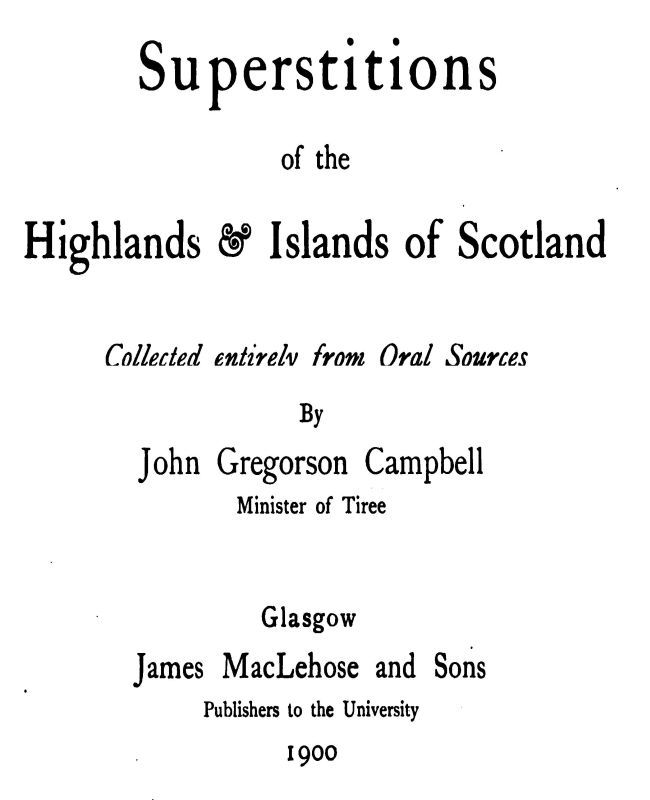
Superstitions of the Highlands & Islands of Scotland / Collected Entirely from Oral Sources cover

Superstitions of the Highlands & Islands of Scotland / Collected Entirely from Oral Sources

Chapter 33: ELFIN QUEEN.
Open in WeRead

About This Book

A collection of oral traditions from the Scottish Highlands and Islands, recorded and arranged thematically to present popular beliefs about fairies, changelings, banshees, tutelary beings, witchcraft, and related customs. The material combines narrative tales and descriptive entries that show regional variants, accounts of sightings and interactions, and practical measures for protection or repair. Gaelic expressions are translated with emphasis on literal meaning and authentic usage, and the compiler relied solely on spoken testimony gathered across multiple districts to preserve the vernacular form of these folk beliefs.

ELFIN QUEEN.

The Banshi is, without doubt, the original of the Queen of Elfland, mentioned in ballads of the South of Scotland. The Elfin Queen met Thomas of Ercildoune by the Eildon tree, and took him to her enchanted realm, where he was kept for seven years. She gave him the power of foretelling the future, ‘the tongue that never lied.’ At first she was the most beautiful woman he had ever seen, but when he next looked—

“The hair that hung upon her head,
The half was black, the half was grey,
And all the rich clothing was away
That he before saw in that stead;
Her eyes seemed out that were so grey,
And all her body like the lead.”

In Gaelic tales seven years is a common period of detention among the Fairies, the leannan sìth communicates to her lover the knowledge of future events, and in the end is looked upon by him with aversion. There is no mention, however, of Fairyland, or of an Elfin King or Queen, and but rarely of Fairies riding. True Thomas, who is as well known in Highland lore as he is in the Lowlands, is said to be still among the Fairies, and to attend every market on the look-out for suitable horses. When he has made up his complement he will appear again among men, and a great battle will be fought on the Clyde.