
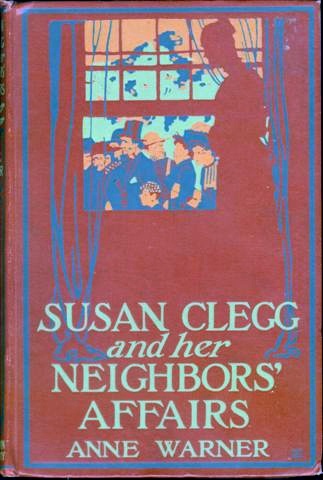
The Project Gutenberg eBook of Susan Clegg and Her Neighbors' Affairs
Title: Susan Clegg and Her Neighbors' Affairs
Author: Anne Warner
Release date: August 4, 2006 [eBook #18987]
Language: English
Credits: Produced by Suzanne Shell, Mary Meehan and the Online
Distributed Proofreading Team at http://www.pgdp.net
Susan Clegg
and
Her Neighbors' Affairs
By Anne Warner
Author of "Susan Clegg and her Friend Mrs. Lathrop," "The Rejuvenation of Aunt Mary," "A Woman's Will," etc.
Boston
Little, Brown, and Company
1906
Copyright, 1904,
By The Red Book Corporation.
Copyright, 1905,
By The Century Company.
Copyright, 1905,
By The Bobbs Merrill Company.
Copyright, 1906,
By Little, Brown, and Company.
All rights reserved
Published June, 1906
THE UNIVERSITY PRESS, CAMBRIDGE, U. S. A.
"It's a brand-new one, fer the price-tag's still hangin' on the back."
PREFATORY NOTE
"Mrs. Lathrop's Love Affair" appeared in "The Century Magazine" in 1905. "The Wolf at Susan's Door" was published in "The Reader's Magazine" in the early part of the present year, and "Old Man Ely's Proposal" is printed for the first time in this volume. The original version of "A Very Superior Man" appeared in "The Red Book."
CONTENTS
MRS. LATHROP'S LOVE AFFAIR
Part First. The Deacon's Dilemma
Part Second. The Automobile
OLD MAN ELY'S PROPOSAL
THE WOLF AT SUSAN'S DOOR
Part First. Miss Clegg's Speculations
Part Second. Gran'ma Mullins's Woe
Part Third. Lucy Dill's Wedding
Part Fourth. Mr. Jilkins's Hat
A VERY SUPERIOR MAN
Other books by Anne Warner
MRS. LATHROP'S LOVE AFFAIR
PART FIRST
THE DEACON'S DILEMMA
Miss Clegg was getting her own favorite tea. This always consisted of itself, toast, and a slice of bacon; and she apparently took as much pleasure in the preparation of the meal as if it were not the ten thousandth of its kind which she had cooked and eaten. As she hustled and bustled here and there, her manner seemed even more sprightly than usual; and it was only occasionally, when her glance fell upon the light shining across from her friend's kitchen window opposite, that her cheerfulness knew any diminution. But there seemed to be some sad influence in the effect of the rays of Mrs. Lathrop's lamp on this particular night; and even if its effect on Susan was merely transitory, it was not the less marked each time that it occurred.
Once, just as she was carrying the tea-pot from the stove to the table, she voiced her thoughts aloud.
"I shall have to tell her to-night, so I may 's well make up my mind to it," she said firmly; and then, after drawing up a chair by making a hook out of one of her feet, she sat down and sought strength for the ordeal in a more than ordinarily hearty supper.
It was a bleak, cold night in early November, and the wind whistled drearily outside. There was a chill atmosphere everywhere, and a hint of coming winter.
"I shall wear my cap an' my cardigan jacket to go over there," the neighborly disposed Susan reflected as she carefully drank the last of the tea. "Dear, dear! but it's goin' to be a terrible shock to her, poor thing!"
Then she arose and carefully and scrupulously put the kitchen back into its customary order. Having removed the last trace of any one's ever having cooked or eaten there, she lighted a candle and sought her wraps in the icy upper regions of the house. As she passed the parlor door she shivered involuntarily.
"I expect he was cold," she murmured; "I know I was. But I could n't see my way to sittin' in the kitchen with a caller: I never was one to do nothin' improper, an' I was n't goin' to begin at my age."
Then she went upstairs and got out the cap and jacket. It was a man's cap, with ear-tabs, and not at all in keeping with the fair Susan's features; but she gave no heed to such matters and tied it on with two firm jerks.
"I jus' do hope," she ejaculated as she struggled into the cardigan, "'t she won't faint. It'll surely come very sudden on her, too, an' all my talk 's to the advantage o' stayin' unmarried, an' the times an' times I 've said as we was always goin' to stay jus' so—"
The termination of the jacket-buttoning terminated the soliloquy also. Miss Clegg went downstairs and warmed her hands at the kitchen stove, preparatory to locking up. Ten minutes later she was tapping at Mrs. Lathrop's door.
"I must n't tell her too quick," she reminded herself as she waited to be let in; "I must lead up to it like they do after a railroad smash. Mrs. Lathrop ain't what you call over-nervous; still, she has got feelin's, an' in a time like this they ought to be a little steered out for. If she saw him comin' in or goin' out, that 'll help some."
Mrs. Lathrop not answering to the tap, the caller knocked again, and then tried to open the door from without, but found it to be bolted inside.
"I s'pose she's asleep, with her feet in the oven," Susan said in a spirit of rebellion and disapproval mixed, and then she battered madly for entrance.
Mrs. Lathrop was asleep, and did have her feet in the oven. She was particularly fond of finishing up her daily desultoriness in that manner. It took time slightly to disturb her slumber, more time yet to awaken her fully, and still again more time to get her to the door and open it.
"Well, Susan!" she said in a tone of cordial surprise when she saw who it was; "the idea of—"
"He wanted as I should see you to-night, rain or shine," said the friend, advancing into the middle of the kitchen.
"Who wanted?"
"The deacon. Did n't you see him this afternoon?"
Mrs. Lathrop furtively rubbed her eyes.
"Oh, yes, yes—I—" she began.
"Well, he wanted as I should come right over an' tell you to-night. An' I told him 't I would."
"Tell me wh—"
"I shall break it to you as easy as I can, Mrs. Lathrop; but there 's no denyin' as it 'll come very sharp on you at the end."
Mrs. Lathrop ceased to rub her eyes, and a vague apprehension opened them effectually instead.
"I presume, if you saw him at all, you saw how long he stayed?"
"Yes, I—"
"All of two hours, an' his talk was as dumfounderin' on me as it will be on you. I 'd never thought o' any such doin's in this direction. I always looked on as a complete outsider, did n't you?"
"I don't un—"
Susan had shed her jacket and cap while talking; she now took a chair and surveyed her friend with the air of one who has pain to inflict and yet is firm.
Mrs. Lathrop looked frankly troubled.
"Well, Mrs. Lathrop, you 'd ought to know me well enough, after all these years, to know as I shall make this as easy as I can for you. Perhaps the best way 'll be to go 'way back to the beginnin' an' speak o' when Mrs. White died. It'll be a proper leadin' up, for if she had n't died, he 'd never 'a' come to see me this afternoon, an' I 'd never 'a' come to see you to-night. Howsumsever, she did die; an', bein' dead, I will say for her husband as you don't find chick or child in town to deny as a nicer, tidier, more biddable little man never lived; 'n' 's far as my personal feelin's go, I should think 't any woman might consider it nothin' but a joy to get a man 's is always so long on the door-mat 'n' so busy with his tie 's the deacon is. He got some wore out toward the last o' her illness, for she was give' up in September 'n' died in July; but even then I 've heard Mrs. Allen say 's it was jus' pretty to see him putterin' aroun' busy 's a bee, tryin' to keep dusted up for the funeral any minute." Susan paused to sigh.
"Seems like she did n't die but yesterday," she said reminiscently; "don't seem like it can possibly be over a year. I never can but remember them last days: they stand out afore me like a needle in a camel's eye. Nobody could n't say 's everythin' was n't done; they had two doctors 'n' a bill 't the drug-store, but the end come at last. She begin to sink 'n' sink, 'n' young Dr. Brown said that way o' sinkin' away was always, to his mind, one o' the most unfortunate features o' dyin'. He said he knowed lots o' people 's 'd be alive 'n' well now if they could just o' been kept from that sinkin' away. Old Dr. Carter told Mrs. Jilkins his theory was 't while the pulse beats there 's life; but even he had to admit 's Mrs. White was about beat out. 'N' it was so, too; for she died while they was talkin', 'n' the deacon just beginnin' on cleanin' the pantry shelves. He had to put all the dishes back on top o' the old papers; 'n' any one could see how hard it was for him, for he 'd counted on havin' everythin' spick 'n' span at the end.
"Well, that was a busy time! It 's too bad you have to miss so much, Mrs. Lathrop; now, that day at Mrs. White's would 'a' done you a world o' good. There was a great deal o' company, 'n' the newspaper man led off, comin' to know what she died of. He explained he had to know right away, 'cause if she did n't die o' nothin' in particular, they needed the extra line for stars to show up a cod-liver oil advertisement. I said the deacon was the one to ask, 'n' we hunted high 'n' low for him until Mrs. Jilkins remembered 's he'd took them keys Mrs. White always had under her pillow 'n' gone up attic to see what trunks they fitted. Mrs. Macy had to holler him down; 'n', my! but he was snappy. He said, 'Ask Dr. Brown,' 'n' then he clumb straight back up his ladder; 'n' Dr. Brown said 's she died o' the complete seclusion of her aspirational 'n' bronchoid tubes. I could see 't the newspaper man did n't know how to spell it, 'n' he told young Dr. Brown any such doin's 'd squeeze the cod-liver oil over into next week, which could n't be considered for a minute. 'N' then he went on to say 't if folks want to die o' more 'n one line, they 've got to do it Tuesday night, or at the very latest Wednesday afore ten o'clock, if it's to be got in right.
"Well, next come the funeral; 'n' I will say right here 'n' now 't the way 's the widows closed in around Deacon White was enough to send any man up a ladder. There was Mrs. Macy 's was actually ready 'n' waitin' to lay Mrs. White out afore she was dead. 'N' Mrs. Macy is n't one 's any one 'd rashly set about makin' love to, I should n't suppose. I 've always understood 's there 's a while 't they sit on laps; 'n' the lap ain't built 's could take pleasure in holdin' Mrs. Macy. But she was on hand, all the same, 'n' 's beamin' 's if she stood a show.
"'N' then there was Gran'ma Mullins! I was perfectly dumb did up at the doin's o' Gran'ma Mullins. I 'd always looked on her 's a very deservin' mother to Hiram, 'n' one 's any one c'd trust 's to doughnuts for sociables; but when she come to Mrs. White's funeral with her hair frizzed, I give up. Gran'ma Mullins—at her age—at the funeral of a widower's dead wife—'n' her hair frizzed! Well, Mrs. Lathrop, if I was on my way to my own hangin' I sh'd still say 't to my order o' thinkin' it wasn't proper mournin'.
"Not 's there was n't others up to the same doin's. The first night Mrs. Allen sent Polly over with one dish o' ice-cream 'n' one slice o' cake for the deacon's supper,—'n' me there 's plain 's day sittin' up alternate with Mr. Jilkins. 'N' Mrs. Allen did n't make no bones about it, neither; she said frank 'n' open 't her disapp'intment over Sam Duruy 'd aged Polly right up to where only a elderly man 'd be anywise fit f'r her, 'n' she said she was teachin' her 'Silver threads among the gold' 'n' how to read aloud 't the tip-top o' your voice. I did n't discourage her none. I told her 't there was n't many like the deacon, 'n' that come true right off; fer we heard a awful crash, 'n' it was then 't he fell through the ceilin' into Phoebe's room 'n' a pretty job we had sweepin' up his dust.
"The minister come in while we was sweepin'. He certainly does come to call always at very uncomfortable times; but I suppose everybody 's got to have a cross, 'n' ours 's him. Anyway, he wanted to know about if it 'd be agreeable to the family to have Mrs. White discoursed on 's a faithful handmaid, 'cause he did n't want to have to alter her after he 'd got her all copied. He said there was the choice o' a bondwoman o' the Lord 'n' a light in Israel, too. We had to go 'n' holler the deacon a long time, 'n' finally we found him out settin' a hen. I did n't think 's he 'd ought to 'a' set a hen the day o' his wife's funeral—I did n't think much o' settin' hens any time; it's set 'n' set, 'n' then half the time all you get is a weasel.
"Well, he come in at last, 'n' he would n't hear o' havin' his wife called a handmaid, 'cause, he said, it was him 's had always done all the work. The minister said it was astonishin' what 'Liza Em'ly could get through in a mornin', 'n' then he coughed; 'n' Mrs. Macy said 't 'Liza Em'ly was very helpful for a child o' her age, 'n' then she coughed; 'n' then the deacon went back to his hen, 'n' the minister sighed 'n' went, too."
Mrs. Lathrop herself sighed as Susan paused.
"I remember—" she said slowly.
"It was a nice funeral, though," her friend continued; "I never see a nicer one, even if Mrs. White was n't able to look after nothin' herself. Mr. Kimball got down to business like it 'd always been his business, 'n' the way he hustled things through was a lesson to them 's takes a whole afternoon to one member of a family. He took all the table-leaves 'n' laid 'em from chair to chair, so 's everybody had a seat; 'n' then, 's folks come in, he had Billy hand 'em each a fan with his advertisement on one side 'n' two rows o' readin' on the other, so 's no one got dull waitin'.
"'N' then I never shall forget what a neat job he done with the dove. You know 's well 's I do 't it 's hard on the dove, 'n' always has been hard on the dove, to go to every funeral 'n' be the window advertisement between deaths. I 've told you before how it was freely remarked in the square, after Mrs. Dill's burial, as the way the dove looked there was suthin' borderin' on scandalous. He 'd hovered with a motto till his wings was 's dirty inside 's outside, 'n' they 'd tipped his head back to look up resurrected or front to look down dejected till at Mrs. Dill's all he was fit for was to sit on the foot of her 'n' mourn, with the hat-pins 's held him steady stickin' out in all directions. Some folks as was really very sorry about Mrs. Dill 'most died when they see the dove, 'n' Mr. Kimball (he had n't bought the business then) remarked openly 's his view was as he 'd better go to two or three baptisms afore he tried another funeral. Such bein' the case, it was no more 'n natural 's we sh'd all feel a little worried thinkin' o' Mrs. White's bein' next to stand the dove; 'n' Mrs. Sperrit said frank an' open 't to her order o' thinkin' the deacon 'd ought to jus' forbid it. We all saw the sense in her view; but even if we did, you know 's well 's I do it 'd be a pretty delicate matter in this c'mmunity to be the first to deliberately skip the dove."
"I think he's pret—" said Mrs. Lathrop, musingly.
"I won't say 't I don't think so, too," said Susan; "but I never was one to turn a blind eye to the dirt on the outside o' nothin',—'s you know to your cost, Mrs. Lathrop,—'n' such bein' the case, I certainly did feel to regret 's the dove 'd had such long wear 'n' tear afore it come Mrs. White's turn to be sat on. I was fond o' Mrs. White; we had n't spoke in years, owin' to her bein' too deaf to hear, but what I see of her from the street was always pleasant, 'n' I did n't like to think 's maybe anythin' 'd be left out o' the last of her. So we let it all go, 'n' we certainly had our reward for so doin' when we see the result; for Mr. Kimball did a fine job then 'n' there, 'n' when he was dry-cleaned inside 'n' out, 'n' his beak 'n' feet painted, 'n' new beads for eyes—well, all I can say is 't I wish you 'd been there to see him, that 's all. He took his wings completely off, so 's to give him the air o' bein' folded up; 'n' then he stuck a gilt arrow in his heart 'n' laid him cornerways on the deacon's cross o' tiger-lilies. 'N' he did n't stop 't that, neither; he took his wings 'n' sewed 'em to each side of a red heart left over from a euchre-party, 'n' laid the whole on Mr. Jilkins's piller o' pansies, so the deacon could n't in conscience feel 't anythin' 's he 'd paid for was wasted. I 've said all along, 'n' I'll say ag'in here 'n' now, 't it was all one o' the prettiest things I ever see; 'n' I was n't the only one 's felt that way, for I 've heard lots o' folks say since 's they 'll want the dove just so for themselves."
Mrs. Lathrop turned a little uneasily; Susan did not appear to notice the indication of a possible impatience.
"It was all a great success," she went on calmly. "The minister's discourse was very fine; only when he prayed for consolation we all knowed he meant 'Liza Em'ly. All but the deacon, that is. I guess the deacon was thinkin' more o' Gran'ma Mullins 'n any one else 't first; Mrs. Jilkins told me he asked how old she was, comin' back in the carriage."
"I allers thought—" said Mrs. Lathrop.
"So did a good many people. I don't know 's that was surprisin', either; for it's a well-known fact 's they was fond o' each other forty or fifty years back. She 's got a daguerre'type o' him 's is so old 't you can't be very sure whether it 's him, after all. She says she ain't positive herself, 'cause she had one o' her cousin 's shot himself by accident on his way to the war, 'n' the wreath o' flowers stamped on the red velvet inside was just the same in both cases. You have to go by the light 'n' tip him a good while to say for sure whether he's got a collar on or not, 'n' you could n't swear to his havin' on anythin' else if you was to turn him round 'n' round till doomsday. She had that picture in a box with her first hair 'n' Hiram's first tooth 'n' a nut 't she said the deacon did a hole in with his knife when they was children together one day. She showed 'em all to me one time when I was there; I did n't think much o' the nut, I must say. But I will say as it seemed to make her happy, so I jus' remarked 't it was surprisin' how foolish we got 's we got old, 'n' let it go 't that. It was a while after 's he took her to Meadville to the circus; it 's a well-known fact 's she was fool enough to look upon bein' took to a circus 's next thing to bein' asked out 'n' out. She come up to tell me all about it afterward."
"'N' yet—" said Mrs. Lathrop.
"It just shows the vanity o' feelin' sure o' mortal man," continued Susan. "She was sure, 'n' Mrs. Allen was sure, 'n' the minister had faith; 'n' then there was Mrs. Macy, too. There was a while when it looked to me 's if swoopin' down 'n' then pinnin' flat c'd catch anythin,' 't Mrs. Macy 'd have the deacon, she was so everlastingly on hand. Why, I never walked by his house but I met her, 'n' that was far too often to ever by any chance be called a' accident. But she was too open; my own experience is 't bein' frank 'n' free is time throwed away on men. If anythin' serious is to be done with a man, it's got to be done from behind a woodpile. I had some little dealin's with men in the marryin' line once, 'n' I found 'em very shy; tamin' gophers is sleepin' in the sun beside grabbin' a man 's dead against bein' grabbed. I don't say 's it can't be done, but I will say 't it 's hard in the first 'n' harder in the last, when you 've got him 'n' he's got you, like the minister 's got his wife."
"But Mrs. Macy ain't—" protested Mrs. Lathrop.
"No; 'n' it's her own fault, too. He told me this afternoon 's the way she smiled on him right in the first days made the marrow run up 'n' down his back. He said he c'd 'a' stood lots o' things, but no human bein' but gets mad bein' forever smiled at. Then she knit him things. He says she knit him a pair o' snap-on slippers 's Heaven 'll surely forgive him if he ever see the like of. He said they stuck out 's far behind 's in front, 'n' all in the world 't he c'd do was to sit perfectly still in the middle of 'em 'n' content himself with viewin' 'em 's slippers. But he says the worst was, she cooked him things; he says he won't say what he 's paid young Dr. Brown for advice regardin' things 's she 's cooked him, not to speak o' that time he cut himself so bad pryin' at one o' her undercrusts. 'N,' just between you 'n' me, Mrs. Lathrop, he says it 's a secret 's he will carry to his grave unsealed as she give him a crock o' gherkins on his birthday, with a pair o' buttonhole scissors at the bottom.
"He said he jus' felt he 'd enjoy to have the revenge o' stayin' single. But he said it did n't take him long to see 's stayin' single is a privilege 's no woman 's goin' to allow to a man whose wife 's dead. He says the way he 's been chased 's all but killin'. He says there 's Mrs. Allen firin' Polly at him when he goes over there for his dinner, 'n' the minister tellin' him every Sunday 'n' prayer-meetin' how 'Liza Em'ly is shootin' up. He says Gran'ma Mullins is forever referrin' to his youth, 'n' Mrs. Macy is forever smilin'. He says he could easy keep his house alone,—he says he understands a house from moth-balls to quicklime,—but they won't let him. He says he 's not only town property, but he 's town talk 's well. He says Mrs. Craig stopped him in the square 'n' asked him point-blank if he'd remembered to put on his flannels day before yesterday.
"I tell you, Mrs. Lathrop, it's plain 't that man has suffered. If you 'd 'a' seen him, your heart would 'a' softened like mine did. 'N' him such a neat little bald-headed man without any wishin' o' anybody anythin'! I give him a lot o' sympathy. I told him 't I'd knowed what it was to have a lot o' folks seem bound to marry you in the teeth o' your own will. I told him the whole community was witness to how I was set upon after father's death 'n' well-nigh drove mad. He said he wished he had my grit 'n' maybe he'd make a try to fight like I did, but he said he was beat out. He said if he is n't up 'n' the smoke pourin' out o' his chimney at six sharp, all the single women in town is lined up in front to know what's happened. He says if he was married, it goes without sayin' 's they'd both be allowed to sleep in peace. He says if he lights a candle at night, he hears of it next day. He said if he gets a letter in a strange hand, it's all over town 's some strange woman 's made his acquaintance. He says the whole world feels free to dust his hat or w'isk his coat if he stops to chat a minute. He says, such bein' the case, he 's made up his mind 't he's got to get married. He says he 's considered very carefully. He says he knows jus' the kind o' woman. He says he 's been fretted, 'n' he don't never want to be fretted no more."
Miss Clegg paused, as if the crisis had arrived. She surveyed her friend with a meaning eye, and Mrs. Lathrop rather shrunk together and endeavored to look courageous.
"Up to now 's been all preparin' your mind. Do you feel prepared? Are you ready?"
"Yes, I—" gasped the victim.
"Left to myself, I sh'd 'a' waited till mornin', but he wanted you to know to-night. He know's I'm your dearest friend. He said if I didn't tell you right off, it might get to you some other way 'n' be a' awful blow. He said he had to go to Meadville to-morrow, so he might mention it down-town to-night, 'n' 'most any one might let it drop in on you. I see the p'int o' his reasonin', 'n' so—"
"Susan," said the friend, her feelings completely overflowing all bounds—"oh, Susan, are you really a-goin' to marry—"
Susan's expression altered triumphantly.
"Why, Mrs. Lathrop," she said, with keen enjoyment, "it ain't me 's he wants to marry; it 's you!"
PART SECOND
THE AUTOMOBILE
Mrs. Lathrop collapsed backward and downward, her eyes closed, her mouth opened, her hands fell at her sides, her feet flew out in front of her. Never in the history of the world were the words "This is so sudden!" more vividly illustrated.
Susan sat bolt upright opposite and surveyed her friend's emotion with an expression of calm and interested neutrality.
After a while Mrs. Lathrop's eyes began to open and her mouth to close; she gathered her hands into her lap, and her feet under her skirt, saying weakly:
"Well, I never hear nothin' to beat—"
"I ain't surprised 't your takin' it to heart like that," said the imparter of news. "I may tell you in confidence 't I was nigh to laid out myself in the first hearin' of it. I looked upon it jus' as you did, an' jus' as anybody in their common senses naturally would. It was n't no more 'n was to be expected that me, bein' neat like himself an' unmarried, too, sh'd 'a' struck him 's just about what he was lookin' for. I 'm younger 'n Gran'ma Mullins 'n' Mrs. Macy, an' older 'n 'Liza Em'ly an' Polly Ann. I 've got property, 'n' nobody can 't say 's I have n't always done my duty by whatever crossed my path, even if was nothin' but snow in the winter. All the time 't he was talkin' I was thinkin', 'n' I tell you, Mrs. Lathrop, it's pretty hard work to smile 'n' look interested in a man's meanderin's while you 're tryin' to figure on how you can will your money safe away from him. I was n't calc'latin' on havin' Deacon White get any of my money, I c'n tell you, an' I meant to have that understood right in the beginnin'. Maybe he would n't 'a' liked it; but if he had n't 'a' liked it, he c'd 'a' give me right square up. Lord knows, I never was after him with no net; I don't set about gettin' what I want that way. 'N' I never for one minute have thought o' wantin' the deacon. I 'm used to lookin' everythin' square in the face, 'n' no one as has got eyes could look the deacon in the face 'n' want him. 'N' the more they turned him round 'n' round, the less they'd want him. It ain't in reason's the friend could be found to deny 't he 's as bow-legged as they make 'em. An' then there's his ears! A woman could, maybe, overlook the bow-legs if she held the newspaper high enough; but I don't believe 's any one in kingdom come could overlook them ears. Mr. Kimball says Belgian hares an' Deacon White 's both designed to be catched by their ears. I looked at him to-day 'n' figured on maybe tryin' to tame 'em in a little with a tape nightcap; but then I says to myself, I says: 'No; if he 's to be my husband, I 'll probably have so much to overlook that them ears 'll soon be mice to the mountain o' the rest,' an' so I give up the idea. I had bother enough with tryin' to see where I 'd put him, fer I certainly would n't consider movin' down to his house for a minute, 'n' it was a question 's to a stove in father's room or givin' him double windows for a weddin' present.
"'N' then, all of a sudden, he come out with wantin' you!
"Well, Mrs. Lathrop, I jumped—I really did. Him so tidy 'n' goin' out on the porch half a dozen times a day to brush up the seeds under the bird-cage—'n' wantin' you! I couldn't believe my ears at first, 'n' he talked quite a while, 'n' I did n't hear a word he said. 'N' then, when I did find my tongue, I jus' sat right down 'n' did my duty by him. Mrs. Lathrop, you know 's well 's I do how fond I am o' you; but you know, too, 's well 's I do 't no woman 's calls herself a Christian c'd sit silent an' let a man keep on supposin' 't he c'd be happy with you. I talked kind, but I took no fish-bones out 'o the truth. I give him jus' my own observation, 'n' no more. I told him 't it was n't in me to try to fool even a deacon; an' so when I said frank and free 't even your very cats soon give up washin' their faces, he c'd depend upon its bein' so. I says to him, I says: 'Deacon White, there's lots o' worse things 'n bein' unmarried, 'n' if you marry Mrs. Lathrop you 'll learn every last one of 'em. Your first wife was deaf,' I says, ''n' Mrs. Lathrop c'n hear. She 's a very good hearer, too,' I says (for you know 's I'd never be one to run you down, Mrs. Lathrop); 'but anythin' 's is more of a' effort than listenin' never gets done in her house. You 're tidy in your ways, Deacon White,' I says; 'any one as's ever passed when you was hangin' out your dish-towels 'd swear to that; an' such bein' the case, how c'd you ever be happy with them 's spreads their wash on the currant-bushes or lets it blow to the dogs?' Maybe I was a little hard on him, but I felt 's it was then or never, 'n' I tried my best to save him. It ain't in nature for them 's goes unhooked to ever realize what their unhookedness is to them 's hooks, an' so it 'd be hopeless to try to let you see why my sympathies was so with the deacon; but, to make a long tale short, he jus' hung on like grim death, 'n' in the end I had to give up. He said I was your friend, an' he wanted 's I sh'd explain everythin' to you; an' to-morrow, when he gets back from Meadville, he 'll come up an' get his answer. He did n't ask 'f I thought you 'd have him, 'cause o' course he knowed you 'd have him 's well 's I did. He said 's he sh'd mention it about town to keep any women from takin' the same train with him. He says he has n't been anywhere by himself for ever so long. He says jus' as soon 's he 's married he 's goin' off for a good long trip, all alone."
Susan ceased speaking for a little; Mrs. Lathrop looked dazed and dubious.
"It's so unex—" she said slowly.
"The beginnin' o' gettin' married always is," said her friend; "but it 's all there is about it 's is even unexpected. It's all cut an' dried from there on. Once you take a man, nothin' 's ever sudden no more. Folks expects all sorts o' pleasant surprises; everybody seems to get married for better, an' then get along for worse. They begin by imaginin' a lot 'n' then lookin' for the thing to be 'way beyond the imaginin'; it ain't long afore they see 't their imaginin' was 'way beyond the thing, 'n' after that they soon have it all on top o' them to carry till they die."
"I never was no great hand at marryin'," said Mrs. Lathrop, faintly. "I was propelled into it the first—"
"Well, nobody ain't propellin' you this time," said Miss Clegg. "I 'm hangin' back on your skirts, with my heels stuck in 's far 's they 'll go." She rose as she spoke.
"I don 't know what I shall—" began the older woman, looking up at the younger.
"You 've got all to-morrow to decide. He won't be back till five o'clock. I should n't worry, 'f I was you. O' course, it 's your last love affair, probably, 'n' you want to get 's much 's you can out of it; but I don't see no call to fret any. He ain't frettin'. He 's jus' in a hurry to get married, 'n' get rid o' Gran'ma Mullins 'n' Mrs. Macy an' Polly Ann an' 'Liza Em'ly, 'n' get started on that nice long trip he 's goin' on alone."
"I shall think—" murmured Mrs. Lathrop.
Susan was decking herself for going home.
"I won't be over in the mornin'," she said as she tied on her cap; "I 've got errands down-town; but I 'll come over after dinner."
"Good-by," said Mrs. Lathrop.
"Good-by," said her friend.
It was somewhat warmer the next morning. Mrs. Lathrop began the day on a cup of extra-strong coffee, and continued it in an unusual mood of clearing up. Her kitchen was really very close to exemplary when two o'clock arrived, and she took up her knitting to wait for the promised visitation.
It matured about half-past the hour. The visitor brought her knitting, too.
"Well, Mrs. Lathrop," she said pleasantly on entering, "if it was n't for the automobile, you 'n' the deacon 'd surely be the talk o' the town this day."
"Whose aut—?"
"Nobody 's; jus' two men's. One steers in goggles, 'n' the other jumps in 'n' out 'n' settles for the damages. I see it first on my way down-town this morning; only, as a matter of fact, I did n't see it, 'n' it was nigh to tootin' right over me, only I jumped in the nick o' time, 'n' it went over my over-shoe an' split the heel open. I c'n assure you I was glad I was wearin' father's over-shoes, as c'n come off so easy, when I saw the split heel; an' them men was as polite 's could be, churned backward right off, 'n' settled with me for a quarter. I can easy sew up the heel myself, so I went on down-town feelin' pretty good. There ain't many things about me 't I can sew up as I would n't split for a quarter any day. The automobile went on ahead, 'n' by the time I got to the square it had had time to run down the minister.
"He was crossin' from Mr. Kimball's to Mr. Dill's, an' stopped short for fear it 'd run over him. Not knowin' the minister's make-up, they 'd calc'lated on his goin' on when he see a' automobile comin'; an' so it was all over him in a jiffy. I don' know what his wife'll ever say, f'r his hat is completely bu'st. However, they settled with him—hat, feelin's, an' all—for ten dollars, an' he went on over to Mr. Dill's. I said 't if I was his wife I 'd anchor him in the middle o' the square 'n' let automobiles run up 'n' down him all day long at that price. I said it to Mrs. Craig; she come up to ask me 'f it was really true about you an' the deacon. She says no one can believe it o' the deacon. She says Mr. Jilkins was in town last night, 'n' he was very mad when he heard of it. He thinks it's a reflection. He says folks 'll say it looks like his sister was n't wife enough for one man. I told her nobody could n't say nothin' about it 't I would n't agree to, considerin' your age an' his ears. I told her 't it did n't seem to me 's marryin' was anyways necessary to the business o' the world. If mother 'd never married, neither she nor me 'd ever of had all them years o' work with father. She says this about you 'n' the deacon was stirrin' up the town a lot. She says there's a good deal o' bitter feelin'. Seems Mrs. Allen never charged him nothin' for his meals on account o' Polly, an' Gran'ma Mullins made him a whole set o' shirts for nothin' on account o' the nut 'n' the daguerre'type, 'n' Mrs. Macy did up all his currants fer nothin' on account o' herself. She says Mr. Kimball says he wonders what the deacon 's a-expectin' to get out o' you.
"We went across to look at the automobile together. It was standin' still in front o' the drug-store, 'n' the men was in buyin' cigarettes an' gettin' their bottles filled. I guess half the community was standin' round lookin' at it an' discussin' it. It's a brand-new one, for the price-tag 's still hangin' on the back. Billy said it was a bargain, but it struck me 's pretty high. They had a wheel 's 'd come off hung on behind, 'n' nobody could n't see where it 'd come off of. Mr. Fisher got down an' crawled in underneath, an' while he was under there the men come out. They asked what Mr. Fisher was tryin' to do, an' when Billy told 'em, they laughed.
"They said that wheel was in case o' accidents. John Bunyan spoke right up an' said, 'Why, does the accidents ever happen to the automobile?' 'N' the men laughed some more. Then they got in 'n' started to start, 'n' it would n' start. It snuffed 'n' chuffed to beat the band, but it would n't budge for love nor money nor the man in goggles. He jerked 'n' twisted, 'n' then all of a sudden it run backward, 'n' went over Mr. Dill's dog 's was asleep in the way, 'n' into the lamp-post, 'n' bu'st the post off short. Well, you never see the beat! They wanted to settle the dog for the same 's the minister, but Mr. Dill would n't hear to it for a minute, 'cause he said his dog was worth suthin'. Judge Fitch come up 'n' said the town 'd want three dollars for the lamp-post, 'n' they paid that, 'n' then they tried to arbitrate the dog; 'n' in the end Mr. Dill took eleven dollars an' fifteen cents, 'cause his collar 's still good. Then they got into the automobile again an' twisted the crank the other way, an' it kited across the square an' right over Gran'ma Mullins. She was on her way to ask if it was true about you 'n' the deacon, an' it was plain 's she wa'n't in no disposition to enjoy bein' run over by nothin'. I never see her so nigh to bein' real put out; 'n' even after they 'd settled with her for five dollars, she still did n't look a bit pleased or happy. Mrs. Craig 'n' me went with her into Mr. Shores' 'n' helped her straighten her bonnet 'n' take a drink o' water, 'n' then she said she s'posed it was true about you an' the deacon, 'n' 't, so help her Heaven, she never would 'a' believed 's either o' you had so little sense. She said to tell you 't all she 's got to say is 't if he deceives you like he 's deceived her, you 'll know how it feels to have him deceive you 's well 's she knows how it feels to of had him deceive her. She says she's goin' to take a hammer an' smash that nut 'n' that daguerre'type into a thousand smithereens this very afternoon."
"I 'm sorry 's—" said Mrs. Lathrop, regretfully.
"While we was sittin' there talkin', in come Mrs. Macy, with her cat over her arm, to ask if there was enough of it left to make a muff. Seems 't when the automobile headed out o' town they come on the cat crossin' the road, 'n' afore she knew 's there was a death in the family they was tryin' to settle the cat at a dollar. Said she never see the beat o' the way the cat was ironed flat; she jus' stood 'n' stared, 'n' then they offered her two dollars. She took the two dollars an' come to town, 'n' 'f there ain't enough for a muff, she 'll have a cap with the tail over her ear. She wanted to know if it was true about you 'n' the deacon, an' she tried to swing the cat around 's if she did n't care, but it was easy seen she did. She said she would n't have the deacon for a gift, 'n' I told her 's there was others havin' to admit the same thing. I says to her, I says: 'There's a good many in this town 's won't have the deacon, but it ain't for lack o' tryin' to get him, Lord knows.' Jus' then we see the man with the cap 's does the settlin' for damages tearin' by the window afoot. We run to the door an' sec him grab Mr. Sweet's bicycle 'n' ride away on it; 'n' it did n't take no great brains to guess 's suthin' fresh had happened under the automobile. A little while after the man with goggles an' Mr. Jilkins come walkin' into the square, a-leadin' Mr. Jilkins's horse. The horse was pretty well splintered up, 'n' the harness was hangin' all out o' tune; the man with goggles looked to be upset, 'n' Mr. Jilkins looked like he 'd been upset 'n' was awful mad over it. Every one went to know what it was; an' I will say, Mrs. Lathrop, 's I never hear such a story o' unforeseen miseries pilin' up. Seems 't when Mr. Jilkins went home las' night 'n' told his wife about you 'n' the deacon, they decided to come to town right off to-day 'n' try to argue common sense into him. Mr. Jilkins said 't he was n't afraid o' the property goin' out o' the family, 'cause you 'n' the deacon could n't naturally expect nothin' but grandchildren at your age; but he said they jus' did n't want him married, 'n' they was goin' to see 't he did n't get drug into it. So they took the horse 'n' the colt an' the democrat 'n' started up to town this mornin', 'n' jus' beyond the bridge they met the automobile warmin' up from Mrs. Macy 'n' her cat. Mr. Jilkins says his horse ain't afraid o' nothin' on earth only threshin'-machines, men asleep, 'n' bicycles; but it never 'd seen a' automobile afore, 'n' it jumped right into it. Well, him in goggles 'n' his friend in damages jumped right out, 'n' the automobile run into the fence an' run over the colt, 'n' spilled Mr. and Mrs. Jilkins 'n' the horse all out. The horse fell down 'n' Mrs. Jilkins could n't get up, 'n' the man in the cap wanted to settle for five hundred dollars right on the spot. Then they went to work an' got the tool-box, 'n' got the horse up, 'n' he seemed to be all right, only pretty badly marred; an' they backed the automobile out o' the fence an' give Mrs. Jilkins a drink out o' their bottle, 'n' tucked her up warm in the seat, an' then set to work on the democrat. They was gettin' everythin' all straightened out neat 's a pin when, all of a sudden, Mrs. Jilkins give a yell, an' they looked up to see the automobile kitin' off up the hill, 'n' her screamin' an' wavin' her hands; 'n' the next thing they see, she went over the top o' the hill 'n' out o' sight."
Miss Clegg stopped; Mrs. Lathrop drew in her breath.
"Well, Mrs. Lathrop, seems to me I never hear nothin' to equal that in all my born days. Mrs. Jilkins off in a' automobile alone! 'N' the man in the cap see it jus' 's I did, for he wanted to settle for a thousand, spot cash, then 'n' there. But Mr. Jilkins would n't settle; there's no denyin' Mr. Jilkins saw what a good thing he 'd got when his wife went off in that automobile; so then the man in the cap hustled in town, got a bicycle, 'n' scurried after her 's fast 's he could paddle."
"Did they find—?" inquired Mrs. Lathrop.
"Not when I come home they had n't. The man in goggles had took Mr. Jilkins to the hotel for dinner, 'n' Mr. Jilkins was tickled to death, for he never eat in a hotel in his life before. If he goes off, he always gets back, or else takes a lunch."
"Are you goin'?" Mrs. Lathrop asked.
"Yes; I 'm goin' down-town again. I 'm goin' right now. I want to know the end 's Mrs. Jilkins made. 'N' there 's lots o' people 's ain't had no chance yet to ask me if it's true about you 'n' the deacon."
"When's he a-com—?" Mrs. Lathrop asked.
"On the five-o'clock; 'n' he said 's he sh'd come straight up here to settle it all. I s'pose you 've turned the subjeck round an' round 'n' upside down till you 've come out jus' where I said you would at first."
"I guess I'll take—"
"I would 'f I was you. Mr. Kimball says Deacon White 's as good help 's any woman can hope to get hold o' in a place this size, an' I guess he 's hit that nail square on top. I don't see but what, when all's said an' done, you can really take a deal o' comfort havin' him so handy. He likes to keep things clean, 'n' you 'll never let him get a chance to go to Satan emptyhanded. 'N' we can always send him to bed when we want to talk, 'cause bein' 's he 'll be your husband, we won't never have to fuss with considerin' his feelin's any."
"I—" said Mrs. Lathrop, thoughtfully.
"O' course there would n't be nothin' very romantic in marryin' the deacon; 'n' yet, when you come right square down to it, I don't see no good 'n' sufficient reasons for long hair bein' romantic an' big ears not. Anyway, I sh'd consider 't a man 's can clean a sink, 'n' will clean a sink, was a sight safer to marry 'n one 's whose big hit was standin' up the ends o' his mustache. 'N' besides, you can have the man with the sink, 'n' the man with the mustache would n't even turn round to look at you the first time."
"I—" said Mrs. Lathrop.
"Romance is a nice thing in its place. I 've had my own romances—four on 'em,—'n' not many women can say that 'n' still be unmarried, I guess. I 've lived 'n' I 've loved, as the books say; 'n' I 've survived, as I say myself; 'n' you can believe me or not, jus' as you please, Mrs. Lathrop, but I ain't got no feelin' toward you this night but pity. I would n't be you if I could—not now 'n' not never. I 'd really liefer be the deacon, 'n' Heaven knows 't he 's got little enough to look forward to hereafter."
"I—" expostulated Mrs. Lathrop.
"Well, Mrs. Lathrop, if you keep me here much longer, I sha'n't get down-town this afternoon; 'n' when you think how near Mrs. Jilkins 's comin' to bein' related to you, it certainly will look very strange to the community."
As she spoke, Miss Clegg rapidly prepared herself for the street, and with the last words she went toward the door.
"If the deacon gets here afore I come back," she said, pausing with her hand on the knob, "you 'd better say 's what he told me yesterday in confidence 'n' what I told him in consequence is still a secret; it 'll be pleasanter for you both so."
"I—" said Mrs, Lathrop.
"Good-by," said Susan.
Mrs. Lathrop slept some that afternoon and rocked more. She experienced no very marked flutterings in the region of her heart; indeed, she was astonished herself at the calmness of her sensations.
The deacon had not come when Susan returned. Susan looked somewhat puzzled.
"Anybody been here since me?" she inquired, not facing her friend, but examining the stovepipe with interest.
"No; no—"
"Mrs. Jilkins is all safe," she said next.
"I'm so—"
"That automobile run 'way past Cherry Pond, 'n' their hired man see her ridin' by 'n' made after her on a mule. The gasolene give out before the mule did, so he hauled her home, 'n' the man in the cap come 'n' took the automobile back to town."
"So it's all—"
"They all landed over at the drug-store 'n' got in 'n' started out fresh. Mr. Jilkins settled for the five hundred, 'n' they went off feelin' real friendly. They run out across the square, an' then—" Susan hesitated. "You got a shock yesterday," she said, still not looking at her friend, but speaking sympathetically, "'n' it seems too bad to give you another to-day; but you 'll have to know—"
"Heaven pro—" cried Mrs. Lathrop.
"They run over the deacon comin' out o' the station. They did n't see him, an' he did n't see them. He ain't dead."
Mrs. Lathrop was silent.
"Mrs. Allen took him home. Of course that means Polly 'll get him in the end."
Mrs. Lathrop was silent for a long time. Finally she said very deliberately:
"Maybe it's just as—"
"It's better," said her friend, with decision; "for the man settled with the deacon for fifteen hundred."
OLD MAN ELY'S PROPOSAL
Mrs. Lathrop had been dumbfounded to see a horse and wagon being driven into her neighbor's yard a little before noon one warm spring day. Her eyesight was not good enough to identify the horse's driver, but she hung breathlessly in her kitchen window and peered gaspingly out upon his boldness and daring during the whole four minutes that it took him to hitch to a clothes-pole; and then, when the fell deed was accomplished, she watched him go in by the kitchen door, and waited, with a confidence born of a very good understanding of her neighbor's views as to driving in and hitching, to see him cast ignominiously forth by Miss Clegg.
But even that omniscience of a friend's habits which may be acquired during a next-door residence for years sometimes fails, and Mrs. Lathrop, after an hour of more or less active bobbing in the window that commanded the best view of the rear of the house on the other side of the fence, was forced to see that the caller, whoever he might be, was not cast forth, and a further hour's attention showed that he did not quit the premises either just before or just after dinner. When Mrs. Lathrop had quite settled the last point to her complete satisfaction and un-understanding, she decided to give up watching and to go to sleep as usual. She slept until four in the afternoon, and when she awoke and hurried to the window the horse and wagon were gone. Susan seemed gone too, for her house looked very shut up and sounded more than silent. So Mrs. Lathrop went back forthwith to her chair and slept again, and the next time she awakened it was her friend's voice that awakened her, as the latter stood over her and demanded briskly,
"Well, did you see him?"
"I—oh—oh—I—" began Mrs. Lathrop, vaguely.
"I thought you could n't but see him," said Susan, "hitchin' his horse to one o' my clothes-poles as large as life. If it 'd been any day in his life but this one I 'd surely of told him frank 'n' open my views on hitchin' to my clothes-poles, but bein' as it was to-day I only told him my views on drivin' over my grass."
"But—" began Mrs. Lathrop.
"The horse did n't bite the pole," continued Susan; "he said as he wa'n't no cribber. I told him it wa'n't cribs as was the question, but clothes-poles, an' I might of spoken some stronger, but just then he stepped on the edge of the cistern cover 'n' I got such a turn as drove everythin' else clean out o' my mind. You know how easy it is to turn that cover, Mrs. Lathrop, 'n' I must say that if he and it had fell in together there'd have been a fine tale to tell, for the cover always sinks straight to the bottom, 'n' is no joke to find 'n' fish up,—you and I both know that. Ever since the brace give way I 've always got it on my mind to keep the clothes-bars sittin' over it, but now the brace in the clothes-bars is give way too 'n' as a consequence they won't sit over nothin' no more. If money was looser I 'd certainly never spare it gettin' them two braces mended, but money bein' tight and me alone in the house 'n' the most of my callers them as it 's all one to me whether I see 'em in the parlor or in the cistern, I ain't botherin'. I was never one to worry an' scurry unnecessarily, Mrs. Lathrop, an' you know that as well as I do, 'n' to-day I had my mind all done up in my curtains anyway, 'n' I was more'n' a little put out over bein' interrupted, even by a man as come in through the woodshed door, that I never bolt 'cause it 's a understood thing as woodshed doors is not to be come in at. The turn he give me when I hear him clutterin' aroun' in the woodshed!—I thought he was rats, an' then a cat, an' then a rat an' a cat come together, an' then all of a sudden I see him an' remembered the cistern cover."
"But who—" asked Mrs. Lathrop.
Susan looked surprised.
"Why, I thought you said you seen him," she said; "you certainly give me that impression, Mrs. Lathrop. I 'd have took any vow anywhere as I asked you if you seen him 'n' you said you did. It's funny if you did n't for he drove hisself in 'n' hitched hisself too, 'n' me up in the garret when he done it, foldin' off my curtains to iron. My, to think how I did hate the idea o' ironin' them curtains! Mother always ironed the curtains. She said I was young n' she did n't mind anyhow. I ain't washed 'em since. I 've been in the habit o' sayin' I was afraid it'd bring mother over me too much to take 'em down without her. That 's a thing as this community can easy understand, f'r they leave all their hard work layin' around for any reason a tall, and although I can't in reason deny as in most ways they 're as different from me as anything can be from me, still when it comes to ironin' curtains the stove is as hot on the just as on the unjust 'n' you can't mention nothin' hotter."
"Did you—" said Mrs. Lathrop, sympathetically.
"Well, I sh'd say I did. What I set out to do I always do whether it's curtains or Mr. Kimball. Mr. Kimball has got a great idea as to his sharpness, but I guess if our sharp ends was under a microscope, he 'd be the needle an' me the bee-sting most every day. It was too bad you was n't to that lecture, Mrs. Lathrop,—I did learn a great deal. Not just about the sting, but some very handy things. It seems if you go among 'em quietly, they 'll let you take the honey out any time 'n' you can buy the queens by mail in a box 'n' they 'll lay a whole hive alone by themselves in no time. Mrs. Macy said she thought some of sendin' for one or two queens 'n' settin' 'em up in business in bushel baskets, but when she went home 'n' looked the baskets over 'n' thought what work it'd be to clean the honey out of 'em each fall she give up the idea. She's going to set out a orange tree in a flower pot instead. It says in the 'Ladies' Home Diary' as they grow very nicely so."
"But who—" interrupted Mrs. Lathrop, wrinkling up her face somewhat over the long strain on her eager attentiveness.
"But I thought you said you seen him," said her friend, with a second recurrence of her surprised expression; "did n't you see him when you see him drivin' in? He was holdin' the reins at the big end o' the whip, I should suppose. I can't well see how you saw everythin' else without seein' him. He was some better dressed 'n' usual but it just shows what bein' left a widower does for a man. It seems to somehow put new spirit in 'em 'n' sets 'em to wearin' ties again. Why, do you know when he come to go he actually asked me to ride a piece with him 'n' show him which finger-post to turn in to, an' I will say as, where I would n't of dreamed o' ridin' with him a week ago, I went to-day an' really enjoyed it. Yes, I did."
"Was it—" cried Mrs. Lathrop, with a sudden gleam of intuition.
Susan looked surprised for the third time.
"Why, of course," she said, "who else could it be?" Then she left her position near the door, came over nearer to her friend, took a chair and began to untie her bonnet.
"I don't know as I 'm surprised over your bein' surprised, Mrs. Lathrop," she continued in a slightly milder tone after a brief pause for vocal renovation. "I will confess as I was really nothin' but surprised myself. I supposed as a matter o' course that to-day he was in Meadville buryin' her, 'n' when I first see him the funeral was so strong in my mind as I thought he'd druv over to maybe borrow father's black bow for his front door. I made my mind right up to tell him straight to his face as he couldn't have it, for I told you once as I was keepin' that bow for you, Mrs. Lathrop, an' when I promise anybody anythin' I keep my word, whether it's a receipt or a bow for their own funeral, an' when I saw old man Ely it didn't take me no two minutes to keep my word the same as ever,—'n' father's black bow too. But laws, he was n't after no bow!—I very quickly found out as all as he was after was the funeral, f'r it seems as they was uncommonly spry with it. He told me right off as they had it pretty prompt too, for he says when it comes to buryin' a wife there 's no need for a man to go slow, 'n' so he had all Meadville up with the lark 'n' out after old Mrs. Ely. He seemed to feel all of a sudden as it was a little awkward me not havin' been there, but I saw how he felt 'n' made his mind easy by tellin' him frank 'n' open that it was n't nothin' agin his wife as kept me here, for when it come right square down to it I did n't know any one as I 'd enjoy their funeral more 'n gettin' my curtains ironed; an' I may in truth repeat to you as that 's so, Mrs. Lathrop, for although it may seem hard at first hearin', still we both know what it is to iron curtains, 'n' my motto always is as a live lion has rights above a dead dog, and the proverb says as the dead is always ready to bury the dead anyhow. Old man Ely seemed to look on it much as I did, for he did n't fiddle about none with his affairs, but came right to the point an' told me fair an' square as, not havin' anythin' particular on hand after it was over, an' seein' clear as he was three miles out of his way anyhow, he 'd thought he 'd come on as far as Pete Sanderson's 'n' see about a cow as he 'd heard Pete had, 'n' then after that it looked to him like it was pretty much a day for odd jobs straight through, so he come over here to get some graftin's from our grape-vine. He said as father 'd told him once as he could have some graftin's from the porch-vine if he 'd come and cut 'em, 'n' so he was come. I told him as when it was n't nothin' more important than grape-vines father's words was ever my laws; so he went out 'n' cut some pieces from the Virginia creeper an' come in perfectly satisfied, 'n' I may in confidence remark as I was satisfied too for I was n't overpleased to have him meddlin' with the porch-vine. I will remark, though, as his cuttin' Virginia creeper for grape-vines did amuse me some, for it's been a well-known fact for years as Mrs. Ely was Mr. Ely in everythin' but the clothes he wore, 'n' they say the way she managed to figger-head him through plantin' 'n' harvest, 'n' pasture 'n' punkins, was nothin' short of genius, bred in the bone 'n' bustin' out every seam.
"Howsomesoever, he stayed 'n' stayed 'n' I ironed 'n' ironed, 'n' we talked about the farm 'n' father 'n' how well he remembered father 'n' what a good daughter I was 'n' what a good wife Mrs. Ely was 'n' how well he was goin' to bear it, 'n' I begun to wonder when he was intendin' to go or whether he was thinkin' of stayin' all day, 'n' at last there was nothin' but to ask him to dinner, 'n' I was n't intendin' to have no dinner on a'count o' the curtains. It's a very hard thing, Mrs. Lathrop, when you're not intendin' to have dinner to have to invite company for it, but there did n't seem no way to help it. I could n't in decency more than mention as Mrs. Brown was to home an' I knowed as the Fishers was give to Irish stew on Tuesdays, but no, sir, there he sat like a bump on a log 'n' in the hind end I could n't but ask him to stay 'n' have just cold pork 'n' beans on a'count o' the funeral. 'N' so he stayed. I set my irons back with a heavy heart 'n' said it seemed like some days misfortunes never come single, for I 'd already seen a water-bug in the kitchen that very mornin'; but he seemed to have decided to be thick-skinned, so I put on the tea-kettle 'n' brought out the pork 'n' beans 'n' we sat down to eat."
"Was—" asked Mrs. Lathrop.
"Well, I should think he was," replied Susan. "I never see such a appetite. He eat pork 'n' beans like he thought they was twins off a vine, 'n' I had to finally get up 'n' clear away to save any a tall. I set the tea-kettle by him 'n' told him to end by havin' all the tea he wanted to pour through the leaves by himself, 'n' I went back to my ironin'. He sat there 'n' drank tea very happy for a long spell. Seemed like it sort o' thawed him out, 'n' finally he begin to talk about her, 'n' once he got started on that he never quit. I ironed curtains 'n' listened 'n' let him talk. It was n't long afore he begin to show the disadvantages o' bein' dead, for he said as he was always the practical one of them both, 'n' he'd never have dared say that with old Mrs. Ely on top of the earth. I was amused at his sayin' it anyhow, with the Virginia creeper graftin's there in a tomato-can bearin' witness agin him, but I didn't say nothin'. He asked me if I'd believe as she was really a very fair-lookin' girl when they was married. I couldn't but stop at that 'n' ask him if it was ever possible as her nose was ever any different, 'n' he had to say 'No, not any different;' 'n' I can assure you as he set 'n' rubbed his chin with his hand a long time afterwards 'n' then drew a big breath 'n' said 'No, not any different.' I felt to respect his feelin's 'n' did n't say nothin', 'n' after a while he went on an' said that they was very happy married on the whole, 'n' then he rubbed his chin with his hand a nother long while 'n' said over again 'on the whole.' He asked me then if I ever heard how he came to marry her first 'n' I said as I always hear as it was to get the farm. He kind of flared up at that 'n' said there never was nothin' agin her but her nose, 'n' at that I took a fresh iron 'n' said he asked me a plain question 'n' I give him a plain answer, which, considerin' his horse 'n' my clothes-pole 'n' her nose, was all as could in reason be expected of me. He softened down at that 'n' said as he was n't by no means meanin' to make light of his dead wife's nose, 'n' I said as, speakin' o' Mrs. Ely's nose bein' the one thing agin' her, it was the joy of every other person as met her as it was agin her 'n' not agin them, for it was a well-known fact as Mr. Kimball had said hunderds of times as if he had that nose an' leaned over a bridge 'n' see it in the water he 'd be willin' to let it overbalance him then 'n' there 'n' be drowned forever. He got pretty meek at that, for it showed as I was in earnest, 'n' he went on to say as it was large, but he said as afore she took to that way of kind o' shrinkin' back of it it did n't look so large, 'n' anyway she was his married 'n' buried wife. I told him I was certainly glad to know that, seein' as they 'd lived together so many years, 'n' then he said it 'd really be nothin' but a joy to him to tell me how he come to marry her, so I said I 'd listen 'n' welcome 'n' he started in.
"I must say this, Mrs. Lathrop, 'n' that is that I soon see as it was lucky as I was n't feelin' no special call to talk any myself, for he set out in a most steady sort of a discouragin' down-pour, kind of cross-your-legs 'n' clear-your-throat, 'n' I see as I was in for it 'n' just let him pour, for feelin's catches us all ways 'n' whatever he felt about old Mrs. Ely it was plain as some one had got to hear it to the last drop. So I let him drop away, 'n' I will in all fairness say, as a more steady spout I never see no one under. He never seemed to consider as how me or any one might perhaps enjoy to maybe make a remark from time to time, 'n' even when he ain't talkin' he 's got that way o' rubbin' his chin as makes it seem most impolite to bu'st in on. I didn't care much, though, 'cause I had the curtains, 'n' besides I may in confidence state as when I really felt to speak I sailed right in anyhow 'n' spoke what I wanted to. For I never was one to sit by 'n' have my tail calmly trod on, as you 'n' a great many others knows to your cost, Mrs. Lathrop, 'n' then, too, each time when I see as he was nigh to tippin' into the cistern it was really nothin' but a joy to him to know it in time to hitch away."
"Did—" said Mrs. Lathrop.
"In the first place," said Susan, "he asked me if I 'd mind his smokin' his pipe, 'n' I told him I most certainly would, so that ended that subjeck right up square at the beginnin'. Then he said he 'd been married nigh on to forty years 'n' I told him to look out for the cistern 'n' he hitched along a piece 'n' begin again. 'N' then he seemed set a-goin' for keeps.
"Seems, Mrs. Lathrop, as he never had no family, but he says he was a very handsome young fellow for all that. I looked pretty hard at him, but he stuck to it 'n' I let it go. He went on to say as he growed up anyhow 'n' drifted to Meadville when he was long about twenty-four, 'n' went on to the Pearson farm. Oh, my, but he says that was a stony farm! I tell you but he rubbed his chin with his hand a long while afore he said all over again, 'but that was a stony farm!' An' the gophers!—Well, he says whatever the Recordin' Angel has got down he bets he's skipped some o' them gophers. He says the hairs on your head is a mere joy to reckon up, 'n' fallin' sparrows too, beside them gophers. He says savin' a cent in the time o' Egypt 'n' seein' what you 'd have now if you 'd only done it, is nothin' to the way them gophers on the Pearson farm was give to givin' in marriage. He says as it was a very stony farm, 'n' in between every two stones was one hole 'n' half a dozen gophers to a hole, in the single season. He says ploughin' was like churnin' with nothin' but stones 'n' gophers in the churn. He says they was that tame they'd run up your legs 'n' up the horses' legs; he said maybe I would n't believe it, 'n' I told him I certainly would n't, so then he went on to another subjeck.
"He says he used to plough through them gophers all day 'n' court Tilly all night. Tilly was old Mrs. Ely. He says she 'd never been courted on a'count of her nose, but he said he wanted a farm bad enough to be willin' to never forget to tip his face pretty well crossways. He says she was so happy bein' courted that at first it made the gophers just seem like nothin' a tall, 'n' he says as you can't maybe get the full sense o' that but it's there just the same. I tell you, Mrs. Lathrop, you can see that man has suffered. I asked him was he afraid of mice too, 'n' he bristled up pretty sharp 'n' said he wa'n't afraid of gophers, only they took you so unawares. I had to tell him right there to look out for the cistern lid, 'n' he hitched over by the table again 'n' then he said, Well, so it went all summer. He said he got so tired o' gophers, 'n' moonlight, 'n' hittin' her nose hard by accident, times when he was n't thinkin', as he was nothin' but glad when September come 'round. He says he 'd figgered all along on bein' married in September, 'n' he never for one moment mistrusted as he wouldn't be; but he says of all the awful things to count on, Tilly Pearson was the worst. Oh! my, he says, but she was cranky! 'n' then he rubbed his chin with his hand a long while 'n' then said 'cranky,' over again in a very hard tone. He says would you believe it that after all his love-makin' along the first o' September she begin to get terrible uppish 'n' throw her head aroun' 'n' put on airs 'n' he was just dumbfounded at her goin's on."
"What—" asked Mrs. Lathrop.
"Then he says one awful day when he was stackin' straw, Old Pearson told him flat 'n' plain as if he was n't goin' to marry Tilly, he need n't count on spendin' the winter as their company. Well, he says you can maybe realize what a shock that was. He says his nose was just smashed numb 'n' his sleep was full o' grabbin' at 'em in his dreams 'n' now it looked like all was for nothin' a tall. Still he says he scraped up a smile 'n' a cheerful look 'n' told Old Pearson as he was more 'n willin' to marry Tilly for his winter's board but it was Tilly as was makin' the trouble. He says Old Pearson looked sort of surprised at that, but he thought a little while 'n' then he told him as if he was smart he 'd find a way to bring Tilly to her senses, 'cause every woman had some way to be brought to her senses, 'n' then he went off 'n' left him to think.
"Well, Mrs. Lathrop, you can see without any tryin' that that man suffered. I pretty near stopped 'n' burnt jus' to listen to him. He says as he sit there plum beside hisself 'n' most cried from not knowin' what under Heaven's name to do. He says he was placed most awful with winter starin' him stark in the face 'n' no warm place to stay. He says nobody knows how it feels to feel like he was forced to feel,—'nless they've been expectin' to be married 'n' then been discharged themselves instead. He says he looked about most doleful 'n' wished he was dead or anythin' that's warm, 'n' then he got down from the stack 'n' set on a old wagon tongue 'n' jus' tried to figger on if there was n't no way as he could think up as would make Tilly have him. He says the bitter part was to reflect as he had to work to make Tilly have him, when it 'd really ought by all rights to have been the other way. He says to think o' that nose 'n' then him obliged to work 'n' slave to get hold of it!"
"I—" began Mrs. Lathrop.
"Well, he see it different," said Susan; "he says,—'n' I can't in reason see how any one as knows as little as you, Mrs. Lathrop, can deny him,—he says as no one as gets married easy at the end of courtin' can possibly figger on the difficulties of gettin' married hard. He says it was jus' beyond belief the way he felt as he set there reflectin' on his wasted summer 'n' Tilly flippin' aroun' all unconcerned over him leavin' in the end. He says his blood begun to slowly begin to boil as he set there thinkin', 'n' in the end he jus' up an' hit the wagon-tongue with his fist 'n' said 'By Jinks!' 'n' he says when he says 'By Jinks,' it is the end, 'n' don't you forget it.
"He says he 'd no sooner said 'By Jinks' than he thought of a plan, 'n' he says Lord forgive him if he ever thinks of such another plan. He says what put it into his head Heaven only knows, only o' course he never expected as it would work out as it did. He says he thought as she 'd see what he was up to 'n' stop him along half-way. But Oh, my, he says, you never can count on a woman, 'n' then he rubbed his chin with his hand for a long time 'n' said all over again 'never can count on a woman.'
"Well, he says after he'd thought o' the plan he went right to work to carry it out. He says it was one o' them plans as dilly-dally is death on. So he begun by makin' sure as she was pastin' labels on pickle-jars in the back wood-house 'n' then he went out by the shed 'n' got some old clothes-line as was hangin' there 'n' come round to where the bingin'-pole was 'n' whittled notches in it 'n' tied a piece o' the line hard aroun' the end. He says all the time he was tyin' he was countin' on her runnin' right out 'n' askin' him what under the sun he was doin',—but she never budged."
"What—" asked Mrs. Lathrop.
"Well, if you 'll keep still 'n' let me talk I 'll tell you," said Miss Clegg; "I had to keep still while he told me, 'n' the Bible 's authority for sayin' as what man has done woman can always do too if she has a mind to.—Well, he says then he bent the end of the pole around 'n' tied it hard to one of the uprights of the shed so it was sprung around in a terrible dangerous manner 'n' he says when he got it all tied, he looked up at the window 'n' why she did n't come out he can't to this day see. But she did n't—just stayed bobbin' around over her labels 'n' pastin'. Well, he says o' course he wa'n't in no hurry to go on to next part, so he dragged the grin'stone out in plain view of her 'n' begun 'n' sharpened a hatchet most awful sharp. He thought as the hatchet would bring her anyhow, but still she did n't come out,—jus' stuck to her stickin' there in the window. I can't well see why he looked for her to come out because my view would be as if you did n't want a man aroun', the more ropes an' hatchets he was inclined to the more I 'd let him tie 'n' sharpen, but old Mrs. Ely was always another parts o' speech from me. She never could eat her own chickens, they say, nor sausage her own pigs, 'n' I s'pose he knowed her tender spots aforehand 'n' was layin' for 'em. Anyhow, to go back to him 'n' the grin'stone, he says you can't under no circumstances keep on sharpenin' a hatchet forever, 'n' so after a while he had to go on to the next part. He says he was beginnin' to feel kind o' shaky, but he took more line 'n' made a slip-noose 'n' tied it hard 'n' fast to the pole. He says he looked up real bright 'n' hopeful then, but still she did n't come out, 'n' he says he slid it up over his arm two or three times so she could n't but see as it was a noose too. Oh, my, but he says he did begin to feel mad at her then,—he says it wa'n't in reason as any man 'd be pleased at a woman's smilin' out of a window at him fixin' a noose in plain sight. He says he 'll leave it to any one dead or alive to get into his skin 'n' enjoy the way he was beginnin' to feel, but o' course he had to keep on with his plan, 'n' he says next he laid the hatchet handy an' set down (Oh, my, but he says the ground sent up a cold chill up his back!) 'n' tied his feet to the other upright. Well, he says that foot-tyin' was no joke, for he says he must of took fifteen minutes to it, for he was jus' about wild by this time, not knowin' what he would do if she did n't come out now. He says no one knows what it is to begin a thing as you count on surely havin' stopped 'n' then not be stopped a tall. He says as the sentiments as he begun to get was too awful for any ordinary words 'n' he would scorn to use the words as could describe 'em even if he knowed any such. Well, he says, at last, when he was through tyin' his feet, he turned 'n' looked at the window 'n' if she wa'n't gone to put up the jars, so he had no choice but to sit there on that cold ground 'n' wait for her to come back. He said he hoped I 'd never know what his feelin's was as he waited 'n' then he rubbed his chin with his hand a long time 'n' said all over again, 'as he waited.' I told him it was n't likely as I would, 'n' to look out for the cistern or he 'd know new feelin's 'n' a new kind of waitin', so he had to hitch back by the table again 'n' then he took a long breath before goin' on to the next part.