
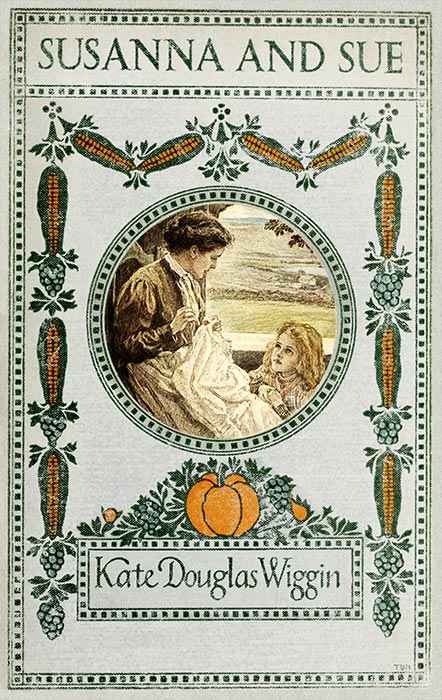
The Project Gutenberg eBook of Susanna and Sue
Title: Susanna and Sue
Author: Kate Douglas Smith Wiggin
Illustrator: Alice Barber Stephens
N. C. Wyeth
Release date: April 28, 2010 [eBook #32169]
Most recently updated: January 6, 2021
Language: English
Credits: Produced by David Edwards, Linda Hamilton and the Online
Distributed Proofreading Team at https://www.pgdp.net (This
file was produced from images generously made available
by The Internet Archive)
Susanna and Sue. Illustrated by Alice Barber Stephens.
The Old Peabody Pew. Illustrated by Alice Barber Stephens.
Rebecca of Sunnybrook Farm.
New Chronicles of Rebecca. Illustrated by F. C. Yohn.
Rose o' the River. Illustrated by George Wright.
The Affair at the Inn. Illustrated by Martin Justice.
The Birds' Christmas Carol. Illustrated.
The Story of Patsy. Illustrated.
The Diary of a Goose Girl. Illustrated by C. A. Shepperson.
A Cathedral Courtship and Penelope's English Experiences. Illustrated by Clifford Carleton.
A Cathedral Courtship. Holiday Edition. Enlarged, and with illustrations by Charles E. Brock.
Penelope's Progress. Experiences in Scotland.
Penelope's Irish Experiences.
Penelope's Experiences. Holiday Edition. In three volumes. Illustrated by Charles E. Brock. I. England; II. Scotland; III. Ireland.
Marm Lisa.
The Village Watch-Tower. Short Stories.
Polly Oliver's Problem. A Story for Girls. Illustrated.
Timothy's Quest. A Story for Anybody, Young or Old, who cares to read it.
Timothy's Quest. Holiday Edition. Illustrated by Oliver Herford.
A Summer in a Cañon. A California Story. Illustrated by Frank T. Merrill.
Nine Love Songs and a Carol. Poems set to music by Mrs. Wiggin.
BOSTON AND NEW YORK
SUSANNA AND SUE
COPYRIGHT, 1909, BY KATE DOUGLAS RIGGS
ALL RIGHTS RESERVED
Published October 1909
CONTENTS
| I. | Mother Ann's Children | 1 |
| II. | A Son of Adam | 23 |
| III. | Divers Doctrines | 43 |
| IV. | Louisa's Mind | 67 |
| V. | The Little Quail Bird | 87 |
| VI. | Susanna speaks in Meeting | 107 |
| VII. | "The Lower Plane" | 121 |
| VIII. | Concerning Backsliders | 141 |
| IX. | Love Manifold | 163 |
| X. | Brother and Sister | 177 |
| XI. | "The Open Door" | 195 |
| XII. | The Hills of Home | 211 |
ILLUSTRATIONS
| Looking up into her mother's face expectantly (page 102) | Frontispiece |
| Do you remember the little Nelson girl and her mother? | 12 |
| Susanna sat in her corner beside the aged Tabitha | 112 |
| Hetty looking at the lad with all her heart in her eyes | 130 |
MOTHER ANN'S CHILDREN
I
It was the end of May, when "spring goeth all in white." The apple trees were scattering their delicate petals on the ground, dropping them over the stone walls to the roadsides, where in the moist places of the shadows they fell on beds of snowy innocence. Here and there a single tree was tinged with pink, but so faintly, it was as if the white were blushing. Now and then a tiny white butterfly danced in the sun and pearly clouds strayed across the sky in fleecy flocks.
Everywhere the grass was of ethereal greenness, a greenness drenched with the pale yellow of spring sunshine. Looking from earth to sky and from blossom to blossom, the little world of the apple orchards, shedding its falling petals like fair-weather snow, seemed made of alabaster and porcelain, ivory and mother-of-pearl, all shimmering on a background of tender green.
After you pass Albion village, with its streets shaded by elms and maples and its outskirts embowered in blossoming orchards, you wind along a hilly country road that runs between grassy fields. Here the whiteweed is already budding, and there are pleasant pastures dotted with rocks and fringed with spruce and fir; stretches of woodland, too, where the road is lined with giant pines and you lift your face gratefully to catch the cool balsam breath of the forest. Coming from out this splendid shade, this silence too deep to be disturbed by light breezes or vagrant winds, you find yourself on the brow of a descending hill. The first thing that strikes the eye is a lake that might be a great blue sapphire dropped into the verdant hollow where it lies. When the eye reluctantly leaves the lake on the left, it turns to rest upon the little Shaker Settlement on the right—a dozen or so large comfortable white barns, sheds, and houses, standing in the wide orderly spaces of their own spreading acres of farm and timber land. There again the spring goeth all in white, for there is no spot to fleck the dazzling quality of Shaker paint, and their apple, plum, and pear trees are so well cared for that the snowy blossoms are fairly hiding the branches.
The place is very still, although there are signs of labor in all directions. From a window of the girls' building a quaint little gray-clad figure is beating a braided rug; a boy in homespun, with his hair slightly long in the back and cut in a straight line across the forehead, is carrying milk-cans from the dairy to one of the Sisters' Houses. Men in broad-brimmed hats, with clean-shaven, ascetic faces, are ploughing or harrowing here and there in the fields, while a group of Sisters is busy setting out plants and vines in some beds near a cluster of noble trees. That cluster of trees, did the eye of the stranger realize it, was the very starting-point of this Shaker Community, for in the year 1785, the valiant Father James Whittaker, one of Mother Ann Lee's earliest English converts, stopped near the village of Albion on his first visit to Maine. As he and his Elders alighted from their horses, they stuck into the ground the willow withes they had used as whips, and now, a hundred years later, the trees that had grown from these slender branches were nearly three feet in diameter.
From whatever angle you look upon the Settlement, the first and strongest impression is of quiet order, harmony, and a kind of austere plenty. Nowhere is the purity of the spring so apparent. Nothing is out of place; nowhere is any confusion, or appearance of loose ends, or neglected tasks. As you come nearer, you feel the more surely that here there has never been undue haste nor waste; no shirking, no putting off till the morrow what should have been done to-day. Whenever a shingle or a clapboard was needed it was put on, where paint was required it was used,—that is evident; and a look at the great barns stored with hay shows how the fields have been conscientiously educated into giving a full crop.
To such a spot as this might any tired or sinful heart come for rest; hoping somehow, in the midst of such frugality and thrift, such self-denying labor, such temperate use of God's good gifts, such shining cleanliness of outward things, to regain and wear "the white flower of a blameless life." The very air of the place breathed peace, so thought Susanna Hathaway; and little Sue, who skipped by her side, thought nothing at all save that she was with mother in the country; that it had been rather a sad journey, with mother so quiet and pale, and that she would be very glad to see supper, should it rise like a fairy banquet in the midst of these strange surroundings.
It was only a mile and a half from the railway station to the Shaker Settlement, and Susanna knew the road well, for she had driven over it more than once as child and girl. A boy would bring the little trunk that contained their simple necessities later on in the evening, so she and Sue would knock at the door of the house where visitors were admitted, and be undisturbed by any gossiping company while they were pleading their case.
"Are we most there, Mardie?" asked Sue for the twentieth time. "Look at me! I'm being a butterfly, or perhaps a white pigeon. No, I'd rather be a butterfly, and then I can skim along faster and move my wings!"
The airy little figure, all lightness and brightness, danced along the road, the white cotton dress rising and falling, the white-stockinged legs much in evidence, the arms outstretched as if in flight, straw hat falling off yellow hair, and a little wisp of swansdown scarf floating out behind like the drapery of a baby Mercury.
"We are almost there," her mother answered. "You can see the buildings now, if you will stop being a butterfly. Don't you like them?"
"Yes, I 'specially like them all so white. Is it a town, Mardie?"
"It is a village, but not quite like other villages. I have told you often about the Shaker Settlement, where your grandmother brought me once when I was just your age. There was a thunder-storm; they kept us all night, and were so kind that I never forgot them. Then your grandmother and I stopped off once when we were going to Boston. I was ten then, and I remember more about it. The same sweet Eldress was there both times."
"What is an El-der-ess, Mardie?"
"A kind of everybody's mother, she seemed to be," Susanna responded, with a catch in her breath.
"I'd 'specially like her; will she be there now, Mardie?"
"I'm hoping so, but it is eighteen years ago. I was ten and she was about forty, I should think."
"Then o' course she'll be dead," said Sue, cheerfully, "or either she'll have no teeth or hair."
"People don't always die before they are sixty, Sue."
"Do they die when they want to, or when they must?"
"Always when they must; never, never when they want to," answered Sue's mother.
"But o' course they wouldn't ever want to if they had any little girls to be togedder with, like you and me, Mardie?" And Sue looked up with eyes that were always like two interrogation points, eager by turns and by turns wistful, but never satisfied.
"No," Susanna replied brokenly, "of course they wouldn't, unless sometimes they were wicked for a minute or two and forgot."
"Do the Shakers shake all the time, Mardie, or just once in a while? And shall I see them do it?"
"Sue, dear, I can't explain everything in the world to you while you are so little; you really must wait until you're more grown up. The Shakers don't shake and the Quakers don't quake, and when you're older, I'll try to make you understand why they were called so and why they kept the name."
"Maybe the El-der-ess can make me understand right off now; I'd 'specially like it." And Sue ran breathlessly along to the gate where the North Family House stood in its stately, white-and-green austerity.
Susanna followed, and as she caught up with the impetuous Sue, the front door of the house opened and a figure appeared on the threshold. Mother and child quickened their pace and went up the steps, Susanna with a hopeless burden of fear and embarrassment clogging her tongue and dragging at her feet; Sue so expectant of new disclosures and fresh experiences that her face beamed like a full moon.
Eldress Abby (for it was Eldress Abby) had indeed survived the heavy weight of her fifty-five or sixty summers, and looked as if she might reach a yet greater age. She wore the simple Shaker afternoon dress of drab alpaca; an irreproachable muslin surplice encircled her straight, spare shoulders, while her hair was almost entirely concealed by the stiffly wired, transparent white-net cap that served as a frame to the tranquil face. The face itself was a network of delicate, fine wrinkles; but every wrinkle must have been as lovely in God's sight as it was in poor unhappy Susanna Hathaway's. Some of them were graven by self-denial and hard work; others perhaps meant the giving up of home, of parents and brothers or sisters; perhaps some worldly love, the love that Father Adam bequeathed to the human family, had been slain in Abby's youth, and the scars still remained to show the body's suffering and the spirit's triumph. At all events, whatever foes had menaced her purity or her tranquillity had been conquered, and she exhaled serenity as the rose sheds fragrance.
"Do you remember the little Nelson girl and her mother that stayed here all night, years ago?" asked Susanna, putting out her hand timidly.
"DO YOU REMEMBER THE LITTLE NELSON GIRL AND HER MOTHER?"
"Why, seems to me I do," assented Eldress Abby, genially. "So many comes and goes it's hard to remember all. Didn't you come once in a thunder-storm?"
"Yes, one of your barns was struck by lightning and we sat up all night."
"Yee, yee.[1] I remember well! Your mother was a beautiful spirit. I couldn't forget her."
"And we came once again, mother and I, and spent the afternoon with you, and went strawberrying in the pasture."
"Yee, yee, so we did; I hope your mother continues in health."
"She died the very next year," Susanna answered in a trembling voice, for the time of explanation was near at hand and her heart failed her.
"Won't you come into the sitting-room and rest awhile? You must be tired walking from the deepot."
"No, thank you, not just yet. I'll step into the front entry a minute.—Sue, run and sit in that rocking-chair on the porch and watch the cows going into the big barn.—Do you remember, Eldress Abby, the second time I came, how you sat me down in the kitchen with a bowl of wild strawberries to hull for supper? They were very small and ripe; I did my best, for I never meant to be careless, but the bowl slipped and fell,—my legs were too short to reach the floor, and I couldn't make a lap,—so in trying to pick up the berries I spilled juice on my dress, and on the white apron you had tied on for me. Then my fingers were stained and wet and the hulls kept falling in with the soft berries, and when you came in and saw me you held up your hands and said, 'Dear, dear! you have made a mess of your work!' Oh, Eldress Abby, they've come back to me all day, those words. I've tried hard to be good, but somehow I've made just such a mess of my life as I made of hulling the berries. The bowl is broken, I haven't much fruit to show, and I am all stained and draggled. I shouldn't have come to Albion on the five-o'clock train—that was an accident; I meant to come at noon, when you could turn me away if you wanted to."
"Nay, that is not the Shaker habit," remonstrated Abby. "You and the child can sleep in one of the spare chambers at the Office Building and be welcome."
"But I want much more than that," said Susanna, tearfully. "I want to come and live here, where there is no marrying nor giving in marriage. I am so tired with my disappointments and discouragements and failures that it is no use to try any longer. I am Mrs. Hathaway, and Sue is my child, but I have left my husband for good and all, and I only want to spend the rest of my days here in peace and bring up Sue to a more tranquil life than I have ever had. I have a little money, so that I shall not be a burden to you, and I will work from morning to night at any task you set me."
"I will talk to the Family," said Eldress Abby, gravely; "but there are a good many things to settle before we can say yee to all you ask."
"Let me confess everything freely and fully," pleaded Susanna, "and if you think I'm to blame, I will go away at once."
"Nay, this is no time for that. It is our duty to receive all and try all; then if you should be gathered in, you would unburden your heart to God through the Sister appointed to receive your confession."
"Will Sue have to sleep in the children's building away from me?"
"Nay, not now; you are company, not a Shaker, and anyway you could keep the child with you till she is a little older; that's not forbidden at first, though there comes a time when the ties of the flesh must be broken! All you've got to do now's to be 'pure and peaceable, gentle, easy to be entreated, and without hypocrisy.' That's about all there is to the Shaker creed, and that's enough to keep us all busy."
Sue ran in from the porch excitedly and caught her mother's hand.
"The cows have all gone into the barn," she chattered; "and the Shaker gentlemen are milking them, and not one of them is shaking the least bit, for I 'specially noticed; and I looked in through the porch window, and there is nice supper on a table—bread and butter and milk and dried-apple sauce and gingerbread and cottage cheese. Is it for us, Mardie?"
Susanna's lip was trembling and her face was pale. She lifted her swimming eyes to the Sister's and asked, "Is it for us, Eldress Abby?"
"Yee, it's for you," she answered; "there's always a Shaker supper on the table for all who want to leave the husks and share the feast. Come right in and help yourselves. I will sit down with you."
Supper was over, and Susanna and Sue were lying in a little upper chamber under the stars. It was the very one that Susanna had slept in as a child, or that she had been put to bed in, for there was little sleep that night for any one. She had leaned on the window-sill with her mother and watched the pillar of flame and smoke ascend from the burning barn; and once in the early morning she had stolen out of bed, and, kneeling by the open window, had watched the two silent Shaker brothers who were guarding the smoldering ruins, fearful lest the wind should rise and bear any spark to the roofs of the precious buildings they had labored so hard to save.
The chamber was spotless and devoid of ornament. The paint was robin's egg blue and of a satin gloss. The shining floor was of the same color, and neat braided rugs covered exposed places near the bureau, washstand, and bed. Various useful articles of Shaker manufacture interested Sue greatly: the exquisite straw-work that covered the whisk-broom; the mending-basket, pincushion, needle-book, spool and watch cases, hair-receivers, pin-trays, might all have been put together by fairy fingers.
Sue's prayers had been fervent, but a trifle disjointed, covering all subjects from Jack and Fardie, to Grandma in heaven and Aunt Louisa at the farm, with special references to El-der-ess Abby and the Shaker cows, and petitions that the next day be fair so that she could see them milked. Excitement at her strange, unaccustomed surroundings had put the child's mind in a very whirl, and she had astonished her mother with a very new and disturbing version of the Lord's prayer, ending: "God give us our debts and help us to forget our debtors and theirs shall be the glory, Amen." Now she lay quietly on the wall side of the clean, narrow bed, while her mother listened to hear the regular breathing that would mean that she was off for the land of dreams. The child's sleep would leave the mother free to slip out of bed and look at the stars; free to pray and long and wonder and suffer and repent,—not wholly, but in part, for she was really at peace in all but the innermost citadel of her conscience. She had left her husband, and for the moment, at all events, she was fiercely glad; but she had left her boy, and Jack was only ten. Jack was not the helpless, clinging sort; he was a little piece of his father, and his favorite. Aunt Louisa would surely take him, and Jack would scarcely feel the difference, for he had never shown any special affection for anybody. Still he was her child, nobody could possibly get around that fact, and it was a stumbling-block in the way of forgetfulness or ease of mind. Oh, but for that, what unspeakable content she could feel in this quiet haven, this self-respecting solitude! To have her thoughts, her emotions, her words, her self, to herself once more, as she had had them before she was married at seventeen. To go to sleep in peace, without listening for a step she had once heard with gladness, but that now sometimes stumbled unsteadily on the stair; or to dream as happy women dreamed, without being roused by the voice of the present John, a voice so different from that of the past John that it made the heart ache to listen to it.
Sue's voice broke the stillness: "How long are we going to stay here, Mardie?"
"I don't know, Sue; I think perhaps as long as they'll let us."
"Will Fardie come and see us?"
"Who'll take care of Jack, Mardie?"
"Your Aunt Louisa."
"She'll scold him awfully, but he never cries; he just says, 'Pooh! what do I care?' Oh, I forgot to pray for that very nicest Shaker gentleman that said he'd let me help him feed the calves! Hadn't I better get out of bed and do it? I'd 'specially like to."
"Very well, Sue; and then go to sleep."
Safely in bed again, there was a long pause, and then the eager little voice began, "Who'll take care of Fardie now?"
"He's a big man; he doesn't need anybody."
"What if he's sick?"
"We must go back to him, I suppose."
"To-morrow's Sunday; what if he needs us to-morrow, Mardie?"
"I don't know, I don't know! Oh, Sue, Sue, don't ask your wretched mother any more questions, for she cannot bear them to-night. Cuddle up close to her; love her and forgive her and help her to know what's right."
II
When Susanna Nelson at seventeen married John Hathaway, she had the usual cogent reasons for so doing, with some rather more unusual ones added thereto. She was alone in the world, and her life with an uncle, her mother's only relative, was an unhappy one. No assistance in the household tasks that she had ever been able to render made her a welcome member of the family or kept her from feeling a burden, and she belonged no more to the little circle at seventeen, than she did when she became a part of it at twelve. The hope of being independent and earning her own living had sustained her through the last year; but it was a very timid, self-distrustful, love-starved little heart that John Hathaway stormed and carried by assault. Her girl's life in a country school and her uncle's very rigid and orthodox home had been devoid of emotion or experience; still, her mother had early sown seeds in her mind and spirit that even in the most arid soil were certain to flower into beauty when the time for flowering came; and intellectually Susanna was the clever daughter of clever parents. She was very immature, because, after early childhood, her environment had not been favorable to her development. At seventeen she began to dream of a future as bright as the past had been dreary and uneventful. Visions of happiness, of goodness, and of service haunted her, and sometimes, gleaming through the mists of dawning womanhood, the figure, all luminous, of The Man!
When John Hathaway appeared on the horizon, she promptly clothed him in all the beautiful garments of her dreams; they were a grotesque misfit, but when we intimate that women have confused the dream and the reality before, and may even do so again, we make the only possible excuse for poor little Susanna Nelson.
John Hathaway was the very image of the outer world that lay beyond Susanna's village. He was a fairly prosperous, genial, handsome young merchant, who looked upon life as a place furnished by Providence in which to have "a good time." His parents had frequently told him that it was expedient for him to "settle down," and he supposed that he might finally do so, if he should ever find a girl who would tempt him to relinquish his liberty. (The line that divides liberty and license was a little vague to John Hathaway!) It is curious that he should not have chosen for his life-partner some thoughtless, rosy, romping young person, whose highest conception of connubial happiness would have been to drive twenty miles to the seashore on a Sunday, and having partaken of all the season's delicacies, solid and liquid, to come home hilarious by moonlight. That, however, is not the way the little love-imps do their work in the world; or is it possible that they are not imps at all who provoke and stimulate and arrange these strange marriages—not imps, but honest, chastening little character-builders? In any event, the moment that John Hathaway first beheld Susanna Nelson was the moment of his surrender; yet the wooing was as incomprehensible as that of a fragile, dainty little hummingbird by a pompous, greedy, big-breasted robin.
Susanna was like a New England anemone. Her face was oval in shape and as smooth and pale as a pearl. Her hair was dark, not very heavy, and as soft as a child's. Her lips were delicate and sensitive, her eyes a cool gray,—clear, steady, and shaded by darker lashes. When John Hathaway met her shy, maidenly glance and heard her pretty, dovelike voice, it is strange he did not see that there was a bit too much saint in her to make her a willing comrade of his gay, roistering life. But as a matter of fact, John Hathaway saw nothing at all; nothing but that Susanna Nelson was a lovely girl and he wanted her for his own. The type was one he had never met before, one that allured him by its mysteries and piqued him by its shy aloofness.
John had a "way with him,"—a way that speedily won Susanna; and after all there was a best to him as well as a worst. He had a twinkling eye, an infectious laugh, a sweet disposition, and while he was over-susceptible to the charm of a pretty face, he had a chivalrous admiration for all women, coupled, it must be confessed, with a decided lack of discrimination in values. His boyish light-heartedness had a charm for everybody, including Susanna; a charm that lasted until she discovered that his heart was light not only when it ought to be light, but when it ought to be heavy.
He was very much in love with her, but there was nothing particularly exclusive, unique, individual, or interesting about his passion at that time. It was of the every-day sort which carries a well-meaning man to the altar, and sometimes, in cases of exceptional fervor and duration, even a little farther. Stock sizes of this article are common and inexpensive, and John Hathaway's love when he married Susanna was, judged by the highest standards, about as trivial an affair as Cupid ever put upon the market or a man ever offered to a woman. Susanna on the same day offered John, or the wooden idol she was worshiping as John, her whole self—mind, body, heart, and spirit. So the couple were united, and smilingly signed the marriage-register, a rite by which their love for each other was supposed to be made eternal.
"Will you love me?" said she.
Then they answered together:—
"Through foul and fair weather,
From sunrise to moonrise,
From moonrise to sunrise,
By heath and by harbour,
In orchard or arbour,
In the time of the rose,
In the time of the snows,
Through smoke and through smother
We'll love one another!"
Cinderella, when the lover-prince discovers her and fits the crystal slipper to her foot, makes short work of flinging away her rags; and in some such pretty, airy, unthinking way did Susanna fling aside the dullness, inhospitality, and ugliness of her uncle's home and depart in a cloud of glory on her wedding journey. She had been lonely, now she would have companionship. She had been of no consequence, now she would be queen of her own small domain. She had been last with everybody, now she would be first with one, at least. She had worked hard and received neither compensation nor gratitude; henceforward her service would be gladly rendered at an altar where votive offerings would not be taken as a matter of course. She was only a slip of a girl now; marriage and housewifely cares would make her a woman. Some time perhaps the last great experience of life would come to her, and then what a crown of joys would be hers,—love, husband, home, children! What a vision it was, and how soon the chief glory of it faded!
Never were two beings more hopelessly unlike than John Hathaway single and John Hathaway married, but the bliss lasted a few years, nevertheless: partly because Susanna's charm was deep and penetrating, the sort to hold a false man for a time and a true man forever; partly because she tried, as a girl or woman has seldom tried before, to do her duty and to keep her own ideal unshattered.
John had always been convivial, but Susanna at seventeen had been at once too innocent and too ignorant to judge a man's tendencies truly, or to rate his character at its real worth. As time went on, his earlier leanings grew more definite; he spent on pleasure far more than he could afford, and his conduct became a byword in the neighborhood. His boy he loved. He felt on a level with Jack, could understand him, play with him, punish him, and make friends with him; but little Sue was different. She always seemed to him the concentrated essence of her mother's soul, and when unhappy days came, he never looked in her radiant, searching eyes without a consciousness of inferiority. The little creature had loved her jolly, handsome, careless father at first, even though she feared him; but of late she had grown shy, silent, and timid, for his indifference chilled her and she flung herself upon her mother's love with an almost unchildlike intensity. This unhappy relation between the child and the father gave Susanna's heart new pangs. She still loved her husband,—not dearly, but a good deal; and over and above that remnant of the old love which still endured she gave him unstinted care and hopeful maternal tenderness.
The crash came in course of time. John transcended the bounds of his wife's patience more and more. She made her last protests; then she took one passionate day to make up her mind,—a day when John and the boy were away together; a day of complete revolt against everything she was facing in the present, and, so far as she could see, everything that she had to face in the future. Prayer for light left her in darkness, and she had no human creature to advise her. Conscience was overthrown; she could see no duty save to her own outraged personality. Often and often during the year just past she had thought of the peace, the grateful solitude and shelter of that Shaker Settlement hidden among New England orchards; that quiet haven where there was neither marrying nor giving in marriage. Now her bruised heart longed for such a life of nun-like simplicity and consecration, where men and women met only as brothers and sisters, where they worked side by side with no thought of personal passion or personal gain, but only for the common good of the community.
Albion village was less than three hours distant by train. She hastily gathered her plainest clothes and Sue's, packed them in a small trunk, took her mother's watch, her own little store of money and the twenty-dollar gold piece John's senior partner had given Sue on her last birthday, wrote a letter of good-by to John, and went out of her cottage gate in a storm of feeling so tumultuous that there was no room for reflection. Besides, she had reflected, and reflected, for months and months, so she would have said, and the time had come for action. Susanna was not unlettered, but she certainly had never read Meredith or she would have learned that "love is an affair of two, and only for two that can be as quick, as constant in intercommunication as are sun and earth, through the cloud, or face to face. They take their breath of life from each other in signs of affection, proofs of faithfulness, incentives to admiration. But a solitary soul dragging a log must make the log a God to rejoice in the burden." The demigod that poor, blind Susanna married had vanished, and she could drag the log no longer, but she made one mistake in judging her husband, in that she regarded him, at thirty-two, as a finished product, a man who was finally this and that, and behaved thus and so, and would never be any different.
The "age of discretion" is a movable feast of extraordinary uncertainty, and John Hathaway was a little behindhand in overtaking it. As a matter of fact, he had never for an instant looked life squarely in the face. He took a casual glance at it now and then, after he was married, but it presented no very distinguishable features, nothing to make him stop and think, nothing to arouse in him any special sense of responsibility. Boys have a way of "growing up," however, sooner or later, at least most of them have, and that possibility was not sufficiently in the foreground of Susanna's mind when she finished what she considered an exhaustive study of her husband's character.
"I am leaving you, John [she wrote], to see if I can keep the little love I have left for you as the father of my children. I seem to have lost all the rest of it living with you. I am not perfectly sure that I am right in going, for everybody seems to think that women, mothers especially, should bear anything rather than desert the home. I could not take Jack away, for you love him and he will be a comfort to you. A comfort to you, yes, but what will you be to him now that he is growing older? That is the thought that troubles me, yet I dare not take him with me when he is half yours. You will not miss me, nor will the loss of Sue make any difference. Oh, John! how can you help loving that blessed little creature, so much better and so much more gifted than either of us that we can only wonder how we came to be her father and mother? Your sin against her is greater than that against me, for at least you are not responsible for bringing me into the world. I know Louisa will take care of Jack, and she lives so near that you can see him as often as you wish. I shall let her know my address, which I have asked her to keep to herself. She will write to me if you or Jack should be seriously ill, but not for any other reason.
"As for you, there is nothing more that I can say except to confess freely that I was not the right wife for you and that mine was not the only mistake. I have tried my very best to meet you in everything that was not absolutely wrong, and I have used all the arguments I could think of, but it only made matters worse. I thought I knew you, John, in the old days. How comes it that we have traveled so far apart, we who began together? It seems to me that some time you must come to your senses and take up your life seriously, for this is not life, the sorry thing you have lived lately, but I cannot wait any longer! I am tired, tired, tired of waiting and hoping, too tired to do anything but drag myself away from the sight of your folly. You have wasted our children's substance, indulged your appetites until you have lost the respect of your best friends, and you have made me—who was your choice, your wife, the head of your house, the woman who brought your children into the world—you have made me an object of pity; a poor, neglected thing who could not meet her neighbors' eyes without blushing."
When Jack and his father returned from their outing at eight o'clock in the evening, having had supper at a wayside hotel, the boy went to bed philosophically, lighting his lamp for himself, the conclusion being that the two other members of the household were a little late, but would be in presently.
The next morning was bright and fair. Jack waked at cockcrow, and after calling to his mother and Sue, jumped out of bed, ran into their rooms to find them empty, then bounced down the stairs two at a time, going through the sitting-room on his way to find Ellen in the kitchen. His father was sitting at the table with the still-lighted student lamp on it; the table where lessons had been learned, books read, stories told, mending done, checkers and dominoes played; the big, round walnut table that was the focus of the family life—but mother's table, not father's.
John Hathaway had never left his chair nor taken off his hat. His cane leaned against his knee, his gloves were in his left hand, while the right held Susanna's letter.
He was asleep, although his lips twitched and he stirred uneasily. His face was haggard, and behind his closed lids, somewhere in the centre of thought and memory, a train of fiery words burned in an ever-widening circle, round and round and round, ploughing, searing their way through some obscure part of him that had heretofore been without feeling, but was now all quick and alive with sensation.
"You have made me—who was your choice, your wife, the head of your house, the woman who brought your children into the world—you have made me an object of pity; a poor, neglected thing who could not meet her neighbors' eyes without blushing."
Any one who wished to pierce John Hathaway's armor at that period of his life would have had to use a very sharp and pointed arrow, for he was well wadded with the belief that a man has a right to do what he likes. Susanna's shaft was tipped with truth and dipped in the blood of her outraged heart. The stored-up force of silent years went into the speeding of it. She had never shot an arrow before, and her skill was instinctive rather than scientific, but the powers were on her side and she aimed better than she knew—those who took note of John Hathaway's behavior that summer would have testified willingly to that. It was the summer in which his boyish irresponsibility slipped away from him once and for all; a summer in which the face of life ceased to be an indistinguishable mass of meaningless events and disclosed an order, a reason, a purpose hitherto unseen and undefined. The boy "grew up," rather tardily it must be confessed. His soul had not added a cubit to its stature in sunshine, gayety, and prosperity; it took the shock of grief, hurt pride, solitude, and remorse to make a man of John Hathaway.