
Miss Cissy hummed happily to herself as she ran up-stairs to hug and kiss Cash one-hundred-and-five and explain to her that sister had given her permission to make Priscilla a long, long visit and that she was to begin it right off.
CHAPTER IV
“SWEET P’S”
Up-stairs in the nursery the lamps were lit and a bright fire glowed on the hearth. Hannah was bustling about in her own busy fashion and Priscilla lay cuddled up in the big sleepy-hollow chair with a picture-book in her lap. It was all very quiet and cozy and Little Boy Blue and Mary, Mary Quite Contrary and the rest of the dear Mother Goose people who looked out from their places in the dainty wall-paper, seemed to nod and wink at Priscilla as if they were glad it was their good fortune to be here.
The clock on the mantel-shelf chimed six.
“I wonder what’s keeping James with your supper,” murmured Hannah comfortably. “He’s generally prompt at the stroke o’ six but to-night—— Oh, there he is now!”
Priscilla did not look up from her book as the door-knob turned. She was not hungry and the prospect of James carrying a tray spread with nice things to eat was too familiar to interest her. Poor little Priscilla did not know it, but she was really pining for a change.
The door opened, swung wide upon its hinges and there, on the threshold, stood Miss Cissy clasping a little stranger-girl by the hand. Hannah gave a quick exclamation and Priscilla raised her eyes. The next moment she was in Miss Cissy’s arms.
The little stranger-girl stood by and smiled, while Simple Simon and Miss Muffet, in the wall-paper, quite grinned at each other with satisfaction. It seemed to Polly as if she had stepped right into the middle of a fairy-tale, for surely never was there so wonderful a place as this outside of fairy-land, nor a little princess who was half so fine and delicate.
Miss Cissy beckoned her to come forward saying gaily:
“See, Priscilla, I have brought you a visitor. This is Polly Carter. Won’t you shake hands with her, dear?”
Priscilla shyly put out a frail, soft little hand which Polly grasped in her thin, little chapped one.
“Polly is going to stay all night,” went on Miss Cicely, “and if she has a good time and enjoys herself, and if you get on nicely and like each other, she won’t go home for a while. They will put up a bed for her in your room, right across the way from yours and you can chatter to each other in the morning and be as jolly as you like. Just think what fun it’s going to be, Priscilla! Why, you can have breakfast-parties and dinner-parties and tea-parties together every day at your little table, all by yourselves, and you can show Polly your toys and she can show you new ways of playing with them, and you can keep house and visit and have—oh! lots of good times! And perhaps, if I’m very good, you’ll let me come and join in the sport sometimes, for I think I like your kind of play better than the sort they have down-stairs—I mean, the grown-up people. I wouldn’t tell anybody but you, of course, but it’s sometimes a little—just a little dull down there. But up here! dear me! why there’s no end to the sport you can have up here, if you want to. I don’t believe Polly ever saw anything so funny in all her life as your walking-doll was the other night, Priscilla, when you dropped her on the floor and she lay there on her back, sawing the air with her arms, and kicking.”
Priscilla smiled demurely and drew herself from Miss Cissy’s arm. “I’ll get her now,” she volunteered in a timid whisper. “If you wind her up and put her on the floor she’ll do it again.”
How Polly did laugh to see the fine French lady in such an awkward predicament and seeming to be so indignant about it! Her merry giggle was so irresistible that Priscilla, after a moment, joined in with a soft little chuckle on her own account. Then a music-box was brought out and the Parisian Mademoiselle was set upon her feet and made to walk to its tune. It appeared she could not keep step at all, though at first she flew about very fast trying to do so, but by and by she got discouraged and walked slower and slower, until, at last, she collapsed entirely and fell on the floor with a final wriggle of despair, as if she gave it up as a bad job. Polly’s giggle broke into a laughing shout at this and James, coming in with a huge tray in his arms, almost stumbled over in amazement at the unaccustomed sight and sound of such merriment in the usually quiet nursery.
Priscilla discovered that supper was a very different affair when one did not have to sit and eat it alone. When Hannah served her and Polly to the bread and butter they bit into their slices and compared the impressions made by their teeth. Polly’s arch was wide and shallow with a little uneven place in the centre where one of her front teeth lapped a trifle, and Priscilla’s was narrower but quite exact all around. By biting carefully on one side and another of this first shape they found they could make different figures, new patterns being disclosed by each nibble, a fact which was so amusing that though Priscilla had not been hungry and Polly had thought she had had as much as she could possibly eat down-stairs, they managed to dispose of several slices before they were aware. Hannah shook her head at such “bad table-manners” but Miss Cissy would not have the children disturbed “just for once.” They sipped their creamy milk and ate their fruit and, what she said she used to call “good-for-you pudding” when she was a little girl, with as much relish as if neither of them had tasted a mouthful since morning, and by the end of the meal Polly had told Priscilla about sister and Priscilla had confided to Polly that she did not like to have her hair combed “’cause it pulled so and hurt most aw’fly.”
“That’s ’cause it’s so fine and curly,” explained Polly. “Mine is straight and the tangles come out easy, but I’d rather have yours if I were you. Yours looks like fine silk—the kind ladies buy at the embroidery counter to do fancy-work with. Floss, that’s what they call it. Your hair is just like floss.”
Since Polly appeared to think it was nice to have hair like floss Priscilla felt it might be easier to bear the pulling of the comb. At any rate she made up her mind, then and there, that she would be “as brave as a soldier” after that and show Polly how she could bear pain without a whimper.
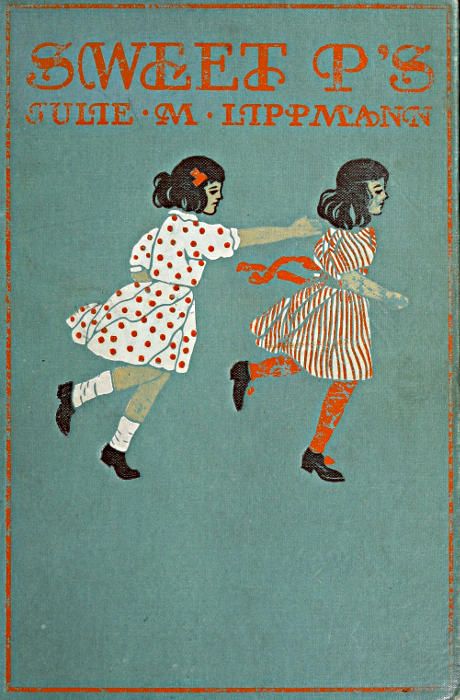
Miss Cicely stayed until the supper-table was cleared and the two Sweet P’s, as she called them, were contentedly cutting out paper dolls in the light of the lamp, and then she slipped quietly away down-stairs to join the rest of the family, who were going in to dinner.
Polly passed the evening in a sort of happy dream of delight. The warmth of the cheerful fire, its soft light and the pleasant coziness of the room, were so different from anything she had ever known before that she felt she would certainly wake up, in a minute or so and find it all vanished and herself back in the little room down-town, where the kerosene lamp gave out a sickening odor, and the fire in the stove couldn’t be kept burning after supper was prepared because coal was so high this winter. The wind came in through the chinks of the windows and door in chilling gusts, and even when one cuddled up in bed under the blankets and snuggled next to sister, one hardly got warmed through before morning. And then, to have to get up before it was light, and go shivering about in the dark, groping around blind with sleep, and have to hurry out into the icy, wintry streets to a weary day of cash-running at the store! She was so full of her own thoughts that her scissors had almost snipped the head off the splendid paper lady she was cutting out before she knew it, and Priscilla seeing the narrow escape, gave a little low exclamation of dismay.
“I guess you’re pretty tired, aren’t you?” Hannah asked kindly, coming and standing beside her chair and looking down at her benevolently. Polly nodded, but could not answer in words. The memory of the cold, bare little down-town room had awakened another memory: the memory of sister, and all at once her heart sickened of the warmth and comfort and light here and just turned hungrily to the poorer place where sister was, in longing to go back.
“Come, you two little ladies, it’s time for bed,” cried Hannah briskly. “Now, which one can get her clothes off first? I warrant I know.”
Poor little Priscilla tugged and wrenched in vain; she was not accustomed to do for herself, and Polly stood undressed and clad in her “nightie” before she even had her slippers untied. At sight of her disappointed little face Hannah caught her up in her arms and gave her a good hug, and the next moment all her buttons were unfastened as if by magic. It was an old story to Priscilla to sit before the fire wrapped in her downy bath-robe and have her hair brushed and braided for the night, while Hannah told her stories of kings and queens or repeated the exciting history of “The Little Schmall Rid Hin.” But to Polly it was a new and curious experience which made her forget for the moment the strange, sickening ache in her heart. She thrust her feet out toward the pleasant fire-glow and laughed approvingly when the fox, having planned to “git the little schmall rid hin” and carry her home in a bag to be “biled and ate up, shure, by his ould marm and he” was cleverly fooled by the wonderful biddy and, with his wicked mother, was killed outright when “the pot o’ boilin’ wather came over thim, kersplash,
Priscilla’s head was fairly nodding by the time prayers were said and Hannah ready to carry her off to bed and tuck her in. But long after she was breathing softly on her pillow, Polly lay awake and thought and thought and thought of sister in her loneliness, at home in the cold and dark, until, at length, she could bear it no longer and the tears came in a flood, quite drenching the fine, embroidered handkerchief Miss Cissy had given her and of whose new crispness she had been so proud.
In a moment Hannah was at her side.
“What is it, honey? Tell Hannah,” she urged very tenderly, as she knelt down and slid her arm under Polly’s head. Then it all came out: about the dreadful ache and longing in her heart and the choking in her throat.
“Why, bless you, you’re homesick and so you are,” explained Priscilla’s nurse encouragingly. “And no wonder at all—not the least in the world. Lots of folks are homesick and they get over it in no time at all, if they just make up their minds to it. Why, think of me! I came over,—away from my father and mother, across the wide sea, when I was but a slip of a girl, not seven years older than you. And think of the gain that’ll come to your sister if you are good and contented here. Why, the hospital doctors will look at her and they’ll say: ‘Now, here is a young woman we must certainly manage to cure whether or not for Miss Cicely Duer says so.’ And the nurses will say the same thing. And they’ll give her a room all to herself with sun coming in at the windows, and there’ll be flowers on the bureau that Miss Cicely and Priscilla’s mamma will send. And her bed will be all soft and white, and the nurses will have on white caps and aprons and cuffs, just spick and spandy and they’ll give her lovely things to eat and then—and then—before you know it almost, sister will be well and walking around as fine as can be. And that will be your doing if you’re a good girl and don’t get mopey and homesick.”
Polly’s eyes were quite dry by the time Hannah paused to take breath. The picture of sister in such pleasant surroundings almost reconciled her to her own good fortune. She saw the sunlight coming in at the windows and the flowers nodding on the bureau and the white-capped nurses hovering round and then, by and by, Hannah’s voice seemed to melt into a gentle drone—the drone of a sleepy fly bobbing against sister’s hospital-room window in the sunlight and then——
Polly opened her eyes to see the sunlight really slanting in at the window of the pretty bedroom in which she and Priscilla had slept. For a moment she lay still, trying to remember where she was and how she came to be in this splendid gold bed, between soft, fleecy blankets and smooth linen. There was another bed just like her own standing against the wall across the room—but the other bed was empty. Then it all came back to her. Priscilla had slept in that other bed. Where was Priscilla?
A sound of splashing and running water seemed to answer her and in another moment Hannah appeared carrying Priscilla wrapped in bath-sheets, fresh from her morning tub.
“Just wait a moment till I have Priscilla dry and then in you go,” threatened Hannah with a pretended frown.
But Polly was not in the least alarmed. She reveled in the warm water and plunged about in the white tub as energetically as if she had been a canary taking a morning dip in a china dish. Then she and Priscilla had breakfast in the nursery, with Peter Pumpkin-Eater and Jack Sprat-Could-Eat-No-Fat looking down at them from the walls and probably wishing they had such delicious milk-toast and cream-of-wheat and poached eggs to feast upon.
Priscilla’s mother came to visit them soon after the meal was over and she proved so sweet and beautiful a lady that Polly felt there was only one person in the whole world who was more wonderful than she and that Miss Cicely was that one. She talked to Priscilla and Polly for a long time and seemed sorry when some one—the haughty Theresa—came to summon her down-stairs and she had to leave them.
Then hats and coats were brought out and the Sweet P’s made ready for a walk. There was not much fun in pacing slowly up the avenue and around the windy paths of the Park. Before they had gone three blocks Polly was stiff and chilly and poor little Priscilla was having the cold shivers inside her fur coat.
“Let’s play las’-tag,” suggested Polly. “Then we can run, and running makes you warm. Why, I used to get as hot as anything at the store, just with running.”
“What’s las’-tag?” asked Priscilla listlessly.
Polly explained. “And I’ll be ‘It’ if you like,” she said. “Now, you run and I’ll try to catch you. Hannah’ll be ‘Hunk.’ One, two, three! Off goes she!”
In no time at all they were both in a glow, their cheeks ruddy and tingling with warmth and their eyes sparkling with fun. Priscilla was delighted and she and Polly las’-tagged each other merrily all the way home. Certainly the hated morning walk was going to be a different affair after this. James could hardly believe his eyes at the change he saw in Priscilla’s appearance when he opened the door to them at one o’clock.
“Why, she looks like another child,” he said to Theresa who was passing through the hall.
Theresa curled her lip.
“You and Hannah may do as you like,” she snapped pettishly, “but nobody’ll get me to wait on any beggar-child—not if I know it. Why couldn’t they have taken that sweet little Angeline Montague, if they must have some one, and not given the place to a common little thing like this Polly-one. I know Angeline’s mother well. I got her the job at Mrs. Hamilton’s and she’s a lady,—I tell you. And Angeline herself is a little angel! Who knows anything about this child they have taken in?” and Theresa tossed her head spitefully.
James pursed his lips as if he were going to whistle. “I don’t know anything about her, that’s certain,” he admitted, “and if you don’t either, Theresa, why, I guess there ain’t any call for you to clap names on her like what you’ve done. After all, she ain’t harming you. Fair play is a jewel. If she don’t interfere with you, you don’t need to interfere with her!”
“Interfere with me!” cried Theresa hotly. “Much you know about it, James Craig. That’s just what she has done, with a vengeance!”
James shrugged his shoulders. “Why, I don’t see what concern it is of yours, if the family chooses to get a companion for Miss Priscilla. You ain’t got to pay for her board and keep.”
“Perhaps I ain’t,” returned Theresa with added sharpness, “but perhaps, on the other hand, I got to pay for the board and keep of somebody else, that she has done out of a rare chance.”
The butler’s eyes opened wide. “You don’t mean to say——” he stammered.
“I don’t mean to say nothing,” the maid retorted quickly. “I just ain’t going to do anything that’s outside my work, that’s all. I respect myself too much to lay a hand to anything I didn’t engage for, and if you and Hannah choose to fetch and carry for strangers from no-one-knows-where, you can do it and welcome! But the more sillies you, that’s all!”
The good-natured James watched the irate woman as she flounced up-stairs and then drew in his breath with a long whistling sound. He thought Theresa was “a terror” and he made up his mind then and there that he would “steer clear of her” in the future.
In the meantime Polly, who was quite unconscious of having given offense to any one in the world and who felt at peace with all men, was astonished and dismayed, as the days went by, to find that Theresa did not like her. At first she did not realize that anything was amiss. The maid seemed to her a very haughty lady whose manners were proud and overbearing to be sure, and not at all gentle and sweet as Priscilla’s mother’s and Miss Cicely’s were, but who was probably, nevertheless, good and kind at heart, like all the rest of the world. Once or twice she brushed roughly against Polly in the halls, but Polly said, “Excuse me,” as sister had taught her to do when she got in any one’s way, and then thought no more about it.
Then, another time, Polly was going down-stairs on an errand for Hannah and just as she reached the second flight Theresa came out of the sitting-room and began to busy herself dusting the top of the baluster-rail. Polly said, “Good-morning!” as politely as she could, but Theresa did not appear to hear her and the next minute Polly’s dress had caught in a nail or something, it could not have been Theresa’s hand, of course, and she was crashing down-stairs, heels over head, bumpety-bump! as hard as she could go. She was so badly frightened that it took her some time to recover herself, but her bruises were not serious and James brought a chocolate spice-cake out of the butler’s pantry, which he said he would give her if she did not cry any more. So she dried her tears and promised she would “look where she walked” after that and was happy again in no time at all.
But before she went up-stairs James whispered in her ear: “Say, I wouldn’t get in Theresa’s way, if I were you. Theresa is—er—nervous and little girls bother her, I guess, and it’s always better when folks is like that to keep yourself to yourself. See?”
CHAPTER V
POLLY’S PLUCK
Angeline Montague did not tell her mother the forfeit she had had to pay to “redeem” the beautiful doll she had brought home from Miss Cicely’s party. In the first place, she conveniently forgot it, and in the second, she always made a point of keeping very still when her mother was in a “tantrum,” and her mother was in a terrible one that day. Something had gone wrong somewhere, for the moment Angeline reached home her mother had caught her by the arm and swung her about roughly, saying: “Ho! So here you are, are you? Then you didn’t get it, did you? And after all the trouble I went to, to teach you how to bow and to hold your tongue and to speak soft and genteel when you did speak! And the money I spent on your clothes, too! I’ve half a mind to beat you well, you great silly. What under the sun your Aunt Theresa’ll do to you, I don’t know—like as not she’ll put you in jail or send you to the reform-school or something. I do declare I never saw such a numb-scull! Where’s your brains, I’d like to know, to let any one else get ahead of you like that?”
Angeline sobbed.
“There now,” continued her mother less harshly. “Quit that, and take off those togs you’ve got on. It makes me just wild to see ’em and think what they cost, and then what a fool you were to let such a chance slip through your fingers.”
Angeline sobbed still more piteously. She knew it was the only way to disarm her mother. After a minute or two the angry woman said: “Hush, hush, I tell you, Angeline, or the neighbors’ll think I’m killing you—and they have enough to say about us already. Besides, you’d better save your tears till your Aunt Theresa comes, for you’ll need ’em then, or I’m mistaken. She ain’t as easy as I am, not by a long sight, and she’ll scold the life out of us both for your foolishness. She’ll probably stop paying for your board and keep into the bargain, and then what’ll become of us, I don’t see. We’ll be turned out into the street, most likely, for I’m two weeks behind with the rent as it is, and goodness knows where I’ll get the money to pay up.”
Angeline’s sobs grew softer. “I did the best I could,” she whimpered. “I never told a livin’ soul my name ain’t Montague or that Aunt Theresa is my aunt, an’ I bowed just like you tol’ me to, an’ I didn’t hardly say annything to annyboddy. I just smiled the way you showed me, as soft as ever I could, an’ Mis’ Hamilton she said I was a sweet little thing. I listened an’ I heard her. I didn’t let noboddy get ahead of me nor nothing. I got the best cakes an’ the biggest orange an’—an’—I would have got a—other things too, but a big man, he was real mean and kept looking!”
“Well, go ’long with you now,” said her mother, whose true name was McGaffey. “Take off those duds or you’ll tear ’em or something an’ then the fat will be in the fire.”
Later that evening when Angeline was in bed her mother had a visitor. It was Theresa, and her angry voice made the little girl quail. She knew Aunt Theresa well and dreaded her, so she pretended to be asleep when her bedroom door was rudely flung open and quick steps came toward her where she lay.
“Get up, you Angeline,” ordered Theresa, clutching her by the arm. “You ain’t asleep, I know your tricks. Get up this minute, I want to talk with you.”
The child came shivering into the outer room.
“Now tell me this minute,” commanded her aunt, “every single thing that happened this afternoon at my house. Don’t you leave out anything, and don’t you tell me a falsehood, or it’ll be the worse for you.”
So the wretched Angeline, shaking with cold and sobbing from fright, confessed to the affair of the broken chocolate-cup.
“There! What did I tell you,” demanded Theresa of Mrs. McGaffey when the story was done. “I knew there was something wrong somewhere, or she’d have gotten the place, sure as preaching. Her tricks will be the ruin of us all before she’s through, I tell you, Harriet. She ought to be beat, that’s what ought to be done to her. She’s a bad child, right through. Why, Mrs. Hamilton as good as told me the whole thing was settled and Angeline was to go straight up to the nursery then and there, and you was to get sixteen dollars a month for the loan of her. The young un that’s there now is nothing to look at—nothing next to Angeline, but she got the place because she hasn’t underhand ways and doesn’t try to make other people suffer for her faults. But I’ll pay her off before I’m through with her, never you fear. In the meantime if I could just punish this child here for her foolishness, it’d do me a world of good. Now go back to bed, you Angeline McGaffey, and if I ever catch you deceiving again and running your mother and me into danger of being disgraced, I’ll attend to you, rest assured of that.”
Angeline crept off to her room, greatly relieved that she had escaped so easily at the hands of her vixenish aunt. She was accustomed by this time, to loud and angry talking, and did not let herself be much disturbed by it. In a very little while, therefore, and long before her Aunt Theresa had gone, she was asleep and dreaming, and the next day she had forgotten all about it. But Theresa did not forget. She had told her sister that she meant to bide her time and wait her chance, but that in the end she’d get even with Polly for having cut Angelina out, as she expressed it, and she intended to keep her word.
After her tumble down-stairs, and the whispered warning James had given her, Polly managed to avoid Theresa. It was not very difficult to do this, for the children spent most of their time in the open air or in the nursery. The cold and stupid morning walks that Priscilla had used to dread, she now looked forward to with pleasure, and her skin and eyes were beginning to show the difference. Miss Cissy’s plan was working like a charm—there could be no doubt about that.
Priscilla, in her quiet, shy little way, had grown to love Polly dearly, and as for Polly, why, she simply adored Priscilla, and would have done anything in the world for her. She “gave up” so entirely in fact, that Hannah often had to interfere to save Priscilla from becoming selfish through too much indulgence. When they played house, Polly was always the baby and Priscilla the mother; when they played school, Polly was the scholar and Priscilla the teacher. In las’-tag, Polly was “It,” no matter how often she caught Priscilla, and when Hannah shook her finger at her, she was sure to whisper: “She’s so little, you know. She can’t run as fast as I can, and it isn’t fair. ’Sides, she likes to think she’s beating. When she las’-tags me she laughs right out loud, she’s so pleased.”
“Well, you mustn’t spoil her, that’s all,” warned Hannah, but she confided to James on more than one occasion that, “that Polly’s a caution. I never saw her equal. She don’t know what it means to think of herself. And the grown-up way she’s got with her, of looking out for Priscilla! Why, you’d think she’d been used to protecting some one all her life.”
“Well, perhaps she has,” suggested James, thoughtfully. “How about that crippled sister of hers. Ain’t she had to protect her? An experience like that puts years on a young thing’s age. By the way, how is the sister?”
Hannah shook her head. “It’s a bad case the doctors think, so Miss Cicely and Mrs. Duer tell me. If it had been properly attended to in the first place, it would be different, but the poor thing was neglected and now it may be too late. We don’t dare tell the child, for her heart is bound up in her sister, and she’s set on her getting well. The two of them were all run down, what with not having enough food to nourish ’em, and perishin’ with the cold last winter on account of no coal, and that tells against the girl’s getting well. She has nothing to bear up on. See now, she’s been at the hospital ever since the week after Priscilla’s birthday, that was the first part of February, and now it’s the last of March. But we don’t give up hope. The doctors say she may possibly get to walk again—only it’ll take a long time, and she’ll have to go through a lot before it happens, if it ever does. She’ll be at the hospital all summer anyhow, and maybe longer. But it’s true, what you say about her being the cause of Polly’s acting old for her years, and having such motherly ways. Poor little creature! She’s actually getting a bit of flesh on her bones, as well as Priscilla, and I declare she’s as pretty as a picture sometimes. I told Mrs. Duer the other day, I was never afraid for Priscilla when Polly was around. She’d just let herself be cut into small pieces before she’d see a hair of Priscilla’s head harmed.”
“She’s got good pluck, I know that,” answered James, thinking of Theresa, and Polly’s fall down-stairs.
Polly had occasion to prove her “pluck” within the course of the next few days.
The children had had their regular romp in the Park one morning and were ready to go home, when Hannah bethought herself of a few little sewing odds and ends that she sorely needed. She made up her mind she would buy them on the way back. It would take her but a few blocks out of her way, and the children would not mind the little extra walk, especially as it was on the fascinating, forbidden ground of the bustling avenue, where so many shops and clanging cable-cars were.
Poor Polly, who had been perfectly used to shifting for herself amid crowds, was greatly amused at Hannah’s command that she “mustn’t let go her hand one minute,” but she did as she was bade, and clung to the nurse’s arm until they reached the shop, where Hannah’s trifles were to be bought. It was an attractive place enough, full of bright-colored ribbons and laces and tinsel and gay embroidery stuffs. There was, however, nothing very interesting to children, except in one corner, where was a counter upon which a number of artistically made rag-dolls were perched. Priscilla fell in love with these at first sight, and tugged at Hannah’s skirts, begging her to “come and see.”
Hannah was busy with her own affairs, but she left them to follow Priscilla and to exclaim, “Why, ain’t they just splendid, now?” as she knew Priscilla wanted her to do.
But Priscilla, it seemed, wanted more than this. “I wish,” she said, in a hesitating, shy murmur: “I wish I could have one of those dollies.”
Hannah stared. “Eh? Mercy on us, what next? Why, what in the world should you want with one of those dolls, when you have a nurseryful already at home. And such superior ones, into the bargain, as these couldn’t hold a candle to. Why, these are nothing but rag-babies, dearie.”
Priscilla swallowed. “I know it,” she whispered, with an effort. “But I like them. I wish I could have one.”
When the little girl spoke in that wistful tone her nurse could deny her nothing. “Well, if you ain’t the curiousest child!” she exclaimed. “But if you want one, why, you want one, and that’s all there is about it.”
The next moment the pinkest-cheeked rag-baby of them all was in Priscilla’s arms. She hugged it to her bosom with a loving clutch she had never given to any of her French dolls, and Hannah exchanged a wink with the saleswoman at sight of her satisfaction.
“May I take my dolly into the street? Just to give her the air?” she asked with motherly solicitude for her baby’s health.
Hannah nodded. “Yes, if you’ll be sure not to leave the door-step. Polly, you go with her, like a good child, and don’t let anything happen to her. Now, run along, like dearies, and let me do my shoppin’ in peace.”
“GIVE THAT DOLL BACK THIS MINUTE!”
“I think,” said Priscilla, as she and Polly stood outside the shop-door, “I think I’ll name this baby Polly. Then she’ll be part yours, won’t she? ’Sides, I think the name of Polly is a ’stremely nice name.”
Polly laughed right out with pleasure at the compliment. “If you name her Polly I’ll be her relation, won’t I? And I’ll have to give her things and look after her. Oh, dear me! I wonder what Hannah’ll say?”
What Hannah would say was never recorded, for just at this moment a dirty hand thrust itself over Priscilla’s shoulder and snatched her precious baby from her arms, while a hoarse voice broke out into a jeering laugh that almost frightened the children out of their wits.
“Hi, there!” it cried roughly. “A doll’s relation! That’s good! The name of Polly is a ’stremely nice name! Bless me if it ain’t!”
Priscilla’s lips were blue with terror and she but dimly saw the face of the mischievous newsboy, as he leered wickedly at her darling doll, pretending to dance it up and down in his dirty hands.
But Polly’s eyes were blazing. “Give that doll back this minute!” she broke out in a tremor of indignation.
The newsboy looked at her and grinned. “Oh, say, now,” he cried. “Who’ll make me? Ain’t I fond o’ dolls meself? An’ ain’t I got a little sister at home as just dotes on ’em? W’y, my little sister—queer now, ain’t it, but her name’s Polly! a ’stremely nice name, Polly is! well my sister Polly will just be tickled out of her boots when I bring her this.”
“You give it back,” stammered Polly, breathless and panting with anger.
“Not on your life,” jeered the young rascal, delighted to see he was teasing her so successfully, and clutching the rag-doll more tightly in one arm while he shifted his bundle of papers in the other.
Polly darted at him; her hand swung out, and the next moment his ear was tingling from a well-aimed blow. For an instant he was too amazed to stir. Then he dropped his papers and the doll together and made a dash for Polly. She ducked, he tripped on the shallow door-step and lost his footing. It was Polly’s chance and she did not lose it. In a twinkling she had dived for his papers, caught them up and was flying down the street as fast as her swift feet would carry her.
“Go in,” she shouted back to Priscilla. “Go in to Hannah!” Then on she sped like a little whirlwind, the newsboy after her in hot pursuit.
She knew he must outstrip her in a very few moments, for he was far older and stronger than she. Her breath was already coming in painful gasps and she felt she could not hold out much longer with the wind blowing against her like this. He was rapidly gaining. She could hear the clatter of his heavy boots on the pavement. In a second more he would have clutched her. Her brain worked like lightning. She snatched a paper from the bunch in her arm and flung it into the teeth of the wind, not daring to pause long enough to look back to see if her pursuer had stopped to capture it. She dropped another and another, all the while making toward home, as fast as she could fly. At length she had only one left, but she was in sight of the house and Priscilla’s tormentor was a full block behind. She flung the last one back with a great sob of relief and then paused a second to catch her breath and look behind her. The wind carried the paper straight into the young rascal’s face. He caught it and hurried on without losing a second. Polly’s heart almost stopped beating. It seemed to her as if her feet had grown suddenly heavy as lead. If she could only reach home! But she heard those heavy boots stamping nearer and nearer. Lagging and panting she reached the house and began to crawl and stumble up the steps scrambling on all fours, like a baby. The fellow was close at hand. He could leap the flight, two steps at a time she knew. She reached the top just as he sprung to the bottom. Her strength served her to touch the bell. It faintly rang—but too faintly to bring James if he did not happen to be right there. On the instant, however, the door opened and to the butler’s amazement Polly stumbled blindly over the threshold and pitched headlong into the hall.
CHAPTER VI
SISTER’S PARTY
When Polly opened her eyes the first thing she saw was James’ kindly face bending over her anxiously.
“Hullo!” he said encouragingly.
Polly sat up, feeling faint and dizzy. “What is it?” she faltered, trying to get upon her feet.
“Oh, nothing much,” replied James. “Nothing at all, in fact. Just, as far as I can make out, you thought you was the Limited an’ I was Chicago. You run in on schedule time, and no mistake. Why, you almost knocked me flat, the way you bolted in this door.”
His good-natured laugh gave Polly courage.
“I’m sorry if I hurt you,” she said in a firmer voice. “I didn’t mean to.”
“Oh, that’s all right,” returned the kind-hearted fellow. “I didn’t mind. I’d a got out of your way if I’d a known this was your busy day and you was in such a hurry, you know.”
He saw that the little girl was weak and trembling and though he did not know the cause, he wisely concluded the best plan was to keep her mind off the matter as long as he could.
So he chatted cheerfully on, meanwhile helping her to rise and guiding her to the dining-room where he offered her a couple of ladies’-fingers and a glass of raspberry juice to “sort-of give you an appetite for your luncheon,” he explained.
But, somehow, Polly’s head had begun to ache and she felt as if the room were rocking. She did not want anything to eat, she only wanted to lie down somewhere and go to sleep. Her eyelids drooped and her head nodded. James, thinking she might have had a bad fall, racked his brains for jokes that would be funny enough to keep her awake and he was just about to give up in despair when the bell rang and in came Hannah with Priscilla clinging to her hand while she clasped a pretty rag-doll to her bosom. Both were as white as paper. Priscilla was crying softly. Before James could open his lips Hannah gasped wildly:
“Polly! Whatever shall I do? She’s running the streets! She’ll get killed. If he catches her he’ll beat her, maybe! Oh, dear! the young ruffian! I was just coming out of the shop when I saw—— But she was off like a shot from a shovel and he after her. I couldn’t keep up with them, not if I’d been paid a million dollars for it, and in a minute they were out of sight. Oh, that poor child! Where is she now?” and Hannah wrung her hands.
James looked bewildered as well he might. “I haven’t the least notion what you’re talking about,” he said, “but I kind of dimly make out you’re worried about Polly. Well, you don’t need to be. She’s in the dining-room, all safe and sound, though a bit unsteady in the feet and dizzy in the head, by the looks of her.”
But Hannah had not waited to hear more than the words that told her Polly was safe. The next instant she was in the dining room with the little girl gathered tight in her arms. Polly tried to smile at her and at Priscilla who was gently patting her arms and whispering something that no one could hear, but she dared not keep her eyes open when the room whirled about so dizzily and Hannah had to call on James to carry her up-stairs and put her on the nursery lounge. It was while she was curled up there, sleeping off her fright and fatigue, with Priscilla sitting on guard beside her, that Hannah told James what had happened. She did not mind his frequent interruptions of “Good girl!” “First-rate!” “Hurrah for Polly!” for she was as excited over the adventure as he was, and was glad to have the child appreciated for her part in it. The story had to be gone over again from beginning to end for the benefit of Priscilla’s mother and Miss Cicely and when Polly woke it was to find herself famous. She was surprised and a little shamefaced at the praise she received. She could not see why they made so much of her. She had “just made that naughty boy give back Priscilla’s doll, that was all. Of course she knew he’d be mad when she boxed his ears, but a boy was a coward who made a little girl cry and he ought to be punished. Then, of course, she ran when he chased her and—and she snatched up his papers ’cause somehow, it came into her mind that if she took them he would forget about Priscilla’s doll. It was too bad she had scared Hannah. She would try not to worry her any more.”
Miss Cissy kissed her tenderly and so did Mrs. Duer, at which Polly felt as if she were a queen who had just been crowned. And that was the end of the affair as far as she knew.
Priscilla seemed to be thriving so splendidly that it was decided to leave the city much earlier than usual so she could spend the bright spring days entirely out of doors and get the good of the beautiful country air.
One morning toward the middle of April Hannah took Polly to the hospital to say good-bye to sister. Polly had often been there before, but to-day she found the invalid in a cheerful little sitting-room, with the sun streaming in at the window and violets and daffodils upon the table. It was all just as Hannah had said it would be, even to the white-capped nurses, “as neat as wax,” bringing sister lovely things to eat. Sister had been in bed when Polly was there before, but now to the little girl’s delight, she found her sitting up in a wheeled-chair and looking cheerful and happy in a dainty pink flannel robe with bows of ribbon on it and lace about the throat and wrists. Miss Cissy had brought it to her the day before.
“Why, you’re almost well,” cried Polly joyously.
Sister smiled. “It looks like it, doesn’t it?” she replied and hugged her little visitor to her with a sort of hungry look in her patient eyes.
“I guess you’ll be walking around before I know it almost,” quoted Polly eagerly, and sister nodded her head.
“So you are going off into the country,” she said quickly. “What fun you’ll have and how beautiful it will be to see the flowers blossoming and to hear the birds singing. The fields will all be green and there’ll be dandelions in them and daisies, and you must hunt for four-leafed clovers. Why, you ought to be the best girl in the world with so much good coming to you. She tries to do right, doesn’t she, Hannah? I’m glad. I knew she would. You’ll remember, won’t you, Polly, that sister wants you to tell the truth always; never to tell a falsehood. And you must be kind and generous to every one and cheerful too. There’s a little young mother here who has the cunningest baby! A tiny thing only a few months old; and she has made up a song to sing to it that goes like this: