
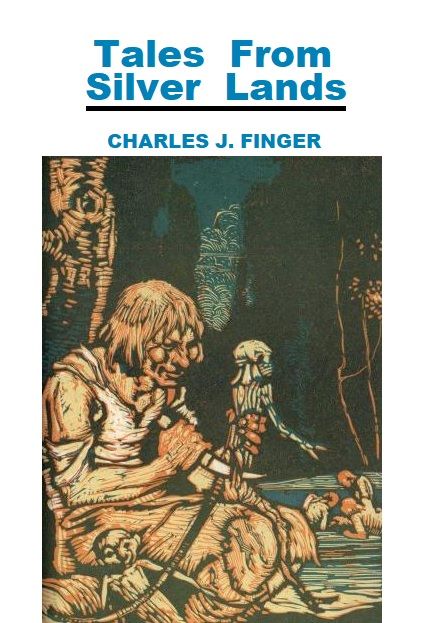
The Project Gutenberg eBook of Tales from silver lands
Title: Tales from silver lands
Author: Charles Joseph Finger
Illustrator: Paul Honoré
Release date: June 11, 2022 [eBook #68292]
Most recently updated: October 18, 2024
Language: English
Original publication: United States: Doubleday & Company, Inc, 1924
Credits: Al Haines, Cindy Beyer & the online Distributed Proofreaders Canada team at https://www.pgdpcanada.net
CL
COPYRIGHT, 1924, BY
DOUBLEDAY & COMPANY
ALL RIGHTS RESERVED
PRINTED IN THE UNITED STATES OF AMERICA
| TO THE GOLDEN HEARTED |
| CARL SANDBURG |
| AND HIS FRIENDS, MY CHILDREN |
| HELEN AND HERBERT |
| CONTENTS | ||
| CHAPTER | PAGE | |
| I | A Tale of Three Tails | 1 |
| II | The Magic Dog | 14 |
| III | The Calabash Man | 23 |
| IV | Na-Ha the Fighter | 35 |
| V | The Humming-Bird and the Flower | 43 |
| VI | The Magic Ball | 48 |
| VII | El Enano | 59 |
| VIII | The Hero Twins | 69 |
| IX | The Four Hundred | 79 |
| X | The Killing of Cabrakan | 92 |
| XI | The Tale of the Gentle Folk | 99 |
| XII | The Tale that Cost a Dollar | 107 |
| XIII | The Magic Knot | 122 |
| XIV | The Bad Wishers | 134 |
| XV | The Hungry Old Witch | 143 |
| XVI | The Wonderful Mirror | 156 |
| XVII | The Tale of the Lazy People | 170 |
| XVIII | Rairu and the Star Maiden | 188 |
| XIX | The Cat and the Dream Man | 197 |
WOODCUTS
| One day there came to their house a man in a torn poncho | Frontispiece |
| PAGE | |
| When the first snow commenced to fall she was always full of glee, standing on a rock, screaming like a wind-gale | 48 |
| He took flat pieces of wood and began cutting out figures like little men | 176 |
| Soon, to his astonishment he saw, close at hand, a beautiful city | 194 |
TALES FROM SILVER LANDS
A TALE OF THREE TAILS
OWN in Honduras there is a town called Pueblo de Chamelecón which is not much of a town after all. There is only one street in it, and the houses are like big beehives that have been squared up, and the roofs are of straw. There is no sidewalk, no roadway, and the houses are unfenced, so that you step from the room into the sandy street and, because of the heat, when you are inside you wish that you were out, and when you are outside you wish that you were in. So the children of the place spend much time down at the little river. At least they did when I was there.
I rode there on a donkey and, the day being hot, let the animal graze, or sleep, or think, or dream, or work out problems—or whatever it is that a donkey does with his spare time—and I watched the children in the water. There was one, a little baby just able to toddle around, who crawled down to the water’s edge, rolled in and swam about like a little dog, much as the babies of Tierra del Fuego will swim in the icy waters of the Far South. He came out on my side of the water, as lively as a grig, smiling every bit as friendly as any other little chap of his age, white, brown, or yellow.
I stayed there that night because the day did not get cool and in the evening the people sat outside of their houses and played the guitar and sang. Now I had with me a little musical instrument like a tiny organ, which I bought in France, and it was so compact and handy that I could carry it everywhere as easily as I could a blanket. In fact, I used to ride with it behind my saddle, wrapped in my bedding. Well, as the people seemed to like their music, I brought out mine, so we had a very jolly concert, in spite of my poor voice, which they politely pretended not to notice. Then later, from curiosity, the children came about me and, to amuse them as well as myself, having done so badly at the singing, I did a few tricks with wads of rolled paper and a couple of tin cups, and the little boy who had swum across the pond laughed as loudly as any one there. That pleased his father mightily, so much indeed that he brought me a cup of goat’s milk and some cassava bread and told me that I was a fine fellow. To please me further, he sang a very, very long song. It was all about the parrot and the wonderful things it did, a parrot that had lived long among people and learned their songs, and when the bird flew back to the forest, it still sang, and so well that all the other parrots in the forest learned to sing the song from beginning to end. But what was curious was that at the end of every other verse, there was this line:
When the rat had a tail like a horse.
So when he had done I asked him about that, for all the rats I had seen had tails which were far from beautiful, according to my notion.
The man listened gravely, then said: “But certainly, once the rat had a tail like a horse.”
“When was that?” I asked.
“When the rabbit had a tail like a cat,” he said.
“But I am still puzzled,” I told him. “Was it long ago?”
“It was when the deer’s tail was plumed like the tail of a dog,” he told me.
As we talked, a kind of polite silence was upon all the people gathered about us; then a very, very old woman who was smoking a cigar nodded her head and said: “But Tio Ravenna is right. It was in the days of Hunbatz, who lived on beetles and spiders, and I heard it from my mother’s mother, and she from the mother of her mother.” Then the old woman went on smoking with her eyes closed, and all who were there nodded at one another, thinking, I suppose, that the old grandmother would presently tell the story. But of course, they who knew her well were wiser than to ask her to tell the Tale of Three Tails, so every one waited.
Presently, a little girl gave the old grandmother a piece of sugar and asked: “Was it two brothers, or three, who had to clear the great forest? I am not sure.”
At that the little old lady’s eyes were bright and she threw away her cigar and said:
“Two brothers. That I have told you before.” After a little sigh, which was only pretending that she was weary of telling the tale, she said: “You know that I have told it to you before, and it is wrong that I should have to tell it so often. But you see this.”
So saying, she took from her bosom, where she had it fastened to a silk thread, a little piece of jade and let us see it. It was broken from a larger piece, but we could make out on it a carving which I saw to be a deer with a tail like a sheep dog’s. We passed it about and every one looked at it carefully, although certainly all of them must have seen it time and time again, and when it came to the old grandmother again she replaced it and told us the Tale of Three Tails, just as I have written it here.
Once, long ago, the rat had a beautiful tail like a horse, with long sweeping hairs, though it was before my time of life. It was in the days of old Hunbatz, and he was a wizard who lived in the dark of the great forest that used to be on the other side of the big river. In those days things were not as now and animals were different; some larger, some smaller. The deer, as you have seen on the stone I showed you, had a tail like a dog, and the rabbit’s tail was long and furry like the tail of a cat.
Now in that land there was a hunter with whom neither lasso nor arrow ever failed, and he had two sons, beautiful to look at and brave of heart, stout and quick of foot. Not only did the brothers work better than any men had ever worked, but they could play ball and sing, throwing the ball higher than birds could fly, and singing in a way that brought the wild things to hear them. Nor was there living creature able to run as swiftly as the two brothers. The birds alone could outrace them.
The brothers being grown, their father thought that it was time for them to make a home for themselves, so chose a place on the farther side of the forest, and told them to clear it, which, he said, could be done in seven days. It was no little forest, you must remember, but a vast place, where sunlight never pierced, and the roots of trees were like great ropes; a jungle that stretched for miles and miles and the tangle in it was so thick that a monkey could barely get through without squeezing. Deep in the forest there was a blackness like the blackness of night. The trunks of the trees were so large that three men holding hands could not circle them and where there were no trees, there were vines and snakelike lianas and thorn-bushes and flowers so great that a man could lie down to sleep in the shade of them.
The first day the brothers took a great space, piling the trees at one corner, clearing the tangle and leaving all as smooth as the water of a lake. They sang as they worked, and they sang as they rested in the heat of the day, and the organ bird and the flute bird answered them from the gold-green shade. So pleasant was their music that the old iguana, though he was as big as a man, came from his resting place in the trees to listen.
Seeing how things were going, old Hunbatz in the dark of the forest grew very angry, fearing that his hiding place would soon dwindle and vanish. So he went to the great gray owl, his friend, and they talked the matter over between them. The owl told Hunbatz that he must set the father’s heart against the brothers, telling him that the boys were lazy and instead of working spent their time in playing with the ball and in singing.
“Go,” said the owl, “to their father, and when he asks how the lads fare with their work, say to him:
They sing and they play
For half of the day.
It may fall out that he will grow angry and cut off their heads, and thus the forest will be safe for us.”
That seemed to the wizard to be good advice, and before the close of the day’s work, old Hunbatz, who could fly by flapping his hands in a certain way like a swimmer, cast himself into the air and flew with great swiftness to the place where the father lived. But he took care to dress himself like a woodman.
“Well met,” said the father, seeing Hunbatz, but thinking him no wizard of course. “From where do you come?”
“From the other side of the forest,” was the reply.
“Then perchance you saw my two sons who are clearing the forest,” said the father.
“I did,” said Hunbatz.
“And how are the boys doing?” asked the father.
At that old Hunbatz shook his head sadly and answered, as the owl had told him:
“They sing and they play
For half of the day.”
That, you know, was quite untrue, for while they sang, there was no stopping of work, and as for the play, it is true that they threw the ball from one to the other, but so clever were they that one would throw the ball so high that it would take hours and hours before it came down again, and of course, while it was in the air, the brothers went on working.
“I would cut off their heads to teach them a lesson,” said Hunbatz, “if they were sons of mine.” Then he turned on his heel and went away, not flying until he was out of the father’s sight, for he did not wish any man to know that he was a wizard.
To be sure, the good man was grieved and his face clouded, when he heard the tale of Hunbatz, but he said nothing, and, a short time after, the brothers came home. He was much surprised when, asking the lads how much work they had done that day, they told him that they had cleared off the space of forest he had bidden them to. After much thought he told them that the next day they would have to do twice as much as before. The brothers thought the new task hard, but they went to work with a good will and on the second day the trees fell like corn before a man with a machete, and before night they had finished that which they had been given to do.
Again old Hunbatz flew through the air to the father and tried to set him against the boys, and again that night, when the boys were home, their task was set for the next day twice as much as the day before.
It was the same the third day, and the fourth, until at last the boys came to a point where by the mightiest working they could not move a stick or a blade of grass more. And yet, because of old Hunbatz, the father set them a task still greater.
On the fifth day things looked very hopeless for the boys, and their hearts were sad as they looked at the forest and saw the task that their father had set them to do. They went to work feeling for the first time it would be impossible for the sun to go down on their finished task, and the heart of old Hunbatz was glad. But the birds in the forest were silent that morning, for they too knew that there were sad hearts in the brothers. Even the grasshoppers and the mosquitoes and the bees were still, and as for the boys, not a note of joy could they raise.
Then to them came the iguana, wise old lizard who knew everything that went on in the forest, and as soon as he had heard what the brothers had to say he smiled and called on them to listen, after making sure that there was no living creature to hear except the birds, for of them he had no fear, knowing that the birds tell no secrets.
“Be cheerful,” said the iguana, “and I will tell you a charm. It is this: mark about the handles of your working tools rings of black, white, red, and green, and before you start to work, sing:
I must do what I can,
Is the thought of a man,
and if your hearts are brave, you will see what happens.”
Having said this and smiled on the brothers, the old iguana climbed into a tree and stretched himself along the branch of it where he could best see, and the birds gathered in a great circle, a matchless melody going up to the sky.
So the brothers took their axes, their spades, their hoes, and their machetes, and painted about the handles of them rings of black and of white and of red and of green, and their voices rang sweet and clear as they sang, as the iguana had told them:
“I must do what I can,
Is the thought of a man.”
No sooner had the last words passed than the whole company of birds broke out into a chorus, singing, chattering, chirping, whistling, screaming, each according to its manner and, without hands touching them, axes went to work cutting down trees, machetes chopped at lianas and vines, spades cleared and dug; and trees, bushes, and weeds piled themselves in great heaps at the edge of the clearing, so that in less than an hour the whole task was done. Then it was that all things in the forest were glad and the good iguana smiled broadly. The very monkeys joined in and, catching the ball which the brothers threw, tossed it from tree to tree until it passed through the whole jungle and back again.
But old Hunbatz was angry beyond measure, so angry that he whirled about on his heels three hundred times, turning so rapidly that he looked like a storm cloud, and his long whiskers were tangled about him like a mantle. But the faster he whirled, the more his anger boiled, and, flapping his hands, he shot into the air, going so swiftly that his very clothes were scorched.
“How are the boys?” asked the father, when Hunbatz stood before him.
For answer, Hunbatz screamed: “Your boys are idle fellows!
They sing and they play
For half of the day.
Had I such sons, I would cut their heads off to teach them a lesson.”
Said the father: “To-morrow I shall go to the forest, and if you have not spoken truth, then this arrow which has never yet missed a mark shall find one in your heart. But if it is as you say, then my sons shall feel my anger.”
Old Hunbatz did not like that at all, for well he knew that the hunter’s arrows were never wasted. So back he flew to the owl and the two of them whispered together. That night there was a great gathering of the animals: of the hare, the deer, the rat, the jaguar, the puma, the opossum, and many others. The rat, the deer, and the rabbit led them, and in a wonderfully short time, not only were all things restored and the work of the day undone, but the trees and the bushes and the vines and the lianas that had been moved on the other days were put back in their old places, growing and blooming, so that all was as though the brothers had never been at the forest at all.
Sad was the hour the next morning when the hunter came with his two sons and saw the forest as though hand had never touched it. The brothers could not believe their eyes. Grinning from the thick of a rubber tree was the face of Hunbatz, and on his shoulder was the owl. For a moment the father thought to cut off the heads of the lads to teach them a lesson, but on second thought he told them that he would give them another chance.
“What should have been done is not done,” he said. “I will grant you a day and a night to clear all the forest as you told me it was cleared. To-morrow morning I will come again, and see whether all is well done.” At that he left them and went his way.
No sooner had he gone than the two brothers went to see the iguana, who told them of the witchery of the owl and Hunbatz and bade them to act as before. So they made the ring about the handles of their working tools once more and sang:
“I must do what I can,
Is the thought of a man,”
and, as on the day before, axes, machetes, and spades went to work and in a short time all was clear again. Then the iguana told the brothers of the evil that Hunbatz had done and bade them set traps and keep watch that night. So three traps were made and set, and when night fell, from all parts of the forest there came animals led by the rat, the deer, and the rabbit, and old Hunbatz and the owl watched from the dark caves of the leaves.
No sooner had the first three animals stepped into the clearing than they were caught fast in the traps, whereupon the rest of the animals turned and fled. Then the brothers rushed to the traps. The rabbit gave a great jump when he felt the jaws close upon his beautiful catlike tail, but it was chopped off close to the body. The deer, with his tail like a plume, fared no better. So both deer and rabbit fled to the woods ashamed, and, as you see for yourself, have had no tails ever since. As for the rat, he was far too wise to jump as the rabbit and deer had done. But seeing the brothers coming, he pulled and pulled and pulled so that all the beautiful hair was stripped, leaving him with but a bare and ugly thing of a tail as you see to-day.
The next morning when the hunter-father came, there was the forest cleared and all in good order as the boys had said. So he sought out old Hunbatz, who flapped his hands and flew for very fear. But so fast he went that his clothes were burnt off, and his skin was baked into a hard crust by the great heat, and he fell to the earth and so became what we call an armadillo. As for the two brothers, they lived very happily for many, many years, and things went well with them and the land they lived in was a land of good harvest and fruit trees.
So now you know the Tale of Three Tails and if you do not believe it, look at the rat and the deer and the rabbit and the armadillo, and see for yourself.
THE MAGIC DOG
OWN where the forest is so thick that the sun rarely pierces the leafy roof, where there are mosses and ferns and little plants of the brightest green, where parrots screech and thousands of little monkeys chatter in the trees, there stands a great white temple. Once, long ago, there was joy and gladness there, and flower-crowned people danced and sang, but now vines hang about the doors and window holes and there are tall rank weeds in the courtyard. Still, it is even now very beautiful, though sad to see.
Long years before this temple was built, there lived a king, and his people loved him, and he on his part loved not only his people, but every flower that grew, every grass blade and every leaf on bush and tree. Where he came from, none knew, but there were those who said that he had come from the sea, not in a ship with men, but alone, in a great and beautiful sea-shell. So they called him, in their own tongue, The King Who Came in a Sea-shell. And when he went about among his people he wore a headdress of gold-green feathers, a feather cloak of turquoise blue, and about his middle was a golden belt set with glittering precious stones. On his feet were golden sandals and in his hand he bore a great spear of silver. The spear he carried for a sign only, for there was no fighting in those days, and it was a time when all went very well. Every one had enough to eat and to drink and to wear, so that none had to worry about the day to come. Men loved diamonds and emeralds and rubies for their beauty, and just as they loved the sight of the tiny rainbow in a sparkling dew drop. As for other things, corn grew so large that a single ear was as much as a man could carry and cotton grew not only white, as we see it now, but red and blue and yellow and scarlet and black and orange and violet and green.
It was the daughter of the Sea-shell King who had taught the people how to grow coloured cotton, and she, with her silky cloud of hair, was the most beautiful creature ever seen. When she walked about, the air was sweet with wonderful perfume, birds sang with joy as though their throats would burst, and slim drooping ferns nodded a welcome.
The story of the beauty and goodness of the maiden ran through all the land, and young men who sought her hand came from far and wide. So many were her suitors that a day was set apart each week, when all the people gathered to see the young men display their powers or their gifts or their clevernesses. Some would shoot with the bow and others cast the lasso. Singers sang the songs they had made and musicians played their flutes so well that the slender boughs bent to listen. There were gifts, too, and some brought rare stones cut into the shapes of birds and animals and flowers, but not one man had touched the heart of the princess, though she was gracious to all.
Now before the king came, an evil creature of a witch had ruled the land, and she had come from the Land of the Shaking Mud. Somehow, the Sea-shell King had driven her away and, that she should worry his people no more, he had set a boundary, and guards were on watch day and night to prevent her in her mischief. So she spent the day in her cave, coming out only at night to prowl about the boundary, and then only when there was no moon. Her name was Tlapa.
One day there came to the king a man in rags, who said that his name was Maconahola, and the king was glad to see him, the more so because age was creeping upon the king, and he sought someone wise and brave enough to rule in his place. But no sooner had the princess looked at the stranger than she cast down her eyes, saying that he had the face of the man she had seen in a dream. When the king asked her questions, she said that in her dream she had followed the stranger about, had slept at his feet, had tended his fields and made his clothes. At that her father was greatly astonished, for that his daughter should be the servant of a man who came clad in rags seemed strange indeed.
The second day, Maconahola was asked if he bore gifts, but he showed his empty hands. Then, to the end that no idle or useless man should be in that land, a time was set and Maconahola was ordered to appear before the young men and compete with them. At the test Maconahola stood very well. When the best bowman sent his arrow into the exact centre of the mark, Maconahola drew his bow and aimed so carefully that his arrow split the arrow of the other man. Nor was he less skilful with the lasso, casting his loop so that it fell about the smallest thing aimed at. It was much the same when the swiftest runner was brought. To be sure, he ran like a deer, but Maconahola ran like the wind, leaving him far behind. As for the singing contest, when the stranger sang the very birds were hushed and, the song being finished, a great quetzal with jet-black wings, a scarlet breast, and head and back of gold-green feathers, flew down and sat on the shoulder of Maconahola.
Then a great shout went up, and all the bowmen, the lasso throwers, the runners, and the singers came forward and greeted Maconahola, for there was no jealousy in that land, nor was there envy, and each had it in his mind to strive for that which seemed best, caring nothing for self-advancement. As for the king, being very old and tired, he was glad indeed to find a man who might become ruler in his place. So he stepped down from his high place and cast his coat made of a thousand turquoise feathers about the stranger’s shoulders. All went very well indeed, and the princess was happy to have found the man of her dreams, and the two of them loved all things, so that all things embraced and loved them.
But Tlapa, the witch with long crooked nails and black teeth and ice-like eyes, learned of all this from the bats. Loving evil, and war, and violence, she was angry that another should come into the land to rule when the old king died, for she had long waited for the breath to pass from his body so that she might rule again. Seeing how the people greeted Maconahola, she became tight-lipped and slit-eyed. One night she went to Roraima, a place of rocks, where lived a wild man of terrible strength who sat in his cave all day, crouched over a fire of smoking green wood. Over the cave fire Tlapa and the wild man whispered long and long, while bats flapped and fluttered and white worms crawled close to listen, for they plotted how to dispose of Maconahola. The wild man was all for dashing into the country, trampling down the guards that stood in his way, and beating the stranger with his great club of long, blunt thorns. But that Tlapa would not hear of, knowing that Maconahola could shoot an arrow that would speedily put an end to the wild man of the rocks. Far more crafty was she, remembering and telling the wild man of a strange plant that grew in the gloomy depths of a forest far away, where, because of the tangled thicket, she could never go.
No sooner had the wild man learnt of the strange plant than he sprang to his feet and with great bounds went crashing through the forest, overturning trees that stood in his way, upsetting huge rocks, splashing through swamps, and climbing a rocky precipice like a wild cat until he came to the place where grew the evil weed. He was back again in his cave before midnight. Taking the weed, Tlapa dried it over a fire of rotten wood and crushed it into powder. The powder she cast into the air and, carried by the wind, it fell where the king’s people lived. Wherever it fell, wherever it touched, there grew hate and suspicion, jealousy and greed. Where the dust fell on plant or flower, though there was but the slightest fleck of it, there was immediately a withering and a dying; the very corn shrivelled and shrunk. Where had been flowers, there grew in a single night dense, thorny tangle. The very weather changed and the pleasant cool passed away, so that the days were hot and the nights icy cold. Some men, touched with a strange greed, laid claim to great tracts of earth, bidding others begone, and so for the first time in that land men quarrelled and fought. Even the old king changed a little and, seeing the trouble that had come upon his land, was persuaded to believe that Maconahola was the cause.
Word passed from mouth to mouth and whispering tongues poisoned truth, and when Maconahola took his walks, grieving to see the withered flowers and fruits, people hid from his gaze. Thoughts passed to words and words to deeds, and one day a crowd turned on Maconahola and with sticks and stones drove him across the border and into a forest where, except for the cry of a distant bird, it was still as midnight.
Sad at heart, Maconahola built a little shelter of branches and leaves and day after day wandered alone. Nor had he living company until one day there came to him a dog, footsore and thin. The creature was hungry and weak and thorn-torn, and Maconahola took it in, washed and tended it and shared with it his meal. And a poor enough meal it was being of small berries and drops of tree gum and little roots.
In the morning when he went down to the stream to bathe, the dog did not follow him, and on his return, to his vast astonishment, he found in front of his house a field with growing corn and many food plants. It had grown up in less than an hour. So that evening he was full of gladness, and with his dog walked about in full enjoyment of the beautiful green earth, thankful for the humming bees and the gentle wind that moved the leaves, thankful for the only living creature that was with him.
On the next day when he returned from his stream, having left the dog sleeping in the sun, he found that his little bower of branches and leaves had been transformed to a house with furnishings all simple, clean, and bright. And around it were glorious flowers and fruits, and in the trees birds sang, and humming-birds, looking like flashing emeralds, darted through the leaves. So again his heart was full of joy and thankfulness.
The third day he made as if to go to the river, but instead turned and hid himself behind the house to watch. Then he saw the wonder, for the dog threw off its skin and there stood the beautiful maiden whom he had known as the king’s daughter. At once she set about making garments of coloured cotton for him, and so rapidly she wrought that they fell from her hands like flower petals. Then she busied herself weaving a hammock of silk grass.
Maconahola made no sign, but went down to the river as usual and when he returned the dog ran to meet him, thrusting its moist nose into his hand. But the next day again he hid, and again the dog cast off its skin and the princess went to the garden, and to her came a cloud of humming birds. Swiftly Maconahola ran to the dogskin, picked it up and threw it into the fire, where it burned like dry leaves. Then the princess saw what had been done and gave a great cry of joy for the spell was broken; and Maconahola knew a fresh vigour of soul.
Hand in hand, they returned to the land, and the old king seeing them coming went out to meet them. And all the people were with him, overjoyed that Maconahola had returned, seeing the evil that had come upon them had not been removed with his departure. Overjoyed, too, were they to see the princess again, for none knew to what place she had gone, knowing only that she had vanished one evening, and at the same time a dog had run swiftly through their midst. For certainly, Tlapa the witch had laid some enchantment upon her with evil design. But evil, though it may touch the good, cannot for ever bind it, wherefore the maiden resumed her own form some part of every day.
There was a great meeting of all the people then, and Maconahola lost no time in seeking out the witch Tlapa, whom he killed with a silver pointed arrow shot through her heart. As for the wild man of Roraima, it is said that learning of the death of the witch, he dashed away in great terror and, sinking in the Shaking Mud, was seen no more. But the King of the Sea-shell made Maconahola a ruler, and on the spot where the bower had been built and where he first saw the dog there was erected the temple of white stone which you may see for yourself to this day if you go to Orinoco.
THE CALABASH MAN
HERE was once a woman who had an only son, and they lived in great contentment in a little house by the side of the lake and at the foot of a mountain. If you go to Guiana, you may see both lake and mountain to this day.
In all that land there was no lad so straight, so tall, so graceful as Aura, and, what is better still, he was kind and gentle. At the close of the day when he came from his fishing, he and his mother would sit in the cool of the evening, watching the glory of the sunset and listening to the music of the silver cascade which fell from the mountain into the lake. Often the forest animals would come and play about before their house. The lively little agouti would sport with the black jaguar and the great armadillo would let the coral snake coil on his shell, while birds of wondrous beauty flashed through the leaves of the trees like living fire. Great butterflies with silky white and green wings fluttered about the flowers showing their beauty, and from them the old mother learned the way to weave bright designs into the hammocks that she made of silk grass. At such times, before the sun dropped into its purple bed of cloud, and before the million glowworms lit their lights, the queen ant would sing:
“From forest and hill
We come at your will.
Call, Aura, call!”
All went very well until one day Aura, going to the lake, found his basket net broken and torn, and taking it from the water saw with surprise that the fish which had been in it were eaten. Such a thing had never happened before, for in forest and hill he knew no enemy. As he stood in wonderment, the torn basket in his hand, he heard a voice behind him say:
“From forest and hill
We come at your will.
Call, Aura, call!”
Looking around he saw a woodpecker, and the bright beady eyes of the bird were looking at him. Thereupon, Aura told the woodpecker to watch well, and setting a new basket net in the water he went a little way into the forest to gather wild fruits. Not far had he gone when he heard the watching woodpecker call, “Toc, Toc!” Swiftly he ran, but though he sped like a deer he was too late, for the second basket net was destroyed even more completely than the first and again the fish were devoured.
A third net was set, and this time he called upon the cuckoo to watch while he gathered his fruits. Very soon he heard the “Pon, pon!” of his new watcher and Aura lost no time in running to the lakeside. There in the water and close to the basket net was the flat, mud-coloured head of a swamp alligator with its dull and heavy-lidded eyes. Quick as lightning, Aura fitted an arrow to his bow and let fly, and the shaft struck the reptile between the eyes. A moment later the beast disappeared into the water.
The basket net had been partly broken by the alligator, but Aura mended it and again entered the forest. But before long he heard the cuckoo call, and much louder this time, so he ran like the wind, fitting an arrow to his bow as he went. On the lake-bank stood a beautiful Indian maiden in a gown that looked like silver, and she was weeping bitterly. At that Aura’s heart was touched with pity, for he could see no living thing unhappy and remain happy himself. Gently he took her by the hand and asked her to tell him her name.
“Anu-Anaitu,” she said, and smiled through her tears like the sun after a summer rain.
“From where do you come?” was his next question.
“Far, far away, where the great owl lives,” she made reply, and pointed in the direction of the dark forest.
“And who is your father?” he asked, and at that there was a ripple of water rings on the lake and Aura thought he saw the nose of the alligator.
But she made no answer to his question. Instead, she covered her face with her hands and bent her head, so that her hair fell about her like a cloud.
Seeing her strange grief Aura said no more, but led her to his mother who received her kindly, and for many months the three of them dwelt together very happily. Yet whenever Anaitu thought of her father, she wept bitterly.
At last there came a day when Aura asked the maiden to be his wife and told her that if she would give him her hand, the two of them would make a journey to her own land so that she might say farewell to her people, telling them that she had made her home in a land of peace and brightness with those who loved her. Hearing that, little Anaitu wept with terror, telling Aura of the fearful journey that would be theirs, through a place where were great bats and gray hairy spiders and centipedes, and harmful and fearful things.
“Then stay with my mother and I shall go alone,” said Aura, seeing her fear. “And I will seek out your father and tell him that all is well with you.”
“That is worse still,” cried the maiden, “for there is an evil spirit in my land and my father is bewitched. Seeing you, he will destroy you and your mother and me as well, once he learns where we are.”
Greatly puzzled with all this, Aura went to see a wise old hermit who lived at the end of the lake, and to him he told his troubles and fears. After much thought, the hermit told Aura that he would make his journey in safety if he feared not and carried himself like a man. “And,” said he, “if it should come to pass that you are offered the choice of things, see to it that you choose the simplest.”
More than that the wise man would not say, so Aura went home and straightway prepared his canoe, persuaded Anaitu to go with him, and presently they set off.
The way was fearful enough, as the maiden had said, for much of it was through dark forests and between high river banks where the tree roots reached out black and twisted like evil serpents. Again, they had to pass through swamps where alligators slept and strange yellow beasts with heads large as houses lay hidden. And for many long hours they wound in and out of tangled jungles where the sun never shone and in the depths of which were strange things that roared so that the very trees trembled.
After many days they came to a smooth stretch of sand, and then the maiden told him that they had arrived in the land of her father.
“And now I must leave you,” she said, “but my mother will come and offer you one of three things. See to it, dear Aura, that you choose wisely, for all depends upon your choice.” At that she waved him a farewell and went up the bank and so passed from his sight.
Before long there came down the bank a wrinkled old woman with sorrowful eyes, and she bore three gourds. Setting them down by the side of the canoe, she bade Aura choose one. On the top of one gourd was a cover of gold, on the second a cover of silver, and on the third a cover of clay. Lifting the covers, Aura saw in the first fresh blood. In the gourd with the silver top he saw flesh, and in the third, a piece of cassava bread. Aura bore in mind the words of the old hermit and quickly chose the gourd that held the bread.
“You have done well,” said the old woman. “This is a land where men believe in gold alone, and much blood is spilled because of it. Far better is it that men should choose that which is in the earth. Now having so chosen, I will lead you to my husband, whose name is Kaikoutji. But here cruelty reigns everywhere and he may tear you to pieces.”
Aura had no mind to do otherwise than go through with his task and so told the old woman. Whereupon she led him to the top of the bank, where he again saw his Anaitu, and the maiden and her mother hid Aura in a forest near the house, while they went in to prepare Kaikoutji for the visit. Hearing that the young man who loved his daughter was near, the old man fell into a most marvellous rage and so great was his anger that he rushed out and bent trees as though they were reeds and bit rocks as a man bites a crust of bread. So there was much trouble before he was persuaded to see the gentle Aura. Even then, Anaitu begged Aura to return, but he threw his arms around her and was gone before she could say a word.
Strange things happened as he ran to the house. Great branches broke and fell without hands touching them and stones leaped from the earth and whizzed close to his ears, but he hastened on and entered into a hall. Kaikoutji was not there; but as Aura looked round, he came in running. The bewitched old man was strangely decked out with bones and teeth which dangled at the ends of strings fastened to his arms and legs and his head was covered with a great calabash painted green, in the front of which were two holes pierced, through which he looked. For a moment Kaikoutji stood, then giving a terrible howl he began to leap about, waving his arms and rattling the dangling bones and teeth—a very painful sight to Aura. The howling the man made was terrible. After much of this he stopped, turning the holes of his calabash on Aura.
“What can you do?” he yelled. “What can you do? Can you bend trees? Can you bite rocks? Can you leap like this?” Again he commenced to dance up and down, each leap being higher than the one before it, so that at last his calabash struck the roof.
When he had quieted down again, Aura said:
“I cannot leap. I cannot bend trees and I cannot bite rocks as you do. But I can work with my hands and make whatever you wish made.”
Hearing that, Kaikoutji whirled about and gave three mighty leaps, rattling his bones and dangling teeth furiously.
“Make me a magic stool,” he shouted. “And carve it of wood, with the head of a jaguar at one end and my head carved at the other. And see to it that you have it finished by sunrise, or else you die.” Then he gave a yell, whirled about and rushed from the hall.
Aura saw that the task would be hard, even if he did what he had been set to do in the quiet of his own home. But without having seen the face of Kaikoutji he wondered greatly how he would complete his work. For all that he took his knife, selected a block of wood and went to work, and he worked with such a will that by midnight he had it all finished but the rough place at the end where was to appear the likeness of Kaikoutji. So he went to the old wife who had brought him the gourds and begged her to describe the features of her husband. But that she refused to do, saying that if she did so, Kaikoutji, who knew everything, being an enchanted man, would kill them all. An hour passed and everything was the same, Aura’s work unfinished, his will as strong as ever. Then to him came the gentle maiden who took him by the hand and led him into another chamber where the old man sat in a corner asleep, his green calabash over his head. In another corner of the room was a hammock and into that Aura crept, thinking that if he kept quiet and remained hidden, by some chance the calabash might fall off and the face of the man be seen. But after looking long and seeing no move on the part of the sleeping man, he grew weak and weary.
Out of the corner near him came a small voice which said: