
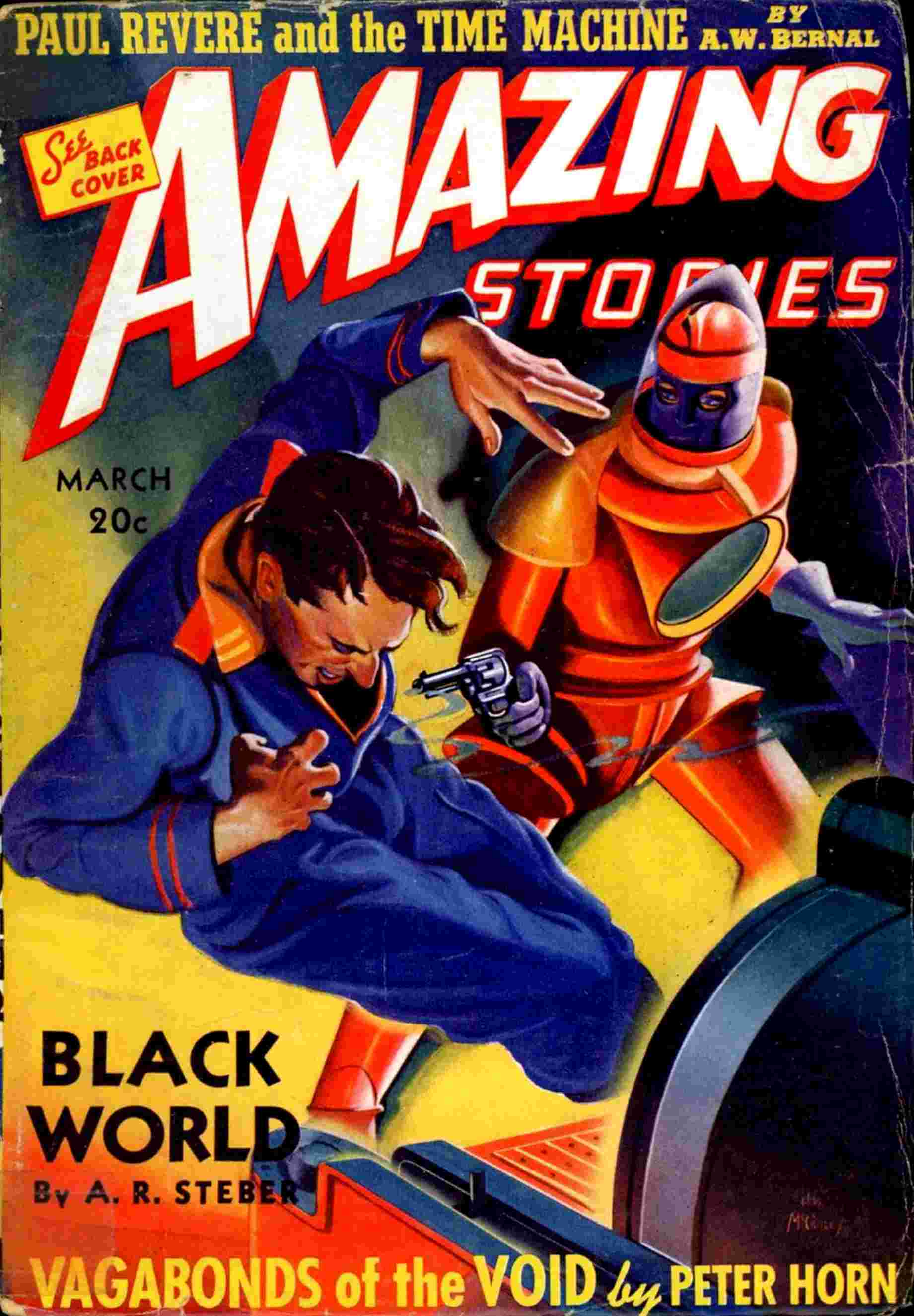
The Project Gutenberg eBook of Terror out of the past
Title: Terror out of the past
Author: Raymond Z. Gallun
Illustrator: Julian S. Krupa
Release date: February 22, 2025 [eBook #75441]
Language: English
Original publication: Chicago, IL: Ziff-Davis Publishing Company, 1940
Credits: Greg Weeks, Mary Meehan and the Online Distributed Proofreading Team at http://www.pgdp.net
Terror out of the Past
By Raymond Z. Gallun
Perry Wilcox descends into the earth to solve
the secret of an incredibly ancient civilization.
[Transcriber's Note: This etext was produced from
Amazing Stories March 1940.
Extensive research did not uncover any evidence that
the U.S. copyright on this publication was renewed.]
"Rod!" Perry Wilcox shouted above the sound of bracewires singing in the slipstream: "In the name of Mathuselah! Look! there!"
Doctor Roderick Murgatroyd's shrewd old eyes probed swiftly along the line of Perry's pointing arm. For a moment he couldn't get it at all—couldn't see what hundreds of airmen, flying over this place during the past three or four decades, had missed entirely. But then, as Perry circled the plane around in a steep bank, it came over the old adventurer-scientist gradually.
There was a humping configuration of those hills down there—faint in outline as an old footprint in a rainwashed garden. It couldn't have been noticed from the ground in a million years, and even from this altitude it was as vague in outline as the memory of a dream.
The hills below looked like a gigantic Indian Mound, a mile in extent, and perfectly though dimly triangular. Regularly placed along its straight sides, were humps—foggy nodules—suggesting somehow the ruins of massive turrets, lying buried beneath layer on layer of repeated glacial silt.
Rod Murgatroyd began to cuss, half to relieve his feelings and half as though to drive away the possibility that he and Perry were mistaken.
"By the nine gods!" he roared back through the propstream. "It's a fortress, Perry! You can almost see the battlements! But who in the name of the Cyclops could have built it? And when? And what in heck are we gonna do about it, Perry?..." Murgatroyd's voice was almost a whine of eagerness at the end.
Perry Wilcox was grinning broadly. "Do?" he returned, knowing that Rod had already passed the obvious answer and was planning far ahead. "What are you asking me that for? It ain't much of a riddle, is it?" He swung the plane into the wind, and began the glide toward Schroeder's hayfield.
Forty-eight hours afterwards, behind a high board fence, erected for secrecy—that is, as much secrecy as they could hope to achieve in surroundings that knew them well—the small crew they had assembled was busy. A heavy diesel motor pounded steadily, driving a rotary drill that was digging deep into the side of a low knoll.
For weeks the work went on. Five separate shafts were sunk into the ground, the first four of them reaching down to the solid stratum of fire rock, below the lowest and oldest fossil levels. From the depths of those first four shafts the drill brought up pieces of stone, some of which had angular corners, like carven blocks. And there were great lumps of rust too, that might have been reenforcing bars of steel. Thus the mystery deepened, taking on qualities of nervous unrest and expectancy.
And then, far down in the fifth shaft, the spinning diamond points of the drill snarled into a new medium. An hour later, in the summer dusk, Roderick Murgatroyd stood shifting a few ounces of muck, brought up from the excavation, back and forth between his palms. Most of it was grey volcanic stuff, but mingled with it were long shreds of metal, scored out by the drillpoints. The metal was as soft and pliable as lead, but it possessed a very considerable tensile strength. Tests had already proved that it was lead, alloyed with certain rare-earth elements, probably to increase its toughness, and to render it immune to the ravages of time.
"It's true, Perry," Murgatroyd said very quietly to the younger man beside him. "Truer than we could have quite understood before. Metal down there shows that. A carefully prepared alloy, such as only a very well developed metallurgical science could have produced. A layer, or a shell. Or maybe just a block. We don't know yet.
"Yes, we're on the right trail, Perry, even if it does look like a wild trail! Only yesterday the drill brought up fossils of an undisturbed stratum belonging to the Jurassic Period, the Age of Reptiles many millions of years ago! That means, Perry—" and the old Scotch-American's voice was still more vibrant and tense—"that means that this lead alloy was made and put into place before—long before—the time of the dinosaurs. In fact, if we are to judge from the stratum immediately surrounding the metal, it is contemporary with the Carboniferous Era or Coal Period. That's the point, Perry. There weren't any men on this planet at that time. And there weren't going to be any men for ages and ages. At least not Earth men...."
Perry Wilcox nodded, controlling his own taut nerves. They were right at the edge of a staggering discovery, he was sure. It might break any minute, now, or any hour. The drill machinery still vibrated, boring into that mass of metal deep in the ground. The pumps, sucking seepage water out of the excavation, still throbbed. The two men's ears were tuned to the sound of the machinery. Any shift or change in the regular beat of the drill would have a story to tell. Thus they waited, as night began to fall, slowly but surely.
They hadn't heard the soft purr of an expensive automobile on the roadway beyond the fence, at the foot of the slope. But now the sounds of a brief, angry argument at the gate, some hundred yards away, drew their startled, nervous attention. With so much that was unknown and unhintable pending, this was hardly the time to receive visitors of any kind, certainly not hostile visitors with ideas of their own.
Uneasily, Wilcox and Murgatroyd turned to face a group of people hurrying toward them across the intervening area of the fenced enclosure. One was a trusted workman, left to guard the gate. But the others—there were four men and a girl—had been able to overrule the guard's refusal to admit them.
Of the four men, three were burly, massive specimens with the scars of many combats marking their coarse features. The fourth was slender and bent, maybe fifty. His head was entirely bald, his cheeks had withered lines in them, and his squinted piggish eyes held a look of secretive, hungry searching.
Murgatroyd and Wilcox had no trouble recognizing this uninvited guest, who clearly was the master mind of the intruding group. All the world knew Lyman Kerwin, whose colossal fortune had thrust dominance-seeking tentacles into most of the key industries of America. Path of Progress, Rod's and Perry's outfit, had tangled with him once. They'd taken newsreel pictures of the collapse of one of the gigantic but poorly constructed power and irrigation dams which he had built in one of the western states. Hundreds of people had been killed, and thousands had been rendered homeless by a disaster traceable to materials and workmanship far less costly than specified. Only Kerwin's money, fixing a corrupt court, had enabled him to escape the consequences of criminal misrepresentation.
Seeing Kerwin, and the inquiring speculative glances he cast about the enclosure, Doctor Murgatroyd's pointed red face suddenly darkened with fury, chagrin, and something like a nameless, nervous panic.
"Thunder of Jupiter!" he whispered hoarsely. "That polecat would have to barge in now—now, of all times! We might have known it, Perry! But you just wait till I sail into him! The dirty—"
Perry silenced the old scientist with a poke in the ribs. "You keep still," he ordered. "Just make believe you're bossing the drill crew."
The young man advanced slowly a few steps toward the intruders. He didn't grin or scowl. He just kept his face straight, ready to meet Kerwin in whatever manner the latter might ask for by his actions or words. Perry did notice the girl in the party, though—briefly. She was walking beside Kerwin. Chestnut curls peeped from beneath an odd little hat. There was a sprinkling of freckles across her tanned, earnest face. Perry knew her slightly. She was Lyssa Arthurs, better known as Troubles, reporter for a paper in the neighboring town of Brenton. Cute, plucky kid, but she seemed a little self-conscious now. And evidently she had strange tastes in company. Perry dismissed her presence with a curt nod that could hardly have been called a greeting.
When he spoke, Kerwin didn't allow a lot of room for doubt as to his attitude, in spite of the veiled terms he used.
"Hello, Wilcox!" he hailed volubly in a rich voice that was in sharp contrast with his cadaverous appearance. "I thought I'd call, since you and the Professor are always doing such interesting things. What's up? Boring for oil or something?"
Perry kept silent, waiting for Kerwin to talk a little more.
"You might as well answer my question, Wilcox," the financier urged. "I'll find out anyway, you know."
"Maybe they're diggin' a road down to China, Chief," one of Kerwin's bodyguards offered with dry and slightly sinister humor. "Or a nice, deep hole to bury themselves in."
Before Perry could speak there was an interruption. The sound of the drill nearby, busy in the dusk, changed abruptly. There was a grating, hollow noise from far underground. Then the whine of machinery racing without resistance. Out of the pipe which ejected the muck and chipped stone and metal shreds brought up from the drilling, there came a gurgling puff, as of air trapped in a subterranean cavern, and under slightly higher pressure than that of the surface, being suddenly released from confinement.
Workmen leaped to throw out the clutch of the big diesel. Old Rod Murgatroyd began to swear excitedly, for it was clear what had happened. The drill had broken through the metal at last. It had reached a hollow space down there. A room, a chamber, perhaps, which the shell of lead alloy was meant to protect.
Perry Wilcox felt his pulses racing wildly. The presence of Kerwin could not spoil his sense of victory. In the evening air around him there was suddenly a faint, musty odor, like that of an old cellar, but with a distinctive quality all its own.
Perry saw the workmen step back from the machinery, as if they didn't know quite what to do or say. And he could tell, too, that the sudden cessation of movement, and that noisome smell, indescribably suggestive of a time that was dead for incredible eons, had had its effect on Lyman Kerwin. Kerwin's lips dangled loosely, and his eyes had lost a lot of their squint. His face was sweaty, and paler than usual.
"You asked what was up, Kerwin," Perry growled at last. "Well, so far we've tried to keep our work here dark so we could get the first investigations completed without interference. But I guess there's no use to stall. You said you'd find out anyway, and you're right—whatever good that'll do you. I think everybody'll get the story in a few days, or even hours. I suppose somebody tipped you off about what we were doing—somebody who lives around here." Perry grinned crookedly at the girl, Lyssa Arthurs, as he made this half accusation.
"But it doesn't matter," he went on. "You saw what just happened, Kerwin. We've evidently reached something with the drill. I don't know what—yet. But it's terribly old, Kerwin. And get this—there's metal down there—a perfectly balanced alloy as old as the Carboniferous fossils! Yes, it's pretty big, Kerwin! And liable to be—dangerous! Why, hell, even that cellar stench that came up from down there might actually be poisonous! It might contain microscopic spores that, in contact with human lungs, could grow and kill. Spores from the past, Kerwin. Sealed up and kept alive through the ages. Of course it's a thin possibility, but who can say? Do you still want to hang around, Kerwin?"
The latter's retreat was just a trifle too quick for good poise, and the sudden fury of his expression wasn't good form either.
"Rot, Wilcox!" he half stammered and half roared as he backed away. "You're talking rot!"
Perry could almost feel sorry for him at that moment. Full of hypochondriac fear, inspired by nothing but the slenderest of chances, Kerwin was trying to mask his cowardice by a show of scorn.
But Perry could feel sorrier for Lyssa Arthurs. Troubles, she was called. And she looked regular, all right.... But why was she hanging around with Kerwin?
Now Kerwin made a nervous, jerking sign to his henchmen.
"Come on, boys," he said. "We might as well leave these fools to their silly grubbing."
Even the three pug-uglies looked a bit sheepish at the hasty departure their boss led them into.
Workmen were grinning and chuckling as Perry turned about, and old Rod Murgatroyd's red face was alight with amusement and satisfaction.
"You sure told that ninny where to dump himself, pal," he complimented, his blue eyes seeming to twinkle even in the dusk.
Perry's answering smile was brief. He glanced toward the fence, from beyond which came the sounds of Kerwin's car speeding away along the concrete road.
"Only," Murgatroyd added, sobering, "I don't think we're through with our playmate yet, Perry. You've got him doubly sore at us now, for making him ridiculous. And he's not so scared that he won't do his damnedest to get even—if nothing else. And—glory but it would be tough to have him mixing in with something really colossal, wouldn't it? What we've got here could be good for all humanity—it could be neutral, or it could be bad. We don't know. But good or bad, depend on Kerwin to make it the latter, if he gets the chance!"
Perry shrugged ruefully. "Yeah," he said. "That means we've got to work quick, Rod. One of us has got to go down there into the bore on a cable—find out just what we're up against in that quarter. Then there'll still be time to see if we can get digging options on the surrounding country—if it turns out to be advisable. Kerwin can't very well beat us to that, anyway. Now who'll it be that goes down there first?"
Perry Wilcox drew a nickel from his pocket. He flipped it dexterously into the air, caught it and slapped it onto the back of his other hand.
"Buffalo!" old Rod called.
Perry raised his palm to reveal a shiny Indian head. "I win," he remarked, grinning.
CHAPTER II
Mystery Below Ground
Lights were snapped on in the gathering darkness. Long lengths of drill-shaft were pulled out of the boring, whose dark maw hid the unknown.
Perry put on a coverall garment of rubberized silk. Over his face he fitted an oxygen mask, and to his shoulders he attached several oxygen bottles. The air blow, after so many countless ages of stagnation, would probably be unbreathable. And though Perry had meant merely to unnerve Kerwin when he had mentioned the possibility of some kind of contamination, one could not quite be sure. It was best to have one's body encased in a sealed garment.
When he had completed his preparations, there was even a small toolkit at his hip. Attached to an elbow there was a powerful electric lamp, fitted with a long cord by means of which it could draw power from the generator here on the surface. And there was a small phone incorporated into his headgear. With the phone, like a subsea diver, he could maintain communication with Rod and the rest of the crew here above ground. And of course he had his motion picture camera—strapped across his chest.
With a stout steel cable fastened under his armpits, Perry clambered over the edge of the boring, and was lowered below. The trip down—nearly three hundred feet—was uneventful. The stillness in the narrow shaft, scarcely wider than his shoulders, deepened with the depth of his descent. There was only the scraping of his kit against the rough walls, and the sleepy trickle of seepage water.
He reached the punctured metal barrier at last, and passed through it. Two feet thick, the shell was. A moment later his feet touched a solid floor, wet with the water that had dribbled down through the opening.
"I'm here, Rod," Perry called into the phone. "At the bottom."
It was a moment before the older man answered, and in this interval Perry heard disquieting sounds from the phones over his ears—sounds from the surface, which seemed so infinitely far away to him now. Automobile motors racing. Voices in much larger numbers than those of the small drill crew. And to Perry Wilcox came a conviction of pending trouble.
Then Murgatroyd spoke: "We've got company up here, Perry," he said, a note of anxiety in his tone. "A lot of curious people from Brenton. Sight-seers rushing to a fire, so to speak. Kerwin couldn't think of anything dirtier to do to gum up the works for us, so he spread the news around that something was up out here. Naturally I've got a whole crowd on my hands. We're trying to keep 'em outside the fence. Of course they ought to be harmless enough, really; but damn it, I wish they'd go someplace else! What do you see down there?"
Perry had his electric lamp blazing at full now. On his chest, his camera, driven by a little spring motor, was turning. And he was staring about him intently, to grasp the character of his surroundings. He began to talk—to describe what he saw and felt.
"I'm in a passage, Rod," he said. "It slants down. Its alloy walls are all bent and crumpled. It must have been the movement of the ground through the ages that did that. Gosh, Rod, but you can feel the length of eternity here! It's written in these tunnel walls, Rod. The way they're bent and rebent. I can understand now why they were made of something tough and pliable, like this lead alloy. It's twisted everywhere, but unbroken. They—whoever built this place—must have known pretty well what they were doing—whatever their purpose was...."
Perry advanced slowly down the slope of the tunnel, cautiously drawing his descent cable and his telephone and electric cords after him.
He reached a room of heroic dimensions, walled with the same grey alloy as the tunnel. The Stygian gloom that obscured it parted before the intense white path of his lamp.
There were tall metal boxes, like packing cases for heavy machinery, arranged in rows on the buckled and humped pavement of the chamber—metal boxes, each with a closed and perhaps hermetically sealed door. And near the farther wall was a machine—an engine or something—that displayed a gigantic, dusty fly-wheel. The walls, at a head-high level, were covered with something crystalline, like glass; though where it had bent it had bent like metal—not shattering as a brittle substance would have done. Behind those crystal panes were compartments, housing queer, complicated devices. They looked a little like astronomical or surveying instruments, Perry thought. Were they perhaps instruments for the navigation of interplanetary or interstellar space?
Seeing charts traced on the walls above the compartments that protected this array of apparatus—charts dotted with winking, diamond-bright bits of glass, which must represent scattered suns of the void—he was half sure that his guess was right. The charts were marked with countless interlocking lines and circles, which might be the geometric equivalent of latitude and longitude, applied not to the navigation of the ocean, but to the limitless, three-dimensional reaches of the cosmos.
This much Perry Wilcox was able to note, before his eager inspection was interrupted. In the heavy stillness there was a rustling whisper, which penetrated easily the thin, rubberized fabric of his hoodlike mask. The sound swiftly built itself up into a regular, soft rhythm. Perry spoke a few warning words about this development into his phone, and described briefly the room he was in. Meanwhile he stared ahead, ready in every taut nerve and muscle to leap out of danger, yet eager to see what it was that caused the disturbance.
His lamp beam focused on the engine near the opposite wall. Its fly-wheel was turning, maybe after half a billion years of motionless waiting in this sealed vault. But why? How?
Perry bounced back a step, icy fingers of dread tickling his flesh. "On your marks up there, Rod," he said tensely into his phone. "I can't tell what kind of a show it is I've started; but you may have to yank me up in a hurry!"
The engine was whizzing now, ancient dust spraying from its fly-wheel. For a few seconds there were no more developments, except that Perry noticed the decorative frieze around the high, shadowy ceiling. Human faces carved in the metal. They smiled down on the young man mysteriously.
Then there was a soft clank in the far distance, muffled apparently by the turn of many passages, and echoed back and forth by crumpled, vaulted ceilings and walls. The sound might have been that of a door opening, or the rattling of chains. Perry was beginning to feel very much like beating a hasty retreat; but he waited a trifle longer.
There came, then, a ponderous, soft thudding, growing nearer. It wasn't till the impression of the sound clicked into a groove in his mind, establishing itself as identical with the regular thud-thud of great, running, elastic-shod feet, entirely inhuman in their note, that he concluded that discretion was the better part of valor.
He had farther to return than he realized. And his electric and telephone cords, his hoist cable, hampered him.
"Draw in the slack of my rig," he shouted into his phone. "And for Pete's sake, if you love me, set the hoist winch going when I tell you!"
He got beneath the bore that penetrated the tunnel roof okay. But the thudding was catching up on him fast. "Up!" he yelled. "Quick!"
It seemed a century before he felt the reassuring tug of the cable under his arms. He had a chance to look back once into the Stygian darkness that concealed a reawakening and incredible ancientness. There a little red light wavered and hurtled nearer.
Perry's feet left the metal pavement. He heard a hiss, like escaping steam, just as he was drawn up into the narrow bore. Something clanked and scraped beneath him, like claws raking at his retreat. And the hissing continued.
He thought he could relax then, a little. But as he was pulled farther up the bore he felt heat burning through his rubberized silk coverall. It was just a harmless warmth at first, but it increased to a burning sensation about his legs. It made him dizzy and sick, and clouded his brain.
He heard Rod Murgatroyd yelling at him through the phone: "What's the matter, Perry? What's up?" And behind the voice of his friend there was the murmur of many other voices. The sightseers from Brenton. They didn't have any business being there; but if anything happened—if they got hurt—it was his and Rod's fault. Even though Kerwin, or someone under Kerwin's orders, had tipped them off for mere malice.
"Back!" Perry yelled. "Order everybody back! When you pull me up, Rod, don't touch me without gloves! And breathe cautiously. Gas, I think. Some kind of corrosive gas...."
The rest, for a while, was like a bad dream to Wilcox. He became aware of stars overhead, and of wind. He was up in the open air once more. Nearby, Herkett, one of the drill crew, was swearing at the inquisitive onlookers, trying to send them on their way. Some were retreating. Others, held by a kind of fascination, still crowded forward against the fence, and met Herkett's blasphemous pleas with boos, or ignored them with a kind of self-conscious indifference.
Perry was sick with that intense, burning pain in his right leg. To keep his senses was a struggle. He heard noises from within the Earth—like ragged drumbeats that made the ground shake. Something unknown, crescendoing on to a preplanned purpose. Hands touched him—Rod's hands, covered with thick gloves. Car headlights flared all around in the night, mingling confusingly with the chaos of voices. Perry's rubber-silk outer garment was crumbling away from him like rotten rags. It had been eaten by a virulently active gaseous chemical, all right. Like combustion, the activity had evolved heat. He was still alive only because he was wearing an oxygen mask.
He tried to stand, clinging to Rod's shoulders; but the burnt leg, which might still put him in danger of death by an unknown chemical poison, would not bear his weight. He sank down to one knee while Rod tore the remnants of rotted rubber and cloth from his leg, and smeared an unguent on the ragged, blistered injury.
"I'll get him to a doctor," someone was saying from very close by. "You can't tell. That's apt to be very dangerous. A physician will know better what to do."
It wasn't till then that Perry saw who it was that was holding the first aid kit. Lyssa Arthurs, the girl who had been with Kerwin and his boys. But she'd come back, somehow. Looking up into the confusing medley of light and shadow, Perry saw her curly chestnut hair blowing in the wind. She looked a little bedraggled, and her lips were pursed very tight.
"Okay!" old Rod snapped, for this moment might involve the question of life and death for his friend, and there was no time to question the connections of this girl, who had been helpful. "Come on, you!" he added, grasping Perry's arm. "You're out of action for a while!"
Perry Wilcox was too dazed to think of all the reasons why he didn't want to be taken away from the scene of action now, and why he didn't want to go with anyone associated with Lyman Kerwin. So his stubborn protests were mostly those of a hard man of action, clinging obstinately to the habit of wanting to be where things were happening.
"Can't leave, Rod!" he grumbled like a great obstinate, drunken child. "Everybody's in danger of—God knows what. Gotta stay with you, Rod...." His words were muffled by his mask.
A moment Murgatroyd hesitated, then his balled fist shot out and caught Perry on the chin with stunning force.
What he'd seen of Troubles Arthurs in the last few seconds made the old scientist like her a lot. But since she was tied up with Kerwin someway, he couldn't trust her entirely with the custody of his pal. So he said:
"Thanks, kid. Otto, here, will go along to help."
Almost as an afterthought, Rod unsnapped the motion picture camera from Perry's chest. Its record of a mystery would be safer in his keeping.
Otto, one of the drill crew, a great, blond bear of a man, picked Perry up and followed the girl through the throng to her car. In a moment it was speeding away toward Brenton.
But it hadn't gone far before the sounds of a fresh disturbance issued from the enclosure it had recently quitted. To the thudding from beneath the Earth, was added a droning note, faint but infinitely far-reaching. It was like the drone of a solitary electric generator in a deserted powerhouse at night. And there was a puffing noise from the direction of the enclosure. Voices waxed to screams. First of plain terror; then some of them changed to yelps of agony.
The reviving Perry half rose in the back seat of the speeding car. Then Otto, with all the good intentions in the world followed Murgatroyd's original example, hit Perry on the chin, and told the frightened girl up ahead to drive faster.
Meanwhile, safe in a hotel room in Brenton, a man sat at a writing table and waited. Lyman Kerwin had just received a phone call. One couldn't tell, yet, what was happening. But Kerwin's mind was quick and cold and ruthless. And somewhere in all this he saw a lot to his advantage—if he played his cards right.
CHAPTER III
A War Against Machines
It was many hours later before the doctors at the Brenton hospital knew that Wilcox was out of danger. The gas that had burnt him was a little like mustard gas in its action, though more virulent; and it had narcotic properties that could function through a burn. With the danger from poison past, the injury was small.
But it was still more hours before Wilcox came out of the daze that had slipped over him. The immediate cause of his awakening from heavy slumber, was the roar of a squadron of airplanes, passing over the hospital roof.
He sat up dizzily. In the distance he could hear a muted mutter and clank. Then a series of heavy explosions. He looked about, noticing only subconsciously that he was in a hospital ward. His gaze settled immediately on the nearest window. Weakly he climbed out of bed and limped and staggered toward it.
The view extended for miles to the north, across the little city, and across the hills and woods and fields beyond. Everything he could see had the look of a place in close proximity to the no-man's-land of a great war. Lorries, loaded with troops, were moving in the streets. Tanks roared. Supply trucks, most of them pulling guns, moved in a ragged stream.
Perry's face went haggard and drawn as he looked for the airplanes he had heard. Far up, he saw three. Huge bombers in the clear air. Clusters of black specks trailed down from them—bombs released from the racks. And in the hills beneath there were geysers of flying earth, followed by dull concussions.
Then unseen, hurtling vengeance touched each of the planes in succession. From somewhere in the sylvan terrain beneath, there were three faint pops. A second later, one of the bombers dissolved into a silvery cloud—duralumin and steel. It was the same with the other two planes. They fell apart as though all the cohesive force of the metals from which they were made was suddenly disrupted. The men aboard them hadn't a chance.
Perry Wilcox gulped painfully as his eyes searched the wooded hills, trying to orient things so that he could tell just where Murgatroyd's and his fenced enclosure had been. He couldn't see the fence. It was too far off and was hidden by the trees. But he did see a ragged line of peculiar upjutting earthworks. It appeared to follow the contour of the mounted mystery that he had first observed from the air. Shells from man-made cannon splashed against it.
Just for a moment a gleaming colossus reared its hunched bulk behind the barrier. It glistened in the late afternoon sunshine as it seemed to take a look about; then like a lizard retreating into its hole, it slid back, from view. But behind it there were sounds like the working of great forges. Columns of smoke puffed up, dyed with the red of molten metal.
His attention was attracted to something else. Beyond the partly raised window, and across the street, he could hear a radio in one of the houses there. He bent forward tautly, straining his ears to listen. The voice was unpleasantly familiar:
"The latest newsflashes give us little hope. Our attacking forces are being beaten back, or destroyed. But we have great resources. We must be brave. The enemy is a strange one. We must amass more men, conscript money for war materials. Billions of dollars. That is our hope, our one chance. We must have a strong central government. That means the absolute leadership of one man. Obedience must be the key. My whole resources are at the disposal of the nation. We will triumph! We must! The Murgatroyd-Wilcox Horror will thus be destroyed. Be strong, friends. Be strong. That is all for now...."
Before the brief, artfully worded speech was half delivered, Perry Wilcox knew a good deal of what was spoken between its treacherous lines. The rich, semi-hysterical voice, seemingly overflowing with holy patriotism, had been unmistakable. Lyman Kerwin. But before Perry had time quite to digest this knowledge, someone called from behind him:
"Hey, fella, you're supposed to be in bed!"
Perry swung about, startled, forgetful of his injured leg. He confronted cool dark eyes with a quiet, half smiling challenge in them. It was Lyssa Arthurs again. Perry was glad to see her for a second, then he remembered.
"Well, what do you want?" he blurted sullenly.
"I've signed up for emergency work, and I was put in charge of this ward," she responded frankly, making a plain effort to avoid a painful clash of personalities.
But Wilcox was in no mood to take the hint. "Yeah?" he grunted. "Well, I seem to remember that it was you who brought me here to the hospital. For that, thanks! Otherwise, why don't you go hang around Kerwin some more? He's ambitious and capable! He can do things for an up and coming newspaper woman like you! Why I just heard him make the nicest, smuggest little speech you ever could imagine—over the radio. All about conscripting more money and men, and putting the country under the absolute control of one leader—himself, of course—to fight what he calls the Murgatroyd-Wilcox Horror. But I can see through him as though he was glass! He controls most of the munitions plants on the continent. The money'll go to him!
"But that's penny-pickings! He talks about absolute obedience. Sure! With himself as boss! Kerwin talks smooth. There's only one thing I can't understand about him. He's as yellow as a hyena. How he can find the nerve to talk fight now, is more than I can see!"
The girl regarded Perry coolly, after he had finished. "I'll be kinder than you've been to me, Mr. Wilcox," she said at last. "It's the privilege of all sincere science to explore the unknown. You and Mr. Murgatroyd did just that when you dug into those hills. You had no idea what would happen. But the result is your responsibility. As for my being with Kerwin—it's not your business, of course, but I may not have enjoyed that myself. It happens he owns most of the Brenton Herald, for which I work. He asked me to come along with him to visit the site of your excavations, and I couldn't very well refuse. It happens too, that I didn't tell him that you were digging there, in case you're accusing me of that. But there are plenty of sources from which he could have gotten information to arouse his curiosity. You are well known, and people are curious. But of course all this petty explanation of mine can't mean much now."
Perry bit his lip, feeling briefly sorry that he'd openly connected Lyssa Arthurs with the Kerwin outfit. But he was by no means ready to trust her either.
The rumble of shells, exploding miles off, beat into his mind. There was a mysterious hiss, followed by the screams of dying men. Perry winced. It was logical of course that soldiers should be sent to attack whatever it was out there; but he was sure that Kerwin must have some special knowledge about the enigma up his sleeve, or else he'd never have the guts to be delivering radio lectures that didn't say anything about running away.
"I don't know enough!" he groaned aloud. "I was put out of action too quick to see just what took place at the excavation. I can't judge—"
Suddenly he grasped the girl by the shoulders. "Where's Murgatroyd?" he grated. "Does anybody know?"
Troubles Arthurs stayed cool, in spite of his fury. "Why yes," she said. "He's here." She nodded toward a hospital bed against the wall.
Perry staggered toward the inert form which lay there. Rod, his head swathed in bandages, was completely unrecognizable. His features were covered.
"Gas, same as hit me?" Wilcox asked the girl.
"No," she whispered. "Some kind of beam of concentrated heat waves. It's his eyes, mostly."
"How long was he out there?" Perry questioned. "What I mean is, how long did he stay in action before he got hurt?"
"About two hours, I think," the girl responded. "He helped with the first civilian wounded, managing to stay clear of the gas himself. There was an explosion afterward. And out of the hole blown in the ground the machines—they're like strange robots—began to emerge. That was at ten o'clock the night before last. Mr. Murgatroyd was brought in at eleven o'clock, so he must have been active for half an hour after the explosion."
Perry had heard enough. He bent over the bed of his friend and touched his shoulder. "Hey, Rod!" he called. "Hey, this is Perry! Wake up, you old son-of-a-gun!" Perry's vision was misted.
Murgatroyd groaned and stirred. When he spoke, however, he seemed lucid, his mind clearing after the long siege of unconsciousness, caused by his head injury. "Hello, fella," he muttered, turning his face toward the sound of Perry's voice as though trying to peer through the bandages that covered his damaged eyes.
"Rod," the young man whispered. "I want you to concentrate—try to remember. We've got a big job that's our personal concern. But it's more than that. It's a danger concerning the whole country—maybe the whole world. Just what kind of an enemy is out there, Rod? Those robots. What are they? Is anybody controlling them? Or do they think for themselves? Do you know anything about them, Rod? Anything at all?"
The old Scotch-American's lips moved, almost hidden in the swathing of cloth. "I guess it should—be all right," he said at last. "I guess it's kind of—funny. Machines—think? Some might, but these—don't. They can do things—perfectly. Like a machine that rifles a gun barrel or predicts the tides. They're made that way. But these robots are just refined machines—acting almost human, sure! They'd almost fool you.
"They see, they hear—in a way. They come toward you, aiming and firing explosive slugs, or sending out beams of concentrated heat. But we stopped a few of those robots with shells. Just adding-machine stuff inside, Perry. Cams and rods and wires, like our inventors would build, only a lot more wonderful and complicated. No soul could be in that, Perry. No real consciousness. No ambition....
"Professor Vince had the wrecks hauled off—copped them for examination. I guess he knows a lot now, Perry. He tried to talk me into giving him your camera, with the pictures you took down in the bore, too, Perry. But I sent the camera to the rear with one of our men....
"As for the robots, they may be under some kind of centralized radio control, of course. But even that can't be—real brains. It hasn't the judgment. Any little trick, like stepping out of the path of an automaton chasing you, and staying perfectly still, fools 'em. They go right on past you. And you can pull the same stunt again and again. But they're still hellish."
Old Rod paused, panting with the effort of his long explanation. Then he went on: "So that means—there's nobody at the helm, Perry. The whole business just goes on by itself. And it is pretty awe inspiring and wonderful at that—so damned wonderful you'd want to cheer, if it wasn't so deadly—when a bunch of men makes an attack against it. The thing to do is not to attack, anyway for a few days. We'd learn more, then. Those robots are guardians of some kind, Perry. It's a hunch of mine...."
Suddenly the old man half rose in the bed, as if the expressing of his own thoughts had startled him. "That's the whole crazy irony of the situation, Perry!" he cried. "Men out there, dying—and on the other side—potential progress, inspiration, miracles! The key to a new era! We've got to do something—Perry—now!"
For a second Roderick Murgatroyd looked like a magnificent, blinded seer. Then he dropped back onto the bed, fainting into a coma of fatigue. Perry touched the old man's hand with a brief pressure of comradeship.
But at the same moment Wilcox was thinking fast to correlate his new information. Rod had spoken of Professor Vince. Vince, a shy, moon-faced little man, was a noted professor of physics at Kerwin University. Vince, then, was one of Lyman Kerwin's stooges. What Vince learned from examining the wrecked automatons, Kerwin would promptly find out. Perry was sure he understood the setup at last.
Kerwin knew, somehow, that what he called the Murgatroyd-Wilcox Horror was of little danger to himself, if he kept out of the battle zone! He was only using it as a means to his own ends. Power. Complete control of the nation. Free access to the inventions this marvelous archeological discovery might reveal!
It was all too clear.
Instantly Perry's plan was formulated. His injury was really superficial, now that the effect of the poison was gone. Exertion would work the stiffness out of his leg. But he glanced in frustrated exasperation at the pajamas he was wearing. A second later he was tugging at the door of the closet in the corner of the ward.
"Doggone! Where's my rig?" he was grumbling, as he clawed at the piled contents of the closet—mostly clothing of the wounded that had not been damaged by corrosive gas or heat.
He found his oxygen mask and tanks at last. Quite indiscriminately he seized a shirt and a pair of trousers, and yanked them on over his pajamas. Shoes were similarly selected and donned. Then he hurried toward the door of the room.
Lyssa Arthurs barred his way here, her lips firm though smiling. Her dark eyes had a roguish glint that admired and challenged. She looked like a courageous small boy standing up for his rights, that way, Perry thought with a strange pang.
"I'm responsible for the patients in this ward," she said pertly. "Where do you think you're going, Mister?"
Perry shoved her unceremoniously aside. "Places," he grunted almost good-humoredly. "You said before that I had responsibilities."
He rushed down the hall. In thirty seconds he was out in the street, with the bustle of behind-the-lines activity around him. He dodged ahead of trucks and tanks on his way to the river.
Once, from a radio in a house he passed, he heard the rich, high voice of Lyman Kerwin, exhorting, commanding, praising himself in subtle terms, using fear as a means to power:
"All my resources are at the disposal of the nation to combat the Murgatroyd-Wilcox Horror. The response has been good to our appeal for money. But it must be better. Better! We are pitted against something incredible—something that possesses many unknown weapons. The women and children of America must be protected...."
Perry Wilcox growled. And almost simultaneously a youth hurled a rock at him, shouting: "There he is! There's Wilcox, one of the two mugs who started all the trouble!"
A gang was after Perry then, pelting stones; and he knew that Kerwin's propaganda had already achieved a very considerable success.
But he didn't stop to argue. He just ran on, limping a little. He reached the powerhouse dam. There he paused briefly to don his oxygen mask and tanks. Then he leaped into the swirling water, and sank into its concealing depths. He didn't try really to swim. He made only a few strokes to keep himself righted, and safely beneath the surface. The current was swift, and it flowed in the proper direction. He had air to breathe. There was nothing much to do but wait.
Dusk began to settle. Perry heard guns on the banks of the stream, and shouts and cries, as he drifted invisible through the human battle lines. Presently, looking through the goggles of his air-tight oxygen mask, he saw light around him, then darkness, then light again. It was the regular play of a great searchbeam from up there on the hills. And there were noises too, now loud and near. At least he'd come this far without being detected.
Clinging to a rock of the river bottom, he waited a little till it got darker. Then, still being careful to keep well beneath the surface of the water, he swam toward the shore.
He came up in the reeds at the river's edge, and peered cautiously toward the low bluffs. He had to duck his head again, before he saw anything but humping, moving shapes, and part of a great, half-restored battlement; for the search beam, swinging majestically and regularly back and forth, swept blindingly toward him.
But there were regular intervals between each successive blaze of light; and these allowed him to observe. Little, gleaming robots, walking like human beings on broad, elastic-shod feet, and provided with metal arms, were rebuilding the battlemented wall with limestone quarried from the hillside. They worked with perfect efficiency, raising blocks into place, and applying a kind of mortar with spatulate-ended arms. But their movements for each operation were always identical, betraying not intellect but standardized mechanical perfection.
And it was the same with the other machines and weapons. A gun—it didn't look so very different from a familiar artillery piece, except for its complex breech-loading mechanism, fired intermittently, without any crew to operate it. Watching, Perry concluded that its sighting and firing apparatus must be stimulated by certain sounds, movements, and lights, out there where the soldiers were entrenched. For when he heard a shout from the rear, or saw a cannon flash, or troops advancing from the trenches, there was always a volley of small, screaming shells, the latter directed with a precise, cold accuracy, that must depend on the spiritless exactness of instruments. And the result was massacre.
Heat beam projectors, lensed boxes in their webwork supports, seemed to operate under the same kinds of stimuli, turning their faint, barely visible spears of heatwaves toward sudden light, noise, or movement. Searchlights swept the sky, probably drawn by motor sounds. And if they located a plane, the movement of its light-enveloped form was enough to attract the high-angling muzzles of slender guns that fired with soft pops, but reduced duralumin to powder. The aiming was always perfect.
When the search beam was turned away from him, Perry got cautiously out of the water and dashed for the nearest bush. He crouched behind it, as the beam swept past him like a great eye. Then higher, to another bush. And so he advanced. Once, because he stumbled, he was caught in the open; but he threw himself flat and waited, cursing his clumsiness. But the blazing glare passed him, and no blasting death followed. Perhaps camera eyes had photographed his inert form; but mechanical, adding-machine brains had not enough reasoning powers to recognize him as an interloper, as long as he did not move. Perry breathed with relief, and continued his intermittent climb at each brief moment of darkness.
Near the top, however, it didn't look so simple. He was hiding in a clump of tall weeds, face to face with those guns—and nobody knew what other deadly devices. He was stumped as to how he should try to advance further. Make a rush? There was a pretty good chance of getting past the guns that way, as far as he could tell by visual inspection; but surely there'd be something there, in the narrow gaps between the guns—something to kill him, or at least detect his presence! It made his flesh crawl; but need gave his wits a sharper edge. He had to get through, somehow!
He searched the line of fantastic, flame-spewing weapons avidly. A hundred yards away there was a small break in it, where an aerial bomb, dropped by one of the planes, had struck. The crater still smoked with the vapors of the explosive. If there was any detecting device there, any taut-stretched wire, or anything that would bring some death machine into play at his accidental touch, it would be shattered, now, and still unrepaired.
Scrambling from bush to bush during intervals of darkness, as before, he got to the break in the line, and through it safely. Thus, he looked at last over the hilltops, and down into the area enclosed by that great, mounded rectangle.
It was a queer, contrasting scene. Familiar farm buildings stood out in the weird illumination. But everywhere there were mounds of earth and deep pits. From some of the latter, red-lit smoke trailed up toward the stars. Massive things, not unlike army tanks, moved in circles, as if pacing beats, and there was the muffled clang of what could be buried factories. The old fortress had come to life once more, resurrecting itself from its bed of Carboniferous slumber. It was a camp, bristling with strange armaments and bustling with activity.
CHAPTER IV
Into the Robot's Lair
Perry lay prone in the high grass. He was panting and tired, and he felt a little sick again. He knew that whatever chances he had of accomplishing any good here, would be diminished if he waited. There were dozens of ways of getting uselessly killed. So far he hadn't encountered any of that corrosive gas, but hisses, and distant human screams from the flats along the river, told him that it was being used. And though he had his oxygen mask, his clothing and skin could be eaten away and his blood poisoned. Two bombers burst overhead, their powdered wreckage silvery in paths of searchlights. Perry knew he might even be destroyed by the weapons of his own countrymen.