
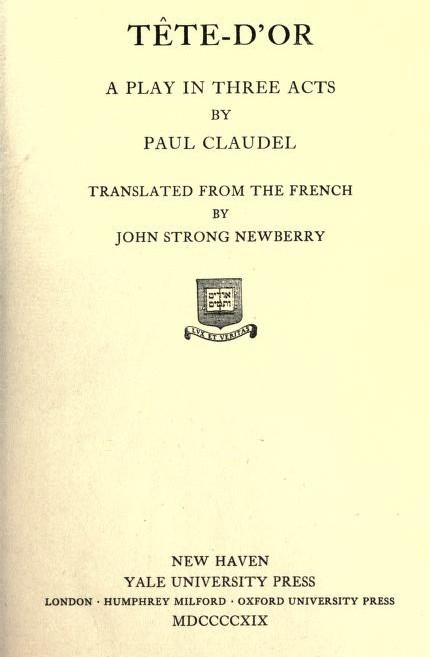
The Project Gutenberg eBook of Tête-d'Or: A play in three acts
Title: Tête-d'Or: A play in three acts
Author: Paul Claudel
Translator: J. S. Newberry
Release date: May 16, 2016 [eBook #52088]
Most recently updated: October 23, 2024
Language: English
Credits: Produced by Winston Smith. Images provided by the Internet Archive.
TÊTE-D'OR
TRANSLATED FROM THE FRENCH
BY
JOHN STRONG NEWBERRY
NEW HAVEN
YALE UNIVERSITY PRESS
LONDON - HUMPHREY MILFORD - OXFORD UNIVERSITY PRESS
MDCCCCXIX
COPYRIGHT, 1919, BY YALE UNIVERSITY PRESS
Table of Content
Dedication
O day! Having felt, like the touch of water upon the head,
The desire to be alone and to weep where none could find me,
Laughing I walked where the fragrance of the riotous garden spread
Its honeyed share, and left the flowers and the trees behind me.
And from behind me, borne from the breathing depths, as I went,
With eyes half-closed, there came to fall upon my hair
The holy benediction of things most excellent,
And seeds and shreds of down were softly mingled there.
Behind me the eternal woods uplifted leafy domes,
Behind me banks of blossoms, packed to the brim with sweets,
Towards the expectant nose, prepared to breathe their balms,
Like some strong nuptial body upraised their ardent heats.
Roses and yellow asphodels that sturdy stems upbear,
In the mellow disarray of their golden panoply,
Shone forth like lamps that gleam through the white and liquid air
When but a single diamond adorns the sleeping sky.
For like one who stops and turns and listens to the sea
When to his ear is borne its low, mysterious whisper,
Above the shining earth, beaming resplendently,
I saw that star, First-Born of the dawning Future, Vesper!
O only child of the King, among so many slaves!
Pilgrim unique o'er city paths seeking the distant sea!
Planet of morn, re-born in evening's dusky caves!
Star anadyomene in the depth of the garden's greenery!
Mysteriously o'er the hour a subtle influence reigns,
Deepening peace, maintaining, with strange and mystic art,
The secret length of the days that are gone where only the honey remains
Of animate life, enhived in this everlasting heart.
Feebly the dying breeze stirs in its dark retreat.
O joy supreme, O love beyond what words can say!
Over this sordid world that has so enslaved my feet
Endureth the ineffable unfolding of the day!
In such an hour there passes in laughing ecstasy
The poet, sprung from a race obscure, who never shall grow old,
His golden dream fulfills itself in the twilight. Silently
He is merged in the springtime of the gods, the eternal age of gold!
Gazing into the eye of the world with an eye on fire to see,
As one gapes for the juicy plums that the topmost branches bear,
As, 'twixt his dusky brides, hard Jacob bowed the knee
To gain from the hand of a father the blessing on an heir,
I live! Come, rain and storm! I shall not be unmanned!
Bearing my destiny, aware of the term of Fate's delay,
Laughing I walked beneath the grim and terrifying land
Of burning constellations that cross a milky way.
Dramatis Personae
Simon Agnel, later Tête-d'or, afterwards the King
Cébès
The King
First Watcher
Second Watcher
Third Watcher
Fourth Watcher
Fifth Watcher
The Princess
Cassius, the Messenger
The Tribune of the People
The Go-Between
The High Prefect
The Schoolmaster
The Brother of the King
The Man Out of Office
The Chief of Staff
First Captain
Second Captain
Third Captain
Fourth Captain
The Deserter
The Standard-Bearer
First Subaltern
Second Subaltern
The Messenger
The Centurion
The Commander of the Cavalry
The Commander of the Second Army
Citizens, Soldiers, Officers
Place
Act I: The Open Fields.
Act II: A Hall in the King's Palace.
Act III: A Waste Place in the Caucasus.
Act I
The open fields at the end of winter.
Enter, at the back, simon agnel, dressed like a peasant. He bears upon his shoulder the body of a woman, and carries a spade.
Enter, in front, cébès, walking slowly.
Cébès: I stand here,
Untaught, irresolute,
A man new-born confronting things unknown.
I turn my face towards the Future and the lowering arch of the sky. My soul is full of weariness!
I know nothing. There is nothing I can do. What shall I say? What shall I do?
How shall I use these hands that hang at my sides, these feet
That bear me about as in a dream?
Speech is but a noise and books are only paper.
There is no one here but myself. And all that is about me,
The foggy air, the rich fields,
The trees, the low-lying clouds
Seem to speak to me, soundlessly, to ask inarticulate questions.
The ploughman
Turns homeward with his plough. I hear its slow creaking.
It is the time when women bring water from the wells.
It is night.—What am I?
What am I doing? For what do I wait?
And I answer, "I do not know!"
And in my heart there is a wild desire
To weep or to cry aloud
Or to laugh or leap in the air and wave my arms!
"Who am I?"
There are still some patches of snow. I hold in my hand a sprig of pussy-willow.
For March is like a woman blowing a fire of green wood.
—That the Summer
And the dreadful day under the glare of the sun may be forgotten,
O Nature,
Here I offer myself to you!
I know so little!
Look at me! There is something that I need.
But what it is I do not know and I could cry forever
Loud and low like a child that one hears in the distance, like children left alone beside the glowing embers!
O lowering sky! Trees, earth, darkness, night of rain!
Look upon me! Grant my prayer!
(He sees simon.
Who is that?
(He approaches him.
Are you digging a drain? It is getting late.
Simon (straightening his back): Who is there? What do you want?
Cébès: What are you doing there?
Simon: Does this field belong to you?
Cébès: It is my father's.
Simon: Suffer me to dig this hole in it.
Cébès (seeing the body): What is that?
Simon (continuing to dig): The woman who was with me.
Cébès: Who is she? Oh, I know her! And is she dead!
Simon: I did not cause her death.
Cébès: Oh! Oh! It is she! It is she!
And is it thus that I find you! Cold and wet!
You that were kind to all, light-hearted, vital!
Simon: Cébès!
Cébès: What? You know me?
Simon: What do they call that slate-roofed belfry, Cébès?
What place is this?
Cébès: Agnel! Simon Agnel!
Simon: Are any of my family still here?
Cébès: No. The house has been sold.
Simon: Is my father alive?
Cébès: He is dead, and your mother also.
The others have gone away.
Simon: Is it so!
Cébès: Where have you been, unhappy man? Why did you go?
And what of that woman lying there?
Simon: Why? Who knows?
A wild and adventurous spirit, shame,
A desire to reach the end of the road, to follow the lure of the plain that stretches towards the horizon,
And I went out from the house and left the old familiar faces.
Dead!
Cébès: Where did you go?
Simon: I did not know that she loved me.
One day I caught her by the throat, crushing her body against the side of the barn,
For I was a violent man. She came to join me.
I have wandered,
I have dreamed many dreams, I have known
Men and the things that at present exist.
I have seen strange roads, strange cultures, strange cities. One leaves them behind and they are gone.
And the sea that is very far away and further than the sea.
And as I was returning, bringing back the branch of a pine...
Cébès: It was there that she found you?
Simon: Together
By many mountains and rivers we wandered seeking the South and that other ocean.
Then we returned to this place.
Cébès: Where did you say?
Simon: There, to that hut. I tried to light a fire but it was too wet.
—I think it is deep enough now.
(He climbs out of the hole.
Cébès: O that she should be lying there like this!
Simon: O this place! This place!
Turning hence my unworthy eyes what have I sought among multitudes of men but the testimony of my own soul!
And it was here that, girding up its loins, it came to find me!
Standing in the red of the dawn, the warmth of the rising sun on our hair,
We had re-united our souls through our lips, and with artless arms she clasped me to her breast!
And I brought her here that this place whence I had set out might mock me! There she lies fallen at my feet!
My curse on this country! A murrain on the cattle! May the pigs die of plague!
Ah! Ah! This place! O soil of sticky clay!
I am worthless! What could I do! What was the use! Ah, why should I try to be
Different from what I am? And it is here
That alone and with my feet in the earth I raise my bitter cry,
While the wind masks my face with rain!
O woman, ever faithful
Who followed me, uncomplaining
Like a fairy in thrall, like a queen
Who wraps her bleeding feet in tatters of cloth of gold!
I cried to her, "Come, down into the mud!"
Horror incarnate, shame, infamy teeming with desires, this is the knowledge I have gained at the last!
Listen! When she was dying she pressed my hand against her cheek,
And kissed me, keeping her eyes on mine,
And she said that she could sing me prophecies
Like an old ship that has come to the end of the world.
And at the last when she was dying she tried to speak,
Tears were in her eyes! Who knows what she saw, what she regretted!
Cébès: Alone and so pale!
Simon: She looked at me and wept and kissed my hands with burning lips!
"Are you in pain?" I said.
She shook her head.
She looked at me and I do not know what she wished to say. Who can understand a woman?
Into the grave with you!
(He lifts the body.
Cébès: May I help you?
Simon: Yes. I shall be glad of your help. It shall not be forgotten.
I will take her shoulders, you take her feet.
(They take up the body.
Not like that! Let her sleep face downward.
(They lower her face downward, into the grave.
Cébès: May she sleep well!
Simon: There! Go! Enter, enter into the raw earth! Lie at your ease, hearing nothing, seeing nothing, your mouth pressing against the clay,
As in the days when prone upon our pillows we rushed towards sleep!
And now I shall load a burden of earth on your back!
(He throws the earth into the grave. When it is full he walks on it, stamping it down.
Fill it up! Room must be found for the earth whose place you have taken.
—So there are none of my family left?
Cébès: Not one. The house is closed. The fields lie fallow.
(Silence.
Her father is still alive.
Simon: Would you have me ask him for a night's lodging?
Cébès: He is old. He has known much sorrow.
He lives alone, an object of charity, despised by everyone.
He is bent like a scythe. His hands hang down below his knees. He has never been the same since his daughter went away.
Simon: I shall come to this place no more.
Can you see where the grave was?
Cébès: There is not a sign of it. How it rains!
Simon: O gentle Giver of Knowledge,
Twofold teacher who while you spoke held your face before me like a book,
Here take your rest, deeper than the buried grain!
Here, where you cannot hear the noise of the roads or the fields, the sounds of ploughing and sowing,
Remembered only by me, in a place that no one knows,
And let not even this spade nor your staff like the broken oar of a sailor
Remain to mark your grave!
(He throws away the spade.
And now let us go!
Cébès: May I go with you?
Simon: Come.
You do not talk, comrade.
(They walk along together.
Cébès: Oh, I am sad! I am exceedingly sad!
Simon: Death!
Thoughts,
Actions that sleep, like new-born babes
Drawing up their knees to their bellies reassume
The shape of the maternal mold.
One ceases to live.
Old age obscures the memory. The sick man
Wakes all alone and while the rain drives against the windows, he hears the sound of a falling silver spoon.
And the smile has mercifully been given to the old.
Cébès: She is dead.
Simon: A woman has withdrawn her hand from mine, mysteriously veiling her eyes.
And I, her mate, am left alone.
To what pale region of the air shall I raise my yearning mouth?
What shall I repeat in my silence, "I shall find strength, I shall make the effort...."
Ah, where shall I look? Where shall I go? The skies are like iron and I remain here, the woman's legacy, full of vague menaces and anguished cries.
—What is there left in life? I have travelled. I have seen the world. O worthless calendar of petty days!
Though the members of my body
Should bristle as thick as fir saplings upon a mountain side,
For what would I employ that multitude?
The woman I loved is no more!
And yet... When she was sleeping yesterday, I went out
Knowing that the next day I should be alone.
It was night and my heart was heavier than a suspended stone.
But, as I walked to and fro, slowly there came to me
A sense of the living force within my soul, the vital essence,
That does not enter into marriage, nor pass through the gates of birth,
The secret purpose of my being.
Cébès: O that I also might...
But no one has ever bothered about me.
Simon: What did you say?
Cébès: I could tell you...
I could lament in such a fashion that you would comprehend....
Simon: Some woman already...?
Cébès: No.
Simon: Indeed the desire
For this being who has the face of a child
Is strange. I do not believe in their laughter.
Age makes them fat like fowls.
But to slip away thus like a handful of sand that runs through the fingers...
Pah! These fancies!
Perhaps some day you will understand.
(They come to the road.
Cébès: Who is that? (aside) It is her father.
(An old man, bent almost double, enters, trundling a wheelbarrow on which is a basket and a hoe.
Simon (aside): Speak to him.
Cébès (to the peasant): Good evening.
(the peasant stops and sets down the wheelbarrow.
(Silence.
How are things going to-day?
The Peasant: Eh, I don't know. I think it can't be more than five o'clock. The days don't get much longer.
Simon (shouting in his ear): And how is your daughter?
The Peasant: I don't know. She is not with me any more.
Simon: Perhaps she is better off than you are, eh?
The Peasant: Ah! She might help me out a bit then.
'Tis a bad business, surely!
Good-night to you, masters.
(He goes out. They remain silent for a moment.
Cébès (pointing up the road): That way lies the village.
You must spend the night with me.
Simon: No, my road lies yonder.
There is now no place to receive me. I will not lodge in the house of another.
I have no other wealth than these old clothes. But I shall stretch myself on a stone and be content.
I myself am my table and my bed.
I shall not die, but live!
I shall not die, but live!
I wish not to die, but to live!
For I am not alone.
Cébès: Who is with you?
Simon: The voice of my living soul!
I have heard men mourn their misfortunes, but what misfortune can there be?
None.
—It grows dark.
Cébès: It is night.
Simon: Watch the road and speak more softly.
The dry brambles shiver; the branches creak or sway without a sound; the brooks gurgle among the reeds.
We stand in the midst of space, with all about us the blackness,
The melancholy of Earth.
We pass along the road.
And we alone exhale the warm breath of living beings.
Haha! My nerves are unstrung.
You there ... Cébès... Do you hear me?
Cébès: Yes.
Simon: Speak to me. Had you not something to tell me?
Cébès: I want...
Simon: What do you want?
Cébès: Nothing!
Only a room when it snows and that no one should know where I am!
Simon: What did you say?
Cébès: I am only a boy. There has been no one to help me!
I have had to endure much suffering.
I am plagued with bitter fancies. I shrink from the light of the sun.
Why should you force me to speak only to mock at me? Simon: I will take you by the hair of your head and shake you.
Come, in whom will you confide if not
In the man who at this very moment
Walks at your side through the blackness of night.
I tell you that you are a man and not a child, like some pale seedling pushing its way through the mould.
I am only a little older than you,
Yet I have sworn
To hold myself erect!
To never yield, to have no fear, and to accomplish what I undertake!
Speak! Take my arm
For the night is so dark one can scarcely see.
Cébès: Ah, well! I am very wretched! O that I might set forth clearly things that are obscure!
Where shall I begin?
To express the weariness that has no beginning, but has become a part of one's consciousness like the familiar things of every day?
Thus might the young man speak
Who like an emperor dethroned, his head thrust through a sack, sits motionless with haggard eyes,
While the wind makes free with his hair like a wanton trull,
Vacantly contemplating the dawn of another day
Full of little whisperings like a dead tree;
The multitude of foolish men who interrogate each other, fight, talk, and cast their eyes this way and that,
And then, turning towards us the hairy side of the head, disappear like the Manes;
The catastrophes and the sombre passions;
The clouds that cover the hills with shadows; the cries of beasts, the hum of the villages, the clatter of the highways;
The wood, and the chant of the coursing wind; the carts that are charged with sheaves and flowers;
And the Victories that pass their appointed way like harvesters, with swarthy cheeks,
Veiled and bearing a drum on a golden thigh.
Simon: Finish. What would he say?
Cébès: Nothing. Are there not men whose eyes
Melt like the broken medlar that scatters abroad its pips,
And women with cancer at work in their bodies, like the amadou in the beech?
And monstrous births, men having the muzzles of oxen?
And children violated and murdered by their fathers,
And old men whose children grudgingly count the days that still are left them?
All the diseases spy upon us, ulcer and abscess, epilepsy and shaking palsy and at the last, comes gout and the gravel that clogs urination.
Phthisis lights its fire; the pudenda grow mouldy like grapes; and the bag of the belly
Breaks and empties out entrails and excrements.
Is it not horrible? But our life,
Spreading a feast, stuffs itself with a banquet of crawling maggots
Till, like a dog who vomits worms and morsels of meat,
The loaded belly revolts and disgorges it all on the table!
I long for happiness!
But I am like a man beneath the earth in a cell no sound can enter.
Who will open the door? Who will descend into the blackness of my dungeon, bearing in his hand the yellow flame?
Simon: I also lie in that secret place.
I shall arise and burst open the door and I shall appear before men!
Ah! Ah!
Cébès: What is it?
Simon: Do not speak! Ah!
(He stops.
Cébès: What ails you? Why do you snuff the air? What do you smell?
Simon: The air and the earth. Ah!
O the Spring that renews the year and the strong love that triumphs over virginity!
O the ferment of life when the Springtime prepares its nuptials! There is not a thing that grows
But feels the divine delirium entering like a creator, producing the flower and the seed.
Cébès: The wind is warm.
Simon: I have in my mouth the bitter savor of buds! The block
Of my body
Like a clod of frozen earth
Thaws! O juice of life! Force and acquisition! Strength and the rising sap!
I will open wide my jaws and I will raise my arms and hold them extended like branches!
But come!
Cébès: Where are you taking me? Why have we left the road?
Simon: Why do we need a road? I know my way. Follow me!
O Cébès in this you were right that not to an older man nor to any one of an age unlike your own did you address yourself so obscurely,
For they could not answer you, not knowing what you ask.
But if one can tell the vintage of a wine by its taste
Why should we not believe that each generation of men
Springing from the maternal furrow in its season
Keeps a common secret, a changeless knot in the hidden texture of its wood?
(Or rather I think of a carpet whose maker disposes the colors one after the other)
—And a baby is weaned at eleven months, but the weaning of the spirit is slower.
And till he learns to forage for himself (the amount being equal to the expenditure) the breast is not taken away, the communication with the source.
—So if you put your ear against my heart—... But I myself am full of sorrow.
Cébès: We are going further and further.
Simon: As for me, I have never tried to fathom
What lay in the heart of anyone, young or old.
But a tree has been my father and my preceptor.
For often when I was a child
A black and bitter humor overwhelmed me,
Making all company hateful, the air breathed by others a poison,
So that I fled into solitude there to obscurely nourish this grief that I felt unfolding itself within me.
And there I met this tree,
Like some primordial man, surviving antiquity,
And I embraced it, clasping its trunk in my arms.
For it was there before I was born and will be there when we are here no longer,
And the measure of its time is not the same as ours.
How many an afternoon I have passed beneath its shadow, having quieted the clamor of my thoughts.
Cébès: And what has it taught you?
Simon: Now, in this hour of anguish! Now I must find it again!
(They come to the foot of a huge tree.
O tree, receive me again! Alone I left the protection of your branches. And now it is alone that I return, O immovable father!
Take me once more beneath your shadow, O son of the Earth! O wood, in this hour of sorrow! O murmuring branches, impart to me
That message which I am and of which I feel within me the terrible striving.
For you yourself are only a ceaseless striving, the unwearied drawing of your body out of inanimate matter.
How you suck the earth, old tree,
Thrusting down, stretching out in every direction your strong and subtile roots! And the sky, how you cling to it! How your whole being breathes it in through one great leaf, Form of Flame!
The inexhaustible earth in the grasp of all the roots of your being
And the infinite sky, with the sun, with the stars in their constellations,
Of which you lay hold with that mouth made of all your arms, with the cluster of your branches, with the clutch of all there is in you that breathes.
All the earth and all the sky, these are what you require that you may hold yourself erect!
Let me also hold myself erect! Let me not lose my soul! That essential sap, that innermost secretion of my ego, that effervescence
Which constitutes my true self, oh let me not squander that to make a useless tuft of leaves and flowers! Let me grow in my unity! Let me remain unique and erect!
But it was not to hear your murmuring that I came, O branches that now are bare mid the air opaque and nebulous!
But it is you that I would question, deep-reaching roots and that primal depth of the earth where you are nourished.
(He stands beneath the tree.—Pause of indefinite duration.
Simon (sighing, like one awakening from a dream): Let us go.
Cébès: O Simon, you will not leave me so!
Have you learned nothing then, under that tree of knowledge?
Simon: Nothing that I can tell you.
Cébès: Well, the thing that you cannot tell, that is what I demand.
Oh, if indeed
Some law is graven on your heart, if some commandment
And edict of Nature
Pushes you as from its knee into the midst of us, miserable wretches....
(He kneels before him.
Simon: What do you want?
Cébès: Do not forget me!
Simon: Why do you wish to make me speak?
Leave me, for my spirit smokes and boils, and I am shaken through all my being!
Cébès: I am the first to summon you.
Simon: What do you seek?
Cébès: Your hands! Let me take them! Do not refuse me!
Simon: Ah! ah!
Cébès: What is it?
Simon: A spirit has breathed upon me and I vibrate like a post.
—Cébès, a force has been given to me, stark, savage! It is the fury of the male. There is no woman in me.
Cébès: I implore you.
Simon: Do not hope to know more than I wish to tell you.
Cébès: Listen to me! I understand and I will not let you go! Was I not there?
Surely to-day I must ask and you must answer!
You shall not go before
You have given me the portion that is due me.
Reply or I will throw myself upon you and constrain you by force!
I implore you!
You have robbed me of the light of my eyes! You have carried away my hope and my joy!
You have taken from me the woman I love and brought her to her death! So now it is to you that I make my cry!
I charge you by the woman we both have loved,
And by the pity, greater than that of a father for his child,
Which you must feel for me who am the image of yourself.
Do not leave me to languish in the depths in which I lie!
O father, O father, for am I not now your child,
By all that I lack, I beseech you!
See, I will not let go your hands,
And as did that woman when she died, I will hold them close against my cheek, thus,
Until you have answered me!
Simon: I could stay here the whole night through, not stirring from this place,
And I would not say a word and those who passed would not see me.
I am here alone and the multitude of men is about me on every hand, in the fields or in the houses that they have made, beside the lamps that they have lighted.
And standing at this cross-road I will raise my hand,
And I will not be afraid and I will make a vow repeating the words that have been taught me.
(He raises his hand.
Cébès: O Simon, I will not let go of your other hand.
Simon: Know that a right has been given to me! Know that a force has been given to me!
Who are you and what do you want?
Cébès: One who appeals to you for help, O young elder brother!
Simon: In whom do you put your trust! For a terrible thing has been shown to me, to me who was but a child.
And I am weak and in pain.
Take my other hand also, brother!
(He gives him his right hand.
In the midst of this vast universe we are like two little children who wander in the dark. Yet there is a force in me, and I pity you!
Cébès: Save me!
Simon: Love me! Understand me! Swear that you will be loyal and put yourself wholly in my hands.
This is a serious matter. Do not decide it too soon.
Cébès: I am ready to do whatever you ask.
Simon: What you will do for me I will also do for you.
Will you love me? You ask me for words
And I will surrender to you my sovereign self.
Cébès: What did you say?
Simon: You hold between your hands a living man.
I live and I am here with the mystery of my soul.
O death, O night, there are here two guilty persons, who have found each other.
You lay your hand on my blouse and that which you touch is still yourself.
It is also I and I am only a man!
Understand me! With your hands lay hold upon this sorrow! The irresolute man bereft of knowledge!
How fine a thing it is that these lips should say "I."
Yet my eyes, those consuls that should always be vigilant,
Close, and he who is standing must take good heed lest he fall.
All things change. I must be strong and resist! I have been a wandering fire, I must rise like a rooted flame!
Do not leave me alone! Trust in me! Tell me I have the power!
Cébès: Hope!
Simon: Yes, I can do it.
Cébès: Here I, the first, salute you!
Simon: You have knelt before me, alas!
Yet honor me, since thus we have encountered, since we are here together.
Stay, and that I may serve you as an altar,
Draw near and lay your head against my side.
Cébès: I give you my prayer and my salutation.
Simon: O pride! you embrace me then!
Cébès: Ah!
What is this that drips on my head!
Simon: It is my blood; thus man, though he has no breasts, knows how to pour forth his milk!
And now, O Cébès,
You are like a servant who before he departs
Clasps to his breast the cross,
But that crucified thing with its lips of granite draws towards heaven a band of briars,
And a robin is singing on its ruined shoulder.
Receive my blood upon you! Oh, I will stab myself to the heart that my blood may burst forth like a fountain, as you drive in the bung of a cask with a resolute blow!
It is my blood. Thus do we greet each other, you and I, we who walk through the shades with warm blood in our veins.
Like two brothers who, after death, recognise one another in the eternal night, although they cannot see
And throw themselves into each others' arms, the tears streaming down their cheeks.
Cébès: I salute you, O King!
I hold you in my arms, Majesty!
And I have tasted of your blood, like the first wine trod from the wine-press!
(He rises.
Simon: Farewell!
Cébès: Farewell!
(He goes out.
Simon: And whom have I myself? And whom have I?
(He paces to and fro, for a little, with a hesitating step.
Two trees and all the night behind!
The mist parts and in places the stars appear!
O equilibrium of things in the night! O energy that acts with unconquerable power, according to its nature!
I also will do my work. Creeping beneath it I will cause the great stone to tremble!
And with a blow I will take the burden upon me, as a butcher takes on his back a side of beef!
Oh, to act! To act! To act! Who will give me the strength to act!
Ah! ah!
(He throws himself flat on the ground.
O night, my mother!
Crush me or close my eyes with earth!
Mother, why have you cleft through the midst the skin of my eyelid! Mother, I am alone! Mother, why do you force me to live!
Far better it would be for me if to-morrow the dewy earth in the East should not be reddened by the dawn! O night, you seem very beautiful!
I cannot do it! Comfort me, your child!
And you, O Earth, look how I lie on your breast!
O sheltering night, earth! earth!
(He faints.
Act II
A hall in the king's palace, with high windows at the hack.
Night. Cébès, sick, lying upon a bed. A little lamp is placed on the floor. Here and there men, stretched out asleep, snoring.
Pantomime—Enter, as if half-crazed, the king, barefoot, his clothes in disorder. He runs hither and thither about the hall in great agitation.
Cébès (not seeing the king): They are all asleep.
The lamp sputters and smokes.
(He painfully stretches himself on his back.
The King(groaning, in a low voice): Ah!
(Pause.
Cébès (lowering his voice): Two, four,
Six, eight, twelve,
Fourteen,
Sixteen, eighteen, thirty-six,
Seventy-two, a hundred and forty-four. I wish that I could sleep, too.
The King: Ah!
Cébès: I am thirsty. I would like a drink!
But I will not drink.
I am sick! The night is long. If only I could sleep a little!
(He closes his eyes.
The King: Ah!
Cébès: Who is sighing? Is anyone there?
(He turns his head and sees the king.
(Silence.
The King: Ah!
(He catches sight of cébès.
Can't you sleep, my child?
Cébès: I cannot sleep.
The King: Are you thirsty? Would you like me to get you a drink?
Cébès: Pardon me, Sire. I shall not drink till he returns.
The King: Sire! Is there still such a title? Do not call me Sire, my child!
They have left us all alone, my daughter and me, and everyone has fled, for the enemy is at hand.
They did not trouble themselves much about me.
The Prime Minister did it all. He explained to me how matters stood. He was always making me late to dinner. I have a bad digestion; I ought to have my meals at regular hours.
They held a meeting, some ten or twelve of them, and they brought a great pile of papers. One sees strange people nowadays.
Then they all went away. The Prime Minister went away also, taking with him the crown jewels to put them in safe keeping.
Even the servants have gone. Not a single one is left.
(The bells begin to chime midnight.
It is as it is in the city. Only the poor remain and those who have no choice.
(The last strokes sound.
What hour is that?
Cébès: Midnight.
The King: There is no one here any longer.
But I cannot sleep and I wander through the palace
From the kitchen to the immense garrets and I seem to hear behind the doors the quiet breathing of sleepers, and the fire upon the hearth sends out a little glow.
These poor folk who arrived yesterday, seeing the palace empty, asked if they might spend the night here. They are visionaries; they wish to watch and pray.
It seems that we have been beaten everywhere. It is a shameful thing!
Our blunders
Surpass our misfortunes, and all is submerged in dishonor. And at will the enemy crosses our frontiers.
—Terror is upon us!
(Silence.—The snores of the watchers are heard.
Hark to these watchers who watch!
They whistle, wheeze and snort, they are so fast asleep! It is a voice, a horn, a leather trumpet!
(Silence.
I tell you that a panic has seized the city
And each man cowers in his home and dares not stir from his door.
O people! O city! O my wretched country, destroyed, devastated, plundered like an unguarded sheep-fold!
Oh! oh!
Will this terrible night never end!
Sight was horrible to me; I went to bed. O Sleep,
Kill me with your leaden dart!
But I cannot sleep and I open my eyes again in the black Nothingness.
It has no knowledge nor any real existence
But the gloom takes weight and stiflingly presses upon us.
Oh! oh!
I shudder from head to foot and I cry aloud in my anguish!
And I leap out of bed and run hither and thither, striking my head against the walls.
And I see again these frightful places and I meet
Only Madness and Horror!
—Am I keeping you awake, my child?
Cébès: I cannot sleep.
The King: Well, I will wait here with you.
Cébès: How far away is the enemy?
The King: Not more than a day's march.
I think the battle must have already been fought.
—Still five hours till dawn! We shall see. Very soon we shall know.
Cébès: This very morning! It must be so.
The King: Where are your parents, Cébès?
Cébès: I do not know, Sire. The war has swept them away.
The King: I have only one daughter and I have no male child.
Cébès: Are you speaking to me, Sire?
The King: How pale you are, my poor boy! You are very ill. Tête-d'or
Was wise to leave you here. We will look after you, lad.
I look at you! I wish to contemplate
A thing still young, as I myself have been,
And the dawning of power in astonished eyes!
The young man sleeps very tranquilly. He dreams, and in his dream is the morning sun.
The evening has been glorious, a golden day awaits him.
I also have been young. I have been a young man also,
And I have been a little, little child. Now I have lived three score and fifteen years, and I am old and at the end of my life.
And this is what I am, and this is what I see!
Cébès: I shall be the first to die.
I have been weighed in the balance and found wanting.
I have not strength enough to rise and walk.
Yes! What a thing it is to live!
What an astonishing thing it is
Only to live! What a mighty thing it is, only to live!
He who lives
And treads the earth under his feet, what does he envy the gods?
I die,
And only ask to once again behold him.
The King: Of what are you dreaming?
Cébès: I dream of the day.
The King: Go, die!
Cébès: What did you say?
The King (rising and running about distractedly): Go, die! We all must die!
O my country! My country! Behold your King wanders alone through his palace and can give you no aid.
I am weaker than a woman in childbirth.
(He is seized with a fit of coughing.
A-ha! A-hha! O my country!
You were weary of me. And everyone said that I built too much and did not know what I was doing and they took the money from me.
But what of that! I loved you, O my realm!
And must I see you thus destroyed and ravaged!
Ah! Ah! Ah! Tremble, you lofty chimneys that tower to the stars and midst the marguerites and glow-worms are mirrored in the brimming moat.
Uproot yourself,
Ancestral beech whose branches shade the courtyard!
Down to the dust with you, genealogy!
And let the walls be rent asunder from base to battlement!
—Hola! You there! Wake up!
(He jostles against a sleeper, who grunts.
What are you muttering down there?
(He kicks him.
The Watcher (asleep): Oh hum!
The King: Wake up there, sack of wool! Wake up, block!
(He kicks him.
The Watcher (talking indistinctly in his sleep): Ho! Ho!
Do not push me! I am falling! I am falling!
The King (catching him by the foot and dragging him across the hall): Will you wake up, or won't you?
The Watcher (waking and rubbing his eyes): Eh? Eh?
What's that? What? What? What?
What? What time is it?
Eh?
(He sees the king.
(The king goes to the middle of the hall and strikes furiously on a gong. All awake and look at him, dumbfounded, not moving from their places.
The King: Well, Watchers!
(Silence.
Behold you sleep, and the first part of the night is not yet spent!
They care for nothing but eating and drinking and talking to each other!
Like brutes, like dogs that wag their tails! And when they cease their chatter, they fall asleep.
Their souls are simple! They are not capable of thinking for themselves.
Do you know where we are? Do you know for what we are waiting?
We must watch and listen! We must listen and wait!
(The song of the nightingale is heard.
The nightingale is singing. All night he pours out his soul.
All night the tiny bird sings of the marvels of God.
And you, could you not watch? The worries of your wretched trades cannot trouble you now. That care has been taken from you. Could you not watch and wait?
But, like hulking lackeys you sleep!
And it may be that someone has entered and looked at you,
Like the bird that flies and does not alight.
But they sleep and leave me all alone!
And I David, The King, with my white hairs,
I wander through the palace in the pangs and agony of death,
And I tread my mitre under my feet and like an infant or an animal that one clutches to one's breast,
I hold back with my hands my escaping soul!
The First Watcher: Pardon us, O King.
The Second Watcher: O King, why do you waken us and keep us from sleeping?
Go! Put out the light and lie down with us. Pillow your head on my side. All too soon will come the day.
The light troubles my eyes. I am going to sleep.
(He drops his head on his chest. The king gazes at him and, opening his mouth little by little, begins to yawn.
The Third Watcher: O King, you yourself are yawning!
It is weariness. It is the wind, the exhalation of the void within us.
We talked and our words were only an empty sound; and from morning until evening we gave ourselves no rest.
In truth we are dead.
As tired
As a man who comes home drunk in the morning and goes to bed without undressing or taking off his boots.
At first the heart was silent,
And then, like a tom-cat that yowls very softly, it began to voice its lament.
The Second Watcher: Be still, heart! Be still, poor heart! What would you have?
The Fourth Watcher: And even now they come to extinguish us
As you quench a stinking lamp with a damp cloth.
The First Watcher: O night! O chasm of blackness!
O open door through which whistles the wind!
We had come hither and stretched ourselves on your threshold.
But the abyss gave back no words. Who can fathom its secret ways?
So we remained here and the thought has come to me that there is nothing that can be changed.
The night is black and there is no more hope.
The Third Watcher: They die together. All the people shall be found cold in death, men and women and children and babes at the breast.
Therefore let us lie here and sleep,
Or go, if you have a wife, and lie with her.
And let not the maid-servant make too much noise in the kitchen or the baby in the room below,
Or the mouse in the cupboard or the fly against the pane.
We have begged and it has been in vain. Our sin has found us out. Who can conquer our ignorance?
Why are we born, since now it seems better to die?
What should we do and why should we do it?
We cannot attain to ability and we sway and stagger like a man who stands in a hot bath,
Or one who yawns from the fumes of a reeking opium pipe.
This parish dreams and is like a people who, like a nation of hens
Ranged on the ramparts of the quay, watch how the red sun drops away into a night that knows no day....
(Pause.
The First Watcher: Such is the report that we have to make to you.
The King: Wretched nonentities! He is a fool who puts his trust in you!
I knew you and your fathers before you, a broken reed to lean upon!
In my old age and bitter need there is little comfort in you!
My curse upon you, watchers that sleep! My curse upon you, sleepers, dreamers of dreams!
The Fifth Watcher: A curse upon you yourself, old man! Be accursed, crowned carrion, lapdog, clown!
Is it not you who have brought us to this pass?
Curse you, and curse all men who have power in their hands,
Who have power in their hands, O God, and do not know how to use it!
Why do you come to break our sleep and keep our eyes from slumber?
You curse me, do you, old phantom? And I throw back your curse in your teeth!
A curse on your royal race, temporal King, on the office that you hold, on the system that permits your impotent sway!
A curse on all my teachers, from the one who taught me to read to the one who turned me loose with a box on the ear, dazzled and full of words!
For they took me when I was only a child and they gave me dirt to eat.
A curse on my father and on my mother also!
A curse on the food they gave me, and on their ignorance, and on the example they set me!
The King: Madman, be still!
The Fifth Watcher: Why did you waken me, old man? Now you shall not silence me!
Whom else shall I curse? I am full of malediction!
My bile pours forth in a flood and boils up even to my eyes!
And so great is the spasm that shakes me
That my ribs are cracking with it and my bones are riven apart!
I will curse myself!
Myself, because I am worthless, lost, dishonored,
Degraded below all beings and cowardly beyond all measure!
And I will bury my teeth in my arms and tear my face with my nails!
Come then, O Death! Come, O Death!
(A scratching is heard at the door. The door creaks. Silence. The scratching comes again.
The King: Who is there?