
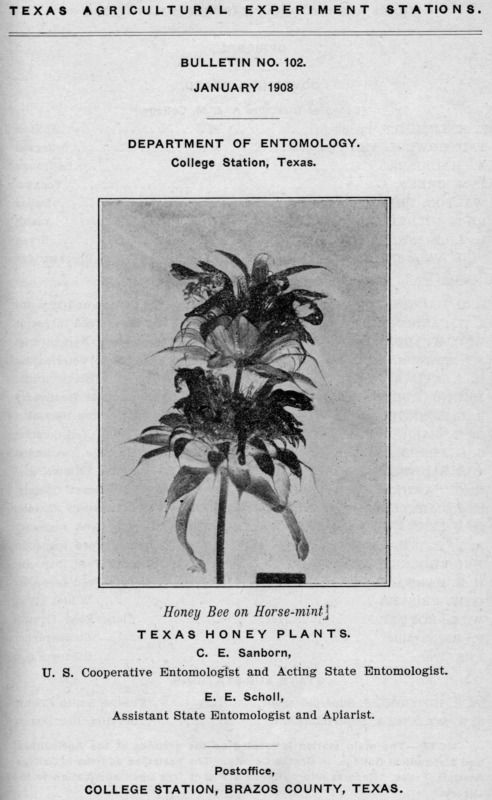
"Throughout Texas." (Coulter). College Station: on dry soils and prairies. Bees work on it well but plants not abundant. May, July.*
"Swamps and along streams throughout Texas." (Coulter). Hunter: along rivers and creeks. Bees work on it. July.*
"Sandy soil, low grounds of Texas to mouth of Rio Grande." (Coulter). Low sandy soils; honey yield good and valuable as it comes during drouth. No surplus. July, August.*
"Sterile plains throughout Texas." (Coulter). In open prairies; honey yield good in fall for winter stores; dark amber and strong flavor. September, October.*
Occurs in all parts of Texas. September. See A. B. C. 173.
"Throughout Eastern and Central Texas. Dr. Harvard remarks that it is one of the commonest weeds about the streets of San Antonio." (Coulter). Hunter: in waste places and open town lots of which it takes possession. Honey yield good in favorable seasons when not too dry. White pollen. April, November.*
"A common weed of waste grounds, extremely variable." (Coulter). Dry upland soils and waste places; probably pollen only. July, August.*
"Low grounds in Southern and Western Texas." (Coulter). Hunter: along field fences and low places. Some honey but more pollen of a resinous nature. July and August.*
"Moist river banks throughout Eastern and Central Texas." (Coulter). College: in low moist creeks and along Brazos river. Honey yield not important, but yields much pollen. July and August.*
"Alluvial shores and waste ground." (Coulter). Hunter: along creeks, in pastures and fields; not important; furnishes pollen late in the fall. September, October.*
"Dry and open ground throughout Texas." (Coulter). Waysides and prairies; of no importance; bees gather propolis from resinous heads sometimes. May, June.*
"Pine woods or sandy soil, Eastern and Southern Texas." (Coulter). "In woods and sandy soil, Arkansas to Alabama and Texas." (Small). Waysides and prairies; of no importance; bees gather propolis from resinous heads sometimes. May, June.*
"Abundant in all valleys." (Coulter). Hunter: along roadsides and in waste fields. Honey yield sometimes good in the fall but strong in flavor. Much propolis gathered from the large composite heads of the flower and stems and leaves of the plant. May, September.*
"Rich dry soil from the Mississippi and Gulf States through Texas to Mexico." (Coulter). In rich soils, lowlands and woodlands; honey yield very abundant, depending upon seasons; fine quality of honey. October.*
"River bottoms, etc., extending from the Gulf and Mississippi States to Western Texas." (Coulter). College: abundant on open woodland prairies and plains of Eastern Texas. Honey yield good in favorable seasons; pollen; honey golden yellow, heavy body but very bitter, as if 50 per cent quinine and some pepper was added. June to October.*
"Extending from plains of Arkansas and Louisiana through Texas to those of Arizona and Mexico." (Coulter). Hunter: waysides and prairies. Honey yield of good quality, dark amber colored. A main yielder of surplus. May, June.*
"Borders of woods and open ground. Common in the Atlantic States and extending into Texas." (Coulter). Hunter: scattered over open prairies; honey yield unimportant; some pollen. July, August.* "Bees working heavily on it in June, 1907 along Guadalupe River, New Braunfels, Texas, where some of the pastures were literally covered with it." (E. Scholl).
"Extending from the plains of Arkansas and Louisiana through Texas to Arizona and adjacent Mexico." (Coulter). Hunter: open prairies and pastures. Not important. July, August.*
"Common everywhere; an introduction from Europe." (Coulter). See A. B. C. of Bee Culture. February.*
Cultivated in flower gardens; honey yield not important; bees only occasionally visiting it. July.*
"Valley of the lower Rio Grande." (Coulter). Specimen sent from the Nueces River. (Cotulla). June.*
"Woods along streams, Matagorda Bay to the Concho River and southward." (Coulter). "Mexicans call it "Chapote," also known as "black persimmon." Often found on rocky mesas but thrives best in canyons and on the edges of ravines." (Harvard). Hunter: in woodlands: honey yield abundant, not harmed by showers on account of bell-shaped flowers. April.*
"A common tree of the Atlantic States. Extending Into Texas to the valley of the Colorado." (Coulter). Throughout East Texas; honey yield good, not long and trees not abundant. Bell-shaped blossoms are protected in rain. April.*
"Thickets and on roadsides, Ontario to Pennsylvania and North Carolina." (Small). Ornamental shrub cultivated for hedges, etc., honey yield good; flowering trees scarce, trimmed and kept down in hedges. April, May.* "A good flow at College Station in 1906." (E. Scholl).
College Station; cultivated ornamental on campus. Honey yield abundant in narrowly funnel-shaped blossoms hanging downward. Nectar runs to mouth of flower. Protected from rains. Corolla 8mm. deep. Long-tongue bees would be of advantage. October, November.*
College Station: cultivated ornamental shrub on campus; honey yield good; bees work on blossom. April.*
Beeville; on plains and prairies. Honey yield good but pollen attaches to bee's feet and cripples them. March.*
"Throughout Texas." (Coulter). Rich places and moist woods; honey yield sparing. April, June.*
"Low prairies Arkansas and East Texas." (Coulter). On prairies Eastern Texas. March, April.*
College: cultivated; honey yield good; bees working busily on it during June. Old stalks die down in July and large lower leaves protect root stock during severe drouth and sprout out for bees to work on bloom in August. June, July.*
Most common in cultivated fields. Honey yield light, pollen. June to November.*
"Plains throughout Texas." (Coulter). Hunter: waste lands, prairies and roadsides. Honey very little; some pollen. May, October.*
"Moist soil, extending from Atlantic and Gulf States into Texas and common in cultivation." (Coulter). Cultivated and along river bottoms: honey yield of little importance; external nectar glands; pollen from flowers. July to October.*
"Waste or open grounds, extending from the Atlantic regions through Texas to tropical America." (Coulter). College Station: in waste open ground. April, August.*
"Extending from Louisiana through Texas to Southern California and Mexico." (Coulter). College: in sandy soils, honey yield sparing and scattering throughout its season. April, August.*
"Low ground extending from the Gulf States to Western Texas." (Coulter). In moist places, rivers and creeks; honey yield very light and of little importance. July.*
"Common on rocky slopes throughout Texas." (Coulter). "Foliage eaten by cattle, sheep and goats." (Harvard). All over Southwest Texas; honey yield very heavy of fine quality but very short duration, only a few days; blooms after each rain during season. May to November.*
"Extending from the Gulf States through Southeastern Texas to tropical America." (Coulter). On light soils of Southwest Texas; unimportant; bees seldom on it. April, October.*
"Rich or moist grounds, extending from Gulf States to Southern Texas." (Coulter). Brazos bottoms, College; rich soil in woods, abundant: honey yield only fair. May.*
"In light fertile soils, Western Texas." (Coulter). Hunter: rich soils in forests. Unimportant as a honey plant; not abundant; deep corollas. May, June.*
"From Gulf States to extreme Western Texas." (Coulter). Hunter: dry soil and waste places; corolla deep and visited much more frequently by bumble bees than honey bees. April, October.*
Cultivated on Apiary Experimental Plats, 1904; only a few plants grew and bloomed. A few bees visited it. Soon died. July.*
"Dry soil throughout Texas, etc." (Coulter). College: along banks of ravines. Honey yield good but plants not abundant. May, July.*
"Eastern and Southern Texas." (Coulter). Prairies and waste land; honey yield abundant; one of the main yielders; honey compared to bass-wood in flavor. May, June.*
"Sandy ground extending from the Atlantic regions to Southern and Western Texas." (Coulter). In open prairies and waste land; honey yield abundant; one of the main crop yielders; honey compared with basswood. May, July.* "A good yielder in Brazos bottoms. College Station, Texas, in 1907, June." (E. Scholl).
"Common throughout Texas in damp rich soil." (Coulter). "On prairies, Kansas to Texas." (Small). Hunter: waste places in fields and prairies. Honey yield abundant in spring; much visited by bees. April, May.*
"A common escape in waste or open ground." (Coulter). Hunter: most all parts of the South; fertile places; fence corners and pens; honey yield abundant; steady flow; dark amber colored. Claimed bitter by some. February, July.*
College; ornament for borders, etc. Honey yield of no importance. Bees gather pollen from it only occasionally. July.*
"Throughout Texas." (Coulter). Waste lands and fields; honey yield of no importance; some pollen. July, September.*
"From Tom Green County to Laredo." (Coulter). Annual weedy herbs. In waste places and cultivated soils presumably pollen only; not important. August.*
"From the upper Pecos to the lower Rio Grande, (Ringgold)." (Coulter). Hunter. Texas; cultivated for shade on verandas; honey yield fair, bees work on it industriously, but the plants are scarce. May, September.*
Cultivated in fields in a small way; honey yield good on favorable moist mornings, not in dry weather. Honey very dark and strong in flavor; not important for bees in Texas. June, July.* "A good yielder to bridge over from early spring flower to cotton bloom at College Station, Texas." (E. Scholl).
"From Eagle Pass to Central Texas. Reported on Ulmus, Prosopis, Quercus, etc." (Coulter). Honey yield abundant and also pollen, very valuable for early brood rearing. The first source for bees in the season. December, January.* "Blooms in January and February if weather is not too cold, yields pollen and honey." (Milam, D. C, Uvalde, Texas).
"Throughout the valleys of the Pecos and Rio Grande." (Coulter). Along valleys and lowlands; honey yield of no importance. June, October.*
"On rocky bluffs of the upper Llano." (Coulter). Hunter: open places in woodland bluffs; honey yield only light, but comes in dearth and good if rains; pollen. July, August.*
"From the Pecos to Southern and Central Texas." (Coulter). Roadsides and prairies; unimportant; some pollen when no other bloom. July, September.* "Plenty of pollen at College Station in August, 1907." (E. Scholl).
"From the staked plains to Corpus Christi." (Coulter). Hunter: roadsides and fields; honey yield very light, not important. June, August.*
"Central and Southern Texas." (Coulter). Hunter: open prairies and pastures; honey yield fair, but unimportant. May, June.
"Cultivated extensively for ornament and sparingly escaped in Missouri and southwestward to Central Mexico." (Coulter). Planted for ornamental purposes; honey yield good in favorable seasons; pollen; has glands at base of leaves. March, April.*
"Extending westward to the streams of Southern and Central Texas." (Coulter). College: along moist creeks and streams; honey yield good but not very plentiful. August.*
"On streams extending to the valley of the Trinity." (Coulter). Tree with corky winged branches, along streams and low soils in woods; honey yield good sometimes giving surplus; much pollen; honey of amber color and strong characteristic aroma. August, September.*
"Very common on all mesas and foot-hills of Western and Southern Texas." (Coulter). Beekeepers value it as an important plant in Southwest Texas. March, April.*
"Extending to Central Texas." (Coulter). In woodlands; much planted for shade; honey yield fair, valuable for pollen in the spring. March, April.*
"Very common in the valleys of Western and Southwestern Texas, 'Palo Blanco'" (Coulter). In woods and valleys, planted for shade; honey yield fair, much pollen, valuable for early brood rearing. March, April.*
"Near waters from Eastern to Central and Southern Texas. Extensively used for hedges." (Coulter). Planted for hedges and timber; honey yield not important on account of scarcity of trees. April.*
"Extending from the Mississippi States to the streams of Central and Southwestern Texas as far west as Fort Concho." (Coulter). Along rivers and creeks; honey yield where plentiful; valuable for brood rearing on account of its pollen. March.*
"Extending to the Valley of the Brazos." (Coulter). College Station, Brazos River. Abundant in the sandy valley land; some honey and pollen. March.*
"Extending from the east to the valley of the Colorado and San Antonio." (Coulter). In forests, along creeks and rivers; some honey, more pollen; good to stimulate bees. March.*
"Sandy or sterile soils, extending from the Atlantic States to Central Texas." (Coulter). In sandy land sections of the country; honey yield inferior but with large amount of pollen; good for early brood rearing. March, April.*
"Common along water courses extending from the Gulf States through Southern and Western Texas to the mountains of New Mexico." (Coulter). Hunter: in forests, honey yield good, poor in quality, dark; valuable for early brood rearing; much pollen. March.*
"Extending to the valleys of the Colorado and San Antonio. Not abundant and timber poor." (Coulter). Along creeks and low-lands; scarce; pollen. March, April.*
"Low grounds extending to the valley of the Colorado." (Coulter). Forests; good honey yield and also pollen; valuable for brood rearing, March, April.*
"Wet grounds extending from the South Atlantic States to the valley of the Colorado." (Coulter). College: along creeks and streams; scarce and scattering; pollen. March.*
"Extending to the valleys of the Colorado and Nueces." (Coulter). In post oak woods in sandy sections of the country; early pollen. March, April.*
"On banks bending over the water of most streams of Western Texas." (Coulter). Along rivers and creeks; honey yield good and valuable for brood rearing, and for abundance of pollen. February to April.*
"Extending into the mountains of Western Texas." (Coulter). Lowlands and along streams; some honey but more pollen; valuable for early brood rearing. March.*
"Abundant along the Rio Grande and Pecos." (Coulter). "In thickets Massachusetts to Florida and Texas. Stretch berry." (Small). In thickets; honey yield fair; bees work on it well, but of short duration. April.*
"In waste places and salt marshes. New Brunswick to Georgia and Louisiana. Naturalized from Europe." (Small). Cultivated for its young shoots for food; honey yield of no importance, but good for pollen. March, April.*
"Moist thickets and borders of rivers southern and southwestern Texas." (Coulter). Hunter: moist fence corners and open woods; honey yield unimportant, valuable for pollen. April, May.*
"On plains or prairies, Texas." (Small). New Braunfels; in and about hedges of woodlands; honey yield unimportant but good for early pollen. March, May.*
Hunter: cultivated for hay crops, etc., valuable for abundant yield of pollen; some honey. June, August.*
"Cultivated in fields for grain; honey yield not positively known; valuable for its pollen in abundance. May, June.*
INDEX
Latin or Technical Names.
- Acacia amentacea
- Acacia Berlandiera
- Acacia Farnesiana
- Acacia Greggii
- Acacia Roemeriana
- Ailanthus glandulosus
- Amaranthaceae
- Amaranthus retroflexus
- Amaranthus spinosus
- Ambrosia aptera
- Ambrosia artemisiaefolia
- Ambrosia trifida
- Ampelidaceae
- Amygdalus Persica
- Anacardiaceae
- Anredera scandens
- Argemone platyceras
- Asclepiadeae
- Asclepias sp
- Asparagus officinalis
- Astragalus Mexicanus
- Berberideae
- Berberis trifoliata
- Bignoniaceae
- Berchemia scandens
- Borage officinalis
- Boragineae
- Brassica nigra
- Brassica rapa
- Bumelia angustifolia
- Callicarpa Americana
- Callirrhoe digitata
- Cactaceae
- Campsis radicans
- Caprifoliaceae
- Cardiospermum Halicacabum
- Celtis pallida
- Celtis occidentalis
- Celtis Mississippiensis
- Centaurea Americana
- Cephalanthus occidentalis
- Cercis Canadensis
- Cercis occidentalis
- Chenopodiaceae
- Cissus incisa
- Citrullus Citrullus
- Citrus trifoliata
- Cnicus altissimus
- Coleus blumei
- Columbrina Texensis
- Commelinaceae
- Commelina Virginica
- Compositae
- Condalia obovata
- Convolvulaceae
- Cornaceae
- Cornus asperifolia
- Crataegus arborescens
- Crataegus spathulata
- Croton Capitatus
- Croton monanthogynus
- Croton Sonorae
- Croton Texensis
- Cruciferae
- Cucumis Melo
- Cucumis sativa
- Cucurbitaceae
- Cucurbita foetidissima
- Cucurbita pepo
- Cupuliferae
- Daubentonia longifolia
- Diodia teres
- Diospyros Texana
- Diospyros Virginiana
- Dolichos lablab
- Ebenaceae
- Elaeagnaceae
- Elaeagnus angustifolia
- Elaeagnus argentia
- Euphorbiaceae
- Euphorbia marginata
- Eysenhardtia amorphoides
- Firmiana platinifolia
- Fagopyrum fagopyrum
- Gaillardia pulchella
- Gaura filiformis
- Geraniaceae
- Gleditschia triacanthos
- Gossypium herbaceum
- Gramineae
- Greggia camporum
- Gutierrezia Texana
- Helenium tenuifolium
- Helianthus annuus
- Hibiscus syriacus
- Hicoria alba
- Hicoria Pecan
- Houstonia angustifolia
- Hydrophyllaceae
- Ilex Caroliniana
- Ilex decidua
- Ilicineae
- Ipomoea Caroliniana
- Juglandeae
- Juglans nigra
- Jussiaea diffusa
- Jussiaea repens
- Kallstroemia maxima
- Labiatae
- Lagerstroemia Indica
- Lantana Camara
- Leguminosae
- Lepidium virginicum
- Ligustrum vulgare
- Liliaceae
- Lippia ligustrina
- Lippia nodiflora
- Lonicera albiflora
- Lonicera fragrantissima
- Loranthaceae
- Lupinus subcarnosus
- Lythraceae
- Malus malus
- Malvaceae
- Malvaviscus drummondii
- Marrubium vulgare
- Medicago denticulata
- Medicago sativa
- Meliaceae
- Melia azedarach
- Melilotus alba
- Melilotus officinalis
- Monarda clinopodioides
- Monarda fistulosa
- Monarda punctata
- Nepeta cataria
- Neptunia lutea
- Oleaceae
- Onagrarieae
- Opuntia englemannii
- Oxalis stricta
- Papaveraceae
- Papaver rhoeas
- Parkinsonia aculeata
- Parthenium Hysterophorus
- Phacelia congesta
- Phacelia glabra
- Phoradendron flavescens
- Pisum sativum
- Polygonaceae
- Populus monilifera
- Portulaceae
- Portulaca grandiflora
- Prosopis juliflora
- Prunus (sp.)
- Prunus domestica
- Ptelea trifoliata
- Pyrus communis
- Quercus aquatica
- Quercus minor
- Quercus nigra
- Quercus palustris
- Quercus rubra
- Quercus Virginiana
- Reseda odorata
- Resedaceae
- Rhamneae
- Rhus copallina
- Rhus virens
- Ricinus communis
- Robinia Pseudacacia
- Rosa
- Rosaceae
- Rudbeckia bicolor
- Rudbeckia hirta
- Rubiaceae
- Rubus trivialis
- Rutaceae
- Salicineae
- Salix nigra
- Salvia azurea
- Salvia Roemeriana
- Sambucus Canadensis
- Sapindaceae
- Sapindus marginatus
- Sapotaceae
- Schrankia angustata
- Scutellaria drummondii
- Sida spinosa
- Sida angustifolia
- Simarubaceae
- Smilax bona-nox
- Solanaceae
- Solanum rostratum
- Solidago sp. (?)
- Sorghum vulgare
- Spiraea Virginiana
- Symphoricarpos symphorlcarpos
- Tagetes patalus
- Tamariscineae
- Tamarix gallica
- Taraxacum officinale
- Tilia Americana
- Tiliaceae
- Toxylon pomiferum
- Tradescantia gigantea
- Tribulus cistoides
- Trifolium pratense
- Trifolium repens
- Ulmus Americana
- Ulmus alata
- Ungnadia speciosa
- Urticaceae
- Verbenaceae
- Verbena urticaefolia
- Verbena xutha
- Verbesina Virginica
- Vigna sinensis (Var. ?)
- Vigna (sp).
- Virburnum prunifolium
- Vitis monticola
- Vitis (?) (Varieties)
- Xanthium Canadense
- Xanthoxylum clava-Herculis
- Zea mays
- Zygophylleae
INDEX
Vernacular or Common Names.
- Alfalfa or Lucerne
- Amaranth family
- American Knapweed
- American mistletoe
- American or White elm
- Apple
- Appodilla family
- Asparagus
- Barberry family
- Basswood. American linden
- Bean-caper family
- Bigonia family
- Black haw
- Black jack or Barren oak
- Black locust
- Black walnut
- Black willow
- Blue lupine. Bluebonnet
- Blue sage
- Blue thistle
- Blue vervain
- Borage
- Borage family
- Brasil wood
- Bridal wreath
- Broomweed
- Buckthorn family
- Buckwheat family
- Bush honeysuckle
- Button bush
- Button weed
- Cactus family
- California privet
- Cassia
- Castor-oil plant
- Catnip
- Catsclaw
- Cockle-burr. Clot-burr
- Coleus
- Common Balloon Vine
- Common cactus or Prickly pear
- Common hoarhound
- Common pigweed
- Common pumpkin
- Common Sunflower
- Common turnip
- Composite family
- Cone flower. Nigger Head
- Convolvulus family
- Coral berry. Indian currant
- Cotton
- Cottonwood. Necklace poplar
- Cow itch
- Crepe myrtle
- Cucumber
- Cultivated wine grapes
- Cow pea
- Dandelion
- Dense-flowered phacelia
- Devils claws
- Dew-berry
- Dogwood family
- Drummond's skull-cap
- Dwarf sumach
- Ebony family
- Elder
- Evening primrose family
- Eysenhardtia
- French mulberry
- Fringed poppy mallow
- Garden pea
- Geranium family
- Goldenrod
- Goosefoot family
- Gourd family
- Grass family
- Granjeno
- Greater caltrop
- Great ragweed
- Green briar. Cat briar
- Green sumach
- Greggia
- Hardy orange
- Hackberry
- Hawthorn. White thorn
- Holly family
- Honey locust
- Honey suckle family
- Hop tree
- Horse-mint
- Houstonia
- Huajilla
- Huisache
- Indian corn
- Japanese buckwheat
- Japanese delchos
- Japanese varnish tree
- Jussiaea
- Lantana
- Large-flowered caltrop
- Large-flowered verbena
- Lily family
- Linden family
- Live oak
- Loose strife family
- Madder family
- Madeira vine
- Mallow family
- Marigold
- Medick. Burr clover
- Melia family
- Mezquit tree. Screw bean
- Mexican buckeye
- Mexican ground plum
- Mexican persimmon
- Mignonette
- Mignonette family
- Milk weed family
- Mint family
- Mistletoe family
- Mockernut. Whiteheart Hickory
- Morning glory
- Mountain grape
- Musk melon
- Mustard family
- Narrow-leafed iron wood
- Narrow-leafed sida
- Nettle family
- Night-shade
- Night-shade family
- Oak family
- Oleaster family
- Olive family
- One-seeded croton
- Osage orange
- Paradise flower
- Peach
- Pear
- Pecan-nut
- Persimmon (common)
- Peppergrass. Pepperwort
- Plum
- Poppy family
- Portulaca
- Possum haw. Bear berry
- Post oak
- Prickly poppy
- Pulse family
- Purslane family
- Quassia family
- Rattan vine
- Red bud
- Red bud. Judas tree
- Red clover
- Red oak
- Retama
- Roemer's sage
- Roman wormwood
- Rose
- Rose family
- Rose of sharon. Shrubby althaea
- Round-flowered catsclaw
- Rue family
- Salt cedar
- Sensitive briar
- Silk weed
- Silver berry
- Sneeze weed. Bitter weed
- Soapberry. Wild china
- Soapberry family
- Sonora croton
- Sorgum
- Spanish apple
- Spatulate-leafed fog-fruit
- Spiderwort family
- Spring sida
- Spurge
- Spurge family
- Sumach family
- Swamp, Spanish, or Pin oak
- Sweet clover
- Sweet olive
- Tall ragweed
- Tamarisc family
- Texas croton
- Thorny amaranth
- Tooth-ache tree. Prickly ash. Sea ash. Pepperwood
- Tree of heaven
- Triple-leafed barberry
- Trumpet creeper. Trumpet flower
- Umbrella china tree
- Vervain family
- Vine family
- Virginian crown-beard
- Virginian spiderwort
- Walnut family
- Water-leaf family
- Watermelon
- Water oak
- White brush
- White clover
- White-flowered honey suckle
- Willow family
- Wild bergamont
- Wild gourd
- Wild plum
- Winged elm or Wahoo
- Yellow Wood sorrel
- Yellow sweet clover
- Youpon