
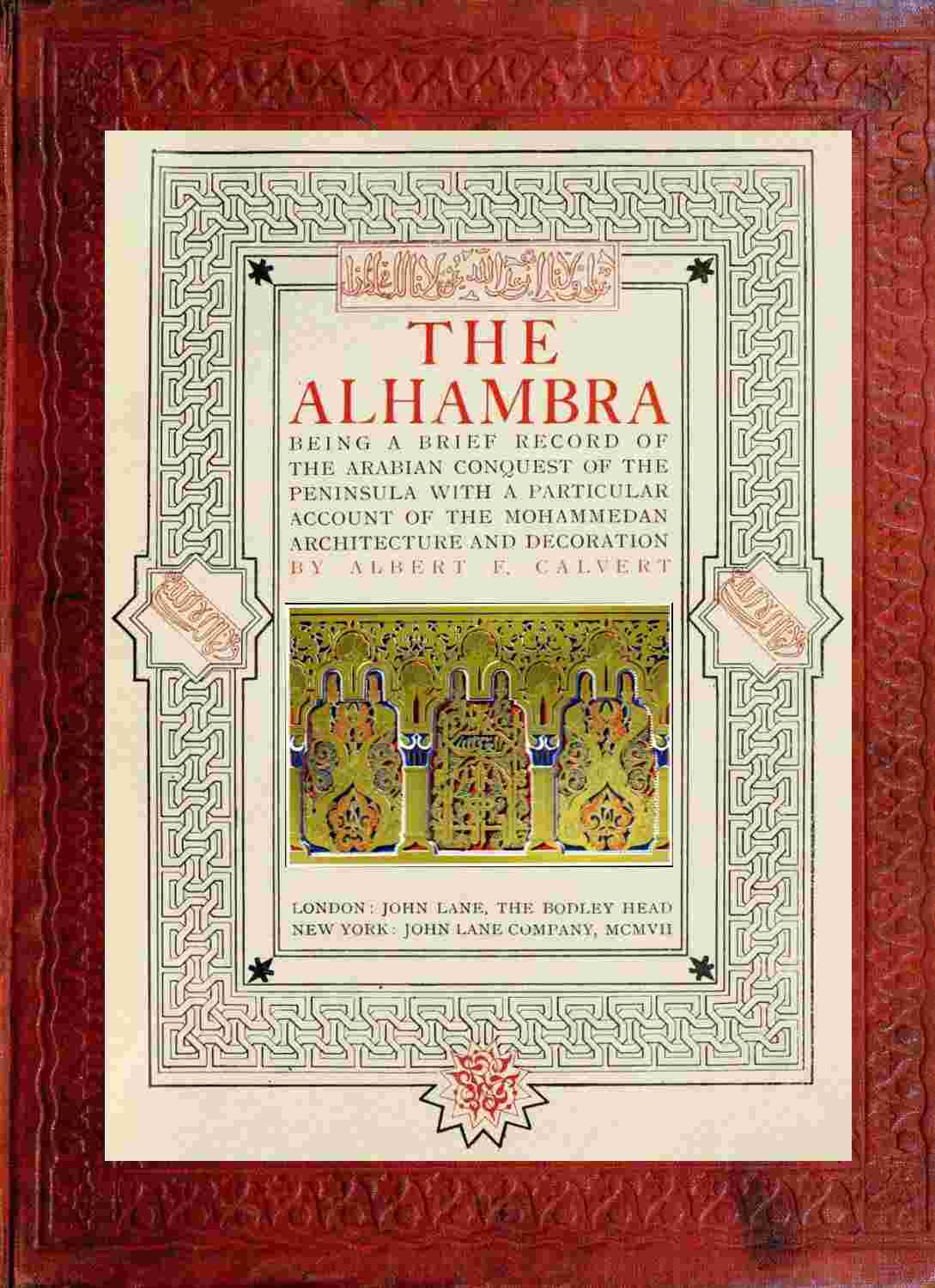
The Project Gutenberg eBook of The Alhambra
Title: The Alhambra
Author: Albert Frederick Calvert
Release date: March 15, 2021 [eBook #64822]
Most recently updated: October 18, 2024
Language: English
Credits: Chuck Greif and the Online Distributed Proofreading Team at http://www.pgdp.net (This file was produced from images available at The Internet Archive)
|
List of Illustrations Index: A, B, C, D, E, F, G, H, I, J, K, L, M, P, Q, S, T, V, W, X, Y, Z (etext transcriber's note) |
THE ALHAMBRA
Has not seen a marvel great;
Who to Granada has not been
Can have nothing to relate.
THE
ALHAMBRA
THE ARABIAN CONQUEST OF THE
PENINSULA WITH A PARTICULAR
ACCOUNT OF THE MOHAMMEDAN
ARCHITECTURE AND DECORATION
B Y A L B E RT F. C A L V E R T
LONDON: JOHN LANE, THE BODLEY HEAD
NEW YORK: JOHN LANE COMPANY, MCMVII
E. Goodman and Son, The Phœnix Press, Taunton.
TO
HIS MAJESTY KING ALFONSO XIII.
Sire,
The great interest your Majesty has evinced in the Moorish Monuments
which adorn your Majesty’s loyal and noble country, and the gracious
appreciation with which you were pleased to regard my first work on The
Alhambra, inspired me with the presumption to solicit the honour of your
Majesty’s August Patronage for this volume, which is humbly dedicated to
your Majesty agreeably to your gracious permission, by
Your Majesty’s humble Servant,
Albert F. Calvert.
PREFACE
ALTHOUGH the admission may be construed by the censorious as betraying a lack of becoming diffidence, I am tempted to believe that no apology will be demanded for the publication of this volume by that section of the reading public for which it has been chiefly compiled. My temerity goes even further, and I anticipate with some confidence that visitors to the Alhambra, and pilgrims to that glorious Mecca of Moorish workmanship will recognise in this book an earnest attempt to supply a long-felt want. When I paid my first visit to Granada some years ago, I was surprised and disappointed to find that no such thing as an even fairly adequate illustrated souvenir of this “city of the dawn” was to be obtained. Many tomes, costly and valuable (not necessarily the same thing), have been written to place on record the wonders of “the glorious sanctuary of Spain,” but these are beyond the reach of the general public. Many beautiful pictures have caught odd ecstasies of this superb and perfectly harmonised palace of art, but these impressions are not available to the ordinary tourist.
What is wanted, as I imagine, is a concise history and description of the Alhambra, illustrated with a series of pictures constituting a tangible remembrancer of the delights of this Granadian paradise
A torch to give thee light!”
The Alhambra may be likened to an exquisite opera which can only be appreciated to the full when one is under the spell of its magic influence. But as the witchery of an inspired score can be recalled by the sound of an air whistled in the street, so—it is my hope—the pale ghost of this Moorish fairy-land may live again in the memories of travellers through the medium of this pictorial epitome.
I desire, however, to submit an explanation—or excuse—for the unusual form in which this volume is issued. At the commencement of my work I experienced no little difficulty in collecting the requisite illustrations, for most of the obtainable photographs were ill-chosen and but carelessly developed, and I was compelled to press my own cameras into the service of my scheme. But when my designs became known, I was inundated with offers of pictures of every description until the embarrassment of artistic treasures entirely upset the original purpose of my book. Artists placed their studies at my disposal; collectors begged me, with irresistible Spanish courtesy, to regard their galleries as my own; and students directed my attention to little known publications on the subject.
Don Mariano Contreras, Conservator of the Alhambra, the son of the gifted Raphaël Contreras, who devoted thirty-seven years of his life to the restoration of the Palace—gave me the benefit of his knowledge of this unique treasure-house of art; and I have also laid under contribution the beautiful plates of Owen Jones, who disposed of a Welsh inheritance in order to produce his great work on the Plans, Elevations, Sections and Details of the Alhambra. Jones’s Grammar of Ornament, which has been described as “beautiful enough to be the horn-book of the Angels,” also contains the result of his researches in the Alhambra, which occupied him for the greater part of eleven years. A selection of these illustrations is here rescued from the obscurity of public libraries and the inaccessible recesses of private collections. The inclusion of John F. Lewis’s drawings, and the reproduction of a series of pictures by James C. Murphy, who spent seven years in the study of the artistic marvels of the Alhambra, I do not feel called upon to defend. The photographs, several of which were placed at my disposal by Don Rafaël Garzón, represent the buildings as they appear to-day; the drawings were made before the Palace was damaged by the disastrous fire of September, 1890.
For the historical portions of the description contained in the letterpress I have levied tribute on a variety of authors. The History of the Mohammedan Dynasties in Spain, by the learned Spanish Orientalist, Don Pascual de Gayángos; Raphaël Contreras’ Etude Descriptive des Monuments Arabes; Richard Ford’s reverent appreciations; Dr. R. Dozy’s history; Mr. Stanley Lane-Poole’s The Moors in Spain; Washington Irving’s fascinating writings; and The Alhambra Album, presented by Prince Dolgorouki in 1829, containing the autographs, poems and thoughts of succeeding generations of visitors to Granada, these and many others have been drawn upon in the following pages.
But the multiplicity of my illustrations convinced me that if I adhered to my idea of furnishing an amount of letterpress sufficient to “carry” the blocks, I should only end in producing a book that would tax the physical endurance of my readers by reason of its bulk, and exhaust their patience with a tedious superabundance of minute descriptive pabulum. I resolved, therefore, to give pride of place to the pictorial side of the volume; to abandon the traditions regulating the proportions of prose to pictures; and make my appeal to the public by the beauty and variety of the illustrations I have collected, and the immensity of elaborate letterpress which I have not written.
A. F. C.
“Royston,”
Hampstead, N.W., 1904.
PREFACE TO SECOND EDITION
THE compilation of a book of this kind reveals in the author a refreshing optimism which does not always survive the ordeal of publication, and it is perhaps out of sympathy with the misgivings that assail him as he approaches the bar of public and critical opinion, that convention cedes to him the privilege of making some apology for the faith that is in him. In his preface he is permitted to explain himself, and this apologia or justification, call it which you will, stands as the last word in his own defence. But the demand for a further edition is the outcome of an amiable conspiracy on the part of the public, and it is not required of the author to explain, justify, or excuse an issue for which he is not directly responsible. Any revision or amplification, however, which is to be found in a second impression, may be briefly referred to, and at the same time tradition allows him to express the feelings of gratitude and gratification that the occasion inspires. It has been my ambition to acknowledge the favour with which this book has been received, by having this edition produced with the greatest care on special paper, and by the addition of a number of new illustrations, including some half-tone and coloured plates reproduced from the Monumentos Arquitectonicos de España and others, which I have acquired since it was first produced. It will be seen that several of the coloured pictures illustrate designs which are common to the Arabian ornamentation to be found in Cordova and Seville, and as being representative of the Moresco work of the period, they also appear in the companion volume on “Moorish Remains in Spain,” but it may be stated that the whole of the plates reproduced here are from photographs and drawings secured, or specially made to illustrate The Alhambra. In its pictorial appeal it has been my ambition to make this edition as worthy of its subject as means and ability permit, and I offer this assurance as an earnest of my sincere appreciation of the generous manner in which the Press and public rewarded my previous effort.
List of Illustrations.
| Page | |
| Frontispiece | |
| Panels and Inscriptions in the Alhambra | xxxiii. |
| Various Mosaics from the Alhambra | xxxvii. |
| Panel Ornament in the Alhambra | xxxix. |
| Fret.—Fig. 1. Formed by the Interlacing of Lines | xli. |
| Fret.—Fig. 2. Formed by the Interlacing of Lines | xlii. |
| Plan of General Construction of Central Ornament of Ceilings | xliii. |
| Section of the Columns and Arches of General Construction in the Palace | xliv. |
| Diagrams | xlv. |
| Miscellaneous Ornament in the Alhambra | xlvii. |
| Cornices, Capitals, and Columns in the Alhambra | xlix. |
| Capitals from the Courts and Halls of the Alhambra | li. |
| View of Granada, Showing the Alhambra and the Sierra Nevada | 2 |
| General View of the Alhambra from San Nicolas | 3 |
| Part of the Alhambra, Exterior | 4 |
| The Alhambra and the Sierra Nevada | 5 |
| Ascent to the Alhambra by the Cuesta Del Rey Chico—Lesser King Hill | 7 |
| Balcony of the “Captive” (Isabel de Solis), Overlooking The Vega, or Plain, of Granada | 8 |
| Alcove of the “Captive” | 9 |
| Interior of the “Captive’s” Tower | 11 |
| The Gothic Inscription set up in the Alhambra by the Count of Tendilla, to Commemorate the Surrender of the Fortress in 1492 | 14 |
| The Surrender of Granada by Boabdil to Ferdinand and Isabella, January 2nd, 1492 | 15 |
| Gold Coin (Obverse and Reverse) of Mohammed I., the Founder of the Alhambra, who Reigned 1232-1272 a.d. | 21 |
| “Wa La Ghalib Ila Alá!”—There is no Conqueror but God!—the Famous Motto, in Kufic Characters, of Mohammed I. and his Successors, which is Inscribed on the Walls of the Alhambra in Countless Repetition | 25, 51 |
| The Wine Gate, Attributed to Yúsuf I. | 29 |
| Hall of the Two Sisters from the Entrance Door, Built by Yúsuf I. | 30 |
| The Sultán’s Bath, Constructed by Yúsuf I. | 31 |
| Court of Myrtles, or of the Fish-pond, Formed by Yúsuf I. | 32 |
| The Korán Recess in the Mosque, the Scene of Yúsuf’s Assassination | 33 |
| The Gate of Justice, Erected by Yúsuf I. | 37 |
| Hall of Justice and Court of the Lions | 39 |
| Hall of Justice | 41, 43 |
| Hall of Justice, Showing Fountain of Court of the Lions | 42 |
| Hall of Justice and Part of Court of the Lions | 45 |
| Hall of Justice.—Three Figures from the Picture of the Moorish Tribunal | 45 |
| Part of Picture in the Hall of Justice Representing a Christian Knight Rescuing a Maiden from a Wicked Magician, or Wild-man-o’-the-woods. The Christian Knight is, in turn, Slain by a Moorish Warrior | 47 |
| Hall of Justice.—Moor’s Head | 48 |
| Façade, Court of the Mosque, Built by Yúsuf I. | 49 |
| Elevation of the Ancient Gate of Justice | 53 |
| Sections of the Hall of Justice | 55 |
| Paintings on the Ceiling of the Hall of Justice | 57, 59 |
| Part of Picture in the Hall of Justice.—the Moor’s Return from Hunting | 61 |
| Hall of Justice.—The Death of the Lion at the Hands of a Christian Knight | 63 |
| Part of Picture in Hall of Justice.—Moorish Huntsman Slaying the Wild Boar | 63 |
| Entrance to Hall of the Two Sisters, from the Court of Lions | 65 |
| Hall of the Two Sisters, from Entrance Door | 66 |
| Hall of the Two Sisters | 67, 79, 113 |
| Upper Balcony of the Hall of the Two Sisters | 68 |
| Hall of the Two Sisters, from the “Lindaraja” Balcony | 69 |
| Balcony of the Favourite, “Lindaraja” | 71 |
| Details of the Glazed Tiles in the Dado of the Hall of the Two Sisters | 73 |
| The Favourite’s Balcony | 76 |
| El Jarro. The Arabian Vase and Niche in which it Formerly Stood, Hall of the Two Sisters. The Vase, Considerably Mutilated, is now in the Museum of the Palace | 77, 95 |
| Hall of the Two Sisters | 79 |
| View in the Hall of the Two Sisters | 81 |
| Detail of the Upper Story, Hall of the Two Sisters | 83 |
| Section of the Hall of the Two Sisters, and Section of Part of the Court of the Lions | 84, 85 |
| Inscriptions in the Hall of the Two Sisters | 87, 89 |
| Panel, Ornament, and Inscriptions in the Hall of the Two Sisters | 91 |
| Details on the Front of “Lindaraja’s” Balcony | 93 |
| Details at the Exit of the Hall of the Two Sisters | 97 |
| An Arab Vase of the XIVth Century in the Niche Wherein it Stood until the Year 1837 | 99 |
| Mosaic in Dado of the Entrance to the Hall of the Two Sisters | 100 |
| Mosaic in Dado of Recess, Hall of the Two Sisters | 101 |
| Mosaic in Dado, Hall of the Two Sisters | 101 |
| Hall of the Abencerrages (Beni Cerraj) | 105 |
| Mosaic—Hall of the Abencerrages | 107 |
| Hall of the Abencerrages | 109, 119, 121 |
| Wooden Door, Hall of the Abencerrages | 111 |
| Interior View, Taken from the Hall of the Two Sisters | 115 |
| Ceiling of the Hall of the Two Sisters | 117 |
| Ceiling of the Hall of the Abencerrages | 124 |
| Mosaic, from a Fragment in the Alhambra | 125 |
| Mosaic, North Side of the Court of the Lions | 125 |
| Chief Gate of the Alhambra | 127 |
| Transversal Section of the Alhambra | 129 |
| Section Showing Heights of the Alhambra | 131 |
| Elevation of the “Wine Gate” | 133 |
| The Gate of Judgment | 135 |
| Porch of the Gate of Judgment | 137 |
| A Section of the Gate of Judgment | 139 |
| Interior Perspective of the Alhambra | 141 |
| View of the Aqueduct, Near the Alhambra | 143 |
| A View of the Alhambra from the Albaycin | 145 |
| Gate of Justice | 147 |
| North Side of the Court of the Fish-pond | 151 |
| Elevation of an Alcove in the Court of the Fish-pond | 153 |
| Elevation of the Arcade on the North Side of the Court of the Fish-pond | 155 |
| Section through Part of the Court of the Fish-pond and the Hall of the Ambassadors | 157 |
| The Baths; Hall of Repose | 159 |
| Ground Plan of the Baths in the Alhambra | 161 |
| Section of the Hall of the Baths | 163 |
| A Section of the Baths in the Alhambra | 165 |
| The Sultána’s Bath | 167 |
| The Sultán’s Bath | 169 |
| The Hall of the Baths | 171 |
| Ceiling of the Hall of the Baths | 173 |
| Longitudinal Section through the Baths | 175 |
| The Court of the Fish-pond; or, of the Myrtles | 177, 181, 191 |
| Gallery, the Court of the Fish-pond; or, of the Myrtles | 179 |
| Details of the Gallery in the Court of the Fish-pond; or, of the Myrtles | 183 |
| Court of the Fish-pond | 185, 193 |
| Entrance to the Court of the Fish-pond; or, of the Myrtles | 187 |
| Ornament in the Court of the Fish-pond; or, of the Myrtles | 189 |
| Gallery in the Court of the Fish-pond; or, of the Myrtles | 195 |
| Entrance to the Court of the Lions | 196 |
| Mosaic, South Side of the Court of the Lions | 196 |
| Fountain and East Temple in the Court of the Lions | 197 |
| The Court of the Lions | 198, 199, 201, 213 |
| General View of the Court of the Lions | 203, 207 |
| Little Temple in the Court of the Lions | 205 |
| Fountain in the Court of the Lions | 205 |
| A Little Temple in the Court of the Lions | 206 |
| A Peep into the Court of the Lions | 206 |
| The Court of the Lions, from the West | 209 |
| Temple in the Court of the Lions | 211 |
| Side Elevation of the Court of the Lions and Fountain | 215 |
| Elevation of the Fountain of the Lions | 217 |
| Fountain of the Lions, with Details of the Ornament | 219 |
| Plan of the Basin of the Fountain of the Lions | 221 |
| The First Six Verses of the Inscription Around the Basin of the Fountain of the Lions | 223 |
| The Last Six Verses of the Inscription Around the Basin of the Fountain of the Lions | 225 |
| Entablature in the Court of the Lions | 227 |
| Details of the Centre Arcade of the Court of the Lions | 229 |
| Part of Panel in the Court of the Lions | 231 |
| Entrance to the Court of the Lions | 233, 237 |
| Entrance to the Court of the Lions (Upper Portion) | 235 |
| Longitudinal Section of the Court of the Lions, Taken Through the Pavilion at Each End of the Court, and Exhibiting an Elevation of the Side Porticos | 238, 239 |
| Capitals in the Court of the Lions, with a Measure of one Metre | 241 |
| North Gallery in the Court of the Lions | 243 |
| Entrance to the Hall of the Barque, with View of the Court of the Fish-pond; or, of the Myrtles | 245 |
| The Hall of Ambassadors | 247, 253 |
| Mosaic in Dado, Hall of Ambassadors | 248 |
| General View of the Hall of Ambassadors | 249, 251 |
| Entrance to the Hall of the Barque, the Ante-room of the Hall of Ambassadors | 255 |
| Perspective View of the Hall of Ambassadors | 257 |
| Section and Elevation of the Interior of the Hall of Ambassadors | 259 |
| Detail in the Hall of Ambassadors | 261 |
| Kufic Inscriptions, Hall of Ambassadors | 263 |
| Mosaic on Dado of Balcony, Hall of Ambassadors | 265 |
| Ornament from the Side of a Window, Hall of Ambassadors | 267, 279, 285, 287 |
| Mural Ornament, Entrance to the Hall of Ambassadors | 269 |
| Ornament at the Side of Doorway, Entrance to the Hall of Ambassadors | 271 |
| An Arabian Ornament, Hall of Ambassadors | 273 |
| An Arabian Ornament, Entrance to the Hall of Ambassadors | 275 |
| Inscriptions and Ornament, Hall of Ambassadors | 277 |
| Inscriptions in the Hall of Ambassadors | 281 |
| Mural Ornament, Hall of Ambassadors | 283 |
| Ornament from the Side of a Window, North Front of the Hall of Ambassadors | 289 |
| Ornament in the Side of a Window, Hall of Ambassadors | 291 |
| A Ceiling in Outline, Hall of Ambassadors | 293 |
| The Ceiling of the Dome Laid Flat, Hall of Ambassadors | 295 |
| Details of Glazed Tiles in the Hall of Ambassadors | 297 |
| Mosaic in Dado, East Side of the Hall of Ambassadors | 299 |
| Mosaic in Dado, North Side of the Hall of Ambassadors | 299 |
| Mosaics in Dado, Hall of Ambassadors | 301 |
| Ceiling of Gallery, Hall of Ambassadors | 303 |
| Exterior of the Mosque (Private Property) | 304 |
| Façade of the Mosque | 305 |
| Elevation of Portico Adjacent to the Mosque | 307 |
| Details of Ornament of Korán Recess Near the Entrance Door of the Mosque | 309 |
| Details of Ornament in the Court of the Mosque | 311 |
| Details in the Court of the Mosque, Eastern Façade | 313 |
| Arched Windows of the Mosque | 315 |
| Interior of the Mosque | 317, 319 |
| The Mosque, from Korán Recess | 319 |
| Arab Lamp in the Mosque | 321 |
| Chamber of Repose | 324, 325, 327 |
| Garden of “Lindaraja,” and the Apartments Traditionally said to have been Occupied by “Lindaraja,” a Favourite Sultána | 328 |
| The Garden of “Lindaraja” | 329 |
| Mosaic Pavement in the Queen’s Dressing-room (Tocador de la Reina) | 331, 440 |
| “The Queen’s Dressing-room,” at the Summit of the Mihráb Tower, with Distant View of the Generalife | 332 |
| Towers and Promenade | 333 |
| The Tower of the Peaks | 336 |
| The Homage Tower, Ancient Arab Ruins in the Alcazába | 337 |
| Granada, from the Homage Tower | 337 |
| The Captive’s Tower | 339 |
| Interior of the Infantas Tower | 339 |
| Tower of Infantas | 341, 345 |
| Interior of the Infantas Tower (Ceiling) | 343 |
| Room in the Torre del Cautivo, or Captive’s Tower | 347 |
| The Ladies’ Tower | 347 |
| Torre de la Aqua—Tower of the Aqueduct | 349 |
| Detail of the only Ancient Jalousie Remaining in the Alhambra | 349 |
| The Infantas Tower | 351 |
| Details of the Entrance Door to the Museum | 353 |
| Bas-relief, now in the Museum of the Alhambra | 355 |
| Bas-relief, from an Engraving in Murphy’s Arabian Antiquities | 355 |
| Palace of Charles V. | 356, 361 |
| Elevation of Section of the Palace of Charles V. | 357 |
| Interior, Palace of Charles V. | 359 |
| Roman Court, Palace of Charles V. | 363 |
| Plan of the Alhambra | 365 |
| Ground Floor Plan of the Alhambra, and of the Foundations of the Palace of Charles V. | 367 |
| Plan of the Palace of Charles V., and of the Subterranean Vaults of the Alhambra | 369 |
| Hall of Justice | 371 |
| Sunk Lines on the Walls, Hall of Justice and Court of the Lions | 373 |
| Frieze in the Hall of the Two Sisters | 375 |
| Panel on Jambs of Doorways, Hall of the Two Sisters | 375 |
| Ornament in Panels, Hall of the Barque | 377 |
| Ornament in Panels, Hall of Ambassadors | 377 |
| Cornice over Columns, Court of the Lions | 379 |
| Frieze over Columns, Court of the Lions | 379 |
| Band Round Panels in Windows, Hall of the Two Sisters | 381 |
| Panelling in Windows, Hall of Ambassadors | 381 |
| Ornament in Panels, Court of the Mosque | 383 |
| Ornaments at the Junctions of Inscriptions, Court of the Lions, and Court of the Fish-pond | 385 |
| Sunk Lines on the Walls, House of the Commandant | 387 |
| Ornament in Panels, Hall of Ambassadors | 389 |
| Details of the Ornaments which are Introduced into the Painting over the Centre Alcove of the Hall of Justice | 391 |
| Details and Arabian Inscriptions | 393 |
| Details of Arabian Work | 395 |
| Details and Inscriptions and Arabian Chapiters | 397 |
| Details of Arabian Work | 399 |
| Ground Plan of the Generalife at Granada | 403 |
| The Generalife | 405, 407, 413 |
| A View of the Royal Villa of the Generalife at Granada | 409 |
| Transverse Section of the Royal Villa of the Generalife at Granada | 411 |
| Garden of the Generalife | 415 |
| Perspective View of the Garden of the Generalife | 417 |
| Elevation and Ground Plan of the Portico of the Generalife | 419 |
| Mosaic, Portico of the Generalife | 421 |
| Front View of the Portico of the Generalife | 423 |
| A Ceiling in the Generalife | 425 |
| Generalife (Portrait Gallery), Entrance to the Gallery of Retratos | 427 |
| Gallery in the Acequia Court, Generalife | 427, 437 |
| Gallery in the Generalife | 429 |
| The Acequia Court, Generalife | 431, 435 |
| The Acequia Court, from the Main Entrance, Generalife | 433 |
| A Corner of the Acequia Court, Generalife | 435 |
| Cypress Court, Generalife | 437 |
| Mosaic Pavement in the Dressing-room of the Sultána | 440 |
| Sabre of the Last Moorish King of Granada | 441 |
| Elevation of the Casa del Carbon, or “House of Carbon,” once Known as the House of the Weather-cock | 443 |
| House of Sanchez | 445 |
| Plan and Section of the Great Cistern in the Alhambra | 447 |