
We have followed the generally accepted view and begun the year with the day Kan, though some students follow Mr. J. T. Goodman in his belief that Ik represents the first day. Whoever is right, it is certain that the year can begin with its first day-name only once every four years. If a year begins with Kan, it must, as shown in our table, inevitably finish with the day Lamat. Thus the following day, the first in the New Year, would be Muluc. In the same way the second year will finish with Ben and the third year will commence with Ix. This will finish with Ezenab and the new one would commence with Cauac and finish with Akbal, when Kan would again begin the year. In Goodman's theory these days would change. The beginning days would be Ik, Manik, Eb, and Caban; while the last days of the year would be respectively Cimi, Chuen, Cib, and Imix.
One of the things that the Mexicans seem to have adopted from the Mayans was the twenty-day period. The double meaning of the days of the two countries often is seen in the Zapotec country, where it would seem the knowledge of the Maya Calendar had not entirely died out through the invasion of the Aztec, "unless," says Dr. Seler, "we ought to accept the theory that the Zapotecs or their kindred were those among whom the calendar was invented, and by whom the knowledge of it was originally communicated to both the Mexicans and the Mayas" (Bureau of American Ethnology Report, Bulletin 28, p. 274).
Kan. D. G. Brinton says this was the word in Maya to denote polished stone, shell pendant, or bead. It was their medium for bartering. Seler says it represents an eye, Brasseur de Bourbourg a tooth, and Schellhas a grain of Indian corn.
Chicchan. Brinton thinks this day was called after the Maya chich kuck, "twisted thread," whilst Brasseur thought it to represent a woven petticoat and Seler a "serpent's skin."
Cimi. Supposed to have its root in cimil, "closed in death."
Manik. "A hand in the act of grasping," now spoken of in Maya as mach.
Lamat. Generally supposed to have had its origin in lamal kin, "sun-setting."
Muluc. Having same root as month Mol, probably molay ik, "the winds united."
Oc. Brinton says it means "footprints," but Brasseur says the Maya word oc means "dog."
Chuen. Brinton says it was derived from chi, "with fangs," or chu, a calabash. Brasseur and Seler say it is a monkey, Schellhas "a snake." We would say this came from chi, "mouth," and is to represent a snake's mouth.
Eb. In Maya means "ladder," but the glyph is supposed to represent "an old man."
Ben. Brinton suggests the lines across the glyph to represent a "wooden bridge," Maya be che, Seler a mat or straw roof, and Brasseur "a path," be.
Ix. Seler has seen in this the "spotted skin of a jaguar," while Brinton derives it from xiix, "scattered grain-husks."
Men.
Cib.
Caban. Said by Brinton to mean the "cork-screw curl" of women.
Ezenab. Probably represents the flint sacrificial knife known by the same name.
Canac. Seler thinks this the sign of the Moan bird.
Ahau. Supposed to be the "conventional drawing of the full face."
Imix.
Ik. Meaning air, breath, soul, or life.
Akbal. It is suggested that this has a near resemblance to akab, meaning in Maya, "night."
Pep. Brinton says means "mat."
No. Suggested as meaning a "prickly pear" or frog.
Zip.
Zodz. Brinton says means "bat," and Seler has later connected it with Maya "Bat God."
Tec or Tzec.
Xul.
Yaxkin. In Maya means "new moon or high sun."
Mol. Probably derived the same as day name Muluc.
Chen. Means "spring or well."
Yax. Known as the "feather sign."
Zac. Meaning "white."
Ceh. Meaning in Maya, "deer."
Mac. The first character is supposed to represent the lid of a jar known as mac among the Mayas. The second character is much like the day sign Kan, with a "comb"-shaped design underneath.
Kan kin. This month name is supposed to mean "the yellow sun." The first is thought to show the sun sign Kin, while the second sign has been suggested as a breast-bone, a shield, or a dog.
Moan. This is thought to have been named after the crested falcon known to the Mayas as the Moan bird.
Pax. Probably from the Maya word pax-che, meaning "drum," which seems to form the first elements of this glyph.
Kay ab. According to Landa's alphabet these were the signs for a or ak, but Schellhas thinks they are meant for the turtle.
Cum ku. Forstemann's explanation of this glyph is that it represents "two flashes of lightning or the sun's rays striking on a maize field," but we see nothing for this suggestion.
Knowing then that the Mayan year consisted of eighteen 20-day months, the glyphs to represent these days and months have been looked for, and it is believed they have been found. On the opposite page these glyphs are illustrated, namely, the day and month signs. Further, the signs representing the other time-counts have been looked for and declared recognised. The first, the year or ahau sign, is supposed to be represented in a variety of forms, three of which are given on the opposite page. It is thought to be the same with the katun or 20-year sign, and the cycle (20 katuns) and great cycle (13 cycles) signs, three of each of which we give on the opposite page. The first three of this group, namely, the great-cycle signs, if they have been correctly read, would seem to denote an extraordinary date. According to Goodman's chronological table, he would have us believe that at Copan, where these glyphs always head a series of characters on a tablet, they belong to the 53rd, 54th, and 55th great cycles. From these dates various subtractions are made into which we have no space to go in detail. In any case, according to the present mode of reckoning, the glyphs at Copan and Quirigua bear the highest numbers in the chronological calendar, and thus those cities must be assumed to be the latest built, a proposition which, as we pointed out in Chapter XVII., is untenable.
But whether or not this calendar system is really accurate (there are a great many serious discrepancies) has yet to be proved. In the museums of America and Germany scholars have striven hard to soundly base their theories; while others have done yeoman service in the field, and undergone great hardships in collecting material upon which these learned men might work. In their enthusiasm the latter have, without doubt, blundered into deductions which are unjustifiable. They have detected similarities in glyphs which no other person can detect.
As an example of this we give an illustration from Professor E. Forstemann's own work. In the Bureau of American Ethnology Report (Bulletin 28, p. 549), after speaking of the ahau and katun glyphs, he says: "Then follows, almost of necessity, B 3 = 144,000 days [given in our figure 1], as the sign of similar form on the superscription has led us to conjecture, and as we see it repeated in C 5, F 6, U 2, and V 12."
|
B3
|
V12
|
We agree with him that, as B 3 comes directly under the initial glyph and above the signs representing the ahau and katun, it is the 144,000 days or cycle sign—that is, of course, always allowing that his premisses, to which we give no adherence, are correct; and we follow him when he sees it "repeated" in C 5, F 6, and U 2. There is no doubt that these three glyphs are variations of B 3; but V 12 is an entirely new character bearing not the slightest resemblance except in Professor Forstemann's own imagination. This is but one example of his detecting likeness where none exists. The last-mentioned sign has its counterpart or its variants in many portions of the inscription of the Tablet of the Cross at Palenque with which Professor Forstemann is dealing, and if he had looked he would, with his superior knowledge of the Maya glyphs, have found them quite easily.
But what of the other glyphs? Are they simply all calendar signs interlaced with a few other glyphs appertaining to deities; or are they records of Mayan history? D. G. Brinton, in his book A Primer of Mayan Hieroglyphics (Chicago, 1898), says: "We need not search for the facts of history, the names of the mighty kings or the dates of conquests. We shall not find them. Chronometry we shall find, but not chronicles; astronomy with astrological aims; ritual, but no records. Pre-Columbian history will not be constructed from them. This will be a disappointment to many, but it is the conclusion towards which tend all the soundest investigations of recent years."
Is Dr. Brinton right? Are we to find no records of this mysterious civilisation? Are we to be for ever denied written proof whence the Mayans came and how they attained their civilisation? It is to be hoped that his presumption is incorrect, and that these undeciphered glyphs and those which cannot as yet be regarded as satisfactorily accounted for as mere chronological data will prove to be the key to this problem of the New World. Of the glyphs that are alleged to be calendar signs we have already spoken; their importance can only be shown when their neighbours have been deciphered, and until that day comes the wise will withhold their acceptance of the present calendar or astronomical reading. Searches have been made, searches are being made, but the students who have worked and who are working have received little support in their enterprise.
It has been suggested and in some cases proved that many of the glyphs apart from the calendar signs are astronomical and animal ideographs of deities. Amongst those which are repeatedly made use of is the chief beneficent god of the Mayans, Itzamna, who was to them what Quetzalcoatl was to the Mexicans. Tradition relates, according to D. G. Brinton, that "he came in his magic skiff from the East, across the waters, and therefore he presided over that quarter of the world assigned to him." His name meant "the dew or moisture of the morning." To him all the arts are due. He was the god of their culture, their arts, their writings on stone monuments and books. His sign is found throughout the codices, in paintings, and among the glyphs. The tapir was his principal symbol, and to what does this fact point? Is it not possible to see in him a culture-god coming from the East? The Buddhists came from the East; they were the culture-heroes of Central America; they were the men who taught the building arts and who possibly introduced the tapir as a deity instead of the elephant of their native country. Thus may Itzamna have risen the personification of their arts and crafts after they had died, the elephant cult of Asia being represented by the tapir.
The other deities were but minor ones compared with Itzamna. They were Cuculcan, Kin-ich, the God of the North Star, the Bee-God, the Bat-God, and Ghanan, the God of Earth, growth and fertility; Ah-Pach (God of Death), always depicted in battle scenes with his torch or spear and flint knife; Ek Ahau, the Black God, suggested to have been the god of the much-cultivated cocoa plant, although his attitude of war with appendages of shield and spear does not quite harmonise with this suggestion that he was a god of agriculture. In addition to these anthropomorphic deities we find animal life represented by the serpent, the dog, the jaguar, the macaw, deer, armadillo, turtle, monkey, quail, frog, scorpion, zopilote, pelican, blackbird, and what D. G. Brinton has called his "fish and oyster sign."
Again, many are reminiscent of domestic life, for example, of weaving, the spinning whorl, the flint knife (always denoting death or sacrifice and near the God of Death), and lastly there are those having reference to sacrificial acts and the priests' devotion by the piercing of their tongues. Astronomical ideas figure largely too. Primitive peoples always held the heavens in awe. Their calendar was formed partly by the lunations of the moon and by the celestial bodies, and naturally we find their ideographs often portrayed. Landa mentions that the Mayas measured their time by night, "Regianse de noche, para conocer la hora, por el lucero, i las cobrillas i los artilegros, de dia, por media dia."
There is no doubt the Mayan knowledge of the stars was considerable. The Pleiades and Orion were watched by them. They called the North Star Xaman Ek (Xaman north: Ek star). Their astronomers studied the course of the Milky Way and the sun was figured in the glyphs in various forms. The much-discussed Benik sign (Ben, idea: ik, life) had probably much to do with the sun; but D. G. Brinton believed it to more particularly represent "strength and deific power," and says of Dr. Seler, when referring to this glyph, "that he is apt to see gory human heads everywhere," because Seler thought the glyph represented a head carried in a sling as a sign of "conquered in war."
But the signs which have been most in dispute are those which D. G. Brinton has called "Drum Signs." Professor Leon de Rosny thought these variants of the ahau sign; Professor Cyrus Thomas a heap of stones; Dr. Phillip J. J. Valentini a censer or brazier; and Dr. Seler a precious stone. They are always found on the "initial" or cycle glyphs at Copan, Quirigua, and Palenque. D. G. Brinton is probably correct in the christening of them; for they are exactly like the drums which the Indians possessed at the coming of the Spaniards, according to Father Duran's Historia de los Indios, and which are depicted in the ancient codices. Thus it would seem that these are "Drum Signs" with a symbolical meaning. Another sign which has been the subject of much controversy is that which de Rosny and Professor Forstemann are probably right in calling the "Phallus Sign"; but which Abbé Brasseur de Bourbourg thought represented a gourd, D. G. Brinton the "Yax or Feather Ornament," and Seler a tree of some kind. Dr. Schellhas has gone further and declared it to be the sign "zapote tree," the wood most used by the Mayans in building.
But the time has not yet come when it is possible to say who is right or wrong in the naming of these glyphs. Up to the present it is all more or less surmise based upon the writings of the Spanish historians—such as Bishop Landa. It is on his work that is based the assumption that the signs on the monuments refer chiefly to the calendar. It is true they seem to be mathematically correct, but this could not be otherwise when the numberings of the dates have been assigned by those who have shown them to be correct. The alphabet which Landa bequeathed us has been proved beyond all question to be false. In fact it is obvious that no alphabet can be formed upon the glyphs, for there are hundreds of signs, some of which would appear to have many variants. If his key to the actual writing through his alphabet is incorrect, there is good reason to doubt his statements as to the calendar signs; and the student ought not to allow himself to begin where others have finished in these researches. He should first of all glance back over the ground which is supposed to have been already covered, and see for himself whether or not there is actual proof that the calendar signs have been correctly interpreted.
Much might be said on the codices and books that have been left us by the historians. They belong to two classes and two widely separate dates. The Codices are the surviving ancient glyphic writings of pre-Conquest times which escaped the Spanish bonfires, and are of native paper about ten inches wide and of various lengths, inscribed on both sides, and folded zigzag-fashion like the oldest Buddhist literature. The others are the books written in Latin characters after the Conquest in several towns and villages and known as the "Books of Chilan Balam."
Only four of the former remain, namely the Codex Peresianus in Paris, receiving its name from the fact that the name "Perez" was written on it in Latin characters, probably the name of the Spaniard who saved it from destruction at the Conquest; the Codex Dresdensis in the Museum at Dresden, from which it gets its name; and the Codices Troanus and Cortesianus in the Madrid Museum, which are probably two parts of the same book. It is generally supposed the Codex Peresianus is of Tzental origin written in Guatemala, the Tzentals being a Guatemalan tribe of the Maya family. The Codex Dresdensis is thought to have been written at or near Palenque; the first copy of it to be made public was in Lord Kingsborough's work on the antiquities of Mexico. The Codices Troanus and Cortesianus are supposed to have been written in Central Yucatan; and, under the direction of the French Government, Abbé Brasseur de Bourbourg made many copies in 1869. On them are depicted the same hieroglyphical characters as one sees on the monuments, allowing of course for the difference and discrepancies which would occur between the work on stone and that on paper.
The "Books of the Chilan Balam" are of little value. They are post-Conquest compilations based on the narrations of Indians of their history, traditions, and beliefs. Each town or village at one time probably had its Chilan Balam or record book in which all statements relative to the village were entered. They were formed at the instigation of the Spanish priests, who taught the Indians to write them in Latin characters. The earliest was composed during the latter half of the sixteenth century, but most were written long after the Conquest during the seventeenth and eighteenth centuries, and had become much tainted with the Spanish prejudices. The best collection of these books was that made by D. G. Brinton from various sources, and which he describes in his book The Maya Chronicles. But, as we have said before, if they make indifferently trustworthy sources of history, they offer less help to the deciphering of the hieroglyphics.
Now let us turn to the Mayan paintings. The historians tell us—and there is much reason to believe them—that the buildings of Yucatan were often painted externally in different colours. Traces of paint can be found to-day on many of the monuments. But it is not so much with the painting of the outside of the buildings as the internal mural paintings that we shall deal. From them much of the past history of the country can be gathered. The mode of life, the shape of the houses, the dress, the utensils in use and the food of the Indians are often depicted. Nearly all the buildings in Yucatan have traces of once having been adorned by paintings; but the best still in existence are those in the House of Tigers at Chichen Itza. Although much faded, disfigured and defaced by the vandalism of the conquerors, they show that the ancient inhabitants of Yucatan had a good knowledge of pigments and mixed them so well that to-day, where they exist at all, they are still bright and well preserved. They have been copied by various people; but probably the best reproduction of them is in possession of the American Antiquarian Society of Worcester, Mass.
In them is shown the daily life of the Indians. In one scene we see a woman seated on a kanche, a type of stool still in common use among the natives to-day. Near by her is her basket of small round biscuit-like objects which would seem to be tortillas. The koben or three-stone fireplace, typical of Mayan huts to-day, is just outside the door, and on it a cooking-bowl is standing in which food is being prepared. All the women are dressed in the chemise-like garment, the huipil, which is worn to-day, and ear-ornaments adorn their ears; whilst their long, straight, jet-black hair hangs down over their shoulders, or in some cases is done up in a knot on the nape of the neck. There are warriors, too, depicted in battle array in the act of defending a village, while the women are anxiously watching the result from the doors of their huts. The warriors are shown with their spears raised and shields at the defence ready for the oncoming foe. The figures are very realistic, but the one thing which strikes you above all else is the lack of proportion. Men and women appear as tall as the houses in which they live, and which look mere dolls'-houses. We have spoken of the lack of proportion marking the paintings in the early Buddhistic temples in an earlier chapter, but this is naturally common in all countries during the early stages of development of art.
Considering the vandalism to which the paintings have been subject and the climate, it is clear from the brightness of the paints that the ancient Mayans had the secret of mixing pigments. Nor was their method of placing them on the walls to be despised. This was the superimposing of one colour on another. They would seem to have first of all painted the entire wall with the colour which was to serve as the background for the picture. On this the designs were painted, and in cases where more than one colour was employed in any figure, as was often the case, we found that it had been covered entirely with the most prevalent colour, then overlaid with a new pigment until the desired effect had been obtained. The colours used were yellow, blue, green, and a reddish brown. If the background was green, the wall would first be entirely covered with that colour. If a figure of a man or woman was to be depicted it would be painted in reddish brown (the invariable skin-colour in the paintings), and the colouring of the apparel would be placed on the top of this; and in such cases as depicting ornamentation on the garments, another coating of a different colour would be placed on the top of that. Thus one commonly finds three or four coatings of paint overlaid on the base colour.
It is from these paintings that one can trace the weapons used by the Mayans in the war and chase. The spear or lance is much in evidence; the short serrated sword of flint, examples of which have been unearthed among the ruins, is often depicted. The heavy throwing-stones, which wrought much havoc among the early Spanish adventurers when they attacked and stormed the Mayan cities, and the short obsidian knife associated with those sacrificial orgies that often took place after a victory, are also portrayed. Again, we see shields carried on the warriors' left arm, on which the colour-token of their chief is shown in the same way as our knights of old had painted on their shields the arms of their feudal lords. When in battle array they invariably wear the thick, quilted cotton vest reaching from their necks to their thighs, so closely woven as to be proof against the enemy's darts. When not in battle this is discarded for the more easygoing uit or loin-cloth. Caciques and priests are dressed more elaborately. We see the heavy beplumed head-dress, the leg ornamentation and sandals far more elaborate than the thick, plaited, deerskin, two-thonged foot-covering of their followers.
Last but perhaps not by any means least in importance among these paintings is the much-discussed "red hand." We have spoken of its probable origin on p. 265. We have seen it, as have others, on the ruins of the mainland; but more, we have found it on the walls buried under the débris of fallen roofs in the islands. The best examples of it were found by us at Cozumel in ruins on which probably no other white man has ever looked. On the ruins of the mainland it is rare, but one ruin we discovered, described on p. 180, was literally covered with this form of ornamentation, and here for the first time we realised that the human hand was not always used. It was not always the impression of an actual hand, as has been insisted by many, but of something of a roughly similar shape.
The paintings in all the ruins are fast crumbling away, and to-day a gentle tap upon the walls will show that the layers of paint are losing those adhesive qualities which have held them in position for centuries.
How were such arts of writing and painting attained? The latter question is easily answered. The knowledge of painting in elementary colours has often been found among the most inartistic peoples; but as we have said before, the mural paintings of the monuments of Central America are so similar in design to those of the early Buddhist temples that if we are to believe a migration to America took place in the early Middle Ages the suggestion that the emigrants brought the art of painting into Central America with them is almost irresistible. But it is not so easy with the glyphs. The paper on which the early codices were written and the way in which they are folded bear a striking resemblance to the early manuscripts of the Malay Peninsula, but as yet no counterparts of the characters which form the hieroglyphics on the monuments of Central America have been found in any other part of the world.
Most writers would have us believe, as in the case of the architecture, that it is indigenous to the American continent. It is possible that the invention of this writing is the work of the indigenes, but we are inclined to believe that the Mayan hieroglyphics, if they are ever deciphered, will prove to be a combination writing—partly pictographic and indigenous and partly of a foreign character. In Java and the neighbouring islands have been discovered inscriptions in an ancient form of Sunda writing. These have never been deciphered, and they are in certain particulars reminiscent of some of the markings on the glyphs.
But it may be that for the foreign element, if there be one, students would have to look even further east. Archæology is as yet but a new science. There is much work to be done in the Malay Peninsula and the Eastern Archipelago before the monuments of Cambodia and Indo-China have been explained. Archæologically this region has been little touched. The unsettled condition of the Independent Malay States, the indolence of the natives, the unhealthiness of the kampongs or villages, and the hostility of the tribes of the interior as well as the difficulties of transport have helped to keep the explorer away. But these difficulties are gradually disappearing, and in the near future some enthusiast who has the time and money will perhaps turn his attention to this field, when his name may once and for all become immortal in the annals of science as the discoverer of the cradle-land of the American Indian calculiform writing, at the same time linking the Old World for ever with the New.
FOOTNOTES:
[14] Bishop Landa, first bishop of Yucatan, according to the evidence of a Jesuit chronicler, had everything appertaining to the Mayan religion, upon which he could lay his hands, destroyed. Five thousand idols, 13 large and 22 smaller stone altars, 27 manuscripts on deerskins, and 197 other manuscripts are catalogued as thus perishing.
[15] The word is said to be derived from kat, to ask, and tun, stone: i.e. the stone which when asked gives account, in allusion to the fact that at each katun a stone was set up to memorialize the date.
CHAPTER XIX
SLAVERY ON THE HACIENDAS
"O coch—i—nos! Coch—i—n-o-o-s!"
You wake and turn in your hammock. Through the verandah doorway the breath of morn comes chill to you. The stars twinkle still, and the orange trees are blots of black shadow in the quiet garden. And then there comes to you, again and again repeated, the haunting melody of this cry, the reveille of the hacienda. The Indians are herding the pigs; but if they called "O pigs! O pigs!" there would be none of the romance that there is in this long-drawn weird cry "O Cochinos!"
Outside in the yard a hustling crowd of pigs worry round a heap of pumpkin gourds. In the semi-darkness the barelegged Indians with scarlet blankets wrapped round them move to and fro; the boys chasing the pigs and the fowls, and the men foddering the mules and horses in the corral. Thus does every hacienda throughout Yucatan awake to its day's work. While it is still dark the Indian families tumble out of their hammocks, and the housewife builds a little wood fire in the blackened ring of stones on the earth floor which serves for kitchen range. The coffee is boiled, and, crouching round on their hams, the family drink it black and munch the coarse tortillas of yesterday's baking. Then the boys herd the "cochinos," and the men, if it is a ranch where cattle are kept, straggle out into the woods and "round up" the cows, driving them into the yard to be milked. But this is rare, for there is very little milking done in Yucatan, partly because as a drink milk is not appreciated by the Yucatecans, or indeed by the Indians; and partly because such pasture as exists is of the coarsest kind and the cows are nearly always dry.
When you have seen one hacienda you have seen them all, allowing of course for the difference in size. A large rambling, one-storeyed stuccoed house raised on a small terrace, with a wide arcaded stone verandah in front, and standing in a huge yard bordered by grey stone walls, its surface the natural earth and rock, its entrance usually a pretentious archway, almost ecclesiastical in its pitch and size. Round the yard cluster the huts of the Indians, the corral for the mules, stables and what not. Most of these haciendas, at any rate those deep in the country, have a very shabby and down-at-heel appearance. Between the pompous gateway the iron gates have sagged off their hinges or are missing altogether, their place being taken by two hurdles fastened together by ropes or loops improvised out of lianas. But just around Merida, where are the haciendas of the richest of the henequen lords, much has been done of late to turn these farms into lordly pleasure-houses. Money is no object to the Yucatecan landlord; and his apathy or want of taste is all that can set limits to the beautifying of his country seat. At the hacienda of Yaxche, eighteen miles out of the capital, we saw a good proof of what money can do in the hands of an intelligent land-owner. One of the greatest difficulties in Yucatan is the lack of feed. Grass, as we know it, will not grow, and the best that can be done for the cattle is to provide them with a coarse clover. At Yaxche two large paddocks had been planted with this, and were watered by a contrivance which had cost no less than £30,000. Into several large round galvanised watertowers erected on iron trelliswork standards thirty feet high, the water is pumped from the limestone wells by steam. From these large tanks pipes lead out to feed smaller ones running in parallel rows from one end of the field to the other at distances of about six yards apart. Every twenty yards along these small pipes a standard is erected about five feet high, on the top of which is a rose like that on a gardener's watering-pot. When the water is turned on at the tanks the pressure attained from its height forces it along the pipes up through the standards, and a few seconds later the whole field is being deluged with an artificial rainfall as if from a myriad fountains. Three times a day the clover crop is thus watered.
By the time the sun is up, the cattle have been tended and the Indians are off to the milpas or the henequen fields. The description of the latter we leave to Chapter XXI., where we give an account of the whole henequen industry. Apart from this comparatively artificial product, maize is to-day what it has always been for the Peninsula, what it was to the Mayans four centuries back, the be-all and end-all of Yucatecan agriculture. The Indian is a poor farmer. He has not moved with the times. It is true that in many localities he has not had the chance; but it is also true that he would not take the chance if it offered. The plough is unknown, and if a benevolent society was formed with the object of presenting one to each Indian labourer, he would not be able to use it because of the nature of the soil, which is for the most part a very thin layer of earth on a rock bed, and also because he never takes the trouble to properly clear the ground. An Indian-corn field would give an Essex corn-grower a shock from which his constitution would never rally.
There are two ways in which the farmer in Yucatan sets about making his maize-patch. Each or at least every second year a new piece must be claimed from the dense woodland, for the poorness of the soil does not allow more than two crops to follow each other. The commonest method is to first clear the patch by cutting down the trees one season for the next. After this has been done, the timber is allowed to lie where it falls and rot during the rainy months. When the dry season comes the whole fallen timber is set on fire and all but the largest of the trees are burnt, the charred remains of these lying in all directions year after year. The second method, apparently the most ancient and that still used by the present-day independent Indians, is to fire the forest at the end of the dry season in May just as it stands, cutting down the large trunks that escape the flames about a yard from their base, and letting them lie where they fall. In this condition the Indian considers that his patch is ready. To view it after having been used to English fields is at once rather a strange and depressing experience. Charred tree-trunks lie scattered in all directions. Trees-trunks that have been cut off a yard or so from the ground stand up like the piles of a pier at a watering place after a heavy gale in which the deck of the pier has been carried away. Huge boulders and stones of all sizes are scattered over the soil, making the use of machinery absolutely impossible. But to the native of Yucatan it seems ready enough, and as soon as there comes the first heavy rainfall at the opening of the wet season, the Indians go out to the fields to plant the corn. This is all done by hand, being dibbled in much the same way as is often seen in the Fen districts of England, when a cottager has a patch too small to get a corndrill to work. The rest is "on the lap of the gods," though the Indian has little reason for anxiety. For the rain is sure to come, and then the sun baking down on his sodden milpas will bring up, as if by magic, the long green shoot presently to swell out into a golden yellow crown of leaf shrouding the cob.
The Indian harvest is about our Christmas time, and the labourers troop into the milpas, wicker baskets slung on their brown backs, and pick the cobs, dropping them over their shoulders into the baskets. Milpas are seldom of any great size, and the harvester usually carries his load back to the hacienda when he returns thither for his first real meal of the day, which he takes between ten and eleven. His menu is of the simplest, monotonously the same from year end to year end; just that fare upon which his lowlier ancestors toiled in the sun to build pyramid and temple. Black beans, always black beans; sometimes crushed into a purple-black pulp, sometimes frizzled in lard, sometimes with a thin vegetable soup, the stock,—pork, peppers, garlic, and a slice or two of pumpkin gourd. To this staple dish of frijoles there is very seldom added any meat save when he has been able to bag a chachalaka on his tramp to the milpas or a hacienda pig has been killed. Tortillas and coffee, not always the latter, complete his meal. Before the hour of noon he is back at his work till about five, when his day's labour is over.
There is no hardship in all this. It is just the simple life his race has always lived, and that which the average Mayan always would wish to live. There would be no hardship if—and it is a large, large IF—the patient toiler were a free man. The Yucatecans have a cruel proverb, "Los Indios no oigan sino por las nalgas" ("The Indians can hear only with their backs"). The Spanish half-breeds have taken a race once noble enough and broken them on the wheel of a tyranny so brutal that the heart of them is dead. The relations between the two peoples is ostensibly that of master and servant; but Yucatan is rotten with a foul slavery—the fouler and blacker because of its hypocrisy and pretence.
The peonage system of Spanish America, as specious and treacherous a plan as was ever devised for race-degradation, is that by which a farm labourer is legally bound to work for the land-owner, if in debt to him, until that debt is paid. Nothing could sound fairer: nothing could lend itself better to the blackest abuse. In Yucatan every Indian peon is in debt to his Yucatecan master. Why? Because every Indian is a spendthrift? Not at all; but because the master's interest is to get him and keep him in debt. This is done in two ways. The plantation-slave must buy the necessaries of his humble life at the plantation store, where care is taken to charge such prices as are beyond his humble earnings of sixpence a day. Thus he is always in debt to the farm; and if an Indian is discovered to be scraping together the few dollars he owes, the books of the hacienda are "cooked,"—yes, deliberately "cooked,"—and when he presents himself before the magistrate to pay his debt, say, of twenty dollars (£2) the haciendado can show scored against him a debt of fifty dollars. The Indian pleads that he does not owe it. The haciendado-court smiles. The word of an Indian cannot prevail against the Señor's books, it murmurs sweetly, and back to his slave-work the miserable peon must go, first to be cruelly flogged to teach him that freedom is not for such as he, and that struggle as he may he will never escape the cruel master who under law as at present administered in Yucatan has as complete a disposal of his body as of one of the pigs which root around in the hacienda yard.
It is only by a comparison of the law of debt in Yucatan for a white man, as the Yucatecans love to call themselves, that one can realise how wickedly unjust all this is, and how deliberate is the conspiracy to keep the Indian in a bondage which spells fortune to his master. For the Yucatecan debtor there appears to be no punishment and no means of compelling him to pay. Here is a case in point. To a store in Merida comes a Yucatecan who, falsely representing himself as employed by one of the richest of Meridan merchant-houses, gets a typewriting machine valued at two hundred and twenty-five dollars, on credit. He goes off with it, and at once sells it. For thus obtaining money by false pretences he is not punished, nor can the defrauded shopkeeper recover his goods or their value except by tedious processes which will cost him more than he has already lost, even if he wins the day. Now, had this thief been an Indian, he could have been instantly arrested, his debt sold by the shopman to any haciendado, and the fellow would have become a slave for life. Thus is law meted out by the Yucatecan conspirators.
The Yucatecan millionaires are very sensitive on the question of slavery, and well they may be: for their record is as black as Legree's in Uncle Tom's Cabin. You have but to mention the word "slavery," and they begin a lot of cringing apologetics as to the comforts of the Indians' lives, the care taken of them, and the fatherly relations existing between the haciendado and his slaves. Very fatherly indeed, as we shall shortly demonstrate! They take just so much care of the Indians as reasonably prudent men always take of their live stock; so much and no more.
We have spoken earlier of the recent visit paid to the country by President Diaz. It was the first time during the whole of his long reign that the great man had troubled himself about the limestone peninsula which forms the furthermost eastern part of his dominions, and the trembling Yucatecans looked to the bolts of the cupboard in which the family skeleton was hidden, and they were not over-satisfied with those bolts. They had new locks made and new and thicker doors fixed so that august presidential ears should not be offended by the rattling of those most unfortunate bones. With their teeth chattering, they hastened to put their house in order and sweep and garnish it, for they knew quite well that the eyes into which they had to throw dust were eyes which could see further than most eyes. It was all the fault of a snobbish governor. Many a henequen lord must have cursed the self-importance of their parvenu chief which had induced in him such discontent with the Spartan-like simplicity of his rule at Merida that he must needs wish to entertain presidential guests and bask in the sunshine of the mighty Diaz's approval. Diaz, they knew very well, cared little or nothing for Indians qua Indians. But Diaz cares immensely about the fair name of Mexico, which they knew they had done for years all they could to besmirch. Would he see the skeleton through the fatal door? If money and bribery were of any avail, those slave-owners would see to it that their terrible ruler should be fooled. But they had to calculate on more than his natural perspicacity. There was much reason to believe that ugly rumours had reached Mexico City of the slavery rife in Yucatan, and that the President's visit was not unconnected with these. That skeleton must be cemented into its cupboard with the cement of millions of dollars if necessary.
Well, the President came. Never were there such junketings: night was turned into day; roadways were garlanded; gargantuan feasts were served. Lucullus never entertained Caesar with more gorgeous banquets than the henequen lords of Merida spread before Diaz. Small fortunes were spent on single meals. One luncheon party cost 50,000 dollars: a dinner cost 60,000, and so on. The official report of the reception reads like a piece out of the Arabian Nights. In their eagerness to keep that skeleton in its cupboard some of the haciendados actually mortgaged their estates. One of the most notable of the entertainments provided was that of a luncheon at a hacienda ninety miles south-east of the city of Merida. At the station where the President alighted for the drive to the farm, the roadway was strewn with flowers. Triumphal arches of flowers and laurels, of henequen, and one built of oranges surmounted by the national flag, spanned the route. The farm-workers lined the avenue of nearly two miles to the house, waving flags and strewing the road with flowers, while a feu-de-joie of signal rockets was fired on his alighting from his carriage. He then made a tour of the farm. Having inspected the henequen machinery he (we quote from the official report) "visited the hospital of the finca, and the large chapel where the Catholic labourers worshipped; the gardens and the beautiful orchard of fruit trees; and during his tour of inspection he honoured several labourers by visiting their huts thatched with palm-leaf and standing in their own grounds well cultivated by the occupants. More than two hundred such houses constitute the beautiful village of this hacienda, which breathes an atmosphere of general happiness. Without doubt a beautiful spectacle is offered to the visitor to this lovely finca with its straight roads, its pretty village clustering round the central building surrounded by gardens of flower and fruit trees."
At the luncheon the President in the course of his speech said:—"Only can a visitor here realise the energy and perseverance which, continued through so many years, has resulted in all I have seen. Some writers who do not know this country, who have not seen, as I have, the labourers, have declared Yucatan to be disgraced with slavery. Their statements are the grossest calumny, as is proved by the very faces of the labourers, by their tranquil happiness. He who is a slave necessarily looks very different from those labourers I have seen in Yucatan." The prolonged cheers and measureless enthusiasm evoked by these words (one can understand how the conspirators chuckled at the success of their efforts at deception) were agreeably interrupted by the appearance of an old Indian, who made a speech of welcome in his own language, presenting a bouquet of wild flowers and a photographic album filled with views of the hacienda. It is not necessary to quote the fulsome stuff which had been placed in the mouth of the poor old man by his master. It is simply a string of meaningless compliments which ends with these words: "We kiss your hands; we hope that you may live many years for the good of Mexico and her States, among which is proud to reckon itself the ancient and indomitable [surely a pathetic adjective under the circumstances] land of the Mayans." Well may the official report say that "it is only justice to declare that the preparations of the feast and the decorations of the finca showed that the proprietor had been anxious to prepare everything with the most extraordinary magnificence."
This feast was a gigantic fraud, a colossally impertinent fake from start to finish. Preparations indeed! That is the exact word to describe the lavish entertainments of Mexico's ruler here and elsewhere in Yucatan. Tens of thousands of dollars were lavished to guard the haciendados' secrets. In this particular case the huts of the Indian labourers which the President visited were "fake" huts. They had been, every one of them, if not actually built for the occasion, cleaned, whitewashed, and metamorphosed beyond recognition. They had been furnished with American bentwood furniture. Every Indian matron had been given a sewing-machine; every Indian lass had been trimmed out with finery and in some cases, it is said, actually provided with European hats. The model village round which the President was escorted was the fraud of a day; no sooner was his back turned than to the shops of Merida were returned sewing-machines, furniture, hats and everything, and the Indians relapsed again into that simplicity of furnitureless life which they probably cordially preferred.
We are not quoting the "faking" of this village as an example of hardship dealt out to the Indians, but as a proof of the ludicrous efforts made by those whose fortunes have been and are being built on slave labour to hide the truth from General Diaz. As for the poor old Mayan who addressed him, and as for the deputations of whip-drilled Indians who were paraded before him to express their untold happiness and loyalty, they very well knew that they had got to do exactly what they were told to do. We are not exaggerating when we state that it would have cost any Indian his life to have even attempted to make General Diaz aware of the truth. No Indian throughout civilised Yucatan could have been found to make the attempt. For nothing is sadder than the lack of all manliness and spirit which characterises the average Indian workman. It is the story of the Russian moujik over again. There is no combination or loyalty to each other among the hacienda Indians; and this is what makes possible what we are about to relate.
If the hardship of the Indians' lot was merely slavery, it might be argued that there were slender grounds for our indictment. Slavery may under certain circumstances be far from an evil, where the backward condition of a race is such as to justify its temporary existence, and where the slave-owner can be trusted. But the slave-owner can very seldom be trusted, and he certainly cannot be in Yucatan. It is no exaggeration to say that the enslavement of the Indians of Yucatan never has had, never can have, justification. Conceived in an unholy alliance between the Church and brute force, it has grown with the centuries into a race-degradation which has as its only objects the increasing of the millions of the slave-owners and the gratification of their foul lusts. The social condition of Yucatan to-day represents as infamous a conspiracy to exploit and prostitute a whole race as the history of the world affords. Yucatan is governed by a group of millionaire monopolists whose interests are identical, banded together to deny all justice to the Indians, who, if need be, are treated in a way an Englishman would blush to treat his dog. "The Indians hear only with their backs." Yes, but the ill-treatment of the poor wretches often does not end with a whipping: it ends in murder. We will give particulars of some cases.
Some years ago an Indian was thrashed to death on the estate of the brother of a high official in Yucatan. The body was easily disposed of, buried at night like a dog's. But some of his fellow-workmen talked, it seems, and news of the crime found its way to the capital. There a young lawyer, Perez Escofee, indignant at the report, took a solicitor down to the hacienda and got from some of the Indians affidavits as to their knowledge of the murder. Armed with these he published the facts in the Merida newspaper, demanding an investigation. The haciendado concerned sent his solicitor down and obtained from the very Indians sworn contrary statements. On these Perez, his adviser, and the editor who had had the courage to publish Escofee's first appeal, were arrested and thrown into prison. That is three years and more ago, and Escofee and his lawyer were still in Merida prison without trial at the time of our visit, if our information be correct. The haciendado's family dares not allow, and has so far proved powerful enough to prevent, a trial. The third man was liberated owing to very influential friends who threatened exposure if he were not released.
Another loathsome case was that of the beating to death of an Indian girl of eleven by her old Yucatecan mistress. The poor child had been guilty of some trifling disobedience, and the murderess, having plenty of money, had no difficulty in getting an order for burial, the death being announced as due to pneumonia. The truth would never have come out but for the prattling of the granddaughter of this human beast who, child-like, told some neighbours. Yucatecan mistresses beat their Indian servants mercilessly for slight faults; but it will scarcely seem credible to English readers that Yucatecans are so lost to all sense of manliness that they, too, are often guilty of the basest cruelty towards the women servants. We heard of one case where a Yucatecan, because the Indian girl was a little late in bringing him his early breakfast of milk and bread, threw in her face the jug of boiling milk, and beat her over the head with the long stick of crusty roll till she was unconscious. For such cowardly curs there is no punishment. In this case the poor girl confessed to a friend that for days she had murder in her heart, and this feeling of revenge worried her so that at last she went to the priest for advice. That worthy told her she must be docile: that she must submit herself in all things to her master. This is really the worst feature of the conspiracy to degrade the Indians, the part the Church plays. The priests back up the haciendados in everything because it is from them they get their money.
Another outrageous case was that in which a very rich Yucatecan was concerned. Because his Indian driver did not go quick enough to please him, he thrashed him into unconsciousness in the street, and afterwards had him put in prison on some trumped-up charge for six months. This case, however, was so public, many passers witnessing the grossness of the assault, that the family found it necessary to come to terms with the injured man.
It would not be at all true to say that the Indians are often beaten to death. Labour is far too scarce in Yucatan. A perfect network of regulations and laws are in force on all the haciendas to keep the Indians. The unfortunate wretches are absolutely essential to the fortune-getting of the Yucatecans, and are far too precious to be recklessly killed off. The haciendas are regarded as excellent breeding grounds for new generations of slaves. Thus a rule is that no Indian of either sex shall marry off the hacienda. The real truth is that the Indians are nothing but cattle, and just as much the property of their master as the heifers in a farmyard in England belong to the farmer. To a friend of ours an Indian came, saying he owed his master one hundred dollars, and begging that his debt might be paid and that he might come to work for him. Well, our friend agreed to pay his debt. Then round comes the master to say that the man really owed him three hundred and forty dollars—which of course was a lie, to be supported, if need be, by forged entries in the hacienda books. He further says he will not accept payment, as he wishes to get the man back and whip him publicly to make an example of him. The man said he would rather die than go back; and it ended by the master, fearful lest the slave should kill himself, selling him for his debt to another haciendado, who, in turn, would get all the work he could out of the poor devil. Thus, though there is no open slave market in Merida, these cowardly slave-owners traffic in their slaves at their own free will, and there is literally no escape for the Indians.
There are three reasons for the continuance of this cruel system. First, the prostitution of the Church to the haciendados. Superstitious to a degree remarkable even among the many semi-civilised peoples who have been victimised by Catholicism, the Mayans look to their priests as semi-divinities whose word is law; and a debauched priesthood, eager to make friends with the Mammon of Unrighteousness, and themselves unscrupulous in self-indulgence, greedily support slavery.
Secondly, the lack of loyalty among the Indians to each other. This is the natural effect of the centuries of oppression which they have endured. All the manliness of the race, all the spirit and nobility of a nature which wrung a tribute even from Spanish historians, have been effectually crushed out of them. This is indeed the saddest side of it all. The Yucatecan bullies have done their work so well that if the Indians of all the haciendas could be asked whether they were contented, a large majority, possibly almost all, would apathetically declare themselves content. They are like prisoners who have been so long in the gloom of a dungeon that they would be actually terrified of the sunshine.
And thirdly, the water supply is an enormous auxiliary in the maintaining of the present disgraceful state of affairs. As we have said, there are no rivers in Yucatan, and the only water available is that obtained from the cenotes or wells attached to the haciendas. Practically you may say that the whole water supply of the country is in the hands of the landlords. To leave one farm would only mean going to another for the miserable serf. Each haciendado helps every other in keeping the slaves on the places. Thus, turn where he may, the Indian has no refuge but the woods, from which he would be hunted with dogs just as Mrs. Beecher Stowe has told us was always done in the South.
He submits to his fate; but hard as we have shown that to be, there is worse to be told. A slave, with a wage which is a mockery, a pittance, given really to make more plausible the case of his master, he must see his daughters submit to a systematic tyranny of lust which is really so base that it is difficult to write of it in calm language. Here in Yucatan every sexual horror which in the story of the South in the 'sixties horrified the world is reproduced, cloaked by the foulest hypocrisy. The Indian from her childhood up is the prey of the haciendado and his sons. From their foul clutches she cannot escape. If her father had, poor devil, any scruples left, he must stifle them or be prepared to risk his life by objecting. As a matter of fact, so immoral and degraded have almost all the hacienda Indians become, that objections to this droit du Seigneur, this Jus Primae Noctis, are almost unheard of. We are not writing without weighing our words carefully when we say that there are farms in plenty where the slave-owner demands as part of his serfs' obligations the right to every lass as soon as she enters on womanhood, sometimes much before. He demands it, and he does what he will with these children, for they are usually little else; and there is no remedy for the parents.
Inconceivable cynicism is the attitude of all Yucatecans towards sexual excesses. The young sons of fourteen and upwards are not restrained from, indeed they are often actually encouraged by fathers and even mothers in, indulging their boyish passions at the expense of the little Indian slave-girls. It is no answer to say, as some Yucatecans do, that the girls are in very many cases more than willing victims of their boy-lovers. Yucatecan lads are notably handsome, and even maids of the cold North would find it hard to withstand their wooing. It remains the fact that these youthful Don Juans in many cases do not woo at all. They command; and the girl-child must go at night to the boy's room or be cruelly beaten by him till she surrenders. If she plucked up courage to complain to her mistress, she would be simply laughed at. She is but a little slave-girl. What better fate could she ask for herself than to have thus early attracted the notice of the lad who will some day be her owner? And if a child results, why, it is but one more hacienda baby, brought up with the rest. No one cares; and if it be a girl, why then in the fullness of years it will most probably attract the notice of its own father, who by that time will have inherited the estates. The girl would not know, and dare not disobey if she did; and it is quite certain the man by that time would have ruined so many Indian girls that he would be past any sensitiveness where his self-gratifications were concerned. It is possible that the reader will by this time be willing to acquit us of any unfairness of which we may have seemed guilty in Chapter IV., when we divided the population of so-called civilised Yucatan into "Savages" and "Slaves."
As a rule it may be said that the Yucatecan is a benevolent master. It pays him better to be so, and every Yucatecan's one rule in life is to do what pays him. Indeed there is really no reason for him to be harsh. The average Indian is as submissive as a well-whipped hound, creeping up after a thrashing to kiss his master's hand. This Stephens actually witnessed, and the miserable slaves are always made to do it.[16] He seldom disobeys: he works uncomplainingly all his life for no pay; and he breeds pretty daughters for his lord's gratification. The Yucatecan would indeed be hard to please if he quarrelled with such an exemplary beast of burden. And the habit of submission learnt through centuries of tyranny has affected the Mayan women. They exhibit a complacency towards their Yucatecan lovers which suggests, what alas! cannot be denied, that chastity means little to them to-day. Visiting a large place, a little incident struck us as very significant. The haciendado was showing us his kitchens. Many Indian women were busied at trays and tables preparing meal and so forth. One beautiful girl, about eighteen perhaps, was bending over her task, and as our host passed her he grasped her plump brown neck, squeezing it as one would pet a dog. If we lived a century we should not forget the way that girl looked up at him. It was a mixture of animal submission and feminine coquetry which there was no mistaking. There was in the girl's eyes something which told volumes, and they were not very pleasant reading for any men who have learnt that the love of women is a prize which should be earned.
In truth, Mayan morality is very, very lax, and the blame lies on the "Christians" who came four centuries back to Yucatan to civilise and preach the love of God to the Indians. They cannot wriggle out of that blame: they cannot shirk it. Even if doubt could be entertained as to the ancient Mayan laws we have quoted in Chapter XIV. showing the sanctity attached by them to chastity, there can be no ground for disbelieving the Spanish historians. They bear united testimony to the evils which resulted from the Conquest. They state that the Mayan women dearly prized their chastity, but that all high ideals were lost on the arrival of the Spaniards. Yes, the "Christians" have changed all that. Who will be the thrower of the first stone at the humble Indian lassie who prefers the kisses of a lover to the whip and starvation? It is all very sad, but so natural. They have learnt their lesson. Their masters, their priests even, have taught them not to value chastity. What avails it for them to struggle, even if they had the wit to do so?
From our balcony at Tizimin we watched one morning played that comedy of life which so often turns to tragedy. An Indian girl, a beautiful young creature of about twelve, her soft white huipil clinging round the dainty brown calves, her basket of fruit balanced on her small black head, pattered down the dusty road. There met her a Yucatecan, young, tall, with big black moustache and fine eyes: just the face to win her simple heart. A look, a glance, a giggle. They stopped to speak. By the pretty toss of her head you knew he was pressing her to see him, and she was refusing. But she would, of course. Her heart, simple as a bird's, would be aflutter till she had given her handsome lover all, till she had run eager to meet Life and its secrets half-way. For him it was the merest incident. A month or two and she would be forgotten. What did it matter? She's only an Indian!
|
|
|
|
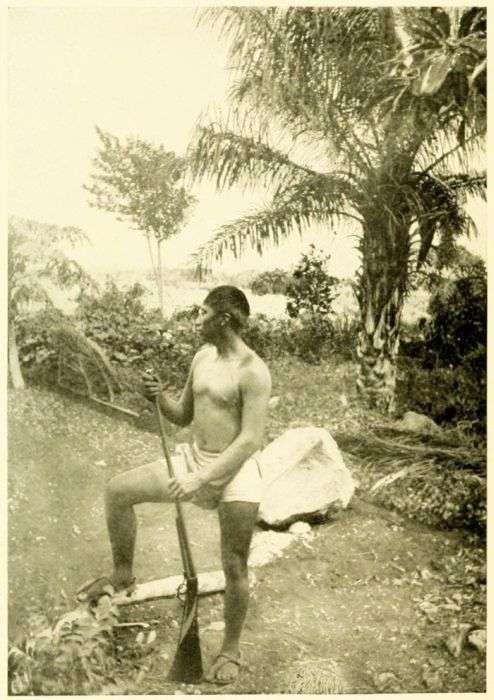
TYPES OF MAYAN WOMEN AND MEN. |
|