
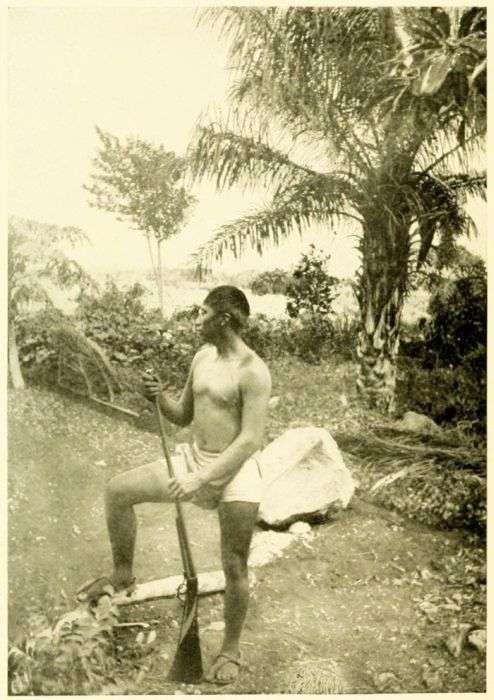
But Aguilar was an idealist, and though, true to his Church's teaching, casuist enough to keep on the right side of Hkin Cutz, he treasured a hope of some day, somehow, returning to Spain and its Catholic joys. With a view to hastening this consummation he so devoutly wished, he took the Saints into his confidence, and, satisfied of their assistance, promised at all costs to preserve that chastity which is believed by the credulous to be still—as it doubtless always has been—the brightest jewel in the crown of the Catholic priesthood. Aguilar's misogynistic tendencies do not seem to have much troubled Hkin Cutz; but his successor Ahmay was distinctly uxorious, and in addition appears to have been something of a humorist. Aguilar's lack of appreciation of his maidens worried him somewhat, and he determined to find out whether it was the lack of opportunity or the lack of taste. When the young priest was not cutting wood or drawing water, he was sent out fishing, going overnight to the coast and sleeping on the beach till dawn, when the fish were feeding. One day Ahmay ordered him to the coast, but as a mark of his favour told him to take as his companion a very beautiful girl of fourteen, to whom the cunning cacique gave instructions that she was to "fish" for Aguilar while he—poor innocent—was seeking his lord's breakfast. Aguilar did not much care for his girl comrade, but he did not dare to refuse: so off they started, the chief first loading his faithful servant with warm garments for the night journey and a sort of en tout cas bedspread. As the coast was not far distant, and the travellers had not much to say to each other, they got over the ground so quickly that the night was not far spent when they reached Aguilar's fishing "pitch." Seeing his companion was sleepy, he gallantly made a bed for her in the woods with the wraps Ahmay had so thoughtfully provided, and then went off to the beach and lay down on the sand. But the temptations of St. Anthony were not in it with those to which that Indian minx subjected the young priest till dawn, and thus it is the more gratifying to learn that he was able to keep his arrangement with the Saints, whereby he passed into the highest favour with Ahmay, who, poor weak mortal that he was, was convinced that Aguilar was a very exceptional young man. This is a Spanish story, and must be taken with a big pinch of salt.
But to return to more serious history. Undeterred by their predecessors' misfortunes, the Spanish undertook a third expedition to Yucatan. On the 8th February, 1517, Francis Hernandez de Cordoba, with one hundred and ten soldiers and three ships, sailed from Cuba, and on the twentieth day sighted an island. On their approach five large canoes put off. Signs of friendship prevailed on some thirty of the Indians to come on board Cordoba's ships, and there such amicable relations were established that the Spaniards landed, finding to their surprise every sign of a considerable civilisation. For the first time Europeans saw stone buildings in America. In the temple, approached by well-laid steps, they saw incense being burnt in front of stone and wooden idols, while files of women ministrants chanted near the altars. Hence Cordoba christened the island "Isla de Mujeres" (Isle of Women). Another version has it that the Spaniards found gigantic female figures of stone at the south end of the island, but our careful search of the island and a consultation of its records do not support this version. Thence he sailed to the most northerly point of Yucatan, where he was welcomed by the chief, who came out with his people in twelve canoes and repeatedly exclaimed, "Connex c otoch" ("Come to our Town"), which the Spaniards believed the name of the place: hence Cape Catoche, as the point is still called.
The Spaniards, led by the treacherous cacique, landed, and were soon attacked in a thick wood by a body of Indians armed with stone axes, bows, and lances of wood hardened by fire, their faces and bodies painted, wearing on their arms an armour of plaited cotton, beating a war tune on turtle-shells and blowing horns of conch-shells. Cordoba lost twenty men, and many of the Indians were killed. Returning to their ships, the Spaniards sailed on to a point where at the mouth of the river was a large Indian town called by the natives Kimpech, the modern Campeachy. Farther on a disastrous fight took place which ended in the loss of fifty Spaniards and the retreat of Cordoba. He himself received twelve arrow-wounds, and but one soldier escaped unhurt. Within ten days of his reaching Havana, Cordoba died of his wounds. This signal disaster did not, however, deter enterprising Spaniards from looking longingly towards this veritable will o' the wisp, La Isla Rica. In 1518 an expedition led by Juan de Grijalva sailed from Matanzas. This resulted in the discovery of the island of Cozumel and a fairly complete reconnaissance of the coastline of Yucatan. A third expedition, commanded by the great Cortes, left Cuba on the 18th February, 1519, made first for Cozumel; and thence, cruising round the north-east coast, the Spaniards continued their voyage as far as what is to-day the city of Vera Cruz, where the glittering promise of Mexico once and for all removed the great Spanish captain from Yucatecan history.
But in Cortes's suite was one Francisco Montejo, a gentleman of Seville. To him, on the 8th December, 1526, a grant was made for the conquest of the "islands" of Yucatan and Cozumel. Fitting out a small armada, he sailed from Seville in May, 1527, with 380 troops. He made first for Cozumel, where he landed in September of that year, establishing friendly relations with the chief, Naum Pat. Thence, taking with him an Indian guide, he sailed to the east coast. With bombastic prematureness the royal standard was planted on the beach, and amid cries of "Viva España!" the whole country claimed for the King of Spain. But Montejo was merely beginning his troubles. A disastrous march through the dense pathless bush—his troops footsore and fever-stricken, hunger and thirst their constant comrades—ended in a battle in which, with fearful losses, the invaders barely held their own. A retreat followed; but, undismayed, in 1528 Montejo with the remnant of his army marched on Chichen Itza. The old chroniclers contradict one another as to this expedition to Chichen. We believe Montejo made but one, though time would allow for two visits and two temporary settlements there, as some writers believe. In the metropolis of the Itza tribe a friendly reception at first was accorded him; but he unwisely divided his forces by dispatching his captain, Alonzo Davila, with some foot and horse to the westward. Thus weakened he was soon driven out of Chichen, and forced to the sea at Campeachy. Davila fared no better. Arrived in the dominions of a neighbouring cacique, his request for provisions was fiercely answered by the latter, who said he "would send them fowls on spears, and maize on arrows." After two years of weary struggle with hunger and fever, harassed the while by Indians, Davila rejoined his chief at Campeachy. Nothing had been achieved: Yucatan was still unconquered. Montejo now returned to Cuba for reinforcements, and, thus heartened, he made an attack on Tabasco, leaving a few Spanish at Campeachy. These few, weakened by privations, were after some years reduced to an effective force of five only. The camp was abandoned. Gonzales Nieto, who had planted the flag amid such bombastic shoutings on the eastern beach nine years earlier, was the last to leave. In 1535 not a single Spaniard remained in Yucatan.
Two years later Montejo, whose attempt on Tabasco had signally failed, returned to the attack, landing at Champoton, where once more the Spanish flag was raised. The Indians, grown shrewd, left the heat and General Malaria to do their skirmishing, and when Montejo's camp had become a hospital, a pitched battle all but drove the Spaniards into the sea. Worse than this, the rumours of the wealth of Peru and Mexico, of the dazzling conquests of Cortes and Pizarro, caused desertions (for the poverty of Yucatan had now become notorious), and one by one Montejo's men slunk off. Nineteen stalwarts at last were all that were left at Champoton. Montejo sent his son to Cuba with urgent requests for relief. In 1539 stores and men arrived, and Montejo, distrusting his own fortune, placed the conquest of Yucatan in his son's hands. The latter marched out from Champoton, gave battle to the Indians, and completely routed them. Advancing into the land, in one day three fights took place, the Indian dead being so numerous that they literally obstructed the roadway. After a march of many months, during which his troops suffered incredible hardships and fought their way almost league by league, Montejo reached the great city of Tihoo early in 1541.
A preliminary victory ensured the invaders some months of peace. But the clouds were gathering: the caciques formed a confederation, and on the 11th of June a final battle took place. Little reliance can be placed on the figures, but if they are anywhere near the truth, the pious historian, Father Cogolludo of the Franciscan Friars, may be forgiven for exclaiming, in an ecstasy of faith, "Divine power works more than human valour!" For the Spanish mustered but 200, while the Indians, it is alleged, were 70,000 strong! Be that as it may, the Spanish firearms won the day, and the 6th January, 1542, saw the formal founding of the city of Merida, built out of the stones and on the ruined site of Tihoo. The Indians never rallied; and the brutal work of enslaving them was thenceforth to be pursued with few interruptions. In 1561 French pirates attacked Campeachy and entered Merida, and in 1575 English buccaneers sacked the city. Forced to withdraw, they renewed their attack in 1606, but unsuccessfully. In 1632 the Dutch appeared on the scene, and two years later British pirates made a descent on the coast. For the next half-century Yucatan was the prey of pirates, and Merida was attacked again in 1684. Meanwhile the country had been constituted a Spanish province under a Captain-General; a see of Merida was created, and Spanish towns built on the ruins of the Indian pueblos.
The internal history of the peninsula from 1684 during the next century and a half is a story of Spanish cruelty and bigotry, of Franciscan arrogance and vandalism. The Spanish settlers, not content with the conquest and enslaving of the Indians, busied themselves in the destruction of everything—buildings, books, statues—which had to do with earlier days. Towns were built on the ruins of Indian villages; large churches—the majority now in ruins—were constructed, for the most part, out of the stones of Indian palaces, and the great haciendas were formed and worked by gangs of miserable natives whose spirit was broken.
In 1824 Yucatan, which had borne its fair share in the War of Independence against Spain of the previous year, became a Federal State. Amicable relations with Mexico were interrupted in 1829 and again in 1840, when heavy taxation brought about an armed revolt. In the June of the latter year the rebels drove the Federal forces out of Yucatecan territory, and independence was declared. In 1843 General Santa Ana, the head of Mexico, by a successful campaign forced Yucatan into the Federation once more. In 1847 a serious Indian revolt occurred, and this was not suppressed till 1853, when a treaty of peace was signed granting autonomy to the Indians of the east. A year later trouble broke out again, but in 1860 an army 3,000 strong attacked and captured Chan Santa Cruz, the Indian capital. The town was almost at once, however, retaken by the natives with a loss of 1,500 whites, and until 1901 it remained in the hands of the Mayans. Of the war which was then declared against these stalwarts, of the injustice of its inception, and of the barbarous methods now being employed against them, we shall speak later. The Mexican Government have done their best to hide from the outside world what exactly is happening in far Eastern Yucatan, but despite official discouragement we penetrated the district and are in a position to tell the whole story.
Of the authentic history of Yucatan previous to the Conquest it might almost be written as succinctly as in the famous chapter "Snakes in Iceland": there is none. Even its ancient name is in dispute, though there is little doubt it was "Maya." Columbus is the first to record that name. For the first half-century or so after the founding of Merida, the Spanish vandals were far too busy, in their ruthless Christian zeal, with the destruction of the Mayan towns and palaces, with the butchering of men and the outraging of women, to give much thought to the past of the unfortunate race which they were bent on degrading and enslaving. Bishop Landa, one of the earliest of the Catholic bishops of Yucatan, bears terrible evidence on this point. The Indian chiefs were burnt alive in many instances; women, after outrage and gross and filthy indignities, were hanged, their babies being hanged on their feet—thus making gibbets of the mothers' bodies. Landa says that there is no doubt that until his countrymen arrived chastity was dearly prized among the Mayans: death being the penalty for both young man and maiden proved unchaste before marriage. To-day Mayan morality in all towns and centres where the Indians are in contact, or have long been in contact, with the whites is loose in the extreme. Prostitution is terribly common, practically universal.
When, towards the end of the sixteenth century, the task of collecting historical data was undertaken, naturally enough the Indians consulted had little to give but a hotchpotch of tradition and legend. With an alacrity positively suspicious the so-called books of Chilan Balam cropped up in all directions. Each important township had one of these almost worthless compilations based on the musty memories of garrulous old Mayans, who thus sought to ingratiate themselves with the domineering Franciscan friars. The Mayan hieroglyphics were, as they still are, undecipherable, the temple records and picture writings had been burnt, and the oldest Indian assisting at the manufacture of these tradition books must have been in long clothes or the Mayan equivalent when Cortes landed. Yet this lack of credibility has not prevented many who have laboured earnestly and long in the field of Mayan archæology from spoiling their work by plunging into the muddied tideway of date and legend and emerging convinced of much for which there is not a tittle of real evidence. Most of the tradition books agree in ascribing Central American civilisation to the Toltec nation, and "Toltec" has become the rallying cry, the shibboleth of those who struggle to unravel the past of Central America. Learned professors from Berlin and Dresden; enthusiastic young men from Harvard and other American universities; foreign and native writers and students, clamber or tumble headlong over the Toltec fence. With the perverse persistence of the National School child, whose memory of dates is restricted to "William the Conqueror, 1066," at which moment its infantile mind supposes England, London, the Tower, the Zoo, and Madame Tussaud's to have come into instant being, so "648 A.D. Toltecs arrived at Tula or Tulapan" crops up in everything these good people write. King Charles I.'s head never worried Mr. Dick half as much as the Toltec bogey worries them.
Where Tula or Tulapan was, is, or ever has been: where the Toltecs sprang from; what ethnical affinities they possessed; whether they were kin to those affiliated tribes which have most certainly inhabited the Americas since prehistoric times; how they came to have cut-and-dried building specifications in what were equivalent to their breeches' pockets, they never stop to tell us. One professor glibly remarks, assuming his Toltec premiss, "While this [the Toltec] race was still quite at a low stage of civilisation the Aztecs advanced out of the north from at least 26° north latitude." No conjurer ever produced rabbit from silk hat with more assurance than the professor produces the Aztecs "out of the north." That "at least" is distinctly precious. Was ever such begging of the question? The Aztecs were builders, too! Where did they get their knowledge? They certainly would have difficulty to find a hint of it in the vast North American Continent. The truth is that, stripped of all nonsensical fetish-worship, there is not an iota of real evidence for this Toltec theory. No Toltec nationality ever existed; and the explanation of that civilisation which differentiates the Mayan peoples and their Aztec neighbours from the natives of the rest of the Americas is to be sought, as we endeavour to demonstrate in Chapter XV., in an altogether different direction.
Well then, we have no real pre-Conquest history. All that seems certain is that in Yucatan no kingship in the true sense existed. The land was ruled by caciques (chiefs), each the head of a tribe or tribal family. As is natural in such a régime, the predominating power was not always in the same hands. About 1436 (Bishop Landa, writing in 1556, gives the date, and this agrees with native tradition) the tyranny of the Cocomes who ruled over the great city of Mayapan caused a rebellious confederation of lesser caciques, which ended in the overthrow of the Cocomes family and the destruction of Mayapan. This—the great event of the more recent pre-Spanish history of Yucatan—was followed by the uprise of the chief of Chichen Itza, who thenceforward till the Conquest maintained predominance. These, the only dates upon which reliance can be placed, fit in well with the date which we are inclined to assign to the superb ruins of Chichen, which we describe in detail in a later chapter.
FOOTNOTES:
[1] While in Mexico City we visited in vain all the map shops and Government offices in search of a map of Yucatan. All the maps available were those based on the Mapa de la Peninsula (1887), which we have proved to be hopelessly inaccurate.
CHAPTER IV
FIRST IMPRESSIONS OF YUCATAN
A sea of greengage green, broken by scarce a ripple save where a shark's fin curves up shiny black in the blazing sun; a semicircle of pale sand, fringed by brown and mahogany-red boarded barns of warehouses, with here and there a gaunt brick chimney; a thin belt of palm trees; three wooden jetties, and beyond, houses stuccoed white and salmon-pink: this is our first sight of Yucatan's only port, Progreso. There is no harbour, for the shallows stretch far seaward, and steamers of any draught dare not come within five miles of the coast.
The outward and visible signs of the town have scarcely come distinctly into view, and we have barely lost sight in the heat mist of the monster form of our liner, anchored miles in our wake, when the panting tug has come alongside the pier and we are for the first time face to face with Yucatecans. A Yucatecan crowd is a pleasant sight to look upon. Personal cleanliness, bright-coloured vests and spotless linen breeches are a welcome change for the traveller who comes from a Mexican port. The Yucatecan and the Mexican, too, are physically very unlike, and the difference is all in favour of the former. The crowd which awaits the tug is a bright, clean-faced, orderly crowd, and as we step ashore, the luggage touts, many of them remarkably intelligent-looking and handsome fellows, take your "No, muchas gracias," for an answer, which is more than you can say for the evil-smelling, vulture-faced, blackmailing gang who throng the quays at such ports as Vera Cruz and Tampico. Alas! months of sojourn in the land of the Mayans are to alter the first favourable impressions of that Progreso crowd. Verily are Yucatecans "Whited Sepulchres"!
And here perhaps it would be as well to define a Yucatecan. The population of Yucatan, speaking broadly, consists of two classes, slaves and savages. The former are the Indians, by centuries of brutality degraded and robbed of that spirit which made them foes worthy of Cortes's prowess, but still a kindly, hospitable people for whom every English heart must feel a keen sympathy. The savages are the Yucatecans, the mongrel people resulting from the early unions of the Spanish with the Indian women; and if the epithet seems harsh, we would ask our readers to reserve judgment till they have finished this volume. The tint of the Yucatecan is that of a half-baked biscuit, but the eyes are black-brown and often small, and the lank black hair suggests the Indian crossings of the sixteenth and seventeenth centuries.
At the end of the jetty a lofty lich-gate of wood houses Señores los Aduaneros, Messrs. the Customs House Officers. But our passports are from headquarters and bear a Cabinet Minister's seal, so our baggage is soon passed. Over the Customs House gate might be written, varying Dante's terrible line, "All hope of cleanliness abandon, ye who enter here": for once inside Progreso town you must do battle with tropical dust at its worst. Through the railway yard, where the sun beats down with a blistering heat on trucks, mules, and men, you make your way to the train through filthy little arcaded streets, your boots disappearing at each footstep in the ill-smelling, garbage-littered compound, your eyes smarting in the clouds of it you kick up. The station is a barn, the railway a three-foot gauge, the cars are rickety, low-roofed, cane-seated yellow wood affairs. From engine to brake van the train is American-made. There seems little to choose in comfort between the classes, but for the sake of more elbow-room we "plunge" our three centavos a kilometre (the usual first-class fare all over Yucatan), a fraction less than a penny a mile, distinctly cheap if the rolling stock were better.
As the little train jolts through the outskirts of the town, ringing its bell, the dust it raises blending with the resinous smoke from the wood fire of its engine, naked yellow babies look up from their play in the dirt and scamper into shelter, while female faces peer out between the iron bars which do duty for glass windows in the one-storeyed-high flat-roofed houses. Northern Yucatan is as level as an Essex marsh, and the line runs through miles of country at first glance quite English with its dense covering of small trees like nut bushes and silver birches. Nature has been niggard of soil to the whole peninsula, but perhaps it is around Progreso that you realise most that the Yucatecan must be content to sow his seed in the "stony ground." The sundried undergrowth is of cactus, stunted shrubs, and sea grasses. Here and there this breaks to give way to swamps, rich in purple and white orchids and golden water plants, fair to look on as the sun touches the water between the waving rushes, but surely enough the happy breeding-ground of the "Yellow Jack" mosquito. Then come fields of henequen or hemp, "the Green Gold of Yucatan,"—the plants like huge green pineapples with waxy green feathers on top,—enclosed within grey stone walls like those of Scotland.
As we near the capital (the distance is but twenty-five miles) the carriages fill up, and you squeeze closer into your caned seat for two to make room for some fat Yucatecan or his ill-shaped, chalk-faced powdered dame. In the suburbs of Merida (there are miles of them) the rail runs between rows of native huts, palm-leaf thatched frameworks of wood upon which red earth is plastered and then stuccoed or whitewashed. Each has its garden, evidently the despair of its owner, for dogs, pigs, and fowls dispute possession of it with tin cans and refuse. But even in these unfavourable surroundings tropic Nature beautifies with the greeny-gold leaf of the banana and the heavy-hanging greener crown of the cocoanut palm. Over all rises a strange vista. Merida might well be called the "City of Windmills." On each side of the train you see the horizon literally crowded with air motors for pumping water from the limestone, and you hear it whispered in a tone of pride by a Yucatecan to his neighbour that there are in Yucatan's capital 6,000 of these eyesores.
Merida could claim another alias. "The City of Windmills" might as appropriately be called "The City of Cabs." And they are curious cabs too: cabs without sides or backs or fronts; mere frameworks of light wood with leather tops and cloth curtains all round, which roll up and button, or roll down and shade the "fare"; spectral four-wheelers, as if in prehistoric times a London "growler" had emigrated here and propagated a species of tropical growler, all skin and bones. Dozens of these hackney phantoms await us in the station yard; the drivers in spotless loose-flying linen shifts and linen trousers bell-bottomed over their bare brown feet shod with sandals, their headgear wideawakes of black or brown felt. The boxes are elaborately ornamented with brass nails burnished to a dazzling brightness. The back seat (you must not sit too far back or you will fall out) has room for two, and in front a shelf like that in a victoria lets down for a third passenger. There are hundreds of these cabs in Merida, and everybody uses them all the time. They are not the luxury they are in most capitals, and are quite a feature of the place. We had understood there is only one hotel in Merida (it is a libel, for there are three), and, seated in the phantom car we select, we bowl noiselessly over asphalted roads towards it.
It was on the 6th January, 1542, that amid—one can be sure—immense bombast of trumpet-blare and drum-beat the first stones were laid of the "Very Loyal and Noble City of Merida." This is what its charter, granted by His Most Catholic Majesty Philip II., called it. It is a double-barrelled misnomer. Merida has no claim to loyalty, for she revolted from Spain as soon as she conveniently could, and she has never been loyal to the Republic of Mexico, of which—much against her will—the country of which she is the capital has formed part, off and on, since the beginning of the nineteenth century. And Merida is in no sense a noble city; never has been and never can be. But she is what perhaps is better—a clean city. Cleanliness is next to godliness. Merida thinks it comes first, and she has let the other virtue lag a very bad second in her civic race.
But she has not always even been clean. Five years back her streets were Saharas of ill-smelling dust to your boot-tops in the dry season, and sloughs of despond in the wet. No one who has not visited Yucatan can realise the Aladdin-like results of the showers of gold which have fallen upon this Danaë land as a result of her staple product, henequen; but directly you enter one of the phantom cabs you come under the spell of a city which is magically perfect; as unlike any other Spanish-American town as is possible. The millionaire henequen growers are so rich that they really do not know what to do with their money; and so it came about that the ex-Governor Señor Molina conceived the idea of reupholstering Merida till its founders would never recognise their handiwork. The shape of the city is much what it was, planned on a vast chessboard system, all the streets running at right angles and parallel to one another, forming nine square miles of squat stone-built houses, almost all one-storeyed, their long windows heavily barred instead of glazed. But just as a carpet makes a room, Señor Molina saw that what Merida needed was paving, and so he proceeded to get an estimate from a French asphalt company. The amount was so huge that his brother-millionaires on the Council only smiled sickly smiles of incredulity when he suggested "voluntary contributions." But if their ill-gotten dollars would not come out of their pockets by fair means, the Governor determined that they should by foul (at least, that was the adjective which these much oppressed Crœsuses probably applied to his methods), and he taxed every bale of henequen loaded at Progreso. In this way he raised a gigantic sum for the beautifying of the capital, part of which, no less than thirty million Mexican dollars (£3,000,000 sterling), was spent in paving the streets.
It took between two and three years, and the result is perfection. From north to south, from east to west, side streets and main streets, for the full three miles' width of the city, the surface is as smooth as glass, as clean as marble. Never was there such paving, and never will there probably ever be again, for there is no parallel to the circumstances of unforeseen wealth which has come to Yucatan's capital.
We had been favourably impressed by the cleanliness of the Yucatecan crowds at Progreso, and, as we moved easily and without a vibration down street after street of well-matched and well-built houses, we rubbed our eyes and wondered whether we were in a land where it was always washing-day, for the people on the sidewalks, the people in the passing carriages, the police at the corners in their trim holland uniforms, the children playing at the pavement edge, the tradesmen at their shop-doors, and the boys and girls in their neat linens returning from school, were so spotless as to beggar all description.
But in the midst of our amazement we reached our hotel, a massive three-storeyed building in two squares, neatly floored with tiles, roofless, wide flights of stone steps leading up to galleries from which was access to the bedrooms, stone-floored, very high-ceilinged, opening through wooden sunblinds on to small balconies. We were very tired with our journey, and the coolness of our rooms and the brightness of the city had such a lulling effect that we were almost persuaded that we had reached Utopia. There was nothing disquieting in our rooms from the insect point of view, except a line of harmless-looking small black ants which were taking an afternoon walk along the tiles at the corner, and the fact that the small iron bedsteads were enveloped in mosquito-nets. We had evidently reached Utopia. The air was balmy as we composed ourselves to sleep that night, and there was not even a mosquito in our nets.
Shortly before dawn the next morning (Sunday) we were roused from a dreamless sleep by a din so terrific that to our half-sleeping wits it converted itself into a giant tattoo beat on cracked tea trays. We started up. Boom-poom (a pause). Pom-m—poom-m. The last was a ragged-edged sound, as flat as stale soda water, as lifeless as Queen Anne. Then came a shrill noise such as might be produced by a violent meeting between a butcher's steel and the treble octave of a "cottage grand." Then Pom-poom again, and then a noise as if the blacksmith of "spreading chestnut tree" fame had gone suicidally mad and had spent his dying fury and the full force "of the muscles of his brawny arms" in one fell blow on his anvil.
Something must be done; we could not patiently bear this. Perhaps it was a Utopian form of fire alarm, and we were doomed to cremation in our mosquito-netting unless we roused ourselves. At this moment our door burst open, and a fellow-traveller from Vera Cruz, in purple silk pyjamas, his hair on end, a wild look in his eyes, cried out, "Do you hear those awful bells?" Bells! Surely—we rubbed our eyes and gazed open-mouthed at him—surely they weren't bells! What superhuman intelligence was this he showed at such an early hour. We listened. Yes, they were (that anvil note again!) meant for—bells; bells as cracked as any March hare; the cathedral bells too, pounding their awful tea-tray notes right across the plaza into our windows. We had never heard such bells; nobody outside Yucatan ever has. It was bedlam in the belfry, and with our fingers in our ears we walked on to the balcony to see how the Utopianites were bearing them.
Merida was up, and did not seem to mind the bells a bit. Perhaps they are an acquired taste; the people in the streets seemed not to notice the noise, and there was as much crowd as there was din. This bell scandal was evidently the rift within the Utopian lute; and presently, thank heaven! the music was dumb, and we were able to watch in peace from our point of vantage the life of the awakening city. It was a picturesque scene. The street was alight with bright colours and pretty faces. The women of Merida were going to early mass. Here were a knot of palefaced maidens in muslins, rainbow-hued in their variety, pale blue, rose pink, saffron, heliotrope, white or green—hatless, their raven-black hair decked with flowers, their service books clasped in small hands. These were the upper middle-class femininity of the city (the wealthiest women never walk at all). But a prettier picture still were the Mestizas (half-castes, the name given by the wealthier Yucatecans to their lowlier sisters), the beauties of the people, whose soft skins were coloured a sweet brown by their Indian blood. Their dress was a long spotlessly white softly-flowing shift of linen, bordered at neck and hem with embroidery, cut open low round the neck, and with no sleeves and exposing their bare feet and ankles. It was a costume which framed their charms in quite a perfect style. And with all these mingled the Indian women and girls, their complexions a warm reddish brown, their black hair draped in cotton wraps of blue or brown, green or pink, thrown sari-fashion round the head and falling over the shoulders; their bare feet, innocent of shoe tortures, small and dainty, if a little broad. There were few men and boys about, but those looked cleaner than ever—spotless in their linens, with felt hats or panamas; the laddies, in their tight linen knickerbockers with their plump bare brown legs, looking the picture of boyish health. As the hour wore on, Indian dames passed on their way homeward from the early market, balancing on their heads large flat baskets filled with oranges, bananas, sweet potatoes, tomatoes, eggs, large slices of salmon-fleshed melons dotted with black seeds, small pineapples, lemons, limes, green and red peppers and garlic, and often in the midst of this market medley sat a small hen or two, as contentedly as if they were brooding over a sitting of eggs.
A wealthy Yucatecan who has travelled much is credited with saying, "After Merida give me Paris." There is really much to be said for his patriotic view. Merida is a beautiful city. The vista down the long street from our balcony, with the gay colours of the girls' dresses, the snowy whiteness of the men's clothes, the smart brass-decked skeleton cabs, the soft yellow of the houses (all houses in Merida are by order painted yellow to prevent the unpleasant sun-glare which white walls would mean), here and there a waving crown of green peeping over the housetops from some garden-patio, made a right pleasant picture against the deep blue of the cloudless sky. But Merida owes none of her undoubted beauty to her buildings. There are but three worth mention, and this not from any architectural merits but solely because of their historical interest. These are the cathedral, the bishop's palace, and the house of Francisco de Montejo, conqueror of Yucatan. They are all in the Plaza.
The cathedral is a gaunt pile of plastered mediocrity, with naked façade flanked by two turreted towers, lair of the accursed bells which had marred the tropic beauty of the morning. It was completed in 1598 and cost some £60,000, equivalent to-day to perhaps a quarter of a million. Within, there is little worth seeing except the twelve immense columns which support the roof. The hangings and drapings are as tawdry as is the much begilded altar. The pulpit is dusty, dirty and old, and is reached by wooden steps literally rotten and in holes. But if there is nothing worth seeing there is something which is very astonishing. On each pillar is hung a notice which reads: "Sirvanse no Escupir en el Pavimento de este Templo" ("You are requested not to spit on the floor of this church"), and on the flooring of the plain yellow-wood seats, and all along each aisle at the entrance to the pews, are spittoons! Yes, it sounds incredible, but they are there—right up to the altar-rails a vista of earthenware abominations such as disfigure the sanded quaintness of the bar-parlour of an old village inn. In a later chapter on Yucatecan manners we shall have more to say of the habit thus officially countenanced by the Church. That perspective of spittoons from door to altar-rail in Merida Cathedral has probably no parallel in any country.
The bishop's palace adjoins the cathedral, and bears the date 1757. It is so hideous in its flat stuccoed plainness that it is really wonderful that even the Yucatecans do not rebel and raze it to the ground. Beneath it entrance is obtained by a large double wooden doorway to a vestibule—opening into the bishop's garden—which forms a Lady Chapel, where on a trestle, such as those upon which the cocoanut and sweetstuff men do their roaring trades on Bank holidays at Hampstead, an iron tray covered with small spikes is provided for the faithful to stick a tallow dip—value one centavo (a farthing)—in front of a plaster image of the Virgin.
The house of Montejo—now the property of one of the many branches of the Peon family, the wealthiest of all Yucatecans—bears the date 1541, and is thus the oldest building in Merida. The façade is fine, and the doorway is a typically Spanish representation of militarism plus bigotry—two knights, armed cap-à-pie, being engaged in the congenial occupation of trampling underfoot two Indians who "take it lying down," as, alas! their descendants are still doing.
Life in Merida is as artificial as—indeed more artificial than—that of Mexico City. The latter, owing, as we have said, her fashions and her veneer of civilisation to Paris and New York, is assisted by her size in still being much herself. Not so Merida. No self-respecting Yucatecan wants to be himself. All of them are pathetically striving all the time after a culture which they do not understand, and which fits them as ill as his dress suit fits the hired butler at a suburban dance. "Scratch the Russian and you find the Tartar." Most Yucatecans are the vulgarest of parvenus, and by the least scratching you find the savage. They are ashamed of their Indian past, and by an exaggerated class-arrogance they try to widen the gulf between themselves and the Indians, as the purse-proud woman thinks she will be mistaken for a lady if she calls every servant a "slut." They love to emphasise their superior wealth by dubbing their lowlier brothers and sisters mestizos and mestizas. The truth is the Yucatecans form but one class, and they are all mestizos. There are few pure Indians in the capital, and those are the domestic servants of the wealthy families.
You do not see the great contrasts of wealth so marked in Mexico City. The whole town has an air of prosperity, and it is not an air merely—it is a fact. During the past twenty years the group of large henequen growers—about a score—have divided among themselves as a result of this "green gold," no less than 800,000,000 Mexican dollars. And this vast sum has percolated through the whole place. Merida is a Monte Carlo for extravagance and extortion. There is no social standard but £ s. d. A man is or is not great socially in proportion to his banking account. Nowhere in the world probably is money so absolutely God as here. We shall show later what moral effect this fact has had upon the citizens, and through them upon the whole of so-called civilised Yucatan. Corruption and venality are rampant. Few races have stamina enough to resist the corroding influences of sudden wealth. The silver mines of Mexico proved the knell of Spanish imperial greatness. Lord Beaconsfield said once, "Only a great man can stand power." In Yucatan wealth is power, the only power, and the Yucatecans stand it very badly.
In this city of mushroom millionaires everything is naturally very dear. Food is practically all imported. We had been told that at our hotel it was impossible to get a square meal for less than five dollars (ten shillings). It was not quite so bad as that, but for half that sum it is true enough you could only get just such a snack as an honestly hungry Briton would regard as a wholly inadequate quick-lunch-talk-business-while-you-eat style of meal. Few of the Yucatecans eat out of their own houses, and thus restaurants—at any rate of the cleanly and better class—are few and far between. Those which do exist are literally dens of robbers. The traveller in Yucatan—as indeed in all Mexico—has to learn what to a Briton, accustomed to more or less trust his fellow-man, is a very unpleasant lesson, namely that you can trust no one. The only safety on ordering a meal is to first drive a bargain. You must know down to the smallest roll or condiment what your repast is going to cost you. No Merida hotels or restaurants ever attach prices to their menus. They know a trick worth two of that. Each restaurateur is a gastronomic Procrustes who cuts his prices according to "the cut" of his customers. An article served at twenty-five centavos to one diner will at the next table boom to fifty at the discretion of the subtle waiter. It is very hard to always remember to do this unpleasant bargaining before you take your place at a table. But you are literally lost if you do not. On this glorious Sunday morning we were successfully caught in a place where they charged four shillings for three glasses of lemonade and three or four fly-blown cakes. The cakes you would get anywhere for a penny, and lemons could be bought in the street outside at six a penny.
The streets of Merida are full of life and bustle, the cleanliest of bustle. Even the blind beggars (blindness is rather common) who crouch against the walls, with their plaintive cry of "Pobre Ciego," are as neat as a new pin. Smartly varnished mule-drawn tramcars tinkle their way to and from the suburbs. Outside the railings of the cathedral sit all day a line of Indian women in front of baskets filled with cakes, flattish, appetising-looking, sometimes as much as two or three feet across. Under the arcades of the Municipal Palace, which forms the north side of the plaza, is a motley scene of life. Here are tiny cigar-booths; small drinking-counters whereat are dispensed hour after hour to thirsty crowds "refrescos," drinks of squashed fruits—the deliciously sweet guanabana, limes, cocoanut water, pineapple or whatnot—and iced waters; withered beldames with baskets of sweets; lottery-ticket sellers and itinerant booksellers; while at the small round tables set in the doorways the Yucatecan loafers drink coffee or the native spirits, and from within the shaded rooms is heard the eternal click-click of billiard balls (billiards, the French game without pockets, is a mania in Yucatan) as the young Yucatecans crowd round the green tables. The edges of the arcaded pavements are occupied by large chairs on daises; lolling in the chair the Yucatecan lad who will polish your boots for fifteen centavos. The Yucatecan jeunesse dorée are dandies if nothing else, and this must be the reason why there are more bootblacks to the square mile in Merida than in any capital we wot of. But the lordly bootblack who waits for you to come to him is not half as picturesque a figure as the peripatetic bootboy. All day long these little roguish-eyed rascals wander round the plaza carrying their boot boxes and begging you to let them kneel in front of you and make your boots like looking-glasses. The boys are all so pretty and have got such winning smiles that you are insanely inclined to have your boots blacked every quarter of an hour. Joking apart, boot-blacking has been reduced to a science in Merida, and the operators put out of joint the noses of the London Boot Brigade.
Time was when Merida was far more picturesque than she is to-day. In the old city, when few of the citizens were grand at reading, streets were, as indeed they were once in London, known by their signs. Thus at one corner there was a wooden image of a flamingo; this was Flamingo Street. Another was the street of the "old woman," the corner being decorated with an effigy, highly coloured, of a bespectacled dame. There was a Tapir Street adorned with a representation of that queer pig-deer which still haunts the swampy forests of Southern Yucatan and Chiapas; a Crane Street, and so on. But all this is a thing of the past. America has invaded Yucatan even to her street-naming, and Merida, with her 48th and 63rd Streets, with the street-numbers reduplicated on the corners thus: 503, 62nd Street, 503, is as maddening and intricate as New York. Only one of the old signs remains, that of the elephant.
As you cross the plaza towards the market, it is difficult to picture what the old city must have been like when roads were not roads and the plaza, now a wonderfully kept square of grass, flowers and stone, was a mangy patch of leprous grass dotted with trees, to which were tied mules which had brought in produce from the country.
But the alterations in Merida are surface alterations. The only wonder is that the city is as healthy as it is, for there is no attempt at any general sewerage system, no main drains, and every householder is a law unto himself on this vital question. Each hot season there are outbreaks, sometimes very serious, of yellow fever. But the city is a healthy city; there is no doubt about that. There is a general avoidance of well-water for drinking purposes, and as a substitute the most elaborate arrangements are made for storing every drop of rain-water during the wet season. This is done by every house of any size having enormous cemented tanks under their patios, the water-pipes from the roofs connecting with them. Thus the two huge quadrangles of our hotel were nothing but gigantic reservoirs tiled over. The rainy season practically never fails Yucatan; and, though not as regular in its advent as the Indian monsoon, keeps up year by year its average of supply. Surface refuse is dealt with summarily by the most picturesque set of road-sweepers imaginable. Neatly uniformed in white drill or brown holland, they wear pith helmets adorned with metal badges bearing their number, and look like soldiers. In front of them they push by means of a long handle a tin shovel, some four feet long, which runs on neat little wheels. These men are everywhere, and take very good care that garbage is nowhere. The water-carts, too, are worth a mention: gigantic wooden hogsheads painted in yellow stripes. These generally work at night, and take up their supply from huge water-taps which jut out from the walls of buildings, and upon which the men tie brown holland piping in the most primitive fashion to fill their carts.
The evenings at Merida are the gayest times, for then all folks, rich and poor, come out to spend the cool hours in the plaza. There is very little twilight ever in the tropics, and as soon as the sun is down and it is dusk enough, the wealthy Yucatecans have a queer habit of sitting in rocking-chairs outside their houses. A whole group of ladies will thus take the air in front of the huge doorways of the biggest houses, surrounded by two or three cavaliers. Later on the carriages are ordered, and sleepy-eyed beauties drive round and round the plaza in the dark, apparently enjoying this rather queer form of carriage exercise. In the centre of the plaza itself the town band assembles, and this is a signal for a nightly promenade of the humbler Meridians. Nothing can be more picturesque or typical. The seats are filled for the most part with the older people; fat old men, linen-suited and besandalled, armed generally with an incongruous ill-rolled umbrella, smoke and doze; beside them solid-looking Yucatecan matrons with gold chains round their necks from which hang gold coins and a metal or ivory crucifix; at their feet a baby or two, dressed in the shortest of shifts, play about.
But young Merida walks. Yet here again there is something which attracts the English eye, for there is a complete separation of the sexes. The girls walk together in twos, threes and fours one way, and the young dandies, in their spotless white-linen bell-bottomed trousers, belted with ornamental belts, over which are hung blue and white striped cloths reaching to their knees like butchers' aprons put on sideways, gaudily coloured silk-cotton vests and over these white-linen coats, walk the other. All the youths have a pretty habit of going hand in hand, or with arms round each other's necks. They are there to see the girls, and in the hope that the girls will see them. But the curious thing is that you never see them look at one another. The groups of chatting youths and maidens pass and repass one another round and round under the trees, in and out of the paths, and watch as hard as you like you will never see an ogling glance or catch a hint of that coarse chaff which is inseparable from such a congregating of lower-class youth of both sexes in a city like London. It really is quite extraordinary, the naïveté of it all, the determined way in which the eternal sex problem seems tabooed here. We sat for hours watching the orderly crowds, and never once did we see a girl stop in her walk to speak to a man or any youth attempt to speak or to walk with a maid. It was decorum in excelsis. It reminded one of the famous description of Boston as the place "where respectability stalks unchecked."
But respectability is usually perilously near being a synonym for mawkish dullness. Here it was not so. You had absolute decorum; there was no suspicion of noisy horseplay or hooliganism; there was not the slightest need for a policeman (as a matter of fact none appeared during the whole evening) to keep order; and yet the crowd was as perfect a specimen of the brightest popular life any city could show. They had all come out to enjoy themselves, and they enjoyed themselves like children, with a simple unaffected gaiety which was very infectious. With all their faults the Yucatecans have the saving grace of good temper, not from a geniality of disposition so much as from a physical apathy which makes them reluctant to the effort which losing one's temper involves. And this merry, laughing crowd in the plaza, the simple unadorned beauty of the dark-eyed lassies, the knots of handsome youths arms-linked, the plump babies contentedly playing in between the legs of the strollers, the old people dozing in the shady seats, and the mellow light from a huge electric standard dappling with a moonlike radiance the exquisitely cleanly pathways, made such a picture of pleasant contentment as was quite Utopian. In the darkened roadways the wealthier beauties of Merida drove round and round the plaza like bats circling round a lamp. But though there were many of them whose lascivious beauty would have made most men forswear their most cherished convictions, our hearts were in the plaza with the chattering, happy crowd, and we were quite sorry when the band, which, with an extraordinary display of energy, had played four tunes in two hours, struck work and the folks dispersed.
CHAPTER V
A YUCATECAN BREAKFAST, AND OTHER "SIGHTS"
Unless one is endowed with the appetite of the proverbial ploughboy there is surely nothing which puts you off your food more than having too much on your plate. One's sympathies go out to the irritable old gentleman at the London club who, having ordered a plate of beef and getting beef and a plate, snapped out angrily to the waiter, "Do you think I haven't eaten for a month?" The next worse thing to having too much on your plate is to have too much on the table. Every traveller knows the bewildering effect of those breakfasts served on the Paris and Mediterranean Railway, when seven dishes are placed before you, with fifteen minutes in which to eat their contents. But though there is no time-limit for feeding in Yucatan, you have got to get accustomed to the whole meal, in all its courses, being placed before you at once.
We had brought with us to Merida several letters of introduction, and on the Monday we presented one of these to a Yucatecan millionaire whom we ran to earth in his office (he was mayor of the city) transacting official business. After our preliminary greetings he said, "We Yucatecans never ask anybody to our houses, but I should like you to see the interior of a Yucatecan home. Therefore, will you breakfast with me to-morrow at 11.30?" In fulfilment of this engagement we turned up the next day in his patio at the appointed hour. The house is one of the finest in Merida, and is so typical of the people as to be worth a short description. Entering through the patio, bright with flowering shrubs, with orange trees loaded with the golden fruit, with palms and evergreens, you ascend a short flight of stone steps into a long central tiled hall forming a kind of glorified verandah on two sides of the courtyard. On the tiles are thrown a few cheap coloured mats. Ranged in two rows facing each other are eight or ten American bentwood rocking-chairs. On the walls hang a few oleographs. Here we were received by our host in a linen suit, and his Señora, a celebrated Meridian beauty, daintily dressed in a pink muslin frock, the mother, as we afterwards discovered, of seven children, though she herself looked little more than out of her teens. One or two other guests, male relatives, all in cool linens, having arrived, our hosts lead the way to the further end of the hall, out of which opens the dining-room. Not at all such a dining-room as we English associate with the sacred occupation of feeding. It is really nothing but another tiled annexe to the hall with huge doorway, but without doors (there are no real doors between the rooms in Yucatecan houses), at which the chickens and turkeys from the back yard are congregating to see the fun, hopping, cackling, out of the way of the half dozens of Indian women servants who are pattering in with bare feet from the kitchen of which you catch a glimpse down a vista of tiled yard.
But here's the table, and what a spread! There are only eight of us to breakfast, for it is the children's school hour, and thus they are not present; but if there were eighty-eight of us we feel, as we look at the groaning board, that the Indian maids would be able, when everybody's appetite was satisfied, to gather up of the fragments that remained many basketfuls. As we take our places, our host perhaps detects the amazement in our eyes, for he says with a wave of his hand, "I wished you to have a Yucatecan meal. It is always our custom to have everything on the table at once." There is certainly everything, almost everything you can think of. There is a dish of steaks; a stew of rabbit; a great plate of pork sausages; chickens stewed and chickens roasted; turkey minced with egg and turkey in puris naturalibus; a greasy mess of pork joints; a great heaped-up mass of venison; a vast soup-tureen of beef broth; a dish of chopped eggs and tortillas; a huge salted sausage in red skin, a favourite food of all Yucatecans; a minced mess of meat known throughout Yucatan as Chile con carne; a plate of veal cutlets; a large boiled fish, the famous red-snapper of the Mexican Gulf; and last but not least, turtle steaks. And for vegetables there are dishes of tomatoes, of green and red peppers, of garlick and onions, of black beans (frijoles) squashed into a greasy dark purple pulp, of snowy pyramids of rice, of boiled plantains, of sweet potatoes, and boiled Indian corn. But the sweets are here too; jellies and stewed fruits, cranberries squashed into a luscious disguise of pipless semi-liquid jelly fringed round with cream; pineapples stewed in thick slabs, and peaches floating in a wine-tinted syrup. And among all these plats de jour (the wonder is that the Indian maids have found room to place them on the table) are china baskets of fruits, apples from California, oranges from our host's farm, bananas and banana-apples, peaches and the purple-brown caumita, which looks like a cross between a rosy-cheeked apple and a nectarine and has a white soapy flesh with a taste which is somewhat like that of a green fig soaked for an hour in a lather of delicately scented soap. And to wash down this Gargantuan feast there were three cut-glass short-stemmed long-bodied goblets beside each breakfaster, which were kept filled by the Indian maids with red and white wines, aërated waters, iced lemonade made from the limes from the patio, fruit drinks, or iced milk.
Bread-throwing at school, if we remember aright, was an offence punishable with the sixth book of the Aeneid to write out and the loss of a half holiday as the minimum penalty. In Yucatan it is all the fashion in the highest circles. No sooner had we taken our places at the table than an Indian maid brought in, holding them in her brown hands, a towering pile of soft white doughy tortillas, each about as big as a large Abernethy biscuit. These she placed at the side of our hostess, who at once began to throw them to us all. It was so adroitly done that before you had recovered from the amazement with which the mere act filled you, you found yourself admiring the exquisite dexterity of the gentle thrower. Those of our readers who have visited Monte Carlo and admired, as every one must, the marvellous precision with which the croupiers flip the golden Louis to the lucky "punters," will be able to imagine something like the dexterity of our hostess. A tortilla whizzed circling across the table under your very nose, and landed with exquisite softness, like a tired dove, at the side of your host's plate. Whizz, whirr! here comes another! Why, it's like boomerang-throwing, for this last, you'll swear, circled round you before it sank nestling under the edge of the plate of steaming pork-stew in front of you. The air is thick with these doughy missiles. Nobody is the least surprised except us, and we become quite absorbed in watching the friendly bombardment. Our host engages us, as the newspapers say, in "animated conversation"; enquires the purposes of our tour, and our theories as to the origin of the Mayan people. It is hard to give him our whole attention, for we feel we are losing all the fun. For the tortillas are whizzing over the table now and round it just like boomerangs, and then the hostess's supply is exhausted. But here is a plump Indian maid with a fresh supply, snowy white and softly fluffy, such as would fill a London muffin man's heart with envy. It is all very funny, and the climax is reached when your host peels an orange of some very rare flavour, and offers you the juicy dripping quarter in his fingers, following this up with a like exhibition of his hospitable wish to share with you his apple and his peach.
We had defended ourselves as well as we could from the unbridled hospitality of our host, but all the same we felt like boa-constrictors who had made an injudicious meal of goats whole, when we packed ourselves into a skeleton cab to pay a visit of inspection to the Merida prison, which is one of the sights of the place. The drive thither was through one of the finest thoroughfares in the city, lined with substantially built bungalow-houses of stone and stucco, each standing in its picturesque tropical garden, a mass of bloom and waving fan-palms. This street debouches upon the broad Avenida de Paz, a wonderful stretch of asphalt running the full width of the city and forming its western frontier. Beyond this opens out the really fine Plaza de Porfirio Diaz, a great oval of lawn intersected by broad paths of asphalt meeting in a large central space ornamented by a small artificial lake with fountain. The Penitenciaria Juarez fronts upon the plaza, a long low building of limestone stuccoed, one-storeyed save over the central doorway, where a turreted second storey forms the residence of the President, as the governor of the gaol is called. This official met us at the doorway. He was a Mexican of about forty, a tall, handsome, military-looking man, swarthy-skinned, with a big black moustache. He impressed us very favourably, for there was in the face a certain charm of frankness and straightforwardness which is not characteristic of the Mexicans, and is almost wholly lacking in the Yucatecans. His smile was quite kindly, though behind it it was not difficult to detect a certain official grimness which suggested a man capable of anything if duty demanded. He had been imported into Yucatan because of his reputation as a specialist in the governing of gaols, and what we saw of the administration of the building under his control suggested that Yucatan had been very wise in her importation.
Armed with an ordinary walking-stick, in linen suit and a panama hat, he led the way across the central hall, where loafed half a dozen soldiers in holland uniforms ornamented with green and white braidings and wearing a cap of the French kepi type, to the interior of the prison. The iron gates were unlocked by a convict dressed in a red and white striped shirt, the President explaining that all the short-term and good-conduct men wore these, while the more desperate characters have blue and white striped shirts. From the gateway three long corridors branched off, and we passed down each in turn. Out of these opened on each side the cells, small cubicles of stone, their only furniture a wooden shelf, some three feet wide, let into the wall about three feet from the ground and supported by two wooden legs. Upon this shelf the prisoner sleeps, his bedclothes the simple blanket universal throughout the country. In the corner of the cell was a small gutter and drain for washing down the cell, which was ventilated by a small grated window in the corner furthest from the corridor. At the end of the central passage was a large stone room where convicts in blue striped shirts were busy making hammocks. The place reminded one of a hop garden in Kent. There were long rows of posts, two to each man, between which were stretched the rough string frameworks of the hammocks, the men passing up and down between the posts threading the strings backward and forwards like carpet-weaving. Passing through this, we came into a large garden quadrangle at the further end of which, in a big shed, scores of red-striped convicts were busy carpentering. At a signal from the President's stick the buzzing of lathes and saws stopped, as if by magic, and the men stood at attention. The superintendent-carpenter was called up, and explained everything to us, and the President called one or two of the men to him and asked particulars of their cases. One of these was a nigger who rejoiced in the British name of John Williams. With a broad grin which showed his white teeth to the gums, he told us that he was serving a month's sentence for fighting a man in the street. All the men looked well cared for and contented.
On the other side of the courtyard was a large washhouse with baths for the men and big sinks in which the prison washing was done. Close by was a blacksmith's shop where a score of men were engaged in all sorts of iron work, much of it quite artistic, the chief job at the moment being the designing of railings for the outside of the Penitenciaria, which had been opened only a short time. Here the President told us that much vigilance had to be exercised to prevent the more desperate men from using their opportunities to make less innocent things than railings. Only a few days before our visit one of the workmen had been found in possession of a bloodthirsty-looking knife which he had manufactured with the purpose possibly, as the President coolly said, of trying its metal upon him. Close by, sitting in the garden, were a row of men busy weaving sacks from henequen fibre. Crossing the yard, we were shown the kitchens. Here were two or three large circular blocks of masonry, into each of which were let several coppers or ovens, the fireplaces beneath. The whole building had a businesslike and cleanly air, and a couple of convicts were engaged in manufacturing a stew which had a very garlicky Yucatecan smell. We complimented the President upon these kitchens, which would certainly very favourably compare with those in even a first-rate British barracks.
After having inspected an excellent miniature hospital which formed an annexe in the rear of the gaol, we were taken by the President to his private room, where from a safe he produced the prison books. These were most interesting volumes from the criminologist's point of view. To each prisoner was devoted a page, headed by a photograph of him, stripped to the waist and with head shaved. Thereunder were entered details of his crimes, birth, parentage, age, health, weight, and any physical peculiarities. They do not go in for fingerprints in Yucatan. Two or three facts struck us as we turned the pages of these truly human documents. First, there appeared to be no Indians in the gaol. Secondly, the clean-shaven presentments of the culprits emphasised to a startling degree the physiognomical lowness of the Mexican type. The majority of the men—certainly of those imprisoned for the more serious offences—were Mexicans, and not Yucatecans. Some of them were mere lads, but one and all had features which suggested the atavism of crime. They were born murderers. And thirdly, as was logical enough, four-fifths of the offences chronicled in these books were homicide or robbery with violence. It was a curious sidelight into the condition of even this peaceful corner of the Mexican Republic—"that purple land where law secures not life." We were astonished, too, to notice that the maximum penalty for murder appeared to be fifteen years' imprisonment. The President explained that as a rule capital punishment was not inflicted, but was reserved for parricides and murderers of the most brutal kind. We ventured to suggest that, in such a land, this was a somewhat ill-judged leniency. But the President shook his head. He probably thought that it would make too serious an inroad upon the population of the Republic if every murderer was shot. The supreme penalty of the law here, as in Mexico, is always by the rifle bullet, never the rope.
The President explained in detail the administration of the prison, and the regulations seemed to be quite Utopian in their mildness. Thus each prisoner is allowed to see his relatives once a fortnight, and they can bring him food. During these visits the utmost vigilance is needed to prevent the smuggling-in of contraband articles, money and so on. As illustration of this, the President took from his desk a broken tortilla into which had been kneaded two half-dollars and the tortilla then cooked. The ruse had been discovered, and now the rule is for every tortilla brought into the gaol to be broken in two by the guards. The Gilbertian element, which we had noticed so much in Mexico, was represented here by the truly astonishing provision of a gaol band, which discoursed sweet music to the culprits every afternoon. Evidently our friend the President firmly believed, with Congreve, that