
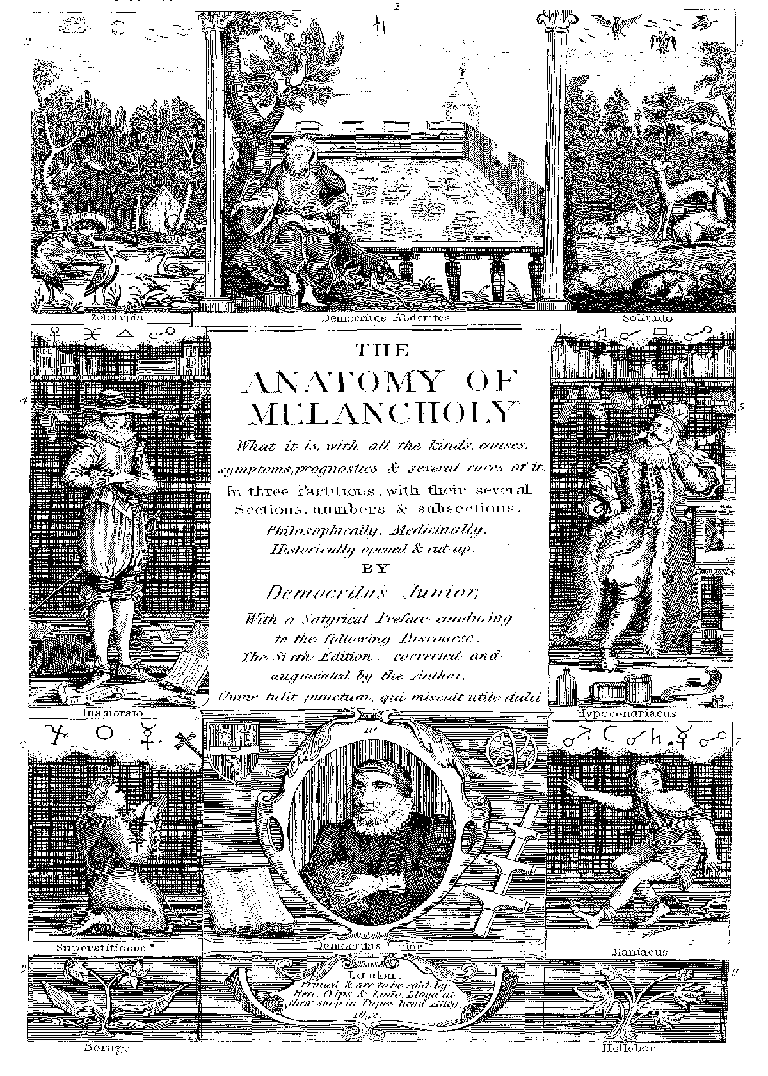
THE FIRST SECTION, MEMBER, SUBSECTION.
The Preface.
There will not be wanting, I presume, one or other that will much discommend some part of this treatise of love-melancholy, and object (which [4414]Erasmus in his preface to Sir Thomas More suspects of his) “that it is too light for a divine, too comical a subject to speak of love symptoms, too fantastical, and fit alone for a wanton poet, a feeling young lovesick gallant, an effeminate courtier, or some such idle person.” And 'tis true they say: for by the naughtiness of men it is so come to pass, as [4415] Caussinus observes, ut castis auribus vox amoris suspecta sit, et invisa, the very name of love is odious to chaster ears; and therefore some again, out of an affected gravity, will dislike all for the name's sake before they read a word; dissembling with him in [4416]Petronius, and seem to be angry that their ears are violated with such obscene speeches, that so they may be admired for grave philosophers and staid carriage. They cannot abide to hear talk of love toys, or amorous discourses, vultu, gestu, oculis in their outward actions averse, and yet in their cogitations they are all out as bad, if not worse than others.
For my part, saith [4423]Maximus Tyrius, a great Platonist himself, me non tantum admiratio habet, sed eliam stupor, I do not only admire, but stand amazed to read, that Plato and Socrates both should expel Homer from their city, because he writ of such light and wanton subjects, Quod Junonem cum Jove in Ida concumbentes inducit, ab immortali nube contectos, Vulcan's net. Mars and Venus' fopperies before all the gods, because Apollo fled, when he was persecuted by Achilles, the [4424]gods were wounded and ran whining away, as Mars that roared louder than Stentor, and covered nine acres of ground with his fall; Vulcan was a summer's day falling down from heaven, and in Lemnos Isle brake his leg, &c., with such ridiculous passages; when, as both Socrates and Plato, by his testimony, writ lighter themselves: quid enim tam distat (as he follows it) quam amans a temperante, formarum admirator a demente, what can be more absurd than for grave philosophers to treat of such fooleries, to admire Autiloquus, Alcibiades, for their beauties as they did, to run after, to gaze, to dote on fair Phaedrus, delicate Agatho, young Lysis, fine Charmides, haeccine Philosophum decent? Doth this become grave philosophers? Thus peradventure Callias, Thrasimachus, Polus, Aristophanes, or some of his adversaries and emulators might object; but neither they nor [4425]Anytus and Melitus his bitter enemies, that condemned him for teaching Critias to tyrannise, his impiety for swearing by dogs and plain trees, for his juggling sophistry, &c., never so much as upbraided him with impure love, writing or speaking of that subject; and therefore without question, as he concludes, both Socrates and Plato in this are justly to be excused. But suppose they had been a little overseen, should divine Plato be defamed? no, rather as he said of Cato's drunkenness, if Cato were drunk, it should be no vice at all to be drunk. They reprove Plato then, but without cause (as [4426]Ficinus pleads) “for all love is honest and good, and they are worthy to be loved that speak well of love.” Being to speak of this admirable affection of love (saith [4427]Valleriola) “there lies open a vast and philosophical field to my discourse, by which many lovers become mad; let me leave my more serious meditations, wander in these philosophical fields, and look into those pleasant groves of the Muses, where with unspeakable variety of flowers, we may make garlands to ourselves, not to adorn us only, but with their pleasant smell and juice to nourish our souls, and fill our minds desirous of knowledge,” &c. After a harsh and unpleasing discourse of melancholy, which hath hitherto molested your patience, and tired the author, give him leave with [4428]Godefridus the lawyer, and Laurentius (cap. 5.) to recreate himself in this kind after his laborious studies, “since so many grave divines and worthy men have without offence to manners, to help themselves and others, voluntarily written of it.” Heliodorus, a bishop, penned a love story of Theagines and Chariclea, and when some Catos of his time reprehended him for it, chose rather, saith [4429]Nicephorus, to leave his bishopric than his book. Aeneas Sylvius, an ancient divine, and past forty years of age, (as [4430]he confesseth himself, after Pope Pius Secundus) indited that wanton history of Euryalus and Lucretia. And how many superintendents of learning could I reckon up that have written of light fantastical subjects? Beroaldus, Erasmus, Alpheratius, twenty-four times printed in Spanish, &c. Give me leave then to refresh my muse a little, and my weary readers, to expatiate in this delightsome field, hoc deliciarum campo, as Fonseca terms it, to [4431] season a surly discourse with a more pleasing aspersion of love matters: Edulcare vitam convenit, as the poet invites us, curas nugis, &c., 'tis good to sweeten our life with some pleasing toys to relish it, and as Pliny tells us, magna pars studiosorum amaenitates quaerimus, most of our students love such pleasant [4432]subjects. Though Macrobius teach us otherwise, [4433]“that those old sages banished all such light tracts from their studies, to nurse's cradles, to please only the ear;” yet out of Apuleius I will oppose as honourable patrons, Solon, Plato, [4434] Xenophon, Adrian, &c. that as highly approve of these treatises. On the other side methinks they are not to be disliked, they are not so unfit. I will not peremptorily say as one did [4435]tam suavia dicam facinora, ut male sit ei qui talibus non delectetur, I will tell you such pretty stories, that foul befall him that is not pleased with them; Neque dicam ea quae vobis usui sit audivisse, et voluptati meminisse, with that confidence, as Beroaldus doth his enarrations on Propertius. I will not expert or hope for that approbation, which Lipsius gives to his Epictetus; pluris facio quum relego; semper ut novum, et quum repetivi, repetendum, the more I read, the more shall I covet to read. I will not press you with my pamphlets, or beg attention, but if you like them you may. Pliny holds it expedient, and most fit, severitatem jucunditate etiam in scriptis condire, to season our works with some pleasant discourse; Synesius approves it, licet in ludicris ludere, the [4436]poet admires it, Omne tulit punctum qui miscuit utile dulci; and there be those, without question, that are more willing to read such toys, than [4437]I am to write: “Let me not live,” saith Aretine's Antonia, “If I had not rather hear thy discourse, [4438]than see a play?” No doubt but there be more of her mind, ever have been, ever will be, as [4439]Hierome bears me witness. A far greater part had rather read Apuleius than Plato: Tully himself confesseth he could not understand Plato's Timaeus, and therefore cared less for it: but every schoolboy hath that famous testament of Grunnius Corocotta Porcellus at his fingers' ends. The comical poet,
And thus much I have thought good to say by way of preface, lest any man (which [4453]Godefridus feared in his book) should blame in me lightness, wantonness, rashness, in speaking of love's causes, enticements, symptoms, remedies, lawful and unlawful loves, and lust itself, [4454]I speak it only to tax and deter others from it, not to teach, but to show the vanities and fopperies of this heroical or Herculean love,[4455]and to apply remedies unto it. I will treat of this with like liberty as of the rest.
I am resolved howsoever, velis, nolis, audacter stadium intrare, in the Olympics, with those Aeliensian wrestlers in Philostratus, boldly to show myself in this common stage, and in this tragicomedy of love, to act several parts, some satirically, some comically, some in a mixed tone, as the subject I have in hand gives occasion, and present scene shall require, or offer itself.
SUBSECT. II.—Love's Beginning, Object, Definition, Division.
“Love's limits are ample and great, and a spacious walk it hath, beset with thorns,” and for that cause, which [4461]Scaliger reprehends in Cardan, “not lightly to be passed over.” Lest I incur the same censure, 1 will examine all the kinds of love, his nature, beginning, difference, objects, how it is honest or dishonest, a virtue or vice, a natural passion, or a disease, his power and effects, how far it extends: of which, although something has been said in the first partition, in those sections of perturbations ([4462] “for love and hatred are the first and most common passions, from which all the rest arise, and are attendant,” as Picolomineus holds, or as Nich. Caussinus, the primum mobile of all other affections, which carry them all about them) I will now more copiously dilate, through all his parts and several branches, that so it may better appear what love is, and how it varies with the objects, how in defect, or (which is most ordinary and common) immoderate, and in excess, causeth melancholy.
Love universally taken, is defined to be a desire, as a word of more ample signification: and though Leon Hebreus, the most copious writer of this subject, in his third dialogue make no difference, yet in his first he distinguisheth them again, and defines love by desire. [4463]“Love is a voluntary affection, and desire to enjoy that which is good. [4464]Desire wisheth, love enjoys; the end of the one is the beginning of the other; that which we love is present; that which we desire is absent.” [4465]“It is worth the labour,” saith Plotinus, “to consider well of love, whether it be a god or a devil, or passion of the mind, or partly god, partly devil, partly passion.” He concludes love to participate of all three, to arise from desire of that which is beautiful and fair, and defines it to be “an action of the mind desiring that which is good.” [4466]Plato calls it the great devil, for its vehemency, and sovereignty over all other passions, and defines it an appetite, [4467]“by which we desire some good to be present.” Ficinus in his comment adds the word fair to this definition. Love is a desire of enjoying that which is good and fair. Austin dilates this common definition, and will have love to be a delectation of the heart, [4468]“for something which we seek to win, or joy to have, coveting by desire, resting in joy.” [4469]Scaliger exerc. 301. taxeth these former definitions, and will not have love to be defined by desire or appetite; “for when we enjoy the things we desire, there remains no more appetite:” as he defines it, “Love is an affection by which we are either united to the thing we love, or perpetuate our union;” which agrees in part with Leon Hebreus.
Now this love varies as its object varies, which is always good, amiable, fair, gracious, and pleasant. [4470]“All things desire that which is good,” as we are taught in the Ethics, or at least that which to them seems to be good; quid enim vis mali (as Austin well infers) dic mihi? puto nihil in omnibus actionibus; thou wilt wish no harm, I suppose, no ill in all thine actions, thoughts or desires, nihil mali vis; [4471]thou wilt not have bad corn, bad soil, a naughty tree, but all good; a good servant, a good horse, a good son, a good friend, a good neighbour, a good wife. From this goodness comes beauty; from beauty, grace, and comeliness, which result as so many rays from their good parts, make us to love, and so to covet it: for were it not pleasing and gracious in our eyes, we should not seek. [4472]“No man loves” (saith Aristotle 9. mor. cap. 5.) “but he that was first delighted with comeliness and beauty.” As this fair object varies, so doth our love; for as Proclus holds, Omne pulchrum amabile, every fair thing is amiable, and what we love is fair and gracious in our eyes, or at least we do so apprehend and still esteem of it. [4473] “Amiableness is the object of love, the scope and end is to obtain it, for whose sake we love, and which our mind covets to enjoy.” And it seems to us especially fair and good; for good, fair, and unity, cannot be separated. Beauty shines, Plato saith, and by reason of its splendour and shining causeth admiration; and the fairer the object is, the more eagerly it is sought. For as the same Plato defines it, [4474]“Beauty is a lively, shining or glittering brightness, resulting from effused good, by ideas, seeds, reasons, shadows, stirring up our minds, that by this good they may be united and made one.” Others will have beauty to be the perfection of the whole composition, [4475]“caused out of the congruous symmetry, measure, order and manner of parts, and that comeliness which proceeds from this beauty is called grace, and from thence all fair things are gracious.” For grace and beauty are so wonderfully annexed, [4476]“so sweetly and gently win our souls, and strongly allure, that they confound our judgment and cannot be distinguished. Beauty and grace are like those beams and shinings that come from the glorious and divine sun,” which are diverse, as they proceed from the diverse objects, to please and affect our several senses. [4477]“As the species of beauty are taken at our eyes, ears, or conceived in our inner soul,” as Plato disputes at large in his Dialogue de pulchro, Phaedro, Hyppias, and after many sophistical errors confuted, concludes that beauty is a grace in all things, delighting the eyes, ears, and soul itself; so that, as Valesius infers hence, whatsoever pleaseth our ears, eyes, and soul, must needs be beautiful, fair, and delightsome to us. [4478]“And nothing can more please our ears than music, or pacify our minds.” Fair houses, pictures, orchards, gardens, fields, a fair hawk, a fair horse is most acceptable unto us; whatsoever pleaseth our eyes and ears, we call beautiful and fair; [4479]“Pleasure belongeth to the rest of the senses, but grace and beauty to these two alone.” As the objects vary and are diverse, so they diversely affect our eyes, ears, and soul itself. Which gives occasion to some to make so many several kinds of love as there be objects. One beauty ariseth from God, of which and divine love S. Dionysius, [4480]with many fathers and neoterics, have written just volumes, De amore Dei, as they term it, many paraenetical discourses; another from his creatures; there is a beauty of the body, a beauty of the soul, a beauty from virtue, formam martyrum, Austin calls it, quam videmus oculis animi, which we see with the eyes of our mind; which beauty, as Tully saith, if we could discern with these corporeal eyes, admirabili sui amores excitaret, would cause admirable affections, and ravish our souls. This other beauty which ariseth from those extreme parts, and graces which proceed from gestures, speeches, several motions, and proportions of creatures, men and women (especially from women, which made those old poets put the three graces still in Venus' company, as attending on her, and holding up her train) are infinite almost, and vary their names with their objects, as love of money, covetousness, love of beauty, lust, immoderate desire of any pleasure, concupiscence, friendship, love, goodwill, &c. and is either virtue or vice, honest, dishonest, in excess, defect, as shall be showed in his place. Heroical love, religious love, &c. which may be reduced to a twofold division, according to the principal parts which are affected, the brain and liver. Amor et amicitia, which Scaliger exercitat. 301. Valesius and Melancthon warrant out of Plato Φιλεῖν and ἐρᾶν from that speech of Pausanias belike, that makes two Veneres and two loves. [4481]“One Venus is ancient without a mother, and descended from heaven, whom we call celestial; the younger, begotten of Jupiter and Dione, whom commonly we call Venus.” Ficinus, in his comment upon this place, cap. 8. following Plato, calls these two loves, two devils, [4482]or good and bad angels according to us, which are still hovering about our souls. [4483]“The one rears to heaven, the other depresseth us to hell; the one good, which stirs us up to the contemplation of that divine beauty for whose sake we perform justice and all godly offices, study philosophy, &c.; the other base, and though bad yet to be respected; for indeed both are good in their own natures: procreation of children is as necessary as that finding out of truth, but therefore called bad, because it is abused, and withdraws our souls from the speculation of that other to viler objects,” so far Ficinus. S. Austin, lib. 15. de civ. Dei et sup. Psal. lxiv., hath delivered as much in effect. [4484]“Every creature is good, and may be loved well or ill:” and [4485]“Two cities make two loves, Jerusalem and Babylon, the love of God the one, the love of the world the other; of these two cities we all are citizens, as by examination of ourselves we may soon find, and of which.” The one love is the root of all mischief, the other of all good. So, in his 15. cap. lib. de amor. Ecclesiae, he will have those four cardinal virtues to be nought else but love rightly composed; in his 15. book de civ. Dei, cap. 22. he calls virtue the order of love, whom Thomas following 1. part. 2. quaest. 55. art. 1. and quaest. 56. 3. quaest. 62. art. 2. confirms as much, and amplifies in many words. [4486]Lucian, to the same purpose, hath a division of his own, “One love was born in the sea, which is as various and raging in young men's breasts as the sea itself, and causeth burning lust: the other is that golden chain which was let down from heaven, and with a divine fury ravisheth our souls, made to the image of God, and stirs us up to comprehend the innate and incorruptible beauty to which we were once created.” Beroaldus hath expressed all this in an epigram of his:
This twofold division of love, Origen likewise follows, in his Comment on the Canticles, one from God, the other from the devil, as he holds (understanding it in the worse sense) which many others repeat and imitate. Both which (to omit all subdivisions) in excess or defect, as they are abused, or degenerate, cause melancholy in a particular kind, as shall be shown in his place. Austin, in another Tract, makes a threefold division of this love, which we may use well or ill: [4487]“God, our neighbour, and the world: God above us, our neighbour next us, the world beneath us. In the course of our desires, God hath three things, the world one, our neighbour two. Our desire to God, is either from God, with God, or to God, and ordinarily so runs. From God, when it receives from him, whence, and for which it should love him: with God, when it contradicts his will in nothing: to God, when it seeks to him, and rests itself in him. Our love to our neighbour may proceed from him, and run with him, not to him: from him, as when we rejoice of his good safety, and well doing: with him, when we desire to have him a fellow and companion of our journey in the way of the Lord: not in him, because there is no aid, hope, or confidence in man. From the world our love comes, when we begin to admire the Creator in his works, and glorify God in his creatures: with the world it should run, if, according to the mutability of all temporalities, it should be dejected in adversity, or over elevated in prosperity: to the world, if it would settle itself in its vain delights and studies.” Many such partitions of love I could repeat, and subdivisions, but least (which Scaliger objects to Cardan, Exercitat. 501.) [4488]“I confound filthy burning lust with pure and divine love,” I will follow that accurate division of Leon Hebreus, dial. 2. betwixt Sophia and Philo, where he speaks of natural, sensible, and rational love, and handleth each apart. Natural love or hatred, is that sympathy or antipathy which is to be seen in animate and inanimate creatures, in the four elements, metals, stones, gravia tendunt deorsum, as a stone to his centre, fire upward, and rivers to the sea. The sun, moon, and stars go still around, [4489]Amantes naturae, debita exercere, for love of perfection. This love is manifest, I say, in inanimate creatures. How comes a loadstone to draw iron to it? jet chaff? the ground to covet showers, but for love? No creature, S. Hierom concludes, is to be found, quod non aliquid amat, no stock, no stone, that hath not some feeling of love, 'Tis more eminent in plants, herbs, and is especially observed in vegetables; as between the vine and elm a great sympathy, between the vine and the cabbage, between the vine and the olive, [4490] Virgo fugit Bromium, between the vine and bays a great antipathy, the vine loves not the bay, [4491]“nor his smell, and will kill him, if he grow near him;” the bur and the lentil cannot endure one another, the olive [4492]and the myrtle embrace each other, in roots and branches if they grow near. Read more of this in Picolomineus grad. 7. cap. 1. Crescentius lib. 5. de agric. Baptista Porta de mag. lib. 1. cap. de plant. dodio et element. sym. Fracastorius de sym. et antip. of the love and hatred of planets, consult with every astrologer. Leon Hebreus gives many fabulous reasons, and moraliseth them withal.
Sensible love is that of brute beasts, of which the same Leon Hebreus dial. 2. assigns these causes. First for the pleasure they take in the act of generation, male and female love one another. Secondly, for the preservation of the species, and desire of young brood. Thirdly, for the mutual agreement, as being of the same kind: Sus sui, canis cani, bos bovi, et asinus asino pulcherrimus videtur, as Epicharmus held, and according to that adage of Diogenianus, Adsidet usque graculus apud graculum, they much delight in one another's company, [4493]Formicae grata est formica, cicada cicadae, and birds of a feather will gather together. Fourthly, for custom, use, and familiarity, as if a dog be trained up with a lion and a bear, contrary to their natures, they will love each other. Hawks, dogs, horses, love their masters and keepers: many stories I could relate in this kind, but see Gillius de hist. anim. lib. 3. cap. 14. those two Epistles of Lipsius, of dogs and horses, Agellius, &c. Fifthly, for bringing up, as if a bitch bring up a kid, a hen ducklings, a hedge-sparrow a cuckoo, &c.
The third kind is Amor cognitionis, as Leon calls it, rational love, Intellectivus amor, and is proper to men, on which I must insist. This appears in God, angels, men. God is love itself, the fountain of love, the disciple of love, as Plato styles him; the servant of peace, the God of love and peace; have peace with all men and God is with you.
The love of angels and living souls is mutual amongst themselves, towards us militant in the church, and all such as love God; as the sunbeams irradiate the earth from those celestial thrones, they by their well wishes reflect on us, [4502]in salute hominum promovenda alacres, et constantes administri, there is joy in heaven for every sinner that repenteth; they pray for us, are solicitous for our good, [4503]Casti genii.
MEMB. II.
SUBSECT. I.—Love of Men, which varies as his Objects, Profitable, Pleasant, Honest.
Valesius, lib. 3. contr. 13, defines this love which is in men, “to be [4505]an affection of both powers, appetite and reason.” The rational resides in the brain, the other in the liver (as before hath been said out of Plato and others); the heart is diversely affected of both, and carried a thousand ways by consent. The sensitive faculty most part overrules reason, the soul is carried hoodwinked, and the understanding captive like a beast. [4506]“The heart is variously inclined, sometimes they are merry, sometimes sad, and from love arise hope and fear, jealousy, fury, desperation.” Now this love of men is diverse, and varies, as the object varies, by which they are enticed, as virtue, wisdom, eloquence, profit, wealth, money, fame, honour, or comeliness of person, &c. Leon Hubreus, in his first dialogue, reduceth them all to these three, utile, jucundum, honestum, profitable, pleasant, honest; (out of Aristotle belike 8. moral.) of which he discourseth at large, and whatsoever is beautiful and fair, is referred to them, or any way to be desired. [4507]“To profitable is ascribed health, wealth, honour, &c., which is rather ambition, desire, covetousness, than love:” friends, children, love of women, [4508]all delightful and pleasant objects, are referred to the second. The love of honest things consists in virtue and wisdom, and is preferred before that which is profitable and pleasant: intellectual, about that which is honest. [4509]St. Austin calls “profitable, worldly; pleasant, carnal; honest, spiritual. [4510]Of and from all three, result charity, friendship, and true love, which respects God and our neighbour.” Of each of these I will briefly dilate, and show in what sort they cause melancholy.
Amongst all these fair enticing objects, which procure love, and bewitch the soul of man, there is none so moving, so forcible as profit; and that which carrieth with it a show of commodity. Health indeed is a precious thing, to recover and preserve which we will undergo any misery, drink bitter potions, freely give our goods: restore a man to his health, his purse lies open to thee, bountiful he is, thankful and beholding to thee; but give him wealth and honour, give him gold, or what shall be for his advantage and preferment, and thou shalt command his affections, oblige him eternally to thee, heart, hand, life, and all is at thy service, thou art his dear and loving friend, good and gracious lord and master, his Mecaenas; he is thy slave, thy vassal, most devote, affectioned, and bound in all duty: tell him good tidings in this kind, there spoke an angel, a blessed hour that brings in gain, he is thy creature, and thou his creator, he hugs and admires thee; he is thine for ever. No loadstone so attractive as that of profit, none so fair an object as this of gold; [4511]nothing wins a man sooner than a good turn, bounty and liberality command body and soul:
Gold of all other is a most delicious object; a sweet light, a goodly lustre it hath; gratius aurum quam solem intuemur, saith Austin, and we had rather see it than the sun. Sweet and pleasant in getting, in keeping; it seasons all our labours, intolerable pains we take for it, base employments, endure bitter flouts and taunts, long journeys, heavy burdens, all are made light and easy by this hope of gain: At mihi plaudo ipse domi, simul ac nummos contemplor in arca. The sight of gold refresheth our spirits, and ravisheth our hearts, as that Babylonian garment and [4512] golden wedge did Achan in the camp, the very sight and hearing sets on fire his soul with desire of it. It will make a man run to the antipodes, or tarry at home and turn parasite, lie, flatter, prostitute himself, swear and bear false witness; he will venture his body, kill a king, murder his father, and damn his soul to come at it. Formosior auri massa, as [4513] he well observed, the mass of gold is fairer than all your Grecian pictures, that Apelles, Phidias, or any doting painter could ever make: we are enamoured with it,
'Tis the general humour of the world, commodity steers our affections throughout, we love those that are fortunate and rich, that thrive, or by whom we may receive mutual kindness, hope for like courtesies, get any good, gain, or profit; hate those, and abhor on the other side, which are poor and miserable, or by whom we may sustain loss or inconvenience. And even those that were now familiar and dear unto us, our loving and long friends, neighbours, kinsmen, allies, with whom we have conversed, and lived as so many Geryons for some years past, striving still to give one another all good content and entertainment, with mutual invitations, feastings, disports, offices, for whom we would ride, run, spend ourselves, and of whom we have so freely and honourably spoken, to whom we have given all those turgent titles, and magnificent eulogiums, most excellent and most noble, worthy, wise, grave, learned, valiant, &c., and magnified beyond measure: if any controversy arise between us, some trespass, injury, abuse, some part of our goods be detained, a piece of land come to be litigious, if they cross us in our suit, or touch the string of our commodity, we detest and depress them upon a sudden: neither affinity, consanguinity, or old acquaintance can contain us, but [4517]rupto jecore exierit Caprificus. A golden apple sets altogether by the ears, as if a marrowbone or honeycomb were flung amongst bears: father and son, brother and sister, kinsmen are at odds: and look what malice, deadly hatred can invent, that shall be done, Terrible, dirum, pestilens, atrox, ferum, mutual injuries, desire of revenge, and how to hurt them, him and his, are all our studies. If our pleasures be interrupt, we can tolerate it: our bodies hurt, we can put it up and be reconciled: but touch our commodities, we are most impatient: fair becomes foul, the graces are turned to harpies, friendly salutations to bitter imprecations, mutual feastings to plotting villainies, minings and counterminings; good words to satires and invectives, we revile e contra, nought but his imperfections are in our eyes, he is a base knave, a devil, a monster, a caterpillar, a viper, a hog-rubber, &c. Desinit in piscem mulier formosa superne;[4518] the scene is altered on a sudden, love is turned to hate, mirth to melancholy: so furiously are we most part bent, our affections fixed upon this object of commodity, and upon money, the desire of which in excess is covetousness: ambition tyranniseth over our souls, as [4519]I have shown, and in defect crucifies as much, as if a man by negligence, ill husbandry, improvidence, prodigality, waste and consume his goods and fortunes, beggary follows, and melancholy, he becomes an abject, [4520]odious and “worse than an infidel, in not providing for his family.”
SUBSECT. II.—Pleasant Objects of Love.
Pleasant objects are infinite, whether they be such as have life, or be without life; inanimate are countries, provinces, towers, towns, cities, as he said, [4521]Pulcherrimam insulam videmus, etiam cum non videmus we see a fair island by description, when we see it not. The [4522]sun never saw a fairer city, Thessala Tempe, orchards, gardens, pleasant walks, groves, fountains, &c. The heaven itself is said to be [4523]fair or foul: fair buildings, [4524]fair pictures, all artificial, elaborate and curious works, clothes, give an admirable lustre: we admire, and gaze upon them, ut pueri Junonis avem, as children do on a peacock: a fair dog, a fair horse and hawk, &c. [4525]Thessalus amat equum pullinum, buculum Aegyptius, Lacedaemonius Catulum, &c., such things we love, are most gracious in our sight, acceptable unto us, and whatsoever else may cause this passion, if it be superfluous or immoderately loved, as Guianerius observes. These things in themselves are pleasing and good, singular ornaments, necessary, comely, and fit to be had; but when we fix an immoderate eye, and dote on them over much, this pleasure may turn to pain, bring much sorrow and discontent unto us, work our final overthrow, and cause melancholy in the end. Many are carried away with those bewitching sports of gaming, hawking, hunting, and such vain pleasures, as [4526]I have said: some with immoderate desire of fame, to be crowned in the Olympics, knighted in the field, &c., and by these means ruinate themselves. The lascivious dotes on his fair mistress, the glutton on his dishes, which are infinitely varied to please the palate, the epicure on his several pleasures, the superstitious on his idol, and fats himself with future joys, as Turks feed themselves with an imaginary persuasion of a sensual paradise: so several pleasant objects diversely affect diverse men. But the fairest objects and enticings proceed from men themselves, which most frequently captivate, allure, and make them dote beyond all measure upon one another, and that for many respects: first, as some suppose, by that secret force of stars, (quod me tibi temperat astrum?) They do singularly dote on such a man, hate such again, and can give no reason for it. [4527]Non amo te Sabidi, &c. Alexander admired Ephestion, Adrian Antinous, Nero Sporus, &c. The physicians refer this to their temperament, astrologers to trine and sextile aspects, or opposite of their several ascendants, lords of their genitures, love and hatred of planets; [4528] Cicogna, to concord and discord of spirits; but most to outward graces. A merry companion is welcome and acceptable to all men, and therefore, saith [4529]Gomesius, princes and great men entertain jesters and players commonly in their courts. But [4530]Pares cum paribus facillime congregantur, 'tis that [4531]similitude of manners, which ties most men in an inseparable link, as if they be addicted to the same studies or disports, they delight in one another's companies, “birds of a feather will gather together:” if they be of divers inclinations, or opposite in manners, they can seldom agree. Secondly, [4532]affability, custom, and familiarity, may convert nature many times, though they be different in manners, as if they be countrymen, fellow-students, colleagues, or have been fellow-soldiers, [4533]brethren in affliction, ([4534]acerba calamitatum societas, diversi etiam ingenii homines conjungit) affinity, or some such accidental occasion, though they cannot agree amongst themselves, they will stick together like burrs, and bold against a third; so after some discontinuance, or death, enmity ceaseth; or in a foreign place:
SUBSECT. III.—Honest Objects of Love.
Beauty is the common object of all love, [4542]“as jet draws a straw, so doth beauty love:” virtue and honesty are great motives, and give as fair a lustre as the rest, especially if they be sincere and right, not fucate, but proceeding from true form, and an incorrupt judgment; those two Venus' twins, Eros and Anteros, are then most firm and fast. For many times otherwise men are deceived by their flattering gnathos, dissembling camelions, outsides, hypocrites that make a show of great love, learning, pretend honesty, virtue, zeal, modesty, with affected looks and counterfeit gestures: feigned protestations often steal away the hearts and favours of men, and deceive them, specie virtutis et umbra, when as revera and indeed, there is no worth or honesty at all in them, no truth, but mere hypocrisy, subtlety, knavery, and the like. As true friends they are, as he that Caelius Secundus met by the highway side; and hard it is in this temporising age to distinguish such companions, or to find them out. Such gnathos as these for the most part belong to great men, and by this glozing flattery, affability, and such like philters, so dive and insinuate into their favours, that they are taken for men of excellent worth, wisdom, learning, demigods, and so screw themselves into dignities, honours, offices; but these men cause harsh confusion often, and as many times stirs as Rehoboam's counsellors in a commonwealth, overthrew themselves and others. Tandlerus and some authors make a doubt, whether love and hatred may be compelled by philters or characters; Cardan and Marbodius, by precious stones and amulets; astrologers by election of times, &c. as [4543]I shall elsewhere discuss. The true object of this honest love is virtue, wisdom, honesty, [4544]real worth, Interna forma, and this love cannot deceive or be compelled, ut ameris amabilis esto, love itself is the most potent philtrum, virtue and wisdom, gratia gratum faciens, the sole and only grace, not counterfeit, but open, honest, simple, naked, [4545]“descending from heaven,” as our apostle hath it, an infused habit from God, which hath given several gifts, as wit, learning, tongues, for which they shall be amiable and gracious, Eph. iv. 11. as to Saul stature and a goodly presence, 1 Sam. ix. 1. Joseph found favour in Pharaoh's court, Gen. xxxix, for [4546]his person; and Daniel with the princes of the eunuchs, Dan. xix. 19. Christ was gracious with God and men, Luke ii. 52. There is still some peculiar grace, as of good discourse, eloquence, wit, honesty, which is the primum mobile, first mover, and a most forcible loadstone to draw the favours and good wills of men's eyes, ears, and affections unto them. When “Jesus spake, they were all astonished at his answers,” (Luke ii. 47.) “and wondered at his gracious words which proceeded from his mouth.” An orator steals away the hearts of men, and as another Orpheus, quo vult, unde vult, he pulls them to him by speech alone: a sweet voice causeth admiration; and he that can utter himself in good words, in our ordinary phrase, is called a proper man, a divine spirit. For which cause belike, our old poets, Senatus populusque poetarum, made Mercury the gentleman-usher to the Graces, captain of eloquence, and those charities to be Jupiter's and Eurymone's daughters, descended from above. Though they be otherwise deformed, crooked, ugly to behold, those good parts of the mind denominate them fair. Plato commends the beauty of Socrates; yet who was more grim of countenance, stern and ghastly to look upon? So are and have been many great philosophers, as [4547]Gregory Nazianzen observes, “deformed most part in that which is to be seen with the eyes, but most elegant in that which is not to be seen.” Saepe sub attrita latitat sapientia veste. Aesop, Democritus, Aristotle, Politianus, Melancthon, Gesner, &c. withered old men, Sileni Alcibiadis, very harsh and impolite to the eye; but who were so terse, polite, eloquent, generally learned, temperate and modest? No man then living was so fair as Alcibiades, so lovely quo ad superficiem, to the eye, as [4548]Boethius observes, but he had Corpus turpissimum interne, a most deformed soul; honesty, virtue, fair conditions, are great enticers to such as are well given, and much avail to get the favour and goodwill of men. Abdolominus in Curtius, a poor man, (but which mine author notes, [4549]“the cause of this poverty was his honesty”) for his modesty and continency from a private person (for they found him digging in his garden) was saluted king, and preferred before all the magnificoes of his time, injecta ei vestis purpura auroque distincta, “a purple embroidered garment was put upon him, [4550]and they bade him wash himself, and, as he was worthy, take upon him the style and spirit of a king,” continue his continency and the rest of his good parts. Titus Pomponius Atticus, that noble citizen of Rome, was so fair conditioned, of so sweet a carriage, that he was generally beloved of all good men, of Caesar, Pompey, Antony, Tully, of divers sects, &c. multas haereditates ([4551]Cornelius Nepos writes) sola bonitate consequutus. Operae, pretium audire, &c. It is worthy of your attention, Livy cries, [4552]“you that scorn all but riches, and give no esteem to virtue, except they be wealthy withal, Q. Cincinnatus had but four acres, and by the consent of the senate was chosen dictator of Rome.” Of such account were Cato, Fabricius, Aristides, Antonius, Probus, for their eminent worth: so Caesar, Trajan, Alexander, admired for valour, [4553] Haephestion loved Alexander, but Parmenio the king: Titus deliciae humani generis, and which Aurelius Victor hath of Vespasian, the darling of his time, as [4554]Edgar Etheling was in England, for his [4555]excellent virtues: their memory is yet fresh, sweet, and we love them many ages after, though they be dead: Suavem memoriam sui reliquit, saith Lipsius of his friend, living and dead they are all one. [4556]“I have ever loved as thou knowest” (so Tully wrote to Dolabella) “Marcus Brutus for his great wit, singular honesty, constancy, sweet conditions; and believe it” [4557] “there is nothing so amiable and fair as virtue.” “I [4558]do mightily love Calvisinus,” (so Pliny writes to Sossius) “a most industrious, eloquent, upright man, which is all in all with me:” the affection came from his good parts. And as St. Austin comments on the 84th Psalm, [4559]“there is a peculiar beauty of justice, and inward beauty, which we see with the eyes of our hearts, love, and are enamoured with, as in martyrs, though their bodies be torn in pieces with wild beasts, yet this beauty shines, and we love their virtues.” The [4560]stoics are of opinion that a wise man is only fair; and Cato in Tully 3 de Finibus contends the same, that the lineaments of the mind are far fairer than those of the body, incomparably beyond them: wisdom and valour according to [4561]Xenophon, especially deserve the name of beauty, and denominate one fair, et incomparabiliter pulchrior est (as Austin holds) veritas Christianorum quam Helena Graecorum. “Wine is strong, the king is strong, women are strong, but truth overcometh all things,” Esd. i. 3, 10, 11, 12. “Blessed is the man that findeth wisdom, and getteth understanding, for the merchandise thereof is better than silver, and the gain thereof better than gold: it is more precious than pearls, and all the things thou canst desire are not to be compared to her,” Prov. ii. 13, 14, 15, a wise, true, just, upright, and good man, I say it again, is only fair: [4562]it is reported of Magdalene Queen of France, and wife to Lewis 11th, a Scottish woman by birth, that walking forth in an evening with her ladies, she spied M. Alanus, one of the king's chaplains, a silly, old, [4563]hard-favoured man fast asleep in a bower, and kissed him sweetly; when the young ladies laughed at her for it, she replied, that it was not his person that she did embrace and reverence, but, with a platonic love, the divine beauty of [4564]his soul. Thus in all ages virtue hath been adored, admired, a singular lustre hath proceeded from it: and the more virtuous he is, the more gracious, the more admired. No man so much followed upon earth as Christ himself: and as the Psalmist saith, xlv. 2, “He was fairer than the sons of men.” Chrysostom Hom. 8 in Mat. Bernard Ser. 1. de omnibus sanctis; Austin, Cassiodore, Hier. in 9 Mat. interpret it of the [4565]beauty of his person; there was a divine majesty in his looks, it shined like lightning and drew all men to it: but Basil, Cyril, lib. 6. super. 55. Esay. Theodoret, Arnobius, &c. of the beauty of his divinity, justice, grace, eloquence, &c. Thomas in Psal. xliv. of both; and so doth Baradius and Peter Morales, lib de pulchritud. Jesu et Mariae, adding as much of Joseph and the Virgin Mary,—haec alias forma praecesserit omnes, [4566]according to that prediction of Sibylla Cumea. Be they present or absent, near us, or afar off, this beauty shines, and will attract men many miles to come and visit it. Plato and Pythagoras left their country, to see those wise Egyptian priests: Apollonius travelled into Ethiopia, Persia, to consult with the Magi, Brachmanni, gymnosophists. The Queen of Sheba came to visit Solomon; and “many,” saith [4567]Hierom, “went out of Spain and remote places a thousand miles, to behold that eloquent Livy:” [4568]Multi Romam non ut urbem pulcherrimam, aut urbis et orbis dominum Octavianum, sed ut hunc unum inviserent audirentque, a Gadibus profecti sunt. No beauty leaves such an impression, strikes so deep [4569], or links the souls of men closer than virtue.