
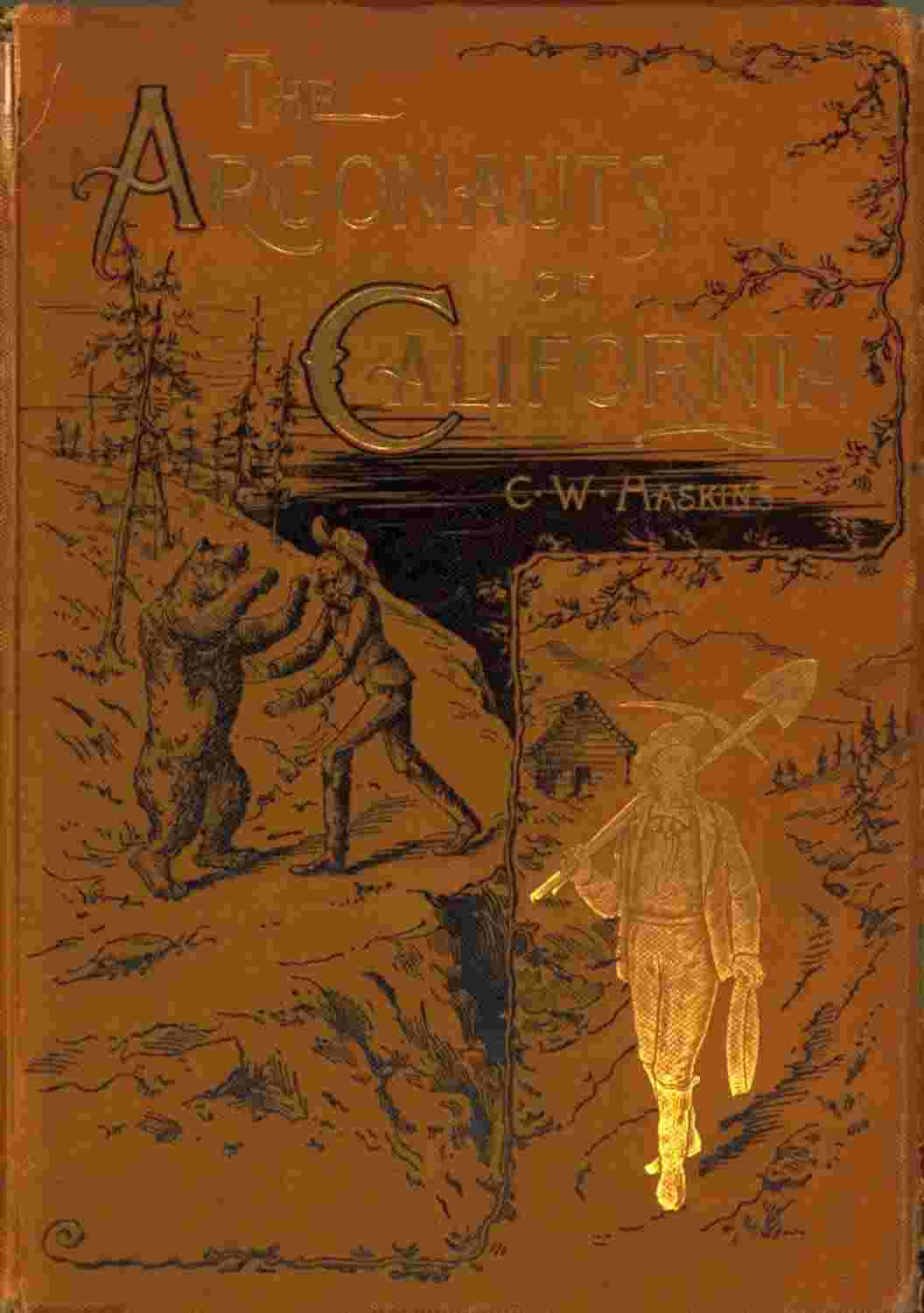
The Project Gutenberg eBook of The Argonauts of California: being the reminiscenses of scenes and incidents that occurred in California in the early mining days
Title: The Argonauts of California: being the reminiscenses of scenes and incidents that occurred in California in the early mining days
Author: Charles Warren Haskins
Release date: January 2, 2025 [eBook #75021]
Language: English
Original publication: NYC: Fords, Howard & Hulbert, 1889
Credits: Chuck Greif and the Online Distributed Proofreading Team at https://www.pgdp.net (This file was produced from images generously made available by The Internet Archive)
LIST OF ILLUSTRATIONS.
CONTENTS.
NAMES OF PIONEERS.
TRANSCRIBER'S NOTE
THE ARGONAUTS
OF CALIFORNIA
BEING THE REMINISCENCES
OF SCENES AND INCIDENTS THAT OCCURRED IN
CALIFORNIA IN EARLY MINING DAYS
BY
A PIONEER
And believing that it will be of some historical value as well
as of interest generally to know the names of those who
were the first to venture forth in the search of gold, and
by whose energy and labor the foundations of a great state
were laid, and also a general prosperity created throughout
the entire country, I have therefore prefixed to the
work the names of those that I have been able to obtain,
numbering about 35,000, and including among them the
names of several thousand who are now living in the
various States of the Union.
TEXT AND ILLUSTRATIONS DRAWN FROM LIFE
BY C. W. HASKINS.
PUBLISHED FOR THE AUTHOR, BY
FORDS, HOWARD & HULBERT
NEW YORK
1890
Entered according to Act of Congress, in the year 1889, by
C. W. HASKINS,
In the Office of the Librarian of Congress at Washington, D. C.
R. Pierce & Co., Printers, 53 Lafayette Place, N. Y.
TO THE
SURVIVING MEMBERS OF THE
ADVANCE GUARD
OF GOLD HUNTERS,
THE CALIFORNIA PIONEERS
AND THEIR DESCENDANTS,
WHO ARE NOW LIVING THROUGHOUT THE
UNITED STATES,
THIS BOOK
IS MOST RESPECTFULLY DEDICATED
BY THE
AUTHOR.
PREFACE.
While residing in the village of Kingston, located upon the Cœur D’Alene River in the silver mining regions of northern Idaho during the winter of ’87-’88, and being compelled to remain within doors during the winter in consequence of the great depth of snow and intense cold, in order to pass away the time I amused myself by writing an account of scenes and incidents that occurred in California in early days in the mining regions, and which came under my observation. These events are written entirely from memory, but I have endeavored to give as near as possible the correct date of the events and incidents mentioned, as well as their location and names with all of which I was familiar. As to the the correct description of scenes and events, I ask the remnant of that band of sturdy Argonauts who laid the foundation of a great State to bear me witness.
C. W. Haskins.
Index to the Names of the Forty-niners.
| Members of the various Pioneer Associations in the U. S. who are now living, | Page | 360 |
| Forty-niners residing in various parts of the Union who do not belong to any Association, | “ | 385 |
| Survivors of Col. Stevenson’s Regiment, | “ | 394 |
| Forty-niners now living in the Atlantic States, | “ | 395 |
| Forty-niners who went over-land to California, | “ | 395 |
| Forty-niners who sailed from City of N. Y., | “ | 414 |
| Forty-niners who sailed from the States of Massachusetts, Rhode Island and Connecticut, | “ | 453 |
| Forty-niners who sailed from New Orleans, Philadelphia, Baltimore and other Southern ports, | “ | 476 |
| From various Eastern ports, | “ | 495 |
LIST OF ILLUSTRATIONS.
-
Frontispiece.
“Hello, Bill!”
The Start for California.
Brazilian Music.
The Swell at Cape Horn.
An Able Seaman.
Forty-niners at the Hotel in Lima.
The Operatic Shark.
The Prolific Topmast.
The Calm.
Neptune’s Orchestra.
The Bullwhacker.
“Ye Done it Weel.”
The Dandy Miners.
Smoked Out.
The Frisky Flapjack.
Hangtown in ’49.
“None in Mine.”
The Industrious Prospectors.
“I Shust Nose It!”
Bulling the Mine.
“Ther, Ther, T, other One.”
The Ducks Take Water.
Dutch Charley.
Dan Boone and the Bear.
The First Rat in Hangtown.
Rats in Sacramento City.
The First Young Lady in the Mines.
The Spartan Mother.
The Boys Aloft.
Emigration of ’50.
The Howly Fragment.
The Argonaut and His Mule.
The Steamboat Runners.
The Miners’ Meeting.
On His Trail.
“I’v Shtruck it, Thin.”
The Sailor Boy.
The Chap Who Insulted a Lady.
The Claim Jumper.
The Art of Self-defense.
Didn’t Believe in Compromise.
The Disgusted Speculator.
“Write Often, Boys.”
The Jack Tars on the Hill.
The Geological Lecture.
Old Nick’s Grand Entrée.
A California Cyclone.
Only Two Days in the Mines.
A Simile.
Female Influence Illustrated.
Not Ready to Go.
The Voice of Old Dick.
Big George and the Road Agent.
“There She Comes, Boys!”
Miners’ Comfort.
“Dis am a Free Kentry, Massa.”
Coasting in Idaho.
Law and Order Triumph’s.
Charley, the Female Stage Driver.
Hank Monk in Time for Lunch.
The Picket Guard.
The Gambler’s Charity.
The Road Agent Outwitted.
From Fry-pan to the Fire.
A Newcomer.
Force of Habit.
The Deserted Camp.
Syd’s Last Prospect.
Skunked.
Ruined Castles.
Meeting of the Old-timers.
An Unexpected Festival.
The Gold-saving Machine.
Tex Gives Satisfaction.
Not Raising Mutiny but Sugar.
It’l Be Our Turn Next.
Bob the Fiddler.
The Power of Music.
Old-timers in the Hall.
Phantoms of the Old timers.
Sam Plunket and the Indians.
The Bear in a Quandary.
The Power of Beauty.
The Bean-pot Comet.
Dick Arnold to the Rescue.
The Brave Policeman.
A New Motor.
The Plum-duff.
Donkey Instinct.
Tex and the Alcalde.$1’49 Mosquitoes.
The Bear and the Prospector.
Sharpshooters.
Discovery of the Old River Beds.
Lost in the Mountains.
Nature’s Lullaby.
Discovery of Red Hill Gold.
Bob Lost a Fortune.
The Surprise.
Curiosity Satisfied.
Mining Ground Transformed.
“Is it Me Agint?”
“No More Frontier in Ourn!”
Not that Kind of Bird.
The Tarantula in the Boot.
The Boston Boy and His Bugle.
Found His Brother.
Kanakas at Work.
The Flight of Time.
The Miller Taking Toll.
Yank Revisiting Old Scenes.
Coasting in Idaho.
Town of Wallace.
A Flush Hand.
The Mississippians.
The Return East.
“Good Morning, William.”
CONTENTS.
| CHAPTER I—The News. Looking Forward. The Start |
| CHAPTER II—Arrival at St. Catherina. American Pluck. The Four Brave Tourists |
| CHAPTER III—A Gale. The Ocean Swell. Cape Horn. The Magellan Cloud. The Native Tradition |
| CHAPTER IV—Arrival in Callao. The Relics of the Earthquake. The Frolic with the English Officers. Target Shooting. The Calm. Water Spouts. The Shark |
| CHAPTER V—The Arrival in San Francisco. Gold Machines. Going to the Mines. The Bullwhacker. Arrival in Hangtown. The View from the Hill |
| CHAPTER VI—Business in the Mines. The Various Mining Camps. Physicians in Camp. Dr. Rankin. Coloma. Process of Mining. The ’49 Emigration. Sauerkraut. Female Influence Illustrated |
| CHAPTER VII—The Kanakas. The Dry Diggings Deserted. Admission of the State. Scarcity of Reading Matter. The Cost of Letter Postage. The Ingenious Bartender. Prices of Drinks. Celebrating the Fourth of July. Hard Characters |
| CHAPTER VIII—Climatic Changes. Appearance of Familiar Herbs. Rats. The true Theory. Fall Emigration. The Johnson Cut Off. The Target. The First Young Lady. A Spartan Mother. The Boys Up a Tree |
| CHAPTER IX—Sickness in the Mines. Earthquakes. The Steamboat Men. A Miners’ Meeting. Lucky Bill. Kit Carson. The Financial Condition of the Miners. Australian Mike and His Tin Can. Portuguese Jo. The Divining-rod |
| CHAPTER X—Where the Rich Placers were Found. Miners’ Superstition. The Blue Clay Deposit. Gold Machines |
| CHAPTER XI—The Indian War. A Change in the Social Conditions. The Desperado. The Sailors. The Mines Worked Out |
| CHAPTER XII—Mining Speculators. The Lost Brother. Gambling. A Generous Gambler. An Important Discovery. Beginning of Fruit Culture and Wine Manufacture in California. The First Church Organization in the Mining Regions. “Old Nick” and His Animals. “Old Syd.” |
| CHAPTER XIII—Emigration of$1’51. Churches Erected. Mines Deserted. The Chinese Miners. Hill, River and Quartz Mining. Nature Frowns. The Course of Events Change. Fruit Raising. Prospecting. On the Homestretch |
| CHAPTER XIV—The Discovery of Silver in Nevada. The Stage Road. Hank Monk. Road Agents. The Parson. The Stool Pigeon. Spirits. The Boys Who Captured the Thief. A Young Dick Turpin. The Irishman and the Road Agent |
| CHAPTER XV—Where are the Pioneers? The Overland Stage. Pony Express. The Sound of War. A Wet Winter. The Hotel on the Road. The Railroad |
| CHAPTER XVI—The Forty-niner. Syd at the North Pole. The Homes of the Old-timers. The Remains of the Cabins of the Forty-niners. Panning out the Old Cabins |
| CHAPTER XVII—Meeting of the Old Timers. The Buckeye Tunnel. The Best as It is. Bozer Who Got Skunked. The Hydraulic Miner. Mike’s Explanation |
| CHAPTER XVIII—Why are so Many of the Old-timers so Poor? The Uncertainty of Mining. Tex and Barton Lee. Tex and the Hound. Tex on Board the Steamer. Tex at Golgona |
| CHAPTER XIX—Tennessee’s Letter from Tex. The War in Chili Gulch. Sam Brown and the Chap with the Mild Blue Eyes. Sam Brown and the Policeman. Old Kentuck and Sleepy Ben |
| CHAPTER XX—Yank Visits the Old Mining Camp. Yank Seated Upon the Boulder. The First Loaf of Bread. The Bean-pot Comet. How Julius Sailed Up the River. Jeff’s Plum Duff. The Stone Statue. The Old Miner Who was Robbed on Board the Steamer. The Cœur d’Alene Mines. Coasting |
| CHAPTER XXI—Their Names Unknown. The Types of Men in the Mines. Pike Illustration of Missouri Character. Bob the Fiddler. The Power of Music Illustrated. John Kelley the Musician. Joe Bowers. Jeff Visits Pioneer Hall. Old Miners in San Francisco |
| CHAPTER XXII—Pioneer Hall. Old Mike Explains. Something Wrong. The Business of Mining. Mike’s Philosophy. Yank at the Bay. The Expressman and the Broom Pedler. Lucky Bill and the Gamblers. Sam Plunket the Arkansas Beauty |
| CHAPTER XXIII—Bill Burnes Lynching the Colored Man. Dick Arnold. The Mining Regions. The Old-timers Disperse. The Phantoms of the Forty-niners. Forty Years have Passed. The Argonaut’s Soliloquy. The Great Changes. The Flight of Time. The Number of Pioneers Now Living |
| CHAPTER XXIV—“Good Morning, William.” The Return. Great Changes |
The Argonauts of California.
CHAPTER I.
The News—Looking Forward—The Start.
IN the winter of ’48 I resided in New Bedford, Mass. I had a chum. What boy has not? My chum’s name was Bill. He had been absent from New Bedford for a few months, and on meeting him, a few days after his return, I greeted him with:
“Hello, Bill! Have you heard the news?”
“No; what is it?”
“Well; while you were away, the news came that a man in California, named Marshall, has made the discovery that there’s lots of Gold out there. He found a big chunk of it where he was at work.”
“You don’t say so! What’s he going to do with it; did he say?”
“That has nothing to do with the case. There’s the greatest excitement here, you ever heard of. Not only here, but all over the country, on account of the discovery. Thousands of men are getting ready to go out there. A lot of ships down at the wharves are being fitted out for the voyage, and they are going to take passengers cheap. Now what do you say to going along?”
Bill did not seem to enthuse nearly as much as the occasion would warrant, for said he,
“Well, now; I don’t see what reasons you can give for supposing that there’s more gold there, simply because this man found a chunk of it.”
“But, Bill,” said I, with undampened ardor; “don’t you understand the scientific nature of it? Isn’t it likely that there must be lots more of it scattered about? Besides, the volcanic character of the country is very favorable for that kind of a product, you know.”
Bill smiled skeptically, and gave me the benefit of his geological knowledge as follows:
“Oh, yes, I know. The gold is thrown out from the bowels of the earth, where it’s manufactured, by the volcanoes and scattered about on the tops of the mountains. Then along come the earthquakes and shake it down among the grass roots and bushes in the valleys, where you expect to scrape it up by the bushel.”
“Oh, well, it may prove to be, as you say, a wild goose chase, after all; but there’s a ship, now at the wharf, right from San Francisco, and one of the sailors, who seems to be a real honest chap, told me that the country was chock full of gold. He said that after they had hoisted up the anchor to start home he scraped the mud off the anchor and washed more than five pounds out of it—”
“Of what—mud?”
“No, of Gold; Real Gold!”
“Oh, pshaw! Do you believe that yarn?”
“Why, of course I do! Sailors are noted for their veracity.”
“Nothing of the kind. They have the reputation of being the biggest liars on earth; especially when out on the water and the wind blows hard.”
Still true to my colors, I protested, “That’s impossible.”
“No, ’tis not, for if you were sailing a ship out at sea and the wind blew real hard, you’d lie too.”
Bill’s levity fell upon unappreciative soil. I was too much in earnest, and resumed:
“I’m bound to go out there, Bill, if I don’t pick more than a hatful of gold in a day. There’s nothing like trying, you know. But what’s the use of going after gold, you say? Well, now, isn’t that what we are all after, and nearly crazy to get? And, isn’t it easier to go to a country where you can scrape it up from the ground or pick it out from among the grass by the bucketful, than it is to toil and sweat and worry through a long life here?”
I cannot now remember whether Bill was just a little cynical, or simply echoed the opinions of some of the wiseacres of that day when he parried my query with,
“There’s plenty of money in the country now, and more is unnecessary. What are you going to do with it all?”
“That’s a singular idea,” I answered. “Do you suppose it’s possible to have too much money in the country? Such old, puritanical notions about money are ridiculous. You and I haven’t too much and we could use a few millions to good advantage, if we had them. And if it should prove true that lots of gold can be found in California, you’ll live to see this country step to the front among nations in wealth, prosperity and enterprise.”
In my ardor I had risen to unwonted heights of eloquence.
Bill thought that there was enough enterprise in the country, already.
I assured him that when we began to send gold back from California in ton lots, the various enterprises would boom to an extent never before witnessed in the world.
Bill had, however, taken the negative side of the issue and fired another broadside at me:
“Yes, but Jo, aren’t you going it a little too fast in anticipating such big things? For my part, I don’t believe that there’s enough gold in all of California to do all that. ’Twould take bushels of it, you know.”
Upon confirmation of the news of the discovery of gold in California, all was commotion in the various seaports of the Atlantic coast. Vessels of all sizes and descriptions, from the small, 50 ton fishing smack, that would be compelled to crawl along near the shore, up to the noble clipper ship, that was able to contend with the elements in mid-ocean, were fitted up with conveniences for passengers in greatest haste. Many vessels sailed early in the year of ’49 for the Eldorado. It was not, however, until the spring that the grand stampede commenced. By April 1, in ’49, 50,000 good, able-bodied men, and a few women, all desirous of bettering their condition and acquiring wealth in a much easier and quicker method than by the old-fashioned, slow and plodding methods of their ancestors, were upon their way to the other side of the continent, willing to encounter the danger from Indians or starvation, whilst an equal number preferred to risk the dangers of a journey by sea to the land of gold. In company with about one hundred others, we took passage in the clipper ship “America,” Capt. C. P. Seabury, from the port of New Bedford, Mass. On the morning of the 1st of April, the fact was announced that all must be on board at 10 A.M. The anchor was raised from its muddy bed below; the sails were unfurled to the breeze; the bow of our boat swung round a bit and pointed out toward the billows in the big ocean beyond. We bade farewell to friends who accompanied us out to the light-house; and, with hearty wishes from them that we might meet with the greatest success in our venturesome undertaking, sailed out upon the broad ocean in the direction of Cape Horn. We watched the green hills, with which we had been familiar from early childhood, as they vanished from sight below the horizon, and wondered then if ’twas so ordained by the powers above, that we would soon be enabled to return again to these familiar scenes of our boyhood days with our pockets lined with tin (and some of us still continue in the same business, at the old stand, of wondering).
Our passengers, being unaccustomed to the situation, soon felt very peculiar sensations produced by the motions of the vessel. We sought the entrance to the basement, into which we managed to make our way in an oblique kind of a style, and retired to our sleeping apartments, there to remain until we deemed it safe to again climb out upon the roof of the vessel.
We were satisfied in a few days that we were very fortunate in our selection of a vessel for the voyage, for we found that she was a strong, staunch one; a fast goer, with a good crew and commanded by an expert seaman, who understood his business. Fortunately for
us, perhaps, we had as passengers a number of old veteran (retired) sea captains, who were always very ready and willing, without remuneration, to give our captain all necessary advice, at such times when, in their opinion, he needed it. When, in their opinion, there was danger of the ship sailing too fast, they would advise him to take down some of the big sails; or, again, when the wind was too high, they would become aware at once of the danger of the ship running under, front end foremost, and at such times they would advise the captain to stop her. Under such conditions, where there were many men of experience keeping their weather eyes open for emergencies, it is evident that we, the passengers, felt perfectly secure from danger, and could sleep without fear.
During the voyage we amused ourselves, no doubt, in the same manner as passengers of vessels usually do, by various games. There were an assortment of musical instruments, and card playing was an amusement much in vogue; but a few of the younger passengers of a sporting tendency, would bet upon the speed of the ship and the number of miles we would sail upon the succeeding day. Some of the older ones, however, of a more elevated character, who were above such petty amusements, would practice at leap-frog upon deck during pleasant weather. When the weather was otherwise they would pass their time below, in betting with each other upon the number of plums they would be able to find in their respective rations of duff, and many were enabled to enjoy double rations at the table in consequence. In the opinion of many of the older passengers, one very important fact had been overlooked in our great haste to start for the golden shores of California, and that was, the failure to make suitable provision for the storage of gold dust. This was, indeed, an oversight, for nothing had been provided suitable for the purpose. It therefore taxed the ingenuity of the older ones, and many were the devices proposed. One very ingenious and sanguine individual commenced the manufacture of leather pouches from old boot-legs or from pieces of canvas, maintaining that these would be found the most convenient. Another insisted that good, strong, stone ale bottles were far superior for stowing the finer grades of dust, and such was his faith in them that he had actually brought two or three dozen with him. But where is the limit to genius or the faculty of adaptation to conditions, for if no other person had appeared upon the stage with a superior device for the purpose, the inventors of the boot-leg pouch and of the ale bottle devices would have divided the honors between them for their ingenuity. The possession of an older head with greater experience, however, suggested that although leather pouches and beer bottles might answer very well, they would probably be found very inconvenient to handle on account of the great specific gravity of gold. He therefore suggested that the best way to pack the gold dust, and the best means of handling it, would be to put it into empty pork barrels, for these could be rolled with ease and of course would be more convenient for shipping. The greater portion of the passengers saw at once the superior advantages of the pork-barrel idea, and resolved to adopt that method.
One old gentleman spent his time in the construction of a dredging machine for raising the sand from the river beds, and for extracting the big nuggets from among the rocks at the bottom; whilst another one busied himself in making sheet-iron scoops, to which long poles were to be attached. His idea was to take his station under the shade of a tree, upon the river bank, scoop up the rich golden sands and extract the gold from it upon dry land, without the danger of being sun struck or wetting his feet. Many of the more intelligent ones among our passengers kept a daily record of scenes and incidents during our voyage; but so much of this class of literature has been heretofore brought before the public that a report from any of them would not be of much interest at this time.
CHAPTER II.
Arrival at St. Catherina—American Pluck—The Four Brave Tourists.
IT having been decided by the Captain of our vessel, at the request of many of the passengers, that we visit some port upon the coast of Brazil, upon consulting the sailing directions of Lieut. Maury, it was found that in order to do so it was necessary to first visit the coast of Africa, to take advantage of the trade winds. The ship’s course was therefore directed towards the Continent of Africa, at which portion of our planet we arrived in good time; and ’twas not until we found that the dust from that continent was accumulating upon our clothing and other articles on ship board, that our Captain concluded we were near enough to the African coast. Our good ship was, therefore, turned around and the bow pointed towards South America. With a fair wind we crossed the ocean again, and on the 20th of May sailed into the port of St. Catherina and dropped anchor under the guns of the fortification located on the summit of a hill near the town.
We found lying at anchor here the steamer “Senator,” on her way to California, as well as two or three other vessels loaded with passengers from the United States for the same destination. An incident in which the passengers of these vessels took a very prominent part occurred a few days previous to our arrival, and is worth relating, as it illustrates the type of American character which constituted the advance guard of the California pioneers, and proves that the Americans will submit to no indignity from a foreign race, if they possess the power and means of resenting it.
A young man, a passenger of one of the vessels, was assassinated by a native, but for what reason was not known, although supposed to be from jealousy. The Americans demanded the arrest and punishment of the assassin, but no attention was paid to the demand, and no efforts were made for the murderer’s arrest, since he had slain only an “Americano.” It may be of some interest to those of the human family who have adopted the great American Eagle as their emblem, to know that at this period in their history—40 years ago—when iron clads were unthought of and monitors unknown, this nation of people were not held in very high esteem by the various governments and peoples of the South American continent, for the reason that their ports were but very seldom visited by our ships of war, only upon certain isolated occasions, when the American sloop of war “St. Marys,” or some craft of similar dimensions, would put into these Southern ports. For this reason, they seemed to be impressed with the idea that, in comparison with England, with the monster ships of war with which they were all familiar, the United States were of little consequence and small potatoes generally. As a consequence, a demand for the arrest for the murderer of the young American was treated with contempt; but they were dealing now with the passengers of three or four ships who were on their way to California—a crowd of Americans who were determined to have the culprit arrested and punished at all hazards. The Governor of the province, beginning to be alarmed by their demonstrations, for they had threatened to capture the fortress upon the hill and to bombard the town, despatched messengers instantly to the Emperor at Rio Janeiro for assistance, believing, no doubt, that it was the intention of these vile “Americanos” to capture the entire country and annex it to the United States. This idea arose from the fact, as we heard related, that the passengers from one ship did actually enter the fortress and unfolded to the breeze the stars and stripes from the flag-staff, and some one, for fun or accident, had with a piece of charcoal put in an additional star which, of course, represented Brazil. But peace was soon restored; the Governor had the culprit arrested, and after a fair trial he was shot in the presence of those who demanded his execution; and in a few days the ships sailed upon their course for California with passengers satisfied and contented.
We found, a short distance in the interior, a man with his family from the State of Vermont, who had emigrated here to live in ease and comfort upon the spontaneous productions of the soil, which consist of oranges, bananas and other tropical fruits. He stated that he had been induced to make his home in this tropical country by an acquaintance who was a seafaring man, and had often visited this portion of the earth. Through representations of the beauty of the country and the little labor and exertion required to live in ease and comfort, he had been persuaded into coming here.
“The first year was pleasant indeed,” said he; “and often when we were conversing upon the pleasures of such a life free from toil and care, we wondered why the greater portion of those who dwelt in the far northern New England States, amidst the snows and rains of their severe winters, toiling and striving for the necessaries of life, did not come to this earthly paradise. These were our thoughts and feelings during the first year; but, after a residence of three years in this beautiful country, with its warm sunny skies and its luxuriant vegetation, despite these advantages, we have been forced to the conclusion that, although the natives of the country were adapted by nature to such conditions of existence, an American never would be. Why, sir, I can take more solid enjoyment and comfort in one year among the rugged hills and rocks of old Vermont, where the maxim is work or starve, than it would be possible to find here in a lifetime, and I intend returning to that country again just as soon as opportunity offers.”
It was here at St. Catherina, also, that we saw for the first time in our lives diamonds in their rough state when taken from the river beds, and which, to all appearances, are ordinary quartz pebbles, such as are often seen upon the sea-shore. In their original state when first formed in nature’s subterranean laboratory, they are crystallized with proper facets and angles; but being subsequently deposited in the beds of running streams, in process of time are worn to a smooth surface by friction amongst the gravel of the river. These gems possess but little value until much time and considerable labor is expended in again restoring the worn out facets and angles. So far as known they serve but one purpose in their rough state, and that is to illustrate the fact that although a man may be very careless in his style of dress, paying no regard to the latest fashion and even with his top-coat in rags, yet he may be a real nice sort of a man for all that; a gem of the first water beneath a rough coating. Experience illustrates the fact that this is often the case, and for this reason it would be as well before driving the tramp from out the back yard to search beneath his rags for the gem that may possibly be there, or for anything else of value that may be concealed.
We saw, also, a specimen of the diamond miner, a few of them having just arrived from the mines, hundreds of miles away to the West, in the interior, to dispose of the diamonds to the merchants in the town. One of them explained to us the manner of finding the valuable gem: the process being similar, in some respects, to the methods adopted in California in mining for gold in the river-beds. By the use of wing dams, the stream is turned, and, after shovelling the sand and gravel from the bed rock, search is then made for what are termed pot holes in the hard bed rock, in the bottom of which is found the diamond, or at least it should be there, but unfortunately this is not always the case, as all miners can testify to with sorrow.
A few miles inland was the border of the great Brazilian forest that we had often read of in our school-boy days, and which, at this point, approaches to within a few miles of the coast. We were informed that a few miles within this dark forest could be found a small lake about two miles in circumference, and that it was filled with a great variety of creeping ferocious reptiles, such as alligators, crocodiles, huge water snakes and water lizards. Upon its surface, also could be seen water fowl of all kinds, and upon the branches of trees surrounding it a great variety of birds, with the gayest plumage, could be found. Frolicking amidst the tall grass upon its banks would be seen a variety of wild animals, including beautiful specimens of the frolicsome Brazilian tiger. A number of us determined to enter this dense forest and investigate the beauties of this wonderful lake and its surroundings; but we were warned by the natives that it was a dangerous undertaking, unless we procured a suitable guide, as it was very dark and dismal within the forest; and furthermore, that the trails formed by the animals were so tortuous and crooked, that there was danger of getting lost. To our inexperienced minds, an undertaking of this nature offered irresistible fascinations, for we were of a nation that knew no fear, and the national characteristic being to satisfy curiosity, let the consequences be what they may, why should we fear? Were we not armed with the latest discovery that the inventive genius of a Yankee could devise as a protection? Perhaps the animals in the forest had not, as yet, been made aware of the fact; but would they not crouch in abject fear when we entered the dark trails of the vast forest to see each of us carrying in his hand a Smith & Wesson, duplex patent, double back action, revolver, vulgarly styled a “pepper-box”? Well, I should say they would, and so we thought. Armed with this style of weapon, one pleasant morning four of us (the bravest ones) determined to enter the forest and beard the tiger in his lair. A native kindly volunteered to leave his daily toil, and, for a small fee, guide us to the entrance of the forest. We examined our weapons, drew a long breath, and in single file, walked in the narrow trail for a short distance into the dark abyss: then stopped, drew another long breath, and marched out again. Not because we had any fear for our individual selves, but for each other, for each didn’t like to see the other torn into a mass of shoe strings by an enraged tiger.
“What was that awful roaring away in there, do you reckon?” asked one.
“Oh,” says another. “That noise was miles away. I ain’t afraid, so let’s try it again.”
After discharging a few shots at imaginary beasts, as a fair warning to others away in the forest that were not imaginary, we again entered the dark trail and proceeded cautiously onward. The monkeys among the branches over our heads would follow us, and occasionally approach near enough to endeavor to snatch our hats from our heads. We had proceeded in this manner for about a mile, when a Cape Cod chap, who was in the van, suddenly came to a stop, at the same time exclaiming in a very emphatic manner, “Go back! go back, quick!” We all pressed forward, however, anxious to see the cause of the alarm, and we saw it. A few straggling rays of the sun had forced their way through the thick foliage above, and illuminated a small patch of the trail of about two feet in extent, and lying in this sunny spot could be discerned the head of an enormous serpent. The body was there too, of course, but being among the bushes it was not visible. We cared nothing for the body, but it was the ferocious looking head that startled us. Its eyes assumed all the colors of the rainbow. Four pairs of very severe eyes were concentrated upon the eyes of the monster, which seemed to realize the situation, and from a feeling of bashfulness at being gazed upon by strangers, or, perhaps, having caught sight of our weapons, and recognized the brand, from an instinct of coming danger closed its eyes. With optics partially closed, its countenance assumed a very amiable expression; but a slight movement from one of us caused it to again raise its eyes, and made one, at least, of us wish that he hadn’t come.
“Oh pshaw!” remarked a Boston chap, who had attended high school some, “let’s go ahead anyhow. You remember that Plato, or some other fellow, said that courage was one of the virtues, or something of the kind. Now let us prove that we are virtuous young men. We will turn his right flank, and get to his rear easy enough.”
“Oh, git out,” said the Cape Cod chap; “them form of animals hain’t got any right nor left flank at all; nor rear end neither, ’cause their bodies come to a point on the fur end.” Just at this moment, the monster made a forward movement and we retired in a rather hasty manner, leaving the serpent to enjoy its sun bath.
But the reader would ask, since we were so well provided with weapons, why in the name of Cæsar didn’t we massacre the brute at once, and go on. It must have been from fear that we did not, and so it was. We were fearful of shooting each other, for we had practiced so little with our weapons that it had not as yet been positively decided whether or not we should aim right at an animal that we desired to massacre, or in the opposite direction. One of the young men who had practiced considerably during the voyage shooting at the big waves, and was always positive that he hit them, somewhere, volunteered to test his skill upon the serpent, but for fear that the noise might make it angry and cause it to bite some of us, he was prevented.
As we emerged from the forest, our ears were assailed with a most unearthly screeching, that seemed to come from the open country beyond the forest. We concluded, at once, that some ferocious monster had by accident got out of the woods, and was unable to find its way back again. We examined our weapons, determined to sell our lives at the highest price, spot cash, and marched manfully in the direction of our vessel.
The Cape Cod lad remarked, as we hurried onward, that the screeching reminded him of a political caucus in his native town, and “the cheerman was a-tryin’ to call ther meetin’ to order.” Upon reaching a slight elevation, we saw, in the road ahead of us, a cart drawn by a pair of oxen, and it was from this that the noise proceeded. We concluded, at once, that the cart contained wild animals that were perhaps being shipped to New York for Mr. Barnum; but upon nearer approach we found, to our astonishment and disgust, that the terrible Brazilian melody was caused by the wheels upon the axles, which in this country are never greased.
We suggested to the driver, by certain signs, that they ought to be greased, and that it was an evidence of barbarism, and would not be tolerated in any civilized country. “Oh no,” he replied, “Americanos no sabe. Wheels no sing: bullocks no go.”
Well, ’tis no wonder they go; anything would go from such a noise, and never return. An army of Kansas grasshoppers would go into the regions above and never again return to earth. The terrible screeching was heard also on board of the ship, and it even suggested to our Captain that we ought to go too, and that ten days was long enough to remain in any country where they didn’t grease their cart wheels, and we went. After taking on board a good supply of tropical fruits of various kinds, with bananas in greatest abundance, which were suspended to the ship’s rigging in all convenient places until she had the appearance of a banana plantation going on an excursion, we sailed again out upon the broad ocean and laid our course for Cape Horn, where we expected to arrive by the middle of June.
CHAPTER III.
A Gale—The Ocean Swell—Cape Horn—The Magellan Cloud—The Native Tradition.
AS is very often the case in relation to human affairs, fate decreed otherwise, and in plain, unmistakable language we heard whispered by the gale which we encountered as it roared through the ship’s rigging, “Go slow! go slow!” And we did. About three hundred miles from the land off the mouth of the La Platte we encountered what all of the old salts, as well as the young, fresh ones, declared to be the heaviest gale that it was ever our misfortune to encounter. It came from off the coast, and of course was favorable for us; but there was a little too much of it. The sea was smooth, for such was the velocity and force of the gale that when a billow attempted to assert its rights and raised its head above the general sea level, it was instantly blown off, leaving in its place but a mass of white and seething foam. In this manner, with our noble ship lying to with the lee rail under water, we remained for thirteen days. To cook was impossible, for the reason that, at the angle at which our galley stove cut the horizon, nothing would stay in the dinner pot, and we were obliged therefore to eat off-hand and at random whatever we could get. It was now getting monotonous, and to add to our troubles the Captain would not grant us permission to go on shore, and it even seemed to hurt his feelings when we asked him.
On the evening of the thirteenth, the Captain, deprived of his accustomed rations of plum duff and soft tack, determined upon the tactics which he should adopt the following day if the gale did not abate and that was to run before the gale. This course was strongly objected to by the veteran skippers on board, who claimed that it would be a most dangerous proceeding and would never be adopted by anyone but a young and inexperienced commander. They had, as they explained, roamed the seas over from infancy and were well aware of the danger of running before a gale of such huge dimensions as we were then experiencing. They therefore strongly protested against it and assured the Captain that in case he did adopt that plan he must be responsible for all damages if the ship should run under and sink away down to the bottom in the cold sea, which they were most positive would be the case.
The Captain, however, after lying all night on the edge of his bunk determined, notwithstanding their protestations, early the next morning to make a break for liberty. With a firm step and with salt water in his larboard eye, he ascended to the deck and soon the command was heard above the roar of the tempest: “All hands on deck!”
In a few minutes every man of us was at his post as soon as we could find it, and when the order was given to the sailors who were holding fast to the wheel to let her go, they did, and it flew around in a most spiteful manner, as if conscious of its freedom. The bows of the ship swung around with the gale and we went flying amidst the foam upon the rough surface of the sea at a rate of speed nearly equal to a railroad train, and in a few hours were again upon our way with a fair wind and under full sail in the direction of Cape Horn.
“Well, well!” exclaimed one of the veteran skippers, who had predicted all kinds of disasters to the inexperienced Captain, as a consequence of his rash proceeding, and who was now standing near the gangway holding in his hand a well-filled carpet-bag, and with a look of disgust and disappointment in his expectations stamped upon his weather-beaten countenance: “Yer come outer that gale in good seaman style; but if yer had only took my advice yer’d done it more ’n a week ago.”
We arrived at Cape Horn on the 4th of July, and with a fair wind sailed around the dangerous point and entered the waters of the Pacific Ocean. This being our national holiday, we dressed up our vessel in appropriate attire, and with various instruments of music, the firing of guns and pistols, celebrated the day in true Yankee style, to the great astonishment of the seagulls, as well as the immense flock of birds of various kinds that arose into the air from the clefts and caverns of the massive rocks of the coast.
Just previous to our arrival at Cape Horn, much surprise had been expressed by many of us at the unusual heavy swell of the sea or of the huge billows we encountered, but had been invariably reminded by the aged veteran seaman on board:
“Oh, pshaw! these are nothing but ripples compared to what you will see when you reach Cape Horn. You just wait, and blast me eyes, but you will see them down there as high as the main mast.”