
The Project Gutenberg eBook of The Art and the Romance of Indian Basketry
Title: The Art and the Romance of Indian Basketry
Author: Clark Field
Release date: May 30, 2020 [eBook #62285]
Most recently updated: October 18, 2024
Language: English
Credits: Produced by Stephen Hutcheson and the Online Distributed
Proofreading Team at https://www.pgdp.net
the art and
the romance
of
indian basketry
clark field
clark field collection
philbrook art center • tulsa • 1964
Published by Philbrook Art Center
Tulsa, Oklahoma
1964
FOREWORD
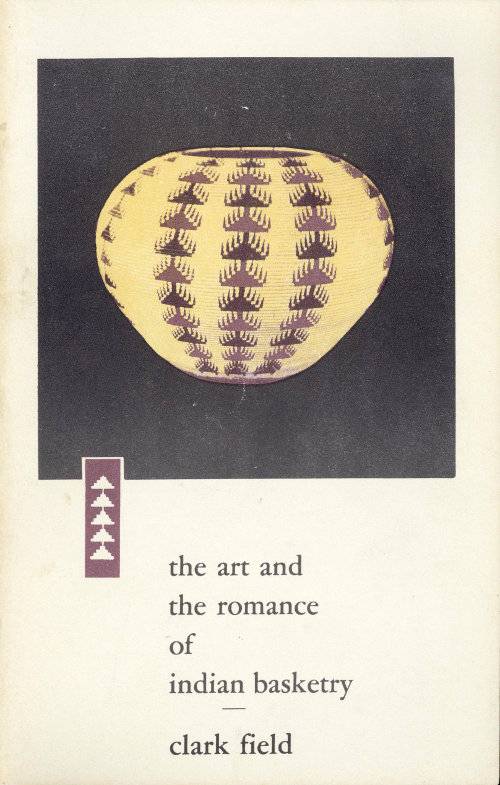
The autobiographical information about Mr. Clark Field, which appears at the end of this brochure, briefly tells the inspiring story of well over four decades of dedication to—and sincere belief in—the American Indian as a creative artist. The results of these many years of collecting Indian baskets (and pottery) are on permanent display at Philbrook Art Center, in the Clark Field Collection; in addition, many other specimens are in storage and available to the scholar in the study collection. This brochure is not intended as a catalogue of all of the baskets in the Clark Field Collection, which includes more than a thousand specimens. Rather, it serves as an introduction to Indian basketry and tells the story of how baskets were made and used. About 90 of the more important baskets are illustrated, including the most famous American Indian basket, woven by Dotsolalee reproduced in color on the cover.
Mr. Field has combined his enthusiasm for the art of Indian basketry with a high degree of scientific scholarship. He has kept careful records, which will become increasingly valuable as old specimens become even more rare and this Indian skill gradually dies out in this modern world. His daughter, Dorothy Field Maxwell, has assisted Mr. and Mrs. Field in their collection and with the preparation of this brochure. Mrs. Jeanne Snodgrass, Curator of Indian Art at Philbrook, has also assisted with the brochure in an editorial capacity.
Mr. Field has performed an invaluable service to humanity in his long dedication to the preservation of this most important facet of the original Americans, and Philbrook Art Center will be, for countless generations, a mecca for those who wish to enjoy this fascinating utilitarian, yet esthetically meaningful art form.
Donald G. Humphrey Director Philbrook Art Center Clark Field
BASKETRY
The need for food containers in early human communities led to the “invention” of basketry. The first baskets may have been made of animal skin or twigs; but soon evolved into the use of more suitable materials such as vegetable fibres. Because of the organic materials used in making baskets, most of the earliest examples have been lost through decay. A few examples have been preserved but only in areas of extremely dry climate, such as in Egypt, in Chile and Peru in South America, and in the southwestern United States. Radiocarbon tests of woven artifacts establish the existence and the use of baskets in Nevada, Utah and Oregon as early as 9000 to 700 B.C., and that Egyptians of the pre-dynastic period (c. 5000 B.C.) used baskets. Early literary sources, such as the Bible, mention baskets and other woven articles such as the “ark of bulrushes” in which the infant Moses was hidden (Exod. 2: 3, 53); baskets were used to bring the tithes to the temple, and Matthew talked of “twelve baskets full.” (Matt. 14: 20.)
In the study of American Indian baskets there are three major factors to be considered: the first is the tribe which produced the basket; the second is the language, since inter-marriage among tribes produced varying cultures; the third factor is the weave of the basket itself. For example, the five major weaves used by American Indians are: Coil, Twine, Twill, Wicker and Imbricated. To the novice there is the obvious difference in shape, color and texture of a collection of Indian baskets viewed in a museum. To the collector there is the hint of the whole pattern of life of the Indians who produced the basket.
The materials used in any particular basket reflect the locale of the tribe which produced it, for the Indian used materials that were at hand. In the case of the Cherokees, a native variety of red honey suckle produced runners that were used by that tribe in Virginia in a wicker-type weave. In North Carolina, the same tribe utilized the Japanese honeysuckle, while in Oklahoma the tribe used buckbrush runners. In Arizona, the Pimas wove split willow twigs and the black Martyna or “Devil’s Claw” of their desert lands.
It is the Indian woman, not the man, who makes baskets (except for few instances, i.e., the Papago carrying basket). They are made either for utilitarian use or for ceremonial use. Basket designs are not taught to the craftsman nor are they copied from a pattern book. They are created by the individual weaver who is an artist of great ability. The artist-craftsman must first develop a manner of weaving that will form a shape adequate for the basket’s final use. She must then find suitable materials in her area for this weaving project. This step completed, she mentally creates a decorative design and invents a method of weaving it into the basket.
It is known that all North American Indian tribes, at some time in their history, made and used baskets. However, the finest and most decorative baskets were made about the middle of the 19th century, in the Northwest, down the Pacific Coast states and into the Southwest through Arizona and New Mexico.
In 1935 there were more than five hundred Pima Indians making baskets for their own use. Now there are less than six good weavers on that reservation. Today Papago Indians make some baskets for tourist trade, but not nearly as many as they made a few years ago. The Hopi Indians bring a few baskets to market places, but there are fewer and fewer each year. For example: at the 1964 Inter-Tribal Indian Ceremonials, Gallup, New Mexico, there were forty classifications in the basketry competition—baskets were submitted to only twenty-seven classifications. There are some basket weavers among other tribes but for the most part, few tribes today may be called “basket makers.”
The influence of other culture groups upon the craft of basket weaving is so great that each year fewer baskets are produced by the regular weavers. The Indian women have learned that they can secure mass produced articles as a substitute for baskets. Only two percent of the types of baskets included in this collection are now being made. It is quite probable that by the year 2000 there will be NO Indian baskets being woven.
EARLY BASKETRY
Ozark Mountains of Arkansas
Very few people are aware that baskets were made by the Ozark “Bluff Dwellers.” A special exhibit in the University of Arkansas Museum, Fayetteville, contains a small basket filled with grasshoppers. The University Museum points out that as long ago as the year 1 A.D., baskets were being made by Indians in the Ozark Area. This provides further evidence of the Indian’s early inhabitance of this country.
BASKETS WHICH ARE NO LONGER MADE—AND WHY
Case No. 5:
These tightly woven baskets made by Thlinkits of Alaska, were woven from spruce tree roots which were split by hand. The baskets were used to hold boiling water for clam cooking. The fibers swelled to such an extent that water could be retained in the basket for as long as five hours. Today this tribe purchases a kettle or bucket for their boiling needs. (See Plate 9c)
Case No. 7:
These large Apache baskets used for storing grain, were made about 1874. It required as long as three months to produce this type of specimen and since 1914 very few have been made. The twenty-five cent burlap sack has replaced it. (See Plate 6c)
Case No. 9:
This Cochiti bird cage, made of a yucca plant, has been replaced by metal bird cages.
IDEAS COPIED FROM INDIAN BASKETS
The Anglo appropriated many Indian basket ideas for his own use:
The Penobscot colander was found in use as such among the people of this Maine tribe and was made about 1841. It is quite possible that we took this as a pattern for our own metal colanders. (See Plate 10a)
It is also quite possible that we copied the pattern of the Catawba, North Carolina, fish trap for our own minnow trap. (See Plate 4a)
BASKETS OF UNIQUE DESIGNS AND USES
The average weaver does not use more than five or six figures in a design.
Case No. 3: Mission of California—a quail and flying duck design. (See Plate 11b)
Case No. 3: Shoshone (Panamint), Death Valley California—Oriole design food bowl. (See Plate 11c)
Case No. 9: Choctaw of Oklahoma—Wall Pocket. (See Plate 16c)
Case No. 9: Niantic of Connecticut—clothes rinsing basket. (See Plate 19d)
Case No. 10: Chitimacha of Louisiana—an alligator intestine design. (See Plate 15c)
Case No. 11: Shoshone (Panamint), Death Valley, California—seventy figures in the design; including the American Eagle, crow in a tree, rocky mountain sheep, and lizard tracks in the sand. (See Plate 6b)
Case No. 11: Quinault of Washington—Clam gathering basket. (See Plate 14b)
Case No. 12: Cahuilla of California—food platter rattlesnake design. (See Plate 12a)
Case No. 12: Chemehueve of Arizona—a “stink bug” design. (See Plate 12c)
Case No. 12: Yavapai Apache of Arizona—a tarantula design. (See Plate 12d)
Case No. 13: Paiute of Nevada—porridge bowl. (See Plate 10b)
Case No. 13: Hoopa of California—grinding tray and stone. (See Plate 10d)
THE VANISHING INDIAN?
The vanishing Indian? He is not vanishing! In 1890, the Indian population in North America numbered about one quarter million and in 1963, records reveal there are over one million Indians.
SYMBOLIC DESIGNS?
There is the mistaken idea that one tribe “understands” the designs of another tribe and that there is symbolism, or meaning, to every design. Actually, most designs are purely decorative renderings and they have no more symbolism for the Indian than a fabric design has for the general public.
The identification of a basket is made not through the interpretation of a “mysterious meaning” of the design but generally from the design motif itself. For instance, baskets made by tribes of southern California are distinguishable to the trained eye since they tend to be of a particularly heavy, bold and angular style. They seldom have mysterious meanings! (See Plate 12b)
BASKETRY
Western Apache—Arizona and New Mexico
Case No. 13:
At one time it was not difficult to identify Apache Basketry by tribal name, such as: San Carlos, Chiricahua, Tonto, and Yavapai. Today it is not possible to identify baskets as belonging to a particular Apache tribe.
During the nineteenth century these southwest tribes waged continual warfare with the Anglos and Spaniards who had settled in the area. Attempts were made by the United States government to establish treaties. However, newly written treaties were broken before the ink dried! About 1880, the army rounded up all the Apaches of Arizona and New Mexico and took them as prisoners to the San Carlos Reservation. There they remained confined for several years. During this period of confinement the basket weavers copied designs and weaving techniques from one another.
When the tribes were released and allowed to return to their respective reservations the “new” styles of basketry were continued. As a result of this situation, today we find baskets woven by these tribes to be so similar in appearance that definite tribal affiliation cannot be determined. They are therefore classified only as Western Apache baskets. (See Plate 13a)
DATSOLALEE
1918
Washoe—Western Nevada
Case No. 3:
This basket was made by Dabuda (Young Willow). She was later given the nick-name of Datsolalee (Broad in the Hips) and is best known by this name since later in life she tipped the scales at 350 pounds.
On March 26, 1917, Datsolalee started weaving this specimen which is fifty-two inches in circumference and has more than 100,000 stitches (more than thirty to the inch). Eleven months later, on February 16, 1918, she completed this basket which is her greatest masterpiece. Although made for ceremonial use, the shape is that of a food bowl. The white background is made of peeled twig from the Mountain Willow; the black color is the root of a Bracken, or giant fern; the reddish-brown is bark from the Nevada Redbud. To her the design meant: We assemble to discuss the happy lives of our ancestors. Shortly after the completion of this basket the weaver lost her eyesight. She died at the age of 95 in 1926.
In 1958 the U. S. Indian Arts and Crafts Board, Department of the Interior, Washington, D.C., rated this basket as probably the finest specimen of basketry ever produced.
During her lifetime, Datsolalee made only forty-six large scale baskets. During the summer months she could often be found at the resort area of Lake Tahoe, California, weaving miniature basketry which she sold to tourists for small sums. In 1914, Mrs. Henrietta K. Burton, from the Bureau of Indian Affairs in Washington, D.C., visited the artist’s home in Carson City, Nevada. Mrs. Burton made numerous photographs of Datsolalee and her baskets for use in federal publications which dealt with Indian basketry. Since that time these photos have appeared in many other basketry publications.
Due to the artist’s reputation and ability, as well as the artistry and craftsmanship of this specimen it is valued at $2000. It is doubtful such a basket could ever again be produced—no weaver today shows ability such as that of Datsolalee. Her baskets are sought by collectors throughout the world.
In 1914, G. A. Steiner, of Pittsburgh, Pennsylvania, purchased the finest basket the artist had produced up to that time. It is forty-nine inches in circumference and has more than eighty thousand stitches. It was purchased for $1950, and added to the Carnegie Library Collection in Pittsburgh (this was the highest price ever paid for a single Indian basket).
Philbrook’s Datsolalee basket has received international recognition. It may be seen, in color, in Indian Art in America, by Frederick J. Dockstader (New York Graphic Society, 1960) and in the magazine America (No. 67) which was distributed by the U. S. Information Agency and printed in Russian. (See Plate 17a)
UTILITARIAN—HISTORICAL
c. 1835
Pennacook—Northern Massachusetts
Case No. 4:
This basket is made of ash splints and is white on the interior. The exterior is decorated with designs painted in native dyes using a swabbing stick which has been pounded at one end to form a brush.
This earliest known type of painted-on decoration ceased about 1870. An approximate dating for this specimen can be established from an April 2, 1835, copy of the Boston Daily Courier, which lines the basket lid. (See Plate 2d)
UTILITARIAN—HISTORICAL
Wampanoag—Massachusetts
Case No. 4:
This very plain basket, constructed of brown ash splints, was authenticated by the late Frank G. Speck, internationally known University of Pennsylvania anthropologist, as being Wampanoag.
The Wampanoags, now extinct, were a branch of the Massachusetts Algonquins.
This specimen was made by a direct descendant of King Massasoit, the Indian chief who met the Puritans at their Plymouth Rock landing in 1621. Massasoit was the father of King Phillip, for whom the King Phillip’s Indian Wars of 1676, were named. (See Plate 2c)
CEREMONIAL WINE BASKET
c. 1837
Papago—Arizona
Case No. 4:
Annually, in July when the fruit of the Saguaro Cactus is ripe, the Papagos hold their Nahwehteete (wine drinking) ceremony. The purpose of this ceremony is to offer a prayer of supplication to bring rain. Wine, made from the Saguaro (called Tizwin) is passed around in this basket and served from a gourd dipper.
Between dances the basket is used for storing the sacred ceremonial paraphernalia used in the dance. The “Keeper of the Sacred Basket” seldom ever parts with the basket. Therefore, not many can be found in public or private collections. (See Plate 17b)
MORTUARY
Pomo—Northern California
Case No. 3:
The Pomo Indians are the only tribe known to have completely and fully decorated baskets with feathers. These baskets were considered to be the tribe’s highest artistic achievement. It was a great honor to the memory of a deceased person when this type of basket, especially made for such an occasion, was placed on his body at the cremation ceremony. It may be said that the sacrifice of these baskets was the tribe’s most profound means of showing respect at the time of cremation.
The custom of making and using these baskets no longer prevails. Few people today know the art, and even fewer people are willing to devote the nearly two years to make one feathered basket.
At the time this ceremony was active in the Pomo culture, each family had several such baskets in reserve. It must therefore be assumed that the women of the tribe devoted a great deal of their time producing these symbols to honor the dead.
It is interesting to compare cultures: The Pomo Indian sacrificed a work of art which took about two years to make—today’s Anglo society calls the florist and orders a “ten dollar spray” of flowers. This basket on the collector’s market is valued at about $300. (See Plate 18c & 18d)
JUMPING DANCE
Hoopa—California
Case No. 4:
The “Jumping Dance Basket” receives its name from a ceremony in which the participants perform with jumping dance motions. This ceremony is a prayer of supplication for the return of the soil’s fertility. It is held in the spring of the year on land that has ceased to bear crops.
Some people question these customs, and actually call them mere “Indian superstitions.” It is revealing to note, however, that less than a century ago Anglos believed that the childhood disease, rickets, could be cured by splitting an ash tree at dawn, and passing the stricken child head-first through the opening in the tree.
This set of three baskets, handed down from generation to generation, was secured from a medicine man. The baskets were made prior to 1860 and no one living today seems to know how to weave them. As a result, the baskets are quite rare, and it is doubtful if another such set could be obtained. (See Plate 18a)
MOURNING BOWL
c. 1870
Menominee—Wisconsin
Case No. 4:
This rare, small birch bark pail is called a “Mourning Bowl.” It is used during the Feast of the Dead, a sacred ceremony which is held one year after burial to honor the deceased. During the Ceremony of the Mourning Bowl, food is placed in the bowl and passed to the mourners. After the ceremony, the basket containing food is giving a final blessing and is placed on the grave of the deceased. (See Plate 17d)
INITIATION CEREMONY
Hopi—Arizona
Case No. 4:
The Soyal (Prayer Offering Ceremony) of the religious organization, Kwan Kwan Tu (One Horn Fraternity), is part of a boy’s initiation ceremony at puberty. The ceremony is held mainly in the Kiva (underground ceremonial chamber), from December through April. Here the novice meets his godfather for the first time.
The design of the large plaque (at top of plate) represents a sand painting which is executed on the floor before the Kiva altar. The novice wears only a breechcloth as his godfather instructs him to kneel on the painting and rubs him with sacred corn meal, which has been blessed by the Cacique or religious leader. The significance of this ritual is that the novice’s sins and evil thoughts are washed away. The corn meal is then taken outside and cast to the winds, thus purifying the boy. (Center of plate 20: basket bowl with corn meal.)
The wicker basket (at bottom of plate 20) is used in carrying bean sprouts and young corn during the “February Twelve Day” Kiva ceremony. The sprouts and corn, signifying new life for the initiated, are eaten by him as he takes the numerous vows of faith.
The two small trays (on either side of the top-center tray) represent the badges, which are given to the newly initiated boy. (See Plate 20)
WEDDING BASKET
Navajo—Arizona
Case No. 4:
The origin of the Navajo basket with the “Spider Woman’s Cross” design dates back hundreds of years. It is no longer made. As a substitute for their own basket during marriage ceremonies, the Navajo people often use a Paiute basket of the type shown in the upper right of the case. (See Plate 19b)
The Paiute basket is illustrated on Plate 19c.
WEDDING PLAQUE
Hopi—Arizona
Case No. 4:
This plaque is made of yucca. The green color is unbleached yucca, the white is bleached yucca and the black color is yucca which has been dyed by using black sunflower seeds.
The plaque is called Kochaiinpi (White Meal Plaque), and is woven by a prospective bride for use in the wedding procession. It is hung in the newly married couple’s home afterwards, partly to commemorate the occasion.
After the wedding the single-file procession proceeds to the new home which has recently been built by the groom. This procession is led by the bride’s mother who carries on her head a large pottery bowl filled with baked beans. The bride follows next. With both hands she carries a large basket tray stacked with the piki bread (a thin wafer of bread—almost like parchment) which she has made from blue corn meal mixed with sweetened siovi ashes and cooked on a hot stone. Next in line are four male relatives of the bridegroom, each holding a corner of a blanket on which rests the “White Meal Plaque.” The plaque filled and running over with the white meal which the bride had ground earlier. Thus, the young couple start their life together with an ample quantity of food.
The spiritual connotation of the basket is this: It is believed that at the time of death an individual’s soul stands on the brink of the Maski (or after world; in this case literally the Grand Canyon). The soul steps onto the “White Meal Plaque,” gently soars over the abyss, and safely descends to the bottom. Thus the soul departs to the abiding place of the dead and forever rests in peace. (See Plate 19a)
WEDDING
c. 1937
Pomo—California
Case No. 4:
This coiled basket is covered with the feathers of about two hundred quail. The feathers which protrude from the basket, are from the head of the Valley Quail, or Gambel’s Quail. The dark blue feathers are taken from different quails. The decorative disk-like beads are fashioned in the following manner: the shells are broken into small pieces and then drilled with a pump drill. They are then strung on a cord and the strand is then rubbed on a wet sandstone until the beads are round and uniform in size.
This type of basket was made by the bride’s mother and is considered to be the finest example of basketry produced by Pomo Indians. The Chimopika (Dowry Basket) is presented to the bridegroom, by the weaver, at the wedding ceremony. Sweetmeats, such as cakes of sugar from sugar sap trees, are placed in the basket and passed around to the guests.
The married couple retains this sacred memento of the marriage ceremony as long as they both live, but if either of the couple dies the basket is sacrificed in the cremation ceremony.
This basket was used in ceremonies prior to about 1889. They are no longer made or used. This basket was obtained in 1937 from an Indian Agent who at that date stated he had seen only six baskets of this type on the reservation since 1907. (See Plate 18b)
CEREMONIAL—CARRYING
1905
White Mountain Apache—White River, Arizona
Case No. 4:
This splendid specimen is woven mainly of lemon bush. The white area is yucca plant and the black area is “Devil’s Claw,” or Martyna.
This basket was made by a White Mountain Apache for use in the “Coming Out Dance.”
When an Indian Girl reaches the marriageable age, a “Coming Out Dance” is given in her honor. The girl’s relatives and friends are invited to attend this important traditional ceremony. Drummers provide music as the girl and her sponsor (usually her aunt) dance on a rug or on the skin of an animal such as the bear or buffalo. These ceremonial baskets are placed for the guests to view—the more guests, the more baskets required. Each basket is filled with a mixture of sweetmeats, fruits and other foods and is placed on a slope in order to make the contents plainly visible to the guests.
After the ceremony the baskets are passed among the guests for the contents to be enjoyed. They are then hung inside the house by the two handles, until the next “Coming Out Dance.” (See Plate 17c)
STORAGE
c. 1900
Pima—Arizona
Case No. 10:
This basket was used for storing mesquite beans after they had been hulled. It is doubtful if this type of basket has been made since 1900. (See Plate 8a)
For storage baskets of other tribes see:
SEED CONTAINER
c. 300 A.D.
Pueblo II—Colorado
Case No. 4:
Evidence of the importance of basketry among the southwestern peoples of the United States in the first few centuries of our era lies in the fact that these peoples and their culture are referred to as the “Basket Makers.”
This basket dates back to approximately 300 A.D., about 1600 years ago. It was used as a seed container to store squash and pumpkin seeds until the next planting season. It was found in the cliff dwellings of the San Juan River basin near Mesa Verde, Colorado. (See Plate 7b)
STORAGE
c. 1875
Tonto Apache and
White Mountain Apache—Southeast Arizona
Case No. 7:
This unusually large specimen is almost three feet tall. Since about 1914, very few, if any, as large as this have been made. An Indian woman would have to devote three to four months to the weaving of a basket of this size. Today she can purchase a gunny sack from the nearest trading post for twenty five cents and store the same amount of grain with much less effort.
This basket, valued at $750.00 on the collector’s market today, is a splendid illustration of a dying art. The forthcoming Indian generation will not be concerned with the making of baskets for daily use. The beautiful weaving techniques and colorful designs will become a thing of the past.
Also, in this show case, is a fine 1890 basket specimen; a Tonto Apache storage basket from the Verde River area below Flagstaff, Arizona. (See Plate 6c & 17c)
HOUSEHOLD
Chitimacha—Louisiana
Case No. 10:
The unusual decorative design of this basket is commonly referred to as “alligator intestines.” This design motif has been used as far back as history records, and serves as an excellent example of the weaver’s skill. (See Plate 15c)
For other examples of household baskets see:
- Plate 15b: Cherokee, household farm basket
- Plate 15d: Hoopa, tobacco basket
- Plate 16a: Yokut, general household basket
- Plate 16b: Rappahannock, household farm basket
- Plate 16d: Cherokee, household farm basket
FOOD BOWL
Hopi—Shongopovi, 2nd Mesa—Arizona
Case No. 11:
This food bowl is one of the finest specimens of decorative symbolism ever produced in Hopi basketry.
The decorations represent the knobhead (or Mudhead) Clown Kachina called Koyemsi, and the Crow Wing Mother (the mother of all Kachinas). The four ears of corn, each in a different color, represent the four seasons of the year.
Made by Lula Joshongeva, it received several awards at the 1956 Inter-Tribal Indian Ceremonials, in Gallup, New Mexico. Further honor was bestowed the basket by a Navajo medicine man’s special blessing at a “Blessing Ceremony.” (See Plate 8b)
BERRY GATHERING
Choctaw—Mississippi
Case No. 4:
The basket with a tall handle was made in 1817, fourteen years after the Louisiana Purchase. The basket with a shorter handle is a contemporary specimen.
The 1817 specimen is of considerable historical significance since it was brought to Oklahoma sometime between 1838 and 1842, at the time the Federal Government removed the Choctaw tribe from Mississippi to Indian Territory (Oklahoma). (See Plate 5b)
WATER BOTTLE
Chiricahua and Havasupai—New Mexico and Arizona
Above door of entrance to Basket Gallery:
These woven specimens are covered with gum from the Pinon Pine and subsequently baked over an open fire until they become as hard as shellac. This coating makes the bottles watertight.
Several Arizona tribes prefer this type of water bottle to any they can procure from the Anglo; they are, therefore, still used extensively in this area. (See Plates 2a & 2b)
CARRYING (or Burden)
Cases No. 1, 7, 8, 11 and Overhead—Various Tribes.
This type of basket was used by the Paiutes of Nevada and the Gabrielenos and Maidus of California for carrying acorns; by the Quileutes of Washington for carrying salmon; by the Hopis of Arizona for carrying peaches and corn, and by the Zunis of New Mexico for carrying peaches. (See Plates 14c & 14d)
Case No. 1. Examples of burden baskets used by the Cherokees of the Smokey Mountains of North Carolina.
Case No. 7 and 8: Examples of baskets used by the Karocs of California, showing the “Tump-line” basket with head band attached. (See Plate 13c)
Case No. 11: Shows a harvest basket of the Cahuilla of California, used in carrying grains. (See Plate 9a)
CARRYING
Cahuilla or Mission—California
Case No. 13:
This basket was used to carry grasshoppers to the brush and grass Wickiup where they were roasted on a long stick over a flame in preparation for eating.
There is nothing too unusual about mankind eating insects: The Holy Bible tells of the children of Israel—forty years in the wilderness—in the land of Canaan, eating locusts, as did John The Baptist while preaching in the wilderness. Today specialty stores retail grasshoppers, fried worms, bees and ants—many of which are chocolate coated! (See Plate 14a)
GRASSHOPPER STEWING
Paiute—Nevada
Case No. 13:
This basket was made for cooking grasshoppers. After the grasshoppers were placed in the basket the top was tied with a buckskin thong and submerged in boiling water. The basket was removed from the water when the grasshoppers were sufficiently cooked and ready to be eaten. (See Plate 10c)
WATER TIGHT
c. 1875
Thlinkit—Alaska
Case No. 5:
This water-tight boiling basket is made of spruce roots which have been finely split by hand. It is woven as tightly as commercially woven canvas water bags. These baskets are no longer made for cooking because metal containers are readily available.
The design motif of this unusually fine specimen is constructed of mountain grass, commonly called Squaw Grass. The grass is soaked in bog mud all winter, giving it the black color. The copper color is obtained by boiling the grass with copper ore, and the white is the same grass, sun bleached. (See Plate 9c)
CARRYING BASKET
c. 1890
Papago—Arizona
Case No. 4:
This carrying, or burden, basket, referred to by Papagos as Kiaha, is made of stems from the Cereus Giganteus Cactus and the twine from leaves of the Maguey plant. The Maguey plant played a major role in Papago life due to the fact that food, rope, twine, varnish, needles, and liquor were obtained from it.
The Papagos taught the Spaniards to make liquors from the juice of the Maguey plant more than four hundred years ago. The liquor is still made today in Mexico.
In 1540, the Spaniards, led by Coronado, arrived in the Southwest and found this basket being used in daily life. Such items as Mesquite beans, cactus, wood, water jars and corn were carried in this basket, which is equipped with a head band and rests on the shoulders. After the Spaniards introduced horses and horses became plentiful, the men ceased to have need for (or to make) this basket.
It is interesting to note that the weaving technique of this (one of the few baskets made by men) may be called the American counterpart of Belgian Point Lace. (See Plate 13d)