
The Project Gutenberg eBook of The art of glass-blowing
Title: The art of glass-blowing
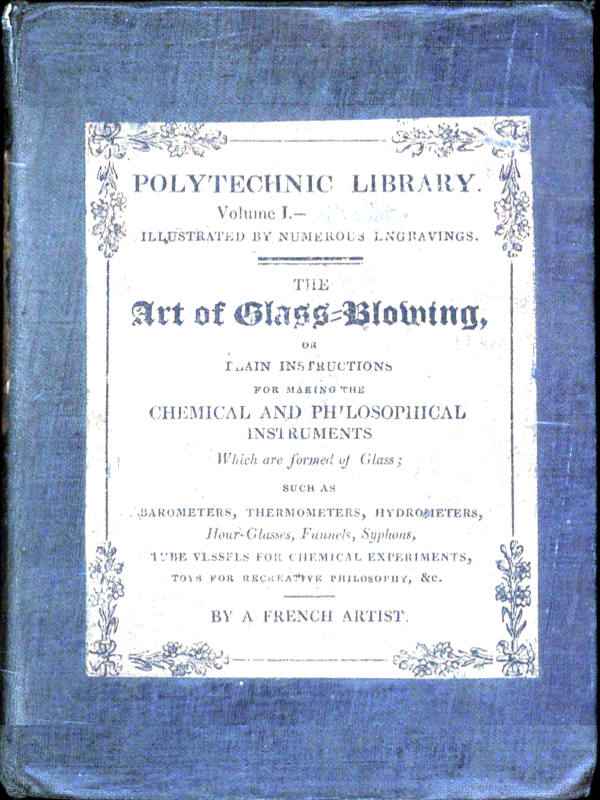
or Plain instructions for making the chemical and philosophical instruments which are formed of glass
Author: T.-P. Danger
Release date: August 4, 2017 [eBook #55266]
Most recently updated: October 23, 2024
Language: English
Credits: Produced by Wayne Hammond and The Online Distributed
Proofreading Team at http://www.pgdp.net (This file was
produced from images generously made available by The
Internet Archive)
Pl. 1.
Published by Bumpus & Griffin London, 1831.
THE
ART OF GLASS-BLOWING,
OR
PLAIN INSTRUCTIONS
FOR MAKING THE
CHEMICAL AND PHILOSOPHICAL
INSTRUMENTS
WHICH ARE FORMED OF GLASS;
SUCH AS
BAROMETERS, THERMOMETERS, HYDROMETERS,
Hour-Glasses, Funnels, Syphons,
TUBE VESSELS FOR CHEMICAL EXPERIMENTS,
TOYS FOR RECREATIVE PHILOSOPHY, &c.
BY A FRENCH ARTIST.
ILLUSTRATED BY ENGRAVINGS.
LONDON:
PUBLISHED BY BUMPUS AND GRIFFIN, 3, SKINNER-STREET;
AND RICHARD GRIFFIN AND CO. GLASGOW:
SOLD ALSO BY STILLIES, BROTHERS, EDINBURGH.
1831.
W. WILSON, PRINTER, 57, SKINNER-STREET, LONDON.
THE
POLYTECHNIC LIBRARY.
The design of the Publishers of the Polytechnic Library is to produce a Series of highly-instructive Works, which the Public may be tempted to buy, because they will be cheap,—be induced to read, because they will be brief,—be competent to understand, because they will be clearly written,—and be able to profit by, because they will be WORKS OF PRACTICAL UTILITY. Every volume, therefore, will contain a complete Treatise relating to one of the useful arts or sciences, or the chemical or mechanical trades.
JUST PUBLISHED, PRICE HALF-A-CROWN,
VOL. I. of the POLYTECHNIC LIBRARY,
Neatly printed in 18mo. and bound in Cloth, containing
THE ART OF GLASS-BLOWING,
Or Plain Instructions for Making the
CHEMICAL & PHILOSOPHICAL INSTRUMENTS
WHICH ARE FORMED OF GLASS;
Such as
BAROMETERS, THERMOMETERS, HYDROMETERS,
Hour-Glasses, Funnels, Syphons,
TUBE-VESSELS FOR CHEMICAL EXPERIMENTS,
TOYS FOR RECREATIVE PHILOSOPHY, &c.
BY A FRENCH ARTIST.
ILLUSTRATED BY UPWARDS OF ONE HUNDRED FIGURES,
Elegantly engraved on Copper plates.
Artists and Students of the Experimental Sciences will find this work adapted to aid them effectually in the economical preparation of their Apparatus; and persons who would willingly occupy their leisure hours in practising the charming art of working Glass and Enamels with the Blowpipe, but who have hitherto been deterred by the anticipated expense of the instruments, and the imaginary difficulties of the undertaking, are taught herein the simplest, most expeditious, least expensive, and most effectual methods of working Glass into every variety of useful or fanciful device.
PUBLISHED BY BUMPUS & GRIFFIN, SKINNER-STREET, LONDON;
R. GRIFFIN AND CO. GLASGOW;
AND STILLIES, BROTHERS, EDINBURGH.
THE FOLLOWING WORKS, INTENDED TO FORM PART OF
THE POLYTECHNIC LIBRARY,
Are nearly ready for Publication.
THE
DOMESTIC CHEMIST;
Comprising Instructions for
THE DETECTION OF ADULTERATIONS
In numerous Articles employed in
DOMESTIC ECONOMY & THE ARTS.
To which is prefixed,
THE ART OF DETECTING POISONS IN FOOD AND
ORGANIC MIXTURES.
Contents.
PART I.—Instructions for the Detection of Mineral Poisons in Vegetable or Animal Mixtures.—Copper, Lead, Antimony, Arsenic, Mercury, Iron, Barytes, Lime, Alumina, Potash, Soda, Sulphuric Acid, Nitric Acid, Muriatic Acid.
PART II.—Instructions for the Examination of Articles supposed to be Adulterated.—Alcohol, Ale, Anchovy Sauce, Arrow-Root, Beer, Brandy, Bread, Calomel, Carmine, Cayenne Pepper, Cheese, Chocolate, Chrome Yellow, Cinnamon, Cloves, Cochineal, Coffee, Confectionery, Crabs’ Eyes, Cream, Cream of Tartar, Epsom Salts, Flour, Gin, Gum Arabic, Spirits of Hartshorn, Honey, Hops, Ipecacuanha, Isinglass, Ketchup, Lakes, Leeches, Lemon Acid, Litharge, Magnesia, Milk, Mushrooms, Mustard, Olive Oil, Parsley, Pepper, Peruvian Bark, Pickles, Porter, Red Oxide of Mercury, Rhubarb, Sal Ammoniac, Salt, Saltpetre, Soap, Soluble Tartar, Spanish Liquorice, Spirits, Sugar, Sulphur, Tamarinds, Tapioca, Tartaric Acid, Tartar Emetic, Tea, Ultramarine, Verdigris, Vermilion, Vinegar, Volatile Oils, Wax, White Lead, Wine, Water,(including directions for testing the purity of all descriptions of Rain, River, or Spring Water.)
PART III.—Instructions for the Preparation of the Tests employed in Domestic Chemistry and for the Performance of various Chemical Operations; with Description of the Glasses and Apparatus proper to be employed.
⁂ The work is written in a popular manner, and intended for the use of Families, Publicans, Wine and Spirit Merchants, Oilmen, Manufacturers, Apothecaries, Physicians, Coroners, and Jurymen.—Price Three Shillings.
THE PERFUMER’S ORACLE.
The object of this work is to present a comprehensive and practical account of the Preparation of PERFUMES and COSMETICS, according to the newest, most successful, and most economical processes. It will be adapted either for Professional Persons, or for Ladies who may wish to amuse themselves with this elegant branch of experimental science.—Price Three Shillings.
Pl. 2.
Published by Bumpus & Griffin London, 1831.
Pl. 3.
Published by Bumpus & Griffin London, 1831.
Pl. 4.
Published by Bumpus & Griffin London, 1831.]
TRANSLATOR’S PREFACE.
The scientific instruments prepared by the glass-blower are numerous and highly useful: barometers, thermometers, syphons, and many other vessels constructed of tubes, are indispensable to the student of physics or chemistry. Some of these instruments are high in price, and liable to frequent destruction; and those by whom they are much employed are subject to considerable expense in procuring or replacing them. It is therefore advisable that he who desires to occupy himself in the pursuit of experimental science, should know how to prepare such instruments himself; that, in short, he should become his own glass-blower. “The attainment of a ready practice in the blowing and bending of glass,” says Mr. Faraday, “is one of those experimental acquirements which render the chemist most independent of large towns and of instrument-makers.”
Unquestionably the best method of learning to work glass is to obtain personal instructions from one who is conversant with the art: but such instructions are not easily obtained. The best operators are not always the best teachers; and to find a person equally qualified and willing to teach the art, is a matter of considerable difficulty. In large towns, workmen are too much engaged with their ordinary business to step aside for such a purpose; and in small towns glass-blowers are seldom to be found. In most cases, also, they are too jealous of their supposed secrets to be willing to communicate their methods of operating to strangers, even when paid to do so.
The following Treatise is a free translation of L’Art du Souffleur à la Lampe, par T. P. Danger. The author is employed, in Paris, in preparing glass instruments for sale, and in teaching others the art of preparing them. He has presented in this work the most minute instructions for the working of glass which have ever been offered to the public. The general processes of the art are so fully explained, and the experimental illustrations are so numerous, that nothing remains except the reducing of these instructions to practice to enable the student to become an adept in the blowing of glass. I trust that, in publishing this work in an English dress, I may be considered as aiding in some degree the progress of physical science.
This work contains a description of a cheap blowpipe and a very convenient lamp; both of them the invention of the author: but any other kind of lamp or blowpipe may be employed instead of these. The reader who wishes for a description of the blowpipes generally employed in England, may consult Mr. Griffin’s Practical Treatise on the Use of the Blowpipe in Chemical and Mineral Analysis.
London, September 1831.
AUTHOR’S PREFACE.
The flame of a lamp, or candle, condensed and directed by a current of air, is exceedingly useful in a great number of arts. The instrument which is employed to modify flame is the Blowpipe. This is an indispensable agent for jewellers, watch-makers, enamellers, glass-blowers, natural philosophers, chemists, mineralogists, and, indeed, for all persons who are occupied with the sciences, or their application to the arts. Its employment offers immense advantages in a multitude of circumstances; and the best method of making use of so powerful an agent ought to be well known to every person who is likely to be called upon to adopt it.
Students, especially those who desire to exercise themselves in chemical manipulation, must feel the want of a simple and economical process, by means of which they could give to glass tubes, of which they make great use, the various forms that are necessary for particular operations. How much reason have they to complain of the high price of the instruments of which they make continual use! The studies of a great number are shackled from want of opportunity to exercise themselves in manipulation; and many, not daring to be at the expense of a machine of which they doubt their ability to make an advantageous use, figure to themselves the employment of the glass-blower’s apparatus as being beset with difficulties, and so rest without having even an idea of the numberless instruments which can be made by its means.
Many persons would very willingly occupy their leisure time in practising the charming art of working glass and enamels with the blowpipe; but the anticipated expense of the apparatus, and the difficulties which they imagine to foresee in the execution of work of this kind, always repels them.
The new species of blowpipe which we have offered to the public, and which has received the approbation of the Society for the Encouragement of Arts, obviates all these inconveniences: its moderate price, its portability, and the facility with which it can be used, adapt it to general employment.
But we should not believe that we had attained the end which we had proposed to ourselves if we had not placed young students in a situation to repeat at their own houses, at little cost, and with the greatest facility, the experiments which are necessary to familiarise them with the sciences. It is with such a view that we present to them this little Treatise, which is destined to teach them the simplest, the most expeditious, the least expensive, and the most effectual methods of constructing themselves the various instruments which they require in the prosecution of their studies.
The word glass-blower, generally speaking, signifies a workman who occupies himself in making of glass and enamel, the instruments, vessels, and ornaments, which are fabricated on a larger scale in the glass-houses: but the domain of the sciences having laid the art of glass-blowing under contribution, the artists of the lamp have divided the labours thereof. Some apply themselves particularly to the construction of philosophical and chemical instruments; others occupy themselves with little ornamental objects, such as flowers, &c.; and, among the latter, some manufacture nothing but pearls, and others only artificial eyes. Finally, a few artists confine themselves to drawing and painting on enamel, which substance is previously applied to metallic surfaces by means of the fire of a muffle.
As we intend to treat separately of these different branches of the art, we commence with that of which the manipulation is the simplest.
Paris, 1829.
CONTENTS.
THE
ART OF GLASS-BLOWING.
I.—Instruments employed in Glass-Blowing.
On seeing, for the first time, a glass-blower at work, we are astonished at the multitude and the variety of the modifications to which he can make the glass submit. The small number and the simplicity of the instruments he employs, is also surprising. The blowpipe, or, in its place, the glass-blower’s bellows and a lamp, are indeed all that are indispensable.
THE BLOWPIPE.
Originally, the blowpipe was only a simple, conical tube, more or less curved towards its point, and terminated by a very small circular opening. By means of this, a current of air was carried against the flame of a candle, and the inflamed matter was directed upon small objects, of which it was desirable to elevate the temperature. Workers in metal still derive immense advantages from the use of this little instrument: they employ it in the soldering of very small articles, as well as for heating the extremities of delicate tools, in order to temper them. But since the blowpipe has passed into the hands of mineralogical chemists, its form has been subjected to a series of very curious and important modifications. In spite, however, of these ameliorations, which rendered the instrument better adapted for the uses to which it was successively applied, we are far from having drawn from it all the advantages to which we might attain, were its employment not as fatiguing as it is difficult. We require no other proof of this than the small number of those who know well how to make use of the blowpipe.
The most economical blowpipe is a tube of glass, bent near one end, and pointed at its extremity. A bulb is blown near that part of the tube which corresponds with the curvature (pl. 3, fig. 7.) This bulb serves as a reservoir for moisture deposited by the air blown into the tube from the mouth. If you employ a tube without a bulb, the moisture is projected in drops into the flame, and upon the objects heated by it—an effect which is very inconvenient in practice. To put this instrument into action, accustom yourself to hold the mouth full of air, and to keep the cheeks well inflated, during a pretty long series of alternate inspirations and expirations; then, seizing lightly with the lips the mouth of the blowpipe, suffer the air compressed by the muscles of the cheeks, which act the part of a bellows, to escape by the beak of the blowpipe, which you will be able to do without being put to the least inconvenience with regard to respiration. When the air contained in the mouth is pretty nearly expended, you must take advantage of an inspiration, to inflate the lungs afresh; and thus the operation is continued. You must never blow through the tube by means of the lungs; first, because air which has been in the lungs is less proper for combustion than that which has merely passed through the nose and mouth; secondly, because the effort which it would be necessary to make, to sustain the blast for only a short time, would by its frequent repetition become very injurious to your health.
The jet of flame produced by the mouth-blowpipe can only be used to heat small objects: when instruments of a considerable bulk have to be worked, it is customary to employ the lamp, or glass-blower’s table.
THE GLASS-BLOWER’S TABLE.
Artists give this name to an apparatus which consists of the following articles:—
1. A Table, below which is disposed a double bellows, capable of being put in motion by means of a pedal. This bellows furnishes a continued current of air, which can be directed at pleasure by making it pass through a tube terminating above the table in a sharp beak. The bellows with which the glass-blower’s tables are commonly furnished have very great defects. The irregular form which is given to the pannels diminishes the capacity of the instruments, without augmenting their advantages. If we reflect an instant on the angle, more or less open, which these pannels form when in motion, we instantly perceive that the weight with which the upper surface of a bellows is charged, and which always affords a vertical pressure, acts very unequally on the arm of a lever which is continually changing its position. This faulty disposition of the parts of the machine has the effect of varying every instant the intensity of the current of air directed upon the flame. All these inconveniences would disappear, were the upper pannel, like that in the middle, disposed in such a manner as to be always horizontal. It ought to be elevated and depressed, in its whole extent, in the same manner; so that, when charged with a weight, the pressure should be constantly the same, and the current of air uniform.
2. A lamp, of copper or tin plate.—The construction of this article, sufficiently imperfect until the present time, has varied according to the taste of those who have made use of it. We shall give, farther on, the description of a lamp altogether novel in its construction.
3. The glass-blower’s table is generally furnished with little drawers for holding the tools employed in modelling the softened glass. Careful artists have the surface of their table coated with sheet iron, in order that it may not be burned by the hot substances that fall, or are laid upon it. As glass-blowers have frequent occasion to take measures, it is convenient to have the front edge of the table divided into a certain number of equal parts, marked with copper nails. This enables the workman to take, at a glance of the eye, the half, third, or fourth of a tube, or to give the same length to articles of the same kind, without having perpetual recourse to the rule and compasses. But when it is desirable to have the tubes, or the work, measured with greater exactness than it can be measured by this method, the rule and the compasses can be applied to.
THE EOLIPYLE.
We shall merely make mention of this instrument. It is a globular vessel, commonly formed of brass. If filled with a very combustible liquor, such as alcohol, and strongly heated, it affords a rapid current of vapour, which, if directed by means of a fine beak into the middle of a flame, produces the same effect as the air which issues from a blowpipe. The eolipyle is a pretty toy, but not a good instrument for a workman, its action being too irregular.
BLOWPIPE WITH CONTINUED CURRENT.
It is after having, during a long period, made use of the instruments of which we have spoken, and fully experienced their inconveniences, that, aware of the indispensable necessity for such instruments in the arts and sciences, we have thought it our duty to make known to the public a New Apparatus, which is, not only calculated to fulfil the same purposes, but presents advantages which it is easy to appreciate. The price of it is only the sixth part of that of the glass-blower’s table1. It is very portable, and capable of being attached to any table whatever. It unites the advantages of not fatiguing the workman, of leaving his hands free, and of rendering him absolute master of the current of air, which he can direct on the flame either of the lamp or the candle,—advantages which are not offered in the same degree even by the table of the glass-blower.
1 In Paris, the blowpipe which is here described is sold for six francs (five shillings English); or, with the improved lamp and candlestick, twelve francs.
The instrument which we have presented is, properly speaking, nothing but a simple blowpipe, C, (pl. 1, fig. 19) communicating with a bladder, or leather bag, fixed on E, which is kept full of air by means of a bent tube, D, through which the operator blows occasionally with the mouth. This tube is closed at its inferior extremity, F, by a valve, which permits the passage of air into the reservoir, but not of its return, so that the air can only escape by the beak of the blowpipe.
The valve at F is constructed in the following manner:—At about two inches from the end of the tube a contraction is made, as represented at a, pl. 1, fig. 24. This reduces the internal diameter of the tube about one-third. A small conical piece of cork or wood is now introduced into the tube in the manner represented by c. The base of the cone must be large enough to close the tube at the point where it is contracted; it must, however, not be so large as to close the tube at the wide part. A brass pin is inserted in the point of the cone, as is shewn in the figure. Between the cone and the end of the tube, the piece of wood, b, is fixed; the shape of this piece of wood is best shewn by figure 25, on the same plate. There is a hole in the centre, in which the pin of the cork cone can move easily. The cone or valve is therefore at liberty to move between the contraction a, and the fixture b. Consequently, when air is blown into the tube at e, the valve is forced from the contraction, falls into the position indicated by the dotted lines d, and allows the air to pass by its sides. When, on the contrary, the operator ceases to blow, the valve is acted upon by the air in the bladder, which, pressing back at f, drives the valve close against the contraction, and effectually closes the aperture. A slight hissing is heard, but when the contraction is well made, and the cork is good, an extremely small quantity of air escapes.
The workman, seated before the table where he has fixed his instrument, blows from time to time, to feed the reservoir or bladder, which, being pressed by a system of strings stretched by a weight, produces an uniform current of air. The force of this current of air can be modified at pleasure, by pressing the reservoir more or less between the knees. (Fig. 22 represents a blowpipe complete, formed not of glass, but of brass tubes. Fig. 22, bis, represents the bladder or reservoir appertaining to this blowpipe.)
M. Gaultier de Claubry, who was charged by the Committee of Chemical Arts of the Society of Encouragement (of Paris) to make a report on this instrument, was astonished at the facility with which the author, in his presence, reduced the oxide of cobalt to the metallic state, and fused the metal to a globule; an experiment which even M. Berzelius could not perform with the simple blowpipe, since he expressly says, in his work on that instrument, that oxide of cobalt suffers no change when heated before the blowpipe. The results obtained with cast iron, oxide of tin, &c.—experiments which are exhibited every day at the public lectures given by the author—evidently prove the superiority of this apparatus over all the blowpipes that have hitherto been contrived.
A detailed account of the glass tubes belonging to this improved blowpipe will be found in the fourth part of this work, at the article Blowpipe.
THE LAMP.
While occupied in rendering popular, if we may so speak, the use of the blowpipe—an instrument which is so advantageous in a great number of circumstances—we have also endeavoured to improve the lamp, which has, until the present time, been used by all those who employ the glass-blower’s table. The lamp which we recommend (pl. 1, fig. 23) is of a very simple construction. It possesses the advantages of giving much less smoke than the old lamp, and of being cleaned with the greatest facility. It also gives sensibly more heat; because the portion of flame which, in the common lamps, rises perpendicularly, and is not used, is, in this case, beaten down by a cap or hood, and made to contribute to the force of the jet. This cap also keeps the flame from injuring the eyes of the operator, and destroys the smoke to such an extent, that the large hoods with which glass-blowers commonly garnish their work table, to carry off the smoke, become unnecessary. This is a peculiar advantage in the chamber of a student, where a large hood or chimney can seldom be conveniently prepared.
THE CANDLESTICK.
For mineralogical researches, chemical assays, and the soldering of small objects, as in jewellery, we recommend the use of a little candlestick, which, by means of a spring fixed to the bottom, maintains the candle always at the same height. A reservoir, or shallow cup, formed at the top of the candlestick, to hinder the running away of the tallow or wax, allows the operator to consume the fragments of tallow or grease which are ordinarily lost in domestic economy. There is a little hole in the centre of the cup or upper part of the candlestick, through which the wick of the candle passes. o, pl. 1, fig. 22, is a representation of this candlestick.
COMBUSTIBLES.
Oil, Tallow, &c.—Among the substances which have been employed to feed the fire of the glass-blower’s lamp, those to which the preference is to be given are wax, olive oil, rape oil, poppy oil, and tallow. Animal oils, such as bone oil and fish oil, are much esteemed by some glass-blowers, who pretend that with these substances they obtain better results than with other combustibles. Nevertheless, animal oils, generally speaking, do not give so much heat as purified rape oil, while they exhale an odour which is extremely disagreeable.
As to alcohol, which is sometimes used with the eolipyle, its combustion furnishes so feeble a degree of heat that its employment cannot be recommended.
Purified rape oil is that of which the use is the most general. Next to olive oil and wax, it affords the greatest heat, and the least smoke. But, in a word, as in the working of glass, the operator has more need of a bright flame without smoke, than of a high temperature, any combustible may be employed which is capable of furnishing a flame possessing these two qualities. The vegetable oils thicken, and suffer alterations more or less sensible, when they are long exposed to the action of the air. They should be chosen very limpid, and they may be preserved in that state by being enclosed in bottles, which should be kept quite full and well corked.
The Wicks.—There has never been any substance so generally used for wicks as cotton; some glass-blowers, indeed, have employed wicks of asbestus, but without deriving from them the advantages which might have been expected; the greater number, therefore, keep to cotton.
But it has been observed that cotton which has been for some time exposed to the air no longer possesses the good properties for which glass-blowers esteem it. The alteration of the cotton is probably brought about by the dust and water which the air always holds in suspension. Such cotton burns badly, forms a bulky coal, and permits with much difficulty the capillary ascension of the liquid which serves to support the flame; so that it is impossible to obtain a good fire, and necessary to be incessantly occupied in snuffing the wick. Cotton is equally subject to alteration when lying in the lamp, even though impregnated with oil. You should avoid making use of wicks that are too old. When you foresee that you will remain a long time without having occasion to employ the lamp, pour the oil into a bottle, which can be corked up, and let the wick be destroyed, previously squeezing from it the oil which it contains.
It is indispensable to make use of none but new and good cotton; it should be clean, soft, fine, and not twisted. It is best to preserve it in boxes, after having folded it in many double papers, to exclude dust and moisture. When you wish to make wicks, take a skein of cotton and cut it into four or six pieces, dispose them side by side in such a manner as to make a bundle, more or less thick, and eight or ten inches in length; pass a large comb lightly through the bundle, to lay the threads even, and tie it gently at each end, to keep the threads from getting entangled.
Relation between the diameters of the beaks of the blowpipe, and the wicks of the lamp.—We believe that we cannot place better than here a few observations respecting the size of the opening in the beak of the blowpipe, considered in relation to the size of the wick of the lamp. These observations will probably be superfluous to those who are already conversant with the use of the blowpipe; but as every thing is interesting to beginners, who are frequently stopped in their progress by very slight difficulties, and as this Treatise is particularly designed for beginners, we do not hesitate to enter into the minutest details on subjects which we deem interesting.
The point of your blowpipe should be formed in such a manner, that you can fix upon it various little beaks or caps, the orifices in which, always perfectly round, ought to vary in size according to the bulk of the flame upon which you desire to act. You cannot, without this precaution, obtain the maximum of heat which the combustion of the oil is capable of affording. This employment of little moveable caps offers the facility of establishing a current of air, greater or smaller, according to the object you wish to effect; above all, it allows you to clean with ease the cavity or orifice of the beak, as often as it may be necessary.
These caps can be made of different materials. It is most advisable to have them made of copper or brass; those which are formed of tin plate (white iron), and which are commonly used in chemical laboratories, are the worst kind of all. They soon become covered with grease or soot, which either completely closes up the orifices, or, at least, very soon alters the circular form which is necessary to the production of a good fire. Glass caps are less liable to get dirty, and are much cheaper than the above; but, on the other hand, they have the disadvantage of being easily melted. This can to a certain extent be remedied by making the points of very thick glass, and by always keeping them at some distance from the flame. Moreover, as you can make them yourself when you are at leisure, their use is very commodious. If they are to be used with the blowpipe described in this work, they must be fixed in the cork that closes the passage through which the current of air arrives. C c and C´ c (pl. 1, fig. 19) are two glass beaks, c c are the corks, which can indifferently be adapted to c, in the wooden vice, by which the various parts of the blowpipe are connected when it is in action.
Of whatever material the beak may be made, its orifice must be perfectly round, and the size of the orifice, as we have before observed, must have a relation to the size of the wick which is to be used with it. You can ascertain the diameters of the orifices by inserting into them a little plate of brass, having the form of a long isoceles triangle, such as is represented by pl. 1, fig. 2. It should be an inch long, the twelfth of an inch wide at one end, and diminish to nothing at the other. When divided into eight equal parts, it will give, at the divisions, the respective proportions of 1, 2, 3, 4, 5, 6, 7 eighths of the diameter at the wide end, as is exemplified by the figure above referred to. We have stated in the following table the relative diameters which long experience has recommended to us, as being adapted to produce the greatest effect; yet it is not to be imagined that these proportions are mathematically correct and indispensable for the obtaining of good results. A sensible difference of effect would be perceived, however, were these proportions departed from in a notable manner.
| Diameter of the wick, in inches. |
Diameter of the orifice of the beak, in parts of an inch. |
Height of the wick above the surface of the oil, in inches. |
|---|---|---|
| ¼ | 96th | ½ |
| ½ | 48th | ½ |
| 1 | 24th | ¾ |
| 1½ | 16th | 1 |
| 2 | 12th | 1¼ |
It must be mentioned, that this table has been formed from experiments made with a glass-blower’s lamp of the ordinary construction; so that, with the new lamp with the hood, described in this work, it will not be necessary to employ wicks of so great a bulk, nor yet to elevate them so much above the level of the oil, in order to produce the same effect. Hence there will be a very considerable saving in oil.
The wicks of a quarter of an inch in diameter are only adapted for mineralogieal examinations, for soldering very fine metallic substances, and for working very small tubes. When the objects are of considerable bulk, it is in general necessary to have a flame sufficiently large to cover the whole instrument, or at least all the portion of the instrument which is operated upon at once. For working tubes, of which the sides are not more than the twelfth of an inch in thickness, you should have a wick at least as wide as the tube that is worked upon. The diameter of the lamp-wick usually employed is one inch; a wick of this size is sufficient for all the glass instruments which are in common use.
THE
ART OF GLASS-BLOWING.
II.—Preliminary Notions of the Art.
THE FLAME.
It is only by long habitude, and a species of routine, that workmen come to know, not only the kind of flame which is most proper for each object they wish to make, but the exact point of the jet where they ought to expose their glass. By analysing the flame, upon the knowledge of which depends the success of the work, we can immediately obtain results, which, without that, could only be the fruit of long experience.
Flame is a gaseous matter, of which a portion is heated to the point of becoming luminous; its form depends upon the mode of its disengagement, and upon the force and direction of the current of air which either supports its combustion or acts upon it mechanically. (Pl. 1, fig. 1.)
The flame of a candle, burning freely in still air, presents in general the form of a pyramid, of which the base is supported on a hemisphere. It consists of four distinct parts: the immediate products of the decomposition of the combustible by the heat which is produced, occupy the centre, o, where they exist in the state of an obscure gaseous matter, circumscribed by a brilliant and very luminous envelope, s; the latter is nothing but the obscure matter itself, in the circumstances where, on coming into contact with the atmosphere, it combines with the oxygen which exists therein, and forms what is properly called flame.
The blueish light which characterises the inferior part of the flame, s, is produced by a current of cold air, which, passing from below upwards, hinders the combustion from taking place at the bottom of the flame, at the same temperature that exists in the parts of the flame not immediately subject to this influence.
Finally, on observing attentively, we perceive a fourth part, which is but slightly luminous, and exists as an envelope of all the other parts of the flame. The greatest thickness of this envelope corresponds with the summit of the flame. From this point it gradually becomes thinner, till it arrives at the lowest part of the blueish light, where it altogether disappears. It is in this last-described portion of the flame that the combustion of the gas is finished, and there it is that we find the seat of the most intense heat which the flame of the candle affords. If we compare the temperature of the different parts of the flame, we find that the maximum of heat forms a ring corresponding to the zone of insertion, A A; a point which is the limit of the superior extremity of the blueish light.
When the flame is acted upon by the blowpipe, it is subject to two principal modifications:—
1. If, by means of a blowpipe with a very fine orifice, you direct a current of air through the middle of the flame, you project a portion of the flame in the direction of the blast. The jet thus formed appears like a tongue of fire, blueish, cylindrical, straight, and very long; the current of air occupies its interior. This flame is enveloped on all sides by an almost invisible light, which, extending beyond the blue flame, forms a jet, A´ B, very little luminous, but possessing an extremely high temperature. It is at the point A´, which corresponds with the extremity of the blue flame, that the maximum of heat is found. The extreme point of the jet B possesses a less degree of heat. This flame is adapted for mineralogical assays, for soldering, for working enamels, and in general for all small objects.
2. When the orifice of the blowpipe is somewhat large, or when (the orifice being capillary) the current of air is very strong, or the beak is somewhat removed from the flame, the jet of fire, instead of being prolonged into a pointed tongue, is blown into a brush. It makes then a roaring noise, and spreads into an irregular figure, wherein the different parts of the flame are confounded beyond the possibility of discrimination. This flame is very proper for the working of glass, and particularly of glass tubes; it ought to be clear and very brilliant, and above all should not deposit soot upon cold bodies suddenly plunged into it. The maximum of temperature in this flame is not well marked; we can say, however, that in general it will be found at about two-thirds of the whole length of the jet. As this roaring flame contains a great quantity of carburetted hydrogen, and even of vapour of oil, escaped from combustion, it possesses a disoxidizing or reducing property in a very high degree.
PLACES FIT TO WORK IN.
Every place is adapted for a workshop, provided it is not too light and the air is tranquil. The light of the lamp enables one to work with more safety than day-light, which does not permit the dull-red colour of hot glass to be seen. Currents of cold air are to be avoided, because they occasion the fracture of glass exposed to them on coming out of the flame.
MEANS OF OBTAINING A GOOD FIRE.
The lamp should be firmly seated upon a steady and perfectly horizontal table, and should be kept continually full of oil. The oil which escapes during the operation, from the lamp into the tin-stand placed below it, should be taken up with a glass tube having a large bulb, and returned to the lamp.
When you set to work, the first thing you have to do is to examine the orifice of the beak. If it is closed, or altered in form, by adhering soot, you must carefully clean it, and open the canal by means of a needle or fine wire. In the next place, you freshen the wick by cutting it squarely, and carrying off with the scissars the parts which are carbonised. You then divide it into two principal bundles, such as C, K (pl. 1, fig. 21), which you separate sufficiently to permit a current of air, directed between the two, to touch their surfaces lightly, without being interrupted in its progress. By pushing the bundles more or less close to one another, and by snuffing them, you arrive at length at obtaining a convenient jet. It is a good plan to allow, between the two principal bundles and at their inferior part, a little portion of the wick to remain: you bend this down in the direction of the jet, and make it lie immediately beneath the current of air.
The wick must be prevented from touching the rim of the lamp, in order to avoid the running of the oil into the stand of the lamp. This is easily managed by means of a bent iron-wire, disposed as it is in the lamp described in this work; see pl. 1, fig. 23, where the wire is seen in an elevated position. When the wick is in the lamp, the wire is brought down round the wick and level with the surface of the lamp. A few drops of oil of turpentine, spread on the wick, makes it take fire immediately, over its whole extent, on the approach of an inflamed substance.
To obtain a good fire, it is necessary to place the lamp in such a position that the orifice of the blowpipe shall just touch the exterior part of the flame. The beak must not enter the flame, as it can then throw into the jet only an inconsiderable portion of the ignited matter. See pl. 1, fig. 20. On the other hand, if the lamp be too far away from the blowpipe, the flame becomes trembling, appears blueish, and possesses a very low degree of heat.
For mineralogical experiments, and for operations connected with watch-making and jewellery, the current of air should project the flame horizontally. For glass-blowing, the flame should be projected in the direction intimated by the arrow in pl. 1, fig. 20—that is to say, under an angle of twenty or twenty-five degrees.
The current of air ought to be constant, uniform, and sufficiently powerful to carry the flame in its direction. When it is not strong enough to produce this effect, it is necessary to add weights to the bellows or the bladder, according as the glass-blowers’ table or our lamp is employed. The point to which you should apply, in the use of these instruments, is to enable yourself to produce a current of air so uniform in its course that the projected flame be without the least variation.
Finally, when you leave off working you should extinguish the flame, by cutting off the inflamed portion of the wick with the scissars. This has the double advantage of avoiding the production of a mass of smoke and of leaving the lamp in a fit state for another operation.
CHOICE AND PRESERVATION OF GLASS.
The only materials employed in the fabrication of the objects described in this Treatise, are tubes of common glass or of flint-glass. They can be had of all diameters, and of every variety of substance. They are commonly about three feet long, but some are found in commerce which are six feet in length. You should choose tubes that are very uniform—that is to say, straight and perfectly cylindrical, both inside and outside. A good tube should have the same diameter from one end to the other, and the sides or substance of the glass should be of equal thickness in every part. This is indispensable when the tubes are to have spherical bulbs blown upon them. We shall describe, in the article Graduation, the method of ascertaining whether or not a tube is uniform in the bore.
The substance of the glass should be perfectly clear, without bulbs, or specks, or stripes. The tubes are so much the more easy of use, as the glass of which they are made is the more homogeneous. Under this point of view, the white glass, known in commerce by the name of crystal or flint-glass, is preferable to common glass: it is more fusible, less fragile, and less liable to break under the alternations of heat and cold; but it is dearer and heavier, and has the serious disadvantage of becoming permanently black when exposed to a certain part of the flame. This is an effect, the causes and consequences of which will be explained in a subsequent chapter.
You must take care never to employ flint-glass for instruments which are to be submitted to the action of certain fluids—such as sulphuretted and phosphuretted hydrogen, and the hydro-sulphurets; for these compounds are capable of decomposing flint-glass, in consequence of its containing oxide of lead. In general, hard common glass is preferable to flint-glass for all instruments which are to be employed in chemistry. Flint-glass should only be used for ornamental objects, and for the barometers, thermometers, and other instruments employed in philosophical researches.
It sometimes happens that glass tubes lose their transparence and ductility, and suddenly become almost infusible, in the fire of the lamp: this effect takes place when they have been kept for some time in a melted state. It is then almost impossible to bring them back to their original condition; it can only be done by exposing them for a long time to an exceedingly high temperature. You can prevent this accident by working such kind of glass with considerable rapidity, and in a pretty brisk fire. There are tubes, however, which vitrify so promptly that it is only a person well versed in the art who can make good use of them. It is best not to employ such glass. But how can it be discriminated before-hand? It is experience, sooner than any characters capable of description, that will teach you how to make choice of good glass; nevertheless we have observed, that, among the glass tubes which occur in commerce, those possessing a very white colour manifest this bad quality most particularly. It may be observed, that, for tubes which are to have thin sides, this vitrifiable sort of glass is better than any other.
For certain philosophical instruments it is necessary to employ flat tubes. These are formed of flint-glass, are very small, and have a canal or bore, which, instead of being round, as in common tubes, has the form of a long and very flat oval. This disposition has the advantage of rendering more perceptible the column of liquid that may be introduced, and which in a round canal would scarcely be visible. In choosing this sort of tubes, carefully avoid those of which the canal is twisted, and not found to be in the same plane, in the whole length of the tube.
The tubes should be sorted, according to their sizes and qualities, and should be deposited in large drawers or on long shelves, in such a manner as to be equally supported through their whole extent. They should also be sheltered from dust and from moisture. If you cannot conveniently warehouse them in this manner, you should tie them up in parcels, and support them in a perpendicular position. It is a very bad plan to place them in an inclined direction, or to support them by their extremities on wooden brackets, as it is the fashion to do in chemical laboratories; because, as the tubes are then supported only at certain points, they bend, in course of time, under the influence of their own weight, and contract a curvature which is extremely prejudicial in certain instruments, and which it is almost impossible to correct.