
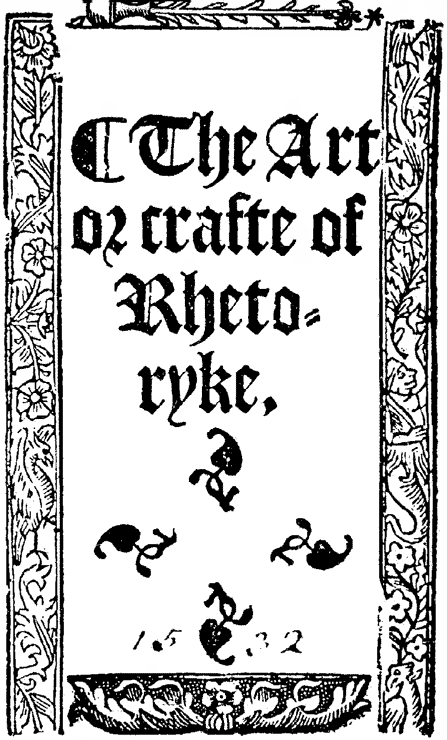
The Project Gutenberg eBook of The Art or Crafte of Rhetoryke
Title: The Art or Crafte of Rhetoryke
Author: Leonard Cox
Contributor: Philipp Melanchthon
Release date: May 26, 2008 [eBook #25612]
Language: English
Credits: Produced by Greg Lindahl, Linda Cantoni, and the Online
Distributed Proofreading Team at http://www.pgdp.net (This
file was produced from images generously made available
by the Bibliothèque nationale de France (BnF/Gallica) at
http://gallica.bnf.fr)
Transcriber’s Notes
About this book. The Art or crafte of Rhetoryke, by Leonard Cox (or Cockes) was originally published c. 1530; the second edition was published in 1532. It is considered the first book on rhetoric written in the English language.
Typography. This e-book was transcribed from the 1532 edition. The original line and paragraph breaks, hyphenation, spelling, capitalization, and punctuation, including the use of a spaced forward slash (/) for the comma, the use of u for v and vice versa, and the use of i for j, have been preserved. All apparent printer errors have also been preserved, and are hyperlinked to a list at the end of this document.
The following alterations have been made:
1. Long-s (ſ) has been regularized as s.
2. The paragraph symbol, resembling a C in the original, is rendered as ¶.
3. Missing hyphens have been added in brackets, e.g. [-].
4. Abbreviations and contractions represented as special characters in the original have been expanded as noted in the table below. A macron means a horizontal line over a letter. A cursive semicolon is an old-style semicolon somewhat resembling a handwritten z. Supralinear means directly over a letter. Superscript means raised and next to a letter. The y referred to below is an Early Modern English form of the Anglo-Saxon thorn character, representing th, but identical in appearance to the letter y.
| Original | Expansion |
| &c with macron | &c[etera] |
| q with cursive semicolon | q[ue] |
| superscript closed curve | [us] |
| long final s | [e]s |
| crossed p | p[er] or p[ar] |
| p with looped downstroke | p[ro] |
| p with macron | p[re] |
| consonant with supralinear upward curve | consonant[er] |
| w with supralinear t | w[i]t[h] |
| y with macron | y[at] (i.e., that) |
| y with supralinear u | y[o]u (i.e., thou) |
Superscript letters are rendered as they appear in the original, e.g., ye = the; yt = that.
A macron over a vowel represents m or n, and is rendered as it appears in the original, e.g., cōprehēded = comprehended.
Greek. This text contains some phrases in ancient Greek. Hover the mouse over the Greek to see a pop-up transliteration, like this: βιβλος.
Pagination. This book was printed as an octavo volume, and was paginated using a recto-verso scheme. In octavo printing, the printer uses large sheets of paper folded and cut into eight leaves each, creating 16 pages. The front of each leaf is the recto page (the right-hand page in a book); the back of each leaf is the verso page (the left-hand page in a book). For this book, the printer apparently used six sheets, lettered A through F, and each leaf is numbered with a lower-case Roman numeral, i through viii. Thus, for example, the first leaf (i) from the second sheet (B) is numbered B.i.
In the original, page numbers are printed only on the recto side of each leaf, and are not printed at all after the fourth or fifth recto page of each sheet, until the first leaf of the next sheet. For the reader’s convenience, all pages in this e-book, even those without a printed number in the original, have been numbered according to the original format, with the addition of “r” for recto and “v” for verso. Pages A.i.v and F.viii.r are blank and are not numbered in this e-book.
Sources consulted. This e-book was prepared from microfiche scans of the 1532 edition, which can be viewed at the Bibliothèque nationale de France (BnF/Gallica) website at http://gallica.bnf.fr. The uneven quality of the scans, and the blackletter font in the original, made the scans difficult to read in some places. To ensure accuracy, the transcriber has consulted the following sources:
1. The 2004 electronic transcription by Robert N. Gaines, available in SGML format from the Arts and Humanities Data Service, http://ahds.ac.uk. The typography notes above are based in part on the notes to that transcription.
2. The 1899 reprint edited and annotated by Frederick Ives Carpenter (University of Chicago Press; facsimile reprint by AMS Press, 1973).