
- Total height: 10 ft 2 in
- Armored cable
- Pressure vessel
- Capacitor bank
- Fuel capsules
- Biological shield
- Equipment package
- Voltage converter
- Depleted uranium
- Thermoelectric generator
- System support structure
Details of the Phillips Petroleum platform, which uses the SNAP-7B nuclear generator.
The final electrical connection is made from the nuclear generator to the platform’s electronic foghorn and two flashing light beacons.
- Fog Horn
- Beacon
- Beacon
- Snap-7B nuclear generator
The radioisotope-powered devices previously described were developed by the AEC under the SNAP-7 Program.[16] The testing of these units has demonstrated the advisability of developing reliable and unattended nuclear power sources for use in remote environments without compromise to nuclear safety standards. As a result of the success of these tests, a variety of potential oceanographic applications have been identified. A study, conducted by Aerojet-General Corporation in conjunction with Global Marine Exploration Company and Northwest Consultant Oceanographers, Inc., described ocean applications including underwater navigational aids, acoustic beacons, channel markers, cable boosters, weather buoys, offshore oil well controls along with innumerable oceanographic research applications. This study was sponsored by the AEC Division of Isotopes Development.
In order to satisfy the requirements for these and other applications, the AEC has begun developing a series of compact and highly reliable isotope power devices that are designed to be economically competitive with alternative power sources. Currently underway are two specific projects, SNAP-21 and SNAP-23.
SNAP-21 is a two-phase project to develop a series of compact strontium-90 power systems for deep-sea and ocean-bottom uses (20,000-foot depths). The first phase of design and component development on a basic 10-watt system already has been completed, and a second phase development and test effort now under way will extend through 1970. A series of power sources in the 10- and 20-watt range will be available for general purpose deep-ocean application.
The SNAP-23 project involves the development of a series of economically attractive strontium-90 power systems for remote terrestrial uses. This project will result in 25-watt, 60-watt, and 100-watt units capable of long-term operation in surface buoys, offshore oil platforms, weather stations, and microwave repeater stations.
In addition to the above, effort is underway by the AEC to develop an isotope-fueled heater that will be used by aquanauts in the Navy’s Sealab Program (see page 12). Future activities, now being planned, will involve the development of large isotope power sources (1-10 electric kilowatts) and small nuclear reactors (50-100 kilowatts) for use in manned and unmanned deep-ocean platforms.
Ocean Engineering
Considerable engineering experience has been derived from the work of federal agencies in development of the largest taut-moored instrumented buoy system ever deployed in the deep ocean. Developed by Ocean Science 81 Engineering, Inc., it is useful in observation and prediction of environmental changes.
The system embodies substantial advances in design. It incorporates, among other features, an acoustically commanded underwater winch for adjustment of the mooring depth after the buoy is deployed, and for recovering a 16,000-pound submerged data-recording instrument canister. This buoy system can survive being moored in up to 18,000-foot depths of the open ocean for upward of 30 days.
The very first deep-ocean, taut-moored buoy system was developed for the government in 1954, and has since become an important tool for oceanographers and others who seek stable instrument platforms at sea. The buoys have the advantage of minimizing horizontal movement due to currents, winds, and waves.
The National Marine Consultants Division of Interstate Electronics Corporation has developed for the government a system for measuring the propagation of seismic sea waves (tsunamis).
Work of these sorts contributes materially to reliable ocean engineering. And the measurements made by these sophisticated instruments contribute to our knowledge of ocean fluid dynamics and wave mechanics.
Corrosion is a huge, ever-present problem plaguing oceanographic engineers, ship designers, mariners, operators of desalination plants, petroleum companies with offshore facilities, and, in fact, everyone who places structures in salt water to do useful work. While the basic mechanisms of corrosion are known, there are many detailed aspects that are not: For example, the precise role of bacteriological slimes in causing corrosion on supposedly protected structures. Radioisotope tracers now are helping engineers follow the chemical, physical, and biological actions in corrosion processes.
Fresh Water from Seawater
In 1960 the chairman of the board of a large U. S. corporation made a fundamental policy decision for his company: Since the greatest critical need of man in the next decade would be fresh water, his company would begin working to produce large volumes of fresh water—including the development of methods for desalting seawater. His pioneering analysis proved to be prophetic.
Throughout the world, more people are using more water for more purposes than ever before. Many areas of the world, including some that are densely populated, have been parched since the dawn of history. In others where water was once abundant, not only are natural sources being depleted faster than they are replaced, but many rivers and lakes have been so polluted that they can now scarcely be used.
The world’s greatest resource of water is the ocean, but energy is required to remove the salt from it and make it potable or even useful for agriculture and industry. The energy produced by nuclear reactors is considered economical in the large quantities that soon will be required.
The AEC and the Office of Saline Water of the Department of the Interior, after a preliminary study, have joined with the Metropolitan Water District of Southern California and the electric utility firms serving the area, to begin construction of a very large nuclear-power desalting plant on a man-made island off the California coast. The plant, when completed in the 1970s, will have an initial water capacity of 50 million gallons per day and also will generate about 1,800,000 kilowatts of electricity. Additional desalting capacity is planned for addition later to achieve a total water capacity of 150 million gallons per day.
Plans to construct a nuclear desalting plant in California were announced in August 1966 by (from left) AEC Commissioner James T. Ramey, Secretary of the Interior Stewart L. Udall, Mayor Samuel Yorty of Los Angeles, and Joseph Jensen, Board Chairman of the Metropolitan Water District of Southern California.
Plans for other nuclear-powered desalting projects around the world are being discussed by the United States government, the International Atomic Energy Agency and the governments of many other nations. Some of these also may be in operation during the early 1970s.[17]
Model of the nuclear power desalting plant to be built on the coast of Southern California.
These projects followed extended detailed studies, including one “milestone” investigation at the AEC’s Oak Ridge National Laboratory in Tennessee, in which the economic feasibility of using very large nuclear reactors coupled to very large desalting equipment to produce power and water was determined.
The significance of these studies was recognized by President Johnson in 1964, when he told the Third International Conference on Peaceful Uses of Atomic Energy: “The time is coming when a single desalting plant powered by nuclear energy will produce hundreds of millions of gallons of fresh water—and large amounts of electricity—every day.”
It is obvious that today realization of that goal is much nearer.
The installation of new and larger desalting plants will in itself require extensive additional oceanographic research. By the nature of their operation these plants will be discharging considerable volumes of heated water with a salt content higher than that of the sea. Throughout the ocean, but particularly in the estuaries, sea life is sensitive to the concentration of ocean salts and temperature. Studies of the effect of such discharges will be an essential part of any large-scale desalination program.
Radiation Preservation of Seafood
The use of nuclear radiation for the preservation of food is a new process of particular importance for seafood. The ocean constitutes the world’s largest source of animal protein food. Yet the harvests of the sea can be stored safely, even with refrigeration, for far shorter periods than can most other foods. In many parts of the world, this tendency to spoil makes fish products available only to people who live near seacoasts.
Many types of seafood, however, when exposed to radiation from radioisotopes or small accelerators, can be stored under normal refrigeration for up to four weeks without deterioration. The process does not alter the appearance or taste of the seafood; it merely destroys bacteria that cause spoilage. This fact holds promise not only for the world’s protein-starved populations, but also for the economic well-being of commercial fishermen, whose markets would be much expanded.
In support of this program, the AEC has built and is operating at Gloucester, Massachusetts, a prototype commercial seafood irradiator plant capable of processing 2000 pounds of seafood an hour. The radiation is supplied by a cobalt-60 source. Private industry is cooperating with the AEC in the evaluation of this facility.[18]
The first shipboard irradiator was on The Delaware, a research fishing vessel. Fish, preserved through irradiation soon after they are caught, have a refrigerated storage life two or three times longer than nonirradiated fish.
The first shipboard irradiator.
Project Plowshare
Nuclear explosives are, among other things, large-scale, low-cost excavation devices. In this respect, with the proper pre-detonation study and engineering, they are ideally suited for massive earth-moving and “geological engineering” projects, including the construction of harbors and canals. The western coasts of three continents, Australia, Africa, and South America, are sparsely supplied with good harbors. A number of studies have been undertaken as to the feasibility of using nuclear explosives for digging deepwater harbors. Undoubtedly at some time in the future, these projects will be carried out.
In addition, there are many places in the world where the construction of a sea-level canal would provide shorter and safer routes for ocean shipping, expedite trade and commerce, or open up barren and unpopulated, but mineral-rich lands to settlers and profitable development. The AEC Division of Peaceful Nuclear Explosives operates a continuing program to develop engineering skills for such projects.[19] Construction of a sea-level canal across the Central American isthmus is one well-known proposal for this “Plowshare” program.
The use of nuclear explosives in this manner may one day change the very shape of the world ocean.
A New Fram
Fridtjof Nansen
Just about 70 years ago, the oceanographer and explorer, Dr. Fridtjof Nansen completed his famous voyage aboard the research vessel Fram, which remained locked in the Arctic ice pack for 3 years, drifting around the top of the world while the men aboard her studied the oceanography of the polar sea. Now the National Science Foundation has taken the first steps toward building a modern version of Fram for Arctic studies. This time the vessel will be an Arctic Drift Barge containing the best equipment modern technology can offer—including, it is proposed, a central nuclear power plant to guarantee heat and power. Scheduled for completion sometime in the 1970s, this project represents yet another use of the atom in the study of the ocean.
THE THREE-DIMENSIONAL OCEAN
The ocean is no longer an area of isolated scientific interest, nor merely a turbulent two-dimensional surface over which man conducts his commerce and occasionally fights his wars.
In today’s world, the ocean has assumed its full third dimension. Men and women are going down into it to study, to play, to work, and, alas, sometimes to fight. As they go, they are taking atomic energy with them. In many instances, only the harnessed power in the nuclei of atoms permits them to penetrate the depths of the mighty sea and there attain their objectives.
Artist’s conception of one of three proposed designs for the National Science Foundation’s Arctic Drift Barge. All three designs incorporate a nuclear power source.
SUGGESTED REFERENCES
Books
The Bountiful Sea, Seabrook Hull, Prentice-Hall, Inc., Englewood Cliffs, New Jersey 07632, 1964, 340 pp., $6.95.
This Great and Wide Sea, R. E. Coker, Harper & Row, New York 10016, 1962, 235 pp., $2.25 (paperback).
Exploring the Secrets of the Sea, William J. Cromie, Prentice-Hall, Inc., Englewood Cliffs, New Jersey 07632, 1962, 300 pp., $5.95.
The Sea Around Us, Rachel L. Carson, Oxford University Press, Inc., New York 10016, 1961, 237 pp., $5.00 (hardback); $0.60 (paperback) from the New American Library of World Literature, Inc., New York 10022.
The Ocean Adventure, Gardner Soule, Appleton-Century, New York 10017, 1966, 278 pp., $5.95.
Proving Ground: An Account of the Radiobiological Studies in the Pacific, 1946-1961, Neal O. Hines, University of Washington Press, Seattle, Washington 98105, 1962, 366 pp., $6.75.
The Effects of Atomic Radiation on Oceanography and Fisheries (Publication 551), National Academy of Sciences—National Research Council, Washington, D. C. 20418, 1957, 137 pp., $2.00.
Oceanography: A Study of Inner Space, Warren E. Yasso, Holt Rinehart and Winston, Inc., New York, 10017, 1965, 176 pp., $2.50 (hardback); $1.28 (paperback).
Booklets
Oceanography Information Sources (Publication 1417), National Academy of Sciences—National Research Council, Washington, D. C. 20418, 1966, 38 pp., $1.50.
A Reader’s Guide to Oceanography, Jan Hahn, Woods Hole Oceanographic Institution, Woods Hole, Massachusetts 02543, August 1965 (revised periodically) 13 pp., free.
The following booklets are available from the Superintendent of Documents, U. S. Government Printing Office, Washington, D. C. 20402:
Undersea Vehicles for Oceanography (Pamphlet No. 18), Inter-agency Committee on Oceanography of the Federal Council for Science and Technology, 1965, 81 pp., $0.65.
Marine Sciences Research, AEC Division of Biology and Medicine, March 1966, 18 pp., $0.15.
Articles
Tools for the Ocean Depths, Fortune, LXXII: 213 (August 1965).
Journey to Inner Space, Time, 86: 90 (September 17, 1965).
Working for Weeks on the Sea Floor, Jacques-Yves Cousteau, National Geographic, 129: 498 (April 1966).
Nucleonics, 24 (June 1966). This special issue on the use of the atom undersea contains the following articles of interest:
Reactors: Key to Large Scale Underwater Operations, J. R. Wetch, 33.
Undersea Role for Isotopic Power, K. E. Buck, 38.
Radioisotopes in Oceanographic Research, R. A. Pedrick and G. B. Magin, Jr., 42.
Motion Pictures
1000 Feet Deep for Science, 27 minutes, color, 1965. Produced by and available from Westinghouse Electric Corporation, Visual Communications Department, 3 Gateway Center, Box 2278, Pittsburgh, Pennsylvania 15230. This film describes the Westinghouse Diving Saucer, which is a two-man laboratory used for underwater research. This is the saucer that is used by Jacques-Yves Cousteau and was featured in his motion picture World Without Sun.
Available for loan without charge from the AEC Headquarters Film Library, Division of Public Information, U. S. Atomic Energy Commission, Washington, D. C. 20545 and from other AEC film libraries.
Bikini Radiological Laboratory, 22 minutes, sound, color, 1949. Produced by the University of Washington and the AEC. This film explains studies of effects of radioactivity from the 1946 atomic tests at Bikini Atoll on plants and marine life in the area 3 years later.
Return to Bikini, 50 minutes, sound, color, 1964. Produced by the Laboratory of Radiation Biology at the University of Washington for the AEC. This film records the ecological resurvey of Bikini in 1964, 6 years after the last weapons test.
Desalting the Seas, 17 minutes, sound, color, 1967. Produced by AEC’s Oak Ridge National Laboratory. Describes various methods of purifying saline water through the use of large dual-purpose nuclear-electric desalting plants.
PHOTO CREDITS
| Page | |
| 2 | U. S. Navy (USN) |
| 3 | University of Pennsylvania Museum—National Geographic Expedition |
| 5 | USN |
| 6 | Woods Hole Oceanographic Institution (WHOI) |
| 7 | Diagram, WHOI; photo, S. Hull |
| 9 | Top, Oregon State University (OSU); bottom, University of California, San Diego, Scripps Institution of Oceanography (SIO) |
| 10 | Lamont Geological Observatory of Columbia University |
| 12 | USN |
| 15 | SIO |
| 19 | R. H. Backus. Physics Today (November 1965), “Sound Reflections In and Under Oceans,” J. B. Hersey |
| 20 | U. S. Bureau of Commercial Fisheries Biological Laboratory, Honolulu, Hawaii |
| 22 | USN |
| 24 | Laboratory of Radiation Biology, University of Washington (LRB) |
| 26 | Jan Hahn |
| 27 | Franklin GNO Corporation |
| 28 | George D. Grice, WHOI |
| 31 | SIO |
| 33 | OSU |
| 35 | Monsanto Research Corporation |
| 37 | USN |
| 38 | Lane-Wells Company |
| 39 | Research Triangle Institute |
| 43 | USN |
| 46, 47 & 48 | Martin-Marietta Company |
| 49 | The Photo Mart |
| 53 | Top, Metropolitan Water District of Southern California; bottom, Bechtel Corporation |
| 55 | U. S. Bureau of Commercial Fisheries, Fish and Wildlife Service; inset, Brookhaven National Laboratory |
| 56 | Norsk Folkemuseum, Oslo, Norway, courtesy The Mariners Museum, Newport News, Virginia |
| 57 | National Science Foundation |
| 61 | S. Hull |
| Cover photo courtesy James Butler, USN | |
| Author’s photo courtesy General Dynamics Corporation | |
| Frontispiece from Jan Hahn | |
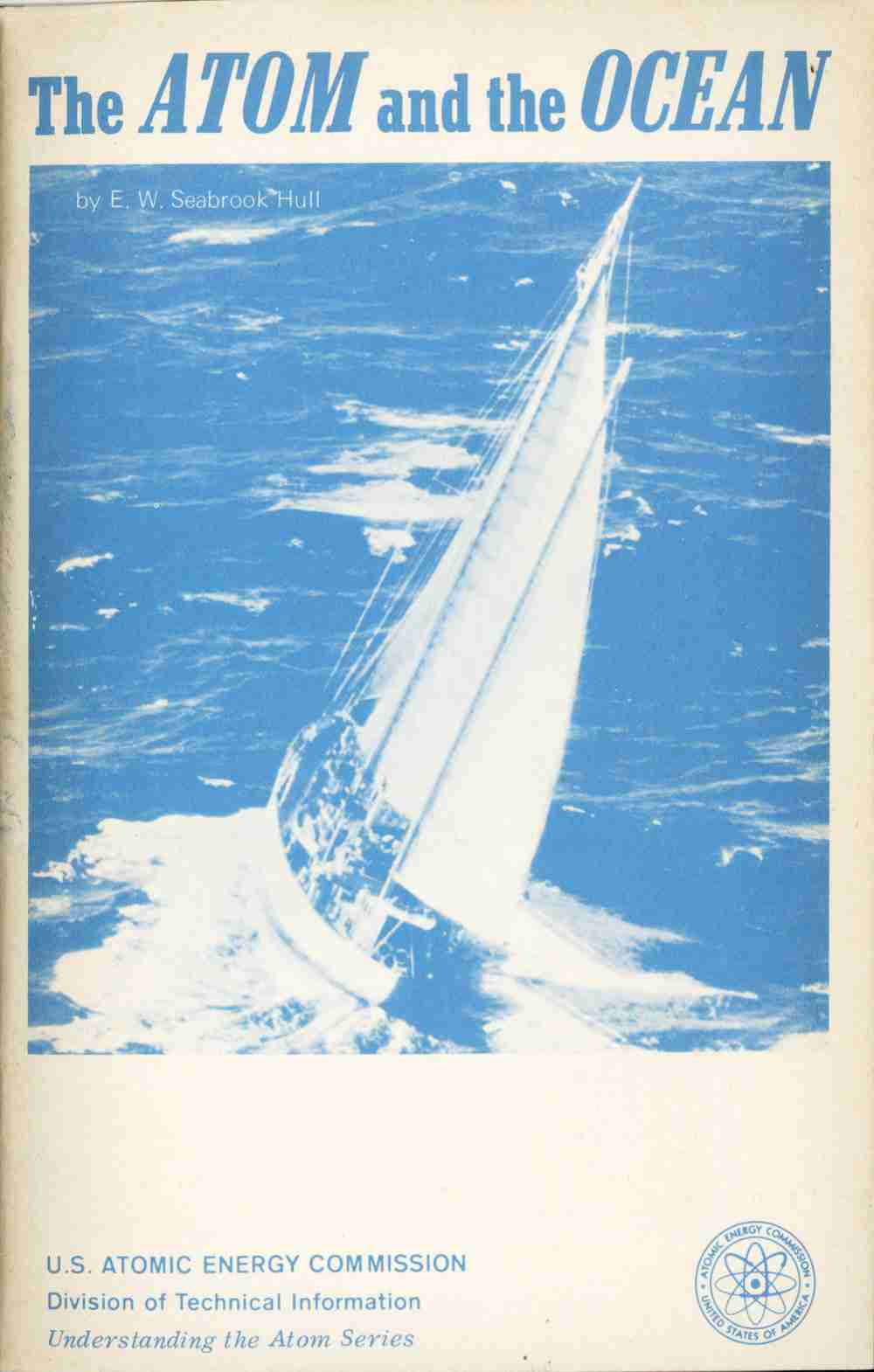
THE COVER
The ship on the cover is the trim Atlantis riding the waves about 200 miles south of Bermuda. The first craft built by the United States as an oceanographic research vessel, she traveled more than 1,200,000 miles across the seven seas for a period of 30 years. She “ran” over 6000 hydrographic stations and was used for innumerable dredging, coring, biological, physical, and acoustical research operations. After she was retired from active service at the Woods Hole Oceanographic Institution in Massachusetts, she was sold to Argentina, where she has resumed her role as an oceanographic research vessel.
THE AUTHOR
E. W. SEABROOK HULL is an experienced writer and editor in technical and engineering fields. He is the author of The Bountiful Sea, published in 1964 by Prentice-Hall, and Plowshare, another booklet in this Understanding the Atom Series. He is the editor of Ocean Science News and editor and publisher of GeoMarine Technology.
Footnotes
This booklet is one of the “Understanding the Atom” Series. Comments are invited on this booklet and others in the series; please send them to the Division of Technical Information, U. S. Atomic Energy Commission, Washington, D. C. 20545.
Published as part of the AEC’s educational assistance program, the series includes these titles:
Accelerators
Animals in Atomic Research
Atomic Fuel
Atomic Power Safety
Atoms at the Science Fair
Atoms in Agriculture
Atoms, Nature, and Man
Books on Atomic Energy for Adults and Children
Careers in Atomic Energy
Computers
Controlled Nuclear Fusion
Cryogenics, The Uncommon Cold
Direct Conversion of Energy
Fallout From Nuclear Tests
Food Preservation by Irradiation
Genetic Effects of Radiation
Index to the UAS Series
Lasers
Microstructure of Matter
Neutron Activation Analysis
Nondestructive Testing
Nuclear Clocks
Nuclear Energy for Desalting
Nuclear Power and Merchant Shipping
Nuclear Power Plants
Nuclear Propulsion for Space
Nuclear Reactors
Nuclear Terms, A Brief Glossary
Our Atomic World
Plowshare
Plutonium
Power from Radioisotopes
Power Reactors in Small Packages
Radioactive Wastes
Radioisotopes and Life Processes
Radioisotopes in Industry
Radioisotopes in Medicine
Rare Earths
Research Reactors
SNAP, Nuclear Space Reactors
Sources of Nuclear Fuel
Space Radiation
Spectroscopy
Synthetic Transuranium Elements
The Atom and the Ocean
The Chemistry of the Noble Gases
The Elusive Neutrino
The First Reactor
The Natural Radiation Environment
Whole Body Counters
Your Body and Radiation
A single copy of any one booklet, or of no more than three different booklets, may be obtained free by writing to:
USAEC, P. O. BOX 62, OAK RIDGE, TENNESSEE 37830
Complete sets of the series are available to school and public librarians, and to teachers who can make them available for reference or for use by groups. Requests should be made on school or library letterheads and indicate the proposed use.
Students and teachers who need other material on specific aspects of nuclear science, or references to other reading material, may also write to the Oak Ridge address. Requests should state the topic of interest exactly, and the use intended.
In all requests, include “Zip Code” in return address.
Printed in the United States of America
USAEC Division of Technical Information Extension, Oak Ridge, Tennessee
Transcriber’s Notes
- Silently corrected a few typos.
- Retained publication information from the printed edition: this eBook is public-domain in the country of publication.
- In the text versions only, text in italics is delimited by _underscores_.