
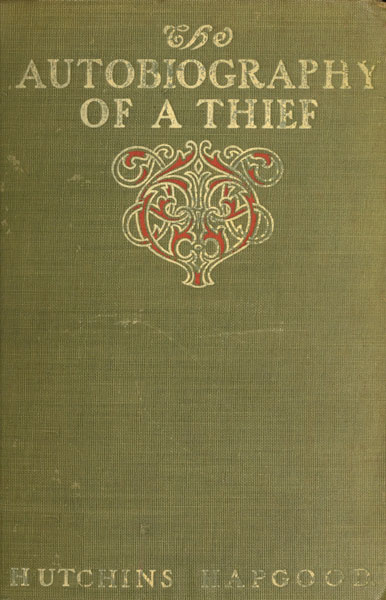
The Project Gutenberg eBook of The Autobiography of a Thief
Title: The Autobiography of a Thief
Author: Hutchins Hapgood
Release date: March 18, 2014 [eBook #45169]
Most recently updated: October 24, 2024
Language: English
Credits: Produced by Melissa McDaniel and the Online Distributed
Proofreading Team at http://www.pgdp.net (This file was
produced from images generously made available by The
Internet Archive)
Transcriber's Note:
Obvious typographical errors have been corrected. Inconsistent spelling and hyphenation in the original document have been preserved.
The Autobiography of a Thief.
The Autobiography of
a Thief
Recorded by
HUTCHINS HAPGOOD
Author of "The Spirit of the Ghetto," etc.
NEW YORK
FOX, DUFFIELD & COMPANY
1903
Copyright, 1903, By
Fox, Duffield & Company
Entered at the Library of Congress, Washington, U. S. A.
Entered at Stationers' Hall, London, England.
Published May, 1903.
"Oh, happy he who can still hope to emerge from this sea of error!"
Faust.
"There is no man doth a wrong for the wrong's sake, but thereby to purchase himself profit, or pleasure, or honour, or the like; therefore why should I be angry with a man for loving himself better than me? And if any man should do wrong merely out of ill-nature, why, yet it is but like the thorn or briar, which prick and scratch because they can do no other."
Bacon.
CONTENTS.
| Chapter | Page | |
| Editor's Note | 9 | |
| I. | Boyhood and Early Crime | 15 |
| II. | My First Fall | 34 |
| III. | Mixed Ale Life in the Fourth and Seventh Wards | 50 |
| IV. | When the Graft Was Good | 73 |
| V. | Mamie and the Negotiable Bonds | 89 |
| VI. | What the Burglar Faces | 107 |
| VII. | In Stir | 132 |
| VIII. | In Stir (Continued) | 154 |
| IX. | In Stir and Out | 182 |
| X. | At the Graft Again | 202 |
| XI. | Back to Prison | 228 |
| XII. | On the Outside Again | 255 |
| XIII. | In the Mad-House | 300 |
| XIV. | Out of Hell | 332 |
| Editor's Postscript | 348 |
Editor's Note.
I met the ex-pickpocket and burglar whose autobiography follows soon after his release from a third term in the penitentiary. For several weeks I was not particularly interested in him. He was full of a desire to publish in the newspapers an exposé of conditions obtaining in two of our state institutions, his motive seeming partly revenge and partly a very genuine feeling that he had come in contact with a systematic crime against humanity. But as I continued to see more of him, and learned much about his life, my interest grew; for I soon perceived that he not only had led a typical thief's life, but was also a man of more than common natural intelligence, with a gift of vigorous expression. With little schooling he had yet educated himself, mainly by means of the prison libraries, until he had a good and individually expressed acquaintance with many of the English classics, and with some of the masterpieces of philosophy.
That this ex-convict, when a boy on the East Side of New York City, should have taken to the "graft" seemed to me, as he talked about it, the most natural thing in the world. His parents were honest, but ignorant and poor. One of his brothers, a normal and honorable man, is a truck driver with a large family; and his relatives and honest friends in general belong to the most modest class of working people. The swell among them is another brother, who is a policeman; but Jim, the ex-convict, is by far the cleverest and most intelligent of the lot. I have often seen him and his family together, on Saturday nights, when the clan gathers in the truckman's house for a good time, and he is the life of the occasion, and admired by the others. Jim was an unusually energetic and ambitious boy, but the respectable people he knew did not appeal to his imagination. As he played on the street, other boys pointed out to him the swell thief at the corner saloon, and told him tales of big robberies and exciting adventures, and the prizes of life seemed to him to lie along the path of crime. There was no one to teach him what constitutes real success, and he went in for crime with energy and enthusiasm.
It was only after he had become a professional thief and had done time in the prisons that he began to see that crime does not pay. He saw that all his friends came to ruin, that his own health was shattered, and that he stood on the verge of the mad-house. His self-education in prison helped him, too, to the perception that he had made a terrible mistake. He came to have intellectual ambitions and no longer took an interest in his old companions. After several weeks of constant association with him I became morally certain that his reform was as genuine as possible under the circumstances; and that, with fair success in the way of getting something to do, he would remain honest.
I therefore proposed to him to write an autobiography. He took up the idea with eagerness, and through the entire period of our work together, has shown an unwavering interest in the book and very decided acumen and common sense. The method employed in composing the volume was that, practically, of the interview. From the middle of March to the first of July we met nearly every afternoon, and many evenings, at a little German café on the East Side. There, I took voluminous notes, often asking questions, but taking down as literally as possible his story in his own words; to such a degree is this true, that the following narrative is an authentic account of his life, with occasional descriptions and character-sketches of his friends of the Under World. Even without my explicit assurance, the autobiography bears sufficient internal evidence of the fact that, essentially, it is a thief's own story. Many hours of the day time, when I was busy with other things, my friend—for I have come to look upon him as such—was occupied with putting down on paper character-sketches of his pals and their careers, or recording his impressions of the life they had followed. After I had left town for the summer, in order to prepare this volume, I wrote to Jim repeatedly, asking for more material on certain points. This he always furnished in a manner which showed his continued interest, and a literary sense, though fragmentary, of no common kind.
H. H.
The Autobiography of a Thief.
CHAPTER I.
Boyhood and Early Crime.
I have been a professional thief for more than twenty years. Half of that time I have spent in state's prison, and the other half in "grafting" in one form or another. I was a good pickpocket and a fairly successful burglar; and I have known many of the best crooks in the country. I have left the business for good, and my reasons will appear in the course of this narrative. I shall tell my story with entire frankness. I shall not try to defend myself. I shall try merely to tell the truth. Perhaps in so doing I shall explain myself.
I was born on the east side of New York City in 1868, of poor but honest parents. My father was an Englishman who had married an Irish girl and emigrated to America, where he had a large family, no one of whom, with the exception of myself, went wrong. For many years he was an employee of Brown Brothers and Company and was a sober, industrious man, and a good husband and kind father. To me, who was his favorite, he was perhaps too kind. I was certainly a spoiled child. I remember that when I was five years old he bought me a twenty-five dollar suit of clothes. I was a vigorous, handsome boy, with red, rosy cheeks and was not only the pet of my family, but the life of the neighborhood as well.
At that time, which is as far back as I can remember, we were living on Munro Street, in the Seventh Ward. This was then a good residential neighborhood, and we were comfortable in our small, wooden house. The people about us were Irish and German, the large Jewish emigration not having begun yet. Consequently, lower New York did not have such a strong business look as it has now, but was cleanly and respectable. The gin-mills were fewer in number, and were comparatively decent. When the Jews came they started many basement saloons, or cafés, and for the first time, I believe, the social evil began to be connected with the drinking places.
I committed my first theft at the age of six. Older heads put me up to steal money from the till of my brother's grocery store. It happened this way. There were several much older boys in the neighborhood who wanted money for row-boating and theatres. One was eighteen years old, a ship-caulker; and another was a roustabout of seventeen. I used to watch these boys practice singing and dancing in the big marble lots in the vicinity. How they fired my youthful imagination! They told me about the theatres then in vogue—Tony Pastor's, the old Globe, Wood's Museum and Josh Hart's Theatre Comique, afterwards owned by Harrigan and Hart.
One day, George, the roustabout, said to me: "Kid, do you want to go row-boating with us?" When I eagerly consented he said it was too bad, but the boat cost fifty cents and he only had a ten-cent stamp (a small paper bill: in those days there was very little silver in circulation). I did not bite at once, I was so young, and they treated me to one of those wooden balls fastened to a rubber string that you throw out and catch on the rebound. I was tickled to death. I shall never forget that day as long as I live. It was a Saturday, and all day long those boys couldn't do too much for me.
Towards evening they explained to me how to rob my brother's till. They arranged to be outside the store at a certain hour, and wait until I found an opportunity to pass the money to them. My mother watched in the store that evening, but when she turned her back I opened the till and gave the eight or ten dollars it contained to the waiting boys. We all went row-boating and had a jolly time. But they were not satisfied with that. What I had done once, I could do again, and they held out the theatre to me, and pretended to teach me how to dance the clog. Week in and week out I furnished them with money, and in recompense they would sometimes take me to a matinée. What a joy! How I grew to love the vaudeville artists with their songs and dances, and the wild Bowery melodramas! It was a great day for Indian plays, and the number of Indians I have scalped in imagination, after one of these shows, is legion.
Some of the small boys, however, who did not share in the booty grew jealous and told my father what was doing. The result was that a certain part of my body was sore for weeks afterwards. My feelings were hurt, too, for I did not know at that time that I was doing anything very bad. My father, indeed, accompanied the beating with a sermon, telling me that I had not only broken God's law but had robbed those that loved me. One of my brothers, who is now a policeman in the city service, told me that I had taken my ticket for the gallows. The brother I had robbed, who afterwards became a truckman, patted me on the head and told me not to do it again. He was always a good fellow. And yet they all seemed to like to have me play about the streets with the other little boys, perhaps because the family was large, and there was not much room in the house.
So I had to give up the till; but I hated to, for even at that age I had begun to think that the world owed me a living! To get revenge I used to hide in a charcoal shed and throw pebbles at my father as he passed. I was indeed the typical bad boy, and the apple of my mother's eye.
When I couldn't steal from the till any more, I used to take clothes from my relatives and sell them for theatre money; or any other object I thought I could make away with. I did not steal merely for theatre money but partly for excitement too. I liked to run the risk of being discovered. So I was up to any scheme the older boys proposed. Perhaps if I had been raised in the wild West I should have made a good trapper or cow-boy, instead of a thief. Or perhaps even birds' nests and fish would have satisfied me, if they had been accessible.
One of my biggest exploits as a small boy was made when I was eight years old. Tom's mother had a friend visiting her, whom Tom and I thought we would rob. Tom, who was a big boy, and some of his friends, put me through a hall bed-room window, and I made away with a box of valuable jewelry. But it did me no good for the big boys sold it to a woman who kept a second-hand store on Division Street, and I received no part of the proceeds.
My greatest youthful disappointment came about four weeks later. A boy put me up to steal a box out of a wagon. I boldly made away with it and ran into a hall-way, where he was waiting. The two of us then went into his back-yard, opened the box and found a beautiful sword, the handle studded with little stones. But the other boy had promised me money, and here was only a sword! I cried for theatre money, and then the other boy boxed my ears. He went to his father, who was a free mason, and got a fifty cent "stamp." He gave me two three-cent pieces and kept the rest. I shall never forget that injustice as long as I live. I remember it as plainly as if it happened yesterday. We put the sword under a mill in Cherry Street and it disappeared a few hours later. I thought the boy and his father had stolen it, and told them so. I got another beating, but I believe my suspicion was correct, for the free mason used to give me a ten cent stamp whenever he saw me—to square me, I suppose.
When it came to contests with boys of my own size I was not so meek, however. One day I was playing in Jersey, in the back-yard of a boy friend's house. He displayed his pen-knife, and it took my fancy. I wanted to play with it, and asked him to lend it to me. He refused, and I grabbed his hand. He plunged the knife into my leg. I didn't like that, and told him so, not in words, but in action. I remember that I took his ear nearly off with a hatchet. I was then eight years old.
About this time I began to go to Sunday School, with what effect on my character remains to be seen. One day I heard a noted priest preach. I had one dollar and eighty cents in my pocket which I had stolen from my brother. I thought that each coin in my pocket was turning red-hot because of my anxiety to spend it. While the good man was talking of the Blessed One I was inwardly praying for him to shut up. He had two beautiful pictures which he intended to give to the best listener among the boys. When he had finished his talk he called me to him, gave me the pictures and said: "It's such boys as you who, when they grow up, are a pride to our Holy Church."
A year later I went to the parochial school, but did not stay long, for they would not have me. I was a sceptic at seven and an agnostic at eight, and I objected to the prayers every five minutes. I had no respect for ceremonies. They did not impress my imagination in the slightest, partly because I learned at an early age to see the hypocrisy of many good people. One day half a dozen persons were killed in an explosion. One of them I had known. Neighbors said of him: "What a good man has gone," and the priest and my mother said he was in heaven. But he was the same man who had often told me not to take money from the money-drawer, for that was dangerous, but to search my father's pockets when he was asleep. For this advice I had given the rascal many a dollar. Ever after that I was suspicious of those who were over-virtuous. I told my mother I did not believe her and the priest, and she slapped my face and told me to mind my catechism.
Everything mischievous that happened at the parochial school was laid to my account, perhaps not entirely unjustly. If a large firecracker exploded, it was James—that was my name. If some one sat on a bent pin, the blame was due to James. If the class tittered teacher Nolan would rush at me with a hickory stick and yell: "It's you, you devil's imp!" and then he'd put the question he had asked a hundred times before: "Who med (made) you?"
I was finally sent away from the parochial school because I insulted one of the teachers, a Catholic brother. I persisted in disturbing him whenever he studied his catechism, which I believed he already knew by heart. This brother's favorite, by the way, was a boy who used to say his prayers louder than anybody else. I met him fifteen years afterwards in state's prison. He had been settled for "vogel-grafting," that is, taking little girls into hall-ways and robbing them of their gold ear-rings. He turned out pretty well, however, in one sense, for he became one of the best shoe-makers in Sing Sing.
Although, as one can see from the above incidents, I was not given to veneration, yet in some ways I was easily impressed. I always loved old buildings, for instance. I was baptized in the building which was until lately the Germania Theatre, and which was then a church; and that old structure always had a strange fascination for me. I used to hang about old churches and theatres, and preferred on such occasions to be alone. Sometimes I sang and danced, all by myself, in an old music hall, and used to pore over the names marked in lead pencil on the walls. Many is the time I have stood at night before some old building which has since been razed to the ground, and even now I like to go round to their sites. I like almost anything that is old, even old men and women. I never loved my mother much until she was an old woman. All stories of the past interested me; and later, when I was in prison, I was specially fond of history.
After I was dismissed from the parochial school, I entered the public school, where I stayed somewhat longer. There I studied reading, writing, arithmetic and later, grammar, and became acquainted with a few specimens of literature. I remember Longfellow's Excelsior was a favorite of mine. I was a bright, intelligent boy, and, if it had not been for conduct, in which my mark was low, I should always have had the gold medal, in a class of seventy. I used to play truant constantly, and often went home and told my mother that I knew more than the teacher. She believed me, for certainly I was the most intelligent member of my family.
Yes, I was more intelligent than my parents or any of my brothers and sisters. Much good it has done me! Now that I have "squared it" I see a good deal of my family, and they are all happy in comparison with me. On Saturday nights I often go around to see my brother the truckman. He has come home tired from his week's work, but happy with his twelve dollar salary and the prospect of a holiday with his wife and children. They sit about in their humble home on Saturday night, with their pint of beer, their songs and their jovial stories. Whenever I am there, I am, in a way, the life of the party. My repartee is quicker than that of the others. I sing gayer songs and am jollier with the working girls who visit my brother's free home. But when I look at my stupid brother's quiet face and calm and strong bearing, and then realize my own shattered health and nerves and profound discontent, I know that my slow brother has been wiser than I. It has taken me many years on the rocky path to realize this truth. For by nature I am an Ishmælite, that is, a man of impulse, and it is only lately that wisdom has been knocked into me.
Certainly I did not realize my fate when I was a kid of ten, filled with contempt for my virtuous and obscure family! I was overflowing with spirits and arrogance, and began to play "hooky" so often that I practically quit school about this time.
It was then, too, that we moved again, this time to Cherry Street, to the wreck of my life. At the end of the block on which we lived was a corner saloon, the headquarters of a band of professional thieves. They were known as the Old Border Gang, and among them were several very well-known and successful crooks. They used to pass our way regularly, and boys older than I (my boy companions always had the advantage of me in years) used to point the famous "guns" out to me. When I saw one of these great men pass, my young imagination was fired with the ambition to be as he was! With what eagerness we used to talk about "Juggy," and the daring robbery he committed in Brooklyn! How we went over again and again in conversation, the trick by which Johnny the "grafter" had fooled the detective in the matter of the bonds!
We would tell stories like these by the hour, and then go round to the corner, to try to get a look at some of the celebrities in the saloon. A splendid sight one of these swell grafters was, as he stood before the bar or smoked his cigar on the corner! Well dressed, with clean linen collar and shirt, a diamond in his tie, an air of ease and leisure all about him, what a contrast he formed to the respectable hod-carrier or truckman or mechanic, with soiled clothes and no collar! And what a contrast was his dangerous life to that of the virtuous laborer!
The result was that I grew to think the career of the grafter was the only one worth trying for. The real prizes of the world I knew nothing about. All that I saw of any interest to me was crooked, and so I began to pilfer right and left: there was nothing else for me to do. Besides I loved to treat those older than myself. The theatre was a growing passion with me and I began to be very much interested in the baseball games. I used to go to the Union grounds in Brooklyn, where after the third inning, I could usually get admitted for fifteen cents, to see the old Athletics or Mutuals play. I needed money for these amusements, for myself and other boys, and I knew of practically only one way to get it.
If we could not get the money at home, either by begging or stealing, we would tap tills, if possible, in the store of some relative; or tear brass off the steps in the halls of flats and sell it at junk shops. A little later, we used to go to Grand Street and steal shoes and women's dresses from the racks in the open stores, and pawn them. In the old Seventh Ward there used to be a good many silver plates on the doors of private houses. These we would take off with chisels and sell to metal dealers. We had great fun with a Dutchman who kept a grocery store on Cherry Street. We used to steal his strawberries, and did not care whether he saw us or not. If he grabbed one of us, the rest of the gang would pelt him with stones until he let go, and then all run around the corner before the "copper" came into sight.
All this time I grew steadily bolder and more desperate, and the day soon came when I took consequences very little into consideration. My father and mother sometimes learned of some exploit of mine, and a beating would be the result. I still got the blame for everything, as in school, and was sometimes punished unjustly. I was very sensitive and this would rankle in my soul for weeks, so that I stole harder than ever. And yet I think that there was some good in me. I was never cruel to any animals, except cats; for cats, I used to tie their tails together and throw them over a clothesline to dry. I liked dogs, horses, children and women, and have always been gentle to them. What I really was was a healthy young animal, with a vivid imagination and a strong body. I learned early to swim and fight and play base-ball. Dime and nickel novels always seemed very tame to me; I found it much more exciting to hear true stories about the grafters at the corner saloon!—big men, with whom as yet I did not dare to speak; I could only stare at them with awe.
I shall never forget the first time I ever saw a pickpocket at work. It was when I was about thirteen years old. A boy of my own age, Zack, a great pal of mine, was with me. Zack and I understood one another thoroughly and well knew how to get theatre money by petty pilfering, but of real graft we were as yet ignorant, although we had heard many stories about the operations of actual, professional thieves. We used to steal rides in the cars which ran to and from the Grand Street ferries; and run off with overcoats and satchels when we had a chance. One day we were standing on the rear platform when a woman boarded the car, and immediately behind her a gentlemanly looking man with a high hat. He was well-dressed and looked about thirty-five years old. As the lady entered the car, the man, who stayed outside on the platform, pulled his hand away from her side and with it came something from her pocket—a silk handkerchief. I was on the point of asking the woman if she had dropped something, when Zack said to me, "Mind your own business." The man, who had taken the pocket-book along with the silk handkerchief, seeing that we were "next," gave us the handkerchief and four dollars in ten and fifteen cent paper money ("stamps").
Zack and I put our heads together. We were "wiser" than we had been half an hour before. We had learned our first practical lesson in the world of graft. We had seen a pickpocket at work, and there seemed to us no reason why we should not try the game ourselves. Accordingly a day or two afterwards we arranged to pick our first pocket. We had, indeed, often taken money from the pockets of our relatives, but that was when the trousers hung in the closet or over a chair, and the owner was absent. This was the first time we had hunted in the open, so to speak; the first time our prey was really alive.
It was an exciting occasion. Zack and I, who were "wise," (that is, up to snuff) got several other boys to help us, though we did not tell them what was doing, for they "were not buried" yet, that is, "dead," or ignorant. We induced five or six of them to jump on and off the rear platform of a car, making as much noise and confusion as possible, so as to distract the attention of any "sucker" that might board. Soon I saw a woman about to get on the car. My heart beat with excitement, and I signalled to Zack that I would make the "touch." In those days women wore big sacques with pockets in the back, open, so that one could look in and see what was there. I took the silk handkerchief on the run, and with Zack following, went up a side street and gloried under a lamp-post. In the corner of the handkerchief, tied up, were five two-dollar bills, and for weeks I was J. P. Morgan.
For a long time Zack and I felt we were the biggest boys on the block. We boasted about our great "touch" to the older boys of eighteen or nineteen years of age who had pointed out to us the grafters at the corner saloon. They were not "in it" now. They even condescended to be treated to a drink by us. We spent the money recklessly, for we knew where we could get more. In this state of mind, soon after that, I met the "pick" whom we had seen at work. He had heard of our achievement and kindly "staked" us, and gave us a few private lessons in picking pockets. He saw that we were promising youngsters, and for the sake of the profession gave us a little of his valuable time. We were proud enough, to be taken notice of by this great man. We felt that we were rising in the world of graft, and began to wear collars and neckties.
CHAPTER II.
My First Fall.
For the next two years, until I was fifteen, I made a great deal of money at picking pockets, without getting into difficulties with the police. We operated, at that time, entirely upon women, and were consequently known technically as Moll-buzzers—or "flies" that "buzz" about women.
In those days, and for several years later, Moll-buzzing, as well as picking pockets in general, was an easy and lucrative graft. Women's dresses seemed to be arranged for our especial benefit; the back pocket, with its purse and silk handkerchief could be picked even by the rawest thief. It was in the days when every woman had to possess a fine silk handkerchief; even the Bowery "cruisers" (street-walkers) carried them; and to those women we boys used to sell the handkerchiefs we had stolen, receiving as much as a dollar, or even two dollars, in exchange.
It was a time, too, before the great department stores and delivery wagon systems, and shoppers were compelled to carry more money with them than they do now, and to take their purchases home themselves through the streets. Very often before they reached their destination they had unconsciously delivered some of the goods to us. At that time, too, the wearing of valuable pins and stones, both by men and women, was more general than it is now. Furthermore, the "graft" was younger. There were not so many in the business, and the system of police protection was not so good. Altogether those were halcyon days for us.
The fact that we were very young helped us particularly in this business, for a boy can get next to a woman in a car or on the street more easily than a man can. He is not so apt to arouse her suspicions; and if he is a handsome, innocent-looking boy, and clever, he can go far in this line of graft. He usually begins this business when he is about thirteen, and by the age of seventeen generally graduates into something higher. Living off women, in any form, does not appeal very long to the imagination of the genuine grafter. Yet I know thieves who continue to be Moll-buzzers all their lives; and who are low enough to make their living entirely off poor working girls. The self-respecting grafter detests this kind; and, indeed, these buzzers never see prosperous days after their boyhood. The business grows more difficult as the thief grows older. He cannot approach his prey so readily, and grows shabbier with declining returns; and shabbiness makes it difficult for him to mix up in crowds where this kind of work is generally done.
For several years we youngsters made a great deal of money at this line. We made a "touch" almost every day, and I suppose our "mob," composed of four or five lads who worked together, averaged three or four hundred dollars a week. We worked mainly on street cars at the Ferry, and the amount of "technique" required for robbing women was very slight. Two or three of us generally went together. One acted as the "dip," or "pick," and the other two as "stalls." The duty of the "stalls" was to distract the attention of the "sucker" or victim, or otherwise to hide the operations of the "dip". One stall would get directly in front of the woman to be robbed, the other directly behind her. If she were in such a position in the crowd as to render it hard for the "dip," or "wire" to make a "touch," one of the stalls might bump against her, and beg her pardon, while the dip made away with her "leather," or pocket-book.
Shortly before I was fifteen years old I was "let in" to another kind of graft. One day Tim, Zack and I were boasting of our earnings to an older boy, twenty years of age, whose name was Pete. He grinned, and said he knew something better than Moll-buzzing. Then he told us about "shoving the queer" and got us next to a public truckman who supplied counterfeit bills. Our method was to carry only one bad bill among several good ones, so that if we were collared we could maintain our innocence. We worked this as a "side-graft," for some time. Pete and I used to go to mass on Sunday morning, and put a bad five dollar bill in the collector's box, taking out four dollars and ninety cents in change, in good money. We irreverently called this proceeding "robbing the dago in Rome." We use to pick "leathers," at the same time, from the women in the congregation. In those days I was very liberal in my religious views. I was not narrow, or bigoted. I attended Grace Church, in Tenth Street, regularly and was always well repaid. But after a while this lucrative graft came to an end, for the collector began to get "next". One day he said to me, "Why don't you get your change outside? This is the fourth time you have given me a big bill." So we got "leary" (suspicious) and quit.
With my big rosy cheeks and bright eyes and complexion I suppose I looked, in those days, very holy and innocent, and used to work this graft for all it was worth. I remember how, in church, I used tracts or the Christian Advocate as "stalls"; I would hand them to a lady as she entered the church, and, while doing so, pick her pocket.
Even at the early age of fifteen I began to understand that it was necessary to save money. If a thief wants to keep out of the "pen" or "stir," (penitentiary) capital is a necessity. The capital of a grafter is called "spring-money," for he may have to use it at any time in paying the lawyer who gets him off in case of an arrest, or in bribing the policeman or some other official. To "spring," is to escape from the clutches of the law. If a thief has not enough money to hire a "mouth-piece" (criminal lawyer) he is in a bad way. He is greatly handicapped, and can not "jump out" (steal) with any boldness.
But I always had great difficulty in saving "fall-money," (the same as spring-money; that is money to be used in case of a "fall," or arrest). My temperament was at fault. When I had a few hundred dollars saved up I began to be troubled, not from a guilty conscience, but because I could not stand prosperity. The money burned a hole in my pocket. I was fond of all sorts of amusements, of "treating," and of clothes. Indeed, I was very much of a dude; and this for two reasons. In the first place I was naturally vain, and liked to make a good appearance. A still more substantial reason was that a good personal appearance is part of the capital of a grafter, particularly of a pickpocket. The world thinks that a thief is a dirty, disreputable looking object, next door to a tramp in appearance. But this idea is far from being true. Every grafter of any standing in the profession is very careful about his clothes. He is always neat, clean, and as fashionable as his income will permit. Otherwise he would not be permitted to attend large political gatherings, to sit on the platform, for instance, and would be handicapped generally in his crooked dealings with mankind. No advice to young men is more common in respectable society than to dress well. If you look prosperous the world will treat you with consideration. This applies with even greater force to the thief. Keep up a "front" is the universal law of success, applicable to all grades of society. The first thing a grafter is apt to say to a pal whom he has not seen for a long time is, "You are looking good," meaning that his friend is well-dressed. It is sure flattery, and if a grafter wants to make a borrow he is practically certain of opening the negotiations with the stereotyped phrase: "You are looking good;" for the only time you can get anything off a grafter is when you can make him think you are prosperous.
But the great reason why I never saved much "fall-money" was not "booze," or theatres, or clothes. "Look for the woman" is a phrase, I believe, in good society; and it certainly explains a great deal of a thief's misfortunes. Long before I did anything in Graftdom but petty pilfering, I had begun to go with the little girls in the neighborhood. At that time they had no attraction for me, but I heard older boys say that it was a manly thing to lead girls astray, and I was ambitious to be not only a good thief, but a hard case generally. When I was nine or ten years old I liked to boast of the conquests I had made among little working girls of fourteen or fifteen. We used to meet in the hall-ways of tenement houses, or at their homes, but there was no sentiment in the relations between us, at least on my part. My only pleasure in it was the delight of telling about it to my young companions.
When I was twelve years old I met a little girl for whom I had a somewhat different feeling. Nellie was a pretty, blue-eyed little creature, or "tid-bit," as we used to say, who lived near my home on Cherry Street. I used to take her over on the ferry for a ride, or treat her to ice-cream; and we were really chums; but when I began to make money I lost my interest in her; partly, too, because at that time I made the acquaintance of a married woman of about twenty-five years old. She discovered me one day in the hallway with Nellie, and threatened to tell the holy brother on us if I didn't fetch her a pint of beer. I took the beer to her room, and that began a relationship of perhaps a year. She used to stake me to a part of the money her husband, a workingman, brought her every Saturday night.
Although the girls meant very little to me until several years later, I nevertheless began when I was about fifteen to spend a great deal of money on them. It was the thing to do, and I did it with a good grace. I used to take all kinds of working girls to the balls in Walhalla Hall in Orchard Street; or in Pythagoras, or Beethoven Halls, where many pretty little German girls of respectable families used to dance on Saturday nights. It was my pride to buy them things—clothes, pins, and to take them on excursions; for was I not a rising "gun," with money in my pocket? Money, however, that went as easily as it had come.
Perhaps if I had been able to save money at that time I might not have fallen (that is, been arrested) so early. My first fall came, however, when I was fifteen years old; and if I was not a confirmed thief already, I certainly was one by the time I left the Tombs, where I stayed ten days. It happened this way. Zack and I were grafting, buzzing Molls, with a pal named Jack, who afterwards became a famous burglar. He had just escaped from the Catholic Protectory, and told us his troubles. Instead of being alarmed, however, I grew bolder, for if Jack could "beat" the "Proteck" in three months, I argued I could do it in twenty-four hours. We three ripped things open for some time; but one day we were grafting on Sixth Avenue, just below Twentieth Street, when I fell for a "leather." The "sucker," a good-looking Moll was coming up the Avenue. Her "book," which looked fat, was sticking out of her skirt. I, who was the "wire," gave Jack and Zack the tip (thief's cough), and they stalled, one in front, one behind. The girl did not "blow" (take alarm) and I got hold of the leather easily. It looked like a get-away, for no one on the sidewalk saw us. But as bad luck would have it, a negro coachman, standing in the street by the pavement, got next, and said to me, "What are you doing there?" I replied, "Shut up, and I'll give you two dollars." But he caught hold of me and shouted for the police. I passed the leather to Jack, who "vamoosed." Zack hit the negro in the face and I ran up Seventh Avenue, but was caught by a flyman (policeman), and taken to the station house.
On the way to the police station I cried bitterly, for, after all, I was only a boy. I realized for the first time that the way of the transgressor is hard. It was in the afternoon, and I spent the time until next morning at ten, when I was to appear before the magistrate, in a cell in the station-house, in the company of an old grafter. In the adjoining cells were drunkards, street-walkers and thieves who had been "lined up" for the night, and I spent the long hours in crying and in listening to their indecent songs and jokes. The old grafter called to one of the Tenderloin girls that he had a kid with him who was arrested for Moll-buzzing. At this they all expressed their sympathy with me by saying that I would either be imprisoned for life or be hanged. They got me to sing a song, and I convinced them that I was tough.
In the morning I was arraigned in the police court. As there was no stolen property on me, and as the sucker was not there to make a complaint, I was "settled" for assault only, and sent to the Tombs for ten days.
My experience in the Tombs may fairly be called, I think, the turning point of my life. It was there that I met "de mob". I learned new tricks in the Tombs; and more than that, I began definitely to look upon myself as a criminal. The Tombs of twenty years ago was even less cheerful than it is at present. The Boys' Prison faced the Women's Prison, and between these two was the place where those sentenced to death were hanged. The boys knew when an execution was to take place, and we used to talk it over among ourselves. One man was hanged while I was there; and if anybody thinks that knowledge of such things helps to make boys seek the path of virtue, let him go forth into the world and learn something about human nature.
On my arrival in the Tombs, Mrs. Hill, the matron, had me searched for tobacco, knives or matches, all of which were contraband; then I was given a bath and sent into the corridor of the cells where there were about twenty-five other boys, confined for various crimes, ranging from petty larceny to offenses of the gravest kind. On the second day I met two young "dips" and we exchanged our experiences in the world of graft. I received my first lesson in the art of "banging a super," that is, stealing a watch by breaking the ring with the thumb and forefinger, and thus detaching it from the chain. They were two of the best of the Sixth Ward pickpockets, and we made a date to meet "on the outside." Indeed, it was not many weeks after my release before I could "bang a super," or get a man's "front" (watch and chain) as easily as I could relieve a Moll of her "leather".
As I look back upon the food these young boys received in the tombs, it seems to me of the worst. Breakfast consisted of a chunk of poor bread and a cup of coffee made of burnt bread crust. At dinner we had soup (they said, at least, there was meat in it), bread and water; and supper was the same as breakfast. But we had one consolation. When we went to divine service we generally returned happy; not because of what the good priest said, but because we were almost sure of getting tobacco from the women inmates.
Certainly the Gerry Society has its faults; but since its organization young boys who have gone wrong but are not yet entirely hardened, have a much better show to become good citizens than they used to have. That Society did not exist in my day; but I know a good deal about it, and I am convinced that it does a world of good; for, at least, when it takes children into its charge it does not surround them with an atmosphere of social crime.
While in the Tombs I experienced my first disillusionment as to the honor of thieves. I was an impulsive, imaginative boy, and that a pal could go back on me never seemed possible. Many of my subsequent misfortunes were due to the treachery of my companions. I have learned to distrust everybody, but as a boy of fifteen I was green, and so the treachery I shall relate left a sore spot in my soul.
It happened this way. On a May day, about two months before I was arrested, two other boys and I had entered the basement of a house where the people were moving, had made away with some silverware, and sold it to a Christian woman in the neighborhood for one twentieth of its value. When I had nearly served my ten days' sentence for assault, my two pals were arrested and "squealed" on me. I was confronted with them in the Tombs. At first I was mighty glad to see them, but when I found they had "squealed," I set my teeth and denied all knowledge of the "touch." I protested my innocence so violently that the police thought the other boys were merely seeking a scape-goat. They got twenty days and my term expired forty-eight hours afterwards. The silverware I stole that May morning is now an heirloom in the family of the Christian woman to whom I sold it so cheap.
If I had always been as earnest a liar as I was on that occasion in the Tombs I might never have gone to "stir" (penitentiary); but I grew more indifferent and desperate as time went on; and, in a way, more honest, more sincerely a criminal: I hardly felt like denying it. I know some thieves who, although they have grafted for twenty-five years, have not yet "done time"; some of them escaped because they knew how to throw the innocent "con" so well. Take Tim, for instance. Tim and I grafted together as boys. He was not a very skilful pickpocket, and he often was on the point of arrest; but he had a talent for innocence, and the indignation act he would put up would melt a heart of stone. He has, consequently, never been in stir, while I, a much better thief, have spent half of my adult life there. That was partly because I felt, when I had once made a touch, that the property belonged to me. On one occasion I had robbed a "bloke" of his "red super" (gold watch), and made away with it all right, when I carelessly dropped it on the sidewalk. A crowd had gathered about, and no man really in his right mind, would have picked up that super. But I did it, and was nailed dead to rights by a "cop." Some time afterwards a pal asked me why the deuce I had been so foolish. "Didn't the super belong to me," I replied, indignantly. "Hadn't I earned it?" I was too honest a thief. That was one of my weaknesses.
CHAPTER III.
Mixed-Ale Life in the Fourth and Seventh Wards.
For a time—a short time—after I left the Tombs I was quiet. My relatives threw the gallows "con" into me hard, but at that time I was proof against any arguments they could muster. They were not able to show me anything that was worth while; they could not deliver the goods, so what was the use of talking?
Although I was a disgrace at home, I was high cock-a-lorum among the boys in the neighborhood. They began to look up to me, as I had looked up to the grafters at the corner saloon. They admired me because I was a fighter and had "done time." I went up in their estimation because I had suffered in the good cause. And I began to get introductions to the older grafters in the seventh ward—grafters with diamond pins and silk hats. It was not long before I was at it harder than ever, uptown and downtown. I not only continued my trade as Moll-buzzer, but began to spread myself, got to be quite an adept in touching men for vests and supers and fronts; and every now and then "shoved the queer" or worked a little game of swindling. Our stamping-ground for supers and vests at that time was Fulton, Nassau, Lower Broadway and Wall Streets, and we covered our territory well. I used to work alone considerably. I would board a car with a couple of newspapers, would say, "News, boss?" to some man sitting down, would shove the paper in front of his face as a stall, and then pick his super or even his entire "front" (watch and chain). If you will stand for a newspaper under your chin I can get even your socks. Many is the "gent" I have left in the car with his vest entirely unbuttoned and his "front" gone. When I couldn't get the chain, I would snap the ring of the watch with my thumb and fore-finger, giving the thief's cough to drown the slight noise made by the breaking ring, and get away with the watch, leaving the chain dangling. Instead of a newspaper, I would often use an overcoat as a stall.
It was only when I was on the "hurry-up," however, that I worked alone. It is more dangerous than working with a mob, but if I needed a dollar quick I'd take any risk. I'd jump on a car, and tackle the first sucker I saw. If I thought it was not diplomatic to try for the "front," and if there was no stone in sight, I'd content myself with the "clock" (watch). But it was safer and more sociable to work with other guys. We usually went in mobs of three or four, and our methods were much more complicated than when we were simply moll-buzzing. Each thief had his special part to play, and his duty varied with the position of the sucker and the pocket the "leather" was in. If the sucker was standing in the car, my stall would frequently stand right in front, facing him, while I would put my hand under the stall's arm and pick the sucker's leather or super. The other stalls would be distracting the attention of the sucker, or looking out for possible interruptions. When I had got possession of the leather I would pass it quickly to the stall behind me, and he would "vamoose." Sometimes I would back up to the victim, put my hand behind me, break his ring and pick the super, or I would face his back, reach round, unbutton his vest while a pal stalled in front with a newspaper, a bunch of flowers, a fan, or an overcoat, and get away with his entire front.
A dip, as I have said, pays special attention to his personal appearance; it is his stock in trade; but when I began to meet boys who had risen above the grade of Moll-buzzers, I found that the dip, as opposed to other grafters, had many other advantages, too. He combines pleasure and instruction with business, for he goes to the foot-ball games, the New London races, to swell theatres where the graft is good, and to lectures. I have often listened to Bob Ingersoll, the greatest orator, in my opinion, that ever lived. I enjoyed his talk so much that I sometimes forgot to graft. But as a general rule, I was able to combine instruction with business. I very seldom dropped a red super because of an oratorical flourish; but the supers did not come my way all the time, I had some waiting to do, and in the meantime I improved my mind. Then a dip travels, too, more than most grafters; he jumps out to fairs and large gatherings of all descriptions, and grows to be a man of the world. When in the city he visits the best dance halls, and is popular because of his good clothes, his dough, and his general information, with men as well as women. He generally lives with a Moll who has seen the world, and who can add to his fund of information. I know a dip who could not read or write until he met a Moll, who gave him a general education and taught him to avoid things that interfered with his line of graft; she also took care of his personal appearance, and equipped him generally for an A No. 1 pickpocket. Women are much the same, I believe, in every rank of life.
It was at this time, when I was a kid of fifteen, that I first met Sheenie Annie, who was a famous shop-lifter. She was twenty-one years old, and used to give me good advice. "Keep away from heavy workers," (burglars) she would say; "there is a big bit in that." She had lived in Graftdom ever since she was a tid-bit, and she knew what she was talking about. I did not work with her until several years later, but I might as well tell her sad story now. I may say, as a kind of preface, that I have always liked the girl grafter who could take care of herself instead of sucking the blood out of some man. When I find a little working girl who has no other ambition than to get a little home together, with a little knick-knack on the wall, a little husband and a little child, I don't care for her. She is a nonentity. But such was not Sheenie Annie, who was a bright, intelligent, ambitious, girl; when she liked a fellow she would do anything for him, but otherwise she wouldn't let a man come near her.
The little Jewish lassie, named Annie, was born in the toughest part of New York. Later on, as she advanced in years and became an expert pilferer, she was given the nickname of "Sheenie." She was brought up on the street, surrounded by thieves and prostitutes. Her only education was what she received during a year or two in the public school. She lived near Grand Street, then a popular shopping district. As a very little girl she and a friend used to visit the drygoods stores and steal any little notion they could. There was a crowd of young pickpockets in her street, and she soon got on to this graft, and became so skilful at it that older guns of both sexes were eager to take her under their tuition and finish her education. The first time I met her was in a well-known dance-hall—Billy McGlory's—and we became friends at once, for she was a good girl and full of mischief. She was not pretty, exactly, but she was passable. She was small, with thick lips, plump, had good teeth and eyes as fine and piercing as any I ever saw in man or woman. She dressed well and was a good talker, as nimble-witted and as good a judge of human nature as I ever met in her sex.
Sheenie Annie's graft broadened, and from dipping and small shop-lifting she rose to a position where she doubled up with a mob of clever hotel workers, and made large amounts of money. Here was a girl from the lowest stratum of life, not pretty or well shaped, but whom men admired because of her wit and cleverness. A big contractor in Philadelphia was her friend for years. I have seen letters from him offering to marry her. But she had something better.
For she was an artist at "penny-weighting" and "hoisting." The police admitted that she was unusually clever at these two grafts, and they treated her with every consideration. Penny-weighting is a very "slick" graft. It is generally worked in pairs, by either sex or both sexes. A man, for instance, enters a jewelry store and looks at some diamond rings on a tray. He prices them and notes the costly ones. Then he goes to a fauny shop (imitation jewelry) and buys a few diamonds which match the real ones he has noted. Then he and his pal, usually a woman, enter the jewelry store and ask to see the rings. Through some little "con" they distract the jeweler's attention, and then one of them (and at this Sheenie Annie was particularly good) substitutes the bogus diamonds for the good ones; and leaves the store without making a purchase.
I can give an example of how Sheenie Annie "hoisted," from my own experience with her. On one occasion, when I was about eighteen years old, Sheenie and I were on a racket together. We had been "going it" for several days and needed some dough. We went into a large tailoring establishment, where I tried on some clothes, as a stall. Nothing suited me.—I took good care of that—but in the meantime Annie had taken two costly overcoats, folded them into flat bundles, and, raising her skirt quickly, had hidden the overcoats between her legs. We left the store together. She walked so straight that I thought she had got nothing, but when we entered a saloon a block away, and the swag was produced, I was forced to laugh. We "fenced" the overcoats and with the proceeds continued our spree.
Once Sheenie "fell" at this line of graft. She had stolen some costly sealskins from a well-known furrier, and had got away with them. But on her third visit to the place she came to grief. She was going out with a sealskin coat under her skirt when the office-boy, who was skylarking about, ran into her, and upset her. When the salesman, who had gone to her rescue, lifted her up, she lost her grip on the sealskin sacque, and it fell to the floor. It was a "blow," of course, and she got nailed, but as she had plenty of fall-money, and a well-known politician dead to rights, she only got nine months in the penitentiary.
Sheenie Annie was such a good shop-lifter that, with only an umbrella as a stall, she could make more money in a week than a poor needle-woman could earn in months. But she did not care for the money. She was a good fellow, and was in for fun. She was "wise," too, and I liked to talk to her, for she understood what I said, and was up to snuff, which was very piquant to me. She had done most of the grafts that I had done myself, and her tips were always valuable.
To show what a good fellow she was, her sweetheart, Jack, and another burglar named Jerry were doing night work once, when they were unlucky enough to be nailed. Sheenie Annie went on the stand and swore perjury in order to save Jack. He got a year, but Jerry, who had committed the same crime, got six. While he was in prison Annie visited him and put up a plan by which he escaped, but he would not leave New York with her, and was caught and returned to "stir." Annie herself fell in half a dozen cities, but never received more than a few months. After I was released from serving my second bit in the "pen," I heard Annie had died insane. An old girl pal of hers told me that she had died a horrible death, and that her last words were about her old friends and companions. Her disease was that which attacks only people with brains. She died of paresis.
Two other girls whom I knew when I was fifteen turned out to be famous shop-lifters—Big Lena and Blonde Mamie, who afterwards married Tommy, the famous cracksman. They began to graft when they were about fourteen, and Mamie and I used to work together. I was Mamie's first "fellow," and we had royal good times together. Lena, poor girl, is now doing five years in London, but she was one of the most cheerful Molls I ever knew. I met her and Mamie for the first time one day as they were coming out of an oyster house on Grand Street. I thought they were good-looking tid-bits, and took them to a picnic. We were so late that instead of going home Mamie and I spent the night at the house of Lena's sister, whose husband was a receiver of stolen goods, or "fence," as it is popularly called. In the morning Lena, Mamie and I made our first "touch" together. We got a few "books" uptown, and Mamie banged a satchel at Sterns. After that we often jumped out together, and took in the excursions. Sometimes Mamie or Lena would dip and I would stall, but more frequently I was the pick. We used to turn our swag over to Lena's sister's husband, Max, who would give us about one-sixth of its value.
These three girls certainly were a crack-a-jack trio. You can't find their likes nowadays. Even in my time most of the girls I knew did not amount to anything. They generally married, or did worse. There were few legitimate grafters among them. Since I have been back this time I have seen a great many of the old picks and night-workers I used to know. They tell the same story. There are no Molls now who can compare with Big Lena, Blonde Mamie, and Sheenie Annie. Times are bad, anyway.
After my experience in the Tombs I rose very rapidly in the world of graft, and distanced my old companions. Zack, the lad with whom I had touched my first Moll, soon seemed very tame to me. I fell away from him because he continued to eat bolivers (cookies), patronize the free baths, and stole horse-blankets and other trivial things when he could not get "leathers." He was not fast enough for me. Zack "got there," nevertheless, and for little or nothing, for several years later I met him in State's prison. He told me he was going to Colorado on his release. I again met him in prison on my second bit. He was then going to Chicago. On my third hit I ran up against the same old jail-bird, but this time his destination was Boston. To-day he is still in prison.
As I fell away from the softies I naturally joined hands with more ambitious grafters, and with those with brains and with good connections in the upper world. As a lad of from fifteen to eighteen I associated with several boys who are now famous politicians in this city, and "on the level," as that phrase is usually meant. Jack Lawrence was a well-educated boy, and high up as far as his family was concerned. His father and brothers held good political positions, and it was only a taste for booze and for less genteel grafting that held Jack back. As a boy of sixteen or seventeen he was the trusted messenger of a well-known Republican politician, named J. I. D. One of Jacks pals became a Federal Judge, and another, Mr. D——, who was never a grafter, is at present a city magistrate in New York.
While Jack was working for J. I. D., the politician, he was arrested several times. Once he abstracted a large amount of money from the vest pocket of a broker as he was standing by the old Herald building. He was nailed, and sent word to his employer, the politician, who went to police headquarters, highly indignant at the arrest of his trusted messenger. He easily convinced the broker and the magistrate that Jack was innocent; and as far as the Republican politician's business was concerned, Jack was honest, for J. I. D. trusted him, and Jack never deceived him. There are some thieves who will not "touch" those who place confidence in them, and Jack was one of them.
After he was released, the following conversation, which Jack related to me, took place between him and the politician, in the latter's office.
"How was it?" the Big One said, "that you happened to get your fingers into that man's pocket?"
Jack gave the "innocent con."
"None of that," said J. I. D., who was a wise guy, "I know you have a habit of taking small change from strangers' pockets."
Jack then came off his perch and gave his patron a lesson in the art of throwing the mit (dipping). At this the politician grinned, and remarked: "You will either become a reputable politician, for you have the requisite character, or you will die young."
Jack was feared, hated and envied by the other young fellows in J. I. D.'s office, for as he was such a thorough rascal, he was a great favorite with those high up. But he never got J. I. D.'s full confidence until after he was tested in the following way. One day the politician put his gold watch on a table in his office. Jack saw it, picked it up and put it in the Big One's drawer. The latter entered the room, saw that the watch was gone, and said: "I forgot my watch. I must have left it home."
"No," said Jack, "you left it on the table, and I put it in your desk." A smile spread over the patron's face.
"Jack, I can trust you. I put it there just to test your honesty."
The boy hesitated a moment, then, looking into the man's face, replied; "I know right well you did, for you are a wise guy."
After that J. I. D. trusted Jack even with his love affairs.
As Jack advanced in life he became an expert "gun," and was often nailed, and frequently brought before Magistrate D——, his old friend. He always got the benefit of the doubt. One day he was arraigned before the magistrate, who asked the flyman the nature of the complaint. It was the same as usual—dipping. Jack, of course, was indignant at such an awful accusation, but the magistrate told him to keep still, and, turning to the policeman, asked the culprit's name. When the copper told him, the magistrate exclaimed: "Why, that is not his name. I knew him twenty years ago, and he was a d—— rascal then; but that was not his name."
Jack was shocked at such language from the bench, and swore with such vehemence that he was innocent, that he again got the benefit of the doubt, and was discharged, and this time justly, for he had not made this particular "touch." He was hounded by a copper looking for a reputation. Jack, when he was set free, turned to the magistrate, and said: "Your honor, I thank you, but you only did your duty to an innocent man." The magistrate had a good laugh, and remarked: "Jack, I wouldn't believe you if you swore on a stack of Bibles."
A curious trait in a professional grafter is that, if he is "pinched" for something he did not do, although he has done a hundred other things for which he has never been pinched, he will put up such a wail against the abominable injustice that an honest man accused of the same offense would seem guilty in comparison. The honest man, even if he had the ability of a Philadelphia lawyer, could not do the strong indignation act that is characteristic of the unjustly accused grafter. Old thieves guilty of a thousand crimes will nourish revenge for years against the copper or judge who sends them up to "stir" on a false accusation.
When I was from fifteen to seventeen years old, I met the man who, some think, is now practically leader of Tammany Hall. I will call him Senator Wet Coin. At that time he was a boy eighteen or nineteen and strictly on the level. He knew all the grafters well, but kept off the Rocky Path himself. In those days he "hung out" in an oyster shanty and ran a paper stand. It is said he materially assisted Mr. Pulitzer in making a success of the World, when that paper was started. He never drank, in spite of the name I have given him. In fact, he derived his real nickname from his habit of abstinence. He was the friend of a Bowery girl who is now a well-known actress. She, too, was always on the level in every way; although her brother was a grafter; this case, and that of Senator Wet Coin prove that even in an environment of thieves it is possible to tread the path of virtue. Wet Coin would not even buy a stolen article; and his reward was great. He became captain of his election district, ran for assemblyman, was elected, and got as high a position, with the exception of that of Governor, as is possible in the State; while in the city, probably no man is more powerful.
Senator Wet Coin made no pretensions to virtue; he never claimed to be better than others. But in spite of the accusations against him, he has done far more for the public good than all the professional reformers, religious and other. He took many noted and professional criminals in the prime of their success, gave them positions and by his influence kept them honest ever since. Some of them are high up, even run gin-mills to-day. I met one of them after my second bit, who used to make his thousands. Now he has a salary of eighteen dollars a week and is contented. I had known him in the old days, and he asked: