
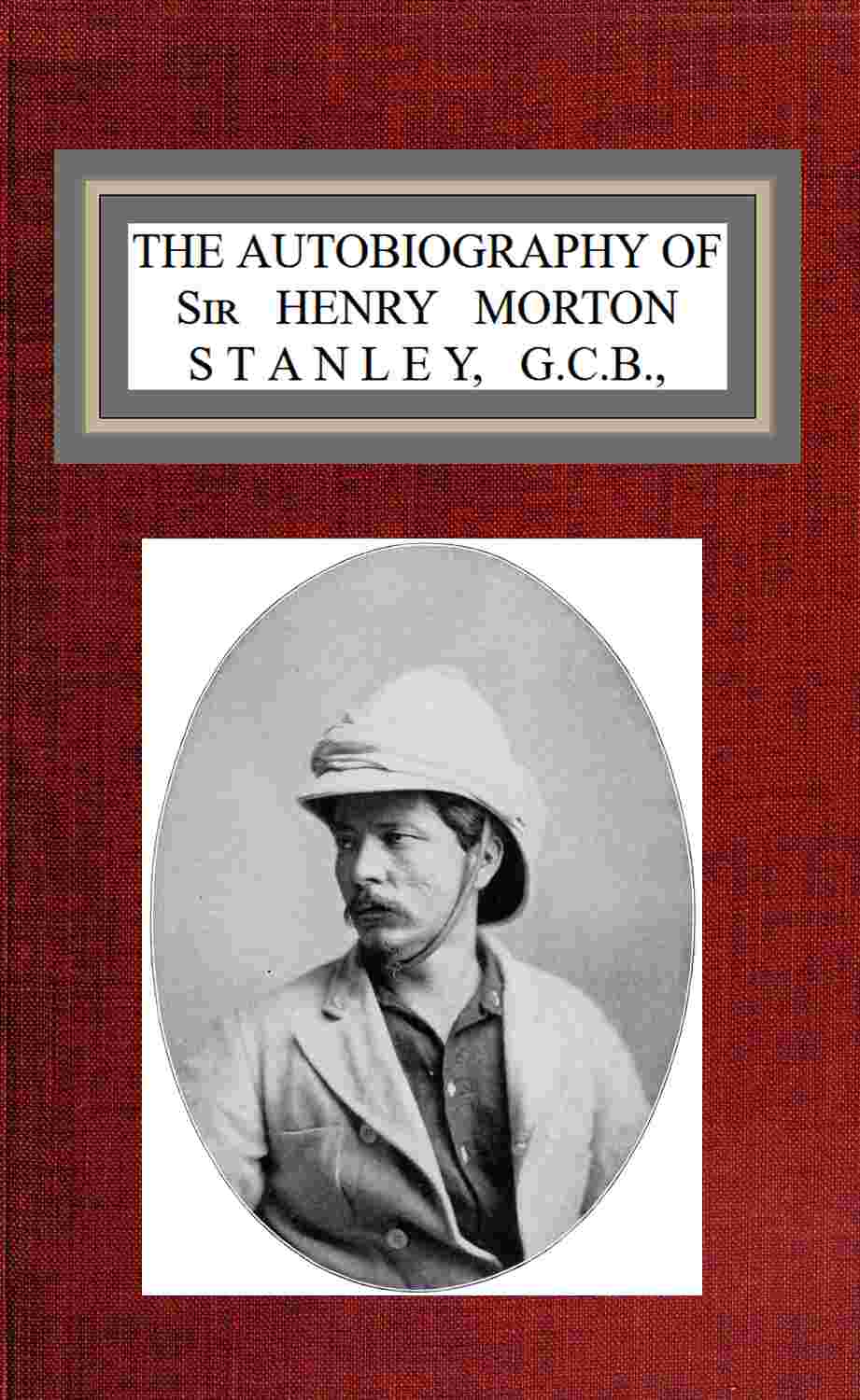
The Project Gutenberg eBook of The autobiography of Sir Henry Morton Stanley, G.C.B.
Title: The autobiography of Sir Henry Morton Stanley, G.C.B.
Author: Henry M. Stanley
Editor: Lady Dorothy Stanley
Release date: October 23, 2025 [eBook #77113]
Language: English
Original publication: London: Sampson Low, Marston and Co., Ltd, 1909
Credits: Chuck Greif and the Online Distributed Proofreading Team at https://www.pgdp.net (This file was produced from images generously made available by The Internet Archive)
CONTENTS.
ILLUSTRATIONS.
BIBLIOGRAPHY.
INDEX: A,
B,
C,
D,
E,
F,
G,
H,
I,
J,
K,
L,
M,
N,
O,
P,
R,
S,
T,
U,
V,
W,
Y,
Z
FOOTNOTES.
TRANSCRIBER'S NOTE.
FOREWORD
The life-story of Sir Henry M. Stanley is not only of intense human interest but presents a noble example of the possibilities of real manhood in the face of unceasing and overwhelming obstacles. Stanley made every obstacle a stepping-stone, and thus rose from waifdom to high estate. He rendered unparalleled services to the cause of humanity and civilization by his fearless penetration of darkest Africa, opening mysterious regions for the first time to the world’s knowledge, to Christian Missions and to peaceful commerce. His work resulted in the suppression of the worst horrors of African Slavery.
We may well note Stanley’s qualities of honest ambition, sense of duty, untiring industry, tenacity of purpose, dauntless courage, breadth of view and steadfast trust in God.
Stanley was my greatly-valued friend, and I treasure my memories of him and of his life work. Pray accept this Autobiography with my Christmas Greeting.
Christmas, 1914
THE AUTOBIOGRAPHY OF
SIR HENRY MORTON STANLEY
THE AUTOBIOGRAPHY OF
Sir HENRY MORTON
S T A N L E Y, G.C.B.,
D.C.L., (Oxford and Durham), LL.D., (Cambridge and Edinburgh), etc.; Doctor of Philosophy of the University of Halle; Honorary Member of The Royal Geographical Society, and the Geographical Societies of The Royal Scottish, Manchester, etc.; Gold Medallist of The Royal Geographical Society of London; Gold Medallist of Paris, Italy, Sweden, and Antwerp Geographical Societies, etc.; Grand Cordon of the Medjidie; Grand Commander of the Osmanlie; Grand Cordon of the Order of the Congo; Grand Commander of the Order of Leopold; Star of Zanzibar; Star of Service on the Congo; etc., etc.
EDITED BY HIS WIFE,
DOROTHY STANLEY.
WITH SIXTEEN ILLUSTRATIONS, MAP, AND
ONE FACSIMILE LETTER.
FOURTH EDITION.
LONDON:
SAMPSON LOW, MARSTON AND CO., Ltd.
COPYRIGHT REGISTERED IN GREAT BRITAIN
AND THE UNITED STATES OF AMERICA
REPRINTED FROM AMERICAN PLATES BY
WILLIAM CLOWES AND SONS, LIMITED, LONDON
EDITOR’S PREFACE
IN giving to the world this Autobiography of my husband’s early years, I am carrying out his wishes. Unfortunately, the Autobiography was left unfinished. I am, however, able to give very full extracts from his journals, letters, and private note-books, in which, day by day, he jotted down observations and reflections.
My best introduction is the following passage from a letter he wrote to me on November 30, 1893:—
‘I should like to write out a rough draft, as it were, of my life. The polishing could take care of itself, or you could do it, when the time comes. Were I suddenly to be called away, how little, after all, the world would know of me! My African life has been fairly described, but only as it affected those whom I served, or those who might be concerned. The inner existence, the me, what does anybody know of? nay, you may well ask, what do I know? But, granted that I know little of my real self, still, I am the best evidence for myself. And though, when I have quitted this world, it will matter nothing to me what people say of me, up to the moment of death we should strive to leave behind us something which can either comfort, amuse, instruct, or benefit the living; and though I cannot do either, except in a small degree, even that little should be given.
‘Just endeavour to imagine yourself in personal view of all the poor boys in these islands, English, Scotch, Welsh, and Irish, and also all the poor boys in Canada, the States, and our Colonies; regarding them as we regard those in the schools we visit in Lambeth, or at Cadoxton, we would see some hundreds, perhaps thousands, to whom we would instinctively turn, and wish we had the power to say something that would encourage them in their careers.
‘That is just how I feel. Not all who hear are influenced by precept, and not all who see, change because of example. But as I am not singular in anything that I know of, there must be a goodly number of boys who are penetrable, and it is for these penetrable intelligences, and assimilative organizations, that I would care to leave the truthful record of my life. For I believe the story of my efforts, struggles, sufferings, and failures, of the work done, and the work left undone,—I believe this story would help others. If my life had been merely frivolous, a life of purposeless drifting, why, then silence were better. But it has not been so, and therefore my life can teach some lessons, and give encouragement to others.’
The pathos of this Autobiography lies in the deprivations and denials of those early years, here recorded for the first time. Yet these sufferings, as he came to realise, were shaping and fitting him for the great work he was to perform; and his training and experiences were perhaps the finest a man could have had, since, day by day, he was being educated for the life that lay before him. Stanley writes:—
‘It can be understood how invaluable such a career and such a training, with its compulsory lessons, was to me, as a preparation for the tremendous tasks which awaited me.’
A boy of intense and passionate feelings, the longing for home, love, friends, and encouragement, at times amounted to pain; yet all these natural blessings were denied him; he received no affection from parents, no shelter of home, no kindness or help of friends, excepting from his adopted father, who died soon after befriending the lonely boy. Baffled and bruised at every turn, yet ‘the strong pulse of youth vindicates its right to gladness, even here.’ Orphaned, homeless, friendless, destitute, he nevertheless was rich in self-reliance and self-control, with a trust in God which never failed him. And so Stanley grew to greatness, a greatness which cannot be fully measured by his contemporaries. As a key to Stanley’s life, it may be mentioned that one of his earliest and dearest wishes, often expressed to me in secret, was, by his personal character and the character of his work in every stage of his career, to obliterate the stigma of pauperism which had been so deeply branded into his very soul by the Poor-Law methods, and which in most cases is so lifelong in its blasting effects on those who would strive to rise, ever so little, from such a Slough of Despond. So that, when he had achieved fame as an explorer, he craved, far more than this, a recognition by the English and American Public of the high endeavour which was the result of a real nobility of character and aim.
The ungenerous conduct displayed towards Stanley by a portion of the Press and Public would have been truly extraordinary, but for the historical treatment of Columbus and other great explorers into the Unknown. Stanley was not only violently attacked on his return from every expedition, but it was, for instance, insinuated that he had not discovered Livingstone, while some even dared to denounce, as forgeries, the autograph letters brought home from Livingstone to his children, notwithstanding their own assurance to the contrary. This reception produced, therefore, a bitter disappointment, only to be appreciated by the reader when he has completed this survey of Stanley’s splendid personality.
That Stanley sought no financial benefit by exploiting Africa, as he might legitimately have done, is borne out by the fact that instead of becoming a multi-millionaire, as the result of his vast achievements, and his unique influence with the native chiefs, the actual sources of his income were almost entirely literary. This is indicated in the text.
Accepting Free Trade as a policy, the blindness of the British Nation to the value of additional colonies, and the indifference, not only of successive Governments, but of the various Chambers of Commerce, and the industrial community generally, whose business instincts might have been expected to develop greater foresight, were a source of the deepest concern and disappointment to Stanley; for it meant the loss to England both of the whole of the present Congo Free State, and, later, of the monopoly of the Congo Railway, now one of the most profitable in the world. The determined opposition for long exhibited to the acquisition of Uganda and British East Africa was also, for a time, a great anxiety to him.
It may also be pointed out here that all that is now German East Africa was explored and opened up to commerce and civilisation by British explorers, Livingstone, Burton, Speke, and Stanley. Thus England threw away what individual Empire-builders had won for the realm. The obvious advantages and paramount necessity to a Free-Trade country of having vast new markets of its own are sufficiently apparent, whatever views are held on the difficult Fiscal Question.
Canon Hensley Henson, in 1907, preached a remarkable sermon at St. Margaret’s Church, Westminster, on St. Paul; and the following passage struck me as being, in some respects, not inapplicable to Stanley:—
‘St. Paul, in after years, when he could form some estimate of the effect of his vision, came to think that it represented the climax of a long course of Providential action; his ancestry, character, training, experiences, seemed to him, in retrospect, so wonderfully adapted to the work which he had been led to undertake, that he felt compelled to ascribe all to the over-ruling Providence of God; that no less a Power than God Himself had been active in his life; and the singular congruity of his earlier experiences with the requirements of his later work, confirmed the impression.’
‘Such men,’ wrote the Rev. W. Hughes, Missionary on the Congo, ‘as Dr. Livingstone and Henry M. Stanley, who went to Africa to prepare the way and open up that vast and wealthy country, that the light of civilisation and the Gospel might enter therein, are men created for their work, set apart, and sent out by Divine Providence, which over-rules everything that it may promote the good of man, and show forth His own glory. No one who has always lived in a civilised country can conceive what these two men have accomplished.’
The following striking picture of Stanley, from an article in ‘Blackwood’s Magazine,’ may well be given here:—
‘If the history of modern discovery has a moment comparable for dramatic interest to that in which Columbus turned his prow westward, and sailed into space, to link for ever the destinies of two hemispheres, it is the one in which a roving white man, in the far heart of Africa, set his face down the current of a mighty river, and committed himself to its waters, determined, for weal or woe, to track their course to the sea. The Genoese navigator, indeed, who divined and dared an unknown world, staked the whole future of humanity on his bold intuition, but posterity may one day trace results scarcely less momentous to the resolve of the intrepid explorer who launched his canoe on the Congo at Nyangwe, to win a second great inheritance for mankind.
The exploration of the great, moving highway of Africa makes an epoch in the discovery of Africa, closing the era of desultory and isolated research, and opening that of combined, steady effort towards a definite, though distant, goal. That goal is the opening-up of the vast Equatorial region to direct intercourse with Europe.’
I will now close my preface with St. Paul’s words, because they so wonderfully apply to Stanley:—
In perils of robbers, in perils by mine own countrymen, in perils by the heathen,
In perils in the city, in perils in the wilderness, in perils in the sea,
In perils among false brethren;
In weariness and painfulness, in watchings often,
In hunger and thirst, in fastings often,
In cold and nakedness.
. . . . . . . . . . . . . . . . . . .
If I must needs glory, I will glory of the things that concern my
weakness.
The first nine chapters of the book are the Autobiography, covering the early years of Stanley’s life. In the remaining chapters, the aim has been to make him the narrator and interpreter of his own actions. This has been done, wherever possible, by interweaving, into a connected narrative, strands gathered from his unpublished writings.
These materials consist, first, of journals and note-books. For many years he kept a line-a-day diary; through some periods, especially during his explorations, he wrote a full journal; and at a later period he kept note-books, as well as a journal, for jotting down, sometimes a personal retrospect, sometimes a comment on the society about him, or a philosophical reflection.
The material includes, next, a number of lectures, upon his various explorations; these he prepared with great care, but they were never published. They were written after he had published the books covering the same travels; and in the lectures we have the story told in a more condensed and colloquial way. Finally, there are his letters; in those to acquaintances, and even to friends, Stanley was always reserved about himself, and his feelings; I have therefore used only a few of those written to me, during our married life.
In some parts of the book, a thread of editorial explanation connects the passages by Stanley’s hand; and for some periods, where the original material was fragmentary, the main narrative is editorial.
The use of the large type signifies that Stanley is the writer; the smaller type indicates the editor’s hand.
I would here record my deep gratitude to Mr. George S. Merriam, of Springfield, Massachusetts, U. S. A., for the invaluable help and advice he has given me; and also to Mr. Henry S. Wellcome, Stanley’s much-valued friend, for the great encouragement and sympathy he has shown me throughout the preparation of this book for the press.
Mr. Sidney Low’s beautiful tribute, I republish, by kind permission of Messrs. Smith and Elder, from the ‘Cornhill Magazine,’ of July, 1904.
Finally, I would draw attention to the map of Africa placed at the end of this volume: Stanley carefully superintended the making of it by the great map-maker, Mr. John Bolton, at Messrs. Stanford’s. It was Mr. Bolton’s suggestion that I should put the small outline map of England beside it to indicate, by comparison, the relative size of that portion of Africa which is included in the larger map.
CONTENTS
| INTRODUCTION TO THE AUTOBIOGRAPHY | xv | |
| PART I | ||
|---|---|---|
| AUTOBIOGRAPHY. THROUGH THE WORLD | ||
| I | The Workhouse | 3 |
| II | Adrift | 35 |
| III | At Sea | 69 |
| IV | At Work | 86 |
| V | I Find a Father | 118 |
| VI | Adrift Again | 140 |
| VII | Soldiering | 167 |
| VIII | Shiloh | 186 |
| IX | Prisoner of War | 205 |
| PART II THE LIFE (continued, from Stanley’s Journals, Notes, etc.) | ||
| X | Journalism | 219 |
| XI | West and East INDIAN WARS OF THE WEST.—ABYSSINIAN CAMPAIGN, ETC. | 225 |
| XII | A Roving Commission | 237 |
| XIII | The Finding of Livingstone | 251 |
| XIV | England and Coomassie | 285 |
| XV | Through the Dark Continent | 296 |
| XVI | Founding the Congo State | 333 |
| XVII | The Rescue of Emin | |
| I THE RELIEF | 353 | |
| II PRIVATE REFLECTIONS | 380 | |
| XVIII | Work in Review | 392 |
| XIX | Europe Again | 409 |
| XX | The Happy Haven | 423 |
| XXI | Politics and Friends | 439 |
| XXII | In Parliament | 466 |
| XXIII | South Africa | 482 |
| XXIV | Farewell to Parliament | 501 |
| XXV | Furze Hill | 506 |
| XXVI | The Close of Life | 512 |
| XXVII | Thoughts From Note-Books | 517 |
| Bibliography | 541 | |
| Index | 543 | |
ILLUSTRATIONS
| Henry M. Stanley, 1890 | Frontispiece |
| Photograph by Mrs. Frederic W. H. Myers. | |
| Cottage where Henry M. Stanley was born | to face 4 |
| Fynnon Beuno | 42 |
| Henry M. Stanley, aged 15 | 52 |
| “Craig Fawr” from the Farm | 54 |
| Henry M. Stanley, aged 17 | 140 |
| Henry M. Stanley, aged 20 | 167 |
| Henry M. Stanley, 1872 | 264 |
| Photograph by the London Stereoscopic Co., Regent St., London. | |
| Doctor Livingstone | 282 |
| Photograph by the London Stereoscopic Co., Regent St., London. | |
| Henry M. Stanley and his Zanzibaris, 1877 | 330 |
| Henry M. Stanley, 1882 | 336 |
| Photograph By Messrs. Thomson, New Bond St., London. | |
| Henry M. Stanley, 1885 | 348 |
| Photograph By Messrs. Elliott & Fry, Baker St., London. | |
| Fac-simile of a Letter by Sir Henry M. Stanley | 378 |
| Henry M. Stanley and his Officers, 1890 | 390 |
| Henry M. Stanley, on his Return from Africa, 1890 | 409 |
| Photograph by Mrs. Frederic W. H. Myers. | |
| Dorothy Stanley | 423 |
| Photograph by Mrs. Frederic W. H. Myers. | |
| In the Village Churchyard, Pirbright | 516 |
| Map of Africa showing Stanley’s Journeys | at end |
| By Messrs. Stanford, London. | |
INTRODUCTION TO THE AUTOBIOGRAPHY
THERE is no reason now for withholding the history of my early years, nothing to prevent my stating every fact about myself. I am now declining in vitality. My hard life in Africa, many fevers, many privations, much physical and mental suffering, bring me close to the period of infirmities. My prospects now cannot be blasted by gibes, nor advancement thwarted by prejudice. I stand in no man’s way. Therefore, without fear of consequences, or danger to my pride and reserve, I can lay bare all circumstances which have attended me from the dawn of consciousness to this present period of indifference.
I may tell how I came into existence, and how that existence was moulded by contact with others; how my nature developed under varying influences, and what, after life’s severe tests, is the final outcome of it. I may tell how, from the soft, tender atom in the cradle, I became a football to Chance, till I grew in hardihood, and learned how to repel kicks; how I was taught to observe the moods and humours of that large mass of human beings who flitted by me.
As I have been in the habit of confining myself to myself, my reserve has been repugnant to gossip in every shape or form, and I have ever been the least likely person to hear anything evil of others, because, when the weakness or eccentricity of a casual acquaintance happened to be a topic, I have made it a principle to modify, if I could not change it. In this book I am not translating from a diary, nor is it the harvest of a journal, but it consists of backward glances at my own life, as memory unrolls the past to me. My inclination, as a young man, was always to find congenial souls to whom I could attach myself in friendship, not cling to for support, friends on whom I could thoroughly rely, and to whom I could trustfully turn for sympathy, and the exchange of thoughts. But, unfortunately, those to whom in my trustful age I ventured to consign the secret hopes and interests of my heart, invariably betrayed me. In some bitter moods I have thought that the sweetest parts of the Bible are wholly inapplicable to actual humanity, for no power, it appeared to me, could ever transform grown-up human beings so as to be worthy of heavenly blessings.
‘Little children, love one another,’ says divine St. John. Ah! yes, while we are children, we are capable of loving; our love is as that of Angels, and we are not far below them in purity, despite our trivial errors and fantasies; for however we err, we still can love. But when I emerged from childhood, and learned by experience that there was no love for me, born, so to say, fatherless, spurned and disowned by my mother, beaten almost to death by my teacher and guardian, fed on the bread of bitterness, how was I to believe in Love?
I was met by Hate in all its degrees, and not I alone. Look into the halls of legislation, of religious communities, of justice; look into the Press, any market-place, meeting-house, or walk of life, and answer the question, as to your own soul, ‘Where shall I find Love?’
See what a change forty years have wrought in me. When a child, I loved him who so much as smiled at me; the partner of my little bed, my play-fellow, the stranger boy who visited me; nay, as a flower attracts the bee, it only needed the glance of a human face, to begin regarding it with love. Mere increase of years has changed all that. Never can I recall that state of innocence, any more than I can rekindle the celestial spark, for it was extinguished with the expansion of intellect and by my experience of mankind. While my heart, it may be, is as tender as ever to the right person, it is subject to my intellect, which has become so fastidious and nice in its choice, that only one in a million is pronounced worthy of it.
No doubt there will be much self-betrayal in these pages, and he who can read between the lines, as a physiognomist would read character, will not find it difficult to read me. But then, this is the purpose of an Autobiography, and all will agree that it must be much more authentic than any record made of me by another man. Indeed, I wish to appear without disguise, as regards manners and opinions, habits and characteristics.
If a nation can be said to be happy which has no history, that man is also happy whose uneventful life has not brought him into prominence, and who has nothing to record but the passing of years between the cradle and the grave. But I was not sent into the world to be happy, nor to search for happiness. I was sent for a special work. Now, from innocent boyhood and trustful youth, I have advanced to some height whence I can look down, pityingly; as a father I can look down upon that young man, Myself, with a chastened pride; he has done well, he might have done better, but his life has been a fulfilment, since he has finished the work he was sent to do.
PART I
AUTOBIOGRAPHY
THROUGH THE WORLD
THE AUTOBIOGRAPHY OF SIR HENRY MORTON STANLEY
CHAPTER I
THE WORKHOUSE
IT is said that one of the patrician Mostyns, of North Wales, possesses a written pedigree forty feet long, to prove the claim of his family to a direct descent from Adam. Though no doubt much of this extraordinary genealogy is fabulous, it allows all of us plebeians a reasonable hope to believe that we are also descended from that venerated ancestor of our common humanity. The time has been when patrician families fondly believed their first progenitor had come direct from Heaven, and we baser creatures had to be content with an earthly sire.
I can prove as ancient a descent for myself, though the names of my intermediate progenitors between Adam and my grandfathers, Moses and John, have not been preserved. My family belonged to a class always strangely indifferent to written pedigrees, which relied more on oral traditions, the preserving of which has been mostly the duties of females, on account of their superior fluency of speech, and their disposition to cling to their family hearth. My earliest pains were caused by the endless rehearsal of family history to which my nurse was addicted; for soon after sunset each evening she would insist on taking me before some neighbour’s fire, where I would meet about a dozen dames from the Castle Row, prepared to indulge in their usual entertainment of recitations from their stock of unwritten folklore. After a ceremonious greeting and kindly interchange of civil enquiries about each other’s health and affairs, they would soon drift into more serious matter. I have a vague idea that much of it bordered on the uncanny and awful, but I retain a strong impression that most of their conversations related to the past and present of their respective families, courtships, marriages, and deaths being prime events. I also remember that there were many long pauses, during which I could hear a chorus of sympathetic sighs. The episodes which drew these from their affectionate breasts are quite forgotten, but those sighs haunt me still.
Such families as were clustered in front of the Green of Denbigh Castle were an exceedingly primitive folk, with far less regard for ancient ancestry than the Bedouin of the Desert. Indeed, I doubt whether any tradesman or farmer in our parts could say who was his great-great-grandfather, or whether one yeoman out of a hundred could tell who was his ancestor of two hundred years back. As King Cazembe said to Livingstone, the ‘Seeker of Rivers,’ ‘We let the streams run on, and do not enquire whence they rise or whither they flow.’
So these simple Welsh people would answer if questioned about their ancestors, ‘We are born and die, and, beyond that, none of us care who were before us, or who shall come after us.’
My personal recollections do not extend beyond the time I lay in the cradle; so that all that precedes this period I have been obliged to take upon trust. Mind and body have grown together, and both will decay according to the tasks or burdens imposed on them. But strange, half-formed ideas glide vaguely into the mind, sometimes, and then I seem not far from a tangible and intelligent view into a distant age. Sometimes the turn of a phrase, a sentence in a book, the first faint outline of a scene, a face like, yet unlike, one whom I knew, an incident, will send my mind searching swiftly down the long-reaching aisles, extending far into remote, pre-personal periods, trying to discover the connection, to forge again the long-broken link, or to re-knit the severed strand.
My father I never knew. I was in my ‘teens’ before I learned that he had died within a few weeks after my birth. Up to a certain date in the early Forties, all is profound darkness to me. Then, as I woke from sleep one day, a brief period of consciousness suddenly dawned upon my faculties. There was an indefinable murmur about me, some unintelligible views floated before my senses, light flashed upon the spirit, and I entered into being.
At what age I first received these dim, but indelible, impressions, I cannot guess. It must have been in helpless