
The Project Gutenberg eBook of The Bad Child's Book of Beasts
This ebook is for the use of anyone anywhere in the United States and
most other parts of the world at no cost and with almost no restrictions
whatsoever. You may copy it, give it away or re-use it under the terms
of the Project Gutenberg License included with this ebook or online
at www.gutenberg.org. If you are not located in the United States,
you will have to check the laws of the country where you are located
before using this eBook.
Title: The Bad Child's Book of Beasts
Author: Hilaire Belloc
Illustrator: B. T. B.
Release date: November 6, 2008 [eBook #27175]
Most recently updated: January 4, 2021
Language: English
Credits: Produced by Chris Curnow, Joseph Cooper, some images
courtesy of The Internet Archive and the Online Distributed
Proofreading Team at https://www.pgdp.net
*** START OF THE PROJECT GUTENBERG EBOOK THE BAD CHILD'S BOOK OF BEASTS ***
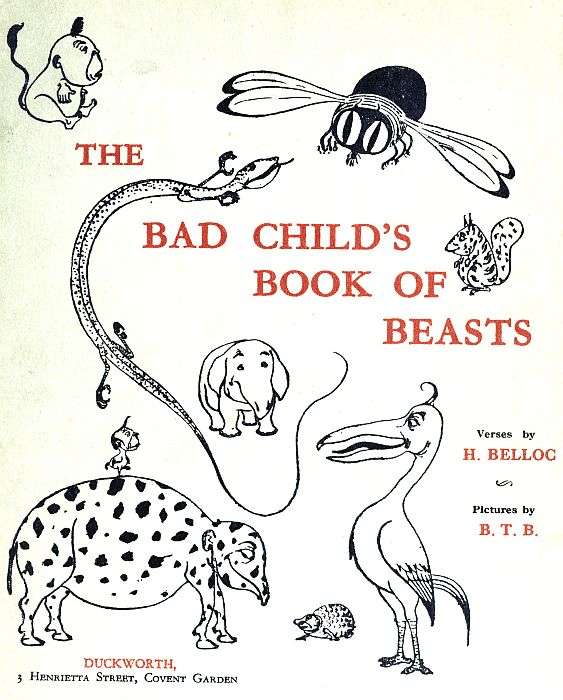
THE
BAD CHILD'S
BOOK OF
BEASTS
Verses by
H. BELLOC
Pictures by
B. T. B.
DUCKWORTH,
3 Henrietta Street, Covent Garden
3 Henrietta Street, Covent Garden
Child! do not throw this book about;
Refrain from the unholy pleasure
Of cutting all the pictures out!
Preserve it as your chiefest treasure.
Child, have you never heard it said
That you are heir to all the ages?
Why, then, your hands were never made
To tear these beautiful thick pages!
Your little hands were made to take
The better things and leave the worse ones.
They also may be used to shake
The Massive Paws of Elder Persons.
And when your prayers complete the day,
Darling, your little tiny hands
Were also made, I think, to pray
For men that lose their fairylands.
Refrain from the unholy pleasure
Of cutting all the pictures out!
Preserve it as your chiefest treasure.
Child, have you never heard it said
That you are heir to all the ages?
Why, then, your hands were never made
To tear these beautiful thick pages!
Your little hands were made to take
The better things and leave the worse ones.
They also may be used to shake
The Massive Paws of Elder Persons.
And when your prayers complete the day,
Darling, your little tiny hands
Were also made, I think, to pray
For men that lose their fairylands.
Made and Printed in Great Britain by The Camelot Press Limited, London and Southampton
DEDICATION
To
Master EVELYN BELL
Of Oxford
Evelyn Bell,
I love you well.
Master EVELYN BELL
Of Oxford
Evelyn Bell,
I love you well.
INTRODUCTION
I call you bad, my little child,
Upon the title page,
Because a manner rude and wild
Is common at your age.
The Moral of this priceless work
(If rightly understood)
Will make you—from a little Turk—
Unnaturally good.
Do not as evil children do,
Who on the slightest grounds
Will imitate
Upon the title page,
Because a manner rude and wild
Is common at your age.
The Moral of this priceless work
(If rightly understood)
Will make you—from a little Turk—
Unnaturally good.
Do not as evil children do,
Who on the slightest grounds
Will imitate
the Kangaroo,
With wild unmeaning bounds:
With wild unmeaning bounds:
Do not as children badly bred,
Who eat like little Hogs,
And when they have to go to bed
Will whine like Puppy Dogs:
Who take their manners from the Ape,
Their habits from the Bear,
Indulge the loud unseemly jape,
And never brush their hair.
But so control your actions that
Your friends may all repeat.
Who eat like little Hogs,
And when they have to go to bed
Will whine like Puppy Dogs:
Who take their manners from the Ape,
Their habits from the Bear,
Indulge the loud unseemly jape,
And never brush their hair.
But so control your actions that
Your friends may all repeat.
'This child is dainty as the Cat,
And as the Owl discreet.'
And as the Owl discreet.'
The Yak
As a friend to the children
with a string.
The Tartar who dwells on the plains of Thibet
(A desolate region of snow)
(A desolate region of snow)
Has for centuries made it a nursery pet,
And surely the Tartar should know!
And surely the Tartar should know!
Then tell your papa where the Yak can be got,
he will not.
(I cannot be positive which.)
(I cannot be positive which.)
The Polar Bear
The Polar Bear is unaware
Of cold that cuts me through:
For why? He has a coat of hair.
I wish I had one too!
For why? He has a coat of hair.
I wish I had one too!
The Lion
The Lion, the Lion, he dwells in the waste,
He has a big head and a very small waist;
He has a big head and a very small waist;
But his shoulders are stark, and his jaws they are grim,
And a good little child will not play with him.
And a good little child will not play with him.
The Tiger
The Tiger on the other hand,
is kittenish and mild,
He makes a pretty playfellow for any little child;
And mothers of large families (who claim to common sense)
He makes a pretty playfellow for any little child;
And mothers of large families (who claim to common sense)
Will find a Tiger well repay the trouble and expense.
The Dromedary
The Dromedary is a cheerful bird:
I cannot say the same about the Kurd.
The Whale
a table fish.
You cannot bake or boil him whole
Nor serve him in a dish;
You cannot bake or boil him whole
Nor serve him in a dish;
the colza bean
(A product of the soil).
(A product of the soil).
These facts should all be noted down
And ruminated on,
And ruminated on,
By every boy in Oxford town
Who wants to be a Don.
Who wants to be a Don.
The Camel
The Hippopotamus
I shoot the Hippopotamus
his hide is sure to flatten 'em.
The | Dodo |
And take the sun and air.
The sun yet warms his native ground—
The sun yet warms his native ground—
The Dodo is not there!
The Marmozet
The species Man and Marmozet
Are intimately linked;
Are intimately linked;
The Marmozet survives as yet,
But Men are all extinct.
But Men are all extinct.
The Camelopard
The Camelopard, it is said
By travellers (who never lie),
He cannot stretch out straight in bed
Because he is so high.
The clouds surround his lofty head,
His hornlets touch the sky.
By travellers (who never lie),
He cannot stretch out straight in bed
Because he is so high.
The clouds surround his lofty head,
His hornlets touch the sky.
| How shall I hunt I | this quadruped? cannot tell! Not I! |
(A picture of how people try
And fail to hit that head so high.)
I'll buy a little parachute
(A common parachute with wings),
I'll fill it full of arrowroot
And other necessary things,
And fail to hit that head so high.)
I'll buy a little parachute
(A common parachute with wings),
I'll fill it full of arrowroot
And other necessary things,
And I will slay this fearful brute
With stones and sticks and guns and slings.
With stones and sticks and guns and slings.
(A picture of
how people shoot
With comfort from a parachute.)
With comfort from a parachute.)
The Learned Fish
The Elephant
|
little tail behind, | |
|
So LARGE a trunk before. |
The Big Baboon
with nothing on
(A shocking thing to do).
(A shocking thing to do).
But if he
To Mister So-and-so!
The Rhinoceros
Rhinoceros, your hide looks all undone,
You do not take my fancy in the least:
The Frog
Be kind and tender to the Frog,
And do not call him names,
As 'Slimy skin,' or 'Polly-wog,'
Or likewise 'Ugly James,'
Or 'Gap-a-grin,' or 'Toad-gone-wrong,'
Or 'Bill Bandy-knees':
And do not call him names,
As 'Slimy skin,' or 'Polly-wog,'
Or likewise 'Ugly James,'
Or 'Gap-a-grin,' or 'Toad-gone-wrong,'
Or 'Bill Bandy-knees':
The Frog is justly sensitive
To epithets like these.
To epithets like these.
No animal will more repay
A treatment kind and fair;
At least
A treatment kind and fair;
At least
so lonely people say
Who keep a frog (and, by the way,
They are extremely rare).
Who keep a frog (and, by the way,
They are extremely rare).
Oh! My!