
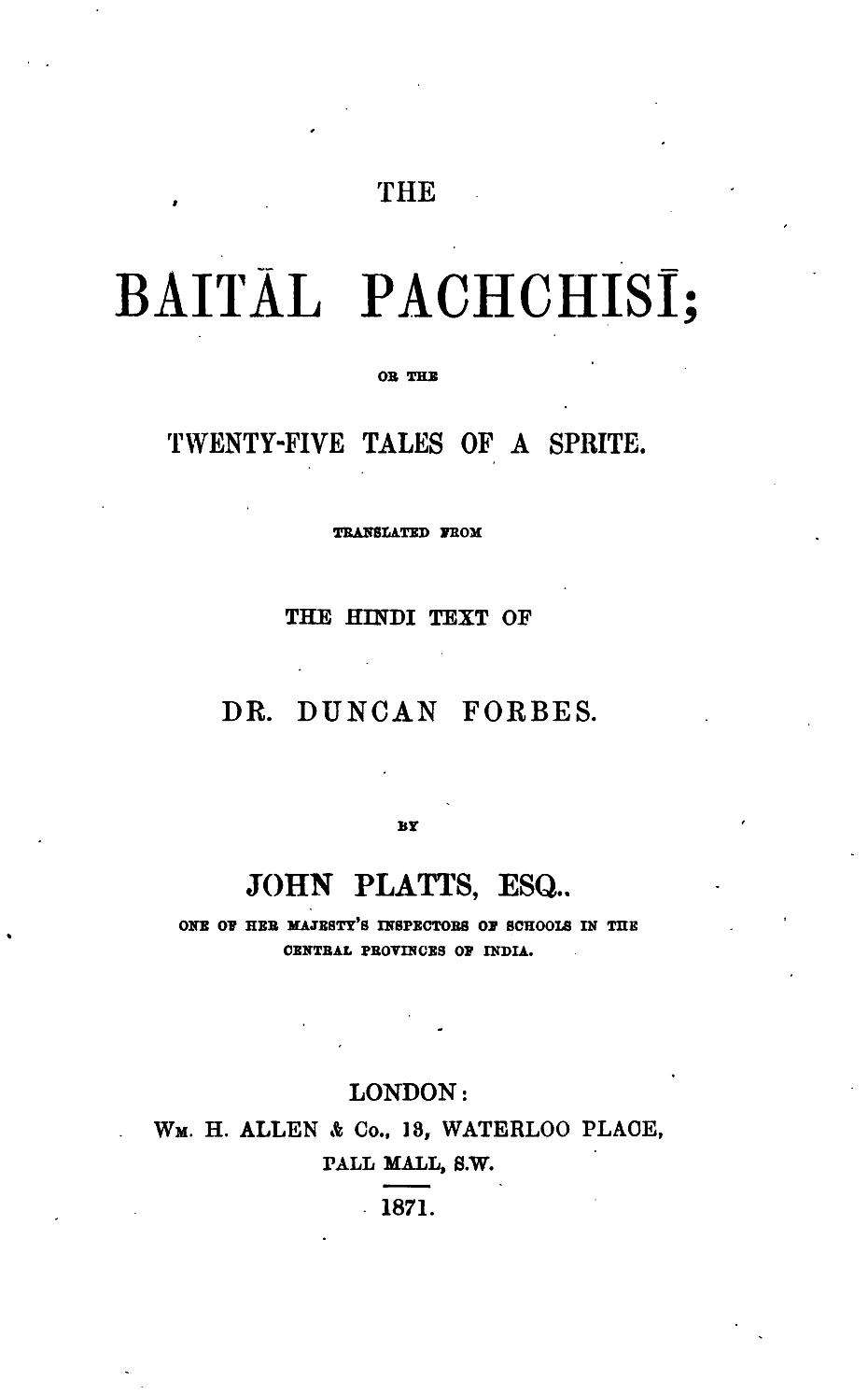
The Project Gutenberg eBook of The Baitâl Pachchisi; Or, The Twenty-Five Tales of a Sprite
Title: The Baitâl Pachchisi; Or, The Twenty-Five Tales of a Sprite
Author: John T. Platts
Lallu Lal
active 1805 Mazhar Ali Khan Vila
Editor: Duncan Forbes
Release date: May 10, 2017 [eBook #54697]
Most recently updated: October 23, 2024
Language: English
Credits: Produced by David Widger from page images generously
provided by the Internet Archive
THE BAITÂL PACHCHISI
Or, The Twenty-Five Tales Of a Sprite
By John Platts
Translated From The Hindi Text of Dr. Duncan Forbes
(One of Her Majesty’s Inspectors of Schools in the Central Provinces of India)
London: Wm. H. Allen & Co.
1871
CONTENTS
TRANSLATORS PREFACE.
The English translation of these tales has been made by special request, to meet repeated demands for a translation of the text as edited by the late Dr. Duncan Forbes. The aim of the Translator has been to produce a work which would enable the student to study the original with facility and accuracy. It being considered that few save students who are compelled to study the Hindi original would be likely to peruse the work, the translation has been made as literal as it was possible to make it without doing unpardonable violence to English idiom. All difficulties have been boldly, if not successfully, met; and explanatory and other notes have been added, wherever the text appeared to call for such. The study of the translation must not be supposed to dispense with that of the Grammar of the language; it will be found, however, to prove of the highest utility to a student who has mastered the elementary principles of Grammar, and uses it—not as a mere “crib” but—for the purpose of discovering what light it sheds on the application of those principles.
PREFACE
THE origin of these tales is as follows:—In the reign of the Emperor Muhammad Shah, Rajã Jaisinh Sawãr (who was the ruler of. Jainagar) ordered the eminent poet, named Sürat, to translate the Baitãl Pachisi (which was in the Sanskrit) into the Braj dialect. Thereupon he translated it into the dialect of Braj, in accordance with the king’s command. And now, during the reign of the Emperor Sfãhi ’Alam, and in the time of the lord of lords, the cream of exalted princes, the Privy-Counsellor of the Monarch of England, whose court stands as high as Saturn; the noblest of the noble, the Governor-General, Marquis Wellesley (may his government be perpetuated!); and in accordance with the bidding of His Honour, Mr. John Gilchrist (may his good fortune endure!); to the end that illustrious gentleman may learn and understand, the poet Mazhar Ali Khan (whose nom de plume is Vila), with the aid of the poet Shrï Lallü Lãl, rendered the same into easy language, such as high and low use in speaking, and which the learned and the ignorant, the talented and the obtuse, would all comprehend, and which would be easy to the mind of every one, no difficulty of any kind presenting itself to the intellect, and wherein the dialect of Braj frequently occurs.
Now, in conformity with the command of the Professor of Hindi, the bounteous patron, His Honour, Captain James Mouat, (may his prosperity last long!) Tãrinïcharan Mitra, (in preparing the work) for the press, has struck out such Sanskrit and Braj words as seldom occur in the Urdu dialect, and introduced words in current use. Some words, however, in use among the Hindus, the exclusion of which he regarded as detrimental, he has preserved intact. He trusts that the work may meet with a favourable reception.
THE BAITÂL PACHCHISI.
INTRODUCTORY TALE.
There was a city named Dhãrãnagar, the king of which was Gandharb Sen. He had four queens, and by them six sons, one more learned and more powerful than another. Fate ordaining, after some days the king died, and his eldest son, Shank by name, became king in his stead. Again, after some days, a younger brother, Vikram, after slaying his eldest brother, himself became king, and began to govern well. Day by day his dominion so increased that he became king of all India; * and, after fixing his government on a firm basis, he established an æra.
world, and implies, the central division, or the known
world; according to the Bauddhas, it is confined to India.
After some time the king thought to himself that he ought to visit those countries of which he had heard. * Having determined on this, he made over his throne to his younger brother Bharthari, and himself assuming the guise of a devotee, set out to wander from land to land and forest to forest.
those countries whose names I am hearing.”
A Brahman was practising austerities in that city. One day a deity brought and presented to him the fruit of immortality. He then took the fruit home and said to his wife, “Whoever shall eat this will become immortal; the deity told me this at the time of giving, the fruit.” Hearing this, the Brahman’s wife wept excessively, and began to say, “This is a great evil we have to suffer! For, becoming immortal, how long shall we go on begging alms? Nay, to die is better than this; (for) if we die, then we escape from the trials of the world.” Then the Brahman said, “I took the fruit and brought it; but, hearing your words, I am bereft of understanding. Now I will do whatever you bid.” Then his wife said to him, “Give this fruit to the king, and in exchange for it take wealth, whereby we may enjoy the advantages of this world as well as that to come.”
Hearing this speech, the Brahman went to the king and gave him his blessing; (and) after explaining the circumstances of the fruit, said, “Great king! do you take this fruit and give me some wealth; there is happiness for me in your being long-lived.” Theking having given the Brahman a lakh of rupees and dismissed him, entered the female apartments, and giving the fruit to the queen whom he loved most, said, “O queen! do thou eat this, for thou wilt become immortal, and wilt continue young for ever.” The queen, hearing this, took the fruit from the king, (and) he came out into his court.
A certain kotwãl was the paramour of that queen: to him she gave the fruit. It so happened that a courtesan was the kotwãl’s mistress; he gave the fruit to her and described its virtues. That courtesan thought to herself that the fruit was a fitting present for the king. Determining this in her mind, she went and presented the fruit to the king. His majesty took the fruit and dismissed her with much wealth; and contemplating the fruit, and pondering within himself, he became sick of the world, and began to say, “The perishable wealth of this world is of no use whatever; for through it one must ultimately fall into hell. Preferable to this is the practising of religious duties and the biding, in the remembrance of the Deity, whereby it may be well in the future.”
Coming to this determination, he entered the female apartments and asked the queen what she had done with the fruit (he gave her). She replied, “I ate it up.” Then the king showed the queen that fruit. She, on the instant of setting eyes on it, stood aghast, and was unable to make any reply. After that, the king having come forth, had the fruit washed, and ate it, and abandoning his kingdom and throne, assumed the guise of a devotee, and betook himself unaccompanied, and without holding communication with a soul, to the jungle.
The throne of Vikram became vacant. When this news reached king Indra, he sent a demon to guard Dhãrãnagar. He kept watch over the city day and night. To be brief, the report of this matter spread from country to country, that king Bharthari had abandoned his government and gone away. King Vikram, too, heard the news, and immediately came to his country. It was then midnight: he was entering the city at that hour, when that demon called out, “Who art thou? and whither goest thou? Stand still (and) mention thy name.” Then the king said, “It is I, king Vikram; I am entering my own city: who art thou, to challenge me?” Then the demon replied, saying, “The deities have sent me to guard this city: if you are really king Vikram, first fight with me, and then enter the city.”
On hearing these words the king girt tight his waist-cloth and challenged the demon. Thereupon the demon, too, stood up to him. The battle began. At last the king threw the demon and sat upon his breast. Then he said, “O king! thou hast thrown me; I grant thy life as a boon.” Upon this the king, laughing, said, “Thou art gone mad; whose life dost thou grant? Did I will, I could slay thee; how canst thou grant me life?” Then the demon said, “O king! I am about to save thee from death; first attend to a tale of mine, and thereafter rule over the whole world free from all care.” At length the king set him free, and began to listen attentively to his tale.
Then the demon addressed him thus: “There was in this city a very liberal king, named Chandrabhãn. One day he went forth casually into the jungle; when, what should he behold but an ascetic hanging, head downwards, from a tree, and sustaining himself by inhaling smoke alone—neither receiving anything from any one, nor speaking to any one. Perceiving this state of his, the king returned home, and seating himself in his court, said, ‘Whoever will bring this ascetic (here), shall receive a lakh of rupees.’ A courtesan bearing these words, came to the king and spake thus: ‘If I obtain your majesty’s leave, I will have a child begotten by that ascetic, and bring it here mounted on his shoulder.’”
“The king was astonished at hearing this speech, and binding the courtesan to (the fulfilment of her contract to) bring the ascetic by giving her a flake of betel-leaf, * dismissed her. She went to that wild, and reaching the ascetic’s place, perceived that he was really hanging head-downwards, neither eating nor drinking anything, and that he was withered up. In short, that courtesan prepared some sweetmeat, and put it into the ascetic’s mouth: he, finding it sweet, ate it up with zest. Thereupon the courtesan applied more (to his mouth). Thus for two days did she continue feeding him with sweetmeat, by eating which he gained a certain degree of strength. Then, opening his eyes, and descending from the tree, he inquired of her, ‘On what business hast thou come hither?’”
tapasvi ke lane ke, waste bïrã dekar. The birã is a betel-
leaf, made up with a preparation of areca-nut, chunara,
cloves, &c. It is given and accepted as a pledge for the
performance of an act.
“The courtesan replied, ‘I am the daughter of a god; I was practising religious austerities in heaven; I have now come into this wild.’ The devotee said again, ‘Where is thy hut? Show me it.’ Thereupon the courtesan brought the ascetic to her hut, and commenced feeding him with savoury (lit. six-flavoured) viands, so that the ascetic left off inhaling smoke; and took to eating food and drinking water daily. Eventually Cupid troubled him; upon which he had carnal intercourse with her, (and) vitiated his austerities; and the courtesan became pregnant. In ten months a boy was born. When he was some months old, the woman said to the devotee, ‘O saint! you should now set out on a pilgrimage whereby all the sins of the flesh may be blotted out.’”
“Deluding him with such words, she mounted the boy on his shoulder, and started for the king’s court, whence she had set out, after taking up the gage to accomplish this matter. When she came before the king, his majesty recognised her from a distance, and seeing the child on the shoulder of the devotee, began saying to the courtiers; ‘Just see! this is the very same courtesan, who went to bring the devotee!’ They replied, ‘O king! you are quite right; this is the very same; and be pleased to observe that all that she had stated in your majesty’s presence ere she set forth, has come to pass.’”
“When the ascetic heard these remarks of the king and courtiers, he perceived that the king had adopted these measures to disturb his religious meditations. With these thoughts in his mind, the devotee returned from thence, and getting out of the city, slew the child, repaired to another jungle, and began to perform penance. And after some time that king died, and the devotee completed his penance.”
“The short of the story is this, that you three men have been born under one asterism, one conjunction, and in one moment. You took birth in a king’s house; the second was an oilman’s (child); the third, the devotee, was born in a potter’s house. You still govern here, while the oilman’s son was the ruler of the infernal regions; but that potter, bringing his religious meditations to thorough perfection, has killed the oilman, turned him into a demon in a burning-ground and placed him hanging head-downwards on a siris-tree, and is intent on killing you. If you escape him, you will rule. I have apprised you of all these circumstances; do not be careless with respect to them.” Having narrated thus much, the demon departed. He (the king) entered his private palace.
When it was morn the king came forth, and took his seat (on the throne), and gave the order for a general court. As many servants as there were, great and small, all came and made their offerings in the presence, and festive music burst forth. An extraordinary gladness and rejoicing possessed the whole city, such that in every place, and every house, dance and song arose. After this the king began to govern justly.
It is related that one day an ascetic named Shãnt-shil appeared at the king’s court with a fruit in his hand, and, presenting the fruit to the king, spread a cloth, and sat down there. After a short time he went away again. On his departure the king thought to himself that this was probably the person of whom the demon had spoken. Habouring this suspicion, he did not eat the fruit, and, summoning the steward, he gave it to him, with instructions to keep it carefully. The devotee, however, came constantly in this same manner, and left a fruit every day.
It so happened that one day the king went to inspect his stable, accompanied by some attendants.
During that interval the ascetic, too, arrived there, and presented the king with a fruit in the usual manner. He began tossing it in the air, when all of a sudden it fell from his hand on the ground, and a monkey took it up and broke it in pieces. So exquisite a ruby came out of it that the king and his attendants were astonished at the sight of its brilliance. Thereupon the king said to the devotee; “Why hast thou given me this ruby?”
On this he said, “O great king! it is written in the Shastra that one should not go empty-handed to the following places, viz., those of kings, spiritual teachers, astrologers, physicians and daughters, for at these places one obtains benefit for benefit. Sire! why do you speak of a single ruby? As many fruits as I have given you, every one of them contains a jewel.” Hearing these words, the king told the steward to bring all the fruits he had given to him. On receiving the king’s order, the steward immediately brought them; and, having had the fruits broken open, he found a ruby in each. When he beheld so many rubies the king was excessively pleased, and, summoning a tester of precious stones, began having the rubies tested, saying the while, “Nothing will accompany one (from this world); integrity is the great essential in the world; tell me honestly, therefore, the exact value of each gem.”
Hearing these words the jeweller said, “O king! you have spoken the truth. He whose integrity is safe, his all is safe: integrity alone accompanies us, and that it is which proves of advantage in both worlds. Hear, O king! each gem is perfect as to colour, stone, and form. Were I to declare the value of each to be a crore of rupees, even that would not come up to the mark. Of a truth, each gem is worth a clime.” Hearing this, the king was pleased beyond measure, and conferring a robe of honour on the jeweller, dismissed him; and taking the devotee’s hand, he brought and seated him on the throne, and began thus: “My whole realm is not worth even one of these rubies; tell me, then, what is the explanation of this, that you, a religious mendicant, have presented me with so many gems?”
The ascetic said, “Your majesty! it is not proper to speak publicly of the following things, viz., magic and incantations, drugs employed in medicines, religious duties, family affairs, the eating of impure meats, evil speech which one has heard—all these things are not spoken of in public; I will tell you in private. Attend! it is a rule, that whatever is heard by three pairs of ears remains no secret; the words which reach two pairs of ears no man hears; while the contents of one pair of ears are unknown to Brahma himself, not to speak of man.” On hearing these words, the king took the devotee apart and began to say, “O holy man! you have given me so many rubies, and have not once partaken of food even; you have put me to great shame! Let me know what it is you desire.” The ascetic said, “Sire! I am about to practice magical arts in a large body-burning-ground on the bank of the river Godavari, whereby I shall acquire supernatural powers, and so I beg of you to pass one whole night with me; by your being near me my magic arts will succeed.” Then the king said, “Very well; I will come: leave word with me of the day.” The ascetic said, “Do you come to me, armed and unattended, on the Tuesday evening of the dark half of the month Bhãdon.” The king replied, “You may go; I will assuredly come, and alone.”
Having thus exacted a promise from the king and taken leave, he, for his part, went into a temple and made preparations, and taking all necessaries with him, went and fixed himself in a place for burning bodies; while here the king began to ponder (over what had happened). In the meantime the moment (for him to depart) too, arrived. Upon this the king there and then girt on his sword, tightened the cloth he wore between his legs, and betook himself alone to the devotee by night, and greeted him. The devotee requested him to be seated, whereupon the king sat down, and then perceived goblins, evil spirits, and witches, in various frightful shapes, dancing around; while the ascetic, seated in the centre, was striking two skulls together by way of music. The king felt no fear or alarm on beholding this state of things; but said to the devotee, “What command is there for me?” He replied, “O king! now that you have come, do this;—at a distance of two kos south of this place is a burning-ground, wherein is a siris-tree, on which a corpse is suspended; bring that (corpse) to me at once to this place, where I shall be performing my devotions.” Having despatched the king thither, he himself settled down in devotional attitude and began muttering prayers.
For one thing, the darkness of the night was in itself terrifying; more than this, the downpour of the rain was as unceasing as if it would rain for once and all that night; whilst the goblins and ghosts, too, were creating such an uproar, that even daring heroes would have been agitated at the spectacle;—the king, however, went on his way. The snakes, which kept coming and twining themselves about his legs, he used to disentangle by repeating incantations. At length, when after passing somehow or other over a perilous road, the king reached the burning-ground, he perceived that goblins were constantly seizing men and destroying them; witches continually munching the livers of children; tigers were roaring, and elephants screaming. In short, when he noticed the tree, he perceived that every leaf and branch of it, from the root to the topmost twig, was burning furiously, while from all four sides arose a tumultuous cry of “Kill him! kill him! Seize him! seize him! Take care he does not escape!”
The king had no fears on beholding that state of things; but he said to himself, “It may or may not be so, but (I am convinced) this is the same devotee about whom the demon spoke to me.” And having gone close and observed, he perceived a corpse fastened by a string, and hanging head downwards. He was glad to see the corpse, thinking his trouble had been rewarded. Taking his sword and shield, he climbed the tree fearlessly, and struck such a blow with the sword that the rope was severed and the corpse fell down, and instantly began to weep aloud. On hearing his voice the king was pleased, and began to say to himself, “Well! this man at least is alive.” Then, descending, he enquired of him who he was. He burst out laughing as soon as he heard (the question). The king was greatly astonished at this. Again the corpse climbed up the tree and suspended himself. The king, too, that instant climbed up, and clutching him under his arm, brought him down, and said, “Vile wretch! tell me who thou art.” He made no reply. The king reflected and said to himself, “Perhaps this is the very oilman whom the demon said the devotee had deposited in the place where bodies are burnt.” Thus reflecting, he bound him up in his mantle and brought him to the devotee. The man who displays such courage will (be sure to) succeed in his under-takings.
Then the sprite * said, “Who art thou? and whither art thou taking me?” The king replied, “I am king Vikram, and am taking thee off to a devotee.” He rejoined, “I will go on one condition,—if thou utterest a word on the way, I will come straight back.” The king agreed to his condition and went off with him. Then the sprite said, “O king! those who are learned, discerning, and wise—their days are passed in the delight of song and the shãstras, while the days of the unwise and foolish are spent in dissipation and sleep. Hence, it is best that this long road should be beguiled by profitable converse: do you attend, O king! to the story I relate.”
rather, places where bodies are burned and animating dead
bodies.
TALE I.
There was a king of Banãras, named Pratãpmukut; and Bajra-mukut was the name of his son, whose queen’s name was Mahãdevï. One day the prince, accompanied by his minister’s son, went to the chase, and advanced far into a jungle, in the midst of which he beheld a beautiful tank; on the margin of which wild geese, brãhmanï ducks, male and female, cranes and water-fowl were, one and all, disporting on all four sides ghats of solid masonry were constructed: within the tank, the lotus was in full bloom: on the sides were planted trees of different kinds, under the dense shade of which the breezes came cool and refreshing, while birds were warbling on the boughs; and in the forest bloomed flowers of varied hues, on which whole swarms of bees were buzzing;—(such was the scene) when they arrived by the margin of that tank, and washed their hands and faces, and reascended.
“On that spot was a temple sacred to Mahãdeva, Fastening their horses, and entering the temple, they paid adoration to Mahãdeva, and came out. While they were engaged in adoration, the daughter of a certain king, accompanied by a host of attendants, came to another margin of the tank to bathe; and, having finished her ablutions, meditations and prayers, she, with her own maidens, began to walk about in the shade of the trees. On this side the minister’s son was seated, and the king’s son was walking about, when, suddenly, his eyes, and the eyes of the king’s daughter, met. As soon as he beheld her beauty, the king’s son was fascinated, and began saying to himself, ‘You wretch, Cupid! why do you molest me?’ And when the princess beheld the prince, she took in her hand the lotus-flower which she had fixed on her head after her devotions, placed it to her ear, bit it with her teeth, put it under her foot, then took it up and pressed it to her bosom, and, taking her maidens with her, mounted (her chariot) and departed home.”
“And the prince, sinking into the depths of despair, and overwhelmed with grief on account of her absence, came to the minister’s son, and with a feeling of shame laid before him the actual, state of affairs, saying, ‘O friend! I have seen a most beautiful damsel; (but) I know neither her name nor her abode: should I not possess her, I will give up my life: this I am firmly resolved upon in my mind.’ Hearing these circumstances, the minister’s son caused him to mount, and brought him home, it is true; but the king’s son was so restless from grief at separation, that he entirely abandoned writing, reading, eating, drinking, sleeping, the business of government—everything. He used to be constantly sketching her portrait and gazing at it and weeping; not speaking himself, nor listening to what others said.”
“When the minister’s son saw this state of his, the result of separation from his flame, he said to him, ‘Whosoever treads the path of love doth not survive; or if he survive, he suffers great sorrow. * On this account the wise avoid treading this path.’ The king’s son, on hearing his words, replied, ‘I, in sooth, have entered upon this path, be there joy in it or be there pain.’ When he heard so determined a speech from him, he (the minister’s son) said, ‘Great king! at the time of leaving did she say anything to you, or you to her?’ Upon this he made answer, saying, ‘I said nothing, nor did I hear anything from her.’ Then the minister’s son said, ‘It will be very difficult to find her.’ He said, ‘If she be secured, my life will be preserved; otherwise, it is lost.’”
has not survived after it; or if he has survived, then he
has experienced great affliction.
“He enquired again, ‘Did she make no signs even?’ The prince said, ‘These are the gestures she made,—suddenly seeing me, she took the lotus-flower from her head, put it to her ear, bit it with her teeth, placed it under her foot, and pressed it to her bosom.’ On hearing this, the minister’s son said, ‘I have comprehended her signs, and discovered her name, habitation, and all about her.’ He (the prince) replied, ‘Explain to me whatever you have discovered.’ He began to say, ‘Attend, O king! Her having taken the lotus-flower from her head and put it to her ear, is equivalent to her having informed you that she is an inhabitant of the Karnãtak (Carnatic); and in biting it with her teeth, she intimated that she is the daughter of king Dãnta-vãt; and by pressing it under her foot, she declared that her name is Padmãvati; and in again taking it up and pressing it to her bosom, she informed you that you dwell in her heart.’ When the prince heard these words, he said to him, ‘It is advisable that you take me to the city in which she dwells.’ No sooner had he said this than both dressed themselves, girt on their arms, and taking some jewels with them, mounted their horses and took the road to that quarter.”
“Having reached the Kamãtak after several days, and having arrived below the palaces of the king in their stroll through the city, what do they see there but an old woman sitting at her door and plying her cotton-wheel. The two, dismounting from their horses, approached her, and began to say, ‘Mother! we are travelling merchants, our goods are following us; we have come on ahead to seek a lodging; if you will give us a place, we will abide.’ On looking at their faces and hearing their words, the old woman took compassion on them and said, ‘This house is yours; remain here as long as you please,’ In short, they took possession of the house on hearing, this; and after some delay the old woman came and kindly sat with them, and began chatting with them. On this, the minister’s son enquired of her, ‘What family and relations have you got? and how do you subsist?’ The old woman said, ‘My son is very comfortably provided for in the king’s service, and your humble servant is the wet-nurse of Padmãvatï, the king’s daughter; in consequence of old age having overtaken me I remain at home, but the king provides for my maintenance. Once a day, however, I go regularly to see that girl; it is on my return from thence, in my home, alone, that I give vent to my woe.’”
“Hearing these words, the prince rejoiced at heart, and said to the old woman, ‘When you are starting to-morrow, please carry a message from me too.’ She replied, ‘Son! what need to defer it till tomorrow? I will this moment convey any message of yours that you communicate to me.’ Then he said, ‘Do you go and tell her this,—The prince whom you saw on the margin of the tank on the fifth day of the light half of the month Jeth has arrived here.’”
“On hearing these words the old woman took her stick and went to the palace. When she got there she found the princess sitting alone. When she appeared before her, she (the princess) saluted her.
“The old woman gave her, her blessing, and said, ‘Daughter! I tended you in your infancy, and suckled you. God has now caused you to grow up: what my heart now desires is, that I should see you happy in your prime, then should I, too, receive comfort.’ Addressing her in such affectionate words as these, she proceeded to say, ‘The prince whose heart you took captive on the fifth day of the light half of Je|h, by the side of the tank, has alighted at my house, (and) has sent you this message, for you to perform the promise you made him, now that he has arrived. And I tell you, for my part, that that prince is worthy of you, and is as excellent in disposition and mental qualities as you are beautiful.’”
“On hearing these words she became angry, and applying sandal to her hands, and slapping the face of the old woman, began to say, ‘Wretch! get out of my house!’ She rose annoyed, and went, in that very condition, straight to the prince, and related all that had happened to her. The prince was astounded at these words. Then the minister’s son spoke, saying, ‘Great king! feel no anxiety; this matter has not come within your comprehension.’ Hereupon he said, ‘True; do you then explain it, that my mind may obtain rest.’ He said, ‘In smearing sandal on the ten fingers, and striking the (woman on the) face, she intimated, that when the ten nights of moonlight shall come to an end, she will meet you in the dark.’”
“To be brief, after ten days the old woman again went and announced him; then she tinged three of her fingers with saffron, and struck them on her cheek, saying, ‘Get out of my house!’ After all, the old woman moved from thence in despair, and came and related to the prince all that had occurred. He was engulfed in an ocean of sorrow as soon as he heard it. Seeing this state of his, the minister’s son said again, ‘Be not alarmed, the purport of this matter is something else.’ He replied, ‘My heart is disquieted; tell me quickly.’ Then he said, ‘She is in the state which women are in every month, and hence has stipulated for three days more; on the fourth day she will send for you.’ In short, when the three days elapsed, the old woman made enquiries after her health on the part of the prince. Then she brought the old woman angrily to the western wicket, and turned her out. Again the old woman came and informed the prince of this event: he became cast-down at hearing it. On this the minister’s son said, ‘The explanation of the affair is, that she has invited you to-night by way of that wicket.’ He was pleased beyond measure at hearing this. To be brief, when the hour arrived, they took out brown suits of clothes, arranged them, fastened on their turbands, dressed themselves, placed their weapons in order about them, and were ready; by this time midnight had passed. At that time an universal stillness prevailed, when they, too, pursued their way in unbroken silence.”
“When they arrived near the wicket, the minister’s son remained standing without, and he (the prince) entered the wicket. What does he perceive, but the princess, too, standing there expecting him! Thus their eyes met. Then the princess laughed, and, closing the wicket, took the prince with her into the festive chamber. Arrived there, the prince beheld censers filled with perfume alight in different parts of the room, and maidens dressed in garments of various colours standing respectfully, with hands joined, each according to her station; on one side a couch of flowers spread; atr-holders, pan-boxes, rose-water bottles, trays and four-partitioned boxes arranged in order; on another side, compound essences, prepared sandal-wood, mixed perfumes, musk, and saffron filled in metal cups; here, coloured boxes of exquisite confections laid out; there, sweetmeats of various kinds placed in order; all the doors and walls adorned with pictures and paintings, and holding such faces, that the beholder would be enchanted, at the very sight of each single one. In short, everything that could contribute to pleasure and enjoyment was got together. The whole scene was one of an extraordinary character, of which no adequate description can be given.”
“Such was the apartment to which the princess Padmãvatï took the prince and gave him a seat, and having his feet washed, and applying sandal to his body, and placing a garland of flowers round his neck, and sprinkling rose-water over him, began fanning him with her own hands. Upon this the prince said, ‘At the mere sight of you I have become refreshed; why do you take so much trouble? These delicate hands are not fit to handle a fan; give me the fan; you be seated.’ Padmãvatï replied, ‘Great king! you have been at great trouble to come here for my sake, it behoves me to wait upon you.’ Then a maiden took the fan from the princess’s hand, and said, ‘This is my business; I will attend on you, and do you both enjoy yourselves.’ They began eating betel-leaf together, and engaging in familiar conversation, when, by this time, it became morning. The princess concealed him; (and) when night came on, they again engaged in amorous pleasures. Thus several days passed away. Whenever the prince showed a wish to depart the princess would not permit him. A month passed thus; then the prince became much disturbed, and very anxious.”
“Once it happened that he was sitting alone by night and thinking thus to himself, ‘Country, throne, family,—everything had already been separated from me; but such a friend as mine, by whose means I found all this happiness, even him have I not met for a whole month! What will he be saying in his heart? and how do I know what may be happening to him?’ He was sitting occupied with these anxious thoughts when, in the meanwhile, the princess too arrived, and seeing his predicament, began to inquire, ‘Great king! what grief possesses you that you are sitting so dispirited here? Tell me.’ Then he said, ‘I have a very dear friend, the son of the minister; for a whole month I have received no accounts of him: he is such a clever, learned friend, that through his talents (it was that) I obtained thee, and he (it was who) explained all thy secrets.’ The princess said, ‘Great king! your soul is really there; what happiness can you enjoy here? Hence, this is best,—I will prepare confections and sweetmeats, and all kinds of meats, and have them sent; do you, too, go there and feast and comfort him well, and return with your mind at ease.’”
“On hearing this the prince rose up and came forth; and the princess had different kinds of sweetmeats, with poison mixed, cooked and sent. The prince had but just gone and sat beside the minister’s son when the sweetmeats arrived. The minister’s son enquired, ‘Great king! how did these sweetmeats come here?’ The prince replied, ‘I was sitting there anxious concerning you, when the princess came, and looking at me, asked, ‘Why do you sit cast-down? Explain the reason of it.’ On this I gave her a full account of your skill in reading secrets. * On hearing this account, she gave me permission to come to you, and had these sent for you; if you will partake of them, my heart, too, will be rejoiced.’ Then the minister’s son said, ‘You have brought poison for me; it is well, indeed, that you did not eat of it. Sire! listen to a word from me,—a woman has no love for her lover’s friend: you did not act wisely in mentioning my name there.’ On hearing this the prince said, ‘You talk of such a thing as no one would ever do: if man have no fear of man, it is to be presumed he fears God at least.’”