
When throats with ale are mellow?
What wight with nieve so stout and strong
Dares lift it, jolly freres among,
And cry, "Knaves, cease to bellow?"
"'Twas doleful drear,"—the gossips vowed,—
To hear the minstrel's piteous tale!
But, when the swineherd tuned his crowd,[14]
And the gosherd began to grumble loud,
The gossips smiled, and sipped their ale!
"A boon, bold Thorold!" boldly cried
The gosherd from Croyland fen;
"I crave to sing of the fen so wide,
And of geese and goosish men!"
Loud loffe they all; and the baron, with glee,
Cried "begin, good Swithin! for men may see
Thou look'st so like a knowing fowl,
Of geese thou art skilled right well to troll!"
Stout Swithin sware the baron spake well,—
And his halting ditty began to tell:
The rhyme was lame, and dull the joke,—
But it tickled the ears of clownish folk.
The Gosherd's Song.
I've heard my grannam tell;
And I'll tell it to you, my masters, here,
An' it likes you all, full well.
A Gosherd on Croyland fen, one day,
Awoke, in haste, from slumber;
And on counting his geese, to his sad dismay,
He found there lacked one of the number.
O the Gosherd looked west, and he looked east,
And he looked before and behind him;
And his eye from north to south he cast
For the gander—but couldn't find him!
So the Gosherd he drave his geese to the cote,
And began, forthwith, to wander
Over the marshy wild remote,
In search of the old stray gander.
O the Gosherd he wandered till twilight gray
Was throwing its mists around him;
But the gander seemed farther and farther astray—
For the Gosherd had not yet found him.
So the Gosherd, foredeeming his search in vain,
Resolved no farther to wander;
But to Croyland he turned him, in dudgeon, again,
Sore fretting at heart for the gander.
Thus he footed the fens so dreary and dern,
While his brain, like the sky, was dark'ning;
And with dread to the scream o' the startled hern
And the bittern's boom he was heark'ning.
But when the Gosherd the church-yard reached,—
Forefearing the dead would be waking,—
Like a craven upon the sward he stretched,
And could travel no farther for quaking!
And there the Gosherd lay through the night,
Not daring to rise and go further:
For, in sooth, the Gosherd beheld a sight
That frighted him more than murther!
From the old church clock the midnight hour
In hollow tones was pealing,
When a slim white ghost to the church porch door
Seemed up the footpath stealing!
Stark staring upon the sward lay the clown,
And his heart went "pitter patter,"—
Till the ghost in the clay-cold grave sunk down,—
When he felt in a twitter-twatter!
Soon—stretching aloft its long white arms—
From the grave the ghost was peeping!—
Cried the Gosherd, "Our Lady defend me from harms,
And Saint Guthlacke[15] have me in his keeping!"
The white ghost hissed!—the Gosherd swooned!
In the morn,—on the truth 'tis no slander,—
Near the church porch door a new grave he found,
And, therein, the white ghost—his stray gander!
————
The Gosherd, scarce, his mirthful meed
Had won, ere Tibbald of Stow,—
With look as pert as the pouncing glede
When he eyeth the chick below,—
Scraped his crowd,
And clear and loud,
As the merle-cock shrill,
Or the bell from the hill,
Thus tuned his throat to his rough sire's praise—
His sire the swineherd of olden days:—
The Swineherd's Song.
Who tendeth his flock in the wide forest-fold:
He sheareth no wool from his snouted sheep:
He soweth no corn, and none he doth reap:
Yet the swineherd no lack of good living doth know:
Come jollily trowl
The brown round bowl,
Like the jovial swineherd of Stow!
He hedgeth no meadows to fatten his swine:
He renteth no joist for his snorting kine:
They rove through the forest, and browse on the mast,—
Yet, he lifteth his horn, and bloweth a blast,
And they come at his call, blow he high, blow he low!—
Come, jollily trowl
The brown round bowl,
And drink to the swineherd of Stow!
He shunneth the heat 'mong the fern-stalks green,—
Or dreameth of elves 'neath the forest treen:
He wrappeth him up when the oak leaves sere
And the ripe acorns fall, at the wane o' the year;
And he tippleth at Yule, by the log's cheery glow.—
Come, jollily trowl
The brown round bowl,
And pledge the bold swineherd of Stow!
The bishop he passeth the swineherd in scorn,—
Yet, to mass wends the swineherd at Candlemas morn;
And he offereth his horn, at our Lady's hymn,
With bright silver pennies filled up to the brim:—
Saith the bishop, "A very good fellow, I trow!"—
Come, jollily trowl
The brown round bowl,
And honour the swineherd of Stow!
And now the brave swineherd, in stone, ye may spy,
Holding his horn, on the Minster so high!—
But the swineherd he laugheth, and cracketh his joke,
With his pig-boys that vittle beneath the old oak,—
Saying, "Had I no pennies, they'd make me no show!"—
Come, jollily trowl
The brown round bowl,
And laugh with the swineherd of Stow![16]
————
So merrily the chorus rose,—
For every guest chimed in,—
That, had the dead been there to doze,
They had surely waked with the din!—
So the rustics said while their brains were mellow;
And all called the swineherd "a jolly good fellow!"
"Come, hearty Snell!" said the Baron good;
"What sayest thou more of the merry greenwood?"
"I remember no lay of the forest, now,"—
Said Snell, with a glance at three maids in a row;
"Belike, I could whimper a love-lorn ditty,—
If Tib, Doll, and Bell, would listen with pity!"
"Then chaunt us thy love-song!" cried Baron and guests;
And Snell, looking shrewd, obeyed their behests.
The Woodman's Love Song.
One summer's day a musing strayed,
And, as the cowslips sweet she pressed,
This burthen to the breeze confessed—
I fear that I'm in love!
For, ever since so playfully
Young Robin trod this path with me,
I always feel more happy here
Than ever I have felt elsewhere:—
I fear that I'm in love!
And, ever since young Robin talked
So sweetly, while alone we walked,
Of truth, and faith, and constancy,
I've wished he always walked with me:—
I fear that I'm in love!
And, ever since that pleasing night
When, 'neath the lady moon's fair light,
He asked my hand, but asked in vain,
I've wished he'd walk, and ask again:—
I fear that I'm in love!
And yet, I greatly fear, alas!
That wish will ne'er be brought to pass!—
What else to fear I cannot tell:—
I hope that all will yet be well—
But, surely, I'm in love!
————
Coy was their look, but true their pleasure,
While the maidens listed the woodman's measure;
Nor shrunk they at laughter of herdsman or hind,
But mixed with the mirth, and still looked kind.
One maid there was who faintly smiled,
But never joined their laughter:
And why, by Yule-mirth unbeguiled,
Sits the Baron's beauteous daughter?
Why looks she downcast, yet so sweet,
And seeketh no eyes with mirth to greet?
"My darling Edith,—hast no song?"
Saith Thorold, tenderly;
"Our guests have tarried to hear thee, long,
And looked with wistful eye!"
Soft words the peerless damosel
Breathes of imperfect skill:
"Sweet birds," smiles the Baron, "all know—right well,
Can sweetly sing an' they will."
And the stranger minstrel, on his knee,
Offers his harp, with courtesy
So rare and gentle, that the hall
Rings with applause which one and all
Render who share the festival.
De Thorold smiled; and the maiden took
The harp, with grace in act and look,—
But waked its echoes tremulously,—
Singing no noisy jubilee,—
But a chanson of sweetly stifled pain—
So sweet—when ended all were fain
To hear her chaunt it o'er again.
The Baron's Daughter's Song.
That welcomes the purple dawn;
But a sweeter chorister far is heard
When the veil of eve is drawn:
When the last lone traveller homeward wends
O'er the moorland, drowsily;
And the pale bright moon her crescent bends,
And silvers the soft gray sky;
And in silence the wakeful starry crowd
Their vigil begin to keep;
And the hovering mists the flowerets shroud,
And their buds in dew-drops weep;
Oh, then the nightingale's warbling wild,
In the depth of the forest dark,
Is sweeter, by far, to Sorrow's child,
Than the song of the cheerful lark!
————
"'Twas sweet, but somewhat sad," said some;
And the Baron sought his daughter's eye,—
But, now, there fell a shade of gloom
On the cheek of Edith;—and tearfully,
He thought she turned to shun his look.
He would have asked his darling's woe,—
But the harp, again, the minstrel took;
And with such prelude as awoke
Regretful thoughts of an ancient foe
In Thorold's soul,—the minstrel stranger—
In spite of fear, in spite of danger,—
In measures sweet and soft, but quaint,—
Responded thus to Edith's plaint:—
The Minstrel's Response.
That softly hushed, yet struggling sigh?
Hast thou a thought of woe or weal,
Which, breathed, my bosom would not feel?
Why should'st thou, then, that thought conceal,
Or hide it from my mind, Love?
Did'st thou e'er breathe a sigh to me,
And I not breathe as deep to thee?
Or hast thou whispered in mine ear
A word of sorrow or of fear,—
Or have I seen thee shed a tear,—
And looked a thought unkind, Love?
Did e'er a gleam of Love's sweet ray
Across thy beaming countenance play,—
Or joy its seriousness beguile,
And o'er it cast a radiant smile,—
And mine with kindred joy, the while,
Not glow as bright as thine, Love?
Why would'st thou, then, that something seek
To hide within thy breast,—nor speak,
Its load of doubt, of grief, or fear,
Of joy, or sorrow, to mine ear,—
Assured this heart would gladly bear
A burthen borne by thine, Love?
————
Sir Wilfrid sat in thoughtful mood,
When the youthful minstrel's song was ended;
While Edith by her loved sire stood,
And o'er his chair in sadness bended.
The guests were silent;—for the chaunt,
Where all, of late, were jubilant,
Had kindled quick imagining
Who he might be that thus dared sing—
Breathing of deep and fervent feeling—
His tender passion half-revealing.
Soon, sportive sounds the silence broke:
Saint Leonard's lay-brother,
Who seldom could smother
Conception of mischief, or thought of a joke,
Drew forth his old rebeck from under his cloak,—
And touching the chords
To brain-sick words,—
While he mimicked a lover's phantasy,
Upward rolling his lustrous eye,—
With warblings wild
He flourished and trilled,—
Till mother and maiden aloud 'gan to laugh,
And clown challenged clown more good liquor to quaff.
These freakish rhymes, in freakish measure,
He chaunted, for his wayward pleasure.
The Lay-Brother's Love Song.
Where the brooklet glides through the dell;
But I view not a lily so fair, while I rove,
As the maid whose name I could tell.
The roses are sweet that blush in the vale,
Where the thorn-bush grows by the well;
But they breathe not a perfume so sweet on the gale
As the maid whose name I could tell.
The lark singeth sweetly up in the sky,—
Over song-birds bearing the bell;
But one bird may for music the skylark defy,—
'Tis the maid whose name I could tell.
The angels all brightly glitter and glow,
In the regions high where they dwell;
But they beam not so bright as one angel below,—
'Tis the maid whose name I could tell.
————
Sport may, a while, defy heart-cares,
And woo faint smiles from pain;
Jesting, a while, may keep down tears—
But they will rise, again!
And saddening thoughts of others' care,
Unwelcome, though they be, to share,—
And though self-love would coldly say
"Let me laugh on, while others bear
Their own grief-fardels as they may!"—
Yet, while in sadness droops a brother,
No brother-heart can sadness smother:
The tear of fellowship will start—
The tongue seek comfort to impart.
And English hearts, of old, were dull
To quell their yearnings pitiful:—
The guests forgot the jester's strain,
To think upon the harp again,
And of the youth who, to its swell,
So late, his sighs did syllable.
Natheless, no guest was skilled to find,
At once, fit words that might proclaim,—
For one who seemed without a name,—
Their sympathy;—and so, with kind
Intent, they urged some roundelay
The stranger minstrel would essay.
He struck the harp, forthwith, but sung
Of passion still,—and still it clung
To Love—his full, melodious tongue!
The Minstrel's Avowal.
Nor shall thy cherished form depart
From its loved home: though sad I be,—
My heart, my Love, still cleaves to thee!
My dawn of life is dimmed and dark;
Hope's flame is dwindled to a spark;
But, though I live thus dyingly,—
My heart, my Love, still cleaves to thee!
Though short my summer's day hath been,
And now the winter's eve is keen,—
Yet, while the storm descends on me,—
My heart, my Love, still cleaves to thee!
No look of love upon me beams,—
No tear of pity for me streams:—
A thing forlorn—despairingly—
My heart, my Love, still cleaves to thee!
Thine eye would pity wert thou free
To soothe my woe; and though I be
Condemned to helpless misery,
My heart, my Love, still cleaves to thee!
————
The maidens wept—the clowns looked glum—
Each rustic reveller was dumb:
Sir Wilfrid struggled hard to hide
Revengeful throes and ireful pride,
That, now, his wounded bosom swelled,—
For in that youth he had beheld
An image which had overcast
His life with sorrow in the Past:—
He struggled,—and besought the youth
To leave his strains of woe and ruth
For some light lay, or merry rhyme,
More fitting Yule's rejoicing time.—
And, though it cost him dear, the while,
He eyed the minstrel with a smile.
The stranger waited not to note
The Baron's speech: like one distraught
He struck the harp—a wild farewell
Thus breathing to its deepest swell:—
The Minstrel's Farewell.
Too long it hath mourned, 'neath reproach and reviling:
Thy smile is a false one: it never can bless me:
It doth not relieve,—but more deeply distress me!
I care not for beauty; I care not for riches:
I am not the slave whom their tinsel bewitches:
A bosom I seek
That is true, like mine own,—
Though pale be the cheek,
And its roses all flown,—
And the wearer be desolate, wretched, forlorn,—
And alike from each soul-soothing solace be torn.
That heart I would choose, which is stricken and slighted;
Whose joys are all fled, and whose hopes are all blighted;
For that heart alone
Would in sympathy thrill
With one like my own
That sorrow doth fill;—
With a heart whose fond breathings have ever been spurned,—
And hath long their rejection in solitude mourned.
The harp of my heart is unstrung; and to gladness
Respond not its chords—but to sorrow and sadness:—
Then speak not of mirth which my soul hath forsaken!
Why would ye my heart-breaking sorrows awaken?
————
It is the shriek of deathful danger!
None heed the heart-plaint of the stranger!
All start aghast, with deadly fear,
While they, again, that wild shriek hear!
"He drowns—Sir Wilfrid!" cries a hind:
"The ferryman is weak:
He cannot stem the stream and wind:
Help, help! for Jesu's sake!"
"Help one,—help all!" the Baron cries;
"Whatever boon he craves,
I swear, by Christ, that man shall win,
My ferryman who saves!"—
Out rush the guests: but one was forth
Who heard no word of boon:
His manly heart to deeds of worth
Needed no clarion.
He dashed into the surging Trent—
Nor feared the hurricane;
And, ere the breath of life was spent,
He seized the drowning man.—
"What is thy boon?" said Torksey's lord,—
But his cheek was deadly pale;
"Tell forth thy heart,—and to keep his word
De Thorold will not fail."—
"I rushed to save my brother-man,
And not to win thy boon:
My just desert had been Heaven's ban—
If thus I had not done!"—
Thus spake the minstrel, when the hall
The Baron's guests had gained:
And, now, De Thorold's noble soul
Spoke out, all unrestrained.
"Then for thy own heart's nobleness
Tell forth thy boon," he said;
"Before thou tell'st thy thought, I guess
What wish doth it pervade."—
"Sweet Edith, his true, plighted love,
Romara asks of thee!
What though my kindred with thee strove,
And wrought thee misery?
"Our Lord, for whom we keep this day,
When nailed upon the tree;
Did he foredoom his foes, or pray
That they might pardoned be?"—
"Son of my ancient foe!" replied
The Baron to the youth,—
I glad me that my ireful pride
Already bows to truth:
"Deep zeal to save our brother-man—
Generous self-sacrifice
For other's weal—is nobler than
All blood-stained victories!
"Take thy fair boon!—for thou hast spoiled
Death,—greedy Death—of prey—
This poor man who for me hath toiled
Full many a stormy day!
"I feel—to quell the heart's bad flame,
And bless an enemy,
Is richer than all earthly fame—
Though the world should be its fee!
"My sire was by thy kinsman slain;—
Yet, as thy tale hath told,
Thy kinsman's usurping act was vain—
He died in the dungeon cold.
"Perish the memory of feud,
And deeds of savage strife!
Blood still hath led to deeds of blood,
And life hath paid for life!
"My darling Edith shall be thine—
My blood with thine shall blend—
The Saxon with the Norman line—
In love our feuds shall end.
"In age I'll watch ye bless the poor,
And smile upon your love;
And, when my pilgrimage is o'er,
I hope to meet above
"Him who on earth a Babe was born
In lowliness, as on this morn,—
And tabernacled here below,
Lessons of brotherhood to show!"
————
High was the feast, and rich the song,
For many a day, that did prolong
The wedding-revelry:
But more it needeth not to sing
Of our fathers' festive revelling:—
How will the dream agree
With waking hours of famished throngs,
Brooding on daily deepening wrongs—
A stern reality!—
With pictures, that exist in life,
Of thousands waging direful strife
With gaunt Starvation, in the holds
Where Mammon vauntingly unfolds
His boasted banner of success?
Oh, that bruised hearts, in their distress,
May meet with hearts whose bounteousness
Helps them to keep their courage up,—
"Bating no jot of heart or hope!"[17]
My suffering brothers! still your hope
Hold fast, though hunger make ye droop!
Right—glorious Right—shall yet be done!
The Toilers' boon shall yet be won!
Wrong from its fastness shall be hurled—
The World shall be a happy world!—
It shall be filled with brother-men,—
And merry Yule oft come again!
NOTES.
NOTES.
I.
Torksey's Hall.
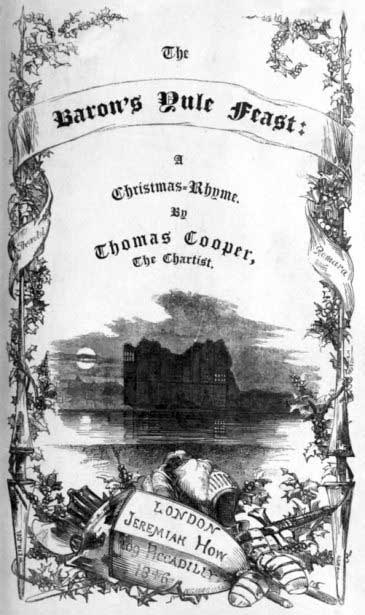
The remains of this ancient erection (of which a representation is given in the accompanying vignette) form an interesting antiquarian object beside the Trent, twelve miles from Lincoln, and seven from Gainsborough. The entire absence of any authentic record, as to the date of the foundation, or its former possessors, leaves the imagination at full liberty to clothe it with poetic legend. Visits made to it, in my childhood, and the hearing of wild narratives respecting the treasures buried beneath its ruins, and the power of its lords in the times of chivalry, fixed it, very early, in my mind, as the fit site for a tale of romance. In addition to the beautiful fragment of a front on the Trent bank, massive and extensive foundations in the back-ground show that it must have been an important building in by-gone times.
Torksey was, undoubtedly, one of the first towns in Lincolnshire, in the Saxon period. Only three of the towns in the county are classed in Domesday Book, and it is one of them: "Lincoln mans. 982; Stamford 317: Terchesey 102." (Turner's Hist. of the Anglo-Saxons, 1836, vol. iii. page 251.) Writers of parts of the county history,—(for a complete history of Lincolnshire has not yet been written,)—affirm that Torksey is the Tiovulfingacester of Venerable Bede; but Smith, the learned editor of the Cambridge edition of Bede, inclines to the opinion that Southwell is the town indicated by the pious and industrious monastic. The passage in Bede leaves every thing to conjecture: he simply relates that a truth-speaking presbyter and abbot of Pearteneu, (most likely, Partney, near Horncastle, in Lincolnshire,) named Deda, said that an old man had told him, that he, with a great multitude, was baptized by Paulinus, in the presence of King Edwin, "in fluvio Treenta juxta civitatem quæ lingua Anglorum Tiovulfingacaestir vocatur"—in the river Trent, near the city which in the language of the Angles is called Tiovulfingacaestir (Smith's Bede: Cambr. 1722, page 97.)—This passage occurs immediately after the relation of the Christian mission of Paulinus into Lindsey, and his conversion of Blecca, governor of Lincoln, and his family, while the good King Edwin reigned over East Anglia, to which petty kingdom Lincolnshire seems sometimes to have belonged, though it was generally comprehended in the kingdom of Mercia, during the period of the Heptarchy.
If Stukeley be correct in his supposition that the "Foss-dyke," or canal which connects the Trent here with the Witham at Lincoln, be the work of the Romans,—and I know no reason for doubting it,—Torksey, standing at the junction of the artificial river with the Trent, must have been an important station even before the Saxon times. These are Stukeley's words relative to the commercial use of the Foss-Dyke: "By this means the corn of Cambridgeshire, Bedfordshire, Huntingdonshire, Northamptonshire, Rutland, and Lincolnshire, came in;—from the Trent, that of Nottinghamshire; all easily conveyed northward to the utmost limits of the Roman power there, by the river Ouse, which is navigable to the imperial city of York. This city (York) was built and placed there, in that spot, on the very account of the corn-boats coming thither, and the emperors there resided, on that account; and the great morass on the river Foss was the haven, or bason, where these corn-boats unladed. The very name of the Foss at York, and Foss-dyke between Lincoln and the Trent, are memorials of its being an artificial work, even as the great Foss road, equally the work of the spade, though in a different manner." (Stukeley's Palæographia Britannica: Stamford, 1746: No. 2, page 39.)
In the superb edition of Dugdale's Monasticon Anglicanum, edited by Sir Henry Ellis and others (1825), occurs the following note, also evidencing the extent of ancient Torksey:—"Mr. T. Sympson, who collected for a history of Lincoln, in a letter preserved in one of Cole's manuscript volumes in the British Museum, dated January 20, 1741, says, 'Yesterday, in Atwater's Memorandums, I met with a composition between the prior of St. Leonard's in Torksey and the nuns of the Fosse, by which it appears there were then three parishes in Torksey: viz. All Saints, St. Mary's, and St Peter's." (Vol. iv. page 292.)
At what date this "composition" took place between the prior and nuns, we are not told: of course, it must have been before the dissolution of the religious houses. Leland's account of Torksey, which is as follows, applies to a period immediately succeeding that event.
"The olde buildinges of Torkesey wer on the south of the new toune, [that is, at the junction of the Trent with the Fosse] but ther now is litle seene of olde buildinges, more than a chapelle, wher men say was the paroch chirch of olde Torkesey; and on Trent side the Yerth so balkith up that it shewith that there be likelihod hath beene sum waulle, and by it is a hill of yerth cast up: they caulle it the Wynde Mille Hille, but I thinke the dungeon of sum olde castelle was there. By olde Torkesey standith southely the ruines of Fosse Nunnery, hard by the stone-bridge over Fosse Dik; and there Fosse Dike hath his entering ynto Trente. There be 2 smaul paroche chirches in new Torkesey and the Priory of S. Leonard standith on theste [the East] side of it. The ripe [bank] that Torkesey standith on is sumwhat higher ground than is by the west ripe of Trent. Trent there devidith, and a good deale upward, Lincolnshire from Nottinghamshire." (Itinerary: Oxon, 1745: vol. i. page 33.)
II.
Thorold.
The high character for generousness and hospitality assigned to this most ancient of Lincolnshire families, by history and tradition, was my only reason for giving its name to an imaginary lord of Torksey. Ingulphus, the Croyland chronicler, in a passage full of grateful eloquence,—(commencing, "Tunc inter familiares nostri monasterii, et benevolos amicos, erat præcipuus consiliarius quidam. Vicecomes Lincolniæ, dictus Thoroldus,"—but too long to quote entire,)—relates, that in a dreadful famine, which occurred in the reign of Edward the Confessor, Thorold, sheriff of Lincolnshire, gave his manor of Bokenhale to the abbey of Croyland, and afterwards bestowed upon it his manor of Spalding, with all its rents and profits. (Gale's Rer. Ang. Script. Vet. Tom. i. page 65. Oxon, 1684.)
Tanner thus briefly notices the latter circumstance: "Spalding. Thorold de Bukenale, brother to the charitable countess Godiva, gave a place here, A.D. 1052, for the habitation, and lands for the maintenance of a prior and five monks from Croiland." (Notitia, page 251. fol. 1744.) The generosity of the female Thorold, Godiva, is matter of notoriety in the traditionary history of Coventry; and her name, and that of her husband, are found in connection with the history of the very ancient town of Stow, in Lincolnshire, as benefactors to its church. "Leofricus, comes Merciæ, et Godiva ejus uxor ecclesiam de S. Marie Stow, quam Eadnotus, episcopus Lincolniæ, construxit, pluribus ornamentis ditavit"—Leofric, earl of Mercia, and Godiva his wife, enriched with many adornments the church of St. Mary at Stow, which Eadnoth, bishop of Lincoln, built. (Leland's Collectanea, vol. i. page 158. London, 1770.)
In Kimber and Johnson's Baronetage (vol. i. page 470.) the Thorold of the reign of Edward the Confessor is said to be descended from Thorold, sheriff of Lincolnshire in the reign of Kenelph, king of Mercia. Betham, in his "Baronetage of England" (Ipswich, 1801, vol. i. page 476) says the pedigree of the Thorolds is a "very fine" one, and enumerates its several branches of Marston, Blankney, Harmston, Morton, and Claythorp, and of the "High Hall and Low Hall, in Hough, all within the said county of Lincoln." Betham, and other writers of his class, enumerate Thorolds, sheriffs of Lincolnshire, in the reigns of Philip and Mary, Elizabeth, James I. and Charles I.; and Sir George Thorold of Harmston was sheriff of London and Middlesex, in 1710,—and afterwards Lord Mayor.
Sir John Thorold of Syston is now the chief representative of this Saxon family; but report says that he delights to live abroad—rather than in the midst of his tenantry and dependants, to gladden the hearts of the poor, and receive happiness from diffusing it among others, after the good example of his ancestors.
III.
Fosse Nunnery.
"The Nunnery of the Fosse was begun by the inhabitants of Torksey upon some demesne lands belonging to the Crown, pretty early in King John's time; but King Henry III. confirming it, is said to have been the founder. The circumstance of the foundation by the men of Torksey is mentioned in King Henry's charter. The Inspeximus of the 5th Edw. II., which contains it, also contains a charter of King John, granting to the nuns two marks of silver which they had been used to pay annually into the Exchequer for the land at Torksey. In this charter King John calls them the Nuns of Torkesey."—Dugdale's Monasticon, vol. iv. p. 292.
IV.
Saint Leonard's.
Bishop Tanner, following Speed and Leland, says, "Torkesey. On the east side of the new town stood a priory of Black Canons, built by K. John to the honour of St. Leonard."—Notitia, p. 278. This priory was granted to Sir Philip Hobby, after the Dissolution: the Fosse Nunnery to Edward Lord Clinton.
V.
Thorney Wood.
In the neighbourhood of Torksey, and, traditionally, part of an extensive forest, in past times. A branch of the Nevils, claiming descent from the great earls of Warwick and Montagu, reside at Thorney.
VI.
Grunsel.
This old word for threshold is still common in Lincolnshire; and with Milton's meaning so plainly before his understanding (Paradise Lost, book i. line 460.), it is strange that Dr. Johnson should have given "the lower part of the building" as an explanation for grunsel. Lemon, in his "Etymology," spells the word "ground-sill," and then derives the last syllable from "soil." Nothing can be more stupid. Door-sill is as common as grunsel, for threshold, in Staffordshire, as well as Lincolnshire; and, in both counties, "window-sill" is frequent. I remember, too, in my boyhood, having heard the part of the plough to which the share is fitted—the frame of the harrows—and the frame of a grindstone, each called "sill" by the farmers of Lindsey.
VII.
Romara.
In this instance I have also used a name associated with the ancient history of Lincolnshire as an imaginary Norman lord of Torksey. "William de Romara, lord of Bolingbroke, in Lincolnshire, was the first earl of that county after the Conquest. He was the son of Roger, son of Gerold de Romara; which Roger married Lucia, daughter of Algar, earl of Chester, and sister and heir to Morcar, the Saxon earl of Northumberland and Lincoln. In 1142 he founded the Abbey of Revesby, in com. Linc., bearing then the title of Earl of Lincoln."—Bankes' Extinct and Dormant Peerage.
VIII.
The Trent.
"Or Trent, who like some earth-born giant spreads
His thirty arms along the indented meads."
Milton.
IX.
The Heygre.
The tide, at the equinoxes especially, presents a magnificent spectacle on the Trent. It comes up even to Gainsborough, which is seventy miles from the sea, in one overwhelming wave, spreading across the wide river-channel, and frequently putting the sailors into some alarm for the safety of their vessels, which are dashed to and fro, while "all hands" are engaged in holding the cables and slackening them, so as to relieve the ships.
To be in a boat, under the guardianship of a sailor, and to hear the shouts on every hand of "'Ware Heygre!"—as the grand wave is beheld coming on,—and then to be tossed up and down in the boat, as the wave is met,—form no slight excitements for a boy living by the side of Trent.
I find no key to the derivation of the word Heygre in the Etymologists. The Keltic verb, Éigh, signifying, to cry, shout, sound, proclaim; or the noun Eigin, signifying difficulty, distress, force, violence—may, perhaps, be the root from whence came this name for the tide—so dissimilar to any other English word of kindred meaning. It is scarcely probable that the word by which the earliest inhabitants of Britain would express their surprise at this striking phenomenon should ever be lost, or changed for another.
X.
The Porpoise.
The appearance of a porpoise, at the season when his favourite prey, the salmon, comes up the river to spawn, is another high excitement to dwellers on the Trent. I remember well the almost appalling interest with which, in childhood, I beheld some huge specimen of this marine visitor, drawn up by crane on a wharf, after an enthusiastic contest for his capture by the eager sailors.
XI.
Agnes Plantagenet.
The very interesting relic of the Old Hall at Gainsborough is associated, in the mind of one who spent more than half his existence in the old town, with much that is chivalrous. Mowbrays, Percys, De Burghs, and other high names of the feudal era are in the list of its possessors, as lords of the manor. None, however, of its former tenants calls up such stirring associations as 'Old John of Gaunt, time-honoured Lancaster,' who, with his earldom of Lincoln, held this castle and enlarged and beautified it. Tradition confidently affirms that his daughter was starved to death by him, in one of the rooms of the old tower,—in consequence of her perverse attachment to her father's foe,—the knight of Torksey. Often have I heard the recital, from some aged gossip, by the fireside on a winter's night; and the rehearsal was invariably delivered with so much of solemn and serious averment—that the lady was still seen,—that she would point out treasure, to any one who had the courage to speak to her,—and that some families had been enriched by her ghostly means, though they had kept the secret,—as to awaken within me no little dread of leaving the fireside for bed in the dark!
With indescribable feeling I wandered along the carven galleries and ruined rooms, or crept up the antique massive staircases, of this crumbling mansion of departed state, in my boyhood,—deriving from these stolen visits to its interior, mingled with my admiring gaze at its battlemented turret, and rich octagonal window, (which tradition said had lighted the chapel erected by John of Gaunt,) a passion for chivalry and romance, that not even my Chartism can quench. Once, and once only, I remember creeping, under the guidance of an elder boy, up to the 'dark room' in the turret; but the fear that we should really see the ghostly Lady caused us to run down the staircase, with beating hearts, as soon as we had reached the door and had had one momentary peep!
Other traditions of high interest are connected with this ancient mansion. One, says that Sweyn the Danish invader, (the remains of whose camp exist at the distance of a mile from the town,) was killed at a banquet, by his drunken nobles, in the field adjoining its precincts. Another, avers that in the Saxon building believed to have stood on the same spot, as the residence of the earls of Mercia, the glorious Alfred's wedding-feast was held. Speed gives some little aid to the imagination in its credent regard for the story: "Elswith, the wife of king Ælfred, was the daughter of Ethelfred, surnamed Muchel, that is, the Great, an Earle of the Mercians, who inhabited about Gainesborough, in Lincolnshire: her mother was Edburg, a lady borne of the Bloud roiall of Mercia." (Historie of Great Britaine, 1632: page 333.)
XII.
Roche.
A visit to the beautiful ruins of Roche Abbey, near ancient Tickhill, and to the scenery amidst which they lie, created a youthful desire to depict them in verse. This doggrel ditty (I forestall the critics!) of the Miller of Roche is all, however, that I preserved of the imperfect piece. The ditty is a homely versification of a homely tale which was often told by the fireside in Lincolnshire. I never saw anything resembling it in print, until Mr. Dickens (whose kind attention I cannot help acknowledging) pointed out to me a similar story in the Decameron.
Roche Abbey, according to the "Monasticon Anglicanum," was founded by Richard de Builli and Richard Fitz-Turgis, in 1147. "The architecture bespeaks the time of Edward II. or III." (Edit. 1825: vol. v. p. 502.)
XIII.
Scrogg and Carr.
Johnson says, "Scrog. A stunted shrub, bush, or branch; yet used in some parts of the north." In Lincolnshire, however, the word is used to designate wild ground on which "stunted shrub, bush, or branch" grows, and not as a synonyme with shrub or bush.
Carr I have looked for in vain among the etymologists. Johnson merely quotes Gibson's Camden to show that, in the names of places, Car "seems to have relation to the British caer, a city;" and Junius, Skinner, Lemon, Horne Tooke, Jamieson, &c. are silent about it. The word is applied, in Lincolnshire and Nottinghamshire, to the low lands, or wide marsh pastures that border the Trent; and I feel little doubt that, like the word heygre, and many others that might be collected, it has been in use ever since it was given to these localities, by the primeval tribes, the Kelts, when they first saw these beautiful tracts, so much subject to inundation, like the flat borders of their own rivers in the East. כַּר (car) a pasture, is found in Isaiah, xxx. 23. Psalm lxv. 14, &c., and although כִּכָּר (kicar) is simply translated "plain" in the established version, and Gesenius would, still more vaguely, render it "circuit, surrounding country," (from כור, in Arabic, to be round,) yet I suspect the words come from the same root, and have the same meaning. Thus, Genesis xiii. 10.