
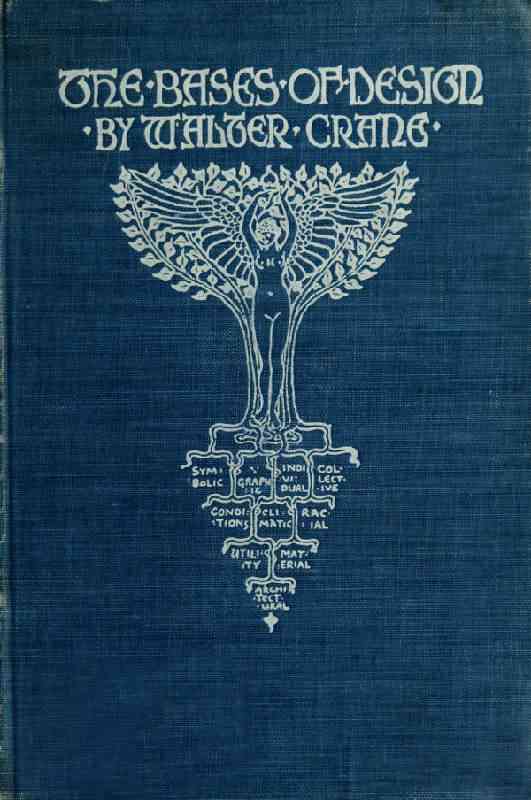
The Project Gutenberg eBook of The Bases of Design
Title: The Bases of Design
Author: Walter Crane
Release date: January 13, 2015 [eBook #47967]
Most recently updated: October 24, 2024
Language: English
Credits: Produced by Chris Curnow, Wayne Hammond and the Online
Distributed Proofreading Team at http://www.pgdp.net (This
file was produced from images generously made available
by The Internet Archive)
THE BASES OF DESIGN
THE BASES
OF DESIGN
BY WALTER CRANE
LONDON
GEORGE BELL AND SONS
1902
First Edition, Medium 8vo, 1898.
Second Edition, Crown 8vo, 1902.
CHISWICK PRESS: CHARLES WHITTINGHAM AND CO.
TOOKS COURT, CHANCERY LANE, LONDON.
TO CHARLES ROWLEY, J.P. CHAIRMAN OF THE MANCHESTER MUNICIPAL SCHOOL OF ART, TO WHOSE ENERGY, SYMPATHY, AND ENTHUSIASM THE SCHOOL, IN ITS NEWER DEVELOPMENT, OWES SO MUCH, AND TO MY FORMER COLLEAGUES OF THE TEACHING STAFF, AS WELL AS TO ALL STUDENTS, I DEDICATE THIS BOOK.
PREFACE
THE substance of the following chapters originally formed a series of lectures addressed to the students of the Manchester Municipal School of Art during my tenure of the directorship of Design at that institution.
The field covered is an extensive one, and I am conscious that many branches of my subject are only touched, whilst others are treated in a very elementary manner. Every chapter, indeed, might be expanded into a volume, under such far-reaching headings, to give to each section anything like adequate treatment.
My main object, however, has been to trace the vital veins and nerves of relationship in the arts of design, which, like the sap from the central stem, springing from connected and collective roots, out of a common ground, sustain and unite in one organic whole the living tree.
In an age when, owing to the action of certain economic causes—the chiefest being commercial competition—the tendency is to specialize each branch of design, which thus becomes isolated from the rest, I feel it is most important to keep in mind the real fundamental connection and essential unity of art: and though we may, as students and artists, in practice be intent upon gathering the fruit from the particular branch we desire to make our own, we should never be insensible to its relation to other branches, its dependence upon the main stem and the source of its life at the root.
Otherwise we are, I think, in danger of becoming mechanical in our work, or too narrowly technical, while, as a collective result of such narrowness of view, the art of the age, to which each individual contributes, shows a want of both imaginative harmony and technical relation with itself, when unity of effect and purpose is particularly essential, as in the design and decoration of both public and private buildings, not to speak of the larger significance of art as the most permanent record of the life and ideals of a people.
My illustrations are drawn from many sources, and consist of a large proportion of those originally used for the lectures, only that instead of the rough charcoal sketches done at the time, careful pen drawings have been made of many of the subjects in addition to the photographs and other authorities.
It may be noted that I have freely used both line and tone blocks in the text and throughout the book, although I advocate the use of line drawings only with type in books wherein completeness of organic ornamental character is the object. Such a book as this, however, being rather in the nature of a tool or auxiliary to a designer's workshop, can hardly be regarded from that point of view. The scheme of the work, which necessitates the gathering together of so many and varied illustrations as diverse in scale, subject, and treatment as the historic periods which they represent, would itself preclude a consistent decorative treatment, and it has been found necessary to reproduce many of the illustrations from their original form in large scale drawings on brown paper touched with white, as well as from photographs which necessarily print as tone-blocks.
I have to thank Mr. Gleeson White for his valuable help in many ways, as well as in obtaining permission from various owners of copyright to use photographs and other illustrations, and also the publishers, who have allowed me the use of blocks in some instances—Mr. George Allen for a page from "The Faerie Queene"; Messrs. Bradbury, Agnew and Co. for the use of the "Punch" drawings; and Messrs. J. S. Virtue and Co. for the use of photographs of carpet weaving and glass blowing, which were specially taken for "The Art Journal." My thanks are also due to Mr. Metford Warner (Messrs. Jeffrey and Co.) for the use of his photo-lithographs of my wall-paper designs issued by his firm; to Mr. R. Phené Spiers for the use of his sketch of the iron balustrade from Rothenburg; to Mr. T. J. Cobden-Sanderson for photographs of two of his recent bookbindings; to the executors of the late Rev. W. H. Creeny for permission to reproduce two of the illustrations from his "Monumental Brasses on the Continent of Europe" (now published by Mr. B. T. Batsford); also to Mr. Harold Rathbone, who kindly allows me to reproduce the cartoons by Ford Madox Brown in his possession; to Mr. J. Sylvester Sparrow for the practical notes on painting glass; and to Mr. Emery Walker for help in several ways in the preparation of the book.
Kensington,
November, 1897.
AUTHOR'S NOTE ON THE PRESENT EDITION
THIS reprint of "The Bases of Design" gives me an opportunity to correct a few errors which had inadvertently crept in on its first appearance, and also to add a word here and there.
I venture to hope that the book may prove more useful and accessible to students in its present form.
Kensington,
November, 1901.
CONTENTS
| CHAP. | PAGE | |
| I | OF THE ARCHITECTURAL BASIS | 1 |
| II | OF THE UTILITY BASIS AND INFLUENCE | 48 |
| III | OF THE INFLUENCE OF MATERIAL AND METHOD | 91 |
| IV | OF THE INFLUENCE OF CONDITIONS IN DESIGN | 123 |
| V | OF THE CLIMATIC INFLUENCE IN DESIGN—CHIEFLY IN REGARD TO COLOUR AND PATTERN | 160 |
| VI | OF THE RACIAL INFLUENCE IN DESIGN | 191 |
| VII | OF THE SYMBOLIC INFLUENCE, OR EMBLEMATIC ELEMENT IN DESIGN | 222 |
| VIII | OF THE GRAPHIC INFLUENCE, OR NATURALISM IN DESIGN | 259 |
| IX | OF THE INDIVIDUAL INFLUENCE IN DESIGN | 302 |
| X | OF THE COLLECTIVE INFLUENCE IN DESIGN | 350 |
LIST OF ILLUSTRATIONS |
||
|---|---|---|
| PAGE | ||
| Three typical Constructive Forms in Architecture—Lintel, Round Arch, Pointed Arch. | 5 | |
| Gate of Mycenæ. | 6 | |
| Imitation of Wooden Construction in Stone Tomb in Lycia. | 7 | |
| Ornamental lines in the Frieze of the Parthenon. | 8 | |
| Metope of the Parthenon, showing relation and proportions of the masses in relief to the ground. | 9 | |
| The Parthenon. | 11 | |
| The Parthenon—Eastern Pediment, sketches showing relation of lines of sculpture to angle of Pediment. | 12 | |
| The Parthenon—Elevation showing portion of Pediment, Frieze and Columns. | 13 | |
| Architectural influence in design of small accessories (Greek). | 15 | |
| Section of the Colosseum. | 17 | |
| Hanging the Festal Garland—Visit of Bacchus to Icarius. | 18 | |
| Arch of Constantine. | 19 | |
| Mosaic, St. Apollinare in Classe, Ravenna. | 21 | |
| Part of Interior of Dome of St. Mark's, Venice. | 23 | |
| Mosaic of the Empress Theodora, St. Vitale. | 24 | |
| Anselm's Tower, Canterbury. | 27 | |
| Transitional Arcade, South Transept, Canterbury. | 28 | |
| Typical Forms of Arches. | 30 | |
| Typical Forms of Gothic Geometric Foliation. | 30 | |
| Westminster Abbey: the Nave, looking east. | 31 | |
| Wells Cathedral, West Front. | 33 | |
| Westminster Abbey, Fan Tracery in Henry VII.'s Chapel. | 35 | |
| The Five Sisters of York. | 37 | |
| Details of Tomb, Winchelsea Church (1303). | 38 | |
| Fourteenth Century Canopied Tomb, Winchelsea Church. | 39 | |
| Wrought-iron Railing, Wells Cathedral. | 40 | |
| Canopied Seat and Sideboard, French Fifteenth Century. | 41 | |
| Carved Bench-ends, Dennington Church, Suffolk. | 42 | |
| Brocade Hanging, from the Annunciation, by Memling. | 43 | |
| St. David's Cathedral. | 44 | |
| Structural lines of different periods in harmonious combination, Canterbury Cathedral. | 45 | |
| Matting. | 49 | |
| Primitive Rush Mat. | 50 | |
| Assyrian Border. | 50 | |
| Assyrian enamelled Tile. | 51 | |
| Greek Anthemion Ornament. | 52 | |
| Wattled Fence. | 52 | |
| Ancient Volute Ornament. | 53 | |
| Types of Decoration derived from Thonging. | 54 | |
| Frieze of the Temple of the Sybil at Tivoli. | 55 | |
| Yoke of Oxen, Carrara. | 55 | |
| Barge-board, Ightham Mote House. | 57 | |
| Types of Gables. | 57 | |
| Hazelford Hall, Derbyshire. | 59 | |
| The Principle of the Dripstone. | 60 | |
| Towers of San Gimignano. | 61 | |
| Tower of the Palazzo Vecchio, Florence. | 63 | |
| Tower with corner Turret, Axmouth Church, Devon. | 64 | |
| Cut Brick Chimneys, Leigh's Priory, Essex. | 65 | |
| Brick Chimney, Framlingham Castle. | 66 | |
| Cast-iron Fire-dog, St. Nicholas's Hospital, Canterbury. | 67 | |
| Cast-iron Grate Back, Bruges. | 68 | |
| Fireplace with wrought-iron Crane, Church Farm, Hempstead, Essex. | 69 | |
| Candlesticks. | 71 | |
| Brass Chandelier, German Seventeenth Century. | 74 | |
| Details of above. | 75 | |
| Lamps, Candlestick, and Snuffers. | 77 | |
| Drinking Vessels, etc. | 81 | |
| German Beer Mugs. | 82 | |
| Italian Flasks and Bottle. | 83 | |
| Pitcher from Rothenburg. | 87 | |
| Plate and Dish Decoration. | 87 | |
| Typical Border Systems. | 89 | |
| Persistent Pattern Plans, Rectangular Basis. | 89 | |
| Corbel, Fourteenth Century, Dennington Church, Suffolk. | 92 | |
| Misereres, St. David's Cathedral. | 93, 94 | |
| Scandinavian Clay Vessel. | 95 | |
| Modern Egyptian Clay Vessel. | 97 | |
| Bronze Statue of Louis XV. by Bouchardon, showing internal Iron-work and Core. | 99 | |
| The same, showing distribution of Ducts and Vents. | 101 | |
| Wrought-iron Gates, St. Lawrence, Nuremberg. | 103 | |
| Wrought-iron Fender, Tongs, Fire-dog and Shovel, Bruges. | 103 | |
| Wrought-iron Altar Screen, St. Thomas's, Salisbury. | 104 | |
| Wrought-iron Balustrade, Rothenburg, from a sketch by R. Phené Spiers. | 105 | |
| Lady at a Hand Loom, from Erasmus's "Praise of Folly" (1676). | 107 | |
| Diagrams showing the principle of the Loom. | 107 | |
| Persian Carpet, South Kensington Museum. | 109 | |
| Embroidery. | 114 | |
| Facsimile of a page from the "Buch von den Sieben Todsünden" (Augsburg, 1474). | 117 | |
| Hans Baldung Grün, facsimile of a page from "Hortulus Animæ" (Strassburg, 1511). | 118 | |
| William Blake, "A Cradle Song". | 120 | |
| Ceiling Papers. Designed by Walter Crane. | 124, 125, 126 | |
| Repeating Pattern Wall-paper. Designed by Walter Crane. | 127 | |
| Pattern Plans and Motives controlled by conditions of Position and Purpose. | 129 | |
| Floor Motive, sketch design for inlaid wood, by Walter Crane. | 130 | |
| Drop Repeat Wall-papers. Designed by Walter Crane. | 132, 134 | |
| Page Plans, showing various arrangements of Text and Decorations. | 137 | |
| Page from "The Glittering Plain" (Kelmscott Press). | 139 | |
| Page from Spenser's "Faerie Queene" (Walter Crane). | 140 | |
| Thirteenth Century Glass from the Sainte Chapelle, Paris (South Kensington Museum). | 142, 143, 145 | |
| Sixteenth Century Glass from Winchester College Chapel (South Kensington Museum). | 147 | |
| Thirteenth Century Glass Grisaille, Salisbury Cathedral. | 151 | |
| Cartoons for Glass, showing lead design, by Ford Madox Brown. | 152, 153 | |
| Modern Glass, designed and executed by J. S. Sparrow. | 157 | |
| Porch of Cathedral of S. Jacopo, Pistoia. | 165 | |
| Primitive Egyptian House, after Viollet le Duc. | 168 | |
| Column from Temple of Luxor. | 169 | |
| Persian Capital, influenced by Primitive Timber Construction. | 170 | |
| Lotus Capital, Philæ. | 171 | |
| Frieze in coloured and glazed Bricks, Palace of Susa (from the Reproduction in the South Kensington Museum), drawn by W. Cleobury. | 173 | |
| Holy Carpet of the Mosque at Ardebil (South Kensington Museum). | 177 | |
| Arab Casement from Cairo (South Kensington Museum), drawn by W. Cleobury. | 181 | |
| Carved stone lattice Window from the Mosque of the Palace of Ahmedabad. | 183 | |
| Portion of the Alhambra, drawn by Gustave Doré. | 187 | |
| Old House in Turnov, dated 1816. | 188 | |
| Street in Eger. | 189 | |
| Egyptian Hieroglyphics, Tomb of Beni Hasan (XIXth Dynasty). | 195 | |
| Altar with Offerings, Egyptian Mural Painting, Thebes. | 196 | |
| Egyptian Wall-painting (British Museum). | 197 | |
| Assyrian Tree of Life. | 198 | |
| Assyrian Bas-reliefs (British Museum). | 199, 200, 201 | |
| Assur Beni Pal, Assyrian Lions from the British Museum. | 203 | |
| Lion modelled by Alfred Stevens and cast in iron. | 205 | |
| Greek Stele or Head-stone. | 206 | |
| Indian Flame Halo or Nimbus. | 207 | |
| Persian Pomegranate forms, from a goat-hair Carpet (South Kensington Museum). | 208 | |
| Celtic design, from a Cross at Campbeltown, Argyllshire. | 209 | |
| Typical ornamental Forms in Persian, Indian, and Chinese designs. | 211 | |
| Arabian Fourteenth Century carved and inlaid Pulpit, Cairo (South Kensington Museum), drawn by W. Cleobury. | 213, 215 | |
| Panel in carved and inlaid Wood, from the Mosque of Tooloon in Cairo, Fourteenth or Fifteenth Century Saracenic. | 217 | |
| The Fylfot or Sauvastika, and its incorporation in ornament. | 224 | |
| Primitive Symbols, Sun, Fire, Water. | 224 | |
| Polynesian Carved Ornament, from Hervey Island Paddle. | 225 | |
| Polynesian Ornament—Evolution of the Zigzag. | 227 | |
| Hindu Symbol of the Universe. | 229 | |
| Examples of Egyptian Symbolism. | 231 | |
| Il Nilo (Vatican, Rome). | 235 | |
| Venus and Paris—the Apples of the Hesperides (from a relief at Wilton House). | 237 | |
| Christian Emblem: Stags Drinking (Mausoleo di Galla Placidia, Ravenna). | 240 | |
| Christian Emblem: Peacocks and Vine (Sarcophagus, St. Apollinare in Classe, Ravenna). | 241 | |
| Fra Angelico, Angel (Uffizi, Florence). | 242, 243 | |
| Orcagna, Fiends from "The Triumph of Death," Fresco (Campo Santo, Pisa). | 245 | |
| Combat of King with Griffin (Ancient Persian Sculpture, Persepolis). | 247 | |
| Typical Forms of Shields and of Heraldic Treatment. | 249 | |
| Sicilian Silk Tissue, Twelfth century (South Kensington Museum). | 251 | |
| Alciati's Emblems, designed by Solomon Bernard, Ex Bello Pax, Fortune, Ambition, Avarice. | 253, 254, 255, 256 | |
| Prehistoric Graphic Art of the Cave Men. | 260, 261 | |
| Egyptian Treatment of Birds (from painted Mummy Cases, British Museum). | 264 | |
| A Fowler, Wall-painting, XIXth Dynasty (British Museum). | 265 | |
| Japanese Graphic Art (from "The Hundred Birds of Bari"). | 266, 267 | |
| Egyptian Scribe, Portrait Statuette, Vth or VIth Dynasty (Louvre). | 269 | |
| Sculptured Frieze discovered in the Forum, 1872. | 271 | |
| Auxerre Cathedral, Thirteenth Century Sculpture. | 272 | |
| Amiens Cathedral, Fourteenth Century Sculpture. | 273 | |
| Statue of St. Martha (St. Urbain, Troyes). | 275 | |
| Memling, "Deliverance of St. Peter" (Grimani Breviary). | 276 | |
| Memling, "David placing the Ark in the Tabernacle" (Grimani Breviary). | 277 | |
| Albert Dürer, "The Apocalypse". | 279 | |
| Albert Dürer, Portrait of Erasmus (1526). | 280 | |
| Albert Dürer, "The Cannon" (1513). | 281 | |
| Albert Dürer, The taking down from the Cross ("Little Passion"). | 283 | |
| Hans Burgmair, Group of Knights from "The Triumphs of Maximilian". | 284 | |
| Horned Poppy, from Fuchsius' "De Historia Stirpium" (1542). | 287 | |
| Japanese Plant Drawing. | 288, 289 | |
| Brass of Joris de Munter and Wife (Bruges, 1439). | 291 | |
| Brass of King Eric Menved and Queen Ingeborg of Denmark (Ringstead, 1319). | 293 | |
| Charles Keene, Drawing from "Punch". | 295 | |
| Linley Sambourne, Drawing from "Punch". | 297 | |
| Phil May, Drawing from "Punch". | 299 | |
| Simone Memmi, Fresco containing portrait of Cimabue and Contemporaries (S. M. Novella, Florence). | 307 | |
| Giotto, Portrait of Dante (Pretorian Palace, Florence). | 309 | |
| Giotto, Frescoes (Arena Chapel, Padua). | 310, 311 | |
| Giotto, Frescoes (Assisi). | 312, 313 | |
| Niccolo Pisano, Pulpit (Baptistery, Pisa). | 315 | |
| Orcagna, "Triumph of Death," Fresco (Campo Santo, Pisa). | 317 | |
| Benozzo Gozzoli, Frescoes (Riccardi Chapel, Florence). | 318, 319, 320, 321 | |
| Botticelli, Detail from "The Adoration of the Magi" (Uffizi, Florence). | 323 | |
| Botticelli, "La Prima Vera" (Academy, Florence). | 325 | |
| Mantegna, Bronze Monument (S. Andrea, Mantua). | 327 | |
| Mantegna, "The Triumph of Julius Cæsar," from Andrea Andreani's woodcut. | 331 | |
| Leonardo da Vinci, "The Last Supper" (Milan). | 335 | |
| Leonardo da Vinci, Study for the Head of Christ. | 337 | |
| Bust of Michael Angelo (S. Croce, Florence). | 339 | |
| Michael Angelo, Ceiling of the Sistine Chapel ("The Creation of Man"). | 341 | |
| Michael Angelo, Ceiling of the Sistine Chapel. | 343 | |
| Michael Angelo, The Delphic Sibyl (Sistine Chapel). | 345 | |
| Michael Angelo, Tomb of Giuliano de Medici (Florence). | 346 | |
| Michael Angelo, Tomb of Lorenzo de Medici (Florence). | 347 | |
| Natural variation in Repetition of Ornamental Forms—Primary School Children drawing on the blackboard, Philadelphia. | 356, 357 | |
| Axminster Carpet Weaving. | 361 | |
| Tapestry Carpet Weaving. | 362 | |
| Interior of the Atelier of Etienne Delaune, Paris, 1576. | 364 | |
| Glass Blowing. | 366 | |
| Interior of a Printing Office, Sixteenth Century, from Jost Amman. | 367 | |
| Gold-Tooled Bindings, by T. J. Cobden-Sanderson. | 370, 371 | |
OF THE BASES OF DESIGN
CHAPTER I.—OF THE ARCHITECTURAL BASIS
WHEN we approach the study of Design, from whatever point of view, and whatsoever our ultimate aim and purpose, we can hardly fail to be impressed with the vast variety and endless complexity of the forms which the term (Design) covers, understanding it in its widest and fullest sense.
From the simplest linear pattern, or bone scratchings of primitive man, to the most splendid achievements in mural decoration of the Italian Renascence—or, shall we say, from the grass mat of the first plaiter to the finest Persian carpet: or from Stonehenge to Salisbury Cathedral—the range is enormous, and were we to attempt to trace, step by step, the true relation between the diverse and multitudinous characteristics which such contrasts suggest, we should be tracing the course of the development of human thought and history themselves.
When we stand amazed in this labyrinth—this enchanted and beautiful wood of human invention which the history of art displays, we might be content to gaze at the loveliness of particular forms there, and simply enjoy, like children, the beauty of the trees and flowers; gathering here and there at random, and casting them aside again when we were tired, without a thought as to their true significance.
If, however, we desire to find some clue to the labyrinth—something which will explain it in part, at least, something which will give us a key to the relation of these manifold forms, and enable us to place them in harmonious order and coherence, we shall presently ask:
(1) How and whence they derived their leading characteristics?
(2) Upon what basis have they been built up? and
(3) What have been the chief influences which have determined, and still determine, their varieties?
Let us try to address ourselves to these questions, since, I believe, even if we only end as we begin, by inquiry, that, in the course of that inquiry, by study, by comparison, and careful observation, we shall be able greatly to clear our path, and find much to help us as individual students and practical workers in art.
(1) The first arts are, of course, those of pure utility, which spring from the primal physical necessities of man: which are concerned in the maintenance of life itself—the art or craft of the hunter and the fisherman, the tiller of the soil, the hewer of wood and the drawer of water: but seeing that next to securing sufficiency of food, the efforts of man are directed towards providing himself with shelter, both of roof and raiment, and since most of the arts of the creative sort must be practised under shelter of some kind, and that all of them contribute in some way towards the building or adornment of such shelter, I think we shall find the true basis and controlling influences, which have been paramount in the development of decorative design, in the form and character of the dwellings of man and their accessories; from the temples he has raised to enshrine his highest ideals—these temples themselves being but larger and more monumental dwellings—to the tomb, his last dwelling-place. We shall find, in short, the original and controlling bases of design in architecture, the queen and mother of all the arts.
In asserting this one does not lose sight of the view that all art is, primarily, the projection or precipitation in material form of man's emotional and intellectual nature; but, being projected and taking definite shape, it becomes subject to certain controlling forces of nature, of material, of condition, which re-act upon the mind; and it is with these controlling forces and conditions, and the distinctions which arise out of them, that we are now concerned.
Such distinctions as exist, for instance, in the feeling, the plan and construction of those patterns intended to be laid upon the floors (as in carpets or tiles), and such as are intended to cover ceilings and walls (as in plaster-work, textile hangings or wall papers), obviously arise from the relative positions of floor, walls, and ceilings, and the differences between horizontal and vertical positions; and these conditions are necessarily part and parcel of the constructional conditions of the dwelling itself.
The first shelter may be said to have been the shelter of nature without art—the Tree and the Cave, the first homes of man; although he was probably not by any means the first animal to hide among the woods and the rocks, since he had many and formidable foes to dispute with or disturb him in possession. It is noticeable that such art as is associated with this strange and remote chapter of man's existence on the earth—the art-instinct which impelled the primitive hunter to incise the bone and stone implements he used with the images of the animals he hunted—is purely graphic, and does not show any feeling of that adaptive ornamental quality characteristic of what we call decorative design, which would seem to belong to a more highly organized condition of society. "Among the primitive Greeks," remarks Messrs. Guhl and Köner in their Life of the Greeks and Romans, "fountains and trees, caves and mountains, were considered as seats of the gods, and revered accordingly, even without being changed into divine habitations by the art of man." But, as proving literally that art springs out of nature, the cave itself led to a development of architecture, as in some early Greek tombs where the cave, or cleft in the rocks, is utilized and added to by masonry; or where the rock itself was carved and hollowed, as in the rock-cut temples of Egypt and India. To which some trace the origin of columnar architecture.
The Tent of the Asiatic wandering tribes, and the wattled and wooden Hut of the western and northern, come next in the order of human dwellings, and not only may we trace certain types of pattern design to both sources, but it would seem as if both the tent and the hut, and perhaps the wagon of the Aryans, had had their influence upon the more substantial stone structures which succeeded them. When tribes became communities, townships were founded, and more fixed and settled habits of life prevailed.