
YE KNYGHTE-MARE.
A POST-MORT-D’ARTHURIAN LEGEND.
Ye log burns low, ye feaste is donne,
Twelve knyghtes of ye Table Rounde
Slyde down fromme ye benches, one by one,
And snore upon ye ground.
Ye log to a dimme blue flame has died,
When ye doore of ye banquet halle
Is opened wide, and in there glyde
Twelve spectral Hagges ande Talle.
Ye log burns dimme, and eke more dimme,
Loud groans each knyghtlie gueste,
As ye ghoste of his grandmother, gaunt and grimme,
Sitts on each knyghte hys cheste.
Ye log in pieces twaine doth falle,
Ye daye beginnes to breake,
Twelve ghostlie grandmothers glyde from ye hall,
And ye twelve goode knyghtes awake.
Ande ever whenne Mynce Pye was placed
On ye table frome thatte daye,
Ye Twelve knyghtes crossed themselves in haste
Ande looked ye other waye.
METAPHYSICS.
Why and Wherefore set one day
To hunt for a wild Negation.
They agreed to meet at a cool retreat
On the Point of Interrogation.
But the night was dark and they missed their mark,
And, driven well-nigh to distraction,
They lost their ways in a murky maze
Of utter abstruse abstraction.
Then they took a boat and were soon afloat
On a sea of Speculation,
But the sea grew rough, and their boat, though tough,
Was split into an Equation.
As they floundered about in the waves of doubt
Rose a fearful Hypothesis,
Who gibbered with glee as they sank in the sea,
And the last they saw was this:
On a rock-bound reef of Unbelief
There sat the wild Negation;
Then they sank once more and were washed ashore
At the Point of Interrogation.
The Princess That was n’t.
In a very lonely tower,
So the legend goes to tell,
Pines a Princess in the power
Of a dreadful Dragon’s spell.
There she sits in silent state,
Always watching—always dumb,
While the Dragon at the gate
Eats her suitors as they come—
King and Prince of every nation
Poet, Page, and Troubadour,
Of whatever rank or station—
Eats them up and waits for more.
Every Knight that hears the legend
Thinks he’ll see what he can do,
Gives his sword a lovely edge, and—
Like the rest is eaten too!
All of which is very pretty,
And romantic, too, forsooth;
But, somehow, it seems a pity
That they should n’t know the truth.
If they only knew that really
There is no Princess to gain—
That she’s an invention merely
Of the crafty Dragon’s brain.
Once it chanced he’d missed his dinner
For perhaps a day or two;
Felt that he was getting thinner,
Wondered what he’d better do.
Then it was that he bethought him
How in this romantic age
(Reading fairy tales had taught him)
Rescuing ladies was the rage.
So a lonely tower he rented,
For a trifling sum per year,
And this thrilling tale invented,
Which was carried far and near;
Far and near throughout the nations,
And the Dragon ever since,
Has relied for daily rations,
On some jolly Knight or Prince.
And while his romantic fiction
To a chivalrous age appeals,
It’s a very safe prediction:
He will never want for meals.
The Lion’s Tour
A Fable
is Majesty the King of Beasts,
Tired of fuss and formal feasts,
Once resolved that he would go
On a tour incognito.
But a suitable disguise
Was not easy to devise;
Kingly natures do not care
Other people’s things to wear.
is Majesty the King of Beasts,
Tired of fuss and formal feasts,
Once resolved that he would go
On a tour incognito.
But a suitable disguise
Was not easy to devise;
Kingly natures do not care
Other people’s things to wear.
The very thought filled him with shame.
“No, I will simply change my name,”
Said he, “and go just as I am,
And call myself a Woolly Lamb.”
And so he did, and as you’ll guess,
He had a measure of success.
Disguised in name alone, he yet
Took in ’most every one he met.
The first was Mister Wolf, who said,
“Your Majesty—” “Off with his head!”
The angry monarch roared. “I am,
I’d have you know, a Woolly Lamb.”
Then Mistress Lamb, who, being near,
Had heard, addressed him: “Brother dear—”
“Odds cats!” the lion roared. “My word!
Such insolence I never heard!”
His rage was a terrific sight
(It almost spoiled his appetite).
And so it went, until one day
He met Sir Fox, who stopped to say
(Keeping just far enough away,
Yet in a casual, off-hand way,
As if he did n’t care a fig),
“Good-morning to you, Thingumjig.”
To-day we think it infra dig,
To use such words as Thing um jig;
But what is now a vulgar word
In those days never had been heard.
Sir Fox himself invented it
This great emergency to fit.
The King of Beasts, quite unprepared
For this reception, simply stared.
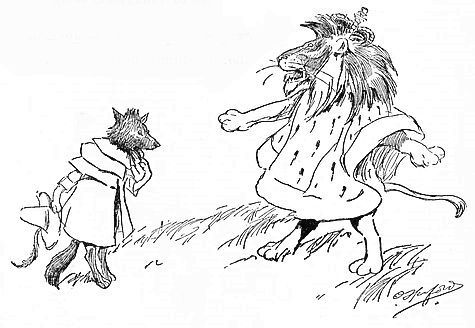
The King of Beasts, quite unprepared
For this reception, simply stared.
Of course he was not going to show
There was a word he did not know.
He bowed, and with his haughtiest air
Resumed his walk; but everywhere
He went his subjects, small and big,
Took up the cry of Thingumjig.
It followed him where’er he went;
He did n’t dare his rage to vent.
Suppose it were a compliment?
His anger then would only show
Here was a word he did not know!
The only course for him ’t was clear,
Was to pretend he did not hear.
And this he did until, at length,
Long fasting so impaired his strength
He gave his tour up in despair,
Mid great rejoicing everywhere.
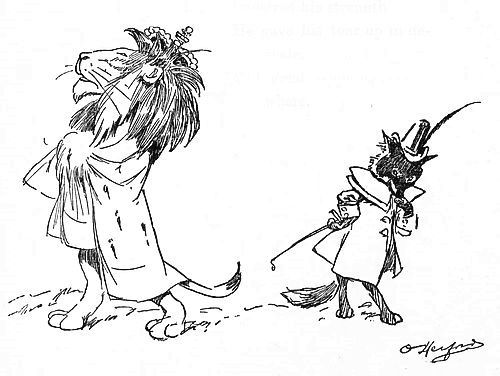
And this he did until, at length,
Long fasting so impaired his strength
He gave his tour up in despair,
Mid great rejoicing everywhere.