
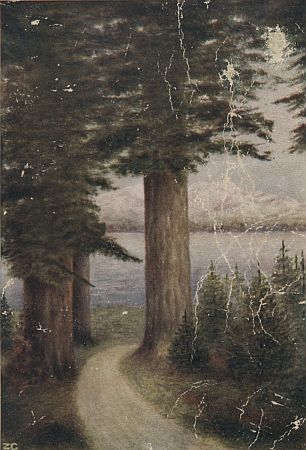
OLYMPIA: "The Pearl of Puget Sound," the "Salem of the Northwest," and seat of state government. Three railroads and four state highways converge here. The waters of Puget Sound reflect the low verdure covered hills protecting the city and extending out along the shores. The mountains are seen on every side. At the edge of city, on the north, is Priest Point Park, of 160 acres. The end of the Oregon trail is marked by a monument in Capitol Park in the heart of the city. Tumwater, a mile away, is the site of the first settlement on Puget Sound. In Olympia the first store was opened for business in the state. The Old New England Inn, formerly the scene of all territorial functions, is marked forever by a brass plate embedded in the sidewalk, and the homes of the first Territorial Governor, Isaac I. Stevens, and General R. H. Milroy are still to be seen.
Trips should include:
ABERDEEN AND HOQUIAM: Two cities on Grays Harbor, connected by electric interurban. The gateway to the Olympics by the southern route. Combined population about 29,000 (over 18,000 in Aberdeen), Near by are some of the largest trees in the state. Splendid highways, an increase of nearly 400 per cent in 14 years, due chiefly to lumbering and fishing industries, but farming and dairying are gaining. including the Olympic, lead in various directions, while the broad, firm ocean beaches a short distance away offer miles of excellent motor race tracks. Three transcontinental trains serve the district.
Suggested trips:
SOUTH BEND AND RAYMOND: Two progressive cities in southwestern Washington on Willapa Bay, one of the best harbors on Coast. Lumbering, farming, shell and salmon fisheries, and cranberry culture are sustaining industries. Read also "The Harbor Country."
CENTRALIA AND CHEHALIS: Important railroad centers four miles apart, connected by trolley and half way between Tacoma and Portland. Combined population about 15,500 (10,000 in Centralia). A rich dairy and farm country surrounds them, formed by the Chehalis, the Newaukum and Skookumchuck rivers. About 44 trains leave Centralia daily. Coal mines, farms and lumber are important. Between cities are Southwest Washington Fair Grounds. At Chehalis, county seat, is a large condensery. The Pacific Highway and the Rainier National Park Highway cross near by.
Suggested trips:
VANCOUVER: Oldest city in state; settled in 1824 by the Hudson Bay Company. It slopes gently towards the Columbia river, visible from all points. To the north are the prune orchards for which Clarke county is noted, and the English walnut seems to have found its ideal habitat. Adjoining city are the Vancouver Barracks, occupying 640 acres of land, 300 of which constitute a natural park with many winding roads. State schools for the deaf and the blind are located near. What is said to be the oldest apple tree in the Northwest still thrives. Electric lines extend to the outlying districts, also to Portland, Oregon, while auto drives may be made along the river, nowhere more picturesque, or through the surrounding prosperous farming districts.
Suggested trips:
GOLDENDALE: County seat of Klickitat county; reached via S. P. & S. railway. Surrounding country is one immense beauty spot with valleys, mountains, prairie, and timber. Mounts Hood, Adams, and St. Helens, are always visible. Many beautiful trips may be taken. Historical sights are numerous.
When you have seen Washington, the vast territory of Alaska awaits you. Alaska, the last of the undeveloped free empires! This region is so extensive that even the state of Washington would be lost in its midst, for its area is equal to that of the original thirteen colonies, with Maine, Vermont, Ohio, Indiana, Tennessee, Kentucky and Michigan thrown in, or one-fifth of the entire United States. It has a range of latitude of 1,100 miles, while its extreme longitude would reach from the Atlantic to the Pacific.
In proportion to its vastness, so are its wonders. Stupendous mountains reach to three and nearly four miles in height, loftier than any others in the United States or its possessions. The Yukon River is 2,300 miles in length and its nearest rival, 1,000 miles. The biggest glaciers in North America are here, which make those of Europe look like mere pygmies, and volcanoes still in eruption may be viewed from a safe point. The scenery produced by the green rock-bound fiords with the snowy peaks beyond is truly magnificent.
It is also a great treasure house. By the end of 1914 there had been produced, $540,000,000, or about 75 times the price paid for its purchase, representing over $15,000.00 for each white person now inhabiting it. Almost half was from gold mining and within the last twenty years. The rest was from fisheries, seals, furs, copper and silver—permanent resources of region.
Alaska is not cold and bleak like Labrador, although its latitude is similar. The Japan current acts as it does on Washington and as the Gulf Stream affects England. Both plant and animal life flourish and about 100,000 square miles of land are available for agricultural purposes.
To partially realize its glories take the inside passage trip from Seattle—a thousand miles of calm sea.
Transcriber's Notes:
Obvious punctuation errors repaired.
The remaining corrections made are indicated by dotted lines under the corrections. Scroll the mouse over the word and the original text will appear.