
‘I hope I have not kept you waiting; I have been delayed longer than I expected.’
‘Not at all,—though I am quite ready to get away; it’s a little tiresome waiting here.’
This with a mischievous glance towards me,—a glance which compelled Lessingham to notice me.
‘You do not often favour us.’
‘I don’t. I find better employment for my time.’
‘You are wrong. It’s the cant of the day to underrate the House of Commons, and the work which it performs; don’t you suffer yourself to join in the chorus of the simpletons. Your time cannot be better employed than in endeavouring to improve the body politic.’
‘I am obliged to you.—I hope you are feeling better than when I saw you last.’
A gleam came into his eyes, fading as quickly as it came. He showed no other sign of comprehension, surprise, or resentment.
‘Thank you.—I am very well.’
But Marjorie perceived that I meant more than met the eye, and that what I meant was meant unpleasantly.
‘Come,—let us be off. It is Mr Atherton to-night who is not well.’
She had just slipped her arm through Lessingham’s when her father approached. Old Lindon stared at her on the Apostle’s arm, as if he could hardly believe that it was she.
‘I thought that you were at the Duchess’?’
‘So I have been, papa; and now I’m here.’
‘Here!’ Old Lindon began to stutter and stammer, and to grow red in the face, as is his wont when at all excited. ‘W—what do you mean by here?—wh—where’s the carriage?’
‘Where should it be, except waiting for me outside,—unless the horses have run away.’
‘I—I—I’ll take you down to it. I—I don’t approve of y—your w—w—waiting in a place like this.’
‘Thank you, papa, but Mr Lessingham is going to take me down.—I shall see you afterwards.—Good-bye.’
Anything cooler than the way in which she walked off I do not think I ever saw. This is the age of feminine advancement. Young women think nothing of twisting their mothers round their fingers, let alone their fathers; but the fashion in which that young woman walked off, on the Apostle’s arm, and left her father standing there, was, in its way, a study.
Lindon seemed scarcely able to realise that the pair of them had gone. Even after they had disappeared in the crowd he stood staring after them, growing redder and redder, till the veins stood out upon his face, and I thought that an apoplectic seizure threatened. Then, with a gasp, he turned to me.
‘Damned scoundrel!’ I took it for granted that he alluded to the gentleman,—even though his following words hardly suggested it. ‘Only this morning I forbade her to have anything to do with him, and n—now he’s w—walked off with her! C—confounded adventurer! That’s what he is, an adventurer, and before many hours have passed I’ll take the liberty to tell him so!’
Jamming his fists into his pockets, and puffing like a grampus in distress, he took himself away,—and it was time he did, for his words were as audible as they were pointed, and already people were wondering what the matter was. Woodville came up as Lindon was going,—just as sorely distressed as ever.
‘She went away with Lessingham,—did you see her?’
‘Of course I saw her. When a man makes a speech like Lessingham’s any girl would go away with him,—and be proud to. When you are endowed with such great powers as he is, and use them for such lofty purposes, she’ll walk away with you,—but, till then, never.’
He was at his old trick of polishing his eyeglass.
‘It’s bitter hard. When I knew that she was there, I’d half a mind to make a speech myself, upon my word I had, only I didn’t know what to speak about, and I can’t speak anyhow,—how can a fellow speak when he’s shoved into the gallery?’
‘As you say, how can he?—he can’t stand on the railing and shout,—even with a friend holding him behind.’
‘I know I shall speak one day,—bound to; and then she won’t be there.’
‘It’ll be better for you if she isn’t.’
‘Think so?—Perhaps you’re right. I’d be safe to make a mess of it, and then, if she were to see me at it, it’d be the devil! ’Pon my word, I’ve been wishing, lately, I was clever.’
He rubbed his nose with the rim of his eyeglass, looking the most comically disconsolate figure.
‘Put black care behind you, Percy!—buck up, my boy! The division’s over—you are free—now we’ll go “on the fly.”’
And we did ‘go on the fly.’
CHAPTER XVI.
ATHERTON’S MAGIC VAPOUR
I bore him off to supper at the Helicon. All the way in the cab he was trying to tell me the story of how he proposed to Marjorie,—and he was very far from being through with it when we reached the club. There was the usual crowd of supperites, but we got a little table to ourselves, in a corner of the room, and before anything was brought for us to eat he was at it again. A good many of the people were pretty near to shouting, and as they seemed to be all speaking at once, and the band was playing, and as the Helicon supper band is not piano, Percy did not have it quite all to himself, but, considering the delicacy of his subject, he talked as loudly as was decent,—getting more so as he went on. But Percy is peculiar.
‘I don’t know how many times I’ve tried to tell her,—over and over again.’
‘Have you now?’
‘Yes, pretty near every time I met her,—but I never seemed to get quite to it, don’t you know.’
‘How was that?’
‘Why, just as I was going to say, “Miss Lindon, may I offer you the gift of my affection—”’
‘Was that how you invariably intended to begin?’
‘Well, not always—one time like that, another time another way. Fact is, I got off a little speech by heart, but I never got a chance to reel it off, so I made up my mind to just say anything.’
‘And what did you say?’
‘Well, nothing,—you see, I never got there. Just as I was feeling my way, she’d ask me if I preferred big sleeves to little ones, or top hats to billycocks, or some nonsense of the kind.’
‘Would she now?’
‘Yes,—of course I had to answer, and by the time I’d answered the chance was lost.’ Percy was polishing his eyeglass. ‘I tried to get there so many times, and she choked me off so often, that I can’t help thinking that she suspected what it was that I was after.’
‘You think she did?’
‘She must have done. Once I followed her down Piccadilly, and chivied her into a glove shop in the Burlington Arcade. I meant to propose to her in there,—I hadn’t had a wink of sleep all night through dreaming of her, and I was just about desperate.’
‘And did you propose?’
‘The girl behind the counter made me buy a dozen pairs of gloves instead. They turned out to be three sizes too large for me when they came home. I believe she thought I’d gone to spoon the glove girl,—she went out and left me there. That girl loaded me with all sorts of things when she was gone,—I couldn’t get away. She held me with her blessed eye. I believe it was a glass one.’
‘Miss Lindon’s?—or the glove girl’s?’
‘The glove girl’s. She sent me home a whole cartload of green ties, and declared I’d ordered them. I shall never forget that day. I’ve never been up the Arcade since, and never mean to.’
‘You gave Miss Lindon a wrong impression.’
‘I don’t know. I was always giving her wrong impressions. Once she said that she knew I was not a marrying man, that I was the sort of chap who never would marry, because she saw it in my face.’
‘Under the circumstances, that was trying.’
‘Bitter hard.’ Percy sighed again. ‘I shouldn’t mind if I wasn’t so gone. I’m not a fellow who does get gone, but when I do get gone, I get so beastly gone.’
‘I tell you what, Percy,—have a drink!’
‘I’m a teetotaler,—you know I am.’
‘You talk of your heart being broken, and of your being a teetotaler in the same breath,—if your heart were really broken you’d throw teetotalism to the winds.’
‘Do you think so,—why?’
‘Because you would,—men whose hearts are broken always do,—you’d swallow a magnum at the least.’
Percy groaned.
‘When I drink I’m always ill,—but I’ll have a try.’
He had a try,—making a good beginning by emptying at a draught the glass which the waiter had just now filled. Then he relapsed into melancholy.
‘Tell me, Percy,—honest Indian!—do you really love her?’
‘Love her?’ His eyes grew round as saucers. ‘Don’t I tell you that I love her?’
‘I know you tell me, but that sort of thing is easy telling. What does it make you feel like, this love you talk so much about?’
‘Feel like?—Just anyhow,—and nohow. You should look inside me, and then you’d know.’
‘I see.—It’s like that, is it?—Suppose she loved another man, what sort of feeling would you feel towards him?’
‘Does she love another man?’
‘I say, suppose.’
‘I dare say she does. I expect that’s it.—What an idiot I am not to have thought of that before.’ He sighed,—and refilled his glass. ‘He’s a lucky chap, whoever he is. I’d—I’d like to tell him so.’
‘You’d like to tell him so?’
‘He’s such a jolly lucky chap, you know.’
‘Possibly,—but his jolly good luck is your jolly bad luck. Would you be willing to resign her to him without a word?’
‘If she loves him.’
‘But you say you love her.’
‘Of course I do.’
‘Well then?’
‘You don’t suppose that, because I love her, I shouldn’t like to see her happy?—I’m not such a beast!—I’d sooner see her happy than anything else in all the world.’
‘I see.—Even happy with another?—I’m afraid that my philosophy is not like yours. If I loved Miss Lindon, and she loved, say, Jones, I’m afraid I shouldn’t feel like that towards Jones at all.’
‘What would you feel like?’
‘Murder.—Percy, you come home with me,—we’ve begun the night together, let’s end it together,—and I’ll show you one of the finest notions for committing murder on a scale of real magnificence you ever dreamed of. I should like to make use of it to show my feelings towards the supposititious Jones,—he’d know what I felt for him when once he had been introduced to it.’
Percy went with me without a word. He had not had much to drink, but it had been too much for him, and he was in a condition of maundering sentimentality. I got him into a cab. We dashed along Piccadilly.
He was silent, and sat looking in front of him with an air of vacuous sullenness which ill-became his cast of countenance. I bade the cabman pass though Lowndes Square. As we passed the Apostle’s I pulled him up. I pointed out the place to Woodville.
‘You see, Percy, that’s Lessingham’s house!—that’s the house of the man who went away with Marjorie!’
‘Yes.’ Words came from him slowly, with a quite unnecessary stress on each. ‘Because he made a speech.—I’d like to make a speech.—One day I’ll make a speech.’
‘Because he made a speech,—only that, and nothing more! When a man speaks with an Apostle’s tongue, he can witch any woman in the land.—Hallo, who’s that?—Lessingham, is that you?’
I saw, or thought I saw, someone, or something, glide up the steps, and withdraw into the shadow of the doorway, as if unwilling to be seen. When I hailed no one answered. I called again.
‘Don’t be shy, my friend!’
I sprang out of the cab, ran across the pavement, and up the steps. To my surprise, there was no one in the doorway. It seemed incredible, but the place was empty. I felt about me with my hands, as if I had been playing at blind man’s buff, and grasped at vacancy. I came down a step or two.
‘Ostensibly, there’s a vacuum,—which nature abhors.—I say, driver, didn’t you see someone come up the steps?’
‘I thought I did, sir,—I could have sworn I did.’
‘So could I.—It’s very odd.’
‘Perhaps whoever it was has gone into the ’ouse, sir.’
‘I don’t see how. We should have heard the door open, if we hadn’t seen it,—and we should have seen it, it’s not so dark as that.—I’ve half a mind to ring the bell and inquire.’
‘I shouldn’t do that if I was you, sir,—you jump in, and I’ll get along. This is Mr Lessingham’s,—the great Mr Lessingham’s.’
I believe the cabman thought that I was drunk,—and not respectable enough to claim acquaintance with the great Mr Lessingham.
‘Wake up, Woodville! Do you know I believe there’s some mystery about this place,—I feel assured of it. I feel as if I were in the presence of something uncanny,—something which I can neither see, nor touch, nor hear.’
The cabman bent down from his seat, wheedling me.
‘Jump in, sir, and we’ll be getting along.’
I jumped in, and we got along,—but not far. Before we had gone a dozen yards, I was out again, without troubling the driver to stop. He pulled up, aggrieved.
‘Well, sir, what’s the matter now? You’ll be damaging yourself before you’ve done, and then you’ll be blaming me.’
I had caught sight of a cat crouching in the shadow of the railings,—a black one. That cat was my quarry. Either the creature was unusually sleepy, or slow, or stupid, or it had lost its wits—which a cat seldom does lose!—anyhow, without making an attempt to escape it allowed me to grab it by the nape of the neck.
So soon as we were inside my laboratory, I put the cat into my glass box. Percy stared.
‘What have you put it there for?’
‘That, my dear Percy, is what you are shortly about to see. You are about to be the witness of an experiment which, to a legislator—such as you are!—ought to be of the greatest possible interest. I am going to demonstrate, on a small scale, the action of the force which, on a large scale, I propose to employ on behalf of my native land.’
He showed no signs of being interested. Sinking into a chair, he recommenced his wearisome reiteration.
‘I hate cats!—Do let it go!—I’m always miserable when there’s a cat in the room.’
‘Nonsense,—that’s your fancy! What you want’s a taste of whisky—you’ll be as chirpy as a cricket.’
‘I don’t want anything more to drink!—I’ve had too much already!’
I paid no heed to what he said. I poured two stiff doses into a couple of tumblers. Without seeming to be aware of what it was that he was doing he disposed of the better half of the one I gave him at a draught. Putting his glass upon the table, he dropped his head upon his hands, and groaned.
‘What would Marjorie think of me if she saw me now?’
‘Think?—nothing. Why should she think of a man like you, when she has so much better fish to fry?’
‘I’m feeling frightfully ill!—I’ll be drunk before I’ve done!’
‘Then be drunk!—only, for gracious sake, be lively drunk, not deadly doleful.—Cheer up, Percy!’ I clapped him on the shoulder,—almost knocking him off his seat on to the floor. ‘I am now going to show you that little experiment of which I was speaking!—You see that cat?’
‘Of course I see it!—the beast!—I wish you’d let it go!’
‘Why should I let it go?—Do you know whose cat that is? That cat’s Paul Lessingham’s.’
‘Paul Lessingham’s?’
‘Yes, Paul Lessingham’s,—the man who made the speech,—the man whom Marjorie went away with.’
‘How do you know it’s his?’
‘I don’t know it is, but I believe it is,—I choose to believe it is!—I intend to believe it is!—It was outside his house, therefore it’s his cat,—that’s how I argue. I can’t get Lessingham inside that box, so I get his cat instead.’
‘Whatever for?’
‘You shall see.—You observe how happy it is?’
‘It don’t seem happy.’
‘We’ve all our ways of seeming happy,—that’s its way.’
The creature was behaving like a cat gone mad, dashing itself against the sides of its glass prison, leaping to and fro, and from side to side, squealing with rage, or with terror, or with both. Perhaps it foresaw what was coming,—there is no fathoming the intelligence of what we call the lower animals.
‘It’s a funny way.’
‘We some of us have funny ways, beside cats. Now, attention! Observe this little toy,—you’ve seen something of its kind before. It’s a spring gun; you pull the spring—drop the charge into the barrel—release the spring—and the charge is fired. I’ll unlock this safe, which is built into the wall. It’s a letter lock, the combination just now, is “whisky,”—you see, that’s a hint to you. You’ll notice the safe is strongly made,—it’s air-tight, fire-proof, the outer casing is of triple-plated drill-proof steel,—the contents are valuable—to me!—and devilish dangerous,—I’d pity the thief who, in his innocent ignorance, broke in to steal. Look inside,—you see it’s full of balls,—glass balls, each in its own little separate nest; light as feathers; transparent,—you can see right through them. Here are a couple, like tiny pills. They contain neither dynamite, nor cordite, nor anything of the kind, yet, given a fair field and no favour, they’ll work more mischief than all the explosives man has fashioned. Take hold of one—you say your heart is broken!—squeeze this under your nose—it wants but a gentle pressure—and in less time than no time you’ll be in the land where they say there are no broken hearts.’
He shrunk back.
‘I don’t know what you’re talking about.—I don’t want the thing.—Take it away.’
‘Think twice,—the chance may not recur.’
‘I tell you I don’t want it.’
‘Sure?—Consider!’
‘Of course I’m sure!’
‘Then the cat shall have it.’
‘Let the poor brute go!’
‘The poor brute’s going,—to the land which is so near, and yet so far. Once more, if you please, attention. Notice what I do with this toy gun. I pull back the spring; I insert this small glass pellet; I thrust the muzzle of the gun through the opening in the glass box which contains the Apostle’s cat,—you’ll observe it fits quite close, which, on the whole, is perhaps as well for us.—I am about to release the spring.—Close attention, please.—Notice the effect.’
‘Atherton, let the brute go!’
‘The brute’s gone! I’ve released the spring—the pellet has been discharged—it has struck against the roof of the glass box—it has been broken by the contact,—and, hey presto! the cat lies dead,—and that in face of its nine lives. You perceive how still it is,—how still! Let’s hope that, now, it’s really happy. The cat which I choose to believe is Paul Lessingham’s has received its quietus; in the morning I’ll send it back to him, with my respectful compliments. He’ll miss it if I don’t.—Reflect! think of a huge bomb, filled with what we’ll call Atherton’s Magic Vapour, fired, say, from a hundred and twenty ton gun, bursting at a given elevation over the heads of an opposing force. Properly managed, in less than an instant of time, a hundred thousand men,—quite possibly more!—would drop down dead, as if smitten by the lightning of the skies. Isn’t that something like a weapon, sir?’
‘I’m not well!—I want to get away!—I wish I’d never come!’
That was all Woodville had to say.
‘Rubbish!—You’re adding to your stock of information every second, and, in these days, when a member of Parliament is supposed to know all about everything, information’s the one thing wanted. Empty your glass, man,—that’s the time of day for you!’
I handed him his tumbler. He drained what was left of its contents, then, in a fit of tipsy, childish temper he flung the tumbler from him. I had placed—carelessly enough—the second pellet within a foot of the edge of the table. The shock of the heavy beaker striking the board close to it, set it rolling. I was at the other side. I started forward to stop its motion, but I was too late. Before I could reach the crystal globule, it had fallen off the edge of the table on to the floor at Woodville’s feet, and smashed in falling. As it smashed, he was looking down, wondering, no doubt, in his stupidity, what the pother was about,—for I was shouting, and making something of a clatter in my efforts to prevent the catastrophe which I saw was coming. On the instant, as the vapour secreted in the broken pellet gained access to the air, he fell forward on to his face. Rushing to him, I snatched his senseless body from the ground, and dragged it, staggeringly, towards the door which opened on to the yard. Flinging the door open, I got him into the open air.
As I did so, I found myself confronted by someone who stood outside. It was Lessingham’s mysterious Egypto-Arabian friend,—my morning’s visitor.
CHAPTER XVII.
MAGIC?—OR MIRACLE?
The passage into the yard from the electrically lit laboratory was a passage from brilliancy to gloom. The shrouded figure standing in the shadow, was like some object in a dream. My own senses reeled. It was only because I had resolutely held my breath, and kept my face averted that I had not succumbed to the fate which had overtaken Woodville. Had I been a moment longer in gaining the open air, it would have been too late. As it was, in placing Woodville on the ground, I stumbled over him. My senses left me. Even as they went I was conscious of exclaiming,—remembering the saying about the engineer being hoist by his own petard,
‘Atherton’s Magic Vapour!’
My sensations on returning to consciousness were curious. I found myself being supported in someone’s arms, a stranger’s face was bending over me, and the most extraordinary pair of eyes I had ever seen were looking into mine.
‘Who the deuce are you?’ I asked.
Then, understanding that it was my uninvited visitor, with scant ceremony I drew myself away from him. By the light which was streaming through the laboratory door I saw that Woodville was lying close beside me,—stark and still.
‘Is he dead?’ I cried. ‘Percy!—speak, man!—it’s not so bad with you as that!’
But it was pretty bad,—so bad that, as I bent down and looked at him, my heart beat uncomfortably fast lest it was as bad as it could be. His heart seemed still,—the vapour took effect directly on the cardiac centres. To revive their action, and that instantly, was indispensable. Yet my brain was in such a whirl that I could not even think of how to set about beginning. Had I been alone, it is more than probable Woodville would have died. As I stared at him, senselessly, aimlessly, the stranger, passing his arms beneath his body, extended himself at full length upon his motionless form. Putting his lips to Percy’s, he seemed to be pumping life from his own body into the unconscious man’s. As I gazed bewildered, surprised, presently there came a movement of Percy’s body. His limbs twitched, as if he was in pain. By degrees, the motions became convulsive,—till on a sudden he bestirred himself to such effect that the stranger was rolled right off him. I bent down,—to find that the young gentleman’s condition still seemed very far from satisfactory. There was a rigidity about the muscles of his face, a clamminess about his skin, a disagreeable suggestiveness about the way in which his teeth and the whites of his eyes were exposed, which was uncomfortable to contemplate.
The stranger must have seen what was passing through my mind,—not a very difficult thing to see. Pointing to the recumbent Percy, he said, with that queer foreign twang of his, which, whatever it had seemed like in the morning, sounded musical enough just then.
‘All will be well with him.’
‘I am not so sure.’
The stranger did not deign to answer. He was kneeling on one side of the victim of modern science, I on the other. Passing his hand to and fro in front of the unconscious countenance, as if by magic all semblance of discomfort vanished from Percy’s features, and, to all appearances, he was placidly asleep.
‘Have you hypnotised him?’
‘What does it matter?’
If it was a case of hypnotism, it was very neatly done. The conditions were both unusual and trying, the effect produced seemed all that could be desired,—the change brought about in half a dozen seconds was quite remarkable. I began to be aware of a feeling of quasi-respect for Paul Lessingham’s friend. His morals might be peculiar, and manners he might have none, but in this case, at any rate, the end seemed to have justified the means. He went on.
‘He sleeps. When he awakes he will remember nothing that has been. Leave him,—the night is warm,—all will be well.’
As he said, the night was warm,—and it was dry. Percy would come to little harm by being allowed to enjoy, for a while, the pleasant breezes. So I acted on the stranger’s advice, and left him lying in the yard, while I had a little interview with the impromptu physician.
CHAPTER XVIII.
THE APOTHEOSIS OF THE BEETLE
The laboratory door was closed. The stranger was standing a foot or two away from it. I was further within the room, and was subjecting him to as keen a scrutiny as circumstances permitted. Beyond doubt he was conscious of my observation, yet he bore himself with an air of indifference, which was suggestive of perfect unconcern. The fellow was oriental to the finger-tips,—that much was certain; yet in spite of a pretty wide personal knowledge of oriental people I could not make up my mind as to the exact part of the east from which he came. He was hardly an Arab, he was not a fellah,—he was not, unless I erred, a Mohammedan at all. There was something about him which was distinctly not Mussulmanic. So far as looks were concerned, he was not a flattering example of his race, whatever his race might be. The portentous size of his beak-like nose would have been, in itself, sufficient to damn him in any court of beauty. His lips were thick and shapeless,—and this, joined to another peculiarity in his appearance, seemed to suggest that, in his veins there ran more than a streak of negro blood. The peculiarity alluded to was his semblance of great age. As one eyed him one was reminded of the legends told of people who have been supposed to have retained something of their pristine vigour after having lived for centuries. As, however, one continued to gaze, one began to wonder if he really was so old as he seemed,—if, indeed, he was exceptionally old at all. Negroes, and especially negresses, are apt to age with extreme rapidity. Among coloured folk one sometimes encounters women whose faces seem to have been lined by the passage of centuries, yet whose actual tale of years would entitle them to regard themselves, here in England, as in the prime of life. The senility of the fellow’s countenance, besides, was contradicted by the juvenescence of his eyes. No really old man could have had eyes like that. They were curiously shaped, reminding me of the elongated, faceted eyes of some queer creature, with whose appearance I was familiar, although I could not, at the instant, recall its name. They glowed not only with the force and fire, but, also, with the frenzy of youth. More uncanny-looking eyes I had never encountered,—their possessor could not be, in any sense of the word, a clubable person. Owing, probably, to some peculiar formation of the optic-nerve one felt, as one met his gaze, that he was looking right through you. More obvious danger signals never yet were placed in a creature’s head. The individual who, having once caught sight of him, still sought to cultivate their owner’s acquaintance, had only himself to thank if the very worst results of frequenting evil company promptly ensued.
It happens that I am myself endowed with an unusual tenacity of vision. I could, for instance, easily outstare any man I ever met. Yet, as I continued to stare at this man, I was conscious that it was only by an effort of will that I was able to resist a baleful something which seemed to be passing from his eyes to mine. It might have been imagination, but, in that sense, I am not an imaginative man; and, if it was, it was imagination of an unpleasantly vivid kind. I could understand how, in the case of a nervous, or a sensitive temperament, the fellow might exercise, by means of the peculiar quality of his glance alone, an influence of a most disastrous sort, which given an appropriate subject in the manifestation of its power might approach almost to the supernatural. If ever man was endowed with the traditional evil eye, in which Italians, among modern nations, are such profound believers, it was he.
When we had stared at each other for, I daresay, quite five minutes, I began to think I had had about enough of it. So, by way of breaking the ice, I put to him a question.
‘May I ask how you found your way into my back yard?’
He did not reply in words, but, raising his hands he lowered them, palms downward, with a gesture which was peculiarly oriental.
‘Indeed?—Is that so?—Your meaning may be lucidity itself to you, but, for my benefit, perhaps you would not mind translating it into words. Once more I ask, how did you find your way into my back yard?’
Again nothing but the gesture.
‘Possibly you are not sufficiently acquainted with English manners and customs to be aware that you have placed yourself within reach of the pains and penalties of the law. Were I to call in the police you would find yourself in an awkward situation,—and, unless you are presently more explanatory, called in they will be.’
By way of answer he indulged in a distortion of the countenance which might have been meant for a smile,—and which seemed to suggest that he regarded the police with a contempt which was too great for words.
‘Why do you laugh—do you think that being threatened with the police is a joke? You are not likely to find it so.—Have you suddenly been bereft of the use of your tongue?’
He proved that he had not by using it.
‘I have still the use of my tongue.’
‘That, at least, is something. Perhaps, since the subject of how you got into my back yard seems to be a delicate one, you will tell me why you got there.’
‘You know why I have come.’
‘Pardon me if I appear to flatly contradict you, but that is precisely what I do not know.’
‘You do know.’
‘Do I?—Then, in that case, I presume that you are here for the reason which appears upon the surface,—to commit a felony.’
‘You call me thief?’
‘What else are you?’
‘I am no thief.—You know why I have come.’
He raised his head a little. A look came into his eyes which I felt that I ought to understand, yet to the meaning of which I seemed, for the instant, to have mislaid the key. I shrugged my shoulders.
‘I have come because you wanted me.’
‘Because I wanted you!—On my word!—That’s sublime!’
‘All night you have wanted me,—do I not know? When she talked to you of him, and the blood boiled in your veins; when he spoke, and all the people listened, and you hated him, because he had honour in her eyes.’
I was startled. Either he meant what it appeared incredible that he could mean, or—there was confusion somewhere.
‘Take my advice, my friend, and don’t try to come the bunco-steerer over me,—I’m a bit in that line myself, you know.’
This time the score was mine,—he was puzzled.
‘I know not what you talk of.’
‘In that case, we’re equal,—I know not what you talk of either.’
His manner, for him, was childlike and bland.
‘What is it you do not know? This morning did I not say,—if you want me, then I come?’
‘I fancy I have some faint recollection of your being so good as to say something of the kind, but—where’s the application?’
‘Do you not feel for him the same as I?’
‘Who’s the him?’
‘Paul Lessingham.’
It was spoken quietly, but with a degree of—to put it gently—spitefulness which showed that at least the will to do the Apostle harm would not be lacking.
‘And, pray, what is the common feeling which we have for him?’
‘Hate.’
Plainly, with this gentleman, hate meant hate,—in the solid oriental sense. I should hardly have been surprised if the mere utterance of the words had seared his lips.
‘I am by no means prepared to admit that I have this feeling which you attribute to me, but, even granting that I have, what then?’
‘Those who hate are kin.’
‘That, also, I should be slow to admit; but—to go a step farther—what has all this to do with your presence on my premises at this hour of the night?’
‘You love her.’ This time I did not ask him to supply the name,—being unwilling that it should be soiled by the traffic of his lips. ‘She loves him,—that is not well. If you choose, she shall love you,—that will be well.’
‘Indeed.—And pray how is this consummation which is so devoutly to be desired to be brought about?’
‘Put your hand into mine. Say that you wish it. It shall be done.’
Moving a step forward, he stretched out his hand towards me. I hesitated. There was that in the fellow’s manner which, for the moment, had for me an unwholesome fascination. Memories flashed through my mind of stupid stories which have been told of compacts made with the devil. I almost felt as if I was standing in the actual presence of one of the powers of evil. I thought of my love for Marjorie,—which had revealed itself after all these years; of the delight of holding her in my arms, of feeling the pressure of her lips to mine. As my gaze met his, the lower side of what the conquest of this fair lady would mean, burned in my brain; fierce imaginings blazed before my eyes. To win her,—only to win her!
What nonsense he was talking! What empty brag it was! Suppose, just for the sake of the joke, I did put my hand in his, and did wish, right out, what it was plain he knew. If I wished, what harm would it do! It would be the purest jest. Out of his own mouth he would be confounded, for it was certain that nothing would come of it. Why should I not do it then?
I would act on his suggestion,—I would carry the thing right through. Already I was advancing towards him, when—I stopped. I don’t know why. On the instant, my thoughts went off at a tangent.
What sort of a blackguard did I call myself that I should take a woman’s name in vain for the sake of playing fool’s tricks with such scum of the earth as the hideous vagabond in front of me,—and that the name of the woman whom I loved? Rage took hold of me.
‘You hound!’ I cried.
In my sudden passage from one mood to another, I was filled with the desire to shake the life half out of him. But so soon as I moved a step in his direction, intending war instead of peace, he altered the position of his hand, holding it out towards me as if forbidding my approach. Directly he did so, quite involuntarily, I pulled up dead,—as if my progress had been stayed by bars of iron and walls of steel.
For the moment, I was astonished to the verge of stupefaction. The sensation was peculiar. I was as incapable of advancing another inch in his direction as if I had lost the use of my limbs,—I was even incapable of attempting to attempt to advance. At first I could only stare and gape. Presently I began to have an inkling of what had happened.
The scoundrel had almost succeeded in hypnotising me.
That was a nice thing to happen to a man of my sort at my time of life. A shiver went down my back,—what might have occurred if I had not pulled up in time! What pranks might a creature of that character not have been disposed to play. It was the old story of the peril of playing with edged tools; I had made the dangerous mistake of underrating the enemy’s strength. Evidently, in his own line, the fellow was altogether something out of the usual way.
I believe that even as it was he thought he had me. As I turned away, and leaned against the table at my back, I fancy that he shivered,—as if this proof of my being still my own master was unexpected. I was silent,—it took some seconds to enable me to recover from the shock of the discovery of the peril in which I had been standing. Then I resolved that I would endeavour to do something which should make me equal to this gentleman of many talents.
‘Take my advice, my friend, and don’t attempt to play that hankey pankey off on to me again.’
‘I don’t know what you talk of.’
‘Don’t lie to me,—or I’ll burn you into ashes.’
Behind me was an electrical machine, giving an eighteen inch spark. It was set in motion by a lever fitted into the table, which I could easily reach from where I sat. As I spoke the visitor was treated to a little exhibition of electricity. The change in his bearing was amusing. He shook with terror. He salaamed down to the ground.
‘My lord!—my lord!—have mercy, oh my lord!’
‘Then you be careful, that’s all. You may suppose yourself to be something of a magician, but it happens, unfortunately for you, that I can do a bit in that line myself,—perhaps I’m a trifle better at the game than you are. Especially as you have ventured into my stronghold, which contains magic enough to make a show of a hundred thousand such as you.’
Taking down a bottle from a shelf, I sprinkled a drop or two of its contents on the floor. Immediately flames arose, accompanied by a blinding vapour. It was a sufficiently simple illustration of one of the qualities of phosphorous-bromide, but its effect upon my visitor was as startling as it was unexpected. If I could believe the evidence of my own eyesight, in the very act of giving utterance to a scream of terror he disappeared, how, or why, or whither, there was nothing to show,—in his place, where he had been standing, there seemed to be a dim object of some sort in a state of frenzied agitation on the floor. The phosphorescent vapour was confusing; the lights appeared to be suddenly burning low; before I had sense enough to go and see if there was anything there, and, if so, what, the flames had vanished, the man himself had reappeared, and, prostrated on his knees, was salaaming in a condition of abject terror.
‘My lord! my lord!’ he whined. ‘I entreat you, my lord, to use me as your slave!’
‘I’ll use you as my slave!’ Whether he or I was the more agitated it would have been difficult to say,—but, at least, it would not have done to betray my feelings as he did his. ‘Stand up!’
He stood up. I eyed him as he did with an interest which, so far as I was concerned, was of a distinctly new and original sort. Whether or not I had been the victim of an ocular delusion I could not be sure. It was incredible to suppose that he could have disappeared as he had seemed to disappear,—it was also incredible that I could have imagined his disappearance. If the thing had been a trick, I had not the faintest notion how it had been worked; and, if it was not a trick, then what was it? Was it something new in scientific marvels? Could he give me as much instruction in the qualities of unknown forces as I could him?
In the meanwhile he stood in an attitude of complete submission, with downcast eyes, and hands crossed upon his breast. I started to cross-examine him.
‘I am going to ask you some questions. So long as you answer them promptly, truthfully, you will be safe. Otherwise you had best beware.’
‘Ask, oh my lord.’
‘What is the nature of your objection to Mr Lessingham?’
‘Revenge.’
‘What has he done to you that you should wish to be revenged on him?’
‘It is the feud of the innocent blood.’
‘What do you mean by that?’
‘On his hands is the blood of my kin. It cries aloud for vengeance.’
‘Who has he killed?’
‘That, my lord, is for me,—and for him.’
‘I see.—Am I to understand that you do not choose to answer me, and that I am again to use my—magic?’
I saw that he quivered.
‘My lord, he has spilled the blood of her who has lain upon his breast.’
I hesitated. What he meant appeared clear enough. Perhaps it would be as well not to press for further details. The words pointed to what it might be courteous to call an Eastern Romance,—though it was hard to conceive of the Apostle figuring as the hero of such a theme. It was the old tale retold, that to the life of every man there is a background,—that it is precisely in the unlikeliest cases that the background’s darkest. What would that penny-plain-and-twopence-coloured bogey, the Nonconformist Conscience, make of such a story if it were blazoned through the land. Would Paul not come down with a run?
‘“Spilling blood” is a figure of speech; pretty, perhaps, but vague. If you mean that Mr Lessingham has been killing someone, your surest and most effectual revenge would be gained by an appeal to the law.’
‘What has the Englishman’s law to do with me?’
‘If you can prove that he has been guilty of murder it would have a great deal to do with you. I assure you that at any rate, in that sense, the Englishman’s law is no respecter of persons. Show him to be guilty, and it would hang Paul Lessingham as indifferently, and as cheerfully, as it would hang Bill Brown.’
‘Is that so?’
‘It is so, as, if you choose, you will be easily able to prove to your own entire satisfaction.’
He had raised his head, and was looking at something which he seemed to see in front of him with a maleficent glare in his sensitive eyes which it was not nice to see.
‘He would be shamed?’
‘Indeed he would be shamed.’
‘Before all men?’
‘Before all men,—and, I take it, before all women too.’
‘And he would hang?’
‘If shown to have been guilty of wilful murder,—yes.’
His hideous face was lighted up by a sort of diabolical exultation which made it, if that were possible, more hideous still. I had apparently given him a wrinkle which pleased him most consummately.
‘Perhaps I will do that in the end,—in the end!’ He opened his eyes to their widest limits, then shut them tight,—as if to gloat on the picture which his fancy painted. Then reopened them. ‘In the meantime I will have vengeance in my own fashion. He knows already that the avenger is upon him,—he has good reason to know it. And through the days and the nights the knowledge shall be with him still, and it shall be to him as the bitterness of death,—aye, of many deaths. For he will know that escape there is none, and that for him there shall be no more sun in the sky, and that the terror shall be with him by night and by day, at his rising up and at his lying down, wherever his eyes shall turn it shall be there,—yet, behold, the sap and the juice of my vengeance is in this, in that though he shall be very sure that the days that are, are as the days of his death, yet shall he know that THE DEATH, THE GREAT DEATH, is coming—coming—and shall be on him—when I will!’
The fellow spoke like an inspired maniac. If he meant half what he said,—and if he did not then his looks and his tones belied him!—then a promising future bade fair to be in store for Mr Lessingham,—and, also, circumstances being as they were, for Marjorie. It was this latter reflection which gave me pause. Either this imprecatory fanatic would have to be disposed of, by Lessingham himself, or by someone acting on his behalf, and, so far as their power of doing mischief went, his big words proved empty windbags, or Marjorie would have to be warned that there was at least one passage in her suitor’s life, into which, ere it was too late, it was advisable that inquiry should be made. To allow Marjorie to irrevocably link her fate with the Apostle’s, without being first of all made aware that he was, to all intents and purposes, a haunted man—that was not to be thought of.
‘You employ large phrases.’
My words cooled the other’s heated blood. Once more his eyes were cast down, his hands crossed upon his breast.
‘I crave my lord’s pardon. My wound is ever new.’
‘By the way, what was the secret history, this morning, of that little incident of the cockroach?’
He glanced up quickly.
‘Cockroach?—I know not what you say.’
‘Well,—was it beetle, then?’
‘Beetle!’
He seemed, all at once, to have lost his voice,—the word was gasped.
‘After you went we found, upon a sheet of paper, a capitally executed drawing of a beetle, which, I fancy, you must have left behind you,—Scarabaeus sacer, wasn’t it?’
‘I know not what you talk of.’
‘Its discovery seemed to have quite a singular effect on Mr Lessingham. Now, why was that?’
‘I know nothing.’
‘Oh yes you do,—and, before you go, I mean to know something too.’
The man was trembling, looking this way and that, showing signs of marked discomfiture. That there was something about that ancient scarab, which figures so largely in the still unravelled tangles of the Egyptian mythologies, and the effect which the mere sight of its cartouch—for the drawing had resembled something of the kind—had had on such a seasoned vessel as Paul Lessingham, which might be well worth my finding out, I felt convinced,—the man’s demeanour, on my recurring to the matter, told its own plain tale. I made up my mind, if possible, to probe the business to the bottom, then and there.
‘Listen to me, my friend. I am a plain man, and I use plain speech,—it’s a kind of hobby I have. You will give me the information I require, and that at once, or I will pit my magic against yours,—in which case I think it extremely probable that you will come off worst from the encounter.’
I reached out for the lever, and the exhibition of electricity recommenced. Immediately his tremors were redoubled.
‘My lord, I know not of what you talk.’
‘None of your lies for me.—Tell me why, at the sight of the thing on that sheet of paper, Paul Lessingham went green and yellow.’
‘Ask him, my lord.’
‘Probably, later on, that is what I shall do. In the meantime, I am asking you. Answer,—or look out for squalls.’
The electrical exhibition was going on. He was glaring at it as if he wished that it would stop. As if ashamed of his cowardice, plainly, on a sudden, he made a desperate effort to get the better of his fears,—and succeeded better than I had expected or desired. He drew himself up with what, in him, amounted to an air of dignity.
‘I am a child of Isis!’
It struck me that he made this remark, not so much to impress me, as with a view of elevating his own low spirits.
‘Are you?—Then, in that case, I regret that I am unable to congratulate the lady on her offspring.’
When I said that, a ring came into his voice which I had not heard before.
‘Silence!—You know not of what you speak!—I warn you, as I warned Paul Lessingham, be careful not to go too far. Be not like him,—heed my warning.’
‘What is it I am being warned against,—the beetle?’
‘Yes,—the beetle!’
Were I upon oath, and this statement being made, in the presence of witnesses, say, in a solicitor’s office, I standing in fear of pains and penalties, I think that, at this point, I should leave the paper blank. No man likes to own himself a fool, or that he ever was a fool,—and ever since I have been wondering whether, on that occasion, that ‘child of Isis’ did, or did not, play the fool with me. His performance was realistic enough at the time, heaven knows. But, as it gets farther and farther away, I ask myself, more and more confidently, as time effluxes, whether, after all, it was not clever juggling,—superhumanly clever juggling, if you will; that, and nothing more. If it was something more, then, with a vengeance! there is more in heaven and earth than is dreamed of in our philosophy. The mere possibility opens vistas which the sane mind fears to contemplate.
Since, then, I am not on oath, and, should I fall short of verbal accuracy, I do not need to fear the engines of the law, what seemed to happen was this.
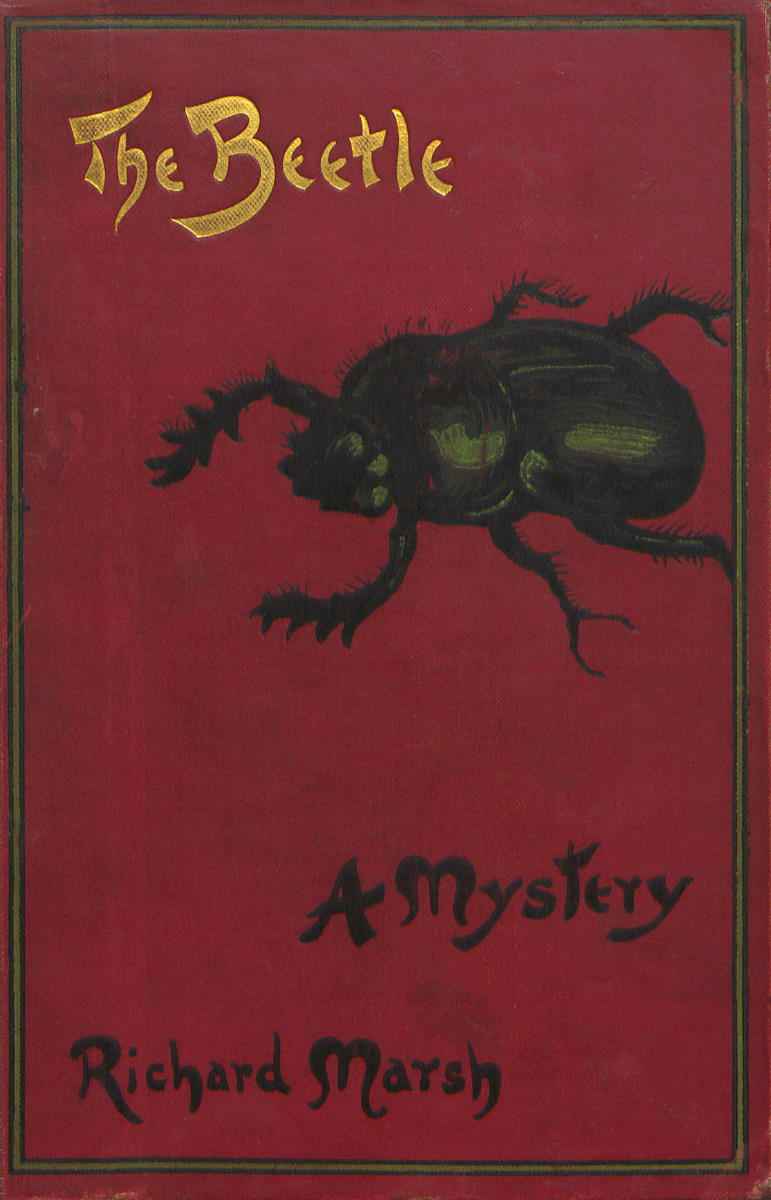
He was standing within about ten feet of where I leaned against the edge of the table. The light was full on, so that it was difficult to suppose that I could make a mistake as to what took place in front of me. As he replied to my mocking allusion to the beetle by echoing my own words, he vanished,—or, rather, I saw him taking a different shape before my eyes. His loose draperies all fell off him, and, as they were in the very act of falling, there issued, or there seemed to issue out of them, a monstrous creature of the beetle tribe,—the man himself was gone. On the point of size I wish to make myself clear. My impression, when I saw it first, was that it was as large as the man had been, and that it was, in some way, standing up on end, the legs towards me. But, the moment it came in view, it began to dwindle, and that so rapidly that, in a couple of seconds at most, a little heap of drapery was lying on the floor, on which was a truly astonishing example of the coleoptera. It appeared to be a beetle. It was, perhaps, six or seven inches high, and about a foot in length. Its scales were of a vivid golden green. I could distinctly see where the wings were sheathed along the back, and, as they seemed to be slightly agitated, I looked, every moment, to see them opened, and the thing take wing.
I was so astonished,—as who would not have been?—that for an appreciable space of time I was practically in a state of stupefaction. I could do nothing but stare. I was acquainted with the legendary transmigrations of Isis, and with the story of the beetle which issues from the woman’s womb through all eternity, and with the other pretty tales, but this, of which I was an actual spectator, was something new, even in legends. If the man, with whom I had just been speaking, was gone, where had he gone to? If this glittering creature was there, in his stead, whence had it come?
I do protest this much, that, after the first shock of surprise had passed, I retained my presence of mind. I felt as an investigator might feel, who has stumbled, haphazard, on some astounding, some epoch-making, discovery. I was conscious that I should have to make the best use of my mental faculties if I was to take full advantage of so astonishing an accident. I kept my glance riveted on the creature, with the idea of photographing it on my brain. I believe that if it were possible to take a retinal print—which it some day will be—you would have a perfect picture of what it was I saw. Beyond doubt it was a lamellicorn, one of the copridae. With the one exception of its monstrous size, there were the characteristics in plain view;—the convex body, the large head, the projecting clypeus. More, its smooth head and throat seemed to suggest that it was a female. Equally beyond a doubt, apart from its size, there were unusual features present too. The eyes were not only unwontedly conspicuous, they gleamed as if they were lighted by internal flames,—in some indescribable fashion they reminded me of my vanished visitor. The colouring was superb, and the creature appeared to have the chameleonlike faculty of lightening and darkening the shades at will. Its not least curious feature was its restlessness. It was in a state of continual agitation; and, as if it resented my inspection, the more I looked at it the more its agitation grew. As I have said, I expected every moment to see it take wing and circle through the air.
All the while I was casting about in my mind as to what means I could use to effect its capture. I did think of killing it, and, on the whole, I rather wish that I had at any rate attempted slaughter,—there were dozens of things, lying ready to my hand, any one of which would have severely tried its constitution;—but, on the spur of the moment, the only method of taking it alive which occurred to me, was to pop over it a big tin canister which had contained soda-lime. This canister was on the floor to my left. I moved towards it, as nonchalantly as I could, keeping an eye on that shining wonder all the time. Directly I moved, its agitation perceptibly increased,—it was, so to speak, all one whirr of tremblement; it scintillated, as if its coloured scales had been so many prisms; it began to unsheath its wings, as if it had finally decided that it would make use of them. Picking up the tin, disembarrassing it of its lid, I sprang towards my intended victim. Its wings opened wide; obviously it was about to rise; but it was too late. Before it had cleared the ground, the tin was over it.
It remained over it, however, for an instant only. I had stumbled, in my haste, and, in my effort to save myself from falling face foremost on to the floor, I was compelled to remove my hands from the tin. Before I was able to replace them, the tin was sent flying, and, while I was still partially recumbent, within eighteen inches of me, that beetle swelled and swelled, until it had assumed its former portentous dimensions, when, as it seemed, it was enveloped by a human shape, and in less time than no time, there stood in front of me, naked from top to toe, my truly versatile oriental friend. One startling fact nudity revealed,—that I had been egregiously mistaken on the question of sex. My visitor was not a man, but a woman, and, judging from the brief glimpse which I had of her body, by no means old or ill-shaped either.
If that transformation was not a bewildering one, then two and two make five. The most level-headed scientist would temporarily have lost his mental equipoise on witnessing such a quick change as that within a span or two of his own nose I was not only witless, I was breathless too,—I could only gape. And, while I gaped, the woman, stooping down, picking up her draperies, began to huddle them on her anyhow,—and, also, to skedaddle towards the door which led into the yard. When I observed this last manoeuvre, to some extent I did rise to the requirements of the situation. Leaping up, I rushed to stay her flight.
‘Stop!’ I shouted.
But she was too quick for me. Ere I could reach her, she had opened the door, and was through it,—and, what was more, she had slammed it in my face. In my excitement, I did some fumbling with the handle. When, in my turn, I was in the yard, she was out of sight. I did fancy I saw a dim form disappearing over the wall at the further side, and I made for it as fast as I knew how. I clambered on to the wall, looking this way and that, but there was nothing and no one to be seen. I listened for the sound of retreating footsteps, but all was still. Apparently I had the entire neighbourhood to my own sweet self. My visitor had vanished. Time devoted to pursuit I felt would be time ill-spent.
As I returned across the yard, Woodville, who still was taking his rest under the open canopy of heaven, sat up. Seemingly my approach had roused him out of slumber. At sight of me he rubbed his eyes, and yawned, and blinked.
‘I say,’ he remarked, not at all unreasonably, ‘where am I?’
‘You’re on holy—or on haunted ground,—hang me if I quite know which!—but that’s where you are, my boy.’
‘By Jove!—I am feeling queer!—I have got a headache, don’t you know.’
‘I shouldn’t be in the least surprised at anything you have, or haven’t,—I’m beyond surprise. It’s a drop of whisky you are wanting,—and what I’m wanting too,—only, for goodness sake, drop me none of your drops! Mine is a case for a bottle at the least.’
I put my arm through his, and went with him into the laboratory. And, when we were in, I shut, and locked, and barred the door.
CHAPTER XIX.
THE LADY RAGES
Dora Grayling stood in the doorway.
‘I told your servant he need not trouble to show me in,—and I’ve come without my aunt. I hope I’m not intruding.’
She was—confoundedly; and it was on the tip of my tongue to tell her so. She came into the room, with twinkling eyes, looking radiantly happy,—that sort of look which makes even a plain young woman prepossessing.
‘Am I intruding?—I believe I am.’
She held out her hand, while she was still a dozen feet away, and when I did not at once dash forward to make a clutch at it, she shook her head and made a little mouth at me.
‘What’s the matter with you?—Aren’t you well?’
I was not well,—I was very far from well. I was as unwell as I could be without being positively ill, and any person of common discernment would have perceived it at a glance. At the same time I was not going to admit anything of the kind to her.
‘Thank you,—I am perfectly well.’
‘Then, if I were you, I would endeavour to become imperfectly well; a little imperfection in that direction might make you appear to more advantage.’
‘I am afraid that that I am not one of those persons who ever do appear to much advantage,—did I not tell you so last night?’
‘I believe you did say something of the kind,—it’s very good of you to remember. Have you forgotten something else which you said to me last night?’
‘You can hardly expect me to keep fresh in my memory all the follies of which my tongue is guilty.’
‘Thank you.—That is quite enough.—Good-day.’
She turned as if to go.
‘Miss Grayling!’
‘Mr Atherton?’
‘What’s the matter?—What have I been saying now?’
‘Last night you invited me to come and see you this morning,—is that one of the follies of which your tongue was guilty?’
The engagement had escaped my recollection—it is a fact!—and my face betrayed me.
‘You had forgotten?’ Her cheeks flamed; her eyes sparkled. ‘You must pardon my stupidity for not having understood that the invitation was of that general kind which is never meant to be acted on.’
She was half way to the door before I stopped her,—I had to take her by the shoulder to do it.
‘Miss Grayling!—You are hard on me.’
‘I suppose I am.—Is anything harder than to be intruded on by an undesired, and unexpected, guest?’
‘Now you are harder still.—If you knew what I have gone through since our conversation of last night, in your strength you would be merciful.’
‘Indeed?—What have you gone through?’
I hesitated. What I actually had gone through I certainly did not propose to tell her. Other reasons apart I did not desire to seem madder than I admittedly am,—and I lacked sufficient plausibility to enable me to concoct, on the spur of the moment, a plain tale of the doings of my midnight visitor which would have suggested that the narrator was perfectly sane. So I fenced,—or tried to.
‘For one thing,—I have had no sleep.’
I had not,—not one single wink. When I did get between the sheets, ‘all night I lay in agony,’ I suffered from that worst form of nightmare,—the nightmare of the man who is wide awake. There was continually before my fevered eyes the strange figure of that Nameless Thing. I had often smiled at tales of haunted folk,—here was I one of them. My feelings were not rendered more agreeable by a strengthening conviction that if I had only retained the normal attitude of a scientific observer I should, in all probability, have solved the mystery of my oriental friend, and that his example of the genus of copridae might have been pinned,—by a very large pin!—on a piece—a monstrous piece!—of cork. It was galling to reflect that he and I had played together a game of bluff,—a game at which civilisation was once more proved to be a failure.
She could not have seen all this in my face; but she saw something—because her own look softened.
‘You do look tired.’ She seemed to be casting about in her own mind for a cause. ‘You have been worrying.’ She glanced round the big laboratory. ‘Have you been spending the night in this—wizard’s cave?’
‘Pretty well.’
‘Oh!’
The monosyllable, as she uttered it, was big with meaning. Uninvited, she seated herself in an arm-chair, a huge old thing, of shagreen leather, which would have held half a dozen of her. Demure in it she looked, like an agreeable reminiscence, alive, and a little up-to-date, of the women of long ago. Her dove grey eyes seemed to perceive so much more than they cared to show.
‘How is it that you have forgotten that you asked me to come?—didn’t you mean it?’
‘Of course I meant it.’
‘Then how is it you’ve forgotten?’
‘I didn’t forget.’
‘Don’t tell fibs.—Something is the matter,—tell me what it is.—Is it that I am too early?’
‘Nothing of the sort,—you couldn’t be too early.’
‘Thank you.—When you pay a compliment, even so neat an one as that, sometimes, you should look as if you meant it.—It is early,—I know it’s early, but afterwards I want you to come to lunch. I told aunt that I would bring you back with me.’
‘You are much better to me than I deserve.’
‘Perhaps.’ A tone came into her voice which was almost pathetic. ‘I think that to some men women are almost better than they deserve. I don’t know why. I suppose it pleases them. It is odd.’ There was a different intonation,—a dryness. ‘Have you forgotten what I came for?’
‘Not a bit of it,—I am not quite the brute I seem. You came to see an illustration of that pleasant little fancy of mine for slaughtering my fellows. The fact is, I’m hardly in a mood for that just now,—I’ve been illustrating it too much already.’
‘What do you mean?’
‘Well, for one thing it’s been murdering Lessingham’s cat.’
‘Mr Lessingham’s cat?’
‘Then it almost murdered Percy Woodville.’
‘Mr Atherton!—I wish you wouldn’t talk like that.’
‘It’s a fact. It was a question of a little matter in a wrong place, and, if it hadn’t been for something very like a miracle, he’d be dead.’
‘I wish you wouldn’t have anything to do with such things—I hate them.’
I stared.
‘Hate them?—I thought you’d come to see an illustration.’
‘And pray what was your notion of an illustration?’
‘Well, another cat would have had to be killed, at least.’
‘And do you suppose that I would have sat still while a cat was being killed for my—edification?’
‘It needn’t necessarily have been a cat, but something would have had to be killed,—how are you going to illustrate the death-dealing propensities of a weapon of that sort without it?’
‘Is it possible that you imagine that I came here to see something killed?’
‘Then for what did you come?’
I do not know what there was about the question which was startling, but as soon as it was out, she went a fiery red.
‘Because I was a fool.’
I was bewildered. Either she had got out of the wrong side of bed, or I had,—or we both had. Here she was, assailing me, hammer and tongs, so far as I could see, for absolutely nothing.
‘You are pleased to be satirical at my expense.’
‘I should not dare. Your detection of me would be so painfully rapid.’
I was in no mood for jangling. I turned a little away from her. Immediately she was at my elbow.
‘Mr Atherton?’
‘Miss Grayling.’
‘Are you cross with me?’
‘Why should I be? If it pleases you to laugh at my stupidity you are completely justified.’
‘But you are not stupid.’
‘No?—Nor you satirical.’
‘You are not stupid,—you know you are not stupid; it was only stupidity on my part to pretend that you were.’
‘It is very good of you to say so.—But I fear that I am an indifferent host. Although you would not care for an illustration, there may be other things which you might find amusing.’
‘Why do you keep on snubbing me?’
‘I keep on snubbing you!’
‘You are always snubbing me,—you know you are. Some times I feel as if I hated you.’
‘Miss Grayling!’
‘I do! I do! I do!’
‘After all, it is only natural.’
‘That is how you talk,—as if I were a child, and you were,—oh I don’t know what.—Well, Mr Atherton, I am sorry to be obliged to leave you. I have enjoyed my visit very much. I only hope I have not seemed too intrusive.’