
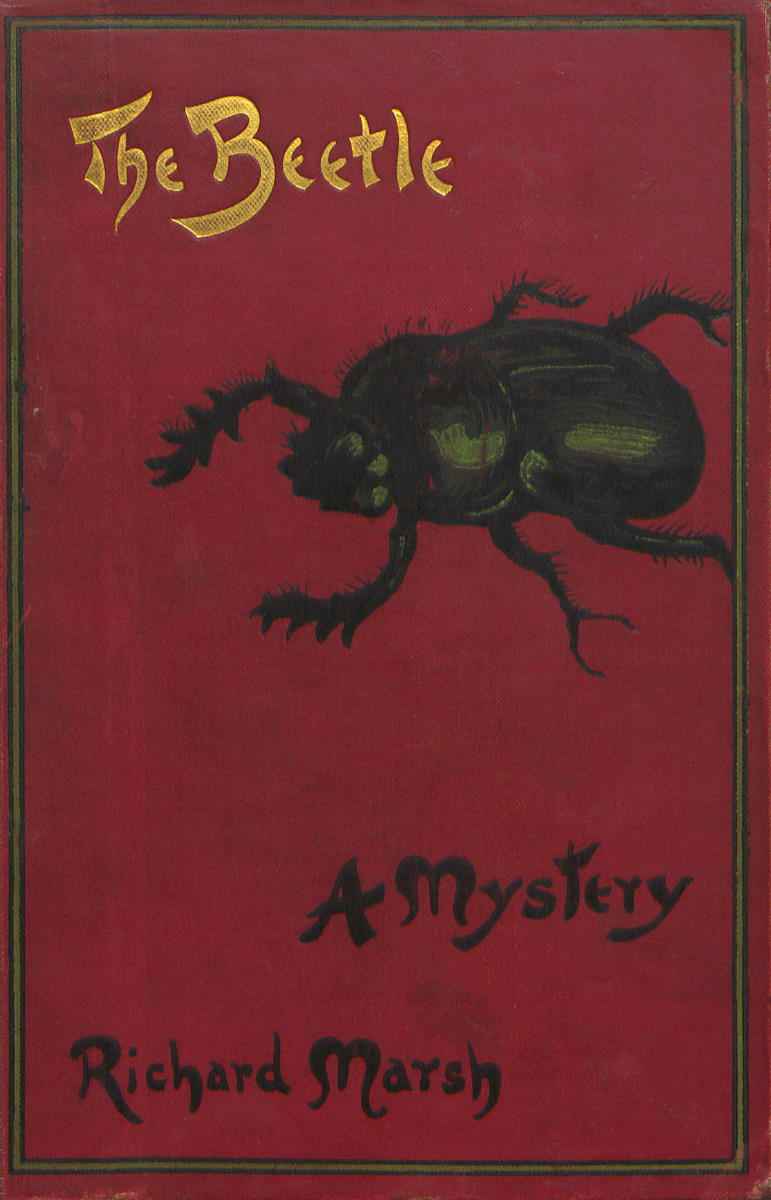
BOOK III.
The Terror by Night and the Terror by Day
Miss Marjorie Lindon tells the Tale
CHAPTER XXIII.
THE WAY HE TOLD HER
I am the happiest woman in the world! I wonder how many women have said that of themselves in their time,—but I am. Paul has told me that he loves me. How long I have made inward confession of my love for him, I should be ashamed to say. It sounds prosaic, but I believe it is a fact that the first stirring of my pulses was caused by the report of a speech of his which I read in the Times. It was on the Eight Hours’ Bill. Papa was most unflattering. He said that he was an oily spouter, an ignorant agitator, an irresponsible firebrand, and a good deal more to the same effect. I remember very well how papa fidgeted with the paper, declaring that it read even worse than it had sounded, and goodness knew that it had sounded bad enough. He was so very emphatic that when he had gone I thought I would see what all the pother was about, and read the speech for myself. So I read it. It affected me quite differently. The speaker’s words showed such knowledge, charity, and sympathy that they went straight to my heart.
After that I read everything of Paul Lessingham’s which I came across. And the more I read the more I was impressed. But it was some time before we met. Considering what papa’s opinions were, it was not likely that he would go out of his way to facilitate a meeting. To him, the mere mention of the name was like a red rag to a bull. But at last we did meet. And then I knew that he was stronger, greater, better even than his words. It is so often the other way; one finds that men, and women too, are so apt to put their best, as it were, into their shop windows, that the discovery was as novel as it was delightful.
When the ice was once broken, we often met. I do not know how it was. We did not plan our meetings,—at first, at any rate. Yet we seemed always meeting. Seldom a day passed on which we did not meet,—sometimes twice or thrice. It was odd how we were always coming across each other in the most unlikely places. I believe we did not notice it at the time, but looking back I can see that we must have managed our engagements so that somewhere, somehow, we should be certain to have an opportunity of exchanging half a dozen words. Those constant encounters could not have all been chance ones.
But I never supposed he loved me,—never. I am not even sure that, for some time, I was aware that I loved him. We were great on friendship, both of us.—I was quite aware that I was his friend,—that he regarded me as his friend; he told me so more than once.
‘I tell you this,’ he would say, referring to this, that, or the other, ‘because I know that, in speaking to you, I am speaking to a friend.’
With him those were not empty words. All kinds of people talk to one like that,—especially men; it is a kind of formula which they use with every woman who shows herself disposed to listen. But Paul is not like that. He is chary of speech; not by any means a woman’s man. I tell him that is his weakest point. If legend does not lie more even than is common, few politicians have achieved prosperity without the aid of women. He replies that he is not a politician; that he never means to be a politician. He simply wishes to work for his country; if his country does not need his services—well, let it be. Papa’s political friends have always so many axes of their own to grind, that, at first, to hear a member of Parliament talk like that was almost disquieting. I had dreamed of men like that; but I never encountered one till I met Paul Lessingham.
Our friendship was a pleasant one. It became pleasanter and pleasanter. Until there came a time when he told me everything; the dreams he dreamed; the plans which he had planned; the great purposes which, if health and strength were given him, he intended to carry to a great fulfilment. And, at last, he told me something else.
It was after a meeting at a Working Women’s Club in Westminster. He had spoken, and I had spoken too. I don’t know what papa would have said, if he had known, but I had. A formal resolution had been proposed, and I had seconded it,—in perhaps a couple of hundred words; but that would have been quite enough for papa to have regarded me as an Abandoned Wretch,—papa always puts those sort of words into capitals. Papa regards a speechifying woman as a thing of horror,—I have known him look askance at a Primrose Dame.
The night was fine. Paul proposed that I should walk with him down the Westminster Bridge Road, until we reached the House, and then he would see me into a cab. I did as he suggested. It was still early, not yet ten, and the streets were alive with people. Our conversation, as we went, was entirely political. The Agricultural Amendment Act was then before the Commons, and Paul felt very strongly that it was one of those measures which give with one hand, while taking with the other. The committee stage was at hand, and already several amendments were threatened, the effect of which would be to strengthen the landlord at the expense of the tenant. More than one of these, and they not the most moderate, were to be proposed by papa. Paul was pointing out how it would be his duty to oppose these tooth and nail, when, all at once, he stopped.
‘I sometimes wonder how you really feel upon this matter.’
‘What matter?’
‘On the difference of opinion, in political matters, which exists between your father and myself. I am conscious that Mr Lindon regards my action as a personal question, and resents it so keenly, that I am sometimes moved to wonder if at least a portion of his resentment is not shared by you.’
‘I have explained; I consider papa the politician as one person, and papa the father as quite another.’
‘You are his daughter.’
‘Certainly I am;—but would you, on that account, wish me to share his political opinions, even though I believe them to be wrong?’
‘You love him.’
‘Of course I do,—he is the best of fathers.’
‘Your defection will be a grievous disappointment.’
I looked at him out of the corner of my eye. I wondered what was passing through his mind. The subject of my relations with papa was one which, without saying anything at all about it, we had consented to taboo.
‘I am not so sure. I am permeated with a suspicion that papa has no politics.’
‘Miss Lindon!—I fancy that I can adduce proof to the contrary.’
‘I believe that if papa were to marry again, say, a Home Ruler, within three weeks his wife’s politics would be his own.’
Paul thought before he spoke; then he smiled.
‘I suppose that men sometimes do change their coats to please their wives,—even their political ones.’
‘Papa’s opinions are the opinions of those with whom he mixes. The reason why he consorts with Tories of the crusted school is because he fears that if he associated with anybody else—with Radicals, say,—before he knew it, he would be a Radical too. With him, association is synonymous with logic.’
Paul laughed outright. By this time we had reached Westminster Bridge. Standing, we looked down upon the river. A long line of lanterns was gliding mysteriously over the waters; it was a tug towing a string of barges. For some moments neither spoke. Then Paul recurred to what I had just been saying.
‘And you,—do you think marriage would colour your convictions?’
‘Would it yours?’
‘That depends.’ He was silent. Then he said, in that tone which I had learned to look for when he was most in earnest, ‘It depends on whether you would marry me.’
I was still. His words were so unexpected that they took my breath away. I knew not what to make of them. My head was in a whirl. Then he addressed to me a monosyllabic interrogation.
‘Well?’
I found my voice,—or a part of it.
‘Well?—to what?’
He came a little closer.
‘Will you be my wife?’
The part of my voice which I had found, was lost again. Tears came into my eyes. I shivered. I had not thought that I could be so absurd. Just then the moon came from behind a cloud; the rippling waters were tipped with silver. He spoke again, so gently that his words just reached my ears.
‘You know that I love you.’
Then I knew that I loved him too. That what I had fancied was a feeling of friendship was something very different. It was as if somebody, in tearing a veil from before my eyes, had revealed a spectacle which dazzled me. I was speechless. He misconstrued my silence.
‘Have I offended you?’
‘No.’
I fancy that he noted the tremor which was in my voice, and read it rightly. For he too was still. Presently his hand stole along the parapet, and fastened upon mine, and held it tight.
And that was how it came about. Other things were said; but they were hardly of the first importance. Though I believe we took some time in saying them. Of myself I can say with truth, that my heart was too full for copious speech; I was dumb with a great happiness. And, I believe, I can say the same of Paul. He told me as much when we were parting.
It seemed that we had only just come there when Paul started. Turning, he stared up at Big Ben.
‘Midnight!—The House up!—Impossible!’
But it was more than possible, it was fact. We had actually been on the Bridge two hours, and it had not seemed ten minutes. Never had I supposed that the flight of time could have been so entirely unnoticed. Paul was considerably taken aback. His legislative conscience pricked him. He excused himself—in his own fashion.
‘Fortunately, for once in a way, my business in the House was not so important as my business out of it.’
He had his arm through mine. We were standing face to face.
‘So you call this business!’
He laughed.
He not only saw me into a cab, but he saw me home in it. And in the cab he kissed me. I fancy I was a little out of sorts that night. My nervous system was, perhaps, demoralised. Because, when he kissed me, I did a thing which I never do,—I have my own standard of behaviour, and that sort of thing is quite outside of it; I behaved like a sentimental chit. I cried. And it took him all the way to my father’s door to comfort me.
I can only hope that, perceiving the singularity of the occasion, he consented to excuse me.
CHAPTER XXIV.
A WOMAN’S VIEW
Sydney Atherton has asked me to be his wife. It is not only annoying; worse, it is absurd.
This is the result of Paul’s wish that our engagement should not be announced. He is afraid of papa;—not really, but for the moment. The atmosphere of the House is charged with electricity. Party feeling runs high. They are at each other, hammer and tongs, about this Agricultural Amendment Act. The strain on Paul is tremendous. I am beginning to feel positively concerned. Little things which I have noticed about him lately convince me that he is being overwrought. I suspect him of having sleepless nights. The amount of work which he has been getting through lately has been too much for any single human being, I care not who he is. He himself admits that he shall be glad when the session is at an end. So shall I.
In the meantime, it is his desire that nothing shall be said about our engagement until the House rises. It is reasonable enough. Papa is sure to be violent,—lately, the barest allusion to Paul’s name has been enough to make him explode. When the discovery does come, he will be unmanageable,—I foresee it clearly. From little incidents which have happened recently I predict the worst. He will be capable of making a scene within the precincts of the House. And, as Paul says, there is some truth in the saying that the last straw breaks the camel’s back. He will be better able to face papa’s wild wrath when the House has risen.
So the news is to bide a wee. Of course Paul is right. And what he wishes I wish too. Still, it is not all such plain sailing for me as he perhaps thinks. The domestic atmosphere is almost as electrical as that in the House. Papa is like the terrier who scents a rat,—he is always sniffing the air. He has not actually forbidden me to speak to Paul,—his courage is not quite at the sticking point; but he is constantly making uncomfortable allusions to persons who number among their acquaintance ‘political adventurers,’ ‘grasping carpet-baggers,’ ‘Radical riff-raff,’ and that kind of thing. Sometimes I venture to call my soul my own; but such a tempest invariably follows that I become discreet again as soon as I possibly can. So, as a rule, I suffer in silence.
Still, I would with all my heart that the concealment were at an end. No one need imagine that I am ashamed of being about to marry Paul,—papa least of all. On the contrary, I am as proud of it as a woman can be. Sometimes, when he has said or done something unusually wonderful, I fear that my pride will out,—I do feel it so strong within me. I should be delighted to have a trial of strength with papa; anywhere, at any time,—I should not be so rude to him as he would be to me. At the bottom of his heart papa knows that I am the more sensible of the two; after a pitched battle or so he would understand it better still. I know papa! I have not been his daughter for all these years in vain. I feel like hot-blooded soldiers must feel, who, burning to attack the enemy in the open field, are ordered to skulk behind hedges, and be shot at.
One result is that Sydney has actually made a proposal of marriage,—he of all people! It is too comical. The best of it was that he took himself quite seriously. I do not know how many times he has confided to me the sufferings which he has endured for love of other women—some of them, I am sorry to say, decent married women too; but this is the first occasion on which the theme has been a personal one. He was so frantic, as he is wont to be, that, to calm him, I told him about Paul,—which, under the circumstances, to him I felt myself at liberty to do. In return, he was melodramatic; hinting darkly at I know not what. I was almost cross with him.
He is a curious person, Sydney Atherton. I suppose it is because I have known him all my life, and have always looked upon him, in cases of necessity, as a capital substitute for a brother, that I criticise him with so much frankness. In some respects, he is a genius; in others—I will not write fool, for that he never is, though he has often done some extremely foolish things. The fame of his inventions is in the mouths of all men; though the half of them has never been told. He is the most extraordinary mixture. The things which most people would like to have proclaimed in the street, he keeps tightly locked in his own bosom; while those which the same persons would be only too glad to conceal, he shouts from the roofs. A very famous man once told me that if Mr Atherton chose to become a specialist, to take up one branch of inquiry, and devote his life to it, his fame, before he died, would bridge the spheres. But sticking to one thing is not in Sydney’s line at all. He prefers, like the bee, to roam from flower to flower.
As for his being in love with me; it is ridiculous. He is as much in love with the moon. I cannot think what has put the idea into his head. Some girl must have been ill-using him, or he imagines that she has. The girl whom he ought to marry, and whom he ultimately will marry, is Dora Grayling. She is young, charming, immensely rich, and over head and ears in love with him;—if she were not, then he would be over head and ears in love with her. I believe he is very near it as it is,—sometimes he is so very rude to her. It is a characteristic of Sydney’s, that he is apt to be rude to a girl whom he really likes. As for Dora, I suspect she dreams of him. He is tall, straight, very handsome, with a big moustache, and the most extraordinary eyes;—I fancy that those eyes of his have as much to do with Dora’s state as anything. I have heard it said that he possesses the hypnotic power to an unusual degree, and that, if he chose to exercise it, he might become a danger to society. I believe he has hypnotised Dora.
He makes an excellent brother. I have gone to him, many and many a time, for help,—and some excellent advice I have received. I daresay I shall consult him still. There are matters of which one would hardly dare to talk to Paul. In all things he is the great man. He could hardly condescend to chiffons. Now Sydney can and does. When he is in the mood, on the vital subject of trimmings a woman could not appeal to a sounder authority. I tell him, if he had been a dressmaker, he would have been magnificent. I am sure he would.
CHAPTER XXV.
THE MAN IN THE STREET
This morning I had an adventure.
I was in the breakfast-room. Papa, as usual, was late for breakfast, and I was wondering whether I should begin without him, when, chancing to look round, something caught my eye in the street. I went to the window to see what it was. A small crowd of people was in the middle of the road, and they were all staring at something which, apparently, was lying on the ground. What it was I could not see.
The butler happened to be in the room. I spoke to him.
‘Peter, what is the matter in the street? Go and see.’
He went and saw; and, presently, he returned. Peter is an excellent servant; but the fashion of his speech, even when conveying the most trivial information, is slightly sesquipedalian. He would have made a capital cabinet minister at question time,—he wraps up the smallest portions of meaning in the largest possible words.
‘An unfortunate individual appears to have been the victim of a catastrophe. I am informed that he is dead. The constable asserts that he is drunk.’
‘Drunk?—dead? Do you mean that he is dead drunk?—at this hour!’
‘He is either one or the other. I did not behold the individual myself. I derived my information from a bystander.’
That was not sufficiently explicit for me. I gave way to a, seemingly, quite causeless impulse of curiosity, I went out into the street, just as I was, to see for myself. It was, perhaps, not the most sensible thing I could have done, and papa would have been shocked; but I am always shocking papa. It had been raining in the night, and the shoes which I had on were not so well suited as they might have been for an encounter with the mud.
I made my way to the point of interest.
‘What’s the matter?’ I asked.
A workman, with a bag of tools over his shoulder, answered me.
‘There’s something wrong with someone. Policeman says he’s drunk, but he looks to me as if he was something worse.’
‘Will you let me pass, please?’
When they saw I was a woman, they permitted me to reach the centre of the crowd.
A man was lying on his back, in the grease and dirt of the road. He was so plastered with mud, that it was difficult, at first, to be sure that he really was a man. His head and feet were bare. His body was partially covered by a long ragged cloak. It was obvious that that one wretched, dirt-stained, sopping wet rag was all the clothing he had on. A huge constable was holding his shoulders in his hands, and was regarding him as if he could not make him out at all. He seemed uncertain as to whether it was or was not a case of shamming.
He spoke to him as if he had been some refractory child.
‘Come, my lad, this won’t do!—Wake up!—What’s the matter?’
But he neither woke up, nor explained what was the matter. I took hold of his hand. It was icy cold. Apparently the wrist was pulseless. Clearly this was no ordinary case of drunkenness.
‘There is something seriously wrong, officer. Medical assistance ought to be had at once.’
‘Do you think he’s in a fit, miss?’
‘That a doctor should be able to tell you better than I can. There seems to be no pulse. I should not be surprised to find that he was—’
The word ‘dead’ was actually on my lips, when the stranger saved me from making a glaring exposure of my ignorance by snatching his wrist away from me, and sitting up in the mud. He held out his hands in front of him, opened his eyes, and exclaimed, in a loud, but painfully raucous tone of voice, as if he was suffering from a very bad cold,
‘Paul Lessingham!’
I was so surprised that I all but sat down in the mud. To hear Paul—my Paul!—apostrophised by an individual of his appearance, in that fashion, was something which I had not expected. Directly the words were uttered, he closed his eyes again, sank backward, and seemingly relapsed into unconsciousness,—the constable gripping him by the shoulder just in time to prevent him banging the back of his head against the road.
The officer shook him,—scarcely gently.
‘Now, my lad, it’s plain that you’re not dead!—What’s the meaning of this?—Move yourself!’
Looking round I found that Peter was close behind. Apparently he had been struck by the singularity of his mistress’ behaviour, and had followed to see that it did not meet with the reward which it deserved. I spoke to him.
‘Peter, let someone go at once for Dr Cotes!’
Dr Cotes lives just round the corner, and since it was evident that the man’s lapse into consciousness had made the policeman sceptical as to his case being so serious as it seemed, I thought it might be advisable that a competent opinion should be obtained without delay.
Peter was starting, when again the stranger returned to consciousness,—that is, if it really was consciousness, as to which I was more than a little in doubt. He repeated his previous pantomime; sat up in the mud, stretched out his arms, opened his eyes unnaturally wide,—and yet they appeared unseeing!—a sort of convulsion went all over him, and he shrieked—it really amounted to shrieking—as a man might shriek who was in mortal terror.
‘Be warned, Paul Lessingham—be warned!’
For my part, that settled it. There was a mystery here which needed to be unravelled. Twice had he called upon Paul’s name,—and in the strangest fashion! It was for me to learn the why and the wherefore; to ascertain what connection there was between this lifeless creature and Paul Lessingham. Providence might have cast him there before my door. I might be entertaining an angel unawares. My mind was made up on the instant.
‘Peter, hasten for Dr Cotes.’ Peter passed the word, and immediately a footman started running as fast as his legs would carry him. ‘Officer, I will have this man taken into my father’s house.—Will some of you men help to carry him?’
There were volunteers enough, and to spare. I spoke to Peter in the hall.
‘Is papa down yet?’
‘Mr Lindon has sent down to say that you will please not wait for him for breakfast. He has issued instructions to have his breakfast conveyed to him upstairs.’
‘That’s all right.’ I nodded towards the poor wretch who was being carried through the hall. ‘You will say nothing to him about this unless he particularly asks. You understand?’
Peter bowed. He is discretion itself. He knows I have my vagaries, and it is not his fault if the savour of them travels to papa.
The doctor was in the house almost as soon as the stranger.
‘Wants washing,’ he remarked, directly he saw him.
And that certainly was true,—I never saw a man who stood more obviously in need of the good offices of soap and water. Then he went through the usual medical formula, I watching all the while. So far as I could see the man showed not the slightest sign of life.
‘Is he dead?’
‘He will be soon, if he doesn’t have something to eat. The fellow’s starving.’
The doctor asked the policeman what he knew of him.
That sagacious officer’s reply was vague. A boy had run up to him crying that a man was lying dead in the street. He had straightway followed the boy, and discovered the stranger. That was all he knew.
‘What is the matter with the man?’ I inquired of the doctor, when the constable had gone.
‘Don’t know.—It may be catalepsy, and it mayn’t.—When I do know, you may ask again.’
Dr Cotes’ manner was a trifle brusque,—particularly, I believe, to me. I remember that once he threatened to box my ears. When I was a small child I used to think nothing of boxing his.
Realising that no satisfaction was to be got out of a speechless man—particularly as regards his mysterious references to Paul—I went upstairs. I found that papa was under the impression that he was suffering from a severe attack of gout. But as he was eating a capital breakfast, and apparently enjoying it,—while I was still fasting—I ventured to hope that the matter was not so serious as he feared.
I mentioned nothing to him about the person whom I had found in the street,—lest it should aggravate his gout. When he is like that, the slightest thing does.
CHAPTER XXVI.
A FATHER’S NO
Paul has stormed the House of Commons with one of the greatest speeches which even he has delivered, and I have quarrelled with papa. And, also, I have very nearly quarrelled with Sydney.
Sydney’s little affair is nothing. He actually still persists in thinking himself in love with me,—as if, since last night, when he what he calls ‘proposed’ to me, he has not time to fall out of love, and in again, half a dozen times; and, on the strength of it, he seems to consider himself entitled to make himself as disagreeable as he can. That I should not mind,—for Sydney disagreeable is about as nice as Sydney any other way; but when it comes to his shooting poisoned shafts at Paul, I object. If he imagines that anything he can say, or hint, will lessen my estimation of Paul Lessingham by one hair’s breadth, he has less wisdom even than I gave him credit for. By the way, Percy Woodville asked me to be his wife to-night,—which, also, is nothing; he has been trying to do it for the last three years,—though, under the circumstances, it is a little trying; but he would not spit venom merely because I preferred another man,—and he, I believe, does care for me.
Papa’s affair is serious. It is the first clashing of the foils,—and this time, I imagine, the buttons are really off. This morning he said a few words, not so much to, as at me. He informed me that Paul was expected to speak to-night,—as if I did not know it!—and availed himself of the opening to load him with the abuse which, in his case, he thinks is not unbecoming to a gentleman. I don’t know—or, rather, I do know what he would think, if he heard another man use, in the presence of a woman, the kind of language which he habitually employs. However, I said nothing. I had a motive for allowing the chaff to fly before the wind.
But, to-night, issue was joined.
I, of course, went to hear Paul speak,—as I have done over and over again before. Afterwards, Paul came and fetched me from the cage. He had to leave me for a moment, while he gave somebody a message; and in the lobby, there was Sydney,—all sneers! I could have pinched him. Just as I was coming to the conclusion that I should have to stick a pin into his arm, Paul returned,—and, positively, Sydney was rude to him. I was ashamed, if Mr Atherton was not. As if it was not enough that he should be insulted by a mere popinjay, at the very moment when he had been adding another stone to the fabric of his country’s glory,—papa came up. He actually wanted to take me away from Paul. I should have liked to see him do it. Of course I went down with Paul to the carriage, leaving papa to follow if he chose. He did not choose,—but, none the less, he managed to be home within three minutes after I had myself returned.
Then the battle began.
It is impossible for me to give an idea of papa in a rage. There may be men who look well when they lose their temper, but, if there are, papa is certainly not one. He is always talking about the magnificence, and the high breeding of the Lindons, but anything less high-bred than the head of the Lindons, in his moments of wrath, it would be hard to conceive. His language I will not attempt to portray,—but his observations consisted, mainly, of abuse of Paul, glorification of the Lindons, and orders to me.
‘I forbid you—I forbid you—’ when papa wishes to be impressive he repeats his own words three or four times over; I don’t know if he imagines that they are improved by repetition; if he does, he is wrong—‘I forbid you ever again to speak to that—that—that—’
Here followed language.
I was silent.
My cue was to keep cool. I believe that, with the exception, perhaps, of being a little white, and exceedingly sorry that papa should so forget himself, I was about the same as I generally am.
‘Do you hear me?—do you hear what I say?—do you hear me, miss?’
‘Yes, papa; I hear you.’
‘Then—then—then promise me!—promise that you will do as I tell you!—mark my words, my girl, you shall promise before you leave this room!’
‘My dear papa!—do you intend me to spend the remainder of my life in the drawing-room?’
‘Don’t you be impertinent!—do-do-don’t you speak to me like that!—I—I—I won’t have it!’
‘I tell you what it is, papa, if you don’t take care you’ll have another attack of gout.’
‘Damn gout.’
That was the most sensible thing he said; if such a tormentor as gout can be consigned to the nether regions by the mere utterance of a word, by all means let the word be uttered. Off he went again.
‘The man’s a ruffianly, rascally,—’ and so on. ‘There’s not such a villainous vagabond—’ and all the rest of it. ‘And I order you,—I’m a Lindon, and I order you! I’m your father, and I order you!—I order you never to speak to such a—such a’—various vain repetitions—‘again, and—and—and I order you never to look at him!’
‘Listen to me, papa. I will promise you never to speak to Paul Lessingham again, if you will promise me never to speak to Lord Cantilever again,—or to recognise him if you meet him in the street.’
You should have seen how papa glared. Lord Cantilever is the head of his party. Its august, and, I presume, reverenced leader. He is papa’s particular fetish. I am not sure that he does regard him as being any lower than the angels, but if he does it is certainly something in decimals. My suggestion seemed as outrageous to him as his suggestion seemed to me. But it is papa’s misfortune that he can only see one side of a question,—and that’s his own.
‘You—you dare to compare Lord Cantilever to—to that—that—that—!’
‘I am not comparing them. I am not aware of there being anything in particular against Lord Cantilever,—that is against his character. But, of course, I should not dream of comparing a man of his calibre, with one of real ability, like Paul Lessingham. It would be to treat his lordship with too much severity.’
I could not help it,—but that did it. The rest of papa’s conversation was a jumble of explosions. It was all so sad.
Papa poured all the vials of his wrath upon Paul,—to his own sore disfigurement. He threatened me with all the pains and penalties of the inquisition if I did not immediately promise to hold no further communication with Mr Lessingham,—of course I did nothing of the kind. He cursed me, in default, by bell, book, and candle,—and by ever so many other things beside. He called me the most dreadful names,—me! his only child. He warned me that I should find myself in prison before I had done,—I am not sure that he did not hint darkly at the gallows. Finally, he drove me from the room in a whirlwind of anathemas.
CHAPTER XXVII.
THE TERROR BY NIGHT
When I left papa,—or, rather, when papa had driven me from him—I went straight to the man whom I had found in the street. It was late, and I was feeling both tired and worried, so that I only thought of seeing for myself how he was. In some way, he seemed to be a link between Paul and myself, and as, at that moment, links of that kind were precious, I could not have gone to bed without learning something of his condition.
The nurse received me at the door.
‘Well, nurse, how’s the patient?’
Nurse was a plump, motherly woman, who had attended more than one odd protégé of mine, and whom I kept pretty constantly at my beck and call. She held out her hands.
‘It’s hard to tell. He hasn’t moved since I came.’
‘Not moved?—Is he still insensible?’
‘He seems to me to be in some sort of trance. He does not appear to breathe, and I can detect no pulsation, but the doctor says he’s still alive,—it’s the queerest case I ever saw.’
I went farther into the room. Directly I did so the man in the bed gave signs of life which were sufficiently unmistakable. Nurse hastened to him.
‘Why,’ she exclaimed, ‘he’s moving!—he might have heard you enter!’
He not only might have done, but it seemed possible that that was what he actually had done. As I approached the bed, he raised himself to a sitting posture, as, in the morning, he had done in the street, and he exclaimed, as if he addressed himself to someone whom he saw in front of him,—I cannot describe the almost more than human agony which was in his voice,
‘Paul Lessingham!—Beware!—The Beetle!’
What he meant I had not the slightest notion. Probably that was why what seemed more like a pronouncement of delirium than anything else had such an extraordinary effect upon my nerves. No sooner had he spoken than a sort of blank horror seemed to settle down upon my mind. I actually found myself trembling at the knees. I felt, all at once, as if I was standing in the immediate presence of something awful yet unseen.
As for the speaker, no sooner were the words out of his lips, than, as was the case in the morning, he relapsed into a condition of trance. Nurse, bending over him, announced the fact.
‘He’s gone off again!—What an extraordinary thing!—I suppose it is real.’ It was clear, from the tone of her voice, that she shared the doubt which had troubled the policeman. ‘There’s not a trace of a pulse. From the look of things he might be dead. Of one thing I’m sure, that there’s something unnatural about the man. No natural illness I ever heard of, takes hold of a man like this.’
Glancing up, she saw that there was something unusual in my face; an appearance which startled her.
‘Why, Miss Marjorie, what’s the matter!—You look quite ill!’
I felt ill, and worse than ill; but, at the same time, I was quite incapable of describing what I felt to nurse. For some inscrutable reason I had even lost the control of my tongue,—I stammered.
‘I—I—I’m not feeling very well, nurse; I—I—I think I’ll be better in bed.’
As I spoke, I staggered towards the door, conscious, all the while, that nurse was staring at me with eyes wide open. When I got out of the room, it seemed, in some incomprehensible fashion, as if something had left it with me, and that It and I were alone together in the corridor. So overcome was I by the consciousness of its immediate propinquity, that, all at once, I found myself cowering against the wall,—as if I expected something or someone to strike me.
How I reached my bedroom I do not know. I found Fanchette awaiting me. For the moment her presence was a positive comfort,—until I realised the amazement with which she was regarding me.
‘Mademoiselle is not well?’
‘Thank you, Fanchette, I—I am rather tired. I will undress myself to-night—you can go to bed.’
‘But if mademoiselle is so tired, will she not permit me to assist her?’
The suggestion was reasonable enough,—and kindly too; for, to say the least of it, she had as much cause for fatigue as I had. I hesitated. I should have liked to throw my arms about her neck, and beg her not to leave me; but, the plain truth is, I was ashamed. In my inner consciousness I was persuaded that the sense of terror which had suddenly come over me was so absolutely causeless, that I could not bear the notion of playing the craven in my maid’s eyes. While I hesitated, something seemed to sweep past me through the air, and to brush against my cheek in passing. I caught at Fanchette’s arm.
‘Fanchette!—Is there something with us in the room?’
‘Something with us in the room?—Mademoiselle?—What does mademoiselle mean?’
She looked disturbed,—which was, on the whole, excusable. Fanchette is not exactly a strong-minded person, and not likely to be much of a support when a support was most required. If I was going to play the fool, I would be my own audience. So I sent her off.
‘Did you not hear me tell you that I will undress myself?—you are to go to bed.’
She went to bed,—with quite sufficient willingness.
The instant that she was out of the room I wished that she was back again. Such a paroxysm of fear came over me, that I was incapable of stirring from the spot on which I stood, and it was all I could do to prevent myself from collapsing in a heap on the floor. I had never, till then, had reason to suppose that I was a coward. Nor to suspect myself of being the possessor of ‘nerves.’ I was as little likely as anyone to be frightened by shadows. I told myself that the whole thing was sheer absurdity, and that I should be thoroughly ashamed of my own conduct when the morning came.
‘If you don’t want to be self-branded as a contemptible idiot, Marjorie Lindon, you will call up your courage, and these foolish fears will fly.’
But it would not do. Instead of flying, they grew worse. I became convinced,—and the process of conviction was terrible beyond words!—that there actually was something with me in the room, some invisible horror,—which, at any moment, might become visible. I seemed to understand—with a sense of agony which nothing can describe!—that this thing which was with me was with Paul. That we were linked together by the bond of a common, and a dreadful terror. That, at that moment, that same awful peril which was threatening me, was threatening him, and that I was powerless to move a finger in his aid. As with a sort of second sight, I saw out of the room in which I was, into another, in which Paul was crouching on the floor, covering his face with his hands, and shrieking. The vision came again and again with a degree of vividness of which I cannot give the least conception. At last the horror, and the reality of it, goaded me to frenzy.
‘Paul! Paul!’ I screamed.
As soon as I found my voice, the vision faded. Once more I understood that, as a matter of simple fact, I was standing in my own bedroom; that the lights were burning brightly; that I had not yet commenced to remove a particle of dress.
‘Am I going mad?’ I wondered.
I had heard of insanity taking extraordinary forms, but what could have caused softening of the brain in me I had not the faintest notion. Surely that sort of thing does not come on one—in such a wholly unmitigated form!—without the slightest notice,—and that my mental faculties were sound enough a few minutes back I was certain. The first premonition of anything of the kind had come upon me with the melodramatic utterance of the man I had found in the street.
‘Paul Lessingham!—Beware!—The Beetle!’
The words were ringing in my ears.—What was that?—There was a buzzing sound behind me. I turned to see what it was. It moved as I moved, so that it was still at my back. I swung, swiftly, right round on my heels. It still eluded me,—it was still behind.
I stood and listened,—what was it that hovered so persistently at my back?
The buzzing was distinctly audible. It was like the humming of a bee. Or—could it be a beetle?
My whole life long I have had an antipathy to beetles,—of any sort or kind. I have objected neither to rats nor mice, nor cows, nor bulls, nor snakes, nor spiders, nor toads, nor lizards, nor any of the thousand and one other creatures, animate or otherwise, to which so many people have a rooted, and, apparently, illogical dislike. My pet—and only—horror has been beetles. The mere suspicion of a harmless, and, I am told, necessary cockroach, being within several feet has always made me seriously uneasy. The thought that a great, winged beetle—to me, a flying beetle is the horror of horrors!—was with me in my bedroom,—goodness alone knew how it had got there!—was unendurable. Anyone who had beheld me during the next few moments would certainly have supposed I was deranged. I turned and twisted, sprang from side to side, screwed myself into impossible positions, in order to obtain a glimpse of the detested visitant,—but in vain. I could hear it all the time; but see it—never! The buzzing sound was continually behind.
The terror returned,—I began to think that my brain must be softening. I dashed to the bed. Flinging myself on my knees, I tried to pray. But I was speechless,—words would not come; my thoughts would not take shape. I all at once became conscious, as I struggled to ask help of God, that I was wrestling with something evil,—that if I only could ask help of Him, evil would flee. But I could not. I was helpless,—overmastered. I hid my face in the bedclothes, cramming my fingers into my ears. But the buzzing was behind me all the time.
I sprang up, striking out, blindly, wildly, right and left, hitting nothing,—the buzzing always came from a point at which, at the moment, I was not aiming.
I tore off my clothes. I had on a lovely frock which I had worn for the first time that night; I had had it specially made for the occasion of the Duchess’ ball, and—more especially—in honour of Paul’s great speech. I had said to myself, when I saw my image in a mirror, that it was the most exquisite gown I had ever had, that it suited me to perfection, and that it should continue in my wardrobe for many a day, if only as a souvenir of a memorable night. Now, in the madness of my terror, all reflections of that sort were forgotten. My only desire was to away with it. I tore it off anyhow, letting it fall in rags on the floor at my feet. All else that I had on I flung in the same way after it; it was a veritable holocaust of dainty garments,—I acting as relentless executioner who am, as a rule, so tender with my things. I leaped upon the bed, switched off the electric light, hurried into bed, burying myself, over head and all, deep down between the sheets.
I had hoped that by shutting out the light, I might regain my senses. That in the darkness I might have opportunity for sane reflection. But I had made a grievous error. I had exchanged bad for worse. The darkness lent added terrors. The light had not been out five seconds before I would have given all that I was worth to be able to switch it on again.
As I cowered beneath the bedclothes I heard the buzzing sound above my head,—the sudden silence of the darkness had rendered it more audible than it had been before. The thing, whatever it was, was hovering above the bed. It came nearer and nearer; it grew clearer and clearer. I felt it alight upon the coverlet;—shall I ever forget the sensations with which I did feel it? It weighed upon me like a ton of lead. How much of the seeming weight was real, and how much imaginary, I cannot pretend to say; but that it was much heavier than any beetle I have ever seen or heard of, I am sure.
For a time it was still,—and during that time I doubt if I even drew my breath. Then I felt it begin to move, in wobbling fashion, with awkward, ungainly gait, stopping every now and then, as if for rest. I was conscious that it was progressing, slowly, yet surely, towards the head of the bed. The emotion of horror with which I realised what this progression might mean, will be, I fear, with me to the end of my life,—not only in dreams, but too often, also, in my waking hours. My heart, as the Psalmist has it, melted like wax within me. I was incapable of movement,—dominated by something as hideous as, and infinitely more powerful than, the fascination of the serpent.
When it reached the head of the bed, what I feared—with what a fear!—would happen, did happen. It began to find its way inside,—to creep between the sheets; the wonder is I did not die! I felt it coming nearer and nearer, inch by inch; I knew that it was upon me, that escape there was none; I felt something touch my hair.
And then oblivion did come to my aid. For the first time in my life I swooned.
CHAPTER XXVIII.
THE STRANGE STORY OF THE MAN IN THE STREET
I have been anticipating for some weeks past, that things would become exciting,—and they have. But hardly in the way which I foresaw. It is the old story of the unexpected happening. Suddenly events of the most extraordinary nature have come crowding on me from the most unlooked-for quarters.
Let me try to take them in something like their proper order.
To begin with, Sydney has behaved very badly. So badly that it seems likely that I shall have to re-cast my whole conception of his character. It was nearly nine o’clock this morning when I,—I cannot say woke up, because I do not believe that I had really been asleep—but when I returned to consciousness. I found myself sitting up in bed, trembling like some frightened child. What had actually happened to me I did not know,—could not guess. I was conscious of an overwhelming sense of nausea, and, generally, I was feeling very far from well. I endeavoured to arrange my thoughts, and to decide upon some plan of action. Finally, I decided to go for advice and help where I had so often gone before,—to Sydney Atherton.
I went to him. I told him the whole gruesome story. He saw, he could not help but see what a deep impress the events of the night had made on me. He heard me to the end with every appearance of sympathy,—and then all at once I discovered that all the time papa had been concealed behind a large screen which was in the room, listening to every word I had been uttering. That I was dumfoundered, goes without saying. It was bad enough in papa, but in Sydney it seemed, and it was, such treachery. He and I have told each other secrets all our lives; it has never entered my imagination, as he very well knows, to play him false, in one jot or tittle; and I have always understood that, in this sort of matter, men pride themselves on their sense of honour being so much keener than women’s. I told them some plain truths; and I fancy that I left them both feeling heartily ashamed of themselves.
One result the experience had on me,—it wound me up. It had on me the revivifying effect of a cold douche. I realised that mine was a situation in which I should have to help myself.
When I returned home I learned that the man whom I had found in the street was himself again, and was as conscious as he was ever likely to be. Burning with curiosity to learn the nature of the connection which existed between Paul and him, and what was the meaning of his oracular apostrophes, I merely paused to remove my hat before hastening into his apartment.
When he saw me, and heard who I was, the expressions of his gratitude were painful in their intensity. The tears streamed down his cheeks. He looked to me like a man who had very little life left in him. He looked weak, and white, and worn to a shadow. Probably he never had been robust, and it was only too plain that privation had robbed him of what little strength he had ever had. He was nothing else but skin and bone. Physical and mental debility was written large all over him.
He was not bad-looking,—in a milk and watery sort of way. He had pale blue eyes and very fair hair, and, I daresay, at one time, had been a spruce enough clerk. It was difficult to guess his age, one ages so rapidly under the stress of misfortune, but I should have set him down as being about forty. His voice, though faint enough at first, was that of an educated man, and as he went on, and gathered courage, and became more and more in earnest, he spoke with a simple directness which was close akin to eloquence. It was a curious story which he had to tell.
So curious, so astounding indeed, that, by the time it was finished, I was in such a state of mind, that I could perceive no alternative but to forgive Sydney, and, in spite of his recent, and scandalous misbehaviour, again appeal to him for assistance. It seemed, if the story told by the man whom I had found in the street was true,—and incredible though it sounded, he spoke like a truthful man!—that Paul was threatened by some dreadful, and, to me, wholly incomprehensible danger; that it was a case in which even moments were precious; and I felt that, with the best will in the world, it was a position in which I could not move alone. The shadow of the terror of the night was with me still, and with that fresh in my recollection how could I hope, single-handed, to act effectually against the mysterious being of whom this amazing tale was told? No! I believed that Sydney did care for me, in his own peculiar way; I knew that he was quick, and cool, and fertile in resource, and that he showed to most advantage in a difficult situation; it was possible that he had a conscience, of a sort, and that, this time, I might not appeal to it in vain.
So I sent a servant off to fetch him, helter skelter.
As luck would have it, the servant returned with him within five minutes. It appeared that he had been lunching with Dora Grayling, who lives just at the end of the street, and the footman had met him coming down the steps. I had him shown into my own room.
‘I want you to go to the man whom I found in the street, and listen to what he has to say.’
‘With pleasure.’
‘Can I trust you?’
‘To listen to what he has to say?—I believe so.’
‘Can I trust you to respect my confidence?’
He was not at all abashed,—I never saw Sydney Atherton when he was abashed. Whatever the offence of which he has been guilty, he always seems completely at his ease. His eyes twinkled.
‘You can,—I will not breathe a syllable even to papa.’
‘In that case, come! But, you understand, I am going to put to the test the affirmations which you have made during all these years, and to prove if you have any of the feeling for me which you pretend.’
Directly we were in the stranger’s room, Sydney marched straight up to the bed, stared at the man who was lying in it, crammed his hands into his trouser pockets, and whistled. I was amazed.
‘So!’ he exclaimed. ‘It’s you!’
‘Do you know this man?’ I asked.
‘I am hardly prepared to go so far as to say that I know him, but, I chance to have a memory for faces, and it happens that I have met this gentleman on at least one previous occasion. Perhaps he remembers me.—Do you?’
The stranger seemed uneasy,—as if he found Sydney’s tone and manner disconcerting.
‘I do. You are the man in the street.’
‘Precisely. I am that—individual. And you are the man who came through the window. And in a much more comfortable condition you appear to be than when first I saw you.’ Sydney turned to me. ‘It is just possible, Miss Lindon, that I may have a few remarks to make to this gentleman which would be better made in private,—if you don’t mind.’
‘But I do mind,—I mind very much. What do you suppose I sent for you here for?’
Sydney smiled that absurd, provoking smile of his,—as if the occasion were not sufficiently serious.
‘To show that you still repose in me a vestige of your confidence.’
‘Don’t talk nonsense. This man has told me a most extraordinary story, and I have sent for you—as you may believe, not too willingly’—Sydney bowed—‘in order that he may repeat it in your presence, and in mine.’
‘Is that so?—Well!—Permit me to offer you a chair,—this tale may turn out to be a trifle long.’
To humour him I accepted the chair he offered, though I should have preferred to stand;—he seated himself on the side of the bed, fixing on the stranger those keen, quizzical, not too merciful, eyes of his.
‘Well, sir, we are at your service,—if you will be so good as to favour us with a second edition of that pleasant yarn you have been spinning. But—let us begin at the right end!—what’s your name?’
‘My name is Robert Holt.’
‘That so?—Then, Mr Robert Holt,—let her go!’
Thus encouraged, Mr Holt repeated the tale which he had told me, only in more connected fashion than before. I fancy that Sydney’s glances exercised on him a sort of hypnotic effect, and this kept him to the point,—he scarcely needed a word of prompting from the first syllable to the last.
He told how, tired, wet, hungry, desperate, despairing, he had been refused admittance to the casual ward,—that unfailing resource, as one would have supposed, of those who had abandoned even hope. How he had come upon an open window in an apparently empty house, and, thinking of nothing but shelter from the inclement night, he had clambered through it. How he had found himself in the presence of an extraordinary being, who, in his debilitated and nervous state, had seemed to him to be only half human. How this dreadful creature had given utterance to wild sentiments of hatred towards Paul Lessingham,—my Paul! How he had taken advantage of Holt’s enfeebled state to gain over him the most complete, horrible, and, indeed, almost incredible ascendency. How he actually had sent Holt, practically naked, into the storm-driven streets, to commit burglary at Paul’s house,—and how he,—Holt,—had actually gone without being able to offer even a shadow of opposition. How Paul, suddenly returning home, had come upon Holt engaged in the very act of committing burglary, and how, on his hearing Holt make a cabalistic reference to some mysterious beetle, the manhood had gone out of him, and he had suffered the intruder to make good his escape without an effort to detain him.
The story had seemed sufficiently astonishing the first time, it seemed still more astonishing the second,—but, as I watched Sydney listening, what struck me chiefly was the conviction that he had heard it all before. I charged him with it directly Holt had finished.
‘This is not the first time you have been told this tale.’
‘Pardon me,—but it is. Do you suppose I live in an atmosphere of fairy tales?’
Something in his manner made me feel sure he was deceiving me.
‘Sydney!—Don’t tell me a story!—Paul has told you!’
‘I am not telling you a story,—at least, on this occasion; and Mr Lessingham has not told me. Suppose we postpone these details to a little later. And perhaps, in the interim, you will permit me to put a question or two to Mr Holt.’
I let him have his way,—though I knew he was concealing something from me; that he had a more intimate acquaintance with Mr Holt’s strange tale than he chose to confess. And, for some cause, his reticence annoyed me.
He looked at Mr Holt in silence for a second or two. Then he said, with the quizzical little air of bland impertinence which is peculiarly his own,
‘I presume, Mr Holt, you have been entertaining us with a novelty in fables, and that we are not expected to believe this pleasant little yarn of yours.’
‘I expect nothing. But I have told you the truth. And you know it.’
This seemed to take Sydney aback.
‘I protest that, like Miss Lindon, you credit me with a more extensive knowledge than I possess. However, we will let that pass.—I take it that you paid particular attention to this mysterious habitant of this mysterious dwelling.’
I saw that Mr Holt shuddered.
‘I am not likely ever to forget him.’
‘Then, in that case, you will be able to describe him to us.’
‘To do so adequately would be beyond my powers. But I will do my best.’
If the original was more remarkable than the description which he gave of him, then he must have been remarkable indeed. The impression conveyed to my mind was rather of a monster than a human being. I watched Sydney attentively as he followed Mr Holt’s somewhat lurid language, and there was something in his demeanour which made me more and more persuaded that he was more behind the scenes in this strange business than he pretended, or than the speaker suspected. He put a question which seemed uncalled for by anything which Mr Holt had said.
‘You are sure this thing of beauty was a man?’
‘No, sir, that is exactly what I am not sure.’
There was a note in Sydney’s voice which suggested that he had received precisely the answer which he had expected.
‘Did you think it was a woman?’
‘I did think so, more than once. Though I can hardly explain what made me think so. There was certainly nothing womanly about the face.’ He paused, as if to reflect. Then added, ‘I suppose it was a question of instinct.’
‘I see.—Just so.—It occurs to me, Mr Holt, that you are rather strong on questions of instinct.’ Sydney got off the bed. He stretched himself, as if fatigued,—which is a way he has. ‘I will not do you the injustice to hint that I do not believe a word of your charming, and simple, narrative. On the contrary, I will demonstrate my perfect credence by remarking that I have not the slightest doubt that you will be able to point out to me, for my particular satisfaction, the delightful residence on which the whole is founded.’
Mr Holt coloured,—Sydney’s tone could scarcely have been more significant.
‘You must remember, sir, that it was a dark night, that I had never been in that neighbourhood before, and that I was not in a condition to pay much attention to locality.’
‘All of which is granted, but—how far was it from Hammersmith Workhouse?’
‘Possibly under half a mile.’
‘Then, in that case, surely you can remember which turning you took on leaving Hammersmith Workhouse,—I suppose there are not many turnings you could have taken.’
‘I think I could remember.’
‘Then you shall have an opportunity to try. It isn’t a very far cry to Hammersmith,—don’t you think you are well enough to drive there now, just you and I together in a cab?’
‘I should say so. I wished to get up this morning. It is by the doctor’s orders I have stayed in bed.’
‘Then, for once in a while, the doctor’s orders shall be ignored,—I prescribe fresh air.’ Sydney turned to me. ‘Since Mr Holt’s wardrobe seems rather to seek, don’t you think a suit of one of the men might fit him,—if Mr Holt wouldn’t mind making shift for the moment?—Then, by the time you’ve finished dressing, Mr Holt, I shall be ready.’
While they were ascertaining which suit of clothes would be best adapted to his figure, I went with Sydney to my room. So soon as we were in, I let him know that this was not a matter in which I intended to be trifled with.
‘Of course you understand, Sydney, that I am coming with you.’
He pretended not to know what I meant.
‘Coming with me?—I am delighted to hear it,—but where?’
‘To the house of which Mr Holt has been speaking.’
‘Nothing could give me greater pleasure, but—might I point out?—Mr Holt has to find it yet?’
‘I will come to help you to help him find it.’
Sydney laughed,—but I could see he did not altogether relish the suggestion.
‘Three in a hansom?’
‘There is such a thing as a four-wheeled cab,—or I could order a carriage if you’d like one.’
Sydney looked at me out of the corners of his eyes; then began to walk up and down the room, with his hands in his trouser pockets. Presently he began to talk nonsense.
‘I need not say with what a sensation of joy I should anticipate the delights of a drive with you,—even in a four-wheeled cab; but, were I in your place, I fancy that I should allow Holt and your humble servant to go hunting out this house of his alone. It may prove a more tedious business than you imagine. I promise that, after the hunt is over, I will describe the proceedings to you with the most literal accuracy.’
‘I daresay.—Do you think I don’t know you’ve been deceiving me all the time?’
‘Deceiving you?—I!’
‘Yes,—you! Do you think I’m quite an idiot?’
‘My dear Marjorie!’
‘Do you think I can’t see that you know all about what Mr Holt has been telling us,—perhaps more about it than he knows himself?’
‘On my word!—With what an amount of knowledge you do credit me.’
‘Yes, I do,—or discredit you, rather. If I were to trust you, you would tell me just as much as you chose,—which would be nothing. I’m coming with you,—so there’s an end.’
‘Very well.—Do you happen to know if there are any revolvers in the house?’
‘Revolvers?—whatever for?’
‘Because I should like to borrow one. I will not conceal from you—since you press me—that this is a case in which a revolver is quite likely to be required.’
‘You are trying to frighten me.’
‘I am doing nothing of the kind, only, under the circumstances, I am bound to point out to you what it is you may expect.’
‘Oh, you think that you’re bound to point that out, do you,—then now your bounden duty’s done. As for there being any revolvers in the house, papa has a perfect arsenal,—would you like to take them all?’
‘Thanks, but I daresay I shall be able to manage with one,—unless you would like one too. You may find yourself in need of it.’
‘I am obliged to you, but, on this occasion, I don’t think I’ll trouble. I’ll run the risk.—Oh, Sydney, what a hypocrite you are!’
‘It’s for your sake, if I seem to be. I tell you most seriously, that I earnestly advise you to allow Mr Holt and I to manage this affair alone. I don’t mind going so far as to say that this is a matter with which, in days to come, you will wish that you had not allowed yourself to be associated.’
‘What do you mean by that? Do you dare to insinuate anything against—Paul?’
‘I insinuate nothing. What I mean, I say right out; and, my dear Marjorie, what I actually do mean is this,—that if, in spite of my urgent solicitations, you will persist in accompanying us, the expedition, so far as I am concerned, will be postponed.’
‘That is what you do mean, is it? Then that’s settled.’ I rang the bell. The servant came. ‘Order a four-wheeled cab at once. And let me know the moment Mr Holt is ready.’ The servant went. I turned to Sydney. ‘If you will excuse me, I will go and put my hat on. You are, of course, at liberty to please yourself as to whether you will or will not go, but, if you don’t, then I shall go with Mr Holt alone.’
I moved to the door. He stopped me.
‘My dear Marjorie, why will you persist in treating me with such injustice? Believe me, you have no idea what sort of adventure this is which you are setting out upon,—or you would hear reason. I assure you that you are gratuitously proposing to thrust yourself into imminent peril.’
‘What sort of peril? Why do you beat about the bush,—why don’t you speak right out?’
‘I can’t speak right out, there are circumstances which render it practically impossible—and that’s the plain truth,—but the danger is none the less real on that account. I am not jesting,—I am in earnest; won’t you take my word for it?’
‘It is not a question of taking your word only,—it is a question of something else beside. I have not forgotten my adventures of last night,—and Mr Holt’s story is mysterious enough in itself; but there is something more mysterious still at the back of it,—something which you appear to suggest points unpleasantly at Paul. My duty is clear, and nothing you can say will turn me from it. Paul, as you are very well aware, is already overweighted with affairs of state, pretty nearly borne down by them,—or I would take the tale to him, and he would talk to you after a fashion of his own. Things being as they are, I propose to show you that, although I am not yet Paul’s wife, I can make his interests my own as completely as though I were. I can, therefore, only repeat that it is for you to decide what you intend to do; but, if you prefer to stay, I shall go with Mr Holt,—alone.’
‘Understand that, when the time for regret comes—as it will come!—you are not to blame me for having done what I advised you not to do.’
‘My dear Mr Atherton, I will undertake to do my utmost to guard your spotless reputation; I should be sorry that anyone should hold you responsible for anything I either said or did.’
‘Very well!—Your blood be on your own head!’
‘My blood?’
‘Yes,—your blood. I shouldn’t be surprised if it comes to blood before we’re through.—Perhaps you’ll oblige me with the loan of one of that arsenal of revolvers of which you spoke.’
I let him have his old revolver,—or, rather, I let him have one of papa’s new ones. He put it in the hip pocket in his trousers. And the expedition started,—in a four-wheeled cab.