
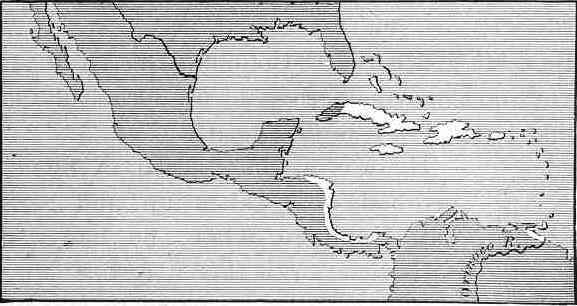
215. Tecumseh and the Indians of Alabama; Tecumseh threatens to stamp his foot on the ground; the earthquake; war begins.—We have already seen how the Indian chief Tecumseh[10] went south to stir up the red men to make war on the white settlers in the west. In Alabama he told the Indians that if they fought they would gain a great victory. I see, said Tecumseh to them, that you don't believe what I say, and that you don't mean to fight. Well, I am now going north to Detroit. When I get there I shall stamp my foot on the ground, and shake down every wigwam you have. It so happened that, shortly after Tecumseh had gone north, a sharp shock of earthquake was felt in Alabama, and the wigwams were actually shaken down by it. When the terrified Indians felt their houses falling to pieces, they ran out of them, shouting, "Tecumseh has got to Detroit!"
These Indians now believed all that Tecumseh had said; they began to attack the white people, and they killed a great number of them.
10 Tecumseh: see paragraph 203.
| Jackson and the Chief |
| GENERAL JACKSON AND THE INDIAN CHIEF. |
216. Jackson conquers the Indians; the "Holy Ground"; Weathersford and Jackson; feeding the starving.—General Jackson marched against the Indians and beat them in battle. The Indians that escaped fled to a place they called the "Holy Ground.", They believed that if a white man dared to set his foot on that ground he would be struck dead as if by a flash of lightning. General Jackson and his men marched on to the "Holy Ground," and the Indians found that unless they made peace they would be the ones who would be struck dead by his bullets.
Not long after this, a noted leader of the Indians, named Weathersford, rode boldly up to Jackson's tent. "Kill him! kill him!" cried Jackson's men; but the general asked Weathersford into his tent. "You can kill me if you want to," said he to Jackson, "but I came to tell you that the Indian women and children are starving in the woods, and to ask you to help them, for they never did you any harm." General Jackson sent away Weathersford in safety, and ordered that corn should be given to feed the starving women and children. That act showed that he was as merciful as he was brave.
217. The British send war-ships to take New Orleans; the great battle and the great victory.—These things happened during our second war with England, or the War of 1812. About a year after Jackson's victory over the Indians the British sent an army in ships to take New Orleans.
General Jackson now went to New Orleans, to prevent the enemy from getting possession of the city.
About four miles below the city, which stands on the Mississippi River,[11] there was a broad, deep ditch, running from the river into a swamp. Jackson saw that the British would have to cross that ditch when they marched against the city. For that reason he built a high bank on the upper side of the ditch, and placed cannon along the top of the bank.
Early on Sunday morning, January 8th, 1815, the British sent a rocket whizzing up into the sky; a few minutes afterward they sent up a second one. It was the signal that they were about to march to attack us.
| Battle of New Orleans |
| BATTLE OF NEW ORLEANS. |
| Monument to Jackson |
| MONUMENT TO GENERAL JACKSON AT NEW ORLEANS. |
Just before the fight began General Jackson walked along among his men, who were getting ready to defend the ditch. He said to them, "Stand to your guns; see that every shot tells: give it to them, boys!" The "boys" did give it to them. The British soldiers were brave men; they had been in many terrible battles, and they were not afraid to die. They fought desperately; they tried again and again to cross that ditch and climb the bank, but they could not do it. The fire of our guns cut them down just as a mower cuts down the tall grain with his scythe.[12] In less than half an hour the great battle was over; Jackson had won the victory and saved New Orleans. We lost only eight killed; the enemy lost over two thousand.[13] We have never had a battle since with England; it is to be hoped that we never shall have another, for two great nations[14] like England and America, that speak the same language, ought to be firm and true friends.
11 See map in paragraph 218.
12 Scythe (sithe).
13 Killed and wounded.
14 Nations: a nation is a people born in the same country and living under the same government; as the American nation, the French nation, the English nation.
218. We buy Florida; General Jackson made President of the United States; the first railroad.—After the battle of New Orleans General Jackson conquered the Indians in Florida, and in 1819 we bought that country of Spain, and so made the United States much larger on the south.[15] This was our second great land purchase.[16]
| US in 1819 |
| The light parts of this map show the extent of the United States in 1819, after we had bought and added Florida. The black and white bars in the northwest show that the ownership of the Oregon country was still in dispute between the United States and Great Britain. |
Ten years after we got Florida General Jackson became President of the United States. He had fought his way up. Here are the four steps: first the boy, "Andy Jackson"; then "Judge Jackson"; then "General Jackson"; last of all, "President Jackson."
| Bridge at St. Louis |
|
THE GREAT STEEL RAILROAD BRIDGE
ACROSS THE MISSISSIPPI RIVER
AT ST. LOUIS. (Built by Captain Eads, and completed in 1874.) |
Shortly after he became the chief ruler of the nation the first steam railroad in the United States was built (1830). From that time such roads kept creeping further and further west. The Indians had frightened the white settlers with their terrible war-whoop. Now it was their turn to be frightened, for the locomotive whistle[17] could beat their wildest yell. They saw that the white man was coming as fast as steam could carry him, and that he was determined to get possession of the whole land. The greater part of the Indians moved across the Mississippi; but the white man kept following them and following the buffalo further and further across the country, toward the Pacific Ocean; and the railroad followed in the white man's track.
| Niagara Suspension Bridge |
| NIAGARA SUSPENSION BRIDGE. |
15 See map in this paragraph.
16 For our first land purchase see paragraph 188.
17 The first steam railroad built in the United States extended from Baltimore to Ellicott's Mills, Maryland, a distance of twelve miles. It was opened in 1830. It forms a part of the Baltimore and Ohio Railroad.
219. Summary.—Andrew Jackson of North Carolina gained a great victory over the Indians in Alabama and also in Florida. In 1815, in our second war with England, General Jackson whipped the British at New Orleans, and so prevented their getting possession of that city. A few years later we bought Florida of Spain.
After General Jackson became President of the United States the first steam-railroad was built in this country. Railroads helped to settle the west and build up states beyond the Mississippi.
Who fought the greatest battle of the War of 1812? Tell about Andrew Jackson's boyhood. Tell the story of the gun. Tell about Tarleton. What did Mrs. Jackson do? What did Andrew do? What did Andrew use to do at the blacksmith shop?
Tell about Tarleton's men and the bees. What did bands of armed men use to do in the country where Andrew lived? Tell about playing at battle. What did Tarleton say? Tell about Andrew and the boots. Tell how he saw a battle through a knot-hole. Tell how Andrew's mother died. What did he say about her? Tell about Andrew Jackson as a judge. Why was he made a general? Tell about Tecumseh and the Alabama Indians. After General Jackson had beaten the Indians, where did they go? What is said about the "Holy Ground." What about Jackson and Weathersford? Tell about the great battle of New Orleans. Who gained the victory? When did we buy Florida? What were the four steps in Andrew Jackson's life? What is said about railroads?
220. How they sent the news of the completion of the Erie Canal to New York City; Franklin and Morse.—The Erie Canal, in the state of New York, connects the Hudson River at Albany with Lake Erie at Buffalo. It is the greatest work of the kind in America, and was completed many years ago. When the water was let into the canal from the lake, the news was flashed from Buffalo to New York City by a row of cannon, about five miles apart, which were fired as rapidly as possible one after the other. The first cannon was fired at Buffalo at ten o'clock in the morning; the last was fired at New York at half-past eleven. In an hour and a half the sound had travelled over five hundred miles. Everybody said that was wonderfully quick work; but to-day we could send the news in less than a minute. The man who found out how to do this was Samuel F. B. Morse.
| News of Erie Canal |
| HOW THEY FLASHED THE NEWS OF THE COMPLETION OF THE ERIE CANAL IN 1825. |
We have seen how Benjamin Franklin[1] discovered, by means of his kite, that lightning and electricity are the same. Samuel Morse was born in Charlestown, Massachusetts, about a mile from Franklin's birthplace, the year after that great man died. He began his work where Franklin left off. He said to himself, Dr. Franklin found out what lightning is; I will find out how to harness it and make it carry news and deliver messages.[2]
1 See paragraph 119.
2 Messages: a message is any word sent by one person to another.
221. Morse becomes a painter; what he thought might be done about sending messages.—When Samuel Morse was a little boy, he was fond of drawing pictures, particularly faces; if he could not get a pencil, he would scratch them with a pin on the furniture at school: the only pay he got for making such pictures was some smart raps from the teacher. After he became a man he learned to paint. At one time he lived in France with several other American artists. One day they were talking of how long it took to get letters from America, and they were wishing the time could be shortened. Somebody spoke of how cannon had been used at the time of the opening of the Erie Canal. Morse was familiar with all that; he had been educated at Yale College, and he knew that the sound of a gun will travel a mile while you are counting five; but quick as that is, he wanted to find something better and quicker still. He said, Why not try lightning or electricity? That will beat sound, for that will go more than a thousand miles while you are counting one.
222. What a telegraph[3] is; a wire telegraph; Professor Morse invents the electric telegraph.—Some time after that, Mr. Morse set sail for America. On the way across the Atlantic he was constantly talking about electricity and how a telegraph—that is, a machine which would write at a distance—might be invented. He thought about this so much that he could not sleep nights. At last he believed that he saw how he could make such a machine.
| One Kind of Telegraph |
| ONE KIND OF TELEGRAPH. |
| Morse at Work |
| PROFESSOR MORSE AT WORK MAKING HIS TELEGRAPH. |
Suppose you take a straight and stiff piece of wire as long as your desk and fasten it in the middle so that the ends will swing easily. Next tie a pencil tight to each end; then put a sheet of paper under the point of each pencil. Now, if you make a mark with the pencil nearest to you, you will find that the pencil at the other end of the wire will make the same kind of mark. Such a wire would be a kind of telegraph, because it would make marks or signs at a distance. Mr. Morse said: I will have a wire a mile long with a pencil, or something sharp-pointed like a pencil, fastened to the further end; the wire itself shall not move at all, but the pencil shall, for I will make electricity run along the wire and move it. Mr. Morse was then a professor or teacher in the University of the City of New York. He put up such a wire in one of the rooms of the building, sent the electricity through it, and found that it made the pencil make just the marks he wanted it should; that meant that he had invented the electric telegraph; for if he could do this over a mile of wire, then what was to hinder his doing it over a hundred or even a thousand miles?
3 Telegraph (tel'e-graf): this name is made up of two Greek words, the first of which means far off, and the second to write.
| First Photograph in America |
|
A COPY OF THE FIRST PHOTOGRAPH MADE
IN AMERICA. (The tower of the Church of the Messiah, in New York. The church is no longer standing.) |
223. How Professor Morse lived while he was making his telegraph.—But all this was not done in a day, for this invention cost years of patient labor. At first, Mr. Morse lived in a little room by himself: there he worked and ate, when he could get anything to eat; and slept, if he wasn't too tired to sleep. Later, he had a room in the university. While he was there he painted pictures to get money enough to buy food; there, too (1839), he took the first photograph ever made in America. Yet with all his hard work there were times when he had to go hungry, and once he told a young man that if he did not get some money he should be dead in a week—dead of starvation.
224. Professor Morse gets help about his telegraph; what Alfred Vail did.—But better times were coming. A young man named Alfred Vail[4] happened to see Professor Morse's telegraph. He believed it would be successful. He persuaded his father, Judge Vail, to lend him two thousand dollars, and he became Professor Morse's partner in the work. Mr. Vail was an excellent mechanic, and he made many improvements in the telegraph. He then made a model[5] of it at his own expense, and took it to Washington and got a patent[6] for it in Professor Morse's name. The invention was now safe in one way, for no one else had the right to make a telegraph like his. Yet, though he had this help, Professor Morse did not get on very fast, for a few years later he said, "I have not a cent in the world; I am crushed for want of means."
4 Alfred Vail: he was the son of Stephen Vail (commonly known as Judge Vail), owner of the Speedwell iron-works, near Morristown, New Jersey. Judge Vail built the engines of the Savannah, the first steamship which crossed the Atlantic.
5 Model: a small copy or representation of something. Professor Morse made a small telegraph and sent it to Washington, to show what his large telegraph would be like.
6 Patent: a written or printed right given by the government at Washington to an inventor to make something; as, for instance, a telegraph or a sewing-machine. The patent forbids any one except the inventor, or holder of the patent, from making such a machine, and so he gets whatever money comes from his work. In order to get a patent, a man must send a model of his invention to be placed in the Patent Office at Washington.
225. Professor Morse asks Congress to help him build a telegraph line; what Congress thought.—Professor Morse now asked Congress to let him have thirty thousand dollars to construct a telegraph line from Washington to Baltimore. He felt sure that business men would be glad to send messages by telegraph, and to pay him for his work. But many members of Congress laughed at it, and said they might as well give Professor Morse the money to build "a railroad to the moon."
Week after week went by, and the last day that Congress would sit was reached, but still no money had been granted. Then came the last night of the last day (March 3d, 1843). Professor Morse stayed in the Senate Chamber[7] of Congress until after ten o'clock; then, tired and disappointed he went back to his hotel, thinking that he must give up trying to build his telegraph line.
7 Senate Chamber: Congress (or the body of persons chosen to make the laws of the United States) is divided into two classes,—Representatives and Senators; they meet in different rooms or chambers in the Capitol at Washington.
226. Miss Annie Ellsworth brings good news.—The next morning Miss Annie G. Ellsworth met him as he was coming down to breakfast. She was the daughter of his friend who had charge of the Patent Office in Washington. She came forward with a smile, grasped his hand, and said that she had good news for him, that Congress had decided to let him have the money. Surely you must be mistaken, said the professor, for I waited last night until nearly midnight, and came away because nothing had been done. But, said the young lady, my father stayed until it was quite midnight, and a few minutes before the clock struck twelve Congress voted[8] the money; it was the very last thing that was done.
Professor Morse was then a gray-haired man over fifty. He had worked hard for years and got nothing for his labor. This was his first great success. He doesn't say whether he laughed or cried—perhaps he felt a little like doing both.
8 Voted: here this word means given or granted.
| What Birds Think |
| WHAT THE BIRDS THINK TELEGRAPH WIRES WERE PUT UP FOR. |
227. The first telegraph line built; the first message sent; the telegraph and the telephone[9] now.—When, at length, Professor Morse did speak, he said to Miss Ellsworth, "Now, Annie, when my line is built from Washington to Baltimore, you shall send the first message over it." In the spring of 1844 the line was completed, and Miss Ellsworth sent these words over it (they are words taken from the Bible): "What hath God wrought!"[10]
For nearly a year after that the telegraph was free to all who wished to use it; then a small charge was made, a very short message costing only one cent. On the first of April, 1845, a man came into the office and bought a cent's worth of telegraphing. That was all the money which was taken that day for the use of forty miles of wire. Now there are about two hundred thousand miles of telegraph line in the United States, or more than enough to reach eight times round the earth, and the messages sent bring in over seventy thousand dollars every day; and we can telegraph not only clear across America, but clear across the Atlantic Ocean by a line laid under the sea. Professor Morse's invention made it possible for people to write by electricity; but now, by means of the telephone, a man in New York can talk with his friend in Philadelphia, Boston, and many other large cities, and his friend listening at the other end of the wire can hear every word he says. Professor Morse did not live long enough to see this wonderful invention, which, in some ways, is an improvement even on his telegraph.
| How a Message is Sent |
| HOW A MESSAGE BY TELEGRAPH IS SENT.[11] |
9 Telephone (tel'e-fone): this name is made up of two Greek words, the first of which means far off, and the second, a voice or sound. The telephone was invented by Professor Alexander G. Bell of Boston; he completed it in 1876. Professor Bell now lives in Washington.
10 See Num. xxiii. 23.
11 When the button at Chicago is pressed down, the electricity passing over the wire to Denver presses the point there down on the paper, and so makes a dot or dash which stands for a letter on the roll of paper as it passes under it. In this way words and messages are spelled out. The message on the strip of paper above is the question, How is trade?
228. Summary.—Professor Morse invented the Electric Telegraph. He received much help from Mr. Alfred Vail. In 1844 Professor Morse and Mr. Vail built the first line of telegraph in the United States, or in the world. It extended from Washington to Baltimore. The telegraph makes it possible for us to send a written message thousands of miles in a moment; by the telephone, which was invented after Professor Morse's death, we can talk with people who are several hundreds of miles away and hear what they say in reply.
Tell how they sent the news of the completion of the Erie Canal. What did Samuel Morse say to himself? Tell about Morse as a painter. What did he want to find? What was he talking about on his voyage back to America? What is a telegraph? How can you make a small wire telegraph? What did Professor Morse make? How did he live? What did he do in 1839? How did he get help about his telegraph? What did he ask Congress to do? What did some men in Congress say? What news did Miss Annie Ellsworth bring him? What was the first message sent by telegraph in 1844? How many miles of telegraph are there now in the United States? Is there a telegraph line under the sea? What is said about the telephone?
229. Sam Houston and the Indians; Houston goes to live with the Indians.—When General Jackson whipped the Indians in Alabama,[1] a young man named Sam Houston[2] fought under Jackson and was terribly wounded. It was thought that the brave fellow would certainly die, but his strong will carried him through, and he lived to make himself a great name in the southwest.
| Sam Houston |
| SAM HOUSTON. |
Although Houston fought the Indians, yet, when a boy, he was very fond of them, and spent much of his time with them in the woods of Tennessee.
Long after he became a man, this love of the wild life led by the red men in the forest came back to him. While Houston was governor of Tennessee (1829) he suddenly made up his mind to leave his home and his friends, go across the Mississippi River, and take up his abode with an Indian tribe in that part of the country. The chief, who had known him as a boy, gave him a hearty welcome. "Rest with us," he said; "my wigwam is yours." Houston stayed with the tribe three years.
1 See paragraph 216.
2 Sam Houston (Hew'ston): he always wrote his name Sam Houston; he was born near Lexington in Rockbridge County, Virginia.
230. Houston goes to Texas; what he said he would do; the murders at Alamo[3]; the flag with one star; what Houston did; Texas added to the United States; our war with Mexico.—At the end of that time he said to a friend, "I am going to Texas, and in that new country I will make a man of myself." Texas then belonged to Mexico; and President Andrew Jackson had tried in vain to buy it as Jefferson bought Louisiana. Houston said, "I will make it part of the United States." About twenty thousand Americans had already moved into Texas, and they felt as he did.
| Lone Star Flag |
| THE "LONE STAR" FLAG. |
War broke out between Texas and Mexico, and General Sam Houston led the Texan soldiers in their fight for independence. He had many noted American pioneers[4] and hunters in his little army: one of them was the brave Colonel Travis[5] of Alabama; another was Colonel Bowie[6] of Louisiana, the inventor of the "bowie knife"; still another was Colonel David Crockett of Tennessee, whose motto is a good one for every young American—"Be sure you're right, then—go ahead." These men were all taken prisoners by the Mexicans at Fort Alamo—an old Spanish church in San Antonio—and were cruelly murdered.
Not long after that General Houston fought a great battle near the city which is now called by his name.[7] The Mexicans had more than two men to every one of Houston's; but the Americans and Texans went into battle shouting the terrible cry "Remember the Alamo!" and the Mexicans fled before them like frightened sheep. Texas then became an independent state, and elected General Houston its president. The people of Texas raised a flag having on it a single star. For this reason it was sometimes called, as it still is, the "Lone Star State."
Texas was not contented to stand alone; she begged the United States to add her to its great and growing family of states. This was done[8] in 1845. But, as we shall presently see, a war soon broke out (1846) between the United States and Mexico, and when that war was ended we obtained a great deal more land at the west.
| US in 1845 |
| Map showing the extent of the United States after we added Texas in 1845. The black and white bars show that the ownership of the Oregon country was still in dispute between the United States and Great Britain. |
3 Alamo (Al'a-mo).
4 Pioneers: those who go before to prepare the way for others; the first settlers in a country are its pioneers.
5 Travis (Tra'vis).
6 Bowie (Bow'e).
7 See map in this paragraph.
8 See map in this paragraph.
231. General Sam Houston in the great war between the North and the South; what he said.—We have seen the part which General Sam Houston took in getting new country to add to the United States. He lived in Texas for many years after that. When, in 1861, the great war broke out between the North and the South, General Houston was governor of the state. He withdrew from office and went home to his log cabin in Huntsville. He refused to take any part in the war, for he loved the Union,—that is, the whole country, North and South together,—and he said to his wife, "My heart is broken." Before the war ended he was laid in his grave.[9]
9 General Houston was buried at Huntsville, about eighty miles northwest of the city of Houston, Texas.
232. Summary.—General Sam Houston of Tennessee led the people of Texas in their war against Mexico. The Texans gained the victory, and made their country an independent state with General Houston as its president. After a time Texas was added to the United States. We then had a war with Mexico, and added a great deal more land at the west. General Houston died during the war between the North and the South.
Tell about Sam Houston and the Indians. Where did Houston go after he became governor of Tennessee? Where did Houston go next? What did he say he would do about Texas? What was David Crockett's motto? What is said about Fort Alamo? What about the battle with the Mexicans? What did Texas become? To what office was Houston elected? What is said of the Texas flag? When was Texas added to the United States? What war then broke out? What did we get by that war? What is said of General Houston in the great war between the North and the South?
233. Captain Gray goes to the Pacific coast to buy furs; he first carries the Stars and Stripes round the globe.—Not long after the war of the Revolution had come to an end some merchants of Boston sent out two vessels to Vancouver[1] Island, on the northwest coast of America. The names of the vessels were the Columbia and the Lady Washington, and they sailed round Cape Horn into the Pacific. Captain Robert Gray went out as commander of one of these vessels.[2] He was born in Rhode Island[3] and he had fought in one of our war-ships in the Revolution.
| Sea Otter |
| A SEA-OTTER. |
Captain Gray was sent out by the Boston merchants to buy furs from the Indians on the Pacific coast. He had no difficulty in getting all he wanted, for the savages were glad to sell them for very little. In one case a chief let the captain have two hundred sea-otter skins such as are used for ladies' sacks, and which were worth about eight thousand dollars, for an old iron chisel. After getting a valuable cargo of furs, Captain Gray sailed in the Columbia for China, where he bought a quantity of tea. He then went to the south, round the Cape of Good Hope, and keeping on toward the west he reached Boston in the summer of 1790. He had been gone about three years, and he was the first man who carried the American flag clear round the globe.
1 Vancouver (Van-koo'ver): part of it is seen north of Portland, Or., paragraph 235.
2 He commanded the Lady Washington at first, and afterward the Columbia.
3 Tiverton, Rhode Island.
| Mount Hood |
| MOUNT HOOD, OREGON. |
| Gray on the Columbia |
| CAPTAIN GRAY EXPLORING THE COLUMBIA RIVER, OREGON. |
234. Captain Gray's second voyage to the Pacific coast; he enters a great river and names it the Columbia; the United States claims the Oregon country; we get Oregon in 1846.—Captain Gray did not stay long at Boston, for he sailed again that autumn in the Columbia for the Pacific coast, to buy more furs. He stayed on that coast a long time. In the spring of 1792 he entered a great river and sailed up it a distance of nearly thirty miles. He seems to have been the first white man who had ever actually entered it. He named the vast stream the Columbia River, from the name of his vessel. It is the largest American river which empties into the Pacific Ocean south of Alaska.[4]
Captain Gray returned to Boston and gave an account of his voyage of exploration; this led Congress to claim the country through which the Columbia flows[5] as part of the United States.
After Captain Gray had been dead for forty years we came into possession, in 1846, of the immense territory then called the Oregon Country. It was through what he had done that we got our first claim to that country which now forms the states of Oregon and Washington.
4 The Yukon River in Alaska is larger than the Columbia.
5 The discovery and exploration of a river usually gives the right to a claim to the country watered by that river, on the part of the nation to which the discoverer or explorer belongs.
235. Summary.—A little over a hundred years ago (1790) Captain Robert Gray of Rhode Island first carried the American flag round the world. In 1792 he entered and named the Columbia River. Because he did that the United States claimed the country—called the Oregon Country—through which that river runs. In 1846 we added the Oregon Country to our possessions; it now forms the two states of Oregon and Washington.
| US in 1846 |
| Map showing the extent of the United States after we added the Oregon Country in 1846. |
| Emigrants To Oregon |
| EMIGRANTS ON THEIR WAY TO OREGON FIFTY YEARS AGO. |
Tell about Captain Gray's voyage to the Pacific coast. What did he buy there? What did he first carry round the globe? Tell about his second voyage. What did he do in 1792? What happened after Captain Gray returned to Boston? What happened in 1846? What two states were made out of the Oregon Country?
| Sutter's Fort Area |
236. Captain Sutter and his fort; how the captain lived.—At the time when Professor Morse sent his first message by telegraph from Washington to Baltimore (1844), Captain J. A. Sutter, an emigrant from Switzerland, was living near the Sacramento River in California. California then belonged to Mexico. The governor of that part of the country had given Captain Sutter an immense piece of land; and the captain had built a fort at a point where a stream which he named the American River joins the Sacramento River.[2] People then called the place Sutter's Fort, but to-day it is Sacramento City, the capital of the great and rich state of California.
In his fort Captain Sutter lived like a king. He owned land enough to make a thousand fair-sized farms; he had twelve thousand head of cattle, more than ten thousand sheep, and over two thousand horses and mules. Hundreds of laborers worked for him in his wheat-fields, and fifty well-armed soldiers guarded his fort. Quite a number of Americans had built houses near the fort. They thought that the time was coming when all that country would become part of the United States.
1 Sutter (Soo'ter).
2 See map in this paragraph.
237. Captain Sutter builds a saw-mill at Coloma;[3] a man finds some sparkling dust.—About forty miles up the American River was a place which the Mexicans called Coloma, or the beautiful valley. There was a good fall of water there and plenty of big trees to saw into boards, so Captain Sutter sent a man named Marshall to build a saw-mill at that place. The captain needed such a mill very much, for he wanted lumber to build with and to fence his fields.
Marshall set to work, and before the end of January, 1848, he had built a dam across the river and got the saw-mill half done. One day as he was walking along the bank of a ditch, which had been dug back of the mill to carry off the water, he saw some bright yellow specks shining in the dirt. He gathered a little of the sparkling dust, washed it clean, and carried it to the house. That evening after the men had come in from their work on the mill, Marshall said to them, "Boys, I believe I've found a gold mine." They laughed, and one of them said, "I reckon not; no such luck."
| Sutter's Saw Mill |
| CAPTAIN SUTTER'S SAW-MILL AT COLOMA, WHERE GOLD WAS FIRST FOUND. |
3 Coloma (Ko-lo'ma): see map in paragraph 236.