
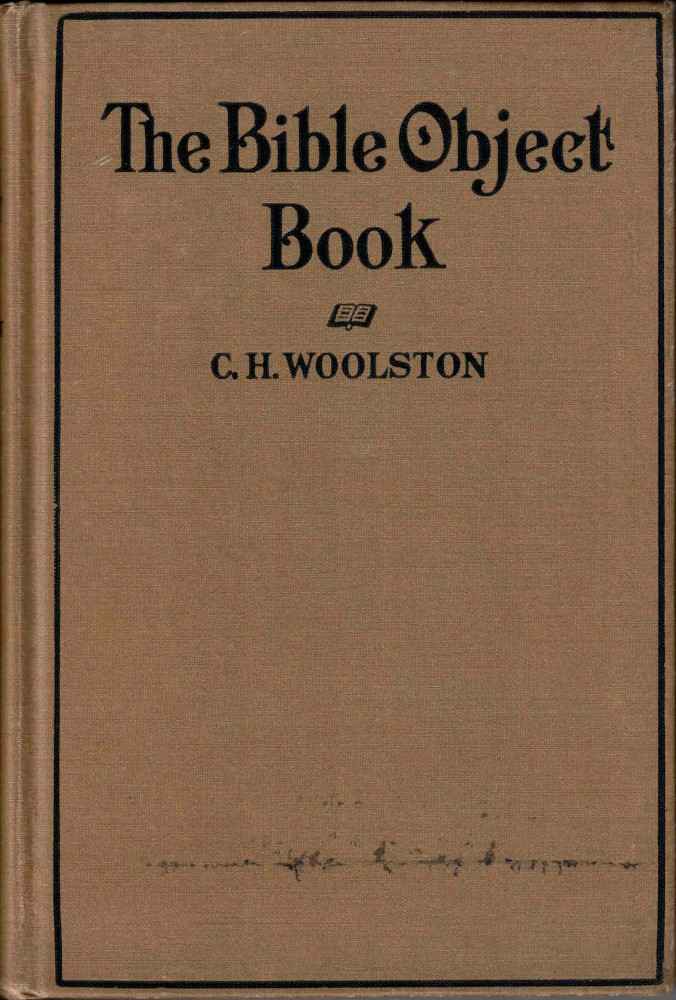
The Project Gutenberg eBook of The Bible object book
Title: The Bible object book
A book of object lessons which are different, written in plain English and in common words
Author: C. H. Woolston
Author of introduction, etc.: Homer A. Rodeheaver
Release date: August 16, 2023 [eBook #71416]
Language: English
Original publication: Philadelphia: The Judson Press, 1926
Credits: Jonathan Gregory
A Group of Children Just After a Happy Hour Service at Winona Lake, Indiana
These Represent the Children to Whom This Book Is Dedicated
The
BIBLE OBJECT BOOK
A Book of Object Lessons Which Are Different
WRITTEN IN PLAIN ENGLISH AND IN COMMON WORDS
By
Rev. CLARENCE HERBERT WOOLSTON, D. D.
Author of
"SEEING TRUTH," "PENNY OBJECT LESSONS, Nos. 1 and 2,"
"THE GOSPEL OBJECT BOOK," and "THE CURIOSITY BOOK."
Also Originator of the "SEEING TRUTH PACKETS," Containing the
Lessons and Objects Needed
PHILADELPHIA
THE JUDSON PRESS
| BOSTON | CHICAGO | LOS ANGELES |
| KANSAS CITY | SEATTLE | TORONTO |
Copyright, 1926, by
THE JUDSON PRESS
Published August, 1926
PRINTED IN U.S.A.
This book is dedicated
to the many Boys and Girls
who have both heard and seen
these visual addresses
at Bethany Hall, Winona Lake, Indiana
and to Mrs. Carrie Besserer
who made these wonderful gatherings possible
For what shall it profit a church if it gain
the whole world and lose its own children
INTRODUCTION
Dr. C. H. Woolston is the one man I know who is most eminently fitted to write a book for children or for the teachers of children. First, because he loves and understands children; for work among children is an affair of the heart. In the second place, through many years he has proved his theories by actual, practical experience and testing. We know that his plans really work.
He is being urged by many of his eminent friends in children's work to give all his time to this great service. He will have a large mission in teaching preachers and teachers how to win children and young people to Christ. For twenty years he has appeared in the great Bible conference at Winona Lake, Ind., and has always been received by adults with great appreciation while the children have hailed him with huge delight.
We must all admit that there is nothing of greater importance among all the problems of the church today. While he has not been able to give all his time to this work he has been most generous and patient in showing others how to use the mechanical and wonder object-lessons in the teaching of children.
In this work he gives the worker something entirely new and off from the beaten path of the regulars, something which would cost months of study and research and literally hundreds of dollars to acquire.
In addition to the wisdom of this and other works he has published and thus given to the world, he will always be glad to help in any of the problems of winning for Jesus the children that may present themselves. His study is an open post-office. Write to him.
And so, for these reasons and many others I am especially glad to commend this newest book of Doctor Woolston. I hope the readers of this book may be able to have him in their churches or in Bible conferences some time. To know him personally is a rare pleasure. He is, in my estimation, the greatest talker to children we have in this country at this present time. His new methods of reaching children and adults through their eyes has given him the highest place among gospel illustrators.
HOMER RODEHEAVER
SUNDAY PARTY, Winona Lake, Ind.
PREFACE
These short addresses are designed to help the busy pastor get a flying start in his effort to fill the minds of his church children with compelling imagery and their eyes with the sweet lessons by Seeing Gospel Truth.
I have made no attempt at phrase-making, nor have I sought to create a literary marvel.
I have used the greatest simplicity of language at my command, in some cases employing the unpolished words of the children themselves. This I have done because many of these chapters have been framed for their eyes and ears, and it has always been my ambition that the children should hear the truth in their own tongue.
Perhaps my words and sentences would not pass the Sanhedrin of the universities, but my ideas are on the run to catch the child before the ever-shortening days of youth have passed, and perhaps sometimes I have run by some of the standards of the school.
When Evangelist D. L. Moody was in London, England, the first time some of the critical divines made sport of the fact that Mr. Moody in pronouncing the word "Jerusalem" did so in two syllables. The secular press also took up the matter and made high glee over it. C. H. Spurgeon, then in all his glory at the Metropolitan Tabernacle, in one of his sermons used the following language, "I am glad there is one minister in London who is in such haste to give the gospel to the people that he does not stop to pronounce every syllable."
The King's business requires haste, and this business of gaining the King's children requires double haste. This will explain some of the sentences of this book that may cause you to stop and think why I said them. C. H. Spurgeon has given you my answer.
These talks aim to fill the eye as well as the ear. This is the reason that a line of simple objects is used.
These objects are golden hooks which hang up ideas in the hall of memory to stay "put" evermore.
Some of the chapters are designed for children and adults alike, for there are some adults who, like Peter Pan, refuse to grow up and still "like to see things."
Read over each chapter twice before you attempt to work it out.
Think yourself back to childhood's happy days and "be a child again just for tonight," and then when your ideas are romping about in your head with the zest of youth, tell your lesson and show them "the things."
And may it come to pass that you may turn the Wonderful Eyes and Hearts of the Wonderful Children toward the "Rose of Sharon" as the rose of the garden turns toward the light of the Sun.
This is the prayer of the author to whom God has given the distinguished honor of talking to a million and a half of little folks about Jesus, "who loves the little children of the world."
C. H. WOOLSTON.
April, 1926.
CONTENTS
| CHAPTER | PAGE |
|---|---|
| 1. JUST A FEW WORDS TO THE CHILDREN | 1 |
| 2. WHEN THE BABY DISCOVERS AMERICA! | 3 |
| 3. A MILLION-DOLLAR CIGARET | 5 |
| 4. HEALING LEAVES | 10 |
| 5. WHAT THE BIBLE IS LIKE | 12 |
| 6. JUDGING BY APPEARANCES | 17 |
| 7. A CHILD FOR SALE | 20 |
| 8. WEEDS | 25 |
| 9. THE SWORD OF — | 28 |
| 10. WHAT CAN TAKE AWAY MY SINS? | 33 |
| 11. WORDS OF ANGER | 37 |
| 12. THE COPPER-FACE GIRL | 41 |
| 13. MAKING A CHURCH FLAG | 44 |
| 14. AN IMMORTALITY LESSON | 48 |
| 15. "OFF FOR HAPPY LAND" | 51 |
| 16. FORGOTTEN HOLY NAMES | 55 |
| 17. I LAY MY SINS ON JESUS | 59 |
| 18. THE LORD'S PRAYER IN CANDLES | 62 |
| 19. HOW GOD COVERS MY SINS | 68 |
| 20. WHAT THE FLAG SIGNALS SAY | 71 |
| 21. THE DEVIL'S GOAT | 75 |
| 22. SHINING TRUTH | 77 |
| 23. THE BEATITUDES IN COLORS | 82 |
| 24. THE GOSPEL IN THE FLAG | 84 |
| 25. WHAT THE LETTERED BLOCKS SAID | 87 |
| 26. BLOTS TAKEN AWAY | 89 |
| 27. A LOST HEART, AND WHERE IT WAS FOUND | 92 |
| 28. "BRIGHTEN YOUR CORNER AS A BUSINESS" | 97 |
| 29. THE POSTAGE-STAMP AS A PREACHER | 101 |
| 30. CANDLES IN THE PULPIT | 105 |
| 31. A POST-CARD SERMON | 109 |
| 32. MAKING JOY | 112 |
| 33. YE LITTLE OLD FOLKS | 114 |
| 34. THE CRUCIFIXION IN COLORS | 116 |
| 35. THE GOSPEL BY RIBBONS | 119 |
| 36. JOINING THE CHURCH | 122 |
| 37. GOD'S MAIL-BAG | 126 |
| 38. TURNING THE PALMS INTO A CROSS | 131 |
| 39. JESUS CHANGES THINGS | 134 |
| 40. THE BUNDLE OF LIFE | 137 |
| 41. THE NORTH POLE OF THE BIBLE | 142 |
| 42. OBJECT-LESSONS FOR SPECIAL DAYS | 146 |
| 43. PUTTING A GOD TO BED | 174 |
| 44. HOW TO MAKE A CHRISTMAS FLAG | 179 |
| 45. THAT SOCIAL HOUR | 183 |
| 46. "THE WORDLESS BOOK" | 189 |
| 47. THE HEART OF SEVEN DEVILS | 196 |
| 48. SHOW YOUR COLORS | 204 |
| 49. THE BOOKS OF THE NEW TESTAMENT IN STORY FORM | 208 |
| 50. WHAT TEN CORDS COULD NOT DO | 210 |
| 51. OBJECT-LESSONS EXTRAORDINARY | 214 |
| 52. A BOTTLE OF MOSQUITOES | 222 |
| 53. A CHRISTMAS TREE IN AUGUST | 228 |
| 54. THE JUNIOR POST-OFFICE | 232 |
| 55. THE BLACK FLAG | 236 |
| 56. HOW FIVE SPADES DUG THROUGH | 240 |
| 57. THE KAISER'S CUP | 245 |
| 58. HOW TO MAKE A RAG MAP | 248 |
| 59. STATIONS OF SALVATION | 252 |
| 60. A SUGGESTIVE PROGRAM | 261 |
| 61. A MORNING AND EVENING PRAYER | 263 |
LIST OF ILLUSTRATIONS
| OPPOSITE | |
|---|---|
| PAGE | |
|
A Group of Children Just After a Happy Hour Service at Winona Lake, Indiana; These Represent the Children to Whom This Book is Dedicated |
Frontispiece |
| Rev. C. H. Woolston and Professor Homer Rodeheaver | 18 |
|
A Meeting of Children in the East Baptist Church, Philadel- phia (Where the Author is Pastor) Giving Attention to Object-lessons Described in This Book |
98 |
|
Atlas, the Big Lion, a Docile, Friendly Beast, Performing for the Children |
216 |
|
A Baby Lion, Six Weeks Old, Receiving the Name of the Youngest Baby in the Audience |
218 |
|
A Baby Leopard, Seven Months Old, Used to Illustrate the Scripture Reference to the Leopard's Spots |
220 |
|
The Bear Is Called the Clown of the Animal Kingdom. This Baby Bear, Visiting a Children's Meeting in Doctor Woolston's Church, Was Used to Illustrate the Sin of Stubbornness |
222 |
1
JUST A FEW WORDS TO THE CHILDREN
SOME HELPFUL WORDS TO THE
SPEAKER TO CHILDREN
At some time during the service the minister will say, "Now just a few words to the children." He has a big task before him, and if he is strong enough to know how to say these "few words," is he learned enough to know what to say in these "few words"?
Many a great preacher meets his Waterloo here. Will he retire beaten dragging the white flag of surrender after him, and hang low his head because of the conscious defeat, or will he with flying banners put it over in these "few words," and take his place in line with the world's greatest conquerors?
He must remember all children will not prick up their ears and listen hard just because he is a great preacher. Children are great critics. Their criticism takes the form of not listening. They know perfectly the art of withdrawing attention when they are not interested in the "few words," but their minds are not vacant during the unheeded "few words." They are counting the number of people present in the pews directly in front of them. They are watching the inattention of the members of the choir. They are thinking of their games of yesterday, or something they received at Christmastime, or of some book just given them as a birthday gift. They may be whispering or nudging each other, or if they have a bit of pencil with them they may be sketching caricatures of the deacons before them or even of the minister who is addressing them.
The little girl's motherly thought may be straying home to a sick doll, or may be smiling at the funny ways of puppy or kitten that she just happens to remember. The boy may be smiling over some funny situation he saw yesterday at the "movies." They are all very resourceful in themselves to save them from being bored by an address that has lost its way in its pilgrimage from the minister to their pews in which they are seated. The "just a few words" like birds have taken to their wings, and gone over the children's heads to the "land of nowhere." The minister, if he has normal eyes and a common mind, is conscious of the fact he has "missed fire," and wonders what he can do to put it over so it will stay "put"! If he thus thinks, there is large hope for him, because he has not graduated from the learner's bench. Let him be a child again and think as a child. Let him learn how to talk to them and not about them, and then his "just a few words" will become as interesting to their mind as the toys they left behind them. This is worth the effort; even the adults who are only "tall kids" will like the talk better than "the preaching at" in which they have only a feeble interest. Even the "polar bear" deacon will thaw out and catch himself smiling at the "few words" of the preacher that just "talks."
Happy is the man who can interest the child in his "few words" and can also interest the child in its efforts to translate the "few words" into big acts on the inside building of a child's character.
2
WHEN THE BABY DISCOVERS AMERICA!
SOME IMPORTANT THOUGHTS FOR WORK
AMONG CHILDREN
A Study of the Object as Well as the Subject
Every little cradle is a ship starting on the voyage of life. Little Eyes looks out from its cabin windows and discovers that the land it sees is America. It is not dreaming of lakes sublime or rivers majestic. It is not in fact a discoverer. It is a see-er. It is seeing things, real things, in the land it has just discovered. Its first adventure is the finding of Mother, which means it has discovered perfect love, protection, and tender care. Mother is heaven, her shining eyes are the stars. There is a cry in the night. Mother understands its language and gives her holy ministrations. Watch Mother, she is the teacher God has trained. Listen to her first "few words." Baby does. Mother understands. God give the preacher this understanding. Learn how Mother her first "few words," then "try, try again." Learn your first lesson in the language of a child. It loves picture words. It learns the names of common things first. Things fix themselves in the eyes. Its language is born as it looks. Looks at a cow and calls it "moo cow." A picture word with action in it! It looks at a lamb and coins its own word "Baa-lamb." Teach the children in words full of pictures. They see objects and fix on them certain ideas. Do the same in teaching them in their older days. Clothe objects with ideas, and they will shine like stars in the children's understanding. Words that are dear and familiar to adult church-goers are so by long and sacred associations. Children have no such relation to our "churchly" words.
This does not mean that we are to talk down to them and use "baby" or silly talk. Children know when they are being "talked down to," and resent it. When the preacher arrives to address the children in a "few words," he should be of the same age as the child in his words in order to establish contact. Why not? The Mother talks to the children in words of their age. Let the preacher be like the Mother when he stands to address his words to the little folks. Let him use short words, plain sentences, pictureful words, and objects which the children know, and thus become a child again. Let him see the big world through the eyes of the children, and he will know what stories the children like and do not like, and when he arrives in the pulpit, their eyes will be fastened on him, and they will hear him gladly because he is one of them.
So, as baby discovers America, you discover baby.
3
A MILLION DOLLAR CIGARET
OBJECTS: A Black Muslin Flag on Which Is Written
Some of the Woes of the Cigaret Habit
Some months ago in Jersey City, N. J., a large warehouse and its contents were destroyed by fire. This was the dreadful blaze known as the Great Triangle Fire which finally destroyed a million dollars worth of property. The deadly cigaret was believed to have been the cause of this disaster. An employee walking about the place tossed or allowed to drop from his hand a lighted cigaret.
A cigar thus dropped goes out at once; a cigaret continues to burn until it burns itself out, and so this cigaret continued to burn and ignited other material, and thus the great fire had its start, and one million dollars worth of property was thus destroyed. That was a Million Dollar Cigaret.
All cigarets are costly. They destroy things much more valuable than personal property or real estate. They destroy health, character, and the chances of good success in life. These things are more valuable than hills of gold. The cigaret is more deadly than natural death, for it produces a living death and at last flings the ruined soul on the bank of the Lost River in the Kingdom of Eternal Darkness.
Sir Christopher Furness has found that cigaret smoking among boys not only causes deterioration of physique, but "tends to develop lounging habits, with the result that the juvenile smoker's work is less conscientiously done, and he is lacking in sprightliness and alertness. Where, as is often the case," Sir Christopher adds, "the boy smokes clandestinely, habits of deceitfulness will probably be formed." Sir George William's experience as an employer has conclusively proved to him that a boy is a far from satisfactory worker if he smokes, and he says:
The effects of smoking, with its tendency to encourage drinking, are to reduce a lad's energy, to lessen his intellectual capacity, and to weaken his moral character.
The fact that every great public school prohibits smoking among its boys, and punishes offenders with a strong hand, is eloquent of the evil effect tobacco has on the young mind. The Leeds School Board some time ago enlisted the services of eminent medical authorities in its battle against the cigaret, and the Plymouth Board circularized the teachers and parents of the children on the subject. A Committee of the Liverpool School Board which investigated the matter declared that "cigaret smoking affects the system generally, and arrests physical development," and it would be possible to quote thousands of such opinions from the educational side.
It goes without saying that the doctor is the strongest enemy of the cigaret for boys. "All the evidence," says Dr. Andrew Wilson, "points to the undermining of a growing lad's physique by indulgence in tobacco," and Doctor Wilson continues:
Add to this the moral effect—that of rendering the already precocious boy still more precocious, and of turning him into an insufferable prig, and you thus condemn the habit from another point of view.
Sir Henry LittleJohn, the veteran medical officer of
health for Edinburgh, has used his great influence
against the boy smoker on many grounds, and there is
much force in his argument that
the practise is fraught with dangers to society at large, owing
to the secrecy with which the habit is carried on, the assembling
at nights, the tendency to visit ice-cream shops to assuage
the heat of the mouth that has been engendered by the filthy practise,
and, in addition, we have ultimately that disregard of the
proprieties due to the other sex which is introducing in our midst
a laxity of morals, which, in the future, must bear fruit.
Magistrate Crane of New York City says:
Ninety-nine out of a hundred boys between ten and seventeen years of age, who come before me charged with crime, have their fingers disfigured by yellow cigaret stains... The poison in the cigaret seems to get into the system of the boy and destroys all moral fiber.
Tobacco interferes with the functions of the eye, of the heart, and of the kidneys. Tobacco smoking interferes with the development of the boy.
Professor McKeever says the cigaret-smoking boys of several schools, the records of which were investigated, were described by his informants by such epithets as sallow, sore-eyed, puny, squeaky-voiced, sickly, short-winded, and extremely nervous.
The greatest danger of the cigaret habit is its insidious nature. The boy does not realize the danger until it is too late to correct it. Hundreds of tombstones today bear silent testimony to this fact.
A chemist took the tobacco used in an average cigaret and soaked it in several teaspoonfuls of water and injected a portion of it under the skin of a cat. The cat almost immediately went into convulsions and died in fifteen minutes. Dogs have been killed with a single drop of nicotine.
Investigation shows that prominent business men positively refuse to engage men for responsible positions who smoke cigarets. The cigaret smoker, sooner or later, proves to be unreliable either physically, mentally, morally, or all three.
In Detroit alone, sixty-nine merchants have agreed not to employ cigaret-users. Chicago firms such as Montgomery Ward & Co., Marshall Field & Co., Morgan & Wright Tire Co., all prohibit cigaret smoking among employees, Thomas Edison and Henry Ford, head of the Ford Motor Company, are both opposed to the cigaret.
The manager of one of Ohio's largest mercantile houses, when asked for a job for a boy who smoked cigarets, said:
I'm sorry, but I can't use cigaret smokers. First, they smell bad, and I don't want to put them in contact with the nice young ladies who work here or the nice ladies who trade here. Second, cigarets prevent the development of strong, clear, reliable moral character. They excite the lower passions and dull the sense of right and wrong.
Judge Ben Lindsay of Denver says:
I have been in the Juvenile Court nearly ten years, dealing with thousands of boys who have disgraced themselves and their parents, and I do not know of any one habit which is more responsible for the troubles of these boys than the vile cigaret habit.
Superintendent, Mervine of the Wells Fargo Express Company, issued a letter to all agents of the company, in which he said:
Any one who habitually smokes cigarets, in this climate especially, has something connected with his record or his qualifications that makes him a dangerous person.
Dr. Sims Woodhead, professor of pathology in Cambridge University, says that cigaret smoking, in the case of boys, partially paralyzes the nerve-cells at the base of the brain, and this interferes with the breathing or heart action.
Now produce a flag made of black muslin which you call the Cigaret Flag, on which you have pinned small slips of paper on which you have written some of the short sayings herewith given, Read these lines from the flag and say, "We will now listen to the message of the Cigaret Flag."
If you blow a mouthful of cigaret smoke through a clean white handkerchief, it will leave a dark brown slimy stain. In this carbon deposit are the different poisons which eat on the delicate spongy membrane of the back of the throat like acid on a piece of cloth.
Conclude by warning the boys not to smoke the deadly cigaret, never to begin; and if they have smoked, then first urge them to make the last cigaret the last forever. Tell them that Jesus wants boys with clean lips and pure hearts. The cigaret habit has roots which go deep into the heart. This is what makes the grip of the habit so strong. Jesus said that "Every plant my heavenly Father has not planted shall be rooted up." So this is one of the plants doomed by God. Let him pull it out from your heart by the roots; only thus can it be taken away to stay.
4
HEALING LEAVES
OBJECTS: A Collection of Eucalyptus Leaves
Secure from a regular drug-store a few dried leaves of the eucalyptus tree which grows in California. Mount them on cardboard or hold them up in a cluster so all the hearers may see them. Then open your Bible and read Revelation 22:2, "and the leaves of the tree were for the healing of the nations." This can be used as a text for this lesson.
This great tree is to remind the saved in heaven that there is no sickness there, for the cure of the nations and the ages is under the shade of the leaves of this healing tree. This tree with its healing leaves is to remind us of Jesus. He is the great Tree of Life, "a root out of the dry ground." His leaves of truth have been for the healing of the nations. This collection of leaves which you now hold in your hand has healing power. An oil is extracted direct from these leaves which has great medicinal value.
Secure some of this oil from your regular druggist and ask him as to how it is used by the local doctors.
In Africa the natives do much of their curing by leaves. They believe that all diseases can be cured by leaves, and when a person is ill or bitten by a serpent they hasten to the jungles and secure a healing leaf. This was one of the most primitive means of healing known to men.
There is another great Tree of Knowledge which we call the great Bible. The leaves of this tree have long been healing the nations. Every leaf has a healing word in it. As you say this hold up the Bible with the other hand and read what some of the leaves say. Read John 3:14 and 16. These words on the leaves of the Bible have healed the millions. They have been and are for the healing of the nations also, and thus a countless number have received the eternal Health of Salvation and are now in heaven, well forevermore.
I remember my mother often told me a Civil War story which to my little head was a wonder story. She said that once in this war a soldier's life was spared because the enemy's bullet embedded itself in the leaves of a New Testament he carried in his pocket. So the leaves of the Bible saved his mortal life. Often the smaller birds fly into the leaves of the trees for safety when the larger wild bird seeks their life.
God's word is a mighty fortress and a shelter from the storm. Its leaves of truth cover us and surround us, like a great wall of chariots and armed horsemen, so we are safe forevermore.
If you have a cluster of leaves put a tag on each containing a verse of Scripture which speaks of God's saving power. Pin these leaves with their tags up on some background and explain that there are the leaves from the Tree of the Bible, with sure healing in them for the nations of the world.
5
WHAT THE BIBLE IS LIKE
OBJECTS: A Lamp, a Mirror, a Bowl, a Glass of Milk,
Bread, a Cup of Honey, a Hammer, a Sword, a Jar
of Seeds
In this chapter we think together as to what the Bible is like, and produce the object referred to.
We confine our thoughts to what the Bible says it is likened unto.
1. The Bible is likened unto a lamp. Here produce an Oriental lamp if possible; if not, use an ordinary house lamp, and quote the following Scripture: Psalm 119:105, 130; Proverbs 6:23.
This is a dark world, it is under the power of darkness. (Col. 1:13.) It is controlled by the "rulers of darkness" (Eph. 6:12). Unless it is enlightened by the Bible lamp it will go to its own place, "the blackness of darkness forever" (Jude 1:13). "God so loved the world, that he gave us his Lamp that whosoever should follow the Light, might not perish, but have everlasting life." Like the golden candlestick it shines upon divine things near at hand, and like the pillar of fire it lights up the way through the wilderness journey. All other lamps will go out, but this light shines more and more to the perfect day.
Harken, ye children of men, listen, ye people of all nations, "The entrance of thy word giveth light."
2. A mirror. (2 Corinthians 3:18; James 1:25.)
An ordinary looking-glass can be used here if it is put in an upright position.
It shows me myself just as I really am, not as I think I am, but as I am. (Rom. 3:19.) The human heart shrinks from looking at it for it shows the heart as it really is. And yet, to see one's self as it is revealed in the mirror is the first step in the true way back to God.
A missionary to China once read aloud, to a large audience, Romans 1. One of the Chinamen present said he thought it was very unfair and unkind for the "foreign devil" (as missionaries were there called) to come to find out all their secret sins and write them down in a book, and read them out in that public way. It is a truth that the Bible is a mirror, "Mine to tell me what I am."
3. A laver. (Ephesians 5:26.)
A large silver bowl can be used here and placed in line with the lamp and mirror. The Bible not only shows us our sins as in a mirror, but shows us the way the remedy can be secured. In the old wilderness tabernacle, a laver was provided at the entrance of the tabernacle to give a means of cleansing from the defilement which would oftentimes render the worshiper unfit for God's presence; so a cleansing stream, seen only by the eye of faith, flows through this book. It broke forth from the first promise of the woman's seed (Gen. 3:15) and flowed all the way through the Bible until it broke into the trumpet-song of the redeemed in glory. "Unto Him that loved us, and washed us from our sins in his own blood" (Rev. 1:5). As water cleanses by separating the body from the outward stains, so the Word of God applied by the Holy Spirit causes the heart to abhor the defilement of sin which would stain and defile the inward life. "Thy word have I hid in my heart that I might not sin against thee" (Ps. 119:11); and Jesus said, "Now are ye clean through the word which I have spoken unto you" (John 15:3).
4. Milk. (1 Corinthians 3:2; Hebrews 5:12,13.)
Here place by the side of the laver a glass or bottle of milk.
This is to teach us that the Bible is so plain and simple that little children can feed on it as they do on milk. Some people declare that the Bible is too profound for children, and that they should seek and read some other simpler book on religion first. But where is the child that can understand human words that does not grasp the stories of many of the Bible records? Noah and the Ark; Daniel in the Lions' Den; The Hebrew Children in the Furnace; the story of the Finding of Moses; Joseph and His Brethren, and the parables and the miracles of Jesus, etc. We are all babes in Christ when first converted, and are exhorted to drink the pure milk of the pure word of God.
5. Bread. (Deuteronomy 8:3; Isaiah 55:10.)
Here secure a few small cakes, and explain the bread of the Bible was not like our loaf of bread, but like our cakes. Place them on a plate and put them in line with the other objects. Here we are taught the Bible is food for the soul. Without it we will all perish.
"I have esteemed thy word more than my necessary food" is the confession of the heart that finds the Bible the real bread for the soul.
The prophet said, "Wherefore do ye spend money for that which is not bread? harken diligently unto me, and eat ye that which is good, and let your soul delight itself in fatness." This is free bread; it is without money and without price. Come to the gospel Free Market and live.
6. Honey. (Psalm 119:10.)
Place now in line with the other symbols a bottle of honey.
This teaches the truth that the word of God is not only to give us our plain, necessary food, but to provide for us God's sweets. An invitation to help ourselves to heaven's luxuries. The Bible is so full of such delights that David cried out, "How sweet are thy words unto my taste! Yea, sweeter than honey to my mouth" (Ps. 119:103).
7. Fire. (Jeremiah 20:9; 23:29.)
Pour out into a metal plate a small quantity of alcohol and light it with a match. It will burn for a few minutes, at least long enough to bring home the lesson. Fire breaks out and spreads forth, so if we are saved and have the Bible in our hearts, it will break forth into acts, and the world will behold it. And with burning words on our lips we will speak it forth; messages for the dying world to hear.
8. Hammer. (Jeremiah 23:29.)
Secure a large mallet if possible, for this is the form of a Bible hammer; if not possible use an ordinary one. Place this in line with the other objects. Some people's hearts are harder than stone. It takes a strong effort to break their hearts of iron. This is often discouraging work. The hammer does not always work at the first blow. It hits again and again, and if we who swing the hammer of the word are faithful to the end the rock heart will at last break asunder; God's word never fails.
9. Sword. (Ephesians 6:17.)
Place an ordinary sword on the table with the other objects. The Bible is a sharp sword, and in the hands of a skilful soldier will often, by quick action, bring down the nature that can avoid the hammer wielded by the workman's hand. It was a quick instrument of light on the day of Pentecost. It reached the heart, and a full surrender was made. Sometimes it falls with a quick, mighty stroke upon those who continue to rebel against its divine authority. (Rev. 19:15.)
10. Seed. (Luke 8:11; Isaiah 55:10.)
Secure a jar of any kind of seed, and place in line with the other objects.
The Bible declares we are born again of "incorruptible" seed, "by the word of God" (1 Peter 1:23). It is our task to go forth and sow this seed. "Behold, a sower went forth to sow" should be said of us every day we leave our homes. We should sow beside all waters. We should sow at all times. "In the morning sow thy seed, and at evening withhold not thy hand," for "He that goeth forth and weepeth, bearing precious seed, shall doubtless come again with rejoicing, bringing his sheaves with him" (Ps. 126:6).
After you have taught this lesson, cause your audience to repeat with you what the Bible is like.
6
JUDGING BY APPEARANCES
OBJECTS: A Collection of Paper Drinking-cups
This is a lesson on the folly of judging by appearances or coming to a conclusion from knowing just one side of the truth, which in the language of the people is called "jumping at conclusions."
Secure ten or twelve paper drinking-cups; cut them all except one into two parts, put the top parts into each other, so that they will look like a pile of cups, but the only real cup is the bottom cup. Say: "Here we seem to have a stack of drinking-cups from which to drink when we are thirsty. Here we seem to have enough cups for a party of ten or twelve [according to the number you have] but in reality there is only one cup that is a real cup that will hold water."
Take the half cups out of the pile, and show the children they are mistaken. You only appeared to have a collection of cups. Then teach the danger of judging by appearances; always be sure you are right before you speak and judge. Look into the cup as well as at it before you declare that here there are ten (or more) cups. It is a dangerous thing oftentimes to judge by knowing a half-truth only.
People who jump at conclusions are in the way of making frequent mistakes and often do great mischief. A woman standing in line before the window of a New England savings-bank, waiting her turn to deposit five dollars, saw a man step up and draw out nine hundred dollars. She was not used to the sight of so much money, and, supposing that this meant a heavy drain on the resources of the bank, held on to her five dollars, and not only that, but went and told her friends about it, saying that the bank must be in danger. The news spread, and soon there was a "run" on the bank. Before the panic was over, and scared depositors satisfied that the bank was sound, between ten thousand and twenty thousand dollars had been withdrawn. Better be sure of facts and not judge by appearances. This "supposing" things makes trouble.
Some time ago a young man in looking around among the people at a public gathering, noticed a tall, heavyset, well-built man, and made up his mind that he was the new minister. He went up to a friend and said: "Very strong, good-looking man, isn't he? I am well pleased and satisfied he will make a very good minister." That man replied to his friend, "Why he is no minister, he is the manager of the new theater." It takes more than a fine-looking man to be a minister. He may only look like one, and be only half a cup.
A gentleman noticed a refined-looking stranger seated opposite to him at the table. He had a magnificent forehead and a fine, venerable, bald head. His eyes were shooting off sparks of expression which seemed to be born of the fires of genius. "Ah," thought he, "if he could but speak, what grand words we would hear! What large utterances would fall from his eloquent lips!" Suddenly the gentleman who possessed the venerable head and a great talent for silence spoke and said, "Hand me them dumplings, them's the jockeys for