
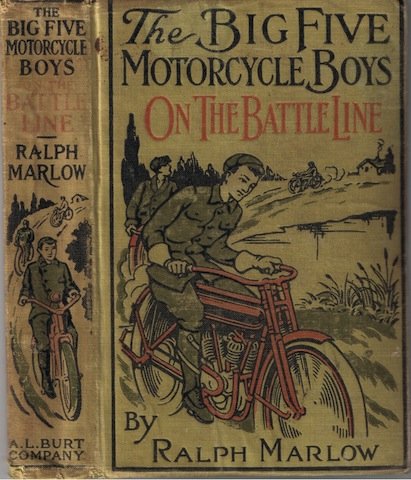
CHAPTER XXIII.
THE THUNDER OF OPPOSING BATTERIES.
Standing there they used their eyes to the best advantage, though none of them felt fully satisfied with their position. Josh looked enviously at a spot only a short distance away. It was something of a small elevation, and he felt positive that if only they could manage to reach it their chances of seeing all that went on would be immeasurably enhanced.
“Yes,” Rod was saying, loud enough for the others to hear him, “I’m afraid, too, his regiment is going to be in the thick of that desperate battle for the possession of the ford across the Marne.”
“Do you mean Andre?” demanded Hanky Panky, instantly.
“Just who I meant,” came the reply.
The others knew that as Rod spoke French, and had talked with a number of people as well as soldiers on the road, he must be primed with information such as had not fallen to their lot. Hence it never occurred to either of them to question the accuracy of anything he might say.
“That would be too bad for all of us,” remarked Josh, “if anything happened to Andre, just when we got within stone’s-throw of him. But Rod, do we have to stay right here, and do our looking?”
“What makes you ask that, Josh?”
“Well, you see, there’s a whole lot better place over yonder, if only we could reach it; but I’m afraid lugging our machines over the rough ground would be too big a job.”
At that Rod took a glance, and of course saw the advantages to be attained by a shift in their position.
“It might be done,” he told the anxious Josh, “if we cared to try and conceal our wheels somewhere near by, and walked or ran over to the rise.”
“Would that be safe?” asked Hanky Panky, fearful lest they after all lose their mounts, and be compelled to walk, or depend on getting an occasional lift from some vehicle going in the direction of Paris.
“Reasonably so, I think,” admitted the leader.
Encouraged by his tone Josh began to cast about in the hope of discovering a hiding place that would stand the test. This he speedily succeeded in doing, for Josh had sharp eyes, and could see things in a flash that it would take another a long time in finding out.
So they made haste to hide the trio of motorcycles in the shrubbery, hoping no one might by accident force a way through just at that particular point, and discover what had been left there.
“Now let’s whoop it up for the rise!” suggested the eager Josh, for the sound of the battle had grown so insistent that he was fairly wild to see everything going on.
They all ran in a bunch, for Rod held Josh in, so that Hanky Panky might not be left too far behind. When they arrived at the place picked out for their station they found that, just as Josh had guessed, it was admirably fitted for their purpose.
Brief though the time had been taken up with this strategic maneuver the fight had evidently progressed beyond the preliminary artillery duel. True, the guns on either side of the Marne were thundering fearfully, and every time a battery sent out its winged messengers of death the very earth seemed to tremble under the boyish trio, who crouched there, and gazed with their hearts fluttering in their breasts like those of frightened birds when held in the hand.
The Germans had left quite a strong detachment of their forces behind to defend that particular ford, which evidently assumed an important position in the eyes of the commander. The Marne could not be crossed with heavy artillery in all that section without the building of a bridge to replace those destroyed by the retreating Teutons, which would take a certain measure of time to execute.
But it was possible to get the guns across here at the ford, for that was what the Germans themselves had done. And a crossing here in force would mean that the pursuing columns of the French must creep that much closer to the precious big guns which the Germans were doing everything in their power to save from capture.
A thousand men might be sacrificed in this endeavor, but what of that? Human material could be replaced readily enough, but it took months to build up one of those magnificent forty-two centimetre mortars with which they meant to batter down the defences of Paris, and win the war.
At the moment the three boys reached their point of observation things were rapidly drawing near a crisis. The French troops were undoubtedly getting wild to be let loose upon the waiting enemy; only their commander knew that the chances were as two to one they would not be able to get across the river so long as that one battery in particular commanded the ford. Its shells were able to sweep over every yard of the crossing, and could cut down those who were wading desperately through the waist-deep water, as though they were helpless flies.
“What are they waiting for, do you think, Rod?” asked Josh, between the roars of the opposing guns.
“The French leader hates to sacrifice so many of his brave men while that battery is in a position to sweep the ford,” replied the other, without hesitation, showing that he had grasped the situation even in that brief time.
“Well, tell me how he expects to get rid of the same?” continued Josh, though he had to place his lips close to Rod’s ear, and fairly bellow his words in order to make himself heard, such was the increasing din close by.
“Perhaps he keeps hoping that some of his own guns will be able to locate the German battery among the bushes there, and disable it,” said Rod.
Hanky Panky pulled at his sleeve. When Rod turned his head he found the other pointing excitedly upwards, and upon casting his own eyes in that quarter Rod instantly knew what his chum meant.
“Two French aeroplanes going up, sure enough!” he exclaimed.
“Mebbe they mean to try and drop bombs on the battery, so’s to destroy it!” suggested Josh, whose attention had also been drawn to the new feature in the lively drama taking place before them.
Rod nodded his head to signify that the idea struck him as worth while. Even had he attempted to speak just then his effort would have been pretty much wasted, for the din had become something terrible. A thousand French soldiers were cheering, even while being held in check by their officers; they made Rod think of hounds restrained by the leash, and loudly bewailing their inability to jump forward. He could easily imagine with what frantic zeal those men would leap ahead and into the waters of the Marne when the time came.
Up higher and higher soared the twin aeroplanes, climbing in eccentric spirals.
Evidently the daring birdmen intended to attain a certain height where they might feel reasonably safe from the shrapnel sent after them from antiaircraft guns manned by the Germans; when they would try their luck in dropping the bombs they undoubtedly carried with them, in hopes of making a lucky shot.
“It’s going to come soon, I guess!” ventured Josh, when a brief lull in all the firing allowed him a chance to get in a few words.
“Yep,” added Hanky Panky, who was getting a stiff neck with looking up so long; “right now you can see that they’re sailing around like they might be looking for a good place to hover. But they’d better take care, because that shrapnel is bursting just below them, and some time a shell might hit home.”
A loud whoop from Josh instantly followed these words.
“There, one let go a bomb, as sure as you live!” he shouted; “look and see where it hits!”
Quickly following came a report, and the boys could see the earth fly in showers.
“Not by a jugful!” whooped Hanky Panky, also carried away with the excitement of the moment; “they’ll have to aim better than that if they expect to knock the German battery out of business.”
The second airman tried his hand, and while possibly he managed to do a little better than the first the result was also disappointing. Evidently they were at too great a height to be able to strike a small mark like the hidden battery. At that early stage in the war which had been sprung so suddenly on France, her aviators had not as yet become proficient in this sort of shooting; later on when they had been given much practice, the result was bound to be quite different.
When the birdmen had exhausted all their bombs and made no impression on the dangerous battery they were compelled to desist and circle around. Evidently it was the intention of the air scouts while aloft to learn all they could connected with the disposition of the German forces. This information would prove valuable to the French commander, whether able to win the coveted ford or not.
“Will they give up trying to cross over now?” asked Hanky Panky, after it was seen that the efforts of the circling birdmen, much more than half a mile aloft, had not met with any sort of success.
“That isn’t the usual French way of fighting, if all I’ve heard and seen of them cuts any figure in the game!” Josh exclaimed.
Rod, too, seemed to be of the same opinion.
“I think they must be getting ready to make a mad effort to rush the ford,” he went on to say; “you notice that their guns are silent just now; but that’s done so they can burst out with a more terrible bombardment than ever, under cover of which the attack will be started.”
“But why all this row over just one contemptible little ford?” asked Hanky Panky innocently.
Josh snorted at hearing this.
“Why, can’t you see what it means to both sides to control a crossing where the artillery can get over without building a bridge?” he demanded. “To hold up the French here the Germans would be willing to sacrifice thousands of their best men, because it would save their big guns now on the way north. There, it’s coming, I do believe.”
None of them heard the last words spoken by Josh, and for a very good reason. Every gun the French had within a mile of the ford began to bellow in concert, and the ground shook under the concussion. Across on the other side they could see the shells bursting everywhere. It seemed as though they sought out each place where they suspected hostile batteries or columns of troops might lie in hiding, thus fairly raking the entire vicinity.
This was “preparing the ground for the seed,” as army men would put it. When this fierce “spraying” was well under way no doubt the order that had been awaited so long and impatiently by the concealed French soldiers was to be given; when they would start toward the bank of the river and strike into the shallow water, breasting their way across if possible.
The three boys fairly held their breath with awe, knowing what was coming next. Hanky Panky crouched there shivering like one who had the “shakes,” yet wholly unable to drag his horrified eyes away from the grim spectacle of war that was passing before him. Josh, on the other hand, had arisen to his feet, knowing that there was little or no chance of his being noticed and fired at, unless indeed some German gunner conceived the idea that they were a group of French officers observing the progress of the battle from an eminence.
This dreadful “spraying” with fire had gone on for some little time now when Rod saw signs that told him the expected event was coming. He could not have made his chums hear, no matter how he shouted, and so he contented himself with clutching each of them, Hanky Panky by the arm and Josh by the calf of his leg. They knew what he meant by this action, too, even though not a word was uttered.
The violent gunfire was being kept up, but from several points there suddenly burst into view living streams of French soldiers racing madly for the ford, and every man apparently wild to be the first to attempt the deadly crossing.
CHAPTER XXIV.
A FRENCH HERO.
“Can they ever do it?”
Undoubtedly this was what was filling the heart and brain of each of those boys as they watched the living stream of French rapidly draw nearer the river ford commanded by that destructive German battery, and which thus far they had not been able to reach and silence with their own guns and aeroplane attacks.
The time between the uprising of these troops and their reaching the shallow water of the ford was of very brief duration. Undoubtedly the French had crept up just as close as the nature of the ground would permit them to go unseen.
Still to those anxious hearts on the little rise it must have seemed dreadfully long, owing to the strain they were laboring under. As yet the Germans had held their fire, for not a man of the attacking force had fallen save when they stumbled, only to rise again.
Possibly Hanky Panky may even have deluded himself with the hope that when it came to a pinch the Germans had deemed it best to give up their desperate intention of defending the ford to the last gasp. Josh knew better, because he understood the holdfast nature of the Teutons better than did his chums. And he was mentally figuring on just when the bitter blast would break forth that was going to mow down those valiant men with the red trousers and the blue tunics rushing pell-mell forward with such ringing huzzas.
At least the men separated as they ran, doubtless following the instructions of their officers. This was bound to be of advantage to them, since the fire of the enemy could not cut them down as ripe grain falls before the scythe of the reaper or the revolving knives of the modern mowing machine.
“Some may manage to get across anyhow!” Josh was telling himself, as though seeking comfort.
Now the first of the French had reached the bank. They leaped impetuously into the water and hastened to start across. As they advanced of course they waded deeper, and their pace lessened. Was this just what those cool, calculating German gunners were waiting for? Rod expected to hear the first crash at any second now. How his heart went out to those gallant fellows splashing through the river at the disputed ford. He felt as though he must shut his eyes so as not to see what was fated to occur; but for the life of him he could not. Some power beyond his control forced him to continue to crouch there and stare with all his might and main, as though he must omit no small detail of the amazing picture.
The ford was now fairly alive with moving figures, all pushing hurriedly toward the other shore, where not a German could be seen. The bushes in that quarter lay there as unassuming as though every one did not conceal a foe with ready rifle waiting for the order to come to pour in a terrific fire.
That was the picture Rod would often recall in days to come. It was stamped on his memory in imperishable colors–the bright sunlight, the hovering clouds of billowy powder smoke, the gay uniforms of the charging Frenchmen, the sombre, oppressive silence hovering over the opposite bank of the river–all these things had a part in the never-to-be-forgotten scene.
Then it seemed as though some volcano, long held in check, must have burst the confines of Nature in a mighty convulsion. From several points there came the thunderous discharge of batteries, while a thousand rifles added their sharper notes to the dreadful chorus.
And the men in the river, what of them?
Scores could be seen to throw up their arms and disappear, the current doubtless bearing them away. Others were forced to turn and start back to the shore they had so recently left, having been wounded more or less severely. Gaps appeared in the various groups, showing what terrible carnage those guns in the leading German battery had already executed.
Still the forward movement had not been as yet effectually stopped. Those who were thus far uninjured kept pushing ahead, even though they must realize that it was into the very jaws of death they advanced. And Rod found himself filled with sincere admiration for the bravery they exhibited. He had read of similar things many times, but seeing with his own eyes an exhibition of such wonderful valor was an entirely different matter.
Oh! how he hoped and prayed that in the end some of those Frenchmen might manage to reach the other shore which they aspired to gain. But when the German guns continued to roar and send torrents of iron hail into the ranks of the adventurous French it began to look very much as though not a single man might be able to accomplish the passage of the disputed ford.
Hanky Panky could stand it no longer. He rolled over and hid his face, while thrusting the forefinger of each hand as deeply into his ears as he could, evidently with the hope of shutting out all that dreadful noise.
Not so Josh, who, though very white, and trembling with excitement, still continued to stand there, drinking it all in eagerly, as one might something that was fairly intoxicating his senses.
The war drama did not last long. Under that murderous fire the French soldiers in the water fairly melted away. Some managed to return safely to the side of the stream held by their comrades, but by far the larger number seemed to have vanished. Further down the river they could be seen, some of them struggling in the water, with others floating along significantly still.
The firing had almost ceased by now, because there was no further need of wasting precious ammunition on the part of the provident Germans. The charge of the impetuous French had been stopped, and if they still meant to carry the ford they must gather what was left of their force for a second attempt.
Still, while that one battery covered the crossing it seemed madness for them to risk the annihilation of their men in another effort.
“It was a fluke, after all!” Josh was calling out in bitter disappointment; “they never had a chance to get over while that awful battery covered the ford. Oh! how I wish a part of them at least had managed to get across. Look, Rod, as I live, one lone Frenchman did succeed in crossing. You can see him crawling along in the scrub there, his red breeches betraying his every movement. Just a single one of all that brave lot, and he’ll be either killed right away or made a prisoner, like as not!”
Somehow both boys found themselves compelled to watch the progress of the crawling Frenchman. He seemed only a grain of sand on the seashore compared with the mighty forces employed on both sides, and yet at that particular moment he occupied the centre of the stage in their minds. Without knowing why this should be so they continued to follow his movements with their eyes.
Then suddenly Josh broke out again. He could make himself heard because there was little if any desultory firing now; the Germans were satisfied with the execution already accomplished, while the mortified French held their fire until further plans could be settled upon.
“Rod, what do you reckon that madman means to try and do?” he asked excitedly; “see how he keeps on creeping straight along toward where that battery is hidden behind some sort of barricade. Honest to goodness, now, I believe he means to tackle the entire business all by himself; just like a Frenchman for desperate bravery. He must be crazy to think he can do anything unaided, Rod.”
“Don’t be too sure of that, Josh,” the other told him immediately; “unless I miss my guess that man has got some project he’s meaning to put through, come what will.”
“Oh! now I see what you mean, Rod; yes, as sure as anything he’s carrying something in his hand, and I do believe it must be a bomb that he’s meaning to throw over the barricade on to that battery! It’s a great scheme, Rod, but with not one chance in ten to succeed.”
With strained eyes they watched the creeping figure with the telltale red trousers that added so greatly to his peril. Shortly afterwards Josh broke out again in what might be called a lament.
“Too bad, too bad, Rod, they’ve glimpsed him at last, just as I was afraid they’d be doing. You can see some of their sharpshooters further back are sending a rain of balls in that direction, for they make little puffs of dust fly up everywhere they strike. He’s bound to be hit in a jiffy now. Oh! see that, would you?”
There could be no question but that one or more of the plunging bullets had reached their intended mark, for the creeping soldier had rolled over as if in agony.
“He’s done for, poor chap, just as I expected!” cried the sympathizing Josh, while even Hanky Panky once more dared to lift his head and look; but almost immediately afterwards Josh changed his tune from despair to one of new hope–“no, he was only badly injured that time, and not killed, you see, because now he’s going on again. Oh! I take off my hat to that gallant man! There never lived a braver chap, never; and now I do hope he’ll get close enough up to fire that bomb he’s carrying along with him on to that battery.”
Perhaps the marksmen who were amusing themselves in trying to pick another foeman off did not realize what the French soldier really meant to do. Had they grasped the full situation a volley would surely have finished his career, and left his self-appointed mission unfulfilled.
Josh kept tabs of his movements. He even knew when again the crawling figure gave signs of having been struck once more by some of that leaden hail. This he could tell from the way in which the heroic fellow writhed as in pain.
“But, Rod, they just can’t keel him over, don’t you see!” cried the admiring Josh, clapping his hands in his excitement; “twice now they’ve hit him, but he won’t give up the game. Why, he has to drag that left leg after him all the while, showing where he’s been hit. Oh! what wouldn’t I give for a chance to help him out; but it’s no use; he’s just got to do it by himself!”
The seconds went on. Perhaps other eyes were following the slow and painful progress of that lone French hero as he crawled along foot by foot, suffering dreadfully no doubt with every movement, yet never for a minute dismayed. Perhaps the eyes of the French commander-in-chief may have been glued on him through his powerful glasses; and realizing what the success of the daring soldier’s mission might mean for a second assault on the defenders of the ford, his heart would begin to pick up renewed hope the closer the private crept to the battery.
There could be no question as to the unflinching spirit that dwelt in the breast of that particular soldier. Rod remembered many things he had read in ancient history, but somehow they all paled into insignificance when with his own eyes he saw this wonderful exhibition of valor unparalleled. The heroic defense of the Pass of Thermopylæ; the swimming of the Hellespont by Leander, yes, and other instances made famous in the annals of history had once struck the boy as wonders in their way, but somehow seeing things was a great deal more impressive than reading about similar happenings.
By now the French adventurer had managed to get close up to the place where the terrible offending battery was hidden. Doubtless he could see much better than the boys at a distance, and knew where it would be possible to throw his bomb so as to accomplish the maximum of damage.
“He’s nearly there, Rod, and oh! I’m scared almost out of my seven senses for fear they’ll get him before he can give that thing a whirl over. There, see, he’s trying to get up on his knees now, though it’s a hard thing for him to do, because he’s so weak from loss of blood, I reckon. Bully boy! now you’re going to take a fling, and here’s wishing you the greatest of luck!”
The brave soldier had indeed managed to raise himself part way and with all his reserve strength hurl the bomb he carried over to where the battery lay concealed.
CHAPTER XXV.
THE WINNING OF THE RIVER FORD.
Immediately there came a loud crash as the bomb exploded. The exhausted French soldier had no further strength to sustain him, for the boys saw him fall over as though he may have died in the climax of his success.
Then came the clear, piercing note of a bugle, like a clarion call. It was undoubtedly the signal for another attempt to force a passage of the river, so essential to the success of the French pursuit of the retiring German armies.
Again did a host of active figures leap into sight from the coverts where until now they had lain concealed awaiting the success or failure of the first action. These were no doubt the reserves intended to be thrown into the breach after some of the others had managed to get safely across and engaged the enemy forces. Now they were taking the initiative in pushing across the ford.
As the others had done these men also scattered when charging, so that no great collective damage might be wrought when the foe started to fire. They were speedily at the water’s edge, and it was then that they anticipated meeting with that sudden avalanche of flame and smoke, and the roaring sound of many guns.
Somehow it did not come in the volume expected; in fact, while rifles and quick-firing guns started to take their toll the one offensive battery remained singularly silent.
Rod and Josh did not need to be told that the bold Frenchman must in some way have succeeded in disabling all the units of that battery when he hurled his bomb over the redoubt. Perhaps that terrific crash may have been an ammunition supply exploding and scattering the guns right and left.
No matter what the cause the battery was as still as death, a fact that must have filled the anxious heart of the French commander-in-chief with a fierce joy; for its presence there intact promised to make all his work of no avail, despite the unrivaled valor of his men.
This time the story was to be quite different, it seemed. Some of the leaders in that mad rush were already almost over, and here, there, everywhere they were trying to shoot back as they found a chance to glimpse an enemy hidden amidst the bushes on the bank of the river.
Josh could hardly contain himself. He jumped up and down “like a flea,” as Hanky Panky afterwards explained it in his peculiar fashion. Indeed, to hear Josh letting out shrieks and cries one would have imagined the whole battle of the Marne ford had been staged for his particular benefit, and that he was enjoying the lively scene with all his heart.
Now some of the Frenchmen were crawling up the bank. They found shelter, such as it was, and immediately began to make good use of their guns, aiming so as to cut down those who were rattling the quick-firing weapons not far away.
More and more came up out of the depths, some of them wounded it was true, but with undiminished ardor hurrying on. With the climax of their ambition at hand and an opportunity for a fight at close quarters with the hated enemy granted to them, why should they mind such a small thing as a bullet in the shoulder, or it might be a leg that dragged as they walked?
The fire and enthusiasm that filled their hearts prevented them from falling out of the line. Some in fact would not know they had been injured until it was all over but the cheering, and a weakness began to overcome them, with the excitement on which they had been living having passed away.
Josh was waving his hat wildly now. Despite the noise and confusion he shouted out his views. In so doing he gave the “escape valve” something to do, and likely enough worked no harm.
“And to think it’s all owing to the work of that one brave fellow!” was the burden of his outcries.
“I’m taking off my hat to him right now. I salute him, living or dead! His family will be proud of him when they learn what a grand thing he really did. Talk to me about the Cross of the Legion of Honor; why, that man ought to be made a general–if he lives!”
The Germans had by no means given up, even when they realized that after all the French had won the passage of the ford. They had been given the task of defending the crossing with their lives, and showed the customary German disregard for death in staying after all was lost.
But more and more French were getting over now. They came from every quarter, all filled with ardor and a desire to get in the fight over there. The guns too were being brought closer to the river, so that the retreating Germans might be shelled warmly as they left the scene of their stubborn combat.
How they splashed across that shallow place in the stream Rod would never forget. Some, getting off the main ford, found themselves in water breast-high; others actually had to swim for it, holding their guns above their heads so that they might not get wet and refuse to continue the good work of chasing off the Germans.
It was an inspiring sight–of course only to those who favored the French, for to the enemy it must have proven a most discouraging one–to see those men wild to cross to where the engagement was being fought to a finish. Each one, as soon as he could set foot on solid ground, lost no time in starting up the bank and adding his quota to the force of the assailants.
And not one single shot had come from that important battery which, more than any other contributing cause, had brought about the first disaster to the French. There could be no question but what that one unknown private soldier, perhaps now dead, had saved the day for his side.
Luckily none of the Germans seemed to have paid any attention to the little assemblage of three figures in faded khaki on that slight rise of ground. At least no annoying shell had fallen near them, nor did the boys at any time catch the irritating whine of a whimpering leaden missile hastening past close to their ears. All of which pleased Rod very much, for he certainly felt no desire to mingle in such terrible scenes as had been spread before them of late.
Well, the end was in sight, for when the French field batteries began to let go it could be easily guessed that they were sending their compliments after that remnant of the enemy now sullenly retreating, and always with faces toward the foe.
Then came the shrill blast of bugles. This undoubtedly told the French soldiers that victory had fallen to their portion, and that the winning of the Marne ford was an accomplished fact.
Loud arose the huzzas of the survivors. Succor for the injured would quickly follow, since no pursuit was expected to be organized. The work to which they had been assigned was now accomplished, and against difficulties that might have frustrated all their efforts only for the one gallant man who made victory possible.
Rod and his chums cheered with the rest. They seemed somehow to feel that their hearts beat in full sympathy for those Frenchmen who were standing up in defense of their native land.
Josh, more demonstrative than either of his companions, went so far as to actually throw his arms around Hanky Panky and give him such a bear-like hug that the other’s eyes almost popped from his head and his breath came in gasps.
“Let up on that sort of business, can’t you, Josh!” he managed to cry indignantly as he broke away from the other’s detaining clutch; “what do you take me for anyway? Must think you’re doing one of the new fangled fox-trot hesitation dances. I’ve got feelings, I’d have you know; and my ribs are brittle bones in the bargain, not hoop-iron. Go hunt up a tree if you must exercise yourself on something. I object!”
Standing there on the rise of ground they could see the first of the French light batteries crossing the ford, the horses prancing, but forced to drag the guns through the shallow water. Later on heavier artillery would also be coming up to follow the fleeing German army, when the full importance of this ford would be better understood. No wonder the tactics of delay upon which the Germans were working had forced them to defend such a spot to the limit.
“What are we going to do next, Rod?” asked Josh, when they had stood and watched these events taking place for some little time.
“We’ll have to hold off until they get things in ship-shape again,” replied the other; “you see there are the wounded to attend to, the dead to gather and bury, it may be, as well as a lot of other matters to be looked after. They’ll be in no hurry to chase after the enemy, I imagine. Their one object was to carry this crossing, and that they’ve done.”
“But at a terrible cost to them,” sighed Hanky Panky, as he saw the injured being carried to a central point, where doubtless the field surgeons would be on hand, ready to give them first attention; besides, there had been scores upon scores carried down the river whose fate could only be guessed at.
“That’s always what war means, I’m afraid,” remarked Rod, not that he himself was getting hardened by seeing such sights, but because he had a broader vision than Hanky Panky, and could anticipate what would follow when two hostile forces came in contact at close quarters.
“If that was Andre’s regiment that went in at the first,” observed Josh gloomily, “I’m mighty much afraid we’re going to have all our trouble for our pains; because they were almost wiped out. Andre is pretty sure to have been among those who were in the water when that battery got in its heavy work, and–well, the current carried away many a gallant fellow, never to give him up again.”
“Oh! it’s hardly as bad as that, Josh,” remonstrated Rod; “a good many managed to get back again, either wounded or whole. If we’re lucky we may find Andre among that lot. We’ll hope to, anyway; and our business will then soon be over.”
“Well, for one I hope and pray we’re able to turn our backs on this thing before another sun sets,” said Hanky Panky, with such a sad look on his face that Rod was quite sorry they had been tempted to follow up this adventure.
Still, they had risked their lives in a good cause, and if only that little French woman Jeanne and her family could be provided for in the future, despite the schemings of Jules Baggott, he for one would not feel tempted to complain on account of perils undergone and risks taken.
“Most of the French have crossed over by now, you notice, Rod,” observed Josh, when some time had crept past, and he could hardly restrain his customary impatience any longer.
“And that means you think we should be getting a move on too?” laughed the other, trying to raise the drooping spirits of Hanky Panky by an assumption of levity which truth to tell Rod was himself far from feeling.
“Well, it seems like we must make the crossing some way or other, and while one of those gun caissons we see coming along is going to get over why not find out if they’d let us climb aboard? It’ll save us from getting our feet wet even if it did nothing else.”
“That isn’t a bad idea, Josh,” commented Rod, “and it might be just as well to try it out. These Frenchmen are pretty accommodating, and they’ll like as not take us for British boys, as has happened so many times before.”
Another troop accompanied by a battery had come up and was starting to reach the northern side of the Marne, so as to presently continue the chase after the retreating enemy. It was to the ammunition caissons belonging to this battery that Josh had referred.
The boys hurried forward now. No one thought to question their right to be present. Perhaps this was because of their looks, or the khaki suits they wore, which would be taken for British uniforms. Indeed, quite a number of those who were seated on gun carriage or ammunition chest waved to them in the hearty and friendly fashion known to soldiers after a victory has thrilled their blood, making them light-hearted and gay.
CHAPTER XXVI.
JOSH MAKES A DISCOVERY.
Rod soon fixed the transportation part of it, just as his confident chums felt sure he would be able to do. He quickly selected a certain outfit that had stopped on the border of the ford for a minute or so, while a loose portion of the harness was tightened.
Entering into conversation with the sergeant, who seemed to be in authority, Rod explained in a measure who they were and how they came to be loose on the battle lines at such a time as this.
Then he made his request, and with such simplicity, accompanied by a winning smile, that the dapper Frenchman could not have refused his modest request even had his heart not warmed toward these young friends of France from across the sea.
“We must get over the river, because it is necessary that we find Andre D’Aubrey if he is yet alive,” Rod had gone on to say ingenuously; “and since it would be unpleasant for us to continue our ride if we were soaked to the waist, perhaps M’sieu le Sergeant would permit us to climb up with him on the caisson, and accompany him over the ford?”
“Indeed, it would be a pleasure to have you along with me,” hastily replied the non-commissioned officer of the battery, “and as the harness is now repaired, make yourselves at home here, if you can find a lodgment where your feet will be out of the reach of the water.”
Gladly then did the trio of lads accept of his friendly offer. Trust them for finding a perch where they would be beyond the reach of the river, unless the soldier astride one of the horses managed to lose the shallow line of the ford and stray into the depths.
Luckily this did not happen. The water did come close to their feet so that Hanky Panky was impelled to draw himself up into something of a knot in the fear of getting wet; but the worst was over, so that presently the gun caisson emerged from the Marne, and the boys were able to jump down.
Rod looked about him. It was indeed a stirring picture taken in all, for everywhere the French had occupied the ground so tenaciously defended by the German rearguard.
Hundreds of soldiers were moving this way and that, with the officers gathering as if for a council of war.
Other batteries could be seen coming on the gallop toward the captured ford, as though the birdmen aloft may have sent the signal along to tell them that now the coast was clear they could make the passage in safety. Some of these were heavier guns than any the boys had as yet seen, showing that the French were hurrying all their available resources forward in order to strike the enemy hard while yet in retreat.
“Now what, Rod?” asked Josh.
“We’ll look around a bit so as to get our bearings,” he was told. “It’s true we came here on a mission, but perhaps it might be wise not to bother the commander-in-chief in too big a hurry. He’s certainly got his hands full as it is, and can’t be worried with our private affairs.”
“I guess that’s about so, Rod,” agreed Hanky Panky. “To us Andre’s business may seem mighty important, but why should a general waste a precious minute of his time with any one’s affairs, when he’s got to map out his movements, with a beaten but still fighting foe ahead?”
“Look there, fellows!” exclaimed Josh just then; “unless I miss my guess that must be the hero of the battle they’re fetching in right now.”
“See how the men take their caps off, will you?” said Hanky Panky reverently; “I’d feel like doing the same myself if he came near me, because it was his work that really made the passage of the ford possible. They all know it too, and just now they fairly worship that lucky chap.”
“Oh! I hope it doesn’t mean he’s dead!” exclaimed Josh with a tinge of deep regret in his voice; “that’d be too everlasting bad, you know, after he’d won his promotion, and the cross these Frenchmen prize so much.”
“No, he is still alive, because I saw him wave his hand feebly just then when he passed that group of cheering soldiers,” said Rod quickly.
“Bully for that!” exploded Josh exultantly; “somehow or other I just seem to be taking a personal interest in that brave chap, as if he might be a friend of mine, though of course I wouldn’t know him from Adam. But a thousand pair of eyes saw what he did, and the army of France knows how to honor such a hero. We must find out his name before we leave here, Rod, that’s sure.”
“I’ll not forget to ask it!” declared the other positively, “because we’ll want to write it down in our log. Whatever his name turns out to be it’s bound to go down to posterity as belonging to one of the heroes of the Battle of the Marne.”
“There,” continued Hanky Panky, “see, the general is going over himself to see the wounded man now. Why, even he takes off his military cap. It must be a proud time for the man who threw that bomb and wrecked the German battery. He not only won the ford for his side, but like as not saved the lives of scores of his comrades.”
Rod was considering his plan of campaign.
“You can see that some of the officers are gathering under that shed yonder,” he went on to explain. “I reckon they mean to hold their council of war there, because it looks like the best shelter around. I wouldn’t be surprised if the German forces had the same places for headquarters before their retreat, because I can see a table there and some camp chairs.”
“Yes, and then, too, it seems to be out of range of the batteries that were on the other side of the river; sort of protected as it were,” Josh observed, for he was quick to notice such things.
“All right,” Rod wound up by saying; “our plan is to hang around until the war council breaks up, and then try to find a chance to speak with the commander-in-chief. All we want to do is to show him who and what we are, and then ask about Andre. He may not have the time to bother with it himself, but I hope he will put us in charge of some subordinate officer who can tell us what we want to know, as well as take us to Andre, if so be the poor fellow still lives.”
While waiting they strolled around the immediate vicinity, being considerably interested in all that was going on.
Josh in particular seemed disposed not to lose anything. He moved this way and that, now watching the labors of a string of men dragging at a rope by means of which they were helping the horses attached to a heavy gun pull the same up out of the river; and a little later even observing the field surgeon and his assistants binding up the grievous wounds of scores of poor fellows who had been more or less injured in the battle.
Rod was seated on a stump and thinking seriously of their own affairs when he suddenly became aware of the fact that his two chums were hurrying toward him. He could also see that they looked both excited and grave, as though something had happened to alarm them.
Of course the first thing that came into Rod’s mind was bad news; he feared that in some way they might have learned about the fate of Andre, and were now hurrying to tell him all their efforts had been in vain, for the husband of poor Jeanne could never sign his name to the paper they carried.
“Is he dead, then?” was the way he addressed them as they came panting up.
“Oh! it isn’t about Andre, Rod!” gasped Hanky Panky.
“What then?” questioned the other, at the same time giving a sigh of relief, for he had feared the worst.
“It’s something Josh here hit on, that’s given us both a bad shock; he’ll tell you, Rod,” continued the other, who was trembling visibly.
“It’s just this way, you see,” Josh spoke up. “There’s a German soldier hiding close by, a wild-looking chap in the bargain. Whee! but he’s got staring eyes, and he makes me think of a crazy man.”
“Oh! he must be one of their wounded,” said Rod; “when they pulled out in such a big hurry they couldn’t take all with them, and some had to be abandoned. This fellow in hiding that you’ve run across must be hurt in the legs, and couldn’t get away with the rest.”
Josh shook his head with a vim.
“Excuse me, Rod, but I don’t think you’ve hit the real secret,” he went on to say. “This man has stayed here for a purpose, and he’s about ready to lose his own life, I’d say, so as to carry it out. I really and truly believe he must have a screw loose in the upper story.”
“Go on,” said Rod, seeing that Josh evidently knew more than he had as yet explained.
“I just noticed him by the merest accident,” explained the other. “He’s hiding in a hole in the ground. I happened to see him lift his head, and noticed that he wore the dark green uniform of a German soldier. Then I discovered something else, Rod, that gave me a cold feeling, and made the chills run down my back.”
“Go on, and hurry, too!” advised Rod.
“It was a wire, Rod, a wire that seemed to come up out of the ground, and disappear by the side of a tree. It headed straight for the shelter that used to be the headquarters of the German staff, and where the French officers are gathering right now, waiting for the general to join them.”
“A wire, did you say, Josh?” demanded Rod, starting up, and looking white.
“Yes, and ten chances to one there’s a mine, planted under headquarters, which he means to explode so as to blow up the French staff, general and all.”
CHAPTER XXVII.
WONDERFUL NEWS.
“If what you suspect is true, Josh,” said Rod hurriedly, “we must do something to baffle the terrible game he is bent on playing. Can you lead us to the place where the man is hiding, and is it possible to get close to him without his knowing about our being there?”
“Sure thing, Rod; why, I could have jumped down on his back if I’d wanted to; but I just moved away as slick as you please.”
On second thoughts, however, Rod changed his plan. What he had contemplated trying seemed too risky; for if the man learned that his plot was discovered he might touch the key and explode the mine before the boys could master him, even though all the staff including the general himself had not gathered as yet under the Headquarters shelter.
“I’ll try and get in touch with the officers before the council is called,” he told his comrades, and immediately started off.
It was an object with Rod to hasten his steps, and yet at the same time try not to arouse any suspicion. If he were detained on the way precious seconds would be lost, and after all he might fail to save the French officers from a dreadful fate at the hands of a crazy German soldier.
Arriving close to the shelter of which mention has been made, Rod boldly singled out a man who he fancied would be apt to listen to him.
“Pardon, Monsieur,” he said hastily, “but by accident myself and friends have just learned that there is a scheme afoot to blow up this shelter while you and your brave fellow officers are in conference. Even now a madman lies hidden close by, his finger on a battery, and ready to close the circuit in haste. I am come to give you warning. Please do not exhibit any alarm, but arrange it so that every one may spring away from this place when you give the word!”
The officer stared hard at him, as indeed he had good reason to. The information was certainly of a thrilling nature, and well calculated to arouse a chill in the region of his heart.
Again that frank and fearless face of Rod convinced his listener of the truth of his story, even though it seemed so remarkable and monstrous. The officer turned to his four companions and said something to them in a low but positive tone. From their startled looks it was soon evident that they chose to take the warning most seriously.
All at once he uttered a loud cry. It was the signal agreed upon, for every man proceeded to leap away from the shelter and make haste to place as many yards as possible between Headquarters and his own person. Rod had taken care to be on his way before this, since his object had already been accomplished.
If any of those French officers had felt disposed to doubt the truth of the astounding story that had been brought to them by the American boy they found immediate cause to change their minds. Hardly had the last of them succeeded in leaving the shelter than there came a heavy shock, and up into the air arose the fragments of the cover under which they had just been gathered.
Had they remained where they were ten seconds before not one of them would have likely escaped death or severe bodily injuries.
A loud shout from Josh just then called attention to a running figure. The hidden conspirator, seeing that his mad scheme had proven a failure, must have crept forth from his hiding place, and was hoping to escape in the general confusion. But his uniform betrayed him, and presently guns began to sound, until finally they saw him curl up on the ground.
It was later on found that he had only been wounded, and he was brought in, foaming at the mouth. There could be no doubt regarding his condition, for even a tyro might see that he was crazy, perhaps from a wound received in the head in some earlier stage of the great battle.
It was not believed that German officers would connive at such a dastardly scheme as trying to blow up a shelter under which the French staff had gathered for consultation; and in the end it was put down as only the plot of one who was wholly irresponsible.
Of course the three American boys were thanked most heartily by the officers whose lives they had saved. It promised to turn out to be one of the best things that could have happened for them; and, as Josh remarked, their old luck seemed to be working at full speed.
They were soon summoned into the presence of the general, who, with his staff gathered about him, publicly thanked Rod and his chums for their recent act. He shook their hands with considerable feeling, as became an effusive Frenchman whose life was not only valuable to himself and his beloved country in time of need, but also to the wife and children who awaited news of his labors at home, and daily prayed for his safety.
While they stood there the madman was brought past, screaming and carrying on in a frightful manner. He must have been connected with the Engineer or Signal Corps of the enemy forces, to have the knowledge of explosives that he did, as well as the ability to lay his wires so as not to attract attention.
The boys could admire any deed of daring that was meant to further the cause of a soldier’s heart; but to plot to blow up a whole staff in such a treacherous way was something that could only originate in a disordered mind, and filled them with horror.
“Now tell me who you are, and what brings you here at such a time, when France is bleeding from ten thousand wounds, and Paris has only been saved as through a miracle?”
It was, of course, the general who asked this. He was looking into the expressive face of Rod while speaking, and perhaps unconsciously saying to himself that if his oldest boy ever grew up to be such a manly looking young fellow as this American cousin he would be contented; for that was usually the way Rod impressed those whom he met.
Rod was just about to answer and explain as briefly as possible, for he knew how valuable time must be with this brave officer, when something interrupted him.
A number of men were passing and carrying a stretcher upon which lay one of their number. Rod guessed that this must be the hero of the battle when he saw every officer make a salute that could only stand for his appreciation toward valor beyond all parallel.
“That’s the man who threw the bomb that saved the ford!” said Josh to Hanky Panky, as the little procession drew near.
Evidently the wounded man had received attention at the hands of the field surgeon, and was now about to be placed in an ambulance and taken to Paris with an escort of honor to guard him. Nothing could be too good for him in the opinion of those who had observed his daring deed.
The general laid his hand on Rod’s arm.
“Come,” he said kindly, “it seems that you too witnessed the wonderful feat performed by this hero of heroes. Perhaps you would be glad to say you had taken his hand when you return to your native country. I am pleased to say he will undoubtedly live to receive the honors that a grateful France is ready to shower on his head.”
“Thank you, Monsieur le General,” said Rod warmly; “I speak for my comrades as well when I say we would esteem it an honor to meet him; and we also hope and pray he may live to see victory come to France.”
Accompanying the general, they advanced toward the party with the stretcher. The attendants had halted at a signal from the commander-in-chief, and set their burden down. Rod saw the face of the man who had dared all to save his fellows. Somehow it seemed to him that somewhere or other he must have met him before, although for the life of him Rod could not imagine how that could be.
“This, then, is the one man whose act made the taking of the ford possible,” said the French general; “and when you remember what this day you have witnessed, always place high on the roll of fame the honored name of Andre D’Aubrey, to whom we who have fought the battle for the ford owe all our success!”
“What! our Andre, and a hero of heroes at that!” cried Josh, able to grasp the amazing fact, even if much that the general had said was as Greek to him; “now what do you think of that, Hanky Panky?”
As for the party in question, he could only stare and shake his head as though utterly unable to understand what it meant.
Rod suddenly remembered why the face of the man on the stretcher had seemed so familiar. When Jeanne told him all about her troubles he had been looking at the small boy who accompanied her on her milk route with the dog team; and it was Andre’s son whose face was in his mind when he stared at the father, for the lad was certainly “a chip off the old block.”
Things could hardly have turned out better for the three Motorcycle Boys. Why, not only would Andre have witnesses when he signed the document, but high honors awaited him after he had recovered from his wounds. Jeanne in her far-distant, humble home in Antwerp must soon hear great tidings that would bring her much joy.
No wonder then that Rod hastened to pour out the story in his best French.
CHAPTER XXVIII.
CONCLUSION.
When the main facts of the story had been told the impulsive and gallant French general insisted that the paper be signed, with him and members of his staff as witnesses. He also declared that he would see to it that the family of Andre should be brought on to Paris with as little delay as possible; because it was expected that sooner or later the Germans would decide to take Antwerp.
All this filled Rod and his chums with the greatest of pleasure. The wounded man was looking exceedingly happy, for the news he had just received concerning his loved ones filled him with more delight than even the prospect of receiving great military honors, and possibly being made a captain on account of his recent feat.
Nor was this all, it seemed. While Rod was relating his story he had noticed that a man who was not in uniform had approached, and seemed to be listening intently. Thinking that he might be some one who desired to make a report to the general, Rod had paid little attention to this unknown party. Judge of his astonishment and delight as well when the other pushed forward, making a respectful salute to the commander-in-chief, and announced his identity.
“Behold in me the villain of the piece,” he remarked grimly; “I am Jules Baggott, the cousin who plotted to keep Andre from receiving the inheritance our uncle had planned to give him. With shame I confess it now, but, my general, never again would I be guilty of conspiring against a member of my family who has won for it and for France such imperishable renown. I, too, saw what Andre did, and even though I had the power to destroy that paper at this minute I would scorn to do so. Here and now I beg his forgiveness. His wife and family have reason to be proud of him, even as we are.”
Rod never knew whether Jules meant all he said. He did not altogether like the man’s looks; but his words were fair enough, and he acted as though for once in his life he was thoroughly ashamed of himself.
It turned out that Jules could not serve as a soldier on account of lacking the sight in one of his eyes; so there was really nothing to his discredit in his absence from the army. In reality he had become a member of the Secret Service, and doubtless would find a means in that capacity to do his part in the long war that faced France.
Of course the general could not give them any more of his valuable time. He did shake hands all around again at parting, and assured Rod that he would take a personal interest in seeing that Andre and his family were speedily reunited in Paris. With that the boys believed they had good reason to feel satisfied; and that they could conscientiously give over their adventurous and perilous journey to the battle front where the two rival armies were fighting so desperately day after day.
Hanky Panky in particular displayed considerable delight at the prospect of once more turning their faces toward home. He had, to tell the truth, become weary of all these pictures of savage warfare, and yearned to again gaze upon peaceful scenes such as the country beyond the sea held in store for them. Faces of his boyhood friends were appearing before him in his dreams every single night, and too the loved ones left behind had never seemed one half so precious as now.
“This fighting business may be all very well for those who like it,” Hanky Panky was saying as they prepared to cross the ford again, this time on the ambulance that would take Andre, as well as several other wounded men, to the hospitals of Paris, “but I’m not much of a hand at that game. Baseball and football are the limit of my scrapping abilities. This thing of standing up before a quick-firing battery, and getting punched all full of holes, doesn’t appeal to me at all, though Josh here seems to never get enough of watching men shoot each other down.”
“Oh! say, don’t make me out to be a regular savage,” remonstrated Josh, in turn; “I feel just as bad as the next one to see a man get hurt; but my folks came of a line of soldiers, I guess, because some of ’em fought in the Revolutionary War; so it must be in my blood to want to see stirring sights all the time. Now, I wouldn’t be caught attending a bull fight, or even watching two roosters scrap, because that makes me sick; but when men are standing up and sacrificing their lives for love of their country it somehow just thrills me to the marrow, and I never can drag myself away. But all the same I confess I’ll be glad to get back home again. There are plenty of ways to get excitement without being on the battle line.”
They took a last look around them, wishing to carry away a full remembrance of the scene at the captured ford. How often would every item of that never-to-be-forgotten engagement come back to haunt them in memory, as time passed, and they found themselves amidst other surroundings. In the bellowing of the thunder they might start up in bed to again fancy themselves listening to the roar of the guns on both sides of the Marne; in imagination to see the valiant French as they splashed through the breast-high waters, seeking to reach the bank where the grim Germans held the fort, and poured such a merciless fire upon them.
So they crossed the river again, dryshod, and hastened to where they had secreted their precious motorcycles. According to Rod they would possibly be able to make the French capital before night had fully set in; but even though delayed on the road this could easily be accomplished on the morrow.
Then, after getting a little rest, they would strike out for Havre or Boulogne, and take passage across on the first boat that could give them any sort of accommodations; for in the rush of American tourists to get home people were even willing to sleep in the steerage in order to quit the inhospitable shores of Europe in flames.
“Take your last look back, fellows,” said Rod, after they had said good-bye to Andre and recovered their machines.
They stood on a slight eminence from which they could see the river and the French forces beyond. Apparently the council of war had been of brief duration, and must have settled on starting in pursuit of the fleeing German rearguard, for already the troops were in motion, with batteries hastening along the road taken by the enemy.
“Good luck to you all!” said Josh, waving his hat toward the Frenchmen, whom they had come to regard highly; “and here’s wishing that when the end of the war comes it will bring glory to France; for her noble sons deserve everything that is good. And now, Rod, say the word, and we’ll make our getaway from here.”
“Then here goes!” called out the leader, as he straddled his machine and started his engine.
With a succession of popping reports he was off, Hanky Panky quickly following suit, and Josh bringing up the rear. Thus they started toward Paris, with high hopes of getting to the French capital before long, and then continuing their journey to the coast.
Whether they succeeded in escaping any more thrilling perils or not while in the country of the Great War does not concern us just now; all that can be left to another story at some future date. They had played a manly part in taking up the cause of the poor little woman in Antwerp, and believed they would never be sorry on account of having decided to search for Andre on the battle line before Paris.
THE END.
The Big Five Motorcycle Boys Series
By RALPH MARLOW
Price, 40 Cents per Volume, Postpaid
It is doubtful whether a more entertaining lot of boys ever before appeared in a story than the “Big Five,” who figure in the pages of these volumes. From cover to cover the reader will be thrilled and delighted with the accounts of their many adventures.
|
THE BIG FIVE MOTORCYCLE BOYS ON THE BATTLE LINE; THE BIG FIVE MOTORCYCLE BOYS AT THE FRONT; THE BIG FIVE MOTORCYCLE BOYS UNDER FIRE; THE BIG FIVE MOTORCYCLE BOYS’ SWIFT ROAD CHASE; THE BIG FIVE MOTORCYCLE BOYS ON FLORIDA TRAILS; THE BIG FIVE MOTORCYCLE BOYS IN TENNESSEE WILDS; THE BIG FIVE MOTORCYCLE BOYS THROUGH BY WIRELESS; |
The Boy Chums Series
By WILMER M. ELY
Price, 40 Cents per Volume, Postpaid
In this series of remarkable stories are described the adventures of two boys in the great swamps of interior Florida, among the cays off the Florida coast, and through the Bahama Islands. These are real, live boys, and their experiences are worth following.
|
THE BOY CHUMS IN MYSTERY LAND; THE BOY CHUMS ON INDIAN RIVER; THE BOY CHUMS ON HAUNTED ISLAND; THE BOY CHUMS IN THE FOREST; THE BOY CHUMS’ THE BOY CHUMS IN THE GULF OF MEXICO; THE BOY CHUMS CRUISING IN FLORIDA WATERS; THE BOY CHUMS IN THE FLORIDA JUNGLE; |
The Boy Scouts Series
By HERBERT CARTER
Price, 40 Cents per Volume, Postpaid
THE BOY SCOUTS ON WAR TRAILS IN BELGIUM; or, Caught Between the Hostile Armies. In this volume we follow the thrilling adventures of the boys in the midst of the exciting struggle abroad.
THE BOY SCOUTS DOWN IN DIXIE; or, The Strange Secret of Alligator Swamp. Startling experiences awaited the comrades when they visited the Southland. But their knowledge of woodcraft enabled them to overcome all difficulties.
THE BOY SCOUTS AT THE BATTLE OF SARATOGA. A story of Burgoyne’s defeat in 1777.
THE BOY SCOUTS’ FIRST CAMP FIRE; or, Scouting with the Silver Fox Patrol. This book brims over with woods lore and the thrilling adventure that befell the Boy Scouts during their vacation in the wilderness.
THE BOY SCOUTS IN THE BLUE RIDGE; or, Marooned Among the Moonshiners. This story tells of the strange and mysterious adventures that happened to the Patrol in their trip among the moonshiners of North Carolina.
THE BOY SCOUTS ON THE TRAIL; or, Scouting through the Big Game Country. The story recites the adventures of the members of the Silver Fox Patrol with wild animals of the forest trails and the desperate men who had sought a refuge in this lonely country.
THE BOY SCOUTS IN THE MAINE WOODS; or, The New Test for the Silver Fox Patrol. Thad and his chums have a wonderful experience when they are employed by the State of Maine to act as Fire Wardens.
THE BOY SCOUTS THROUGH THE BIG TIMBER; or, The Search for the Lost Tenderfoot. A serious calamity threatens the Silver Fox Patrol. How apparent disaster is bravely met and overcome by Thad and his friends, forms the main theme of the story.
THE BOY SCOUTS IN THE ROCKIES; or, The Secret of the Hidden Silver Mine. The boys’ tour takes them into the wildest region of the great Rocky Mountains and here they meet with many strange adventures.
THE BOY SCOUTS ON STURGEON ISLAND; or, Marooned Among the Game Fish Poachers. Thad Brewster and his comrades find themselves in the predicament that confronted old Robinson Crusoe; only it is on the Great Lakes that they are wrecked instead of the salty sea.
THE BOY SCOUTS ALONG THE SUSQUEHANNA; or, The Silver Fox Patrol Caught in a Flood. The boys of the Silver Fox Patrol, after successfully braving a terrific flood, become entangled in a mystery that carries them through many exciting adventures.
Our Young Aeroplane Scouts Series
(Registered in the United States Patent Office)
By HORACE PORTER
Price, 40 Cents per Volume, Postpaid
A series of stories of two American boy aviators in the great European war zone. The fascinating life in midair is thrillingly described. The boys have many exciting adventures, and the narratives of their numerous escapes make up a series of wonderfully interesting stories.
|
OUR YOUNG AEROPLANE SCOUTS IN ENGLAND; OUR YOUNG AEROPLANE SCOUTS IN ITALY; OUR YOUNG AEROPLANE SCOUTS IN FRANCE AND BELGIUM; OUR YOUNG AEROPLANE SCOUTS IN GERMANY; OUR YOUNG AEROPLANE SCOUTS IN RUSSIA; OUR YOUNG AEROPLANE SCOUTS IN TURKEY; |