
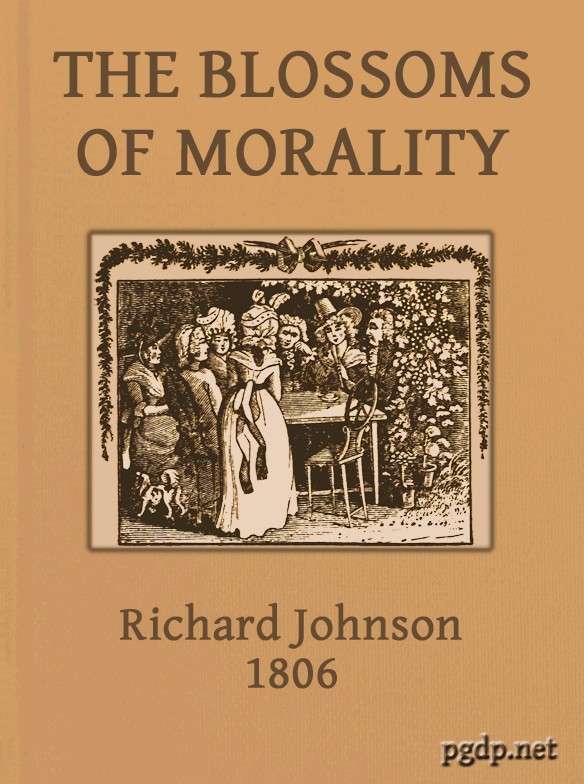
Dorcas and Amarillis.
DORCAS was born in a village far remote from the capital, amidst rocks and precipices, in the northern parts of the island. His parents laboured hard for their daily bread, and with difficulty procured a subsistence for themselves and their little son. A fever, which they both caught, put an untimely end to their existence, and Dorcas was taken care of by the parish, being then of too tender an age even to be sensible of his loss.
His education was adapted to his humble situation, and extended no farther than writing and reading. As soon as he had reached the fifteenth years, the directors of the workhouse thought it time to ease the parish of their burden, and accordingly placed him as a servant to a neighbouring farmer, to watch his cattle, and attend to the duties of husbandry.
Amarillis was of nearly the same age, the daughter of a farmer, and employed by her father in looking after his sheep. She would frequently bring her flock into the meadows to feed and wanton on the enamelled carpet of the sweetest herbage, where she frequently met with Dorcas. The youthful shepherd did her every little service in his power, and Amarillis was pleased to see him so solicitous to oblige her. Dorcas was never so happy as when in company with his shepherdess, and Amarillis always found pleasure in the presence of Dorcas.
Some years glided away in this pleasing intercourse between Dorcas and Amarillis, when what had hitherto appeared only under the name of friendship began gradually to assume a softer title, which at last ripened into love. Their hearts were formed for each other, and they began to be uneasy when separated. Dorcas talked of the happiness of marriage, and obtained permission from Amarillis to ask her father's consent to their union.
The maiden's delicacy would not suffer her to be present when Dorcas paid his visit to her father on that business; and, therefore, appointed a time when she was obliged to go to a neighbouring town, for him to take the opportunity of opening the matter to her parent, desiring he would meet her on her way home at night, and acquaint her with the success of his commission.
At the appointed time the shepherd waited on her father, and disclosed to him the secrets of his heart, adding, how happy he should be to have her for a wife. "I suppose so," replied the old man. "What, you are in love with my daughter! Do you know what you are talking of? Have you any clothes to give her? have you any house of your own? Learn how to get your own living, before you think of encumbering yourself with a wife. A poor shepherd as you are, you cannot have a penny beforehand. My daughter is not rich enough to keep herself, and I am sure you cannot keep her."
"If I am not rich," replied Dorcas, "I am vigorous and hearty, and those who are industrious never want for work. Out of the forty shillings I receive yearly for my wages, I have already saved five pounds, which will buy us goods in plenty. I will take a little farm, and I will work harder. The richest men in the village had no better beginning, and why may not I do as well as they have?"
The old man, however, told him he was young enough, and must wait for better circumstances. "Get rich," said the old farmer, "and Amarillis shall be yours; but speak no more to me concerning her, till your money shall induce me to listen to you."
It was in vain for Dorcas to argue any more; and as Amarillis was by this time on her return home, he went out to meet her. When they met, Dorcas was quite thoughtful, and the pretty shepherdess knew from thence he had not met with success. "I can see," said Amarillis, "that my father is averse to our marriage."—"What a misfortune it is," replied Dorcas, "to be born poor! Yet, I will not be cast down; for I may, by industry, perhaps change my situation. Had your father given his consent to our marriage, I would have laboured to procure you every thing comfortable. But I know we shall still be married, if we do but wait with patience, and trust till it shall please Providence to be more favourable to our wishes."
As the lovers were thus talking over the disappointment to their views, the night rapidly increased upon them; they therefore hastened their pace, that they might reach the cottage in good time. As they were pursuing their way home on the road, Dorcas stumbled over something, and fell down. As he felt about to discover what had occasioned his fall, he found a bag, which, on his lifting it, proved very heavy. Curiosity made them both anxious to know what it could be; but, on opening it, they were presently convinced, dark as it was, that it certainly was money.
"This is the gift of Heaven," said Dorcas, "who has made me rich to make you happy. What say you, my pretty Amarillis, will you now have me? How gracious has Heaven been to my wishes in sending me this wealth, such as is more than sufficient to satisfy your father, and make me happy!"
These ideas gave birth to inexpressible joy in their hearts; they anxiously surveyed the bag, they looked affectionately on each other, and then resumed the path that led to their village, eager to acquaint the old man with their unexpected good fortune.
They had nearly reached their habitation, when a thought struck Dorcas, and made him suddenly stop short. "We imagine," said he to Amarillis, "that this money will complete our happiness; but we should recollect that it is not ours. Some traveller has undoubtedly lost it. Our fair is but just over, and some dealer, coming from thence, may probably have dropped this bag; and while we are thus rejoicing over our good fortune on finding it, we may be assured that somebody is truly wretched on having lost it."
"My dear Dorcas," answered Amarillis, "your thoughts are very just. The poor man is undoubtedly much distressed by his loss. We have no right to this money, and were we to keep it, we should act a very dishonest part."
"We are going with it to your father's," said Dorcas, "and he would undoubtedly be glad to see us so rich; but what joy or happiness can we expect in possessing the property of another, whose family is perhaps ruined by the loss of it? As our minister is a worthy man, and has always been good to me, let us leave it with him. He is the properest person to consult on this occasion, as I am sure he will advise me for the best."
They accordingly went to the minister's, and found him at home. The honest Dorcas delivered the bag into his possession, and told him the whole tale; how happy they were at first on finding it, and what motives, from second thoughts, had induced them to bring it to him. He confessed his love for Amarillis, and acquainted him with the obstacles that poverty threw in the way of his felicity. "Yet," added Dorcas, "nothing shall tempt me to wander from the paths of honesty."
The minister was much pleased with their mutual affection for each other, and assured them, that Heaven would not fail to bless them, so long as they persevered in that line of conduct. "I will endeavour," said the minister, "to find out to whom this bag belongs, who will, no doubt, amply reward your honesty. Even out of the small matters I can save, I will add something to the present he shall make you, and I will then undertake to procure for you the consent of the father of Amarillis. Should the money not be claimed, it will be your property; and I shall then think myself bound to return it to you."
Dorcas and his lovely shepherdess returned to their homes much better satisfied than they would have been, had they otherwise made use of the treasure they had found, and they were happy in the promises the good minister had made them. The money was cried all round the country, and printed bills were distributed in towns and villages even at some distance. Many were base enough to put in their pretensions to it; but as they could neither describe the bag, nor what was in it, all they got by it was to establish their names as scandalous impostors.
In the mean time, the minister was not unmindful of the promise he had made the young lovers. A short time afterwards he put Dorcas into a little farm, provided him with money to purchase stock and farming implements, and at last procured him his beloved Amarillis.
The young couple having acquired every object of their humble wishes, sent up to Heaven their unfeigned thanks, and called down for blessings on the head of their good minister. Dorcas was industrious about the farm, and Amarillis kept every thing right in the house; they were punctual in the payment of their rent, and lived within the bounds of their income.
Two years had now passed, and no one had yet appeared to lay claim to the lost treasure. The minister, therefore, apprehended there was no necessity to wait any longer for a claimant, but took it to the virtuous couple, and gave it to them, saying, "My dear children, take what it has pleased Providence to throw in your way. This bag, which contains five hundred guineas, has not yet been claimed by its right owner, and therefore must at present be your property; but, should you ever discover the real person who lost it, you must then return it to him. At present, make such use of it as may turn it to advantage, and always be equal in value to the money, should it be justly demanded."
Dorcas entirely agreed with the minister, in laying out the money in such a manner that it might be ready on the shortest notice, or at least in something full the value in kind. As the landlord was proposing to sell the farm which Dorcas occupied, and as he valued it at little more than five hundred guineas, he thought he could not lay out the money to greater advantage than in the purchase of this farm; for, should a claimant ever appear, he would have no reason to complain of the disposal of his money, since it would be easy to find a purchaser for it, after it had received improvements from his labour.
The good pastor entirely agreed in opinion with Dorcas: the purchase was made, and, as the ground was now in his own hands, he turned it to much greater advantage. He was happy with his Amarillis, and two sweet children blessed their union. As he returned from his labour in the evening, his wife constantly welcomed his return, and met him on the way with her children, who fondled round him with inexpressible cheerfulness and delight.
The worthy minister, some years after this happy union, paid the debt of nature, and was sincerely wept for by both Dorcas and Amarillis.—The death of this worthy pastor brought them to reflect on the uncertainty of human life. "My dear partner," said Dorcas, "the time will come when we must be separated, and when the farm will fall to our children. You know it is not ours, nor perhaps ever properly will be. Should the owner appear, he will have nothing to show for it, and we shall go to the grave without having secured his property."
Dorcas, therefore, drew up a short history of the whole affair in writing, got the principal inhabitants to sign it, and then put it into the hands of the succeeding minister. Having thus taken all the precautions they could to secure the property to the right owner, should he ever appear, they were much more easy and contented than before.
Upwards of ten years had elapsed since they had been in possession of the farm; when Dorcas coming home from the fields one day to dinner, saw a phaeton in the road, which he had hardly cast his eyes on, till he saw it overset. He hastened to the spot to give them his assistance, and offered them the use of his team to convey their baggage. In the mean time, he begged them to step to his house, and take such refreshment as it afforded, though they had fortunately received no hurt.
"This place," said one of the gentlemen, "is always mischievous to me, and I suppose I must never expect to pass it without some accident.—About twelve years since, I somewhere hereabouts lost my bag, as I was returning from the fair, with five hundred guineas in it."
"Five hundred guineas, sir!" said Dorcas, who was all attention. "Did you make no enquiry after so great a loss?"—"I had it not in my power," replied the stranger, "as I was then going to the Indies, and was on my road to Portsmouth, which place I reached before I missed my bag. The ship was getting under way when I arrived there, and would have gone without me had I been an hour later. Considering it was money I had lost, it appeared to me a doubtful matter whether I should hear any thing of it after making the strictest enquiry; and had I been fortunate enough to succeed, even in that case, by losing my passage, I should have sustained a much greater loss than that of my bag and its contents."
After the part Dorcas has acted, this conversation was undoubtedly pleasing to him, and he consequently became more earnest in wishing the travellers to partake of the fare of his table. As there was no house nearer, they accepted the offer; he walked before to show them the way, and his wife came out to meet them, to see what accident had happened; but he desired her to return, and prepare dinner.
While the good woman was dressing the dinner, Dorcas presented his guests with some refreshments, and endeavoured to turn the conversation on the traveller's loss. Being convinced of the truth of his assertions, he ran to the minister, told him who he had with him, and begged he would come and dine with him. They all sat down to dinner, and the strangers could not help admiring the order, decency, and neatness that were every where conspicuous. They could not but notice the generosity and frankness of Dorcas, and were highly delighted with his helpmate, and the manner in which she treated her children.
As soon as dinner was over, Dorcas showed them his house, his garden, sheepfold, flocks, and granaries. "This house and premises," said he, addressing himself to the traveller who had formerly lost his money, "is your property. I was fortunate enough to find your bag and money, with which I purchased this farm, intending to restore it to the owner, should he ever come forward, and show himself. For fear I should die before an owner was found, I left a full detail in writing with the minister, not wishing my children to enjoy what was not their own."
It is impossible to express the surprise and astonishment of the stranger, who read the paper, and then returned it. He first gazed on Dorcas, then on Amarillis, and then on their young ones. At last, "Where am I?" cried he; "and what is it I have heard? Is this world capable of producing so much probity and virtue! and in what an humble station do I find it! Is this the whole of your property, my friend?"
"This house, my herd, and my cattle," replied Dorcas, "are all I possess. Even though you should keep the premises in your hand, still you will want a tenant, and I shall wish to be indulged with the preference."
The stranger replied, after a moment's pause, "Integrity like yours merits a more ample reward. It is upwards of twelve years since I first lost the money, and Providence threw it in your way. Providence has been no less kind to me, in blessing my undertakings. I had long since forgotten my loss, and even were I to add it to my fortune this day, it would not increase my happiness. Since it has pleased God that you should be the fortunate finder of it, far be it from me to wish to deprive you of it. Keep then what you have so well merited, and may heaven bless and prosper you with it."
He then tore the paper, on which Dorcas had made his acknowledgment of finding the purse, saying, "I will have a different writing drawn up, which shall contain my free gift of these premises, and shall serve to hand down to posterity the virtue and probity of this amiable pair." He fulfilled his word, by immediately sending for a lawyer, when he made over the premises to Dorcas and his heirs for ever.
Dorcas and Amarillis were then going to fall at the feet of their generous benefactor, but he would by no means permit it. "I am infinitely happy," said the generous stranger, "in having it in my power this day to confirm your felicity. May your children long after you inherit your farm, and imitate all your virtues!"
Remember, my youthful readers, that the pleasures and the comforts of human life are not in proportion to the extent of our possessions, but to the manner in which we enjoy them. The cottage of liberty, peace, and tranquility, is preferable to the gilded palaces of slavery, anxiety, and guilt.
The Conversation.
IT happened on one of those delightful summer afternoons, when the heat of the day was tempered with the gently-wafting zephyrs, that Madam Heathcote was entertaining a large company at tea in her arbour in the garden. No situation could be more delightful. The arbour looked full in front of a fine river, on which some were busily employed in fishing, or pursuing their different occupations, while others were skimming on its surface for amusement. All round the arbour the luxuriant grapes hung in clusters, and the woodbine and jessamine stole up between them. A situation like this will naturally incline the mind to be thoughtful, and the whole company, by imperceptible degrees, began to draw moral reflections. They remarked, how different were the objects of our pursuits, how unsteady and fickle are all human affairs, and what empty baubles frequently attract our most serious attention. After some time being spent in a kind of desultory conversation, the principal speakers began to arrange their ideas under distinct heads, and of this class the first who spoke was
Dr. Chamberlaine.
I am very well acquainted with two brothers, whom I shall conceal under the borrowed names of Mercurius and Honestus.
Mercurius was the elder son of a gentleman, who, with a moderate fortune, and by a nice management, so regulated his affairs, that he was generally thought to be exceedingly rich.—He gave a genteel education to his two sons, who finished their studies at Cambridge.
Mercurius attached himself more to the gaiety and politeness of the college, than to the drudgery of books. He was a gay and lively companion, and a perfect master of those little arts which always recommend a young gentleman to the acquaintance of the giddy fools of fortune, who are sent to both our universities more out of complaisance to fashion, than to improve their morals, or enlarge their understandings.
Mercurius had drawn this conclusion, (and it must be confessed, that experience tells us it is too true a conclusion), that powerful connections are more likely to raise a man's fortune in life than all the natural and acquired abilities which human nature is capable of possessing. He, therefore, took every opportunity to ingratiate himself with the noble young students, whose follies he flattered, and the fire of whose vanities he fanned.
Amidst this pursuit after fortune and grandeur, his father died, and left but a small pittance for the support of him and his brother Honestus.—This was soon known in the college, where fortune is considered as the first of all things.—Mercurius was now forced, in order to keep up his noble connections, to stoop to many meannesses, such as the thirst of ambition only can persuade the true dignity of a man to submit to; but, when we once quit the path of virtue in pursuit of imaginary pleasure, we must give up every hope of a retreat.
Among the patrons of Mercurius was a young nobleman of great fortune and connections, such as were more than sufficient to make a coxcomb of the happiest genius. The time arrived in which he was to quit college, and Mercurius accompanied him to London as his companion and friend. He was the constant partner of his nocturnal revels, and little more, in fact, than his footman out of livery. He was the dupe to his prejudices, the constant butt of his wit, and the contempt of every independent mind. But let us leave this mistaken man to the feelings of his own mind, and his fears for his future existence, that we may return to his brother.
Honestus, less ambitious than his brother, had a mind above stooping too low in order to rise the higher. He applied himself closely to his studies, and employed the little his father had left him in the most frugal manner. He turned his whole attention to the study of the law, in which he became a very able proficient, and at last quitted the university with the reputation of a profound scholar, a cheerful companion, and a sincere friend.
These, however, are seldom characters sufficient to raise a man in the world. He long remained unnoticed in his profession as a counsellor; but, however long the beams of the sun may be obscured, they at last pierce through the densest bodies, and shine in their native lustre. He now reaps the fruits of his honest labours, and often looks back with pity on the tottering state of his brother, and the parade of empty ambition.
Madam Lenox.
When we consider the short duration of human life, when extended even to its longest period, and the many perplexities, cares, and anxities, which contribute to disturb the repose of even those whom we should be led to consider as happy mortals, what is there in our sublunary pursuits that ought to make any long and lasting impression on our minds?
We have seen many of the wisest people, on the loss of a darling child, or on a sudden and unexpected wreck in their affairs, retire from the world, and endeavour to seek consolation, by indulging their melancholy in some gloomy retreat. Surely, however, nothing can be more inconsistent with the dignity of human nature than such a conduct.
If to fly from the face of an enemy in the hour of battle, and seek a retreat in some sequestered forest, may be considered as cowardice in the soldier, is it no less so in the moral militant, who has not courage to face the storms of fortune, but precipitately flies from the field of adversity, the ground of which he ought to dispute inch by inch?
It has been an old and long-received maxim, that Fortune favours the daring, and shuns the coward. Whatever may be the whims and caprice of Dame Fortune, who sometimes makes a peer of a beggar, and as often reduces the peer to a state of penury, yet experience tells us, that she is seldom able, for any considerable length of time, to withstand resolute and unremitted importunities; and, when she has hurled us to the bottom of her wheel, whatever motion that wheel afterwards makes, it must throw us upwards. As those, who have enjoyed a good state of health during the prime of their lives, feel the infirmities of age, or a sudden sickness, more keenly than those who have laboured under a weakly and sickly constitution; so those, who have basked in the perpetual sunshine of fortune, are more susceptible of the horrors of unexpected calamities, than those who have been rocked in the cradle of misfortune.
To bear prosperity and adversity with equal prudence and fortitude is, perhaps, one of the greatest difficulties we have to conquer; and it is from hence we may venture to form our opinions of the generality of people. Those who are insolent in prosperity will be mean in adversity; but he who meets adversity with manly courage and fortitude, will, in the hour of prosperity, be humane, gentle, and generous.
To fly from misfortunes, and endeavour to console ourselves by retiring from the world, is undoubtedly increasing the evil we wish to lessen. This has often been the case of disappointed lovers, when the object of their hearts has proved inconstant or ungrateful. They have vainly imagined that there must be something very soothing to the afflicted mind, in listening to the plaintive sound of some purling and meandering stream, or in uttering their plaints to the gentle breezes and the nodding groves. But, alas! these delusive consolations only contribute to feed the disorders of the mind, and increase the evil, till melancholy takes deep root in their souls, and renders their complaints incurable.
The society of the polite and refined of both sexes is the only relief, at least the principal one, for any uneasiness of the mind. Here a variety of objects will insensibly draw our attention from that one which tyrannises in our bosom, and endeavours to exclude all others.
In the commerce of this life there is hardly an evil which has not some good attending it; nor a blessing which does not, in some degree or other, carry with it some bitter ingredient. To be, therefore, too confident in prosperity, is a folly; and to despair in adversity, is madness.
Those who enjoy the good while they have it in their power, and support the evil without sinking under its weight, are surely best fitted for this uncertain and transitory state. To have too nice and delicate feelings is, perhaps, a misfortune; and the wise man has very justly said, "as we increase in knowledge, so we increase in sorrow."
We are apt to form too great an opinion of ourselves, and to examine so closely into the conduct of others, that we at last begin to shun and despise all the world, in whom we can find no belief; but were we to examine our own conduct as critically, we should find, that we have as much to ask from the candour of others, as we have cause to give. Self-love and pride are the sources from whence flow most of our real, as well as imaginary woes; and if we seek the retired and sequestered hut, it is not so much with a view to avoid misery itself, as to endeavour to conceal it in ourselves from the eyes of the world.
Sir John Chesterfield.
Certain philosophers tell us, that "there is no such thing as happiness or misery in this life, and that they are terms merely confined to the ideas of different people, who differently define them." It must indeed be confessed, from constant and invariable experience, that what a man, at one time in his life, considered as a misery, he will at another consider as a happiness.
Cleorus was, from his childhood, bred to business, and the pursuit of riches appeared to him as the principal blessing he had in view, since, from his worldly possessions, he hoped to derive every comfort of life. He viewed, with an eye of pity and contempt, the follies and extravagancies of young fellows of his own age, and considered their nocturnal revels and excursions as so many sad scenes of misery.
He continued in this opinion till he was turned of the age of forty; at which period, losing his wife, and finding his circumstances easy, he joined in the company of those we call free and easy. New company, by degrees, made him imbibe new sentiments, and what he had formerly considered as miseries, began insensibly to assume the name of pleasure, and his former happiness was soon construed to be misery. He began to reflect on the dull path he had trodden all the prime of his life, and therefore determined to atone for it in the evening of his days, by entering on such scenes as were disgraceful even to the youthful partners of his follies. Suffice it to say, that after having exchanged prudence for pleasure, he soon fell a martyr to his vices.
It is a melancholy but a just observation, that the man who turns vicious in the evening of his life, is generally worse than the youthful libertine, and his conversation often more lewd and obscene. Hence we may conclude with Ovid, that no man can be truly said to be blessed, till death has put a seal on his virtuous actions, and rendered him incapable of committing bad ones.
The destruction of happiness and misery is, perhaps, more on a level than we are in general apt to imagine. If the labouring man toils all the day, and hardly earns his bread by the sweat of his brow, yet every meal is to him a sumptuous feast, and he sleeps as soundly between coarse blankets as on a bed of down; nor does any part of his life betray a sense of that state of misery, such as it would be considered by the courtier.
If the courtier basks in the sunshine of fortune; if he be loaded with honours, riches, and titles, keeps a brilliant equipage, and has numerous dependants at his command, the world in general will consider him as placed in a state of happiness; but, if we contemplate him at leisure, see the anxieties of his mind to be still more great and powerful, which interrupt his broken slumbers, and see how insipid to him are all the luxuries of his table, his perpetual succession of false pleasure, and the mean adoration he is compelled to pay to the idol of power, we shall hardly allow him the idea of happiness, but justly consider him as more miserable than the labouring peasant.
The mind is undoubtedly the seat of happiness and misery, and it is within our power to determine which shall hold the empire there. To maintain a uniform conduct through all the varying stations of life—to content ourselves with what comes within our reach, without pining after what we cannot obtain, or envying others what they possess—to maintain a clear unsullied conscience—and to allow for the infirmities of others from a retrospect of our own, are perhaps some of the best rules we can lay down, in order to banish misery from this mortal frame, and to acquire such a degree of happiness, as may enable us to perform our terrestrial journey with some degree of satisfaction to ourselves and others.
Lady Heathcote.
Though the depravity, luxury, and corruption of the times, form just subjects of complaint for the grave, the thoughtful, and the aged, yet I cannot help believing, that many of these complainants are themselves lending a helping hand to render the rising generation as effeminate and corrupt as the present.
I am now appealing to parents on the education of their children, which appears to me a subject that ought to attract the serious attention of those who wish longevity, peace, and happiness to their children, and prosperity, repose, and a reformation of manners to the rising generation.
"The first seasoning," says Plato, "sticks longest by the vessel. Thus those, who are permitted from their earliest periods to do wrong, will hardly ever be persuaded, when they arrive at maturity, to do right." It is a maxim with some people, a maxim surely founded only on pride, that their children shall not be checked in their early years, but be indulged in whatever their little hearts shall pant after; and for this reason, because they will grow wiser as they grow older. But, since the love of ease, finery, and pleasure, is natural to almost every youthful mind, how careful ought each parent to be to check those juvenile sallies, which, if encouraged, will in time be productive of the very evils they complain of in the present generation.
It is not only in childhood, but also in their progress through school, and during their apprenticeship, that these indulgences are continued; and an excuse is always ready, that their children must not be more hardly treated than others. Hence it follows, that you often meet the apprentice of eighteen strutting through the streets in his boots on an errand of business, or screening himself from the dew of heaven under the shade of a large silken umbrella!—It would be worse than sacrilege, in their opinions, to appear abroad with an apron before them, or in their working dress.
Their evenings are too often spent abroad at chair clubs, in alehouses, at the theatres, or in some gardens. "To know the world," as they call it, is more their study than the attainment of their profession, by which they are hereafter to live. But of what does this knowledge of the world consist?—To despise virtue, to laugh at morality, and to give way to the most shocking scenes of folly and dissipation. Their Sundays, part of which, at least, ought to be spent in acts of piety, are passed in revelling and drunkenness; and the exploits and excesses of that day furnish plenty of boastful conversation for the rest of the week.
What can be expected from a youth, when he shall arrive at manhood, who has thus passed the morning of his life? and with what reason can either parents or masters complain of the depravity of the times, since they themselves take so little care of the morals of the rising generation?
The youth who has been long accustomed to revel through the dangerous wilds of gaiety and pleasure, and has once given a loose to the excesses of the town, will hardly ever be prevailed on to quit them, for what he considers as the dull enjoyments of a calm, peaceable, and virtuous life. Deaf to all remonstrances, he pursues his pleasures, and perishes in the midst of his delusive enjoyments.
To check these evils, and thereby prevent the fatal consequences, the infant mind must be carefully watched, and the unruly passions made to give way to the reason and authority of the parent. Nothing can be so pleasing and delightful, and, at the same time, more the duty of the parent, than to watch over the tender thought, and teach the young ideas to flow in a proper channel. To leave these cares to the vain hope, that reason and maturity will gradually fix the wandering mind, and bring it to a proper sense of its duty, is as absurd and ridiculous as to expect that the fiery steed, who has never felt the spur nor the curb, the saddle nor the bridle, will with age become the peaceful, the quiet, and the obedient animal.
Nature seems, in some instances, to have given to the inferior class of beings that degree of instinct, which sometimes puts human reason to the blush. Shall inferior beings, merely by the power of instinct qualities, show more care and prudence in rearing their tender offspring, than proud man, with all his lordly and boasted superiority of human reason?
Dr. Sterne.
When I was last summer on my travels through Yorkshire, I one day met with a person who gave me a very singular history of himself, of the veracity of which I was assured by some gentlemen I might rely upon. I shall repeat his history to you, as nearly as I can recollect, in his own words.
Though I was born of poor parents, said he, I was fortunate enough to pick up a tolerable education in one of those public schools in the country, which are supported by voluntary and charitable contributions.
Nature formed me of an active and lively disposition; and, as I grew up, my vanity began to flatter me, that I was not destitute of genius. I happened one day, accidentally, to take up the tragedy of the Orphan, when I was particularly struck with the following lines, which I seemed inclined never to forget:
"I would be busy in the world, and learn;
Not like a coarse and worthless dunghill weed,
Fix'd to one spot, to rot just where I grow."
As soon as I had reached the age of fourteen, I was discharged from the school, when my parents put me to the farming business; but my ideas soared above that menial profession.
I had frequently heard it mentioned in our village, that the only place for preferment was the great and rich city of London; where a young fellow had only to get himself hired as a porter in some respectable shop, and he would soon rise to be shopman, then clerk, then master, and at last a common-councilman, or an alderman, if not a lord mayor.
I, therefore, soon determined to leave my native village, and hasten up to this centre of preferment and happiness. On my arrival in London, I was advised to apply to a register office, from whence I was sent to a capital grocer in the city, who was then in want of a porter, and where I was accordingly engaged. "How happy am I," said I to myself, "at once to jump into so capital a place? I shall here learn a fine business, and in time, like my master, keep a splendid coach, horses, and livery servants."
However, I was here very sadly mistaken; for I was constantly every day so driven about, from one end of the town to the other, with loads, that I had no opportunity of getting the least insight into the business; and every Sunday morning I almost sunk under a load of various kinds of provisions I was forced to carry to our villa in Kentish-town, from whence I returned in the evening with a still more enormous burden of the produce of the garden, consisting of cabbages, turnips, and potatoes, or whatever happened to be in season, for the use of the townhouse, during the ensuing week. I, therefore, was not much displeased at being obliged to quit this service on my master's becoming a bankrupt.
I next engaged myself with a wholesale linen-draper, to open and shut up shop, and go occasionally on errands; but here again I was disappointed, being obliged to employ all my leisure hours in blacking shoes, cleaning knives, or whatever the cook-maid was pleased to set me about. My stay here consequently was but short, any more than in my next place, where my master starved his servants in order to feed his horses.
I shall not trouble you with an account of all the places I was in, during the space of seven years, without the least hopes of success, till, by accident, I got to be a kind of shopman at a tobacconist's. Here hope seemed to afford me some glimmerings of success, as I was well treated in the house, and taken particular notice of by my master, who was very rich, and had an only daughter, who was young and beautiful.
I soon fell in love equally with her person and her fortune, and had great reason to believe, from her looks, that I was not indifferent to her. One evening, when all the family were out on a visit, and miss had thought proper to stay at home, being a little indisposed, I determined to improve the favourable opportunity, and, by one resolute action, complete the summit of my wishes. I accordingly entered the parlour, threw myself at her feet, and declared my passion for her, assuring her that I could not live without her.
She seemed at first surprised; but, recollecting herself, with a most gracious smile, bid me rise and hope. I instantly retired, thinking I had done enough for the first attempt. But, alas! I was called up the next day after dinner, and was desired by miss, in the presence of a large company, who all joined in the laugh against me, not to trouble myself with paying her any further addresses. My master then kicked me down stairs, and out of the house. I am now returned to my native village, having given over all hopes of ever being either a lord mayor, an alderman, or even a common-councilman!
Here Dr. Sterne finished; and, as the sun was sunk beneath the horizon, and night was speedily advancing, the conversation ended for the present. Madam Heathcote thanked the company for the favour of their visit, and did not doubt but that the young ladies and gentlemen who were present, would go away pleased and edified by the polite conversation they had heard.
Edwin and Matilda.
EDWIN and his sister were natives of a town in Glamorganshire, whose father had but little more to leave them at his death than the virtues he possessed in his lifetime. His character and assiduity procured him an employment of consequence, which, in a few years, enabled him to save a very decent fortune. Honour, virtue, and integrity, however amiable in themselves, will not always protect us against the calamities of human life, though they may contribute to soften them.
In the midst of his career of business, he was attacked by a long and tedious disorder, which considerably impaired his constitution, and obliged him to relinquish all thoughts of business at a very early age. Not long after he had given up all mercantile pursuits, the failure of his banker deprived him of two-thirds of his fortune. The remainder of his possessions, which consisted only of the house he then lived in, and a few cottages in the village, afforded him but a scanty pittance for the support of his wife and two children, Edwin, then about ten years of age, and Matilda, about nine.
Their mother was tenderly fond of them, and consequently was less able to endure the afflicting prospect of seeing them reduced so low, and her philosophy failed her in this instance. The narrow scale of living to which she was now forced to submit, and the parting with many little comforts and conveniences in which she had taken pleasure to indulge her children, and which they were no more to expect;—the affliction of seeing her dear Edwin and Matilda become her servants, and that dumb sorrow she fancied she beheld in their countenances whenever she looked on them;—all these, and many other thoughts, crowding on her mind, so weakened and impaired her constitution, that she was no longer the same woman. Every time she looked at her children, the tears stole down her cheeks; and her husband, who most tenderly loved her, would sometimes mingle his tears with hers, and at other times retire to conceal them.
As Edwin was one day gathering apples in the orchard, he perceived his parents in close conversation with each other. A hedge of rosebushes only parted them, so that he heard every thing they said. His mother gave a sigh, and his father thus endeavoured to console her.
"I was far from blaming," said he, "the excess of your affliction in the infancy of our misfortunes, and I did not attempt to interrupt you; but now you ought to be wiser from experience, and patiently bear those evils which cannot be removed, but may be increased by our impatience under them. I have concealed my sorrows, fearing they might add to yours; but you, in return, put no restraint on yourself; and you are shortening my days, without being sensible of what you are doing. I love my children no less than you, and feel for their misfortune in losing what I hoped they would live to enjoy after we were no more. Consider my infirmities, which will probably carry me to my long home before you. You must then act the part of father and mother; but how will you be able to do this, if you give way to such immoderate grief? You are sensible these misfortunes are not my own seeking; they are the works of the Almighty, and it is impiety not to submit to them. It has pleased him to deprive me of my property and health, while you deprive me of the satisfaction of seeing you submissive to his decrees. I see sorrow must pursue me to the grave, and you will not help to protract that awful hour of my dissolution."
Edwin treasured up in his youthful bosom every word that dropped from the lips of his father, but his mother answered only in sighs and half-finished words. "Do not distress your mind," continued her husband, "on the hapless situation of our children, since they may still be happy though deprived of their fortune. Edwin has noble and generous sentiments; and Matilda has been brought up in the strictest principles of virtue. Let us, therefore, set our children an example, by teaching them to submit to the will of Providence, instead of teaching them to repine at his decrees."
As soon as the conversation was ended, Edwin got away as softly as he could, and, going into the house, met his sister Matilda, who, as she saw him look very serious, asked him what was the matter with him. They went together into the parlour, when Edwin thus addressed his sister.
"Ah! my dear sister, had you, like me, heard what has just passed between my father and mother, on our account, I am sure you would have been equally afflicted. I was very near the arbour in which they were conversing; but though I could hear every thing they said, they could not see me. My mother talks of nothing but about our being ruined; and my father says every thing he can to pacify and comfort her. You well know, that my father has never had a good state of health, and my mother's is going very fast; so that I fear we shall soon lose them both. What, my dear sister, will become of us, and what shall we do without them? I could wish to die with them."
"Let us hope," replied Matilda, "that things will not go so hard with us. Do not let such melancholy thoughts enter your head, and be particularly careful not to cry in their presence, as that would affect them more than any thing else. Let us endeavour to be cheerful, and when they see us so, it will possibly lessen their affliction. They love us tenderly, and we ought, in return, to do every thing in our power to make them cheerful and contented, if we cannot make them happy."
Their father, coming to the door just as they began their conversation, stopped short, and heard every word that passed between the two young folks. His heart could not fail of being tenderly affected by their conversation, he rushed into the room, and caught them in his arms. "My dear children," said he, "how amiable is your conduct, and how worthy are you of a better fortune!"
He then took them by the hand, and led them to their mother, who was reading in another room. "Lay down your book," said he, "and kiss your children; for neither of us need be any more afflicted on their account. They stand not in need of our pity, for they have resources of happiness within their own youthful bosoms. We have been deceiving each other, in thus afflicting ourselves on their account, when nothing has disturbed them. Nothing can be wanting to the possessors of so much virtue."
He then related to their mother the conversation he had just overheard, and appealed to her tenderest feelings, whether she ought not to exert herself to the utmost to make herself happy, and endeavour to promote the felicity of two such children.
Their mother again shed tears, but they were tears of joy. "I will from henceforth," said she, "endeavour to quiet the storm within my breast, that I may be the better able to take care of my dear children. It would be disgraceful in me, to let the world see that I have children from whom I have to learn lessons of philosophy."
Edwin and Matilda were so lost in the delightful sensations they received from the words and caresses of their parents, that they thought themselves the happiest of all little mortals. From this moment all their griefs and anxities seemed to subside, and the six following months glided away without even a desponding look from either of the parties.
Edwin frequently walked abroad with his father, who constantly taught him to draw some moral reflection, or some useful knowledge in the commerce of life, from every thing they saw. It is too often the case with parents, when they take their children abroad, to amuse themselves with their gossiping tales, instead of teaching them to reflect upon the different interesting subjects that fall within their view. Children are much sooner capable of reflecting than the generality of parents are aware of; and they would soon be convinced of the truth of this assertion, would they but make the trial, wait patiently for their answers, and endeavour to correct their youthful ideas when wrong.
Six months had now slid away in peace and serenity; but the apparent tranquility of their mother was only in outward appearance. Despair had taken deep root in her heart, and was secretly making great havoc with her constitution. A fever at last seized her, which soon put a period to her life.
The death of their mother was the source of inexpressible sorrow to her husband, who never recovered the shock it gave him. She expired in his arms, while poor Edwin and Matilda were drowned in tears by her side.
The house, for some time, afforded one continued scene of lamentation. Her character was truly amiable; her children obeyed her through love, for fear had no share in their duty. She possessed the happy skill of penetrating into the infant heart, and making it sensible, by its own feelings, of the propriety of what she commanded to be done. Thus she at once improved the heart and understanding, without ruffling the infant mind.
Edwin and Matilda severely felt the loss of their mother; but it was a still greater shock to their father, whose health, which was bad enough before, evidently grew worse from this fatal stroke. Grief brought on a complication of disorders, which soon confined him to his bed; and in this sad situation he lived near a twelvemonth, when, his strength being totally exhausted, he expired in the arms of his son.
The situation of Edwin and Matilda was much to be pitied. They had no relation left to fly to, and friends are rarely to be found when distress seeks them. Edwin was almost driven to despair; but Matilda had more fortitude, and recalled her brother back to reason. It is certain, that the female mind, in scenes of distress, often shows more fortitude than we meet with in men.
The young orphans agreed to live together, and cultivate the little spot that was left them. The remembrance of the virtues of their parents animated their labour, and their moderation regulated their wants. They enjoyed the sweets of friendship, and lived happily, because they had learned how to be contented with little.
Remember, my youthful readers, how fleeting and uncertain is the possession of riches. Of these Fortune may deprive you, but it cannot rob you of your virtue. Virtue is an invaluable treasure, which even the revolutions of states and empires cannot take from you. Like Edwin and Matilda, love and reverence your parents, cherish them in the evening of their days, and be a comfort to them in the time of trial, in the hour of sickness, and in the expiring moments of their lives. Let every wise mother imitate the mother of Edwin and Matilda, who never suffered passion to get the upper hand of her reason, when she argued with her children on those little imperfections, which young people are apt to run into, and which are necessary to be corrected. It is better to be beloved than feared; but to indulge children in excesses, will neither create fear nor esteem. Happy are those parents who have such children as Edwin and Matilda; and happy those children who know how properly to love, honour, and obey their parents.