
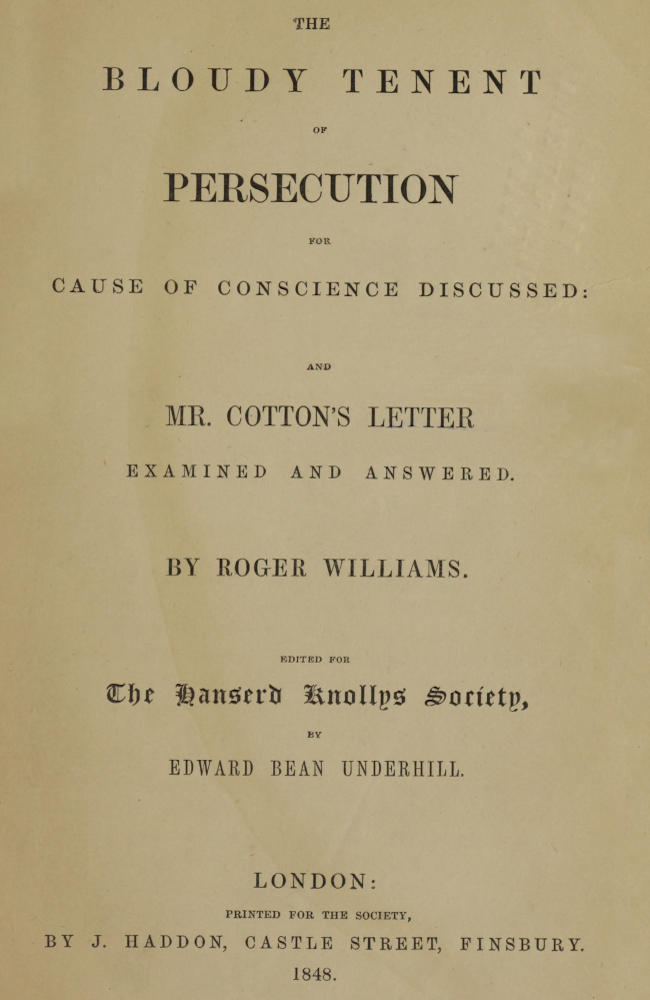
SCRIPTURES AND REASONS,
WRITTEN LONG SINCE BY A WITNESS OF JESUS CHRIST,
CLOSE PRISONER IN NEWGATE,
AGAINST PERSECUTION IN CAUSE OF CONSCIENCE;
AND SENT SOME WHILE SINCE TO MR. COTTON, BY A FRIEND,
WHO THUS WROTE:
“In the multitude of counsellours there is safety;” it is therefore humbly desired to be instructed in this point, viz.:—
Whether persecution for cause of conscience be not against the doctrine of Jesus Christ, the King of kings. The scriptures and reasons are these.[86]
1. Because Christ commandeth, that the tares and wheat, which some understand are those that walk in the truth, and those that walk in lies, should be let alone in the world, and not plucked up until the harvest, which is the end of the world. Matt. xiii. 30, 38, &c.
2. The same commandeth, Matt. xv. 14, that they that are blind (as some interpret, led on in false religion, and are offended with him for teaching true religion) should be let alone, referring their punishment unto their falling into the ditch.
3. Again, Luke ix. 54, 55, he reproved his disciples who would have had fire come down from heaven and devour those Samaritans who would not receive Him, in these words: “Ye know not of what Spirit ye are; the Son of man is not come to destroy men’s lives, but to save them.”
4. Paul, the apostle of our Lord, teacheth, 2 Tim. ii. 24, that the servant of the Lord must not strive, but must be gentle toward all men; suffering the evil men, instructing them with meekness that are contrary minded, proving if God at any time will give them repentance, that they may acknowledge the truth, and come to amendment out of that snare of the devil, &c.
5. According to these blessed commandments, the holy prophets foretold, that when the law of Moses concerning worship should cease, and Christ’s kingdom be established, Isa. ii. 4; Mic. iv. 3, 4, They shall break their swords into mattocks, and their spears into scythes. And Isa. xi. 9, Then shall none hurt nor destroy in all the mountain of my holiness, &c. And when he came, the same he taught and practised, as before. So did his disciples after him, for the weapons of his warfare are not carnal (saith the apostle), 2 Cor. x. 4.
But he chargeth straitly, that his disciples should be so far from persecuting those that would not be of their religion, that when they were persecuted they should pray, Matt. v. 44; when they were cursed, they should bless, &c.
And the reason seems to be, because they who now are tares, may hereafter become wheat; they who are now blind, may hereafter see; they that now resist him, may hereafter receive him; they that are now in the devil’s snare, in adverseness to the truth, may hereafter come to repentance; they that are now blasphemers and persecutors, as Paul was, may in time become faithful as he; they that are now idolaters, as the Corinthians once were, 1 Cor. vi. 9, may hereafter become true worshippers as they; they that are now no people of God, nor under mercy, as the saints sometimes were, 1 Pet. ii. 10, may hereafter become the people of God, and obtain mercy, as they.
Some come not till the eleventh hour, Matt. xx. 6: if those that come not till the last hour should be destroyed, because they come not at the first, then should they never come, but be prevented.
All which promises are in all humility referred to your godly wise consideration.
II. Because this persecution for cause of conscience is against the profession and practice of famous princes.
First, you may please to consider the speech of King James, in his majesty’s speech in parliament, 1609. He saith, “It is a sure rule in divinity, that God never loves to plant his church by violence and bloodshed.”
And in his highness’ Apology, p. 4, speaking of such papists that took the oath, thus:
“I gave good proof that I intended no persecution against them for conscience’ cause, but only desired to be secured for civil obedience, which for conscience’ cause they are bound to perform.”
And, p. 60, speaking of Blackwell, the archpriest, his majesty saith, “It was never my intention to lay any thing to the said archpriest’s charge, as I have never done to any, for cause of conscience.”
And in his highness’ exposition on Rev. xx. printed 1588, and after in 1603, his majesty writeth thus: “Sixthly, the compassing of the saints, and the besieging of the beloved city, declareth unto us a certain note of a false church to be persecution; for they come to seek the faithful, the faithful are them that are sought: the wicked are the besiegers, the faithful are the besieged.”
Secondly, the saying of Stephen, king of Poland: “I am a king of men, not of consciences; a commander of bodies, not of souls.”
Thirdly, the king of Bohemia hath thus written:
“And, notwithstanding, the success of the later times, wherein sundry opinions have been hatched about the subject of religion, may make one clearly discern with his eye, and (as it were) to touch with his finger, that according to the verity of holy scriptures, and a maxim heretofore told and maintained by the ancient doctors of the church; that men’s consciences ought in no sort to be violated, urged, or constrained; and whensoever men have attempted any thing by this violent course, whether openly or by secret means, the issue hath been pernicious, and the cause of great and wonderful innovations in the principallest and mightiest kingdoms and countries of all Christendom.”
And further, his majesty saith: “So that once more we do profess, before God and the whole world, that from this time forward we are firmly resolved not to persecute, or molest, or suffer to be persecuted or molested, any person whosoever for matter of religion; no, not they that profess themselves to be of the Romish church, neither to trouble or disturb them in the exercise of their religion, so they live conformable to the laws of the states,” &c.
And for the practice of this, where is persecution for cause of conscience, except in England and where popery reigns? and there neither in all places, as appeareth by France, Poland, and other places.
Nay, it is not practised amongst the heathen, that acknowledge not the true God, as the Turk, Persian, and others.
Thirdly, because persecution for cause of conscience is condemned by ancient and later writers; yea, and the papists themselves.
Hilary against Auxentius, saith thus: “The Christian church doth not persecute, but is persecuted. And lamentable it is to see the great folly of these times, and to sigh at the foolish opinion of this world, in that men think by human aid to help God, and with worldly pomp and power to undertake to defend the Christian church. I ask of you bishops, what help used the apostles in the publishing of the gospel? With the aid of what power did they preach Christ, and converted the heathen from their idolatry to God? When they were in prisons, and lay in chains, did they praise and give thanks to God for any dignities, graces, and favours received from the court? Or do you think that Paul went about with regal mandates, or kingly authority, to gather and establish the church of Christ? Sought he protection from Nero, Vespasian? The apostles wrought with their hands for their own maintenance, travelling by land and water, from town to city, to preach Christ; yea, the more they were forbidden, the more they taught and preached Christ. But now, alas! human help must assist and protect the faith, and give the same countenance. To and by vain and worldly honours do men seek to defend the church of Christ, as if he by his power were unable to perform it.”
The same, against the Arians:
“The church now, which formerly by enduring misery and imprisonment, was known to be a true church, doth now terrify others by imprisonment, banishment, and misery, and boasteth that she is highly esteemed of the world; when as the true church cannot but be hated of the same.”
Tertull. ad Scapulam: “It agreeth both with human reason, and natural equity, that every man worship God uncompelled, and believe what he will; for another man’s religion and belief neither hurteth nor profiteth any one: neither beseemeth it any religion to compel another to be of their religion, which willingly and freely should be embraced, and not by constraint: forasmuch as the offerings were required of those that freely and with good will offered, and not from the contrary.”
Jerome in Proem. lib. 4. in Jeremiam. “Heresy must be cut off with the sword of the Spirit; let us strike through with the arrows of the Spirit all sons and disciples of misled heretics, that is, with testimonies of holy scriptures. The slaughter of heretics is by the word of God.”
Brentius upon 1 Cor. iii. “No man hath power to make or give laws to Christians, whereby to bind their consciences; for willingly, freely, and uncompelled, with a ready desire and cheerful mind, must those that come, run unto Christ.”
Luther, in his book of the civil magistrate, saith: “The laws of the civil magistrate’s government extend no further than over the body or goods, and to that which is external: for over the soul God will not suffer any man to rule; only he himself will rule there. Wherefore, whosoever doth undertake to give laws unto the souls and consciences of men, he usurpeth that government himself which appertaineth unto God,” &c.
Therefore, upon 1 Kings vi. “In the building of the temple there was no sound of iron heard, to signify that Christ will have in his church a free and a willing people, not compelled and constrained by laws and statutes.”
Again, he saith upon Luke xxii. “It is not the true catholic church which is defended by the secular arm or human power, but the false and feigned church; which although it carries the name of a church, yet it denies the power thereof.”
And upon Psalm xvii. he saith: “For the true church of Christ knoweth not brachium seculare, which the bishops now-a-days chiefly use.”
Again, in Postil. Dom. 1. post. Epiphan., he saith: “Let not Christians be commanded, but exhorted; for he that willingly will not do that whereunto he is friendly exhorted, he is no Christian: whereof they that do compel those that are not willing, show thereby that they are not Christian preachers, but worldly beadles.”
Again, upon 1 Pet. iii. he saith: “If the civil magistrate shall command me to believe thus and thus, I should answer him after this manner: Lord, or sir, look you to your civil or worldly government, your power extends not so far as to command any thing in God’s kingdom; therefore herein I may not hear you. For if you cannot bear it, that any should usurp authority where you have to command, how do you think that God should suffer you to thrust him from his seat, and to seat yourself therein?”
Lastly, the papists, the inventors of persecution, in a wicked book of theirs, set forth in King James’s reign, thus:
“Moreover, the means which Almighty God appointed his officers to use in the conversion of kingdoms, and nations, and people, was humility, patience, charity: saying, Behold, I send you as sheep in the midst of wolves, Matt. x. 16. He did not say, ‘Behold, I send you as wolves among sheep, to kill, imprison, spoil, and devour those unto whom they were sent.’”
“Again, ver. 17, he saith: They to whom I send you will deliver you up into councils, and in their synagogues they will scourge you; and to presidents and to kings shall you be led for my sake. He doth not say, ‘You, whom I send, shall deliver the people, whom you ought to convert, unto councils, and put them in prisons, and lead them to Presidents, and tribunal seats, and make their religion felony and treason.’
“Again he saith, ver. 32: When ye enter into an house, salute it, saying, Peace be unto this house. He doth not say, ‘You shall send pursuivants to ransack or spoil the house.’
“Again he saith, John x. The good pastor giveth his life for his sheep; the thief cometh not but to steal, kill, and destroy. He doth not say, ‘The thief giveth his life for his sheep, and the good pastor cometh not but to steal, kill, and destroy.’”
So that we holding our peace, our adversaries themselves speak for us, or rather for the truth.
TO ANSWER SOME MAIN OBJECTIONS.
And first, that it is no prejudice to the commonwealth if liberty of conscience were suffered to such as do fear God indeed, as is or will be manifest in such men’s lives and conversations.
Abraham abode among the Canaanites a long time, yet contrary to them in religion, Gen. xiii. 7, and xvi. 13. Again: he sojourned in Gerar, and king Abimelech gave him leave to abide in his land, Gen. xx. 21, 23, 24.
Isaac also dwelt in the same land, yet contrary in religion, Gen. xxvi.
Jacob lived twenty years in one house with his uncle Laban, yet differed in religion, Gen. xxxi.
The people of Israel were about 430 years in that infamous land of Egypt, and afterwards seventy years in Babylon, all which time they differed in religion from those States, Exod. xii. and 2 Chron. xxxvi.
Come to the time of Christ, where Israel was under the Romans, where lived divers sects of religions, as Herodians, Scribes and Pharisees, Sadducees and Libertines, Theudæans and Samaritans, beside the common religion of the Jews, Christ, and his apostles. All which differed from the common religion of the state, which is like the worship of Diana, which almost the whole world then worshipped, Acts xix. 20.
All these lived under the government of Cæsar, being nothing hurtful unto the commonwealth, giving unto Cæsar that which was his. And for their religion and consciences towards God he left them to themselves, as having no dominion over their souls and consciences. And when the enemies of the truth raised up any tumults, the wisdom of the magistrate most widely appeased them, Acts xviii. 14, and xix. 35.