
The Project Gutenberg eBook of The Blunders of a Bashful Man
Title: The Blunders of a Bashful Man
Author: Metta Victoria Fuller Victor
Release date: March 6, 2007 [eBook #20754]
Most recently updated: September 10, 2016
Language: English
Credits: Produced by Mark C. Orton, Linda McKeown, Sankar
Viswanathan, and the Online Distributed Proofreading Team
at http://www.pgdp.net
Transcriber's Note:
The author of this book is Metta Victoria Fuller Victor writing under the
Pen name of Walter T. Gray. But the Author's name is not given in the original text.
The Table of Contents is not part of the original text.
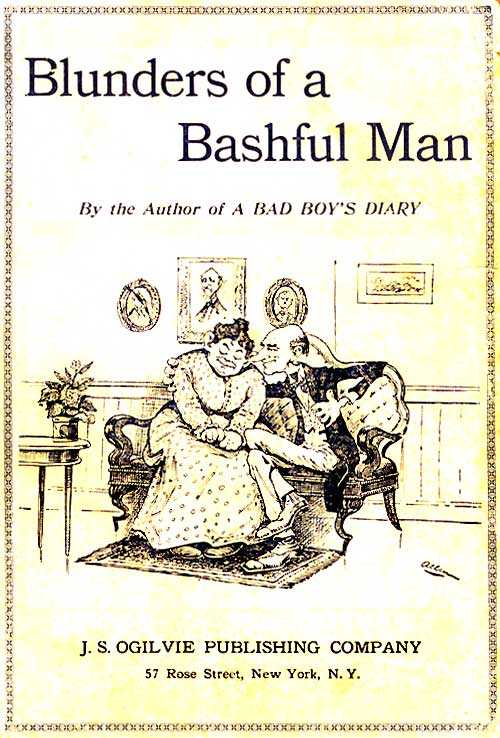
THE BLUNDERS
OF A
BASHFUL MAN.
By the Author of
“A BAD BOY'S DIARY”
Copyright, 1881, by Street & Smith.
New York:
J. S. OGILVIE PUBLISHING COMPANY.
57 Rose Street.
CONTENTS
THE
Blunders of a Bashful Man.
CHAPTER I.
HE ATTENDS A PICNIC.
I have been, am now, and shall always be, a bashful man. I have been told that I am the only bashful man in the world. How that is I can not say, but should not be sorry to believe that it is so, for I am of too generous a nature to desire any other mortal to suffer the mishaps which have come to me from this distressing complaint. A person can have smallpox, scarlet fever, and measles but once each. He can even become so inoculated with the poison of bees and mosquitoes as to make their stings harmless; and he can gradually accustom himself to the use of arsenic until he can take 444 grains safely; but for bashfulness—like mine—there is no first and only attack, no becoming hardened to the thousand petty stings, no saturation of one's being with the poison until it loses its power.
I am a quiet, nice-enough, inoffensive young gentleman, now rapidly approaching my twenty-sixth year. It is unnecessary to state that I am unmarried. I should have been wedded a great many times, had not some fresh attack of my malady invariably, and in some new shape, attacked me in season to prevent the "consummation devoutly to be wished." When I look back over twenty years of suffering through which I have literally stumbled my way—over the long series of embarrassments and mortifications which lie behind me—I wonder, with a mild and patient wonder, why the Old Nick I did not commit suicide ages ago, and thus end the eventful history with a blank page in the middle of the book. I dare say the very bashfulness which has been my bane has prevented me; the idea of being cut down from a rafter, with a black-and-blue face, and drawn out of the water with a swollen one, has put me so out of countenance that I had not the courage to brave a coroner's jury under the circumstances.
Life to me has been a scramble through briers. I do not recall one single day wholly free from the scratches inflicted on a cruel sensitiveness. I will not mention those far-away agonies of boyhood, when the teacher punished me by making me sit with the girls, but will hasten on to a point that stands out vividly against a dark background of accidents. I was nineteen. My sentiments toward that part of creation known as "young ladies" were, at that time, of a mingled and contradictory nature. I adored them as angels; I dreaded them as if they were mad dogs, and were going to bite me.
My parents were respected residents of a small village in the western part of the State of New York. I had been away at a boys' academy for three years, and returned about the first of June to my parents and to Babbletown to find that I was considered a young man, and expected to take my part in the business and pleasures of life as such. My father dismissed his clerk and put me in his place behind the counter of our store.
Within three days every girl in that village had been to that store after something or another—pins, needles, a yard of tape, to look at gloves, to try on shoes, or examine gingham and calico, until I was happy, because out of sight, behind a pile high enough to hide my flushed countenance. I shall never forget that week. I ran the gauntlet from morning till night. I believe those heartless wretches told each other the mistakes I made, for they kept coming and coming, looking as sweet as honey and as sly as foxes. Father said I'd break him if I didn't stop making blunders in giving change—he wasn't in the prize-candy business, and couldn't afford to have me give twenty-five sheets of note paper, a box of pens, six corset laces, a bunch of whalebones, and two dollars and fifty cents change for a two-dollar bill.
He explained to me that the safety-pins which I had offered Emma Jones for crochet-needles were not crochet-needles; nor the red wafers I had shown Mary Smith for gum-drops, gum-drops—that gingham was not three dollars per yard, nor pale-blue silk twelve-and-a-half cents, even to Squire Marigold's daughter. He said I must be more careful.
"I don't think the mercantile business is my forte, father," said I.
"Your fort!" replied the old gentleman; "fiddlesticks! We have nothing to do with military matters. But if you think you have a special call to anything, John, speak out. Would you like to study for the ministry, my son?"
"Oh, no, indeed! I don't know exactly what I would like, unless it were to be a Juan Fernandez, or a—a light-house keeper."
Then father said I was a disgrace to him, and I knew I was.
On the fourth day some young fellows came to see me, and told me there was to be a picnic on Saturday, and I must get father's horse and buggy and take one of the girls. In vain I pleaded that I did not know any of them well enough. They laughed at me, and said that Belle Marigold had consented to go with me; that I knew her—she had been in the store and bought some blue silk for twelve-and-a-half cents a yard; and they rather thought she fancied me, she seemed so ready to accept my escort; should they tell her I would call for her at ten o'clock, sharp, on Saturday morning?
There was no refusing under the circumstances, and I said "yes" with the same gaiety with which I would have signed my own death-warrant. Yet I wanted to go to the picnic, dreadfully; and of all the young ladies in Babbletown I preferred Belle Marigold. She was the handsomest and most stylish girl in the county. Her eyes were large, black, and mischievous; her mouth like a rose; she dressed prettily, and had an elegant little way of tossing back her dark ringlets that was fascinating even at first sight. I was told my doom on Thursday afternoon, and do not think I slept any that or Friday night—am positive I did not Saturday night. I wanted to go and I wanted to take that particular girl, yet I was in a cold sweat at the idea. I would have given five dollars to be let off, and I wouldn't have taken fifteen for my chance to go. I asked father if I could have the horse and buggy, and if he would tend store. I hoped he would say No; but when he said Yes, I was delighted.
"I'll take the opportunity when you are at the picnic to get the accounts out of the quirks you've got 'em into," said he.
Well, Saturday came. As I opened my eyes my heart jumped into my throat. "I've got to go through with it now if it kills me," I thought.
Mother asked me why I ate no breakfast.
"Saving my appetite for the picnic," I responded, cheerfully; which was one of the white lies my miserable bashfulness made me tell every day of my life—I knew that I should go dinner-less at the picnic unless I could get behind a tree with my plate of goodies.
I never to this day can abide to eat before strangers; things always go by my windpipe instead of my æsophagus, and I'm tired to death of scalding my legs with hot tea, to say nothing of adding to one's embarrassment to have people asking if one has burned oneself, and feeling that one has broken a cup out of a lady's best china tea-set. But about tea and tea-parties I shall have more to say hereafter. I must hurry on to my first picnic, where I made my first public appearance as the Bashful Man.
I made a neat toilet—a fresh, light summer suit that I flattered myself beat any other set of clothes in Babbletown—ordered Joe, our chore-boy, to bring the buggy around in good order, with everything shining; and when he had done so, had the horse tied in front of the store.
"Come, my boy," said father, after a while, "it's ten minutes to ten. Never keep the ladies waiting."
"Yes, sir; as soon as I've put these raisins away."
"Five minutes to ten, John. Don't forget the lemons."
"No, sir." But I did forget them in my trepidation, and a man had to be sent back for them afterward.
It was just ten when I stepped into the buggy with an attempt to appear in high spirits. As I drove slowly toward Squire Marigold's large mansion on Main Street, I met dozens of gay young folks on the way out of town, some of them calling out that I would be late, and to try and catch up with them after I got my girl.
As I came in sight of the house my courage failed. I turned off on a by-street, drove around nearly half a mile, and finally approached the object of my dread from another direction. I do believe I should have passed the house after I got to it had I not seen a vision of pink ribbons, white dress, and black eyes at the window, and realized that I was observed. So I touched the horse with the whip, drove up with a flourish, and before I had fairly pulled up at the block, Belle was at the door, with a servant behind her carrying a hamper.
"You are late, Mr. Flutter," she called out, half gayly, half crossly.
I arose from the seat, flung down the reins, and leaped out, like a flying-fish out of the water, to hand the beautiful apparition in. In my nervousness I did not observe how I placed the lines, my foot became entangled in them, I was brought up in the most unexpected manner, landing on the pavement on my new hat instead of the soles of my boots.
This was not only embarrassing, but positively painful. There was a bump on my forehead, the rim of my hat was crushed, my new suit was soiled, my knee ached like Jericho, and there was a rent in my pantaloons right opposite where my knee hurt.
Belle tittered, the colored girl stuffed her apron in her mouth, and said "hi! hi!" behind it. I would have given all I had in life to give if I could have started on an exploring expedition for China just then, but I couldn't. The pavement was not constructed with reference to swallowing up bashful young men who wanted to be swallowed.
"I hope you are not hurt, Mr. Flutter, te-he?"
"Oh, not at all, not in the least; it never hurts me to fall. It was those constricted reins, they caught my foot. Does the basket go with us? I mean the servant. No, I don't, I mean the basket—does she go with us?"
"The hamper does, Mr. Flutter, or we should be minus sandwiches. Jane, put the hamper in."
Miss Marigold was in the buggy before I had straightened my hat-rim.
"I hope your horse is a fast one; we shall be late," she remarked, as I took my place by her side. "Here is a pin, Mr. Flutter; you can pin up that tear."
I was glad she asked me to let the horse go at full speed; it was the most soothing thing which could happen at that time. As he flew along I could affect to be busy with the cares of driving, and so escape the trials of conversation. I spoke to my lovely companion only three times in the eight miles between her house and the grove. The first time I remarked, "We are going to have a warm day"; the second, "I think the day will be quite warm"; the third time I launched out boldly: "Don't you think, Miss Marigold, we shall have it rather warm about noon?"
"You seem to feel the heat more than I do," she answered, demurely, which was true, for she looked as cool as a cucumber and as comfortable as a mouse in a cheese, while I was mopping my face every other minute with my handkerchief.
When we reached the picnic grounds she offered to hold the reins while I got out. As I lifted her down, the whole company, who had been watching for our arrival, burst out laughing. Miss Belle looked at me and burst out laughing, too.
"What's the matter?" I stammered.
"Oh, nothing," said she; "only you dusted your clothes with your handkerchief after you fell, and now you've wiped your face with it, and it's all streaked up as if you'd been making mud pies, and your hat's a little out of shape, and—"
"You look as if you'd been on a bender," added the fellow who had induced me to come to the confounded affair.
"Well, I guess I can wash my face," I retorted, a little mad. "I've met with an accident, that's all. Just wait until I've tied my horse."
There was a pond close by—part of the programme of the picnic was to go out rowing on the pond—and as soon as I had fastened my horse, I went down to the bank and stooped over to wash my face, and the bank gave way and I pitched headlong into twelve feet of water.
I was not scared, for I could swim, but I was puzzled as to how to enjoy a picnic in my wet clothes. I wanted to go home, but the boys said:
"No—I must walk about briskly and let my things dry on me—the day was so warm I wouldn't take cold."
So I walked about briskly, all by myself, for about two hours, while the rest of them were having a good time. Then some one asked where the lemons were that I was to bring, and I had to confess that they were at home in the store, and dinner was kept waiting another two hours while a man took my horse and went for those lemons. I walked about all the time he was gone, and was dry enough by the time the lemonade was made to wish I had some. But the water had shrunk my clothes so that the legs of my pantaloons and the arms of my coat were about six inches too short, while my boots, which had been rather tight in the first place, made my feet feel as if they were in a red-hot iron vise. I couldn't face all those giggling girls, and I got down behind a tree and the tears came in my eyes, I felt so miserable.
Belle was a tease, but she wasn't heartless; she got two plates, heaped with nice things, and two tumblers of lemonade, and sat down by my side coaxing me to eat, and telling me how sorry she was that I had had my pleasure destroyed by an accident.
I had a piece of spring chicken, but being too bashful to masticate it properly, I attempted to swallow it whole. It stuck!—she had to pat me on the back—I became purple and kicked about wildly, ruining her new sash by upsetting both plates. She became seriously alarmed, and ran for aid; two of the fellows stood me on my head and pounded the soles of my feet, by which wise course the morsel was dislodged, and "Richard was himself again."
After the excitement had partially subsided, the punster of the village—there is always one punster in every community—broke out with:
"Oh, swallow, swallow, flying South, fly to her and tell her what I tell to thee."
The girls laughed; I looked and saw Belle trying to wipe the ice-cream from her sash.
"Never mind the sash, Miss Marigold," I said, in desperation, "I'll send you another to-morrow. But if you'll excuse me, I'll go home now. I'm not well, and mother'll be alarmed about me—I ought not to have left father alone to tend store, and I feel that I've taken cold. I presume some of these folks will have a spare seat, and my boots have shrunk, and I don't care for picnics as a general thing, anyway. My clothes are shrinking all the time, and I think we're going to have a thunder-shower, and I guess I'll go."—and I went.
CHAPTER II.
HE MAKES AN EVENING CALL.
It's very provoking to a bashful man to have the family pew only one remove from the pulpit. I didn't feel like going to church the day after the picnic, but father wouldn't let me off. I caught my foot in a hole in the carpet walking up the aisle, which drew particular attention to me; and dropped by hymn-book twice, to add to the interest I had already excited in the congregation. My fingers are always all thumbs when I have to find the hymn.
"I do believe you did take cold yesterday," said mother, when we came out. "You must have a fever, for your face is as red as fire."
Very consoling when a young man wants to look real sweet. But that's my luck. I'll be as pale as a poet when I leave my looking-glass, but before I enter a ball-room or a dining-room I'll be as red as an alderman. I have often wished that I could be permanently whitewashed, like a kitchen wall or a politician's record. I think, perhaps, if I were whitewashed for a month or two I might cure myself of my habit of blushing when I enter a room. I bought a box of "Meen Fun" once, and tried to powder; but I guess I didn't understand the art as well as the women do; it was mean fun in good earnest, for the girl I was going to take to singing-school wanted to know if I'd been helping my ma make biscuits for supper; and then she took her handkerchief and brushed my face, which wasn't so bad as it might have been, for her handkerchief had patchouly on it and was as soft as silk. But that wasn't Belle Marigold, and so it didn't matter.
To return to church. I went again in the evening, and felt more at home, for the kerosene was not very bright. I got along without any accident. After meeting was out, father stopped to speak to the minister. As I stood in the entry, waiting for him, Belle came out, and asked me how I felt after the picnic. I saw she was alone, and so I hemmed, and said: "Have you any one to see you home?"
She said, "No; but I'm not afraid—it's not far," and stopped and waited for me to offer her my arm, looking up at me with those bewitching eyes.
"Oh," said I, dying to wait upon her, but not daring to crook my elbow before the crowd, "I'm glad of that; but if you are the least bit timid, Miss Marigold, father and I will walk home with you."
Then I heard a suppressed laugh behind me, and, turning, saw that detestable Fred Hencoop, who never knew what it was to feel modest since the day his nurse tied his first bib on him.
"Miss Marigold," said he, looking as innocent as a lamb, "if you do me the honor to accept my arm, I'll try and take you home without calling on my pa to assist me in the arduous duty." And she went with him.
I was very low-spirited on the way home.
"As sure as I live I'll go and call on her to-morrow evening, and show her I'm not the fool she thinks I am," I said, between my gritted teeth. "I'll take her a new sash to replace the one I spoiled at the picnic, and we'll see who's the best fellow, Hencoop or I."
The next afternoon I measured off four yards of the sweetest sash-ribbon ever seen in Babbletown, and charged myself with seven dollars—half my month's salary, as agreed upon between father and me—and rolled up the ribbon in white tissue paper, preparatory to the event of the evening.
"Where are you going?" father asked, as I edged out of the store just after dark.
"Oh, up the street a piece."
"Well, here's a pair o' stockings to be left at the Widow Jones'. Just call as you go by and leave 'em, will you?"
I stuck the little bundle he gave me in my coat-tail pocket; but by the time I passed the Widow Jones' house I was so taken up with the business on hand that I forgot all about the stockings.
I could see Miss Marigold sitting at the piano and hear her singing as I passed the window. It was awful nice, and, to prolong the pleasure, I stayed outside about half an hour, then a summer shower came up, and I made up my mind and rang the bell. Jane came to the door.
"Is the squire at home?" says I.
"No, sir, he's down to the hotel; but Miss Marigold, she's to hum," said the black girl, grinning. "Won't you step in? Miss will be dreffle sorry her pa is out."
She took my hat and opened the parlor door; there was a general dazzle, and I bowed to somebody and sat down somewhere, and in about two minutes the mist cleared away, and I saw Belle Marigold, with a rose in her hair, sitting not three feet away, and smiling at me as if coaxing me to say something.
"Quite a shower?" I remarked.
"Indeed—is it raining?" said she.
"Yes, indeed," said I; "it came up very sudden."
"I hope you didn't get wet?" said she, with a sly look.
"Not this time," said I, trying to laugh.
"Does it lighten?" said she.
"A few," said I.
Miss Marigold coughed and looked out of the window. There was a pause in our brilliant conversation.
"I think we shall have a rainy night," I resumed.
"I'm so afraid of thunder," said she. "I shall not sleep a bit if it thunders. I shall sit up until the rain is over. I never like to be alone in a storm. I always want some one close by me," she said, with a little shiver.
I hitched my chair about a foot nearer hers. It thundered pretty loud, and she gave a little squeal, and brought her chair alongside mine.
"I'm so frightened, Mr. Flutter," said she: "I feel, in moments like these, how sweet it would be to have someone to cling to."
And she glanced at me out of the corner of her eye.
"Dear Belle," said I, "would you—would you—could you—now—"
"What?" whispered she, very softly.
"If I thought," I stammered, "that you could—that you would—that it was handy to give me a drink of water." She sprang up as if shot, and rang a little hand-bell.
"Jane, a glass of water for this gentleman—ice-water," in a very chilly tone, and she sat down over by the piano.
Bashful fool and idiot that I was. I had lost another opportunity.
After I had swallowed the water Jane had left the room. I bethought me of the handsome present which I had in my pocket, and, hoping to regain her favor by that, I drew out the little package and tossed it carelessly in her lap.
"Belle," said I, "I have not forgotten that I spilled lemonade on your sash; I hope you will not refuse to allow me to make such amends as are in my power. If the color does not suit you, I will exchange it for any you may select."
She began to smile again, coquettishly untying the string and unwrapping the paper. Instead of the lovely rose-colored ribbon, out rolled a long pair of coarse blue cotton stockings.
Miss Marigold screamed louder than she had at the thunder.
"It's all a mistake!" I cried; "a ridiculous mistake! I beg your pardon ten thousand times! They are for the Widow Jones. Here is what I intended for you, dear, dear Belle," and I thrust another package into heir hands.
"Fine-cut!" said she, examining the wrapper by the light of the lamp on the piano. "Do you think I chew, Mr. Flutter?—or dip? Do you intend to willfully insult me? Leave the hou——"
"Oh, I beg of you, listen! Here it is at last!" I exclaimed in desperation, drawing out the right package at last, and myself displaying to her dazzled view the four yards of glittering ribbon. "There's not another in Babbletown so handsome. Wear it for my sake, Belle!"
"I will," she sighed, after she had secretly rubbed it, and held it to the light to make sure of its quality. "I will, John, for your sake."
We were friends again; she was very sweet, and played something on the piano, and an hour slipped away as if I were in Paradise. I rose to go, the rain being over.
"But about that paper of fine-cut!" she said, archly, as she went into the hall with me to get my hat; "do you chew, John?"
"No, Belle, that tobacco was for old man Perkins, as sure as I stand here. If you don't believe me, smell my breath," said I, and I tried to get my arm about her waist.
It was kind of dark in the hall; she did not resist so very much; my lips were only about two inches from hers—for I wanted her to be sure about my breath—when a voice that almost made me faint away, put a conundrum to me:
"If you'd a kissed my girl, young man, why would it have been like a Centennial fire-arm?"
"Because it hasn't gone off yet!" I gasped, reaching for my hat.
"Wrong," said he grimly. "Because it would have been a blunder-buss."
I reckon the squire was right.
CHAPTER III.
GOES TO A TEA-PARTY.
The Widow Jones got her stockings the next day. As I left them at the door she stuck her head out of an upper window and said to me that "the sewing society met at her house on Thursday afternoon, and the men-folks was coming to tea and to spend the evening, and I must be sure an' come, or the girls would be so disappointed," and she urged and urged until I had to promise her I would attend her sociable.
Drat all tea-parties! say I. I was never comfortable at one in my life. If you'd give me my choice between going to a tea-party and picking potato-bugs off the vines all alone on a hot summer day, I shouldn't hesitate a moment between the two. I should choose the bugs; and I can't say I fancy potato-bugs, either.
On Wednesday I nearly killed an old lady, putting up tartar-emetic for cream-tartar. If she'd eaten another biscuit made with it she'd have died and I'd have been responsible—and father was really vexed and said I might be a light-house keeper as quick as I pleased; but by that time I felt as if I couldn't keep a light-house without Belle Marigold to help me, and so I promised to be more careful, and kept on clerking.
The thermometer stood at eighty degrees in the shade when I left the store at five o'clock Thursday afternoon to go to that infallible tea-party. I was glad the day was warm, for I wanted to wear my white linen suit, with a blue cravat and Panama hat. I felt independent even of Fred Hencoop, as I walked along the street under the shade of the elms; but, the minute I was inside Widow Jones' gate and walking up to the door, the thermometer went up to somewhere near 200 degrees. There were something like a dozen heads at each of the parlor windows, and all women's heads at that. Six or eight more were peeping out of the sitting-room, where they were laying the table for tea. Babbletown always did seem to me to have more than its fair share of female population. I think I would like to live in one of those mining towns out in Colorado, where women are as scarce as hairs on the inside of a man's hand. Somebody coughed as I was going up the walk. Did you ever have a girl cough at you?—one of those mean, teasing, expressive little coughs?
I had practiced—at home in my own room—taking off my Panama with a graceful, sweeping bow, and saying in calm, well-bred tones: "Good-evening, Mrs. Jones. Good-evening, ladies. I trust you have had a pleasant as well as profitable afternoon."
I had practiced that in the privacy of my chamber. What I really did get off was something like this:
"Good Jones, Mrs. Evening. I should say, good-evening, widows—ladies, I beg your pardon," by which time I was mopping my forehead with my handkerchief, and could just ask, as I sank into the first chair I saw, "Is your mother well, Mrs. Jones?" which was highly opportune, since said mother had been years dead before I was born. As I sat down, a pang sharper than some of those endured by the Spartans ran through my right leg. I was instantly aware that I had plumped down on a needle, as well as a piece of fancy-work, but I had not the courage to rise and extract the excruciating thing.
I turned pale with pain, but by keeping absolutely still I found that I could endure it, and so I sat motionless, like a wooden man, with a frozen smile on my features.
Belle was out in the other room helping set the table, for which mitigating circumstances I was sufficiently thankful.
Fred Hencoop was on the other side of the room holding a skein of silk for Sallie Brown. He looked across at me, smiling with a malice which made me hate him.
Out of that hate was born a stern resolve—I would conquer my diffidence; I would prove to Fred Hencoop, and any other fellow like him, that I was as good as he was, and could at least equal him in the attractions of my sex.
There was a pretty girl sitting quite near me. I had been introduced to her at the picnic. It seemed to me that she was eyeing me curiously, but I was mad enough at Fred to show him that I could be as cool as anybody, after I got used to it. I hemmed, wiped the perspiration from my face—caused now more by the needle than by the heat—and remarked, sitting stiff as a ramrod and smiling like an angel:
"June is my favorite month, Miss Smith—is it yours? When I think of June I always think of strawberries and cream and ro-oh-oh-ses!"
It was the needle. I had forgotten in the excitement of the subject and had moved.
"Is anything the matter?" Miss Smith tenderly inquired.
"Nothing in the world, Miss Smith. I had a stitch in my side, but it is over now."
"Stitches are very painful," she observed, sympathizingly. "I don't like to trouble you, Mr. Flutter, but I think, I believe, I guess you are sitting on my work. If you will rise, I will try and finish it before tea."
No help for it, and I arose, at the same moment dexterously slipping my hand behind me and withdrawing the thorn in the flesh.
"Oh, dear, where is my needle?" said the young lady, anxiously scrutinizing the crushed worsted-work.
I gave it to her with a blush. She burst out laughing.
"I don't wonder you had a stitch in your side," she remarked, shyly.
"Hem!" observed Fred very loud, "do you feel sew-sew, John?"
Just then Belle entered the parlor, looking as sweet as a pink, and wearing the sash I had given her. She bowed to me very coquettishly and announced tea.
"Too bad!" continued Fred; "you have broken the thread of Mr. Flutter's discourse with Miss Smith. But I do not wish to inflict needle-less pain, so I will not betray him."
"I hope Mr. Flutter is not in trouble again," said Belle quickly.
"Oh, no. Fred is only trying to say something sharp," said I.
"Come with me; I will take care of you, Mr. Flutter," said Belle, taking my arm and marching me out into the sitting-room, where a long table was heaped full of inviting eatables. She sat me down by her side, and I felt comparatively safe. But Fred and Miss Smith were just opposite and they disconcerted me.
"Mr. Flutter," said the hostess when it came my turn, "will you have tea or coffee?"
"Yes'm," said I.
"Tea or coffee?"
"If you please," said I.
"Oh, excuse me; coffee, ma'am."
"Cream and sugar, Mr. Flutter?"
"I'm not particular which, Mrs. Jones."
"Do you take both?" she persisted, with everybody at the table looking my way.
"No, ma'am, only coffee," said I, my face the color of the beet-pickles.
She finally passed me a cup, and, in my embarrassment, I immediately took a swallow and burnt my mouth.
"Have you lost any friends lately?" asked that wretched Fred, seeing the tears in my eyes.
I enjoyed that tea-party as geese enjoy pate de fois gras. It was a prolonged torment under the guise of pleasure. I refused everything I wanted, and took everything I didn't want. I got a back of the cold chicken; there was nothing of it but bone. I thought I must appear to be eating it, and it slipped out from under my fork and flew into the dish of preserved cherries.
We had strawberries. I am very partial to strawberries and cream. I got a saucer of the berries, and was looking about for the cream when Miss Smith's mother, at my right hand, said:
"Mr. Flutter, will you have some whip with your strawberries?"
Whip with my berries! I thought she was making fun of me, and stammered:
"No, I thank you," and so I lost the delicious frothed cream that I coveted.
The agony of the thing was drawing to a close. I was longing for the time when I could go home and get some cold potatoes out of mother's cupboard. I hadn't eaten worth a cent.
Pretty soon we all moved back our chairs and rose. I offered my arm to Belle, as I supposed. Between the sitting-room and parlor there was a little dark hall, and when we got in there I summoned up courage, passed my arm around my fair partner, and gave her a hug.
"You ain't so bashful as you look," said she, and then we stepped into the parlor, and I found I'd been squeezing Widow Jones' waist.
She gave me a look full of languishing sweetness that scared me nearly to death. I thought of Mr. Pickwick and Mrs. Bardell. Visions of suits for breaches of promise arose before my horrified vision. I glanced wildly around in search of Belle; she was hanging on a young lawyer's arm, and not looking at me.
"La, now, you needn't color up so," said the widow, coquettishly, "I know what young men are."
She said it aloud, on purpose for Belle to hear. I felt like killing her. I might have done it, but one thought restrained me—I should be hung for murder, and I was too bashful to submit to so public an ordeal.
I hurried across the room to get rid of her. There was a young fellow standing there who looked about as out-of-place as I felt. I thought I would speak to him.
"Come," said I, "let us take a little promenade outside—the women are too much for me."
He made no answer. I heard giggling and tittering breaking out all around the room, like rash on a baby with the measles.
"Come on," said I; "like as not they're laughing at us."
"Look-a-here, you shouldn't speak to a fellow till you've been introduced," said that wicked Fred behind me. "Mr. Flutter, allow me to make you acquainted with Mr. Flutter. He's anxious to take a little walk with you."
It was so; I had been talking to myself in a four-foot looking-glass.
I did not feel like staying for the ice-cream and kissing-plays, but had a sly hunt for my hat, and took leave of the tea-party about the eighth of a second afterward.
CHAPTER IV.
HE DOES HIS DUTY AS A CITIZEN.
Babbletown began to be very lively as soon as the weather got cool, the fall after I came home. We had a singing-school once a week, a debating society that met every Wednesday evening, and then we had sociables, and just before Christmas a fair. All the other young men had a good time. Every day, when some of them dropped in the store for a chat and a handful of raisins, they would aggravate me by asking:
"Aren't we having a jolly winter of it, John?"
I never had a good time. I never enjoyed myself like other folks. I spent enough money and made enough good resolutions, but something always occurred to destroy my anticipated pleasure. I can't hear a lyceum or debating society mentioned to this day, without feeling "cold-chills" run down my spine.
I took part in the exercises the evening ours was opened. I had been requested by the committee to furnish the poem for the occasion. As I was just from a first-class academy, where I had read the valedictory, it was taken for granted that I was the most likely one to "fill the bill."
I accepted the proposition. To be bashful is a far different thing from being modest. I wrote the poem. I sat up nights to do it. The way candles were consumed caused father to wonder where his best box of spermacetis had gone to. I knew I could do the poetry, and I firmly resolved that I would read it through, from beginning to end, in a clear, well-modulated voice, that could be heard by all, including the minister and Belle Marigold. I would not blush, or stammer, or get a frog in my throat. I swore solemnly to myself that I would not. Some folks should see that my bashfulness was wearing off faster than the gold from an oroide watch. Oh, I would show 'em! Some things could be done as well as others. I would no longer be the laughing-stock of Babbletown. My past record should be wiped out! I would write my poem, and I would read it—read it calmly and impressively, so as to do full justice to it.
I got the poem ready. I committed it to memory, so that if the lights were dim, or I lost my place, I should not be at the mercy of the manuscript. The night came. I entered the hall with Belle on my arm, early, so as to secure her a front seat.
"Keep cool, John," were her whispered words, as I left her to take my place on the platform.
"Oh, I shall be cool enough. I know every line by heart; have said it to myself one hundred and nineteen times without missing a word."
I'm not going to bore you with the poem here; but will give the first four lines as they were written and as I spoke them: