
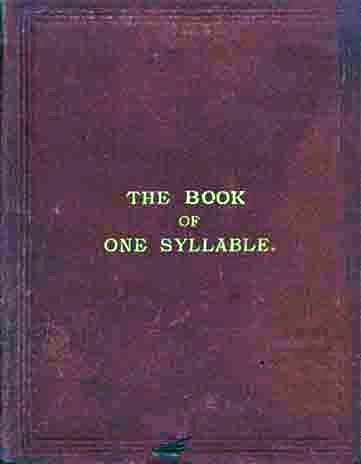
The Project Gutenberg eBook of The book of one syllable
Title: The book of one syllable
Author: Esther Bakewell
Release date: November 12, 2007 [eBook #23453]
Language: English
Credits: Produced by Marilynda Fraser-Cunliffe and the Online
Distributed Proofreading Team at http://www.pgdp.net (This
file was made using scans of public domain works in the
International Children's Digital Library.)
Transcriber's Note:
Minor typographical errors have been corrected without note. Dialect spellings, contractions and discrepancies have been retained.
A LETTER OF ONE SYLLABLE.
Front.
THE BOOK
OF
ONE SYLLABLE.
By
Esther Bakewell
ILLUSTRATED
WITH COLOURED ENGRAVINGS.
LONDON: GEORGE ROUTLEDGE AND SONS,
THE BROADWAY, LUDGATE.
NEW YORK: 416 BROOME STREET.
DALZIEL BROTHERS, CAMDEN PRESS, LONDON.
TO THE FRIENDS OF MY YOUTH.
Fast and far is the stream of time flown on, yet there are thoughts of dear friends and of by-gone things that will not yield to its course. Some friends have long been lost, but there are those who still sail the stream, to whom these scenes from the past will bring back "thoughts of days that are gone." They will bring back thoughts of her whose sails were once set with theirs, and who feels that not one kind word that was then said, not one kind deed that was then done, can the stream wash from her mind, till she, too, shall be lost in the dark gulf to which that stream must lead.
Four of these tales have no hook to the past. These are told by a young boy and girl, who have been taught to write thoughts as soon as they could hold their pens.
PREFACE.
Though in words of one syllable, "The Book of One Syllable" is not meant for a child when first he learns to read; it is meant for him when he knows such words at sight. The tales are told in these small words, that a child need not have to stop to spell, but that he may be led on and on till he comes to the end.
May he feel when he does come to the end, that to read has not been a task.
LIST OF WHAT IS IN THE BOOK.
| PAGE | |
| THE WRECK OF A FEAST | 1 |
| THE AIR | 23 |
| SAIB, THE BLACK BOY | 28 |
| THE EARTH | 65 |
| A FALL FROM THE CLIFFS | 68 |
| THE MOON | 77 |
| THE MAN IN THE MOON | 80 |
| FRANK HART | 87 |
| THE LOST ONES | 105 |
| THE SUN | 117 |
| THE DOLL'S HEAD | 120 |
| PLAY NOT WITH FIRE | 143 |
| ONE FAULT LEADS TO A WORSE ONE | 153 |
| WHAT A PRICE FOR A BOX! | 160 |
THE BOOK OF ONE SYLLABLE.
THE WRECK OF A FEAST.
What a sad sight it is to see a young child who does not know how to keep a check on the wish that tempts him to do wrong. The first rule that they who love a child should teach him, is the rule of self. It is the want of this self-rule that is the cause of so much that is bad in the world. It is this that makes girls and boys think more of what they want to do, than of what they ought to do; and each time they give way to it, they find it more hard not to yield the next time; and thus they go on till they are grown-up folks. They who would not like to grow up in this bad way must take great care while they are young not to think so much of self.
The sense of taste is the sense that a child likes best to use. It would be strange to see a child who did not like cake, or tart, or fruit, or most sweet things. But a child should know when it is right to eat, and when it is right not to eat: he should know that he ought not to touch nice things that are not meant for him.
The tale we have to tell is of a young girl who had not this sense of right so strong as it ought to have been. She knew what it was right to do, and she knew what it was wrong to do, but yet the sense of right was not at all times quite strong. The name of this girl was Ruth Grey.
RUTH GREY.
Page 4.
Now there was a room in Mr. Grey's house known by the name of the green-house room, and here were put a few choice plants that could not bear the cold air. In this room too there was a large stand, on which were set out all the sweet things when Mrs. Grey had friends to dine or take tea with her. Here they were all put, to be brought out at the right time. The door of this room was kept shut, and made fast with a lock and key. Ruth had seen some of these nice things put on the stand, but she had not seen all, and she had a great wish to see them. She thought, if the door should not be shut, she would just peep in. She went twice to the door, but she found it fast. When she went a third time she found the key left in, and as she thought she could turn the key, she did, and went in.
Now it was wrong in Ruth to want to go near this room, as she knew quite well that Mrs. Grey did not wish her to go in. Once when she was near the door she thought she heard some one, and then she ran off as fast as she could. This she would not have done if she had not felt sure it was wrong to go in that room.
But now she was in! and what did she see there? Why, she saw the stand quite full of all sorts of nice sweet things. There were sponge cakes, and plum cakes, and queen cakes; there were two turn-outs, and whips and creams of all sorts; and there was a cake hid in red jam, with small thin white things put all up and down it, which stuck out. What could this be? She was sure it was jam, and yet she was sure jam was too soft to stand up in that way: she would just touch it. She did touch it, and she felt there was some hard thing in it: that could not be jam! It was strange! She would just like to know what it was: she must taste a small bit of the top—that could not spoil it, and she did so much want to know. She did taste—it was jam, spread on a sponge cake.
"A sponge cake! well, this is odd," thought Ruth. "I will just taste a bit: the jam will hide where I take it from."
She then tore a bit from the cake: it was more than she meant to take; but it was done, and she could not help it now. In vain did she try to hide the place—she could not do it; for if she took jam from this place, the cake was left bare on that. And the shape of the cake was not the same as it had been. She thought she would try to make that side of the cake on which the jam still was, like the side on which it was not; so off she took a piece from that side too. The cake was now in such a state that she could not hope to hide what she had done; and she was in such a state that she did not seem to care at all.
She next took up a spoon, and took a large piece from one of the turn-outs. She then went to the plum cake, and to the grapes, and to all the fruit. In short, she went from dish to dish, till there was not one in which she had not put her spoon.
Then she stood still—she stood to see the wreck she had made. Long she did not stand: a rush of thought gave wings to her feet, and she fled to hide in some place where she could not, she thought, be found. She fled to a tool-house in the yard; but she had not been half an hour there when she heard the voice of Mrs. Grey; she heard her step, too, come near and more near, till at length it came close to the door of the tool-house.
"Ruth, my dear," said Mrs. Grey, "why did you come out here? But I am glad to have found you, for I want you to come with me and take a plant to the green-house room."
"Oh, no, no! not in there—do not go in there!" cried Ruth, with a face quite pale.
Mrs. Grey could not think what Ruth meant, so she set off at once to the green-house room, and told Ruth that she must come too. But when Mrs. Grey had got to the door, no Ruth was to be seen. She then went in the room, and what she saw there told her more than words could tell.
"Ruth!" said she, "can you have done this?"
It was grief to think that a child of hers could have done this; but, much as she felt hurt, it was not for the loss of these things. Mrs. Grey sat down, and for a long time she did not move; at length she got up with the air of one who had made up her mind what it would be best for her to do.
And Ruth—where was she? What did she think, what did she feel, what did she do all the time Mrs. Grey was in the green-house room?
What she felt was a kind of grief, such as she had not felt till that time: it was a sense of deep shame. So much did she dread to see Mrs. Grey, that she hid her face in her hands, as though Mrs. Grey were near her. Then all at once she thought that Mrs. Grey would come back to speak to her.
At this thought she sprang up, ran to her own room, shut the door, and fell down on the bed. Here she lay for a long time, with her face hid in the bed-clothes: her tears fell fast, and her sobs were loud. In this sad state she lay for a long time, till at last she went to sleep.
How long she had slept she could not tell, but when she rose up in the bed it was quite dark. At first she could not think how she came to be there, but all at once the green-house scene came back to her mind. Once more she fell down on the bed to hide her face, though no one was there to see it.
Soon there came a stream of light through a chink in the door: it grew more strong, till at length it came in the room in a full blaze. Ruth gave a quick glance, and saw that it was not Mrs. Grey, but Mrs. Grey's maid.
"Miss Ruth," said the maid, "I am sent to bid you go down stairs: the first course is come out of the room, and Mrs. Grey bids me tell you to go down to see the sweet things. You are to go at once."
Poor Ruth! what did she feel then? She took hold of the maid's hand, and said,
"Oh, do not, do not let me go! pray do not let me go!"
"You must go, and go at once too, Miss Ruth," said the maid, as she drew her near the door. "You must come, miss. And see, here is James sent to take you down."
There was no help for it: down stairs she went, and soon she found that she was in the room. There she stood! full of shame and deep grief! And there was spread out each dish of sweets, just as she had left it—each dish spread out with as much care as if it had been right. The eyes of all were on Ruth—in vain did she try to shrink from their gaze.
There was a pause; then Mrs. Grey said, "Ruth, come here, and stand where all my friends can see you."
She came with slow step, her head bent down, and her eyes cast on the ground.
"I grieve to tell you, my friends," said Mrs. Grey, "that it is Ruth—that it is this child whom I love so much—that it is she who has made all this wreck."
There was a pause once more; and there stood Ruth! All had their eyes on her. At length Mrs. Grey said,
"Now leave the room, Ruth."
Ruth did not stay, she was too glad to be gone at once.
The next day, nor the next, did Mrs. Grey speak of the past, and all things went on as they were wont to do. But on the third day, when the first course was gone, a dish that had been in the green-house room was put near her. It was just in the same state in which Ruth had left it. Ruth could not bear the sight of it, so she got up and ran out of the room.
"Poor Ruth!" said Mr. Grey to his wife, "she feels this so much! and to a child like her, who can feel, I think that your plan seems the best way to cure her."
It was the best way. Ruth felt all this much more than she would have felt the stroke of a whip: she felt it in her mind.
For a long time, for months and for years, she could not bear to see a jam cake or a turn-out, nor one of the things like those that had been in the green-house room. When she did see them, she felt a sting of mind that gave her a great deal of pain. Ruth had one young friend who knew what she had done; and this friend had so much love for Ruth, so much real grief for what she knew Ruth felt, that when young friends came to play with her, she took care to beg that there should not be jam cake.
THE AIR.
What is air? Look up and look round; there is air, though it is not to be seen. It fills all things. The glass jug which seems to be quite void is still full of air.
THE LESSON ON AIR.
Page 23.
It is the air we feel when the wind blows. We do not see the wind, but it can blow with such force as to throw down trees. When the wind blows it makes ships sail on the seas to all parts of the world, and brings them back home. It turns mills, to grind corn; and in some parts they use the force of wind to do all kinds of work. The wind is but the air, and it does all these things, though it is not to be seen.
But the air does more than this. If it were not for the air we could not live. It is the air we breathe; and if the breath were stopt, we all know that we should die. How it is that the air does this would take a long time to tell, and you must learn a great deal more of such things than you have yet done, to know why air keeps up life. But so it is. The air is the breath.
It is the breath, too, that makes us warm and keeps us so; for if it were not for the air we breathe, we should be as cold as stones.
The air it is that makes fire burn. The fire in the grate would soon go out if it were not for the air. The flame in a lamp burns dim when it has not so much air as it wants; and when the air is shut from the flame it goes out.
Trees and plants could not live if they had not air. The birds fly by means of the air, which helps to keep them up, while their wings flap up and down. If there were no air, they could not rise from the ground at all, nor could they live if they did not breathe.
It is the air which makes sound. We could not hear men talk, nor bells ring, if the air did not bring the sound to our ears.
Of such great use is the air, though we can not see it, that no one thing could move, or be heard, or live, if it were not with us and round us.
SAIB, THE BLACK BOY.
In a far-off part of the world there is a place where the boys and girls have not the white fair skins that boys and girls have here, but whose skins are quite black, and whose hair is short and thick, like black wool. Some of these poor things know not what it is to have a home, they know not what it is to have kind friends, they know not what it is to do as they would like to do: they must do all that he who has bought them bids them do.
Yes, he who has bought them! for these poor boys and girls can be bought and sold. They are put on board ships that sail far from the homes of their hearts; they are torn from all they like best in the world, from all they have had to love. Far, far off from these scenes do they sail, and with swoln hearts, and tears too big to fall, they feel that they must work or die. Some would think it a joy to die, for death would put an end to what they feel. They think, too, that when they die they will go back to the home round which their thoughts cling.
Saib was one of these poor boys—he was born in that far-off place. As long as he was there, each day was to him a day of joy. Saib had a dear friend, who was near him at all times, and who took part in all his sports, and had a tear for all his pains.
Boa was the name of this friend, and she would sit in the same deep shade with him, and they would climb the same tall tree, and eat the same fruits. They would row in the same boat, and go fast down the dark deep stream. There were, too, those who were glad to see their joy, and who would watch them as they went on and on, till they were far out of sight. They knew no fear—they had no cause for fear, but in the shape of a white man.
It was in one of these sails down the stream that they drew their boat to the shore at a place that was quite strange to them. They got out of it, and went on till they had gone far in a strange wild spot. On and on they went, till the step of Boa was not so firm as it had been; it was less firm each time she put her foot to the ground.
"I can walk no more," she said at last; and quite faint and worn out, she lay down on the ground. Poor Saib! he all at once thought of their lorn state, and of how far they were from their home and from help. There was no sound to be heard, and not a breath of air: all was a still dead calm.
The strength of Saib, too, was gone—he could hold out no more; and he, too, sank on the ground. There they both lay, quite worn out with so much toil; and they fell to sleep. How long they had lain thus they could not know, for when the next day's sun was far on his course, where were they then?
All was strange to them—like the queer things dreams are made of. So they shut their eyes once more, and thought they dreamt about the white men.
But it was no dream: they did see the white men! Yes, it was the white men who had put those cords round their hands and feet. There they lay, like logs of wood thrown on a plank, a man at each end of the plank, and these men took poor Saib and Boa.
For a long time the minds of poor Saib and Boa were in such a state that they could not think, nor could they call to mind how they came to be where they were. Thus did they go for miles, till at last they came near the sea coast, and Saib saw a ship out at sea, with her sails spread. Close to the shore was a small boat, near which there were two or three black men, who, as Saib and the rest came in sight, rose up in haste, and the sound of a gun was heard. Saib did not know if this sound came from the ship or the boat, but as soon as it was heard there was a great rush of men to the sea shore.
THE FIGHT.
Page 37.
Where these men came from it would have been hard to guess, for they rose up all at once, as if they had sprung out of the earth. Long had they lain in wait to try if they could keep that ship from the shore, for that ship was a slave ship, and the white men meant to take on board all the blacks they could seize. That it was a slave ship had been found out by scouts set to watch this part of the coast.
Great was the joy of Saib when he saw the chance of help—when he thought that he should once more be free! The fight was a fight of blood, and some on each side were left dead on the shore.
The ship came near to the shore, and soon a boat was put out in which there were more white men. Few of the poor blacks were left, and those that were took to flight when they saw that all hope was gone.
Saib was one of those who could not take to flight. His cords had been cut off at the first of the fight, but such was his state of mind, so much did he feel from hope and fear, that he could not move, nor make use of his limbs.
And, oh! what a sight for him to see! There was Boa, his friend—the poor girl for whom he had more love than he had for all else on the earth—there she was on the ground at his feet. She would not look at him more; he would hear her voice no more: Boa lay there, dead!
From this time he had no sense of what was said or done; he had no care, no thought, for what might be done to him. So there he stood mute and still, like a thing cut in stone.
Some time he had stood thus when there was seen far off a dense cloud like dust.
"They come! they come!" said the white men. "More blacks are on us! To the ship! to the ship!"
Saib knew not what was said or done, and if he had heard, there would have been no help for him. He was thrown in the boat with two or three more blacks, and then from the boat he was flung on board the ship, and the ship set sail.
Fast did she cut through the sea, and soon was far out of sight of land. It was well for Saib that he could not feel. Four or five days ran their course, and still was Saib in this state.
The first words he heard when he came to his senses were—"He is not dead, I tell you."
"I tell you he is," a voice said: "it is of no use to keep him, so here he goes—(Saib felt a hand)—and let the sea take the rest of him."
Poor Saib had but so much strength left that he could just raise his arm.
"There, there!" said the first voice, "I told you he was not dead, and now you see."
"Well, let him be, then, but he shall pay us well for this; he shall bring us a good price."
Saib could hear no more; but the first man, who was a kind one, went to get some warm drink to put in Saib's mouth. He put more and still more, till at length Saib could move and raise his head.
"Boa! Boa!" were the first words he spoke; and he put his hands to his eyes, and did not speak for a long time. He then gave one loud, deep sob, and his tears fell fast.
Those tears took a weight from his mind, a weight he felt he could not have borne long. For some time did these tears fall, and as they fell the view of things that had been was more clear to his mind.
Saib felt that all joy for him in this world was gone: he felt there was no one for him to love now; and great was his grief when he thought of those who would not know what had been the fate of poor Boa and of him. He thought of these things, and his heart was sad. In this state of mind he was for two or three days, and the ship was still on the wide sea.
Saib knew well what would be his fate: he knew that he would be sold for a slave; and he did all he could to try to bear this thought; nay, lorn and sad as he was, he could find a source of thanks in the fact that the pang he would have felt to have seen Boa a slave was not to be his.
Yes, this was a source of deep thanks; and as the ship cut through the blue waves, Saib would sit for hours with his eyes on some far-off star, and that star would shed a ray of light on his soul.
He would think it shone so bright, to tell him that it was Boa's world now. He felt sure that all things there must be pure and bright, and that Boa might there have more joy than she had had on earth.
"And I shall go there too," he thought, "and so I will not care much for what I have to bear in this world." Poor Saib!
The ship had not been long at shore, when Saib, and the rest of the blacks, were all put in a large slave cart that took them to the place where they were to be sold.
There stood Saib, his eyes bent down: now and then he would raise them up as a white man came near; but these did not want to buy him. At last there came one, a man with a hard cross face: he stood close to him, and Saib felt his stern eyes fix on him. This man spoke to the one who had to sell the slaves, and poor Saib was sold! He was soon put on board a ship that was to set sail to that part of the world where white men may keep slaves; here, in our land, such things are not done.
Saib felt it a hard task to do such things as he was told to do, for he had to work all day long, and had no will of his own. If he were not so quick as Mr. Stone thought he ought to be, he would whip him; and so much would he whip him, that Saib, though he did all he could to try to help it, could not help the scream or groan that would break forth.
There were those on board this ship who had kind hearts, and who could not bear to see a boy feel such pain as Saib was made to feel. There was a Mr. and Mrs. Bright who had felt much grief to see how hard was the lot of Saib.
Saib soon found out that they felt for him; and he would look at Mrs. Bright and think how kind she must be; and he would wish Mr. Bright had bought him, for he thought it would not be so hard a thing to be a slave, if he had to serve those who were kind.
Once, when Mrs. Bright was on deck, and Mr. Stone was not there, Saib came near to her; he could not speak such words as Mrs. Bright spoke, but he could make signs, and the signs that he made were such as told her more than words could have told. All she said was, "Poor boy!" but Saib saw a tear in her eye, and that tear shot a gleam of joy on his soul, for he knew it was for him.
One day Saib was no where to be found. In vain did Mr. Stone call to him—the name of Saib! Saib! Saib! was heard in all parts of the ship, but no Saib came.
In each place that could be thought of was Saib sought for, but in no place could he be found. At length all thought that he had sought a grave in the deep sea, and that no one would see him more. His fate had been a sad one, and all felt that it had been so.
All on board thought a great deal of Saib. All that day did they think of him, and the next day, and the next, and the next. But there was no one who thought of poor Saib so much as Mrs. Bright did; she thought of him so much that she saw him in her dreams, and she would start up in her bed and call Saib! Saib! and this would seem so real that she could not think it had been a dream.
One night when she had had this same dream, and had seen Saib, as she thought, at the foot of her bed, she rose up with a start, but still he was there! This was most strange. "Saib! Saib!" she said, "you are there, and it is no dream."
But Saib was gone! and there was no trace of him to be seen. Yet so sure did Mrs. Bright feel that she had seen him, and that he was not dead, that she could have no peace of mind. She thought of him the whole of that day, and at night she made up her mind that she would not go to sleep, but would lie quite still, as though she were gone to sleep.
When she had been in bed two or three hours, she heard a slight noise in her room, yet she did not move. All was soon still, and then once more she heard a noise. The sound was like that of a piece of wood on the slide, but so soft it was that it could not have been heard by ears less quick than the ears of Mrs. Bright were just at that time. Once more she was still, and then she heard the soft step of a foot. The watch-light was dim, and yet such ray as there was, fell on the form of Saib! Yes! it was he, there he stood; Mrs. Bright saw, and she could not doubt that it was he!
She lay quite still, nor could she have made the least sign of life had she had the wish to do so. Her eyes were not shut, so she could see all that was done. Saib at first stood quite still, as if to be sure that he was safe; and then he went with step soft and slow to a tub of dry ship cakes, that Mrs. Bright kept in her room. She saw him take four or five of these in his hand, and then he stole back to the place from whence he had come.
All this she saw, but she could not have made known to Saib that she saw it. Yet when he was gone out of her sight she gave one loud scream. Mr. Bright, who slept in the berth next to hers, was up and on the floor just in time to see Saib.
When Saib saw that he was seen, and that he was known, he fell on his knees, and, oh, how much was told in that one look of his!
"My poor boy!" said Mr. Bright, "what you must have gone through, to have made you make choice of such a life as this." As he spoke he saw the hole in the side of the room through which Saib had come.
He found that it was a place made to keep things in that were out of use, and it was so small that there was not room for Saib to lie down in. Mrs. Bright did not know that there was such a place, and when it was shut, the door was so like the rest of the side of the room, that no one could have told there was a door there.
Saib had known of it, for he had seen a man put cords and ropes there, at a time when the berths in that room were not in use. The place was not quite dark—there were small holes on the deck of that part of the ship, which let in light and air.
When Saib found that the looks of Mr. and Mrs. Bright were kind, hope took the place of fear, and, by signs and such words as he could speak, he made known his wish that they would let him stay where he had been, till the ship came to shore.
Mr. and Mrs. Bright felt so much grief for the state the poor boy was in, that they each had a strong wish to save him from all chance of more pain, and they knew that the best way to do this would be to buy him from Mr. Stone.
They made this wish known to Saib, and who could have seen the gleam of joy shed on the face of Saib, when he knew what Mr. and Mrs. Bright meant to do—who could have seen it, and not have felt joy too?
Mr. Stone, as has been said, was a hard man, and Mr. Bright had to fear that he might be in such a rage at what Saib had done, that he would not sell him.
Yet, though Mr. Stone was a hard man, he was a man who had so great a wish to be a rich man, that he could not say no, when there was gain in his way; and though he was at first in a great rage, the sum Mr. Bright said he would give for Saib was so large a one, that Mr. Stone did not say no.
What was the joy of poor Saib when told he should be free!—what was the joy of poor Saib when he found how much thought and care Mr. and Mrs. Bright had for him!
They took Saib with them to their own home, and had him taught all things that could be of use to him in the new state in which he now was.
Saib is now more than twelve years old; he has learnt to read, to write, to speak the truth, to try to be calm when rude boys tease him, and to feel grief when he has done wrong. To love his kind friends he has not to learn—his heart bids him do that.
He feels all that Mrs. Bright has done for him—he hopes he may not grieve her or Mr. Bright, but that he may be to them as a good son.—Then they will not part with him; then they will be paid back for all that they have done.
The thought of such a great and good deed must make them glad in this world, and bring them joy in the next.
THE EARTH.
The world we live on is a large round ball, made of all kinds of rocks and of earths; and on a great part of it there are seas and lakes. The earth turns round each day, and goes round the sun once each year. In the day, that part of the world where we live points to the sun, and when the earth turns from the sun, it is night.
When the earth goes round the sun, the heat at one part of the year comes from the sun more straight to that part where we live, and makes the days hot and long, and the nights short, as in June; and when the light and heat do not come to us so straight, there are cold and frost and long nights.
In some parts of the world it is much more cold than where we live. There are parts, too, where the sun is more hot at all times of the year than we feel it. It is the heat of the sun that makes the winds. His heat on the sea makes the clouds.
The clouds rise in the air and fly to the land, where they fall in rain, and make plants and trees grow, and the brooks and springs flow.
The sea is salt, but the heat does not take up the salt in the fogs and clouds; so that the rain is quite pure, and makes springs for us to drink from.
A FALL FROM THE CLIFFS.
George Crisp was a good boy; he was kind to those he knew, and could not bear to have a thing that they had not.
He was glad when he could give things, and he gave a great deal to the poor that came to the house, so that his stock of cash was at a low ebb.
Though George might have set his mind on some toy, he felt glad to think that the pence which would have bought it had been of more use to some one else.
But though he was so good in this way, yet he had one fault which spoilt the whole. This fault was, that he would not do as he was bid; for he thought he knew as well as those who told him, and his Aunt, who taught him, did all she could to break him of the fault, but in vain.
George's house was on the sea coast, and George went to dig in the sands, to get shells, and to fish, and to sail boats in the pools which were left at low tide; and when it was high tide he went with his Aunt on the cliffs.
Now his Aunt had told him he must not go near the edge of the cliffs, for they were steep and high. His Aunt took hold of his hand when she went with him to the cliffs; for once he went so near the edge that he must have gone down, and would have been much hurt, had not his Aunt just caught him in time to save him.
One day, when they were on the cliffs, George's Aunt had left hold of his hand to get a wild rose from a bush. She had got it, and had gone back to take hold of George's hand, but no George was to be seen!
She then ran home, as she thought he might have gone back, but when she came near the town she saw two men with a dead boy in their arms. She ran in haste to look at him, and what was her grief to find that he was George!
The men took him home, and his Aunt, though in such a state that she knew not what she did, went home too.
When Mrs. Crisp saw him she sent at once for Mr. Pill.
Mr. Pill said that he was not quite dead, that he might, with great care, be brought to life, but that he would be ill for a long time. George was brought to the fire and wrapt up in warm things; air was blown down his mouth, and he was put in a warm bed. At last he came to life, but he was so ill that he knew no one, and could not speak.
The men told George's Aunt that they were in their boat, and had just gone out to fish, when they saw George fall down from the cliff. They got their boat to the place as soon as they could, and brought him home. George's Aunt now knew that he had gone to the edge of the cliff, when she had told him not to do so.
While George lay in bed, he thought what a bad boy he had been, and of what his Aunt had told him. And he thought, too, that if he should get well he would try to do what his Aunt told him to do.
George was a month ill. As soon as he was well he told his Aunt he would be a good boy, and try to do as she bid him—for he now knew that what she told him to do was right.
Since that time George has done what he has been told to do, in all things; for he has thought of the fall he had down the cliff.
He was such a good boy, that all were fond of him, and what is more, he has grown up a good man.
Then let this tale warn those boys and girls who read it. May they do as they are bid, and may they not, as George once did, think that they know more than those who are more old than they are.
THE MOON.
What is the bright moon, that shines so in the sky?
It is a world like ours, but not so large; and boys and girls may live there, and go to school and play, as they do on this earth. To boys or girls who live in the moon this earth of ours shines like a large moon, and must give a great deal more light to them than their moon does to us. They could see to read and write by the light of the earth quite well.
The moon gives light from the sun, and does not shine with its own light; and so the earth would give back the sun's light to the men in the moon.
There are land and sea, and hills and dales, in the moon; and the marks we see on it, like a face, are the lights and shades of the land, the hills, and the sea. There are hills too which are on fire, and they can be seen through a large spy-glass. Some men have thought they could make a spy-glass so large as would let them see the boys and girls in the moon, but they have not yet done it.
What a strange sight would it be if we could see them all at work!
THE MAN IN THE MOON.
Once on a time there was a man who had his home in the moon. He was a queer man, with a large round face that was kept so clear and bright that it shone, and on a clear night could be seen far, far off—on the earth.
This man in the moon did like to look on the earth, and though it was so far off, he oft thought he should like to come and live here.
The earth to him did look so large and bright that he thought it must be a fine world to live in, where he could have more room to walk up and down, and not be kept in so small a place as the moon.
It made him sad when he could not look on this world, but for three weeks in each month he was made to turn his face, or to shade it from the world, so that he could not catch a straight view of it at those times.
And then he could not be seen by those men and boys on the earth, to whom he was so great a friend. His large round face was so bright that they, too, did not like him to leave them; but they knew he would come back in less than a month.
When he first came he was seen near to the sun, where it had just set, and he gave a side look at the earth. The next night he would be more from the sun, and swell out his face a bit; it would then look like a hoop that had been cut in two. His face would grow more fat each night, till one eye could be seen, then two, and then his whole round face.
Now this man would fret, and try to get on to the earth. Day by day, hour by hour, he would try, and try, and try to come more near.
He did move quite fast, and thought he got some miles on his way, but for all that he was still as far off. He went in a round, like a horse in a ring, and there kept, and still keeps as far off as he was, and will keep there for years to come.
Now you could tell him that it is far from wise for a man with a fat round face like his, to grieve and want to come to a world that he does not know to be a more nice place than the one he lives in.
You could tell him that there is much grief and pain to be borne here—that few men who live here have such a round fat face as his, and that if he came he would have to work hard, and that care, and work, and pain might soon make him look thin, and lose his round bright face that shines so.
Yes, man in the moon, stay where you are. Do not long to have what you can not get, but rest there, and do what you have to do in peace and joy.
Be sure, man in the moon, you will find peace and joy if you do all the good you can in that world of yours, and that if you pine and grieve to come here, you will do no good at all, and make your life sad.
Boys and girls should do the same. They should not want to reach the man in the moon, but try to make the best of what they have. They may be sure that to be good and do as they are bid, will give them more joy than the most bright things they could find in the moon.