
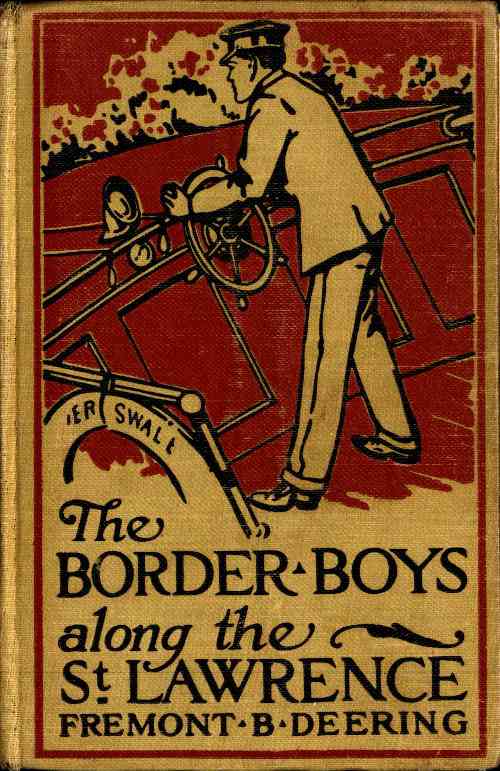
“This is a fine fix,” thought Ralph to himself, as the wind tore about him, the waters rolled high and the lightning flashed and zigzagged across the thunder-ridden sky. “If I ever get the River Swallow through this without piling her up on a shoal or getting the bottom ripped out of her in some rapids, I’m entitled to a gold medal.”
“Will this get worse?” asked La Rue.
The boy noted with glee that there was a note of apprehension in the fellow’s voice.
“I hope not,” Ralph rejoined, shaking his head fearsomely.
“Why?” La Rue was scared. It was plain enough in his voice, which was nervous and jerky. “Are—are we in any danger?” he demanded tremblingly.
“The—the very g-g-g-greatest,” exclaimed Ralph, cleverly acting the part of a seriously alarmed young skipper.
“You mean that if the storm does not die down we may be wrecked?”
“The storm will get a lot worse before it gets any better,” rejoined Ralph. “This is one of the worst nights I have ever seen on the river.”
The River Swallow gave a fearful roll, almost burying her lee gunwale in flying spume. An exclamation that was almost a shriek burst from La Rue’s lips. The man was ashen pale. He was terrified, and, moreover, he was becoming conscious of another feeling. What this was, we shall see before long.
“Gracious! I thought we were gone that time!” cried Ralph, appearing to be on the verge of panic.
“Then there is a pup-pup-possibility that the boat may capsize?”
“I shouldn’t wonder,” said Ralph gravely.
A groan escaped La Rue.
“You really think that, ker-ker-captain?”
Ralph couldn’t help smiling at the title La Rue had conferred on him in his fawning, miserable fright.
“Of course I do,” replied Ralph. “Why, her timbers are very thin. She was only built for a racing machine, not for such work as this.”
Bang! Who-o-o-o-f!
A big sea, which Ralph had purposely met quartering, smote the River Swallow a terrific buffet on the port bow. The spray and spume flew high in the air, drenching the occupants of the bridge.
“A few more of those and we’re goners, sure,” said Ralph with a grin, which he had to turn away his face to conceal, as La Rue broke into a whimper.
“Isn’t there anything you can do, captain?”
“Nothing, except trust to Providence that we don’t go to the bottom within the next half hour,” rejoined Ralph.
Another huge wave hit the craft. A tremor ran through her but it was nothing to the anguish that convulsed the terrified La Rue as the sea struck.
He was now a ghastly blending of two hues, a pasty yellow, a greenish white.
Biff! Bang! Another buffeting blow. Skipper Ralph was actually beginning to enjoy himself.
“Oh-h-h-h! Ah-h-h-h!” quivered the frightened wretch at his elbow.
“Hadn’t you better hand me that pistol?” asked Ralph sweetly. “You might shoot yourself, you know.”
A groan was the only response from La Rue. The man was abject, disgusting in his cravenness.
But Ralph had no mercy upon him.
“It’s getting worse,” he said positively.
“Wer-wer-worse!”
“That’s what. I did think for a while that we might weather it. I know different now. Hawke, we have not much longer to live.”
“Der-der-der-do you mer-mer-mer-mean that we are ger-ger-going to be d-d-d-drowned?” stuttered La Rue, clasping his hands.
“Brace up! Don’t be a coward! Face drowning like a man, Hawke!”
And skipper Ralph contrived it so that another big wave came racing and rolling over the River Swallow’s sharp bow. It was the last straw. La Rue went to pieces utterly.
CHAPTER XXV.
LA RUE’S WILD LEAP.
“Aren’t there any life preservers on board?” he wailed piteously.
His tones might have stirred a heart of flint. Ralph actually felt sorry for the fellow, wretch as he knew him to be. But the thought of the revolver that had been so recently pressed against him, and the threats with which he had been overwhelmed, steeled him against compassion.
“Life preservers? I don’t believe there are, Hawke,” he said. “You see, the boat was to be equipped with a new type of preserver and the old ones were all sent ashore some days ago. They have not yet been replaced by new ones.”
“I’d give a thousand dollars for a life preserver right now!” cried Hawke. “I am rich. I could reward anyone who would save my life.”
Ralph’s strategy had worked. The fellow was in abject fear of his life by this time. He was firmly convinced that the River Swallow was doomed to be annihilated.
Another big wave slapped the craft on the bow, sending a shower of spray high over her.
“Oh, Lord!” groaned La Rue. “I thought sure we were gone that time, Captain Stetson.”
“For shame! Be a man, Hawke. Is there anything you want to save?”
“Oh, gracious, are we going down?”
“I don’t know. As I said before, I think it very likely.”
“We’ll be food for fishes this time to-morrow! Oh-h-h-h-h-h!”
The River Swallow gave a giddy, sidewise plunge. At the same moment a flash of lightning illumined the tossing water. It was Ralph’s turn to give a gasp of dismay. The flash had revealed, down the river, a big, black object that he knew must be an island.
The wind and the current were carrying them down stream.
“Wow!” exclaimed Ralph to himself. “There may be more truth than poetry in Hawke’s fears. If we ever hit——”
He did not dare to complete the sentence even to himself. The thought was too horrible. In his mind’s eye he could see, as clearly as in a nightmare, the breaking up of the River Swallow on the rocky shore of an island.
“You-you asked me if there was anything I wanted to save?”
It was La Rue’s scared, trembling voice again.
“Yes; get what you can, Hawke. But don’t let it be anything bulky. If you don’t want to be dragged down, take only your most valuable possessions.”
“My most valuable possessions! Oh, gracious!”
“What’s the matter now?”
“Oh, I feel seasick. I have a fearful attack of mal-de-mer.”
“Fight it off,” advised Ralph. “This is no time to be seasick. In a short time you may need all your strength.”
With another hollow groan the unhappy wretch dived below to carry out Ralph’s advice about saving his valuables. It was not long before he appeared on deck once more, staggering and moaning in a piteous manner to himself.
This time a flash of lightning gave Ralph an opportunity to observe that La Rue carried a slender black leather wallet, which he clasped as if it were something as precious to him as life itself. In the glare of the lightning, the man’s face was as white as chalk and his eyes blazed with a weird, unnatural light.
In spite of his momentary impulse of pity for the man, Ralph felt a wave of disgust for such a helpless craven sweep over him, as he watched him stagger up the steps to the bridge.
“Do you think there is a chance to save my life?” he stuttered out as he gained Ralph’s side.
“Impossible to say,” was the reply. “But see here, Hawke, you appear to think only of yourself. Haven’t you any concern for your companions below?”
“Never mind them,” cried La Rue, beside himself with fear by this time, for the storm had reached the height of its fury; “they are only understrappers, both of them. Do you see this case?” he continued wildly.
The man’s actions and speech were such that Ralph thought that fright must have turned the fellow’s head.
“Yes, what of it?” demanded Ralph, as he eyed the wallet the man was flourishing under his nose.
“Look!”
He opened the case. In the light of another vivid flash, Ralph saw within the case a transparent pane of talc. Under this thin covering gleamed something that made Ralph’s head swim as he gazed.
The flash had revealed to his astounded gaze a fortune in gems. White, red and green, they mirrored back the lightning with blinding radiance.
“Gems!” gasped the boy.
“Yes, gems,” rejoined Hawke, his face livid as another brilliant flash revealed every line of his features and his wild, staring, frightened eyes; “gems worth two hundred thousand dollars. If you save my life, I will see that you are well rewarded.”
In the now almost incessant glare of the lightning, Ralph’s eyelids flickered. But it was the brilliance of the gems held out almost under his nose by his terrified passenger that made him wink, far more than the electrical display.
“Goodness! They’re enough to blind a fellow,” he exclaimed to himself as he eyed the heap of precious stones.
“But what good are those gems to you in comparison with your life, Hawke?” demanded Ralph.
“None! none!” wailed the wretch abjectly. “I’d give ’em all to you, Captain Stetson, if you’d save my life. But they are not mine to give. I am simply an agent for others.”
“A gem smuggler, in fact?” demanded Ralph sternly.
“Yes; that’s what you might call it. Oh, captain, I have led a bad life! I’d like to repent before I die.”
“You are in the employ of several men engaged in the business of evading duties on precious stones?” remorselessly pursued Ralph.
“Yes, sir. Oh! but I repent all my wickedness now. I’d give all these gems for even ten minutes of life. I——”
He broke off. An appalling flash of lightning pierced the sky, followed by a peal of thunder that rent the heavens. Even Ralph quailed before such a terrific upheaval of the elements. As for La Rue, he sank to his knees on the bridge.
“The gems! the gems for my life!” he implored, his eyes raised skyward.
He was still in the midst of a half-insane tirade, when the River Swallow struck with a quivering shock.
“It is the end!” screamed out La Rue, his voice ringing above the uproar of the storm.
Before Ralph could stop him, he had rushed to the side of the bridge; and then, with a wild cry, he plunged straight overboard into the boiling, angry waters that swept alongside.
CHAPTER XXVI.
LOOKING FOR THEIR CHUM.
We left Harry Ware, Percy Simmons and the three customs inspectors sadly baffled on the dock of the Piquetville Yacht Club. Their search for the River Swallow, it will be recalled, had revealed nothing of the craft. Several inquiries made in the vicinity had met with the same disheartening results.
Sick at heart and worried more than they cared to confess, Harry and Percy listened to the consultation going on between the three experienced servants of Uncle Sam’s revenue service.
“If that fellow La Rue is on board, there is no telling what may have happened,” said Jennings. “He is a desperate man, as we have good cause to know.”
“But he is a coward at heart,” struck in Adams. “Remember how he showed the white feather in that affair of the Chinese smuggling three years ago?”
“Yes, he secured immunity from punishment by turning state’s evidence on his accomplices,” rejoined Jennings. “It was too bad he was allowed to go. There’ll always be plenty of work for us as long as he is at large.”
“It’s odd, the way he’s managed to slip through the toils so many times,” commented Prescott, the third customs man. “Why, the government has had its hands upon him half a dozen times, and yet he has always managed to get away in some mysterious manner.”
“There’s one member of the bunch, though, that I’d rather get than all the rest,” declared Jennings.
“Who is that?”
“Rawson.”
“The captain of that night-running motor boat?” inquired Prescott, who had been but recently transferred to the northern border after commendable work in the southwest.
“That’s the fellow. I see you’ve heard of that boat.”
“Who hasn’t? Even these young men encountered her on several occasions. She has been seen in the vicinity of Dexter Island. I assume that Malvin, who was in the employ of Mr. Stetson, received consignments of gems to be smuggled later.”
“That appears certain. But did you say Stetson was the name of the owner of the island?” inquired Prescott.
“Yes, Stetson, the big railroad man. It’s his son Ralph that is on board the River Swallow in the power of those men.”
“The same Ralph Stetson that was mixed up in that affair of the arms and ammunition, smuggled across the Mexican border by the underground river?”
“The same fellow,” broke in Harry.
“Then depend upon it, young men, that your chum will be able to take care of himself,” assured Prescott. “I heard full details of that affair, and the way in which he and his friend Jack Merrill acquitted themselves, showed that they were made of no ordinary stuff. I’d back that boy against a dozen La Rues any time.”
“The way in which they have all handled this affair so far proves that they are a bunch of uncommonly smart lads,” said Jennings. “If it hadn’t been for a slip-up, we might have had La Rue in our hands by this time.”
Agitated though they were, Harry and Percy could hardly conceal a smile at this ingenious way of putting the case. Had it not been for Jennings’ stupidity in arresting them—for that is practically what he had done—the customs authorities might have reached the River Swallow in plenty of time to apprehend the rascals on board and save Ralph from being carried off. For that he had gone of his own free will never entered the chums’ heads for an instant. They knew Ralph too well to think that he would desert them in such a way, unless he had been literally abducted.
It was this fact that worried them. It pointed inevitably to one conclusion: Ralph had been overpowered by the men on board the craft, and either injured or made captive, while they worked out whatever schemes they had in mind.
“Oh! if only one of us had stayed on board, it would have made the odds less against good old Ralph,” sighed Harry.
But it was too late to indulge in regrets. The harm was done now. Somewhere on the river the River Swallow was speeding along with their chum on board her. They wondered when, and under what circumstances, they would hear from him again, for that they would join him before long they had no doubt.
Great drops of rain began to fall. A puff of warm wind blew from off the river into their faces.
“Here she comes,” declared Jennings, as a flash split the sky. “Boys, we’d better get to shelter.”
“Can’t we do anything more to-night?” asked Harry anxiously.
“I’m afraid not, my boy. I know just how you feel about your chum, but it would be worse than looking for a needle in a haystack to go chasing after that boat to-night.”
“What do you recommend doing, then?” asked Harry.
“I would suggest that you find quarters in a good hotel. Have a sound sleep, and early in the morning we will join you and the hunt will begin in earnest. One other thing,” as he noticed their troubled faces, “don’t worry about that fellow La Rue. He is a big bluff, an arrant coward. His bark is a lot worse than his bite. He wouldn’t dare try any violence. He’s a mixture of knave and craven, with the former predominating.”
How true this description of La Rue was we know from his behavior during the storm, which shortly broke in all its fury. While Ralph was battling with the elements, his chums were snugly in bed at the Piquetville House. Despite their anxieties, they were too worn out not to fall into a sound sleep, which endured till a loud knocking at their door, almost as soon as it was light, informed them that the customs men were below.
They lost no time in dressing, and soon joined the others. They all ate a hearty breakfast together, and then set out for the dock. It was a glorious morning. All trace of the storm had vanished, leaving the air clear and cool.
At the Yacht Club dock lay the River Swallow’s tender. A few minutes’ delay occurred while the little craft was stocked up with extra gasoline, for they knew that they might be off on a long chase. But at last everything was ready. Harry took the wheel. Percy Simmons looked after the engine. The three customs men sat at their ease in the stern seat.
“Which way?” asked Harry, as they chugged out into the stream.
“Down the river,” was the reply of Jennings. “We’ll comb the islands first.”
“Let her out,” ordered Harry to Percy Simmons, as they got clear of the dock.
The engine gave a sputter and a roar, and the chase after their missing chum was on.
CHAPTER XXVII.
A DAZZLING DISCOVERY.
With La Rue’s cry still ringing in his ears, Ralph rushed to the edge of the bridge and peered over. Alongside nothing could be seen but swirling, rushing foam.
But suddenly a flash revealed to Ralph the fact that they had run aground on the point of either an island or the mainland, he could not, for the time being, determine which. Trees and rocks could be made out by the frequent flashes, which showed, also, that the River Swallow had grounded bow on, and was now swinging outward with the current.
Ralph was recalled from his observations by a voice behind him. It was Hansen, the Norwegian. The man had stopped his engines, being seaman enough to know what had occurred as soon as he felt the grinding shock of the landing.
“We bane gone ashore, sare?” he asked.
“Yes, we’ve grounded, Hansen, and I must tell you that your wretch of a master Hawke, while crazed with fright, threw himself overboard. I fear he is lost forever.”
The Norwegian appeared dazed. His fishy blue eyes rolled wildly.
“La Rue bane dade?” he muttered.
“I don’t know anything about La Rue,” said Ralph, thinking the man had not rightly understood him, “I said Hawke had gone. He jumped overboard when we struck. Crazy from fright, I guess.”
“He bane all de same,” said the Norwegian calmly. “Hawke bane La Rue, La Rue bane Hawke. I bane glad he gone.”
“Glad, why?” exclaimed Ralph, horrified at the man’s callousness.
“He bane bad man. He say if I don’t do as he say he lose me mine yob. By yiminy, I got wife and childrens by mine home in Norvay. I no vant lose yob. So I do as he say.”
“What did he make you do?” asked Ralph, too interested for the minute to remember anything but what the man was saying.
“He bane make me take package off motor boat what come by Daxter Island by night. I have to give package to Malvin. Dey say dey bane smoggler and kill me if I talk.”
He sank his voice low.
“Dey bane make me halp Hawke while he put sand by carburetors.”
“So it was Hawke, or La Rue, that played that rascally trick!” cried Ralph.
“Sure. He bane hidden forvard. Dey hear you mean tell police about dem. Den dey cook up plan so you no get avay.”
“The precious scamp!—but, well, he’s gone now. Hansen, you must come below and help me get Malvin on deck. Is he conscious, do you know?”
“He bane sit up when I come trou’ cabin from angine room,” said the man.
“Very well, then. We must get him up here. The boat is hard aground and may be going to break up. We must get ashore.”
“How we do dat?”
“We must swim for it. I’ll try the water and see how deep it is.”
The lead line showed, to Ralph’s great joy, that the water alongside was not beyond his depth. Both Hansen and Malvin were tall men. With good luck, it might be possible to wade ashore. It was while he was heaving up the lead that he noticed a dark object lying on the bridge, right where La Rue had taken his crazed leap.
He picked it up. It was La Rue’s coat. He had cast it off when he took his mad plunge.
As he handled the garment, Ralph suddenly felt a hard, oblong object in one of the pockets. It felt like a case. He plunged his hand into the pocket and drew out—the leather wallet that contained the priceless collection of gems!
What a find!
The boy’s head swam. La Rue, in the desperation of terror, had entirely forgotten the fortune in precious stones. Hastily Ralph thrust the wallet into his pocket.
“You bane find something,” came a voice behind him. Hansen’s voice. Had the Norwegian seen anything? Ralph by no means trusted the man, and he didn’t like the idea of his knowing of the great find.
“It was La Rue’s watch,” he said; “he left it in his coat. Now let us go below and get Malvin on deck.”
“I’ll spare you that trouble,” came a voice behind them both.
They turned and faced Malvin himself. His head was bandaged. His face chalky white.
“Well, you got the upper hand of me,” he said, addressing Ralph, “but I bear no malice. Are we all going to the bottom?”
The man’s cool, calm demeanor offered an odd contrast to the cowardly behavior of La Rue. He appeared to have resigned himself to whatever fate was to be his.
“Better a grave in the river than a long sentence in a Federal penitentiary,” he muttered.
Ralph did not hear this. His mind was concerned with saving their lives. But, like a true boat captain, he still had a feeling that he owed a strong duty to the River Swallow.
“Before we go we must get out stern lines and fasten to them the spare anchors,” he declared. “The boat is riding easily now. If we can keep her stern swung out we may still be able to get her off when the storm dies down.”
Malvin flashed a glance at him. The boy’s voice had rung cool and determined. Malvin was no fool. He recognized in those accents the voice of authority. Moreover, although he had not the slightest intention of using it as a means of persuasion, Ralph had possessed himself of the revolver that La Rue had cast aside when he made his wild leap. The boy contrived that a glint of it should show as he spoke. He didn’t see any harm in providing that his orders should be backed up by a display of force if necessary.
As for Hansen, he was an old hand on the waters. The present situation did not alarm him particularly. He obeyed Ralph’s orders with alacrity. It was the force of habit acting on a man who had so long been accustomed to taking orders that obeying them was second nature.
It did not take long to cast the two spare anchors out astern and swing the River Swallow so that only her prow rested upon the rocks. As mentioned before, she was a very light draft boat and four feet of water was ample to float her.
“She’ll lie snug enough now,” declared Ralph, when his orders had been carried out; “and now let’s see about getting ashore and finding out what sort of a place this is that we have struck.”
The River Swallow’s emergency rope steps were found to be capable of reaching the water’s edge. The lead had already told them that the depth was shallow. Hansen went first with Malvin, displaying no hesitation in following him. Ralph, true to the traditions of the captain’s office, came last. He found Malvin and Hansen half-way to shore, wading painstakingly and not without difficulty, through the swift rushing waters.
The two gained the beach ahead of Ralph. He had supposed that they would be waiting for him. But when he reached the shore he could see nothing of them, and, although he shouted, he gained no response to his cries.
It was then that a disquieting thought occurred to him.
Hansen had seen him transfer a package from La Rue’s coat to his own pocket.
Was it not possible that the man had guessed, through some previous knowledge, that the package he had abstracted was the wallet containing the precious stones destined for transfer across the border? In such a case it behooved him to be on the keen lookout for a surprise of some sort. From what he knew of him, Malvin was not the sort of man to allow a fortune in gems to get into the hands of the enemy.
Ralph felt his breast pocket as, wet through to the skin and half exhausted from his struggle against the rapidly running water, he stood on the shore. A satisfying feeling rewarded his touch. So far he held a prince’s ransom in gems secure.
How long could he do so? Ralph realized that the instant he had become possessed of the wallet of gems he had incurred a responsibility which it might tax his keenest abilities to carry out.
CHAPTER XXVIII.
CHECKMATED.
“Hull-o-o-o-h!”
Ralph sent the cry shrilly echoing among the trees and brush that topped the rocky rise edging the beach upon which they had struck.
There was no answer. Again and again he sent the cry forth, while the storm whipped it out from his lips and scattered it broadcast. But to his far-flung appeals there came no rejoinder.
“Deserted!” muttered Ralph. “That shows how much those fellows really amount to. When they thought they were going to the bottom they were glad enough to depend upon me. Now that their feet have struck the hard shore they’re off again. Within a week they will be up to new schemes of villainy.”
Thoroughly decided in his mind that Hansen and Malvin, once having gained the shore, had left him to shift for himself, Ralph hesitated about his next move.
The storm had abated, but muttering peals of thunder and spasmodic flashes of lightning showed that it was still hovering about the vicinity. The rain fell in torrents, but Ralph was already so thoroughly soaked that this caused him but small inconvenience. His thoughts were centered on the treachery of the other survivors. The least they might have done, he mused, would have been to await his coming on shore. Then they could have taken counsel together and decided upon their next move.
The strain of the night had told upon the boy. He felt nervous, irritable and chilled. Even La Rue’s fate, much as it had bothered him at first (rascal though the man was), now held little of interest for him. His sole idea was to find some place of shelter, and then he would sleep—and sleep, till nature was recuperated.
It was no light task that the boy had performed. Few persons but those who knew the river could have imagined the tireless skill and vigilance necessary, if a craft, once caught in the vortex of a St. Lawrence storm, was to be kept from disaster.
The trust imposed in him Ralph had loyally carried out while opportunity served. It was through no fault of his that, caught in a swirling eddy with an inexperienced engineer to answer his signals, the River Swallow lay helpless.
And yet Ralph was not weak enough to blame anybody but himself. He saw now, and all too clearly, that it had been an error of judgment for him to send both Harry Ware and Percy Simmons ashore at Piquetville. With even one of them to aid him, he might have been able to stand off the rascals who wanted to gain possession of the River Swallow till aid of some sort arrived.
All these thoughts, and many others, surged through his mind as, brain-sick, footsore and wet to the skin, he stood on the beach and looked at the dark hulk on the waters which he knew was the River Swallow. Ralph had never, in all his adventurous times, felt so much like quitting as he did right then and there.
He ran over in memory other predicaments in which he had been placed: The ruined mission from which he had had to escape by a swaying rope from a tower that rose a hundred feet above the solid ground; the terrible trap into which the boys had fallen in the Northwest, and from which they had escaped only by a desperate leap across a boiling, swirling river, ultimately to seek refuge on a drifting log. Once more he recollected their experiences in the Canadian Rockies; the dread moment when the bear almost had them in his grasp at the entrance to the subterranean cavern.
But all these paled into insignificance in his mind beside the present situation.
In all the predicaments which his excited mind had hastily recalled it was either his life or his companion’s that was at stake. Now, however, in addition to the personal equation, the salvation of a fine craft—the River Swallow—depended upon his grit and enterprise.
“Well, there’s no use standing here,” he said to himself, as he listened to the rumbling of the storm dying away in the distance.
Before the tempest broke the weather had been hot, oppressive, in fact. Now the air had become almost chilly in contrast. Ralph, in his wet clothes, shuddered. The night breeze that crept along in the wake of the storm made him feel that a warm fire would be welcome.
“No use standing still here,” he mused; “there’s nothing to be done till morning, at any rate. If this is the mainland, there should be some farmer’s house in sight. In the event that we have struck an island, it seems almost equally positive that some one is living upon it.”
He sat down in the lee of a rock, sheltered from the driving rain and the wind, and considered his position. On second thoughts, it did not seem so serious. He had checkmated a gang of ruffians, and as he thought of this he gave his chest a thump.
The wallet with the fortune within its transparent inside cover was still there. He controlled the situation. The next morning he resolved that, no matter what happened, he would deliver the entire collection to the authorities.
“Thank goodness, Hansen did not guess what I had taken,” he said to himself. “In fact, I doubt if either Malvin or Hawke would have made enough of a confidant of him to let him know that they had such a sum in precious stones to sneak across the border. So far as I can see, this Hansen was a sort of weak-kneed go-between. He was entirely in their power. Their tool, in fact.”
Musing in this way, Ralph arose to his feet. The rain still beat down, but it was not as violent as before.
Far off, intermittent flashes could be seen on the horizon. The storm had plainly passed.
Ralph patted the pocket wherein reposed the gems.
“Checkmated,” he chuckled, “checkmated, by all that’s wonderful! Now for some sleep and then—to-morrow.”
CHAPTER XXIX.
A HERMIT OF THE ST. LAWRENCE.
For some time Ralph floundered and stumbled along the beach in the direction which he had elected to follow. At length, as he rounded a point, he caught sudden sight of a light, burning amid a clump of stunted, dwarfed cedar trees.
“Good!” he exclaimed. “Where there’s a light there’s a promise, anyhow, of a fire and something to eat. Eat! I’ve almost forgotten what the word means, and as for sleep——”
Ralph’s lips parted in an expansive yawn.
“Oh, for a bed! I could sleep the clock round, I do declare,” he confessed to himself.
With the light as an inspiring goal, he pushed forward vigorously along the beach, wondering to himself, meanwhile, if Hansen and Malvin had reached a place of refuge.
“At any rate, they don’t deserve one,” he thought. “Their desertion of me was a base bit of business. If they have to stay out to-night with the stars for a counterpane and the earth for a cot, I, for one, have no great sympathy for them.”
In due time he reached the place from which he had perceived the light shining through the night. So far as he could see, it was a rough-looking shanty, built of driftwood and old timbers nailed or fastened together in haphazard fashion. The light was proceeding from a small window and, peering in through this, Ralph was able to see a very old man seated at a rough table, apparently repairing a fish net.
“I’ve heard strange stories about some of these squatters along the St. Lawrence,” said the boy to himself, as he hesitated outside the door. “I hardly know if I ought to knock or not. Suppose this is some maliciously disposed old hermit, like that one we met down in Texas?”
He hesitated thus for several minutes; but at last he mustered up the resolution to knock on the door.
He struck a good thundering tattoo with his knuckles, and was immediately rewarded by hearing a voice from within. It was querulous, old and cracked. Plainly, it belonged to just such an old man as he had seen seated at the table when he looked through the window. He was an old, bald-headed, patriarchal-looking man.
Despite the apparent age of the occupant of the lone hut on the St. Lawrence, he looked hale and hearty. Ralph’s first view had established this. The old man’s skin was pink and clear, his blue eyes bright, and although he stooped, he showed traces of having been a well-built, powerful man in his youth.
“Rap! rap! rap!” went Ralph’s knuckles again.
Then from within: “Wa’al, what cher want?”
“To see whoever lives here,” spoke up Ralph.
“Who are you?”
“A boy that was cast up here to-night on a motor boat that went aground.”
“Wa’al, speak up, can’t cher? What cher want?”
“To sleep here to-night and a chance to dry my clothes,” replied Ralph, greatly puzzled over the brusqueness of his reception.
“You ain’t one of the La Rue gang?”
Ralph’s heart gave a leap. What could this venerable old solitary know of the La Rue gang?
“No, of course I’m not one of the La Rue gang,” declared Ralph, in an indignant tone. “If I was I guess I might have better quarters. Open up now, will you?”
“I’m a-comin’! I’m a-comin’. Gosh all fish hooks, but yer in a tearin’ hurry, young fellow.”
“So’d you be if you’d gone through a quarter of what I have in the last few hours,” replied Ralph.
The door was flung open and a lamp held high above the head of the shack’s occupant. Seemingly he wanted to make sure of Ralph before he admitted him.
“City, be’ant you?” he asked.
“Well, I’ve been around in cities a bit,” confessed Ralph.
“Oh, well, none the worse for that, I dessay. Come in. You don’t look as if you’d bite.”
Ralph caught himself recalling some recent moving pictures on board the River Swallow.
“Oh, I don’t know,” rejoined the boy, with a smile he could not control, “just give me something to bite on and I’ll see what I can do with it.”
The old man set out baked beans and bacon, cold potatoes, cold corn and a piece of soggy pie.
“Fire’s done plum give out, er I’d give yer coffee,” he said apologetically.
“Never mind,” said Ralph. “I’d rather have water. You get fine water here on the——”
He paused an instant to give the old man a chance to speak.
“Island,” croaked the veteran, “Castle Island, we calls it on ’count the odd-shaped rocks and stuff.”
In this simple manner Ralph ascertained without more ado that he was on an island. This, at least, was a valuable bit of information. It gave him something to go on.
His host at this point appeared to wake up to the fact that, while he had been talking pretty freely with his guest, Ralph had not yet unbosomed himself of any of his affairs. The old man’s inquiries were minute.
Ralph told him all of the truth that he thought advisable. Of course he made no mention of the gems or of the smuggling episodes. To old man Whey, as the old chap said he was to be called, he accounted for his presence on the island by saying that his motor boat had run aground.
The old man inquired where the accident had taken place, and Ralph quickly placed him in possession of all the details.
“That’s nuffin’,” declared old man Whey; “we’ll have her off there in mighty quick time. Lucky thing you landed in Deer Bay; otherwise you’d have got in bad waters. If you are lying where I think you are, you can come pretty nigh gettin’ off under your own power.”
It had already become clear that old man Whey knew the river like a book. To Ralph it appeared that here was a good man to tie to.
“If you’ll help me get my boat off in the morning, and we succeed in floating her, I’ll give you whatever you choose to take for your services.”
The old man exploded.
“Sho, boy! Kain’t I do a good turn ter my neebor?” he asked. “Pay me, indeed! My fishing and the work I do for the cottagers once in a while gives me all I want. Pay me, indeed! Git right into that bunk now. Sleep your head off. I’ll call you when I’m ready in the morning.”
Ralph was nothing loath to turn in on the rough sleeping shelf assigned to him. But before closing his eyes he thrust the wallet containing the gems under his pillow.
“It’ll be safe there,” he muttered drowsily to himself.
But in the morning when he awakened the wallet with its fortune in gems was gone.
And also among the missing was old man Whey.